
Chapter 12 Dealing with Union and Employee Management
- Slides: 50
Chapter 12 Dealing with Union and Employee. Management Issues Mc. Graw-Hill/Irwin Copyright © 2014 by The Mc. Graw-Hill Companies, Inc. All rights reserved.
Chapter Twelve LEARNING GOALS 1. Trace the history of organized labor in the United States 2. Discuss the major legislation affecting labor unions 3. Outline the objectives of labor unions 4. Describe the tactics used by labor and management during conflicts, and discuss the role of unions in the future 5. Assess some of today’s controversial employee– management issues, such as executive compensation, pay equity, child care and elder care, drug testing, and violence in the workplace 12 -2
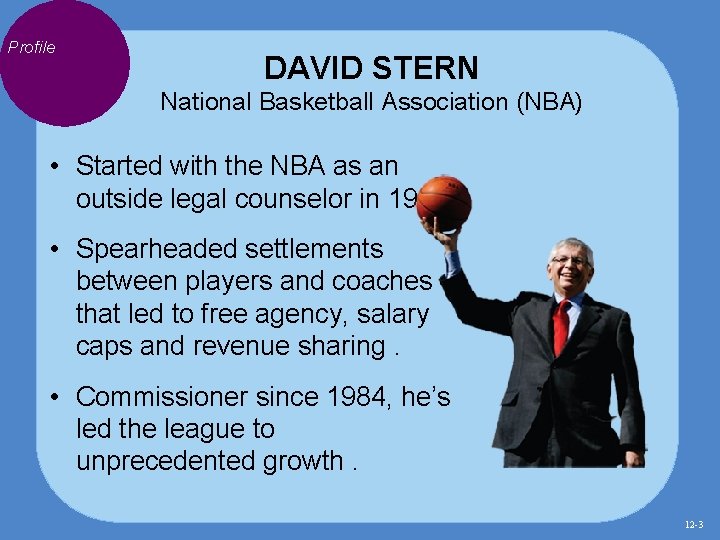
Profile DAVID STERN National Basketball Association (NBA) • Started with the NBA as an outside legal counselor in 1966. • Spearheaded settlements between players and coaches that led to free agency, salary caps and revenue sharing. • Commissioner since 1984, he’s led the league to unprecedented growth. 12 -3
Chapter Twelve NAME that COMPANY As the number of women in the workplace began growing rapidly about 25 years ago, this company recognized that providing child care benefits would be a real advantage for companies. Today it is the largest provider of child care at worksites, operating about 700 child care centers for 400 companies including 90 companies in the Fortune 500. Name that company! 12 -4
Employee Management Issues ORGANIZED LABOR LG 1 Unions -- Employee organizations whose main goal is to represent members in employee-management negotiations of job-related issues. • Labor unions were responsible for: - Minimum wage laws Overtime rules Workers’ compensation Severance pay Child-labor laws Job-safety regulations 12 -5
Employee Management Issues LG 1 PUBLIC SECTOR LABOR UNIONS • Public sector union members work for governments as teachers, firefighters, police officers, etc. • Many states face serious debt problems and want to cut labor costs. But states with public sector unions have limited ability to cut those costs. • In 2011 Governor of Wisconsin challenged public sector labor unions by eliminating union bargaining rights for state and public employees. 12 -6
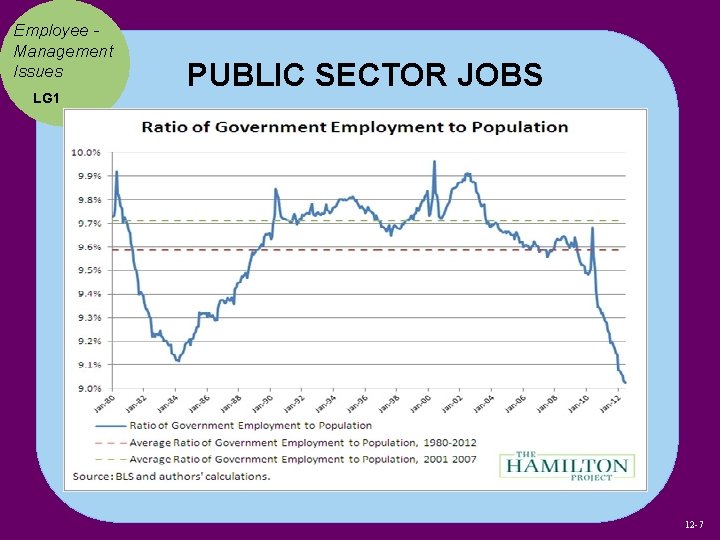
Employee Management Issues LG 1 PUBLIC SECTOR JOBS 12 -7
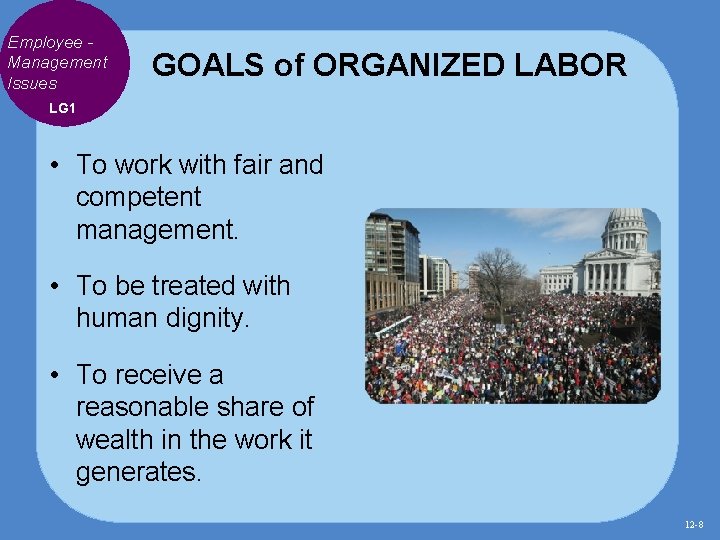
Employee Management Issues GOALS of ORGANIZED LABOR LG 1 • To work with fair and competent management. • To be treated with human dignity. • To receive a reasonable share of wealth in the work it generates. 12 -8
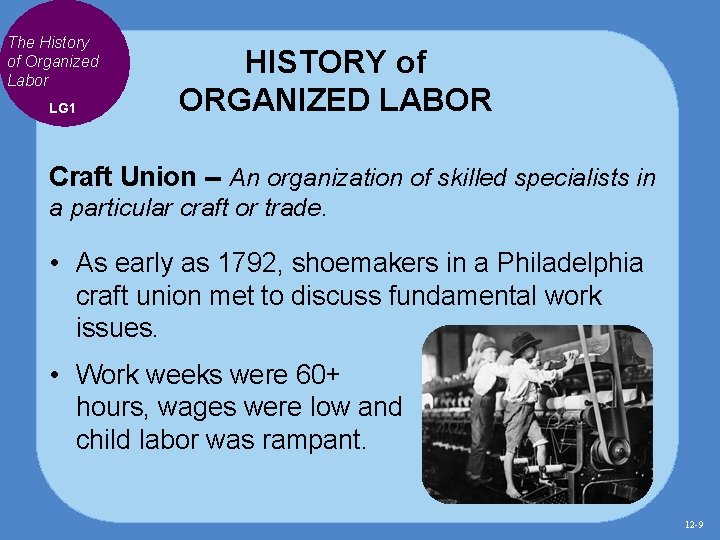
The History of Organized Labor LG 1 HISTORY of ORGANIZED LABOR Craft Union -- An organization of skilled specialists in a particular craft or trade. • As early as 1792, shoemakers in a Philadelphia craft union met to discuss fundamental work issues. • Work weeks were 60+ hours, wages were low and child labor was rampant. 12 -9
The History of Organized Labor LG 1 EMERGENCE of LABOR ORGANIZATIONS Knights of Labor -- First national labor union (formed in 1869). • Knights attracted 700, 000 members, but fell from prominence after a riot in Chicago. American Federation of Labor (AFL) -- An organization of craft unions that championed fundamental labor issues (formed in 1886). 12 -10
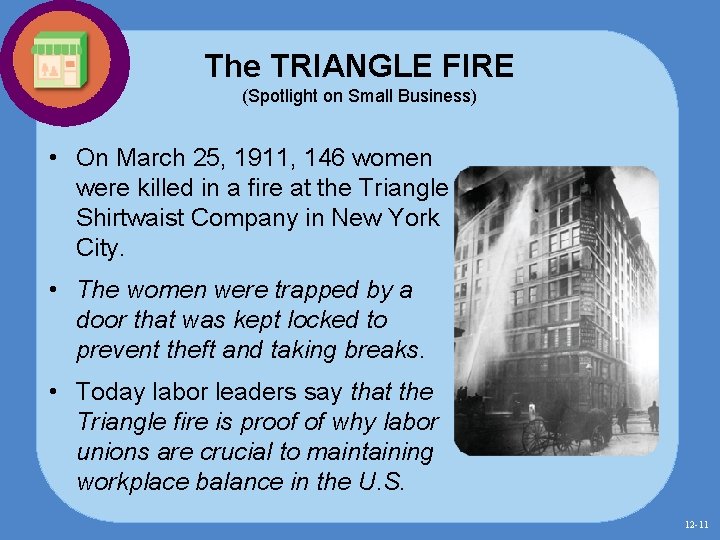
The TRIANGLE FIRE (Spotlight on Small Business) • On March 25, 1911, 146 women were killed in a fire at the Triangle Shirtwaist Company in New York City. • The women were trapped by a door that was kept locked to prevent theft and taking breaks. • Today labor leaders say that the Triangle fire is proof of why labor unions are crucial to maintaining workplace balance in the U. S. 12 -11
The History of Organized Labor INDUSTRIAL UNIONS LG 1 Industrial Unions -- Labor unions of unskilled or semiskilled workers in mass production industries. Congress of Industrial Organizations (CIO) -Union organization of unskilled workers; broke away from the AFL in 1935 and rejoined in 1955 creating the AFL-CIO, having affiliations with 56 unions with approximately 12. 2 million members. 12 -12
Public Sector Union Membership PUBLIC UNIONS LG 1 • For the first time in U. S. history, 7. 6 million of the 14. 7 union members work in government. • Taxpayers, not stockholders, are paying the cost of union workers wages and benefits. • The huge state and local government revenue losses caused by the economic crisis put pressure to reduce wage and benefit costs. 12 -13
Labor Legislation and Collective Bargaining LG 2 EFFECTS of LAWS on LABOR UNIONS • Labor unions’ growth and influence has been very dependent on public opinion and law. • The Norris-La. Guardia Act helped unions by prohibiting the use of Yellow-Dog Contracts -- A type of contract that required employees to agree to NOT join a union. • Collective Bargaining -- The process whereby union and management representatives form an agreement, or contract, for employees. 12 -14
Labor Legislation and Collective Bargaining LG 2 COLLECTIVE BARGAINING and the PUBLIC SECTOR • Collective bargaining among public union workers has become a key issue today. • One of the issues is the fact that public employees are paid by the taxpayers. • When it is perceived that public employees are winning for better health care, or for more or better hours of work, and so on, some have questioned whether or not such negotiations should be allowed to continue. 12 -15
Union Organizing Campaigns LG 2 FORMING a UNION in the WORKPLACE The National Labor Relations Board (NLRB) was created in 1935 to oversee labor-management issues and provide guidelines for unionization. • Certification -- The formal process by which a union is recognized by the NLRB as the bargaining agent for a group of employees. • Decertification -- The process whereby employees take away a union’s right to represent them. 12 -16
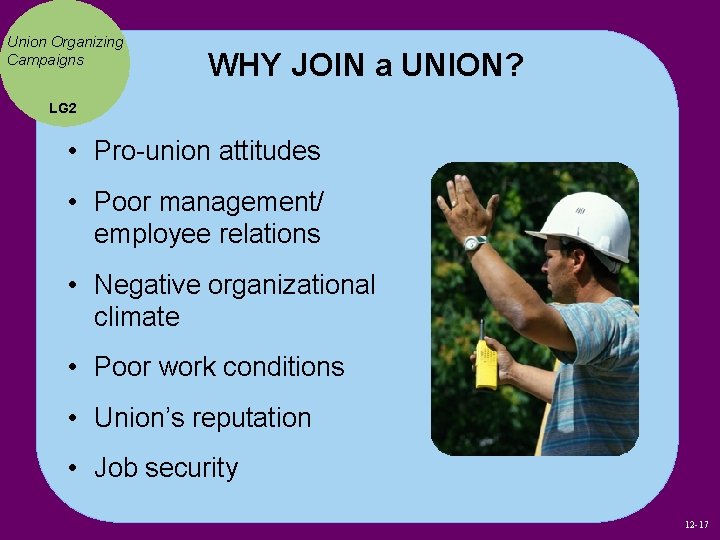
Union Organizing Campaigns WHY JOIN a UNION? LG 2 • Pro-union attitudes • Poor management/ employee relations • Negative organizational climate • Poor work conditions • Union’s reputation • Job security 12 -17
Objectives of Organized Labor Over Time LG 3 LABOR/MANAGEMENT AGREEMENTS Negotiated Labor-Management Agreement (Labor Contract) -- Sets the terms under which labor and management will function over a period of time. Union Security Clause -- Stipulates workers who reap union benefits, must either join the union, or pay dues to the union. 12 -18
Objectives of Organized Labor Over Time UNION SECURITY AGREEMENTS LG 3 • Closed Shop Agreement -- Specified workers had to be members of a union before being hired for a job. • Union Shop Agreement -- Declares workers don’t have to be members of a union to be hired, but must agree to join the union within a specific time period. • Agency Shop Agreement -- Allows employers to hire nonunion workers who don’t have to join the union, but must pay fees. 12 -19
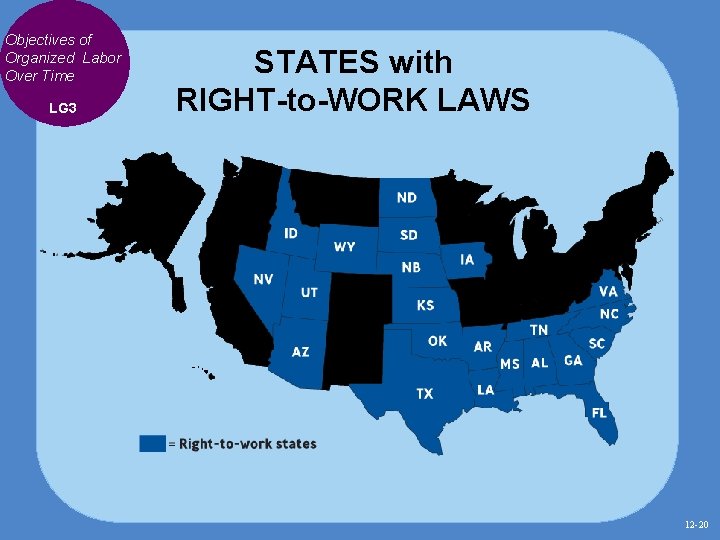
Objectives of Organized Labor Over Time LG 3 STATES with RIGHT-to-WORK LAWS 12 -20
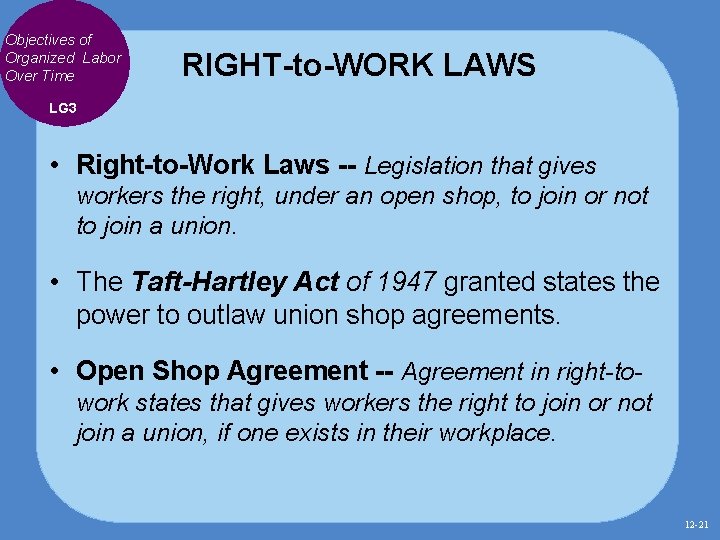
Objectives of Organized Labor Over Time RIGHT-to-WORK LAWS LG 3 • Right-to-Work Laws -- Legislation that gives workers the right, under an open shop, to join or not to join a union. • The Taft-Hartley Act of 1947 granted states the power to outlaw union shop agreements. • Open Shop Agreement -- Agreement in right-towork states that gives workers the right to join or not join a union, if one exists in their workplace. 12 -21
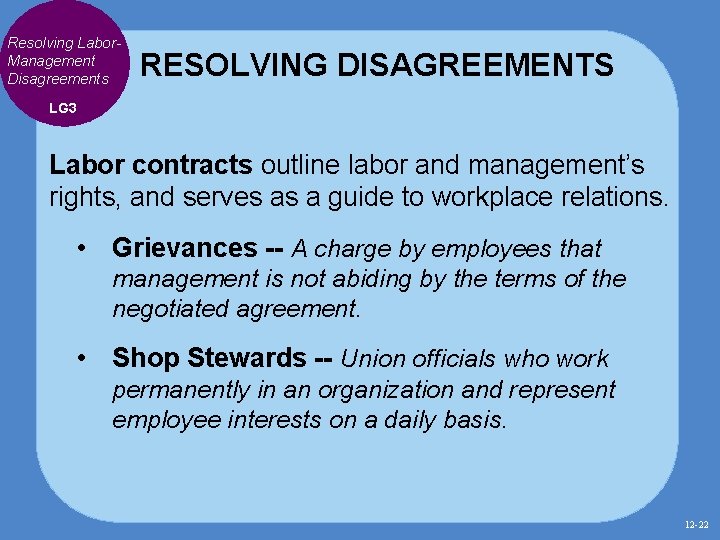
Resolving Labor. Management Disagreements RESOLVING DISAGREEMENTS LG 3 Labor contracts outline labor and management’s rights, and serves as a guide to workplace relations. • Grievances -- A charge by employees that management is not abiding by the terms of the negotiated agreement. • Shop Stewards -- Union officials who work permanently in an organization and represent employee interests on a daily basis. 12 -22
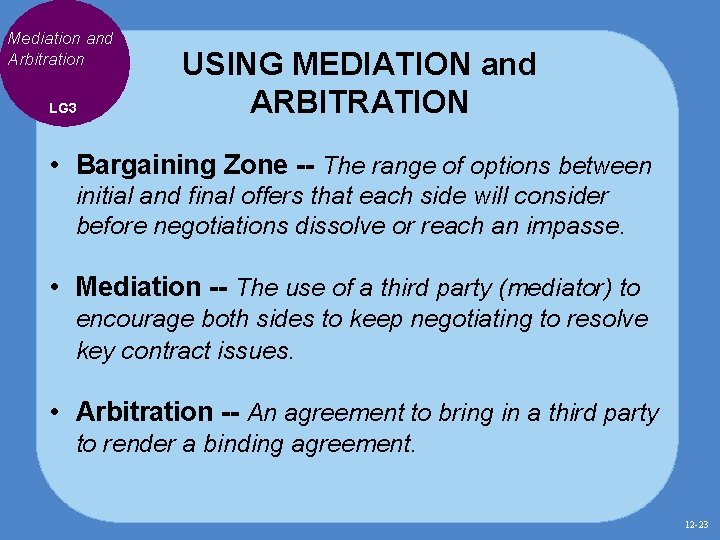
Mediation and Arbitration LG 3 USING MEDIATION and ARBITRATION • Bargaining Zone -- The range of options between initial and final offers that each side will consider before negotiations dissolve or reach an impasse. • Mediation -- The use of a third party (mediator) to encourage both sides to keep negotiating to resolve key contract issues. • Arbitration -- An agreement to bring in a third party to render a binding agreement. 12 -23
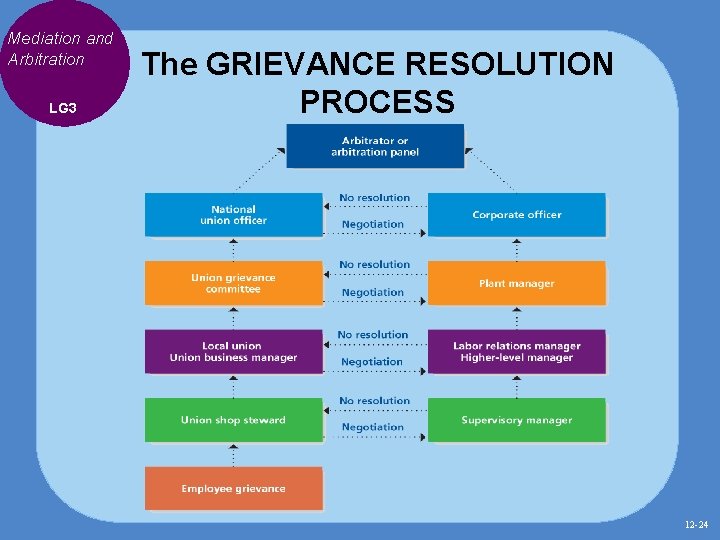
Mediation and Arbitration LG 3 The GRIEVANCE RESOLUTION PROCESS 12 -24
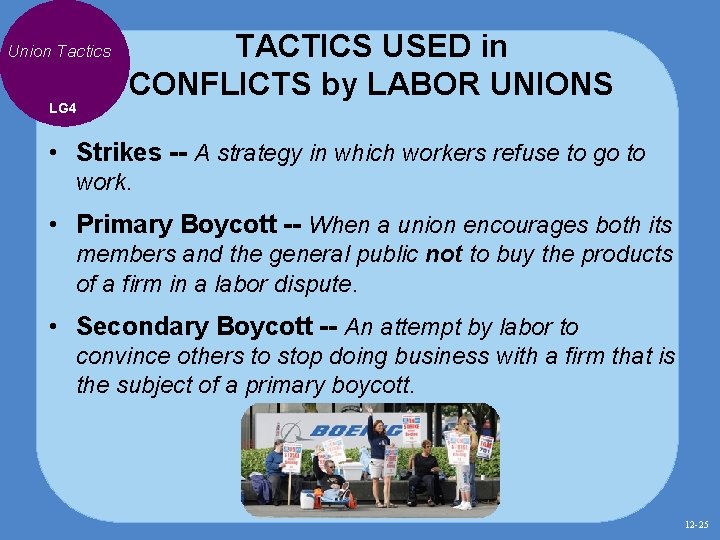
Union Tactics LG 4 TACTICS USED in CONFLICTS by LABOR UNIONS • Strikes -- A strategy in which workers refuse to go to work. • Primary Boycott -- When a union encourages both its members and the general public not to buy the products of a firm in a labor dispute. • Secondary Boycott -- An attempt by labor to convince others to stop doing business with a firm that is the subject of a primary boycott. 12 -25
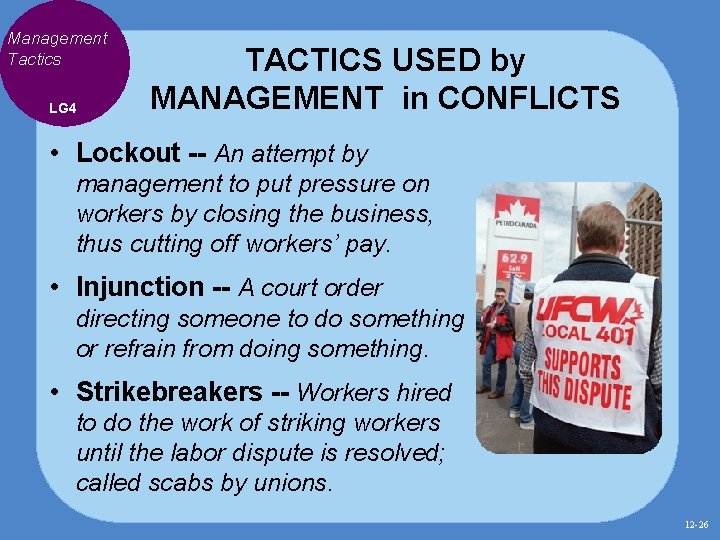
Management Tactics LG 4 TACTICS USED by MANAGEMENT in CONFLICTS • Lockout -- An attempt by management to put pressure on workers by closing the business, thus cutting off workers’ pay. • Injunction -- A court order directing someone to do something or refrain from doing something. • Strikebreakers -- Workers hired to do the work of striking workers until the labor dispute is resolved; called scabs by unions. 12 -26
WALKING a FINE LINE (Making Ethical Decisions) Shop-Til-You-Drop is seeking workers to fill the jobs of striking workers. • Many students at your college are employees and others are supporting the strike. • You need money and legally it’s permissible for you to replace striking workers when your not an employee. • What will you do? What are the consequences? 12 -27
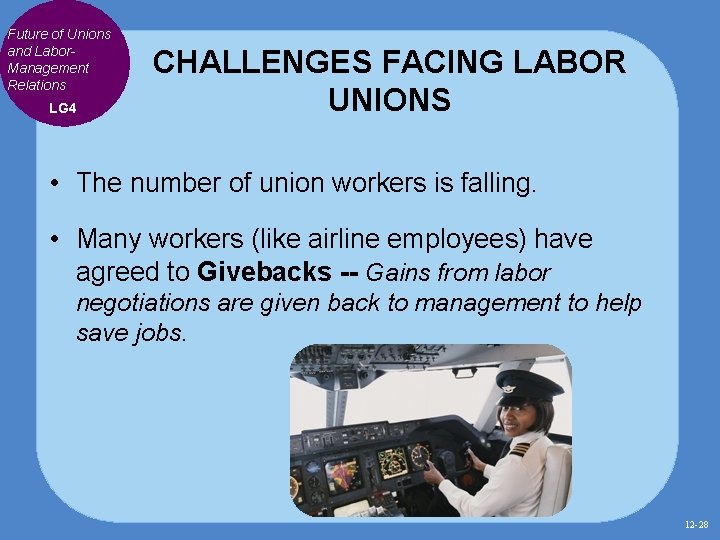
Future of Unions and Labor. Management Relations LG 4 CHALLENGES FACING LABOR UNIONS • The number of union workers is falling. • Many workers (like airline employees) have agreed to Givebacks -- Gains from labor negotiations are given back to management to help save jobs. 12 -28
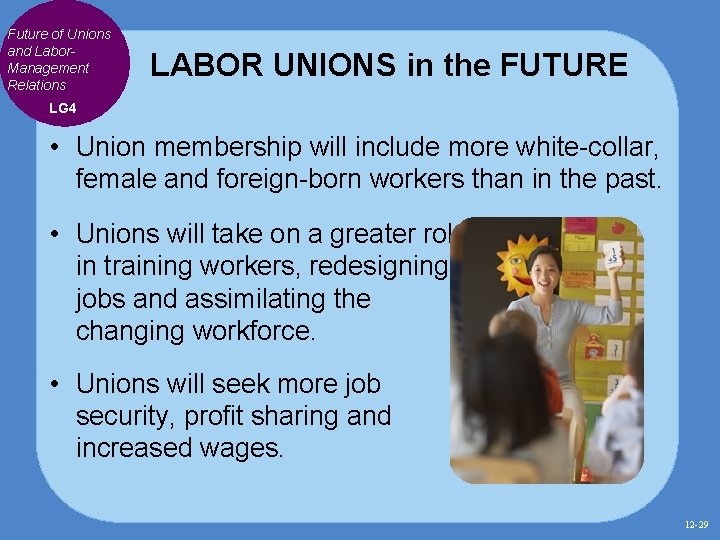
Future of Unions and Labor. Management Relations LABOR UNIONS in the FUTURE LG 4 • Union membership will include more white-collar, female and foreign-born workers than in the past. • Unions will take on a greater role in training workers, redesigning jobs and assimilating the changing workforce. • Unions will seek more job security, profit sharing and increased wages. 12 -29
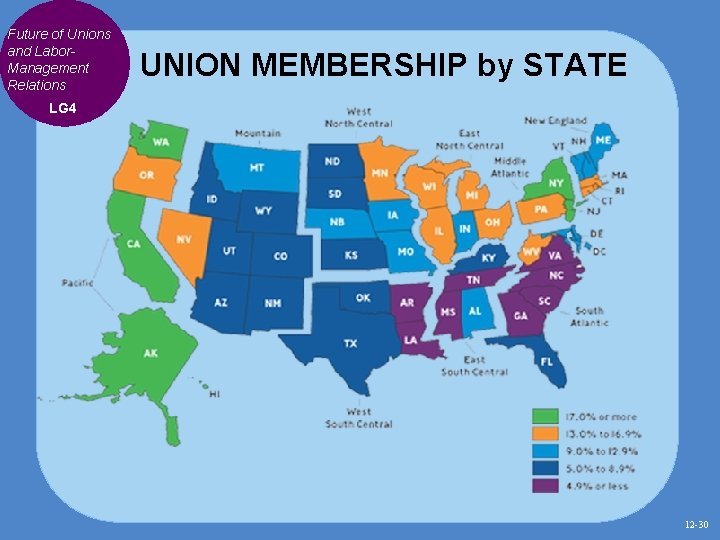
Future of Unions and Labor. Management Relations UNION MEMBERSHIP by STATE LG 4 12 -30
Progress Assessment PROGRESS ASSESSMENT • What are the major laws that affected union growth, and what does each one cover? • How do changes in the economy affect the objectives of unions? • What are the major tactics used by unions and by management to assert their power in contract negotiations? • What types of workers do unions need to organize in the future? 12 -31
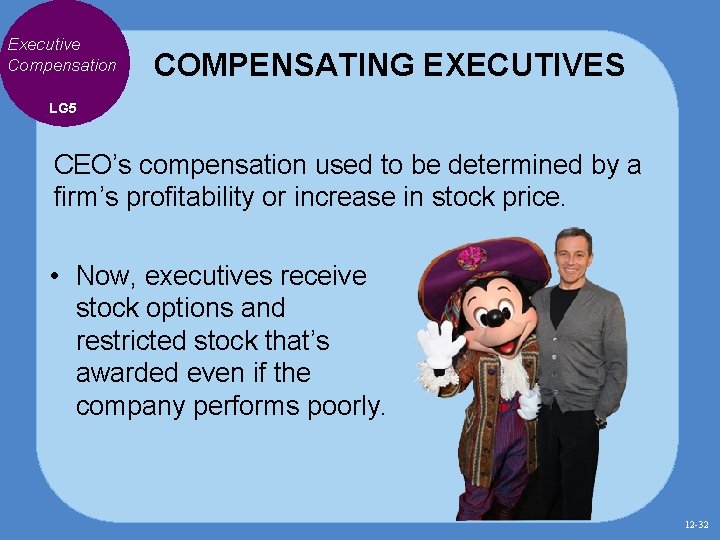
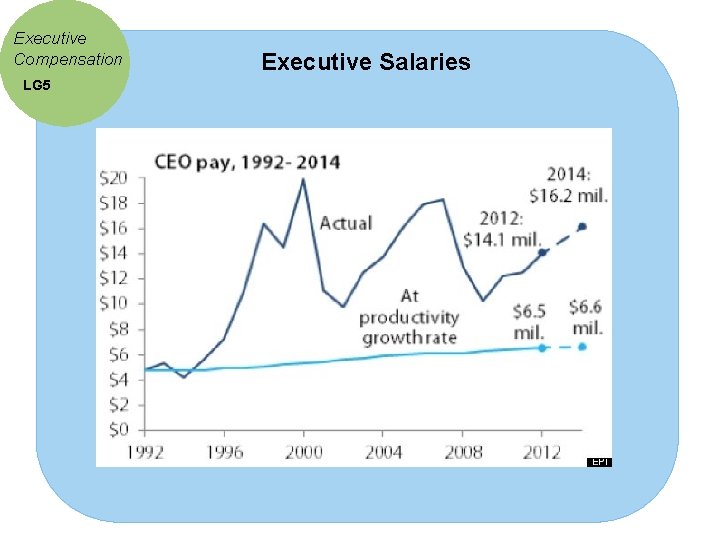
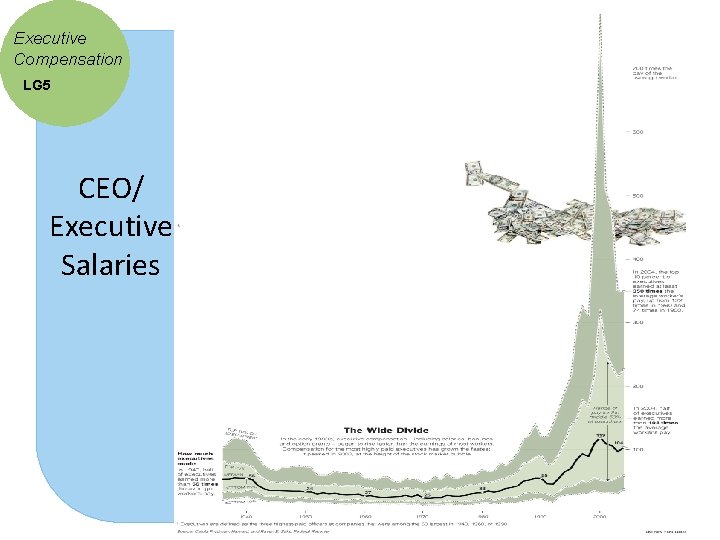
Executive Compensation COMPENSATING EXECUTIVES LG 5 CEO’s compensation used to be determined by a firm’s profitability or increase in stock price. • Now, executives receive stock options and restricted stock that’s awarded even if the company performs poorly. 12 -32
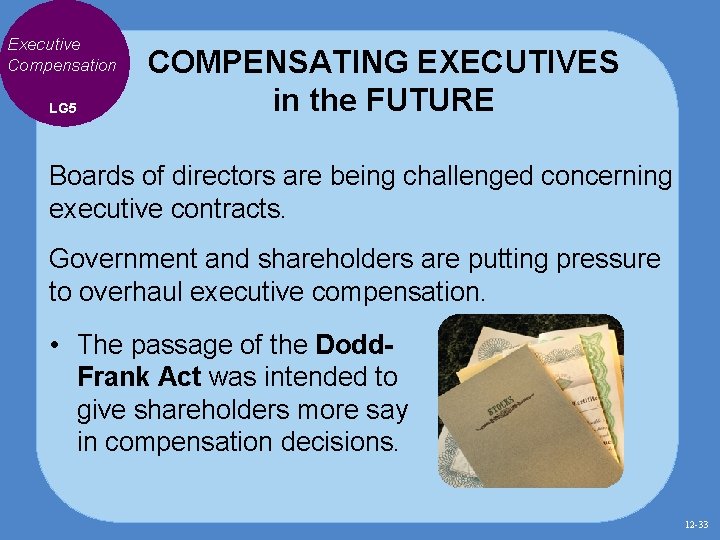
Executive Compensation LG 5 COMPENSATING EXECUTIVES in the FUTURE Boards of directors are being challenged concerning executive contracts. Government and shareholders are putting pressure to overhaul executive compensation. • The passage of the Dodd. Frank Act was intended to give shareholders more say in compensation decisions. 12 -33
Executive Compensation LG 5 DODD-FRANK ACT The Dodd-Frank Act implements changes that, among other things, affect the oversight and supervision of financial institutions, provide for a new resolution procedure for large financial companies, create a new agency responsible for implementing and enforcing compliance with consumer financial laws, introduce more stringent regulatory capital requirements, effect significant changes in the regulation of over the counter derivatives, reform the regulation of credit rating agencies, implement changes to corporate governance and executive compensation practices, incorporate the Volcker Rule, require registration of advisers to certain private funds, and effect significant changes in the securitization market. Morrison & Foerster “Cheat Sheet” 2009 12 -34
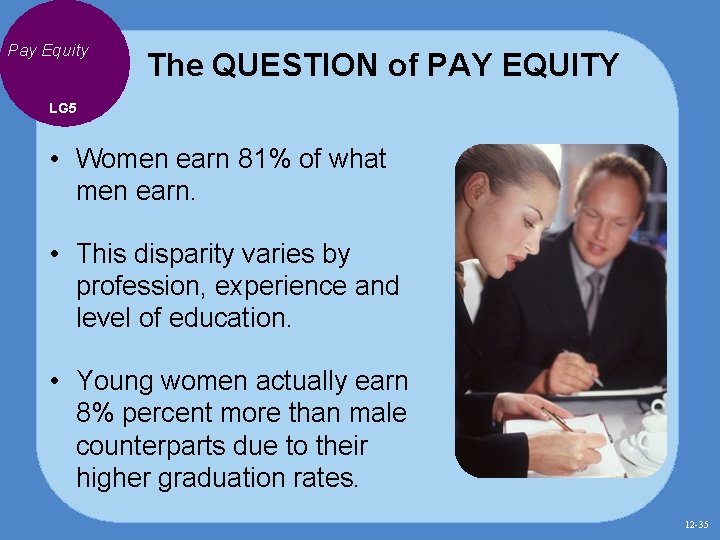
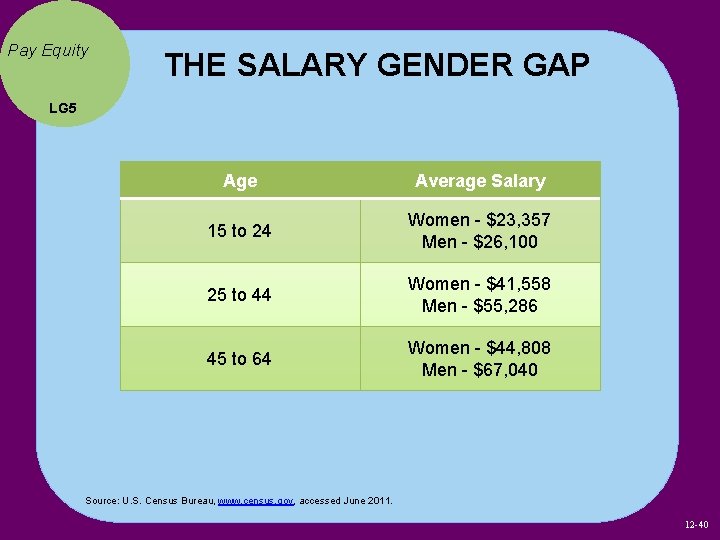
Pay Equity The QUESTION of PAY EQUITY LG 5 • Women earn 81% of what men earn. • This disparity varies by profession, experience and level of education. • Young women actually earn 8% percent more than male counterparts due to their higher graduation rates. 12 -35
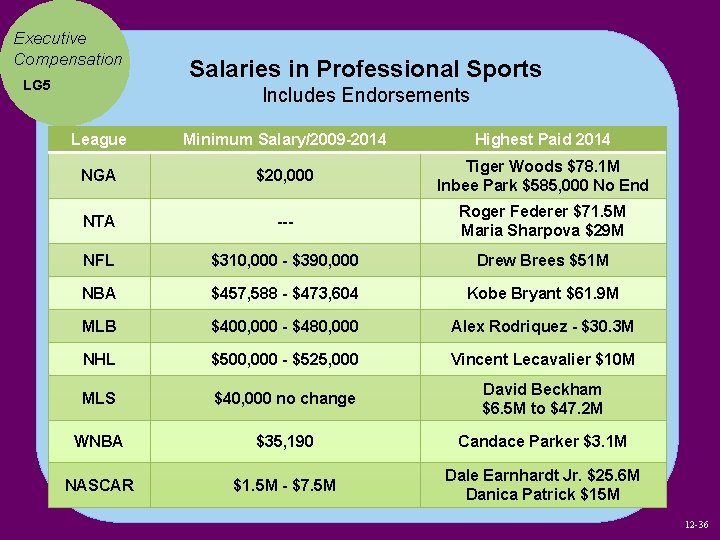
Executive Compensation LG 5 Salaries in Professional Sports Includes Endorsements League Minimum Salary/2009 -2014 Highest Paid 2014 NGA $20, 000 Tiger Woods $78. 1 M Inbee Park $585, 000 No End NTA --- Roger Federer $71. 5 M Maria Sharpova $29 M NFL $310, 000 - $390, 000 Drew Brees $51 M NBA $457, 588 - $473, 604 Kobe Bryant $61. 9 M MLB $400, 000 - $480, 000 Alex Rodriquez - $30. 3 M NHL $500, 000 - $525, 000 Vincent Lecavalier $10 M MLS $40, 000 no change David Beckham $6. 5 M to $47. 2 M WNBA $35, 190 Candace Parker $3. 1 M NASCAR $1. 5 M - $7. 5 M Dale Earnhardt Jr. $25. 6 M Danica Patrick $15 M 12 -36
Executive Compensation Executive Salaries LG 5 12 -37
Executive Compensation LG 5 CEO/ Executive Salaries 12 -38
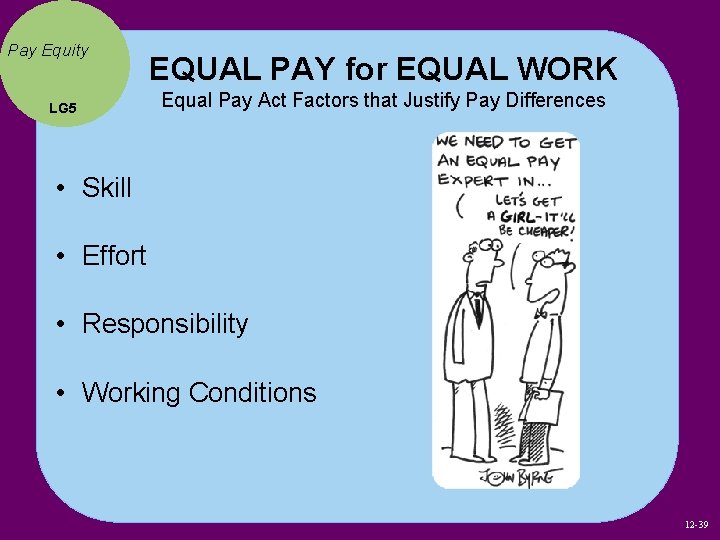
Pay Equity LG 5 EQUAL PAY for EQUAL WORK Equal Pay Act Factors that Justify Pay Differences • Skill • Effort • Responsibility • Working Conditions 12 -39
Pay Equity THE SALARY GENDER GAP LG 5 Age Average Salary 15 to 24 Women - $23, 357 Men - $26, 100 25 to 44 Women - $41, 558 Men - $55, 286 45 to 64 Women - $44, 808 Men - $67, 040 Source: U. S. Census Bureau, www. census. gov, accessed June 2011. 12 -40
Violence in the Workplace VIOLENCE in the WORKPLACE LG 5 • OSHA reports homicides account for 16% of workplace deaths. • Violence is the number one cause of death for women in the workplace. • Companies have taken action to deal with potential problems by using focus groups and other interactions. 12 -41
Violence in the Workplace LG 5 WARNING SIGNS of POSSIBLE WORKPLACE VIOLENCE • Unprovoked outbursts of anger or rage • Threats or verbal abuse • Repeated suicidal comments • Paranoid behavior • Increased frequency of domestic problems 12 -42
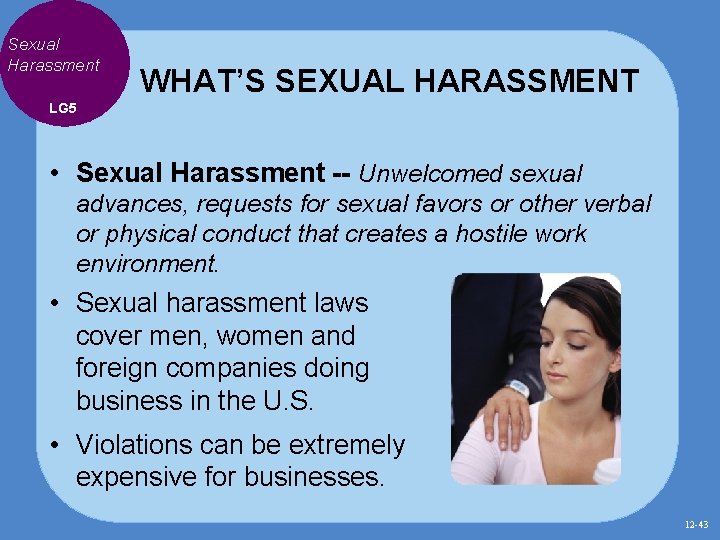
Sexual Harassment WHAT’S SEXUAL HARASSMENT LG 5 • Sexual Harassment -- Unwelcomed sexual advances, requests for sexual favors or other verbal or physical conduct that creates a hostile work environment. • Sexual harassment laws cover men, women and foreign companies doing business in the U. S. • Violations can be extremely expensive for businesses. 12 -43
Sexual Harassment KINDS of SEXUAL HARASSMENT LG 5 Quid pro quo sexual harassment involves threats like “Go out with me or you’re fired. ” An employee’s job is based on submission. Hostile work environment sexual harassment is conduct that interferes with a worker’s performance or creates an intimidating or offensive work environment. 12 -44
Drug Testing LG 5 DRUG USE in the WORKPLACE Alcohol is the most widely used drug. 9% of heavy drinkers and 10% drug users missed work due to hangover, while 6% went to work drunk or high in October 2013 survey, while 11% heavy drinkers and 18% drug users skipped work in the month of September 2013, alone. • Over 8% of full-time and 10. 2% workers aged 18 -49 use illegal drugs and are more likely to be in workplace accidents. • Drug abuse costs the U. S. economy $414 billion in lost work, healthcare costs and crime. • Over 80% of major companies drug test workers. 12 -45
Elder Care LG 5 ELDER CARE in the MODERN HOUSEHOLD More and more boomers are taking care of their parents while still working. - 31% say this may delay their retirement. - The average cost of care of aging parent is can be between $20 -$400 K per year, with maintenance fees in care facilities. Approximately $5, 534 in local facilites, and $1, 000 – $4, 000 in your home. - 76% say they enjoy taking care of their parents. - 54% say it made them closer. 12 -46
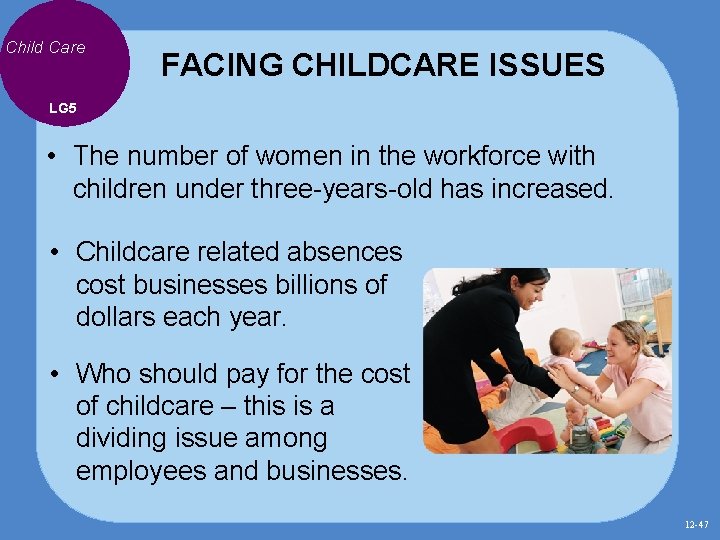
Child Care FACING CHILDCARE ISSUES LG 5 • The number of women in the workforce with children under three-years-old has increased. • Childcare related absences cost businesses billions of dollars each year. • Who should pay for the cost of childcare – this is a dividing issue among employees and businesses. 12 -47
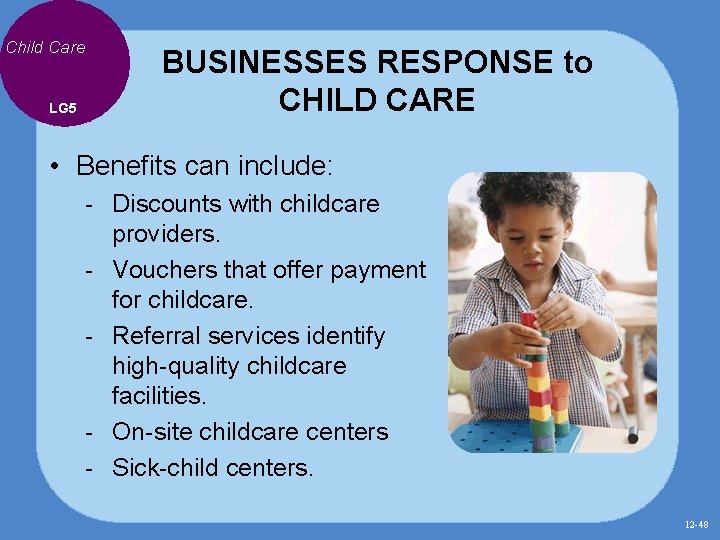
Child Care LG 5 BUSINESSES RESPONSE to CHILD CARE • Benefits can include: - Discounts with childcare providers. - Vouchers that offer payment for childcare. - Referral services identify high-quality childcare facilities. - On-site childcare centers - Sick-child centers. 12 -48
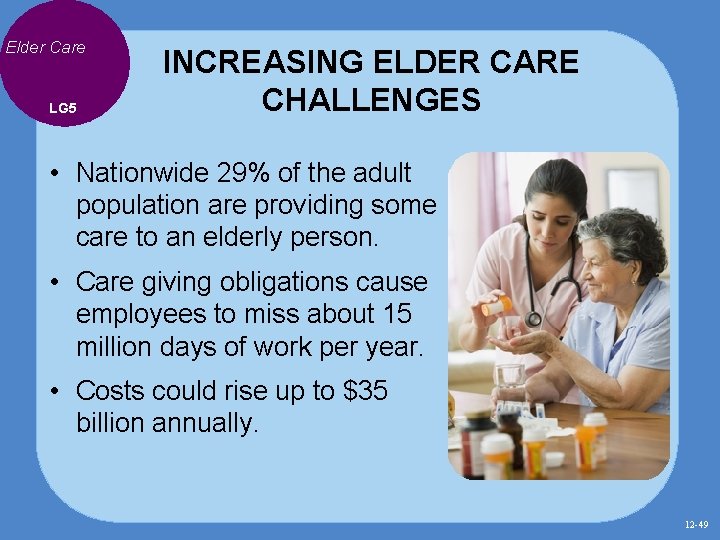
Elder Care LG 5 INCREASING ELDER CARE CHALLENGES • Nationwide 29% of the adult population are providing some care to an elderly person. • Care giving obligations cause employees to miss about 15 million days of work per year. • Costs could rise up to $35 billion annually. 12 -49
Progress Assessment PROGRESS ASSESSMENT • How does top-executive pay in the U. S. compare with top-executive pay in other countries? • What’s the difference between pay equity and equal pay for equal work? • How is the term sexual harassment defined and when does sexual behavior become illegal? • What are some of the issues related to childcare and elder care and how are companies addressing those issues? 12 -50