
Chapter 12 Corporate Governance and Business Ethics Mc
Chapter 12 Corporate Governance and Business Ethics ©Mc. Graw-Hill Education. All rights reserved. Authorized only for instructor use in the classroom. No reproduction or further distribution permitted without the prior written consent of Mc. Graw-Hill Education.
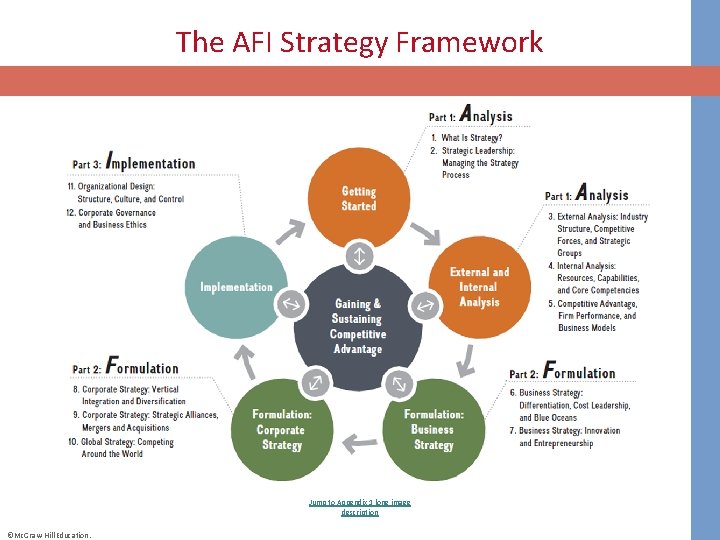
The AFI Strategy Framework Jump to Appendix 1 long image description ©Mc. Graw-Hill Education.
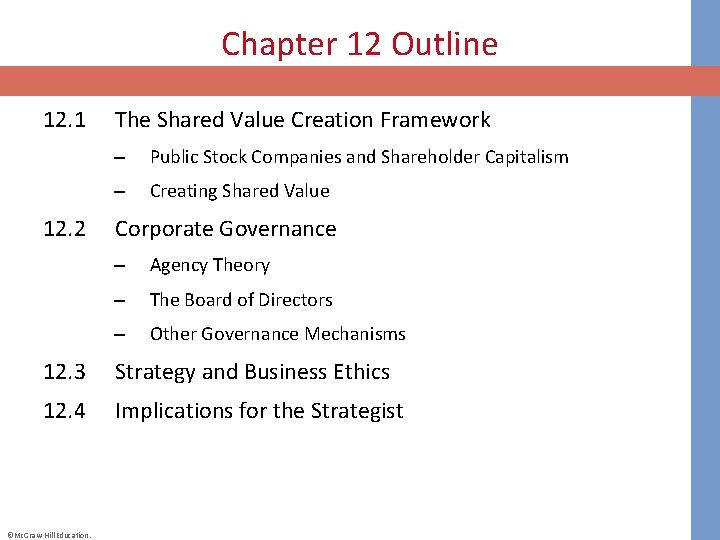
Chapter 12 Outline 12. 1 12. 2 The Shared Value Creation Framework – Public Stock Companies and Shareholder Capitalism – Creating Shared Value Corporate Governance – Agency Theory – The Board of Directors – Other Governance Mechanisms 12. 3 Strategy and Business Ethics 12. 4 Implications for the Strategist ©Mc. Graw-Hill Education.
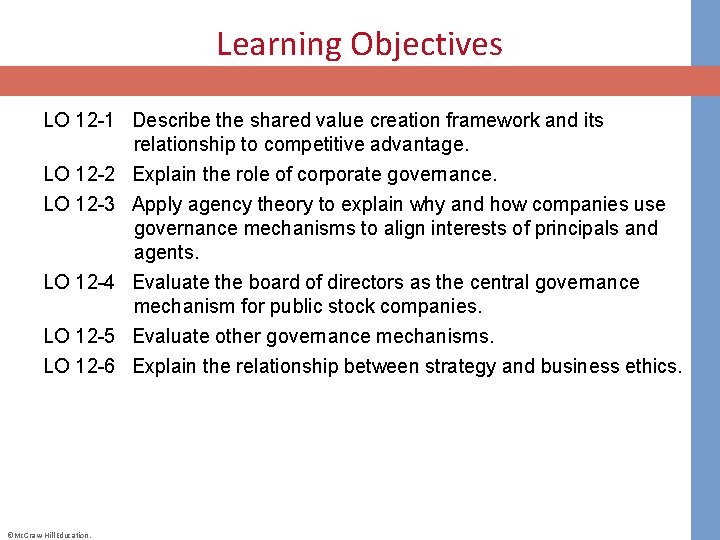
Learning Objectives LO 12 -1 Describe the shared value creation framework and its relationship to competitive advantage. LO 12 -2 Explain the role of corporate governance. LO 12 -3 Apply agency theory to explain why and how companies use governance mechanisms to align interests of principals and agents. LO 12 -4 Evaluate the board of directors as the central governance mechanism for public stock companies. LO 12 -5 Evaluate other governance mechanisms. LO 12 -6 Explain the relationship between strategy and business ethics. ©Mc. Graw-Hill Education.

The Shared Value Creation Framework ©Mc. Graw-Hill Education.
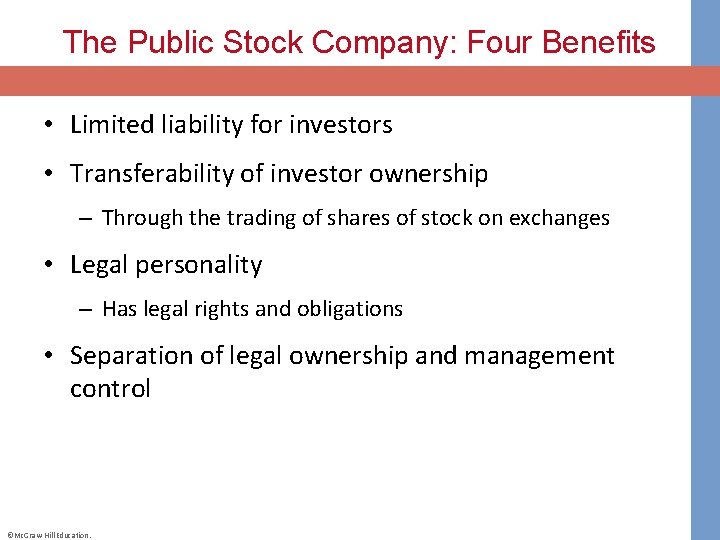
The Public Stock Company: Four Benefits • Limited liability for investors • Transferability of investor ownership – Through the trading of shares of stock on exchanges • Legal personality – Has legal rights and obligations • Separation of legal ownership and management control ©Mc. Graw-Hill Education.
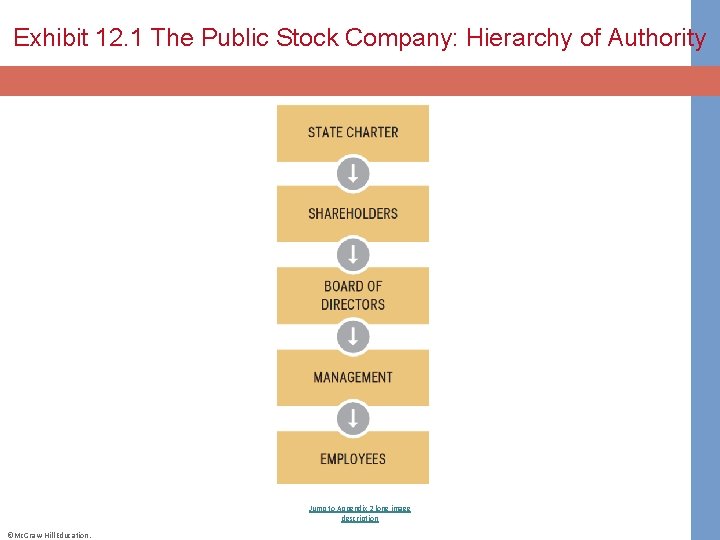
Exhibit 12. 1 The Public Stock Company: Hierarchy of Authority Jump to Appendix 2 long image description ©Mc. Graw-Hill Education.
Milton Friedman’s Philosophy • “The social responsibility of business is to increase its profits. ” • A survey asked the top 25 percent of income earners holding a university degree in each country surveyed whether they agree with Milton Friedman’s philosophy. • The results… ©Mc. Graw-Hill Education.
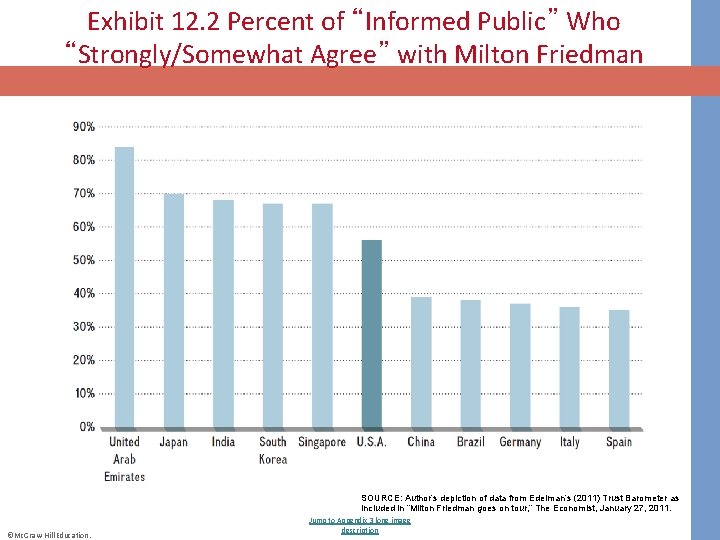
Exhibit 12. 2 Percent of “Informed Public” Who “Strongly/Somewhat Agree” with Milton Friedman SOURCE: Author’s depiction of data from Edelman’s (2011) Trust Barometer as included in “Milton Friedman goes on tour, ” The Economist, January 27, 2011. ©Mc. Graw-Hill Education. Jump to Appendix 3 long image description
Creating Shared Value • Porter argues that executives should not concentrate exclusively on increasing firm profits. • Rather, the strategist should focus on creating shared value, a concept that involves: – Creating economic value for shareholders – Creating social value by addressing society’s needs and challenges ©Mc. Graw-Hill Education.
The Shared Value Creation Framework • A model proposing that managers have a dual focus on: – Shareholder value creation – Value creation for society • Example: GE’s ecomagination initiative – To provide cleaner and more efficient sources of energy – To provide abundant sources of clean water anywhere in the world – To reduce emissions ©Mc. Graw-Hill Education.
Michael Porter’s Recommendations to Reconnect Economic & Societal Needs 1. Expand the customer base – Bring in nonconsumers such as those at the bottom of the pyramid (large / poor socioeconomic group). 2. Expand traditional internal firm value chains. – Include more nontraditional partners such as nongovernmental organizations (NGOs). 3. Focus on creating new regional clusters: – Such as Silicon Valley in the United States – Electronic City in Bangalore, India – Chilecon Valley in Santiago, Chile ©Mc. Graw-Hill Education.
Corporate Governance ©Mc. Graw-Hill Education.
The Role of Corporate Governance • To provide mechanisms to: – Direct and control an enterprise – Ensure that it pursues strategic goals successfully and legally • To offer checks and balances • To ask the tough questions when needed • Attempts to address the principal-agent problem ©Mc. Graw-Hill Education.
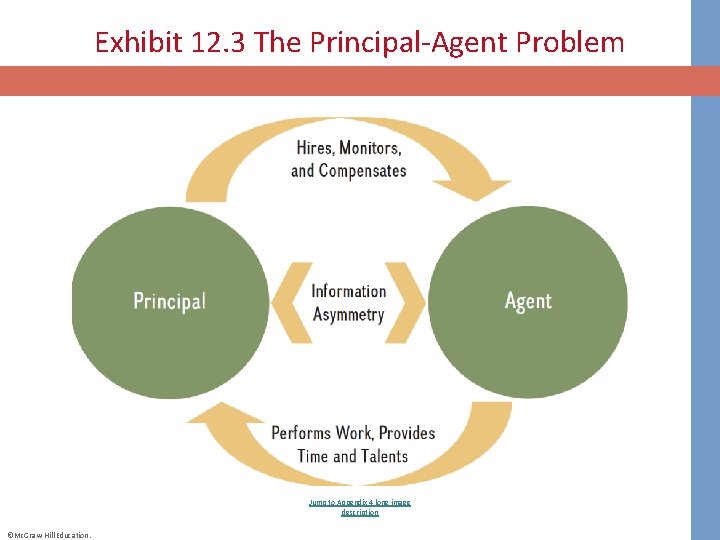
Exhibit 12. 3 The Principal-Agent Problem Jump to Appendix 4 long image description ©Mc. Graw-Hill Education.
Agency Theory • A theory that views the firm as a nexus of legal contracts – So conflicts that arise should be resolve legally. – Therefore, the firm needs to design work tasks, incentives, and employment contracts • To minimize opportunism by agents • Governance mechanisms should be put in place to overcome two agency problems: – Adverse selection – Moral hazard ©Mc. Graw-Hill Education.
Adverse Selection and Moral Hazard • Both caused by information asymmetry • Adverse Selection – Increases the likelihood of selecting inferior alternatives • Moral Hazard – Increases the incentive of one party to take undue risks or shirk other responsibilities – The costs incur to the another party ©Mc. Graw-Hill Education.
The Board of Directors • The centerpiece of corporate governance – Helps overcome the principal-agent problem • Usually consist of inside and outside directors – Inside directors: usually consist of: CEO, COO, CFO – Outside directors: senior execs from other firms • Elected by the shareholders – Shareholder votes determine who is elected to the board ©Mc. Graw-Hill Education.
Responsibilities of the Board of Directors • General strategic oversight and guidance • Selecting, evaluating, and compensating the CEO – The board may fire him or her. – Overseeing the company’s CEO succession plan • Providing guidance for executive compensation • Reviewing, monitoring, evaluating, and approving strategic initiatives – Such as large acquisitions • Risk assessment & mitigation ©Mc. Graw-Hill Education.
Strategy Highlight 12. 1 GE’s Board of Directors • GE’s board consists of: – Members of companies, academia, and government – 16 members, 5 different committees • They meet about 12 times annually • 25% of the board are women (more than usual) – Generally, the larger the company, the greater its gender diversity. – Diverse boards are less likely to fall victim to groupthink. ©Mc. Graw-Hill Education.
Corporate Mechanisms to Align Incentives Between Principals & Agents 1. Executive compensation 2. The market for corporate control 3. Financial statement auditors, government regulators, and industry analysts …we’ll review each of these ©Mc. Graw-Hill Education.
Executive Compensation • Stock options are often part of compensation. • The average ratio of CEO to employee pay is 300: 1. • About 2/3 of CEO pay is linked to firm performance. – But this link is weak – Can further increase job stress – Can negatively impact job performance ©Mc. Graw-Hill Education.
The Market for Corporate Control • An external corporate-governance mechanism • Consists of activist investors who: – Seek to gain control of an underperforming corporation – Buy shares of its stock in the open market • Often pursued when a company is underperforming ©Mc. Graw-Hill Education.
Auditors, Government Regulators, And Industry Analysts • Serve as additional external-governance mechanisms • To avoid misrepresentation of financial results: – Public financial statements must follow GAAP: • Generally accepted accounting principles – Financial statements must be audited • By certified public accountants • Industry analysts often base their buy, hold, or sell recommendations on: – Financial statements filed with the SEC – Business news (WSJ, Forbes, CNBC, etc. ) ©Mc. Graw-Hill Education.
Strategy and Business Ethics ©Mc. Graw-Hill Education.
Business Ethics • An agreed-upon code of conduct in business, based on societal norms • Lay the foundation and provide training for: – “behavior that is consistent with the principles, norms, and standards of business practice that have been agreed upon by society” • Can differ in various cultures around the globe – Universal norms include: • Fairness • Honesty • Reciprocity ©Mc. Graw-Hill Education.
When Facing an Ethical Dilemma • Ask whether the intended course of action falls within the acceptable norms of professional behavior. – As outlined in the organization’s code of conduct – As defined by the profession at large • Would you feel comfortable explaining and defending the decision in public? – How would the media report the business decision if it were to become public? – How would the company’s stakeholders feel about it? ©Mc. Graw-Hill Education.
Strategy Highlight 12. 2 Did Goldman Sachs and the “Fabulous Fab” Commit Securities Fraud? • In 2010, the SEC sued the company and an employee, named Fabrice Tourre, for fraud – Did the bank knowingly mislead investors? – Goldman Sachs argued that it is up to clients to assess risk involved in investments. • Public pressure mounted. – Goldman Sachs ended up paying $550 M to settle the lawsuit, but did not admit wrongdoing. • Tourre was convicted of fraud. ©Mc. Graw-Hill Education.
Ethical Leadership Is Critical • Strategic leaders set the tone for the ethical climate within an organization. – Employees take cues from their environment on how to act. • CEOs of Fortune 500 companies are under constant public scrutiny. – Ought to adhere to the highest ethical standards – Unethical behavior can destroy the CEO’s reputation. • Ethical expectations must be clear. • Management must provide. ©Mc. Graw-Hill Education.
The MBA Oath • Developed by Harvard Business School students • Helps anchor future managers to professional values – Helps management achieve a professional status • Has been taken by: – 6, 000 MBA students – Students in over 300 institutions around the world ©Mc. Graw-Hill Education.
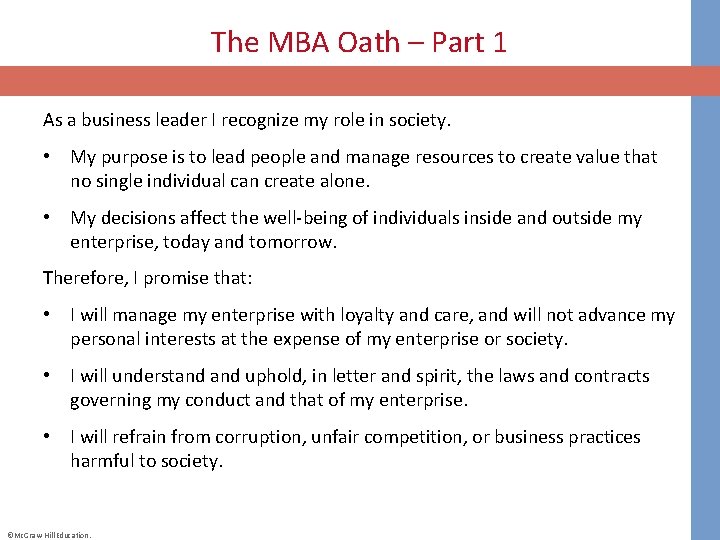
The MBA Oath – Part 1 As a business leader I recognize my role in society. • My purpose is to lead people and manage resources to create value that no single individual can create alone. • My decisions affect the well-being of individuals inside and outside my enterprise, today and tomorrow. Therefore, I promise that: • I will manage my enterprise with loyalty and care, and will not advance my personal interests at the expense of my enterprise or society. • I will understand uphold, in letter and spirit, the laws and contracts governing my conduct and that of my enterprise. • I will refrain from corruption, unfair competition, or business practices harmful to society. ©Mc. Graw-Hill Education.
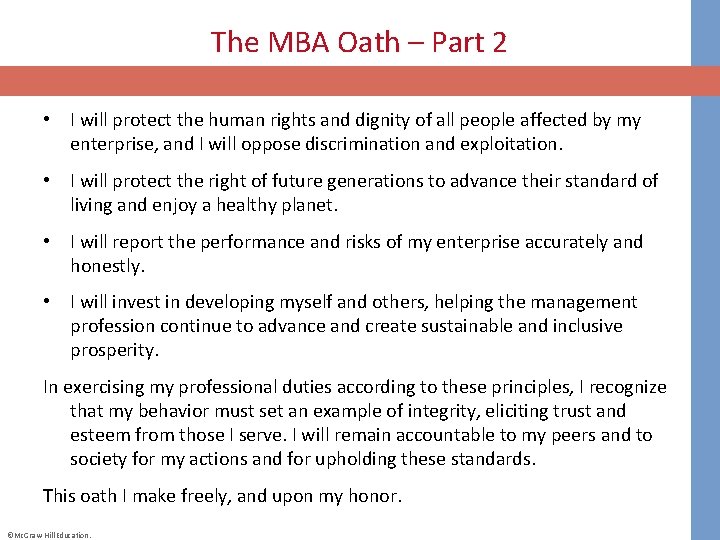
The MBA Oath – Part 2 • I will protect the human rights and dignity of all people affected by my enterprise, and I will oppose discrimination and exploitation. • I will protect the right of future generations to advance their standard of living and enjoy a healthy planet. • I will report the performance and risks of my enterprise accurately and honestly. • I will invest in developing myself and others, helping the management profession continue to advance and create sustainable and inclusive prosperity. In exercising my professional duties according to these principles, I recognize that my behavior must set an example of integrity, eliciting trust and esteem from those I serve. I will remain accountable to my peers and to society for my actions and for upholding these standards. This oath I make freely, and upon my honor. ©Mc. Graw-Hill Education.
Implications for the Strategist ©Mc. Graw-Hill Education.
Corporate Governance Mechanisms • Can be effective in addressing the principal–agent problem • Tend to focus on monitoring, controlling, and providing incentives • Must be complemented by: – A strong code of conduct – Strategic leaders who act with integrity ©Mc. Graw-Hill Education.
Corporate Governance and Business Ethics • Are critical to gaining and sustaining competitive advantage • Are closely intertwined with: – Setting the right organizational core values – Ensuring compliance • Glaring ethical lapses in the last 10 years call for: – Ethical values and code of conduct – Professionalization of management ©Mc. Graw-Hill Education.
The Strategist Must • Help employees to “walk the talk” • Lead by an ethical example • Live organizational core values by example – Fairness and transparency is critical • Needs to apply a stakeholder perspective – To ensure long-term survival and success of the firm ©Mc. Graw-Hill Education.

Chapter 12 Summary ©Mc. Graw-Hill Education.
Take Away Concepts (1 of 6) LO 12 -1 Describe the shared value creation framework and its relationship to competitive advantage. • By focusing on financial performance, many companies have defined value creation too narrowly. • Companies should instead focus on creating shared value, a concept that includes value creation for both shareholders and society. • The shared value creation framework seeks to identify connections between economic and social needs, and then leverage them into competitive advantage. ©Mc. Graw-Hill Education.
Take Away Concepts (2 of 6) LO 12 -2 Explain the role of corporate governance. • Corporate governance involves mechanisms used to direct and control an enterprise in order to ensure that it pursues its strategic goals successfully and legally. • Corporate governance attempts to address the principal–agent problem, which describes any situation in which an agent performs activities on behalf of a principal. ©Mc. Graw-Hill Education.
Take Away Concepts (3 of 6) LO 12 -3 Apply agency theory to explain why and how companies use governance mechanisms to align interests of principals and agents. • Agency theory views the firm as a nexus of legal contracts. • The principal–agent problem concerns the relationship between owners (shareholders) and managers and also cascades down the organizational hierarchy. • The risk of opportunism on behalf of agents is exacerbated by information asymmetry: Agents are generally better informed than the principals. • Governance mechanisms are used to align incentives between principals and agents. • Governance mechanisms need to be designed in such a fashion as to overcome two specific agency problems: adverse selection and moral hazard. ©Mc. Graw-Hill Education.
Take Away Concepts (4 of 6) LO 12 -4 Evaluate the board of directors as the central governance mechanism for public stock companies. • The shareholders are the legal owners of a publicly traded company and appoint a board of directors to represent their interests. • The day-to-day business operations of a publicly traded stock company are conducted by its managers and employees, under the direction of the chief executive officer (CEO) and the oversight of the board of directors. The board of directors is composed of inside and outside directors, who are elected by the shareholders. • Inside directors are generally part of the company’s senior management team, such as the chief financial officer (CFO) and the chief operating officer (COO). • Outside directors are not employees of the firm. They frequently are senior executives from other firms or full-time professionals who are appointed to a board and who serve on several boards simultaneously. ©Mc. Graw-Hill Education.
Take Away Concepts (5 of 6) LO 12 -5 Evaluate other governance mechanisms. • Other important corporate mechanisms are executive compensation, the market for corporate control, and financial statement auditors, government regulators, and industry analysts. • Executive compensation has attracted significant attention in recent years. Two issues are at the forefront: (1) the absolute size of the CEO pay package compared with the pay of the average employee and (2) the relationship between firm performance and CEO pay. • The board of directors and executive compensation are internal corporate-governance mechanisms. The market for corporate control is an important external corporate-governance mechanism. It consists of activist investors who seek to gain control of an underperforming corporation by buying shares of its stock in the open market. • All public companies listed on the U. S. stock exchanges must file a number of financial statements with the Securities and Exchange Commission (SEC), a federal regulatory agency whose task it is to oversee stock trading and enforce federal securities laws. Auditors and industry analysts study these public financial statements carefully for clues of a firm’s future valuations, financial irregularities, and strategy. ©Mc. Graw-Hill Education.
Take Away Concepts (6 of 6) LO 12 -6 Explain the relationship between strategy and business ethics. • The ethical pursuit of competitive advantage lays the foundation for longterm superior performance. • Law and ethics are not synonymous; obeying the law is the minimum that society expects of a corporation and its managers. • A manager’s actions can be completely legal, but ethically questionable. • Some argue that management needs an accepted code of conduct that holds members to a high professional standard and imposes consequences for misconduct. ©Mc. Graw-Hill Education.
Key Terms • Adverse selection • Leveraged buyout (LBO) • Agency theory • Moral hazard • Board of directors • Outside directors • Business ethics • Poison pill • CEO/chairperson duality • Shared value creation framework • Corporate governance • Inside directors ©Mc. Graw-Hill Education. • Shareholder capitalism • Stock options
Chapter 12 Cases & Exercises ©Mc. Graw-Hill Education.
Chapter Case 12: Consider This… (1 of 2) • Uber has – Happy drivers (set their own hours) – Happy customers (rides are convenient and cheap) • It is disrupting the transportation industry: – It has a fleet of vehicles offering cheap rides. – It incorporates eventual use of autonomous vehicles. – People may not need to own cars in the future. • Uber might expand in the future to offer delivery services. ©Mc. Graw-Hill Education.
Chapter Case 12: Consider This… (2 of 2) • Have you used a ride service like Uber? If so, how was your experience? • What is Uber’s business model / strategic intent? • Is Uber “the most ethically challenged company in Silicon Valley”? • Should drivers be reimbursed for gas and car maintenance? Are they “employees”? ©Mc. Graw-Hill Education.
My Strategy Exercise: Gen Y Workforce • This generation: – Has received more individual attention (small classes) – Grew up through an explosion of technology – May expect higher pay, flexible schedules, promotions – Seeks frequent feedback & accomodation • Questions to answer: – Will this hold a new set of business ethics? – Does the MBA oath reflect a new approach Gen Y will take to the business environment? ©Mc. Graw-Hill Education.
Small Group Exercise #1 • Research competitors of Uber: – Lyft: targets college students headed home – Sidecar: offers carpooling & delivery • Questions to answer: – What similarities and differences do you find in the way these firms have implemented sometimes similar ideas? – Why are traditional taxi companies attempting to prohibit these services vs. implementing their own app-calling systems? ©Mc. Graw-Hill Education.
Small Group Exercise #2 • Many corporate boards lack women & minorities – In the U. S. women hold 19% of board seats • This trend has been flat for 10 years. • In Norway, females make up 40% of boards. – Went from 9% - 40% in two years • The government made it mandatory. • Group discussion: – Is it a problem that women are underrepresented? – Why has the trend in the U. S. been flat for 10 years? – Is a regulatory quota a good solution? – What other methods could be used? ©Mc. Graw-Hill Education.

End of Chapter 12 ©Mc. Graw-Hill Education.

Strategy Smart Videos ©Mc. Graw-Hill Education.
Strategy Smart Videos (1 of 6) • INSEAD • Turning around Tyco: How Corporate Governance Saved the Day • Part 1 Link: – http: //www. youtube. com/watch? v=x. UFKEv. Rv. HK 0 • 10: 05 Minutes ©Mc. Graw-Hill Education.
Strategy Smart Videos (2 of 6) • INSEAD • Corporate Governance Comes of Age • Link: – http: //www. youtube. com/watch? v=jx. B 81 Ka. Dy. Rw • 7: 14 Minutes ©Mc. Graw-Hill Education.
Strategy Smart Videos (3 of 6) • Milton Friedman – Greed • An excerpt from an interview with Phil Donahue in 1979 • Link: – http: //www. youtube. com/watch? v=RWsx 1 X 8 PV_A • 2: 24 Minutes ©Mc. Graw-Hill Education.
Strategy Smart Videos (4 of 6) • Patagonia Founder Yvon Chouinard • Can Wal-Mart Be Sustainable? • Link: – http: //www. youtube. com/watch? v=f. X 0 v. Md 9 u. NQY • 2: 02 Minutes ©Mc. Graw-Hill Education.
Strategy Smart Videos (5 of 6) • [one percent] of the story – 1% for the Planet film • Network of companies that give 1% of sales to environmental causes • Link: – http: //www. youtube. com/watch? v=4 ts. Cyh 9 Uhn 0 • 15: 04 Minutes ©Mc. Graw-Hill Education.
Strategy Smart Videos (6 of 6) • Michael Porter • Why business can be good at solving social problems • Link: – http: //www. ted. com/talks/michael_porter_why_business _can_be_good_at_solving_social_problems. html • 16: 28 Minutes ©Mc. Graw-Hill Education.

Chapter Case 12 ©Mc. Graw-Hill Education.
Chapter Case 12: Uber (1 of 2) • The most valuable private start-up ever – Offers cab-hailing service via an app • Uber’s beginning – Started by two tech entrepreneurs – Frustrated by the inconvenience of hailing a cab • Record breaking growth: – Successfully expanded both in the United States and globally to more than 300 cities – Revenue growth: • $400 million in 2014 to $2 billion in 2015 ©Mc. Graw-Hill Education.
Chapter Case 12: Uber (2 of 2) • Ethically challenged? – Uber is pushing the envelope of what is acceptable, ethical, and even legal with all its stakeholders. • Regulators, government, drivers, journalists, competitors • Primary claims, among others: – Dynamic pricing: supply & demand vs. price gouging? – Competitive tactics: ordering rides from competitors, then canceling them? – Death of a child: distracted driver using the app – Disregard for rules: inadequate licensing – Poisoning source of funding ©Mc. Graw-Hill Education.
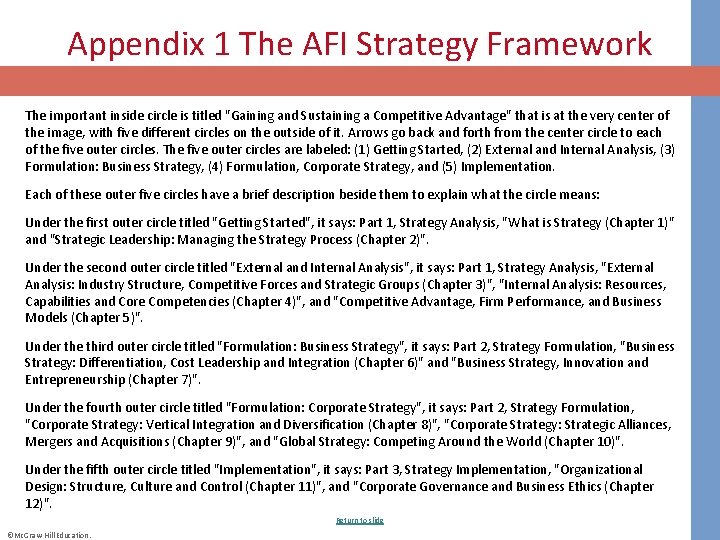
Appendix 1 The AFI Strategy Framework The important inside circle is titled "Gaining and Sustaining a Competitive Advantage" that is at the very center of the image, with five different circles on the outside of it. Arrows go back and forth from the center circle to each of the five outer circles. The five outer circles are labeled: (1) Getting Started, (2) External and Internal Analysis, (3) Formulation: Business Strategy, (4) Formulation, Corporate Strategy, and (5) Implementation. Each of these outer five circles have a brief description beside them to explain what the circle means: Under the first outer circle titled "Getting Started", it says: Part 1, Strategy Analysis, "What is Strategy (Chapter 1)" and "Strategic Leadership: Managing the Strategy Process (Chapter 2)". Under the second outer circle titled "External and Internal Analysis", it says: Part 1, Strategy Analysis, "External Analysis: Industry Structure, Competitive Forces and Strategic Groups (Chapter 3)", "Internal Analysis: Resources, Capabilities and Core Competencies (Chapter 4)", and "Competitive Advantage, Firm Performance, and Business Models (Chapter 5)". Under the third outer circle titled "Formulation: Business Strategy", it says: Part 2, Strategy Formulation, "Business Strategy: Differentiation, Cost Leadership and Integration (Chapter 6)" and "Business Strategy, Innovation and Entrepreneurship (Chapter 7)". Under the fourth outer circle titled "Formulation: Corporate Strategy", it says: Part 2, Strategy Formulation, "Corporate Strategy: Vertical Integration and Diversification (Chapter 8)", "Corporate Strategy: Strategic Alliances, Mergers and Acquisitions (Chapter 9)", and "Global Strategy: Competing Around the World (Chapter 10)". Under the fifth outer circle titled "Implementation", it says: Part 3, Strategy Implementation, "Organizational Design: Structure, Culture and Control (Chapter 11)", and "Corporate Governance and Business Ethics (Chapter 12)". Return to slide ©Mc. Graw-Hill Education.
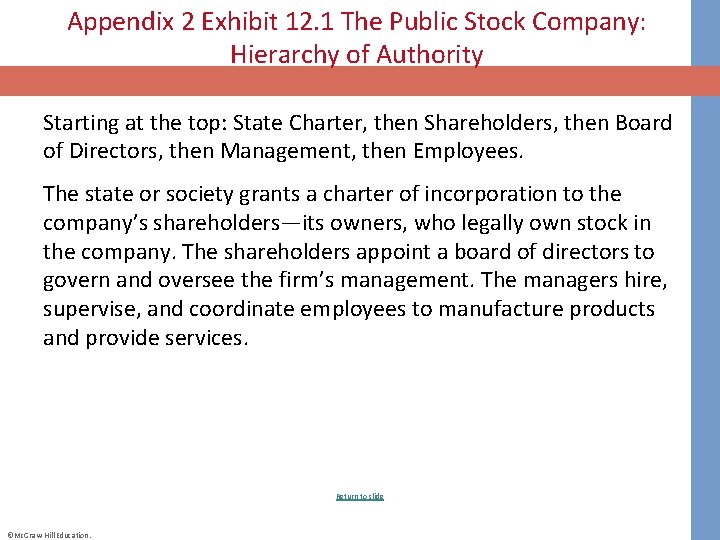
Appendix 2 Exhibit 12. 1 The Public Stock Company: Hierarchy of Authority Starting at the top: State Charter, then Shareholders, then Board of Directors, then Management, then Employees. The state or society grants a charter of incorporation to the company’s shareholders—its owners, who legally own stock in the company. The shareholders appoint a board of directors to govern and oversee the firm’s management. The managers hire, supervise, and coordinate employees to manufacture products and provide services. Return to slide ©Mc. Graw-Hill Education.
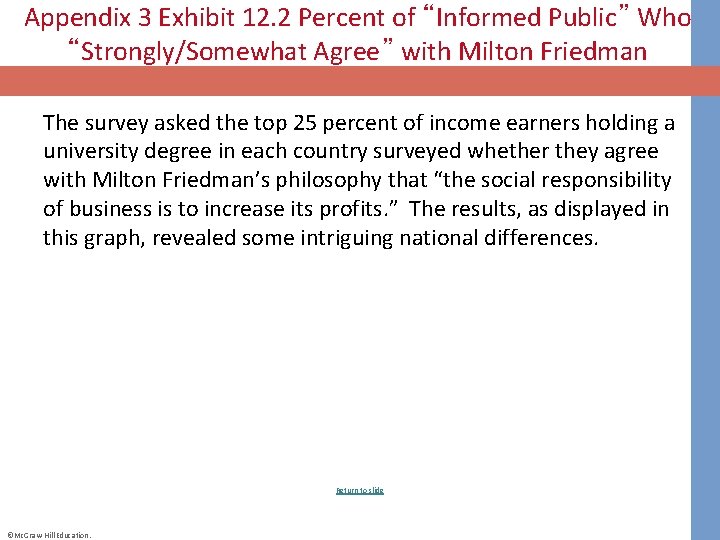
Appendix 3 Exhibit 12. 2 Percent of “Informed Public” Who “Strongly/Somewhat Agree” with Milton Friedman The survey asked the top 25 percent of income earners holding a university degree in each country surveyed whether they agree with Milton Friedman’s philosophy that “the social responsibility of business is to increase its profits. ” The results, as displayed in this graph, revealed some intriguing national differences. Return to slide ©Mc. Graw-Hill Education.
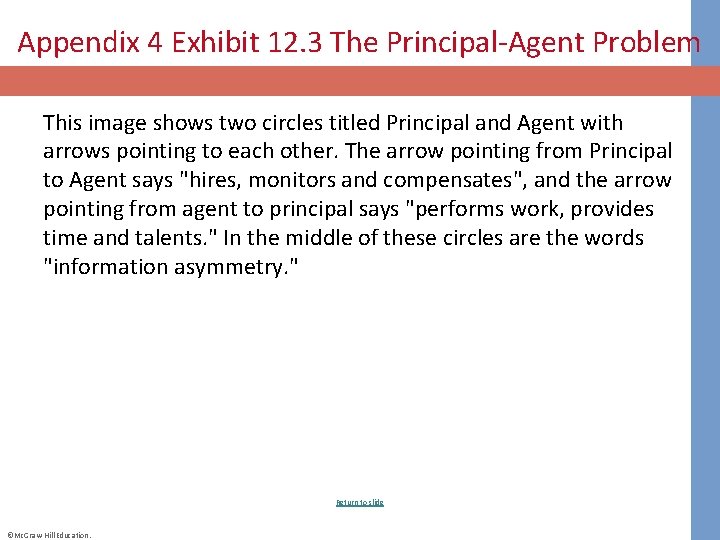
Appendix 4 Exhibit 12. 3 The Principal-Agent Problem This image shows two circles titled Principal and Agent with arrows pointing to each other. The arrow pointing from Principal to Agent says "hires, monitors and compensates", and the arrow pointing from agent to principal says "performs work, provides time and talents. " In the middle of these circles are the words "information asymmetry. " Return to slide ©Mc. Graw-Hill Education.
- Slides: 65