
Chapter 12 Comparative Reasoning Think This is Like


- Slides: 15
Chapter 12 Comparative Reasoning Think “This is Like That” © 2013 Pearson Education, Inc. All rights reserved.
Comparative, Ideological, and Empirical Inferences • Comparative reasoning (or this-is-like-that thinking) enables us to: – Make interpretations, draw inferences, or offer explanations by relying on something that is: • More familiar in order to understand something that is less familiar © 2013 Pearson Education, Inc. All rights reserved.
“This Is Like That”—Recognizing Comparative Reasoning • Gardens of Comparatives – People cultivate an exceptional variety of ways to express comparative reasoning – Most comparative reasoning doesn’t appear as a fully developed argument: • With reasons and claims © 2013 Pearson Education, Inc. All rights reserved.
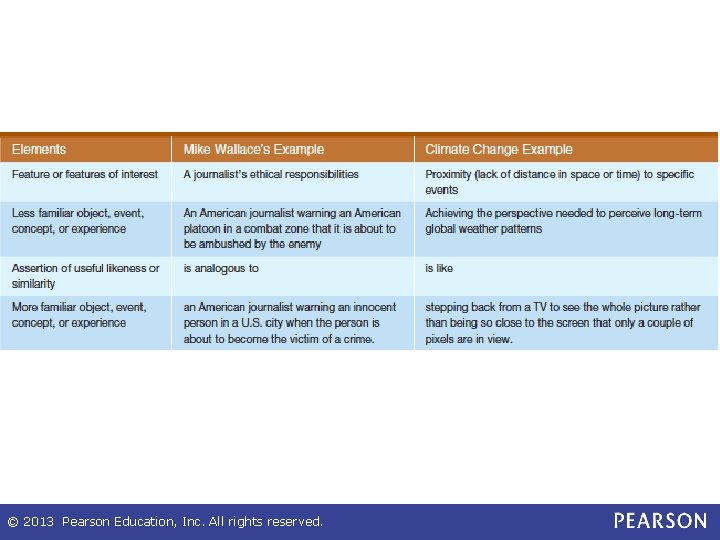
“This Is Like That”—Recognizing Comparative Reasoning • Powerful Comparisons Connect Intellect and Emotion – Knowing that vivid comparisons can move hearts as well as minds, speechwriters: • Strive to associate their ideas with memorable comparisons as these next two examples illustrate © 2013 Pearson Education, Inc. All rights reserved.
© 2013 Pearson Education, Inc. All rights reserved.
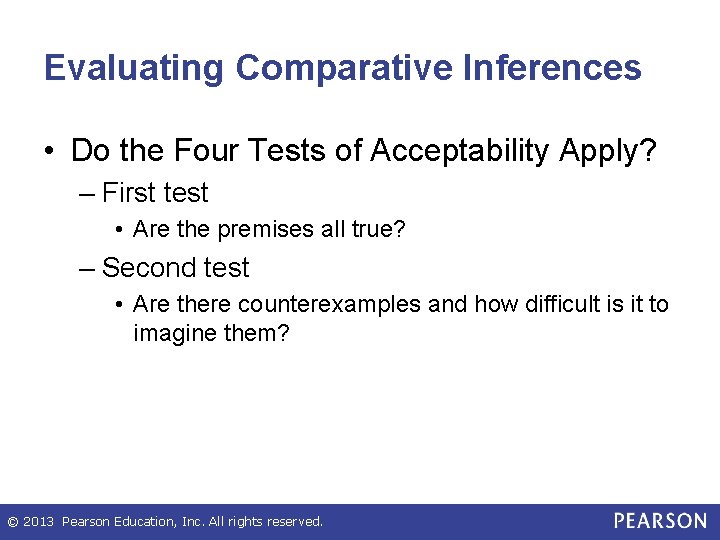
Evaluating Comparative Inferences • Do the Four Tests of Acceptability Apply? – First test • Are the premises all true? – Second test • Are there counterexamples and how difficult is it to imagine them? © 2013 Pearson Education, Inc. All rights reserved.
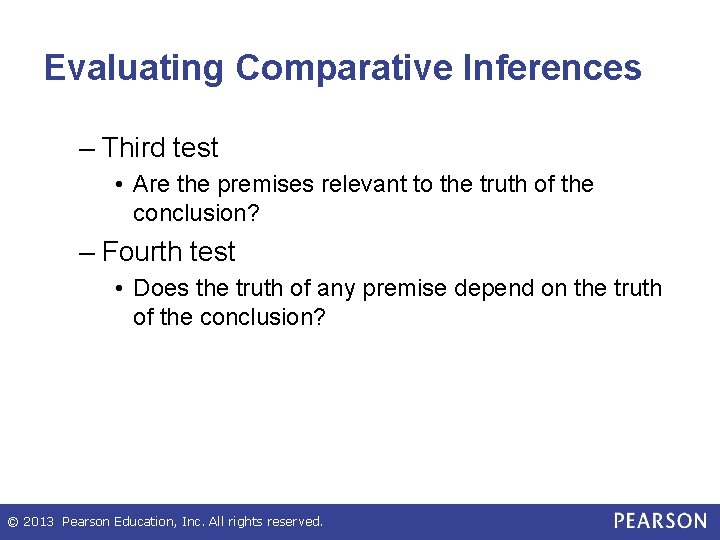
Evaluating Comparative Inferences – Third test • Are the premises relevant to the truth of the conclusion? – Fourth test • Does the truth of any premise depend on the truth of the conclusion? © 2013 Pearson Education, Inc. All rights reserved.
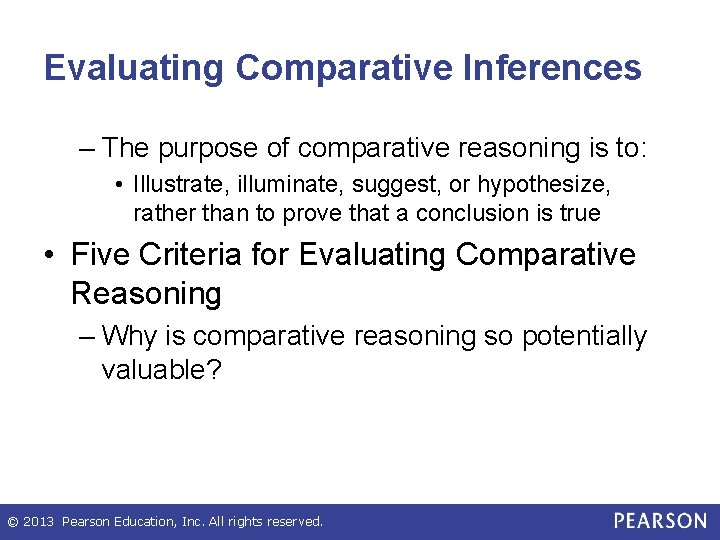
Evaluating Comparative Inferences – The purpose of comparative reasoning is to: • Illustrate, illuminate, suggest, or hypothesize, rather than to prove that a conclusion is true • Five Criteria for Evaluating Comparative Reasoning – Why is comparative reasoning so potentially valuable? © 2013 Pearson Education, Inc. All rights reserved.
Evaluating Comparative Inferences – If the comparison is reasonable, then some salient feature of the more familiar object is: • Also a salient feature of the less familiar object – Comparative inferences, including analogical arguments, are inductive and probabilistic – Familiarity © 2013 Pearson Education, Inc. All rights reserved.
Evaluating Comparative Inferences • Successful comparisons direct the listener’s attention to that which is more familiar – Simplicity • A measure of the relative complexity of the comparison • Simpler comparisons are often more readily understood and remembered © 2013 Pearson Education, Inc. All rights reserved.
Evaluating Comparative Inferences – Comprehensiveness • The virtue of simplicity must be balanced with the importance of comprehensiveness – Productivity • The capacity of a comparison to bring to mind unexpected new ideas that go: – Beyond the points of comparison initially mentioned © 2013 Pearson Education, Inc. All rights reserved.
Evaluating Comparative Inferences – Testability • The capacity of a comparison to project consequences that have: – The potential to be shown to be false, inapplicable, or unacceptable • The criterion of testability enables us to evaluate the acceptability of a proposed comparison © 2013 Pearson Education, Inc. All rights reserved.
Evaluating Comparative Inferences • Shaping Our View of the Universe for Two Thousand Years • The Many Uses of Comparative Inferences – Comparative reasoning is used in discussions of ethics: • Such as to compare cases and infer obligations © 2013 Pearson Education, Inc. All rights reserved.
Evaluating Comparative Inferences – The basic character of the appeal to precedent is the assertion that: • The case in question is so much like the prior case that the ruling that applied there should apply here – A comparison’s persuasive power depends heavily on the suggested parallelism – Simplicity and Hypothetical Entities © 2013 Pearson Education, Inc. All rights reserved.
© 2013 Pearson Education, Inc. All rights reserved.