
Chapter 12 Cognitive Development in SchoolAge Children 12
- Slides: 30
Chapter 12: Cognitive Development in School-Age Children 12. 1 Cognitive Processes 12. 2 The Nature of Intelligence 12. 3 Individual Differences in Intellectual Skills 12. 4 Academic Skills 12. 5 Effective Schools Copyright © 2005 Pearson Education Canada Inc. 1
12. 1 Cognitive Processes Concrete Operational Thinking Memory Skills Copyright © 2005 Pearson Education Canada Inc. 2
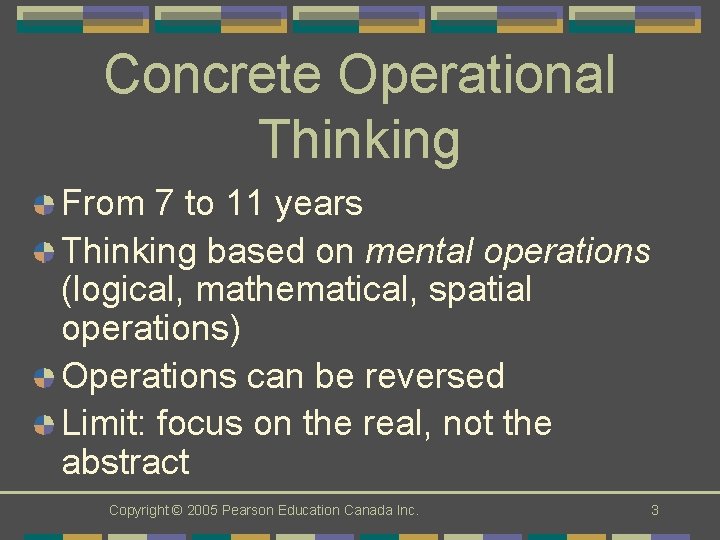
Concrete Operational Thinking From 7 to 11 years Thinking based on mental operations (logical, mathematical, spatial operations) Operations can be reversed Limit: focus on the real, not the abstract Copyright © 2005 Pearson Education Canada Inc. 3
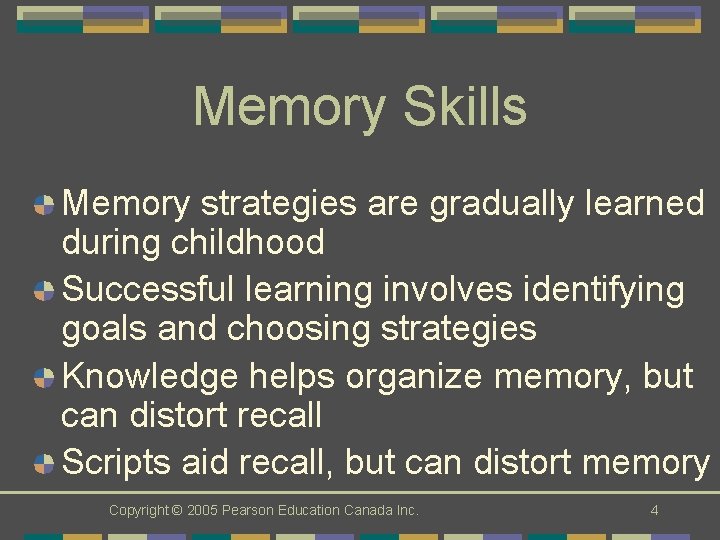
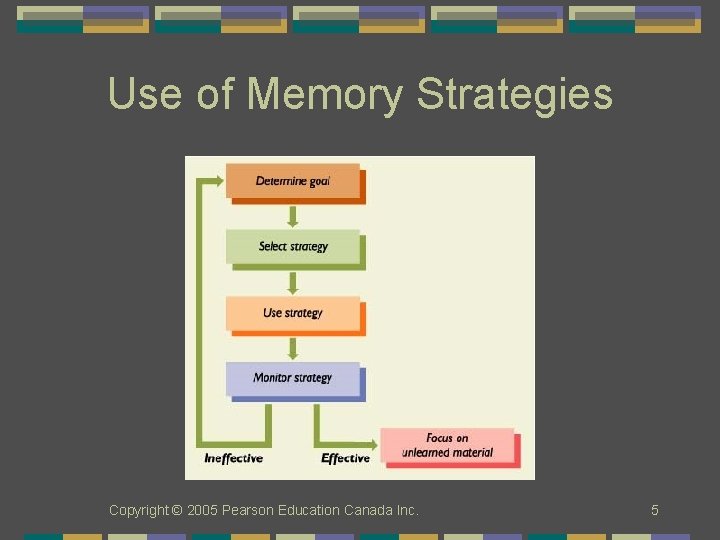
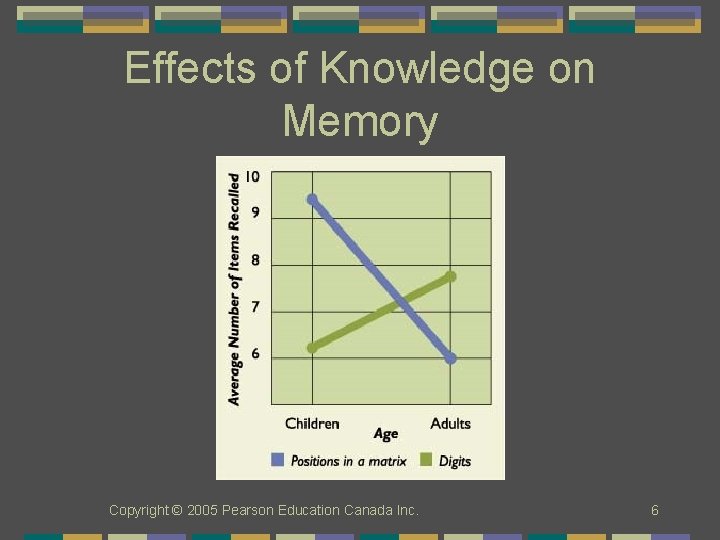
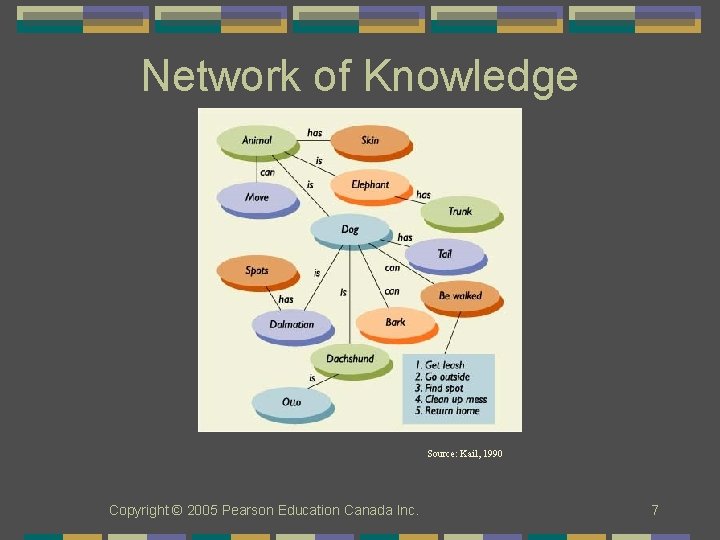
Memory Skills Memory strategies are gradually learned during childhood Successful learning involves identifying goals and choosing strategies Knowledge helps organize memory, but can distort recall Scripts aid recall, but can distort memory Copyright © 2005 Pearson Education Canada Inc. 4
Use of Memory Strategies Copyright © 2005 Pearson Education Canada Inc. 5
Effects of Knowledge on Memory Copyright © 2005 Pearson Education Canada Inc. 6
Network of Knowledge Source: Kail, 1990 Copyright © 2005 Pearson Education Canada Inc. 7
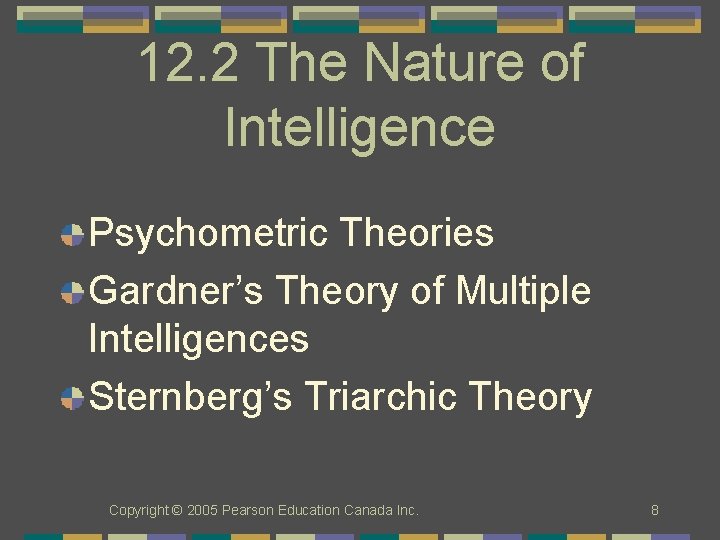
12. 2 The Nature of Intelligence Psychometric Theories Gardner’s Theory of Multiple Intelligences Sternberg’s Triarchic Theory Copyright © 2005 Pearson Education Canada Inc. 8
Psychometric Theories Use patterns of test performance as starting point Test scores provide evidence for general intelligence (g) and specific intelligences Hierarchical theories are a compromise between general and specific theories Copyright © 2005 Pearson Education Canada Inc. 9
Gardner’s Theory of Multiple Intelligences Instead of using test scores, draws upon research in child development, brain-injured persons, and exceptional talent Proposes 7 intelligences: linguistic, logicalmathematical, spatial, musical, bodilykinesthetic, interpersonal, intrapersonal Copyright © 2005 Pearson Education Canada Inc. 10
Sternberg’s Triarchic Theory Contextual subtheory--intelligence involves skillful adaptation to a specific environment Experiential subtheory--on novel tasks, intelligence is shown by readily applying pertinent knowledge; on familiar tasks, by solving them automatically Componential subtheory--any intelligent act consists of cognitive components Copyright © 2005 Pearson Education Canada Inc. 11
12. 3 Individual Differences in Intellectual Skills Binet and the Development of Intelligence Testing Do Tests Work? Hereditary and Environmental Factors Impact of Ethnicity and Social Class Gender Differences in Intellectual Abilities and Achievement Copyright © 2005 Pearson Education Canada Inc. 12
Binet and the Development of Intelligence Testing Binet used mental age to distinguish “bright” from “dull” Led to the Stanford-Binet which gives a single IQ score; average = 100 WISC, devised in the 1930 s, gives verbal and performance IQs Copyright © 2005 Pearson Education Canada Inc. 13
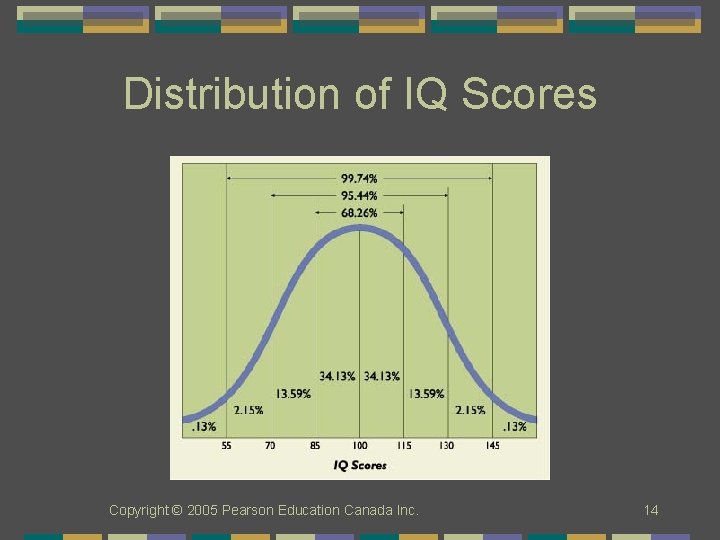
Distribution of IQ Scores Copyright © 2005 Pearson Education Canada Inc. 14
Do Tests Work? Are they reliable? In the short term, yes. In the longer term, less so. Are they valid? Yes, as long as validity is defined as success in school Validity can be increased with dynamic testing Copyright © 2005 Pearson Education Canada Inc. 15
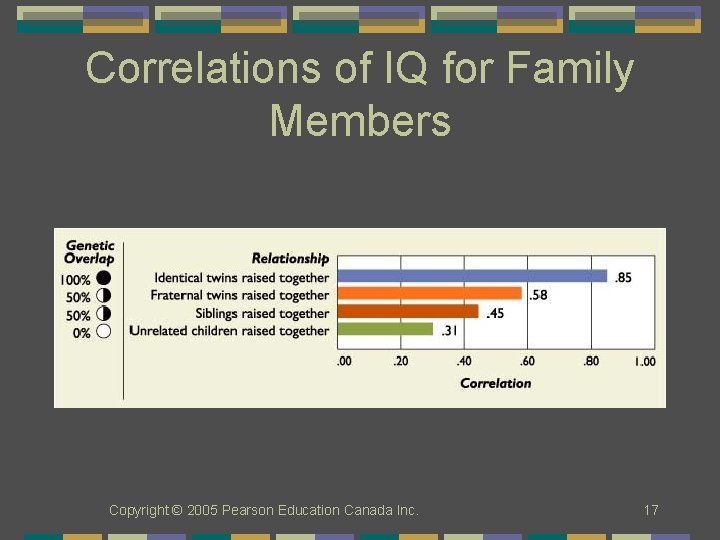
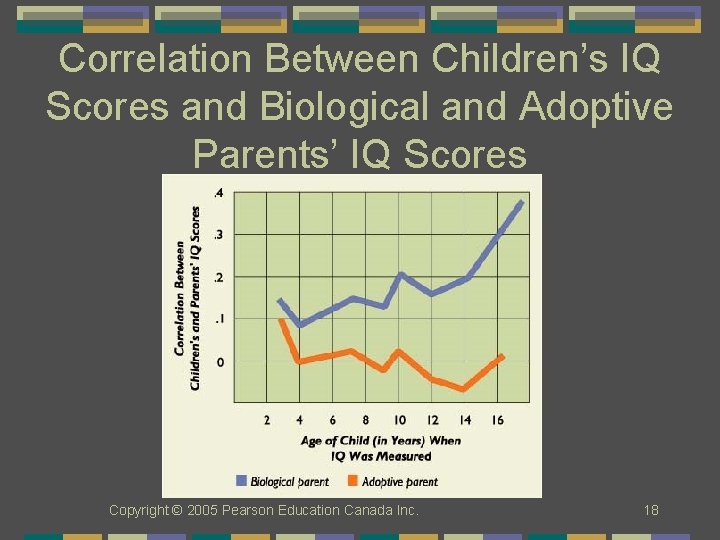
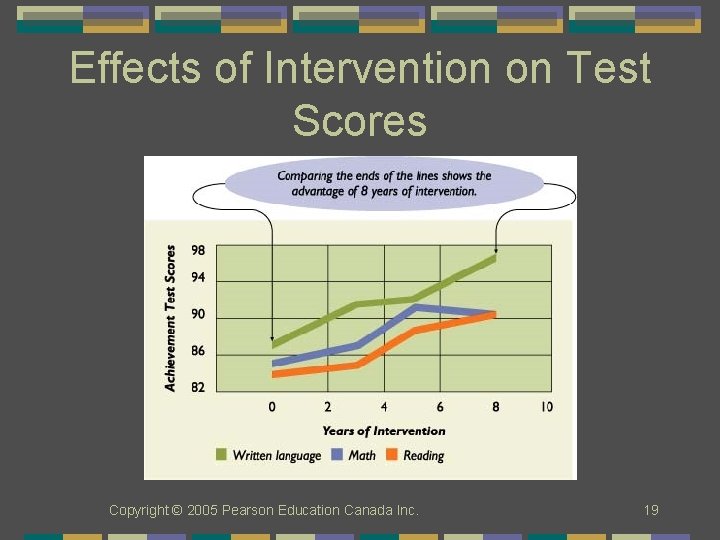
Hereditary and Environmental Factors Effects of heredity shown in family studies and effects of environment shown in intervention studies (e. g. , Carolina Abecedarian Project) Heredity also influences patterns of intellectual development (twins, adoptees) Copyright © 2005 Pearson Education Canada Inc. 16
Correlations of IQ for Family Members Copyright © 2005 Pearson Education Canada Inc. 17
Correlation Between Children’s IQ Scores and Biological and Adoptive Parents’ IQ Scores Copyright © 2005 Pearson Education Canada Inc. 18
Effects of Intervention on Test Scores Copyright © 2005 Pearson Education Canada Inc. 19
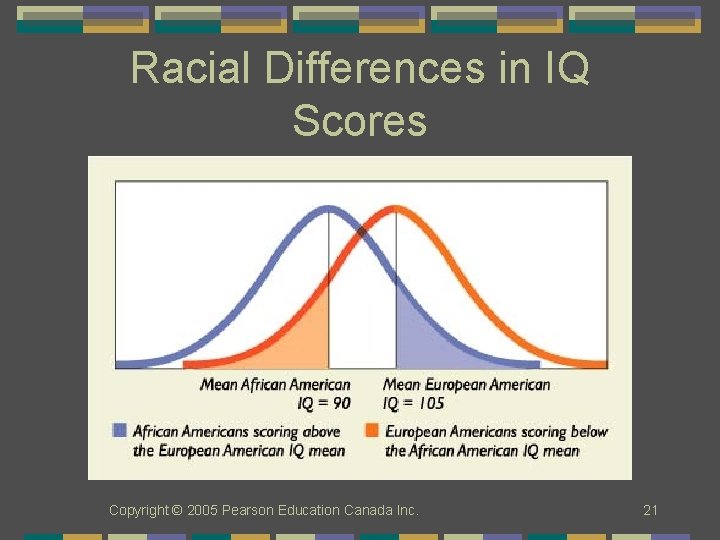
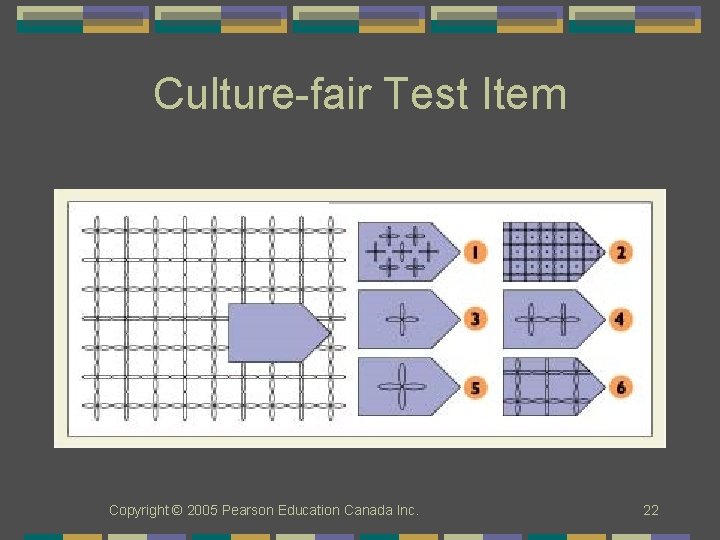
Impact of Ethnicity and Social Class Middle-class, white children tend to get higher scores Culture-fair intelligence tests reduce the difference but don’t eliminate it Test-taking styles must be taken into consideration Copyright © 2005 Pearson Education Canada Inc. 20
Racial Differences in IQ Scores Copyright © 2005 Pearson Education Canada Inc. 21
Culture-fair Test Item Copyright © 2005 Pearson Education Canada Inc. 22
Gender Differences in Intellectual Ability… Verbal ability: girls excel at reading & writing, less likely to have languagerelated disability Spatial ability: boys surpass girls Math: girls often get better grades, but boys have higher test scores Copyright © 2005 Pearson Education Canada Inc. 23
12. 4 Academic Skills Reading Skills Writing Skills Math Skills Copyright © 2005 Pearson Education Canada Inc. 24
Reading Skills Prereading skills: knowing letters and letter sounds Sounding out and whole word recognition used in reading Changes in working memory, knowledge, monitoring, and reading strategies improve comprehension Copyright © 2005 Pearson Education Canada Inc. 25
Writing Skills Older writers have more to tell Older writers know how to organize their writing (knowledge telling vs knowledge transforming strategies) Older writers are better able to deal with the mechanical requirements of writing Older writers are better able to revise Copyright © 2005 Pearson Education Canada Inc. 26
Math Skills Children use many different strategies to add and subtract Compared to students in other countries, North American students rank lower (in some cases, much lower) In other countries, children spend more time in school, have more homework, parents have higher standards, & parents emphasize effort Copyright © 2005 Pearson Education Canada Inc. 27
12. 5 Effective Schools School-Based Influences on Student Achievement Teacher-Based Influences on Students Achievement Copyright © 2005 Pearson Education Canada Inc. 28
School-Based Influences on Student Achievement Schools are successful when they emphasize academic excellence Are safe and nurturing Involve parents Monitor progress of students, teachers, and programs Copyright © 2005 Pearson Education Canada Inc. 29
Teacher-Based Influences on Student Achievement Students learn when teachers manage classrooms effectively Are responsible for students’ learning Emphasize mastery of topics Teach actively and pay attention to pacing Value tutoring and teach techniques for monitoring own learning Copyright © 2005 Pearson Education Canada Inc. 30