
Chapter 12 Chemical Bonding CHM 130 GCC Chemistry
Chapter 12: Chemical Bonding CHM 130 GCC Chemistry
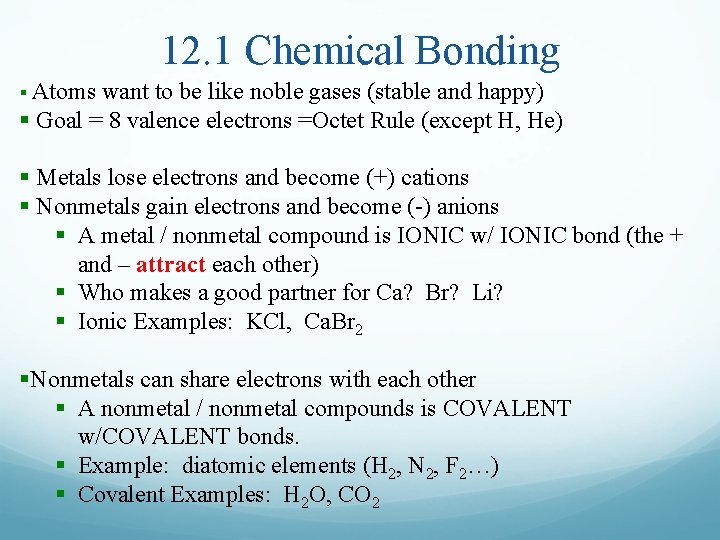
12. 1 Chemical Bonding § Atoms want to be like noble gases (stable and happy) § Goal = 8 valence electrons =Octet Rule (except H, He) § Metals lose electrons and become (+) cations § Nonmetals gain electrons and become (-) anions § A metal / nonmetal compound is IONIC w/ IONIC bond (the + and – attract each other) § Who makes a good partner for Ca? Br? Li? § Ionic Examples: KCl, Ca. Br 2 §Nonmetals can share electrons with each other § A nonmetal / nonmetal compounds is COVALENT w/COVALENT bonds. § Example: diatomic elements (H 2, N 2, F 2…) § Covalent Examples: H 2 O, CO 2
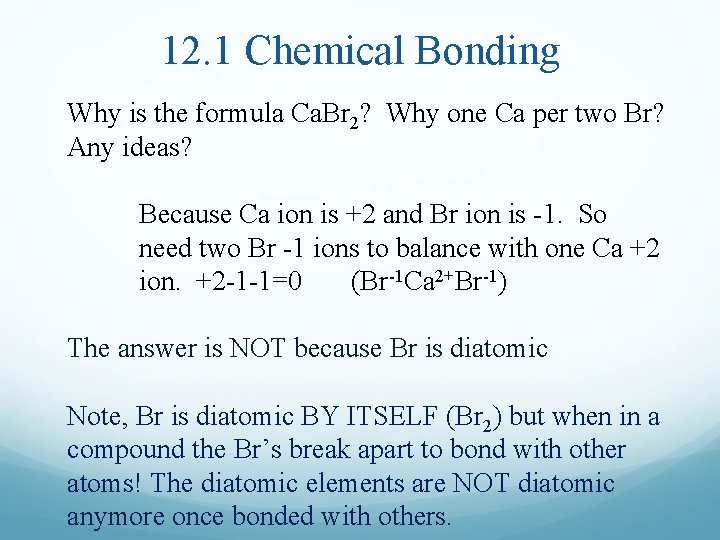
12. 1 Chemical Bonding Why is the formula Ca. Br 2? Why one Ca per two Br? Any ideas? Because Ca ion is +2 and Br ion is -1. So need two Br -1 ions to balance with one Ca +2 ion. +2 -1 -1=0 (Br-1 Ca 2+Br-1) The answer is NOT because Br is diatomic Note, Br is diatomic BY ITSELF (Br 2) but when in a compound the Br’s break apart to bond with other atoms! The diatomic elements are NOT diatomic anymore once bonded with others.
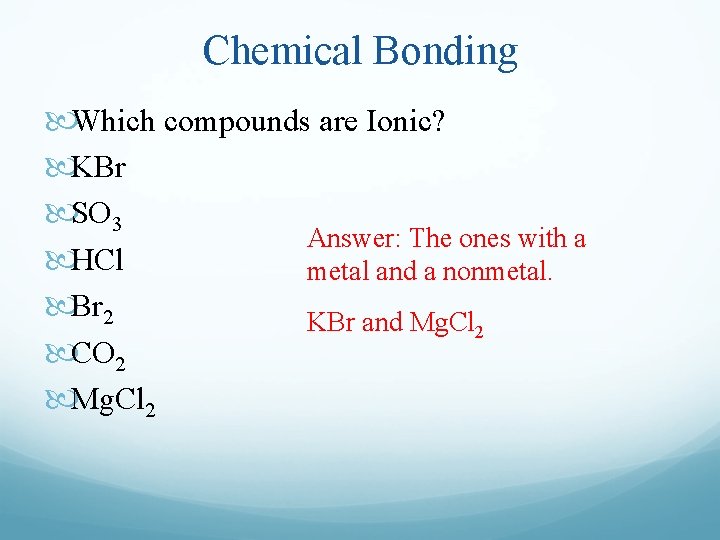
Chemical Bonding Which compounds are Ionic? KBr SO 3 Answer: The ones with a HCl metal and a nonmetal. Br 2 KBr and Mg. Cl 2 CO 2 Mg. Cl 2
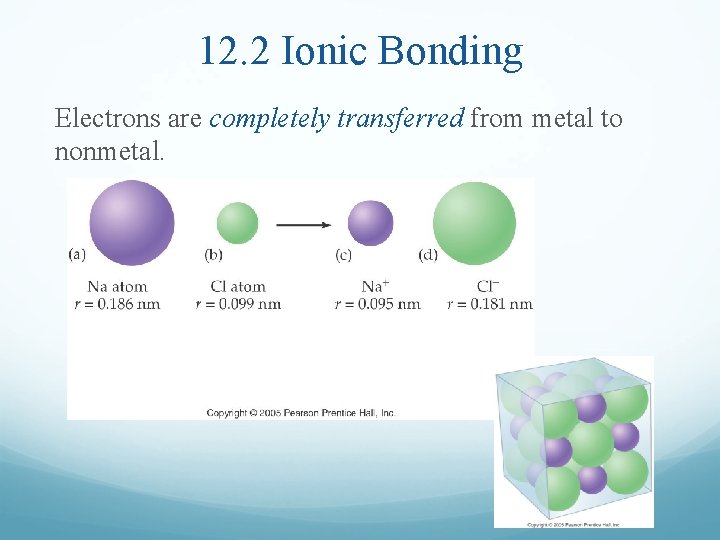
12. 2 Ionic Bonding Electrons are completely transferred from metal to nonmetal.
Ionic Bonding Draw electron dot structures for Mg and S atoms then Mg 2+ and S 2 - ions in Mg. S. How many protons and electrons in Mg 2+ and S 2 - ions? Notice that Mg 2+ and S 2 - are “like” noble gases. They are isoelectronic with Ne and Ar, and that is what makes them happy and stable. While the number of electrons changed, the number of protons did NOT. # Protons never change in chemical reactions.
Ionic Radius Cations have lost electrons, so there are more protons, so they pull the electron orbits in closer to nucleus (smaller than the atom) Anions have gained electrons, so there are more electrons; electrons repel and push orbits farther from nucleus (larger than the atom)
Ionic Radius Are the following statements True or False regarding an ionic bond between aluminum and iodine? 1. The aluminum atom loses electrons, and the iodine True atom gains electrons. 2. The aluminum atom is larger in radius than the True aluminum ion. 3. The iodine atom is smaller in radius than the iodide True ion. 4. The aluminum and iodide ions form a bond by True attraction.
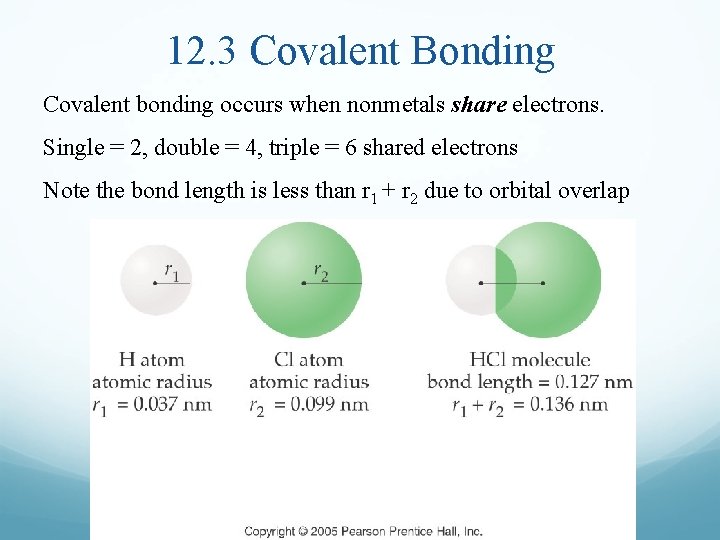
12. 3 Covalent Bonding Covalent bonding occurs when nonmetals share electrons. Single = 2, double = 4, triple = 6 shared electrons Note the bond length is less than r 1 + r 2 due to orbital overlap
Bond Energy (B. E. ) • B. E. = Energy required to break a bond. • Breaking bonds always requires energy. • Energy is a reactant; it is absorbed. Endothermic • Processes that absorb energy are called: _____ • Forming bonds always releases energy • Energy is a product; it is released. Exothermic • Processes that release energy are called: _____ HCl (g) + heat H (g) + Cl (g) HCl (g) + heat
Bond Energy (B. E. ) Are the following statements True or False regarding an ionic bond between hydrogen and sulfur? 1. Electrons are shared in H 2 S. True 2. The bond between H and S is ionic. False 3. The H-S bond length is less than the sum of the two atomic radii. True 4. Breaking the H-S bond releases energy. False
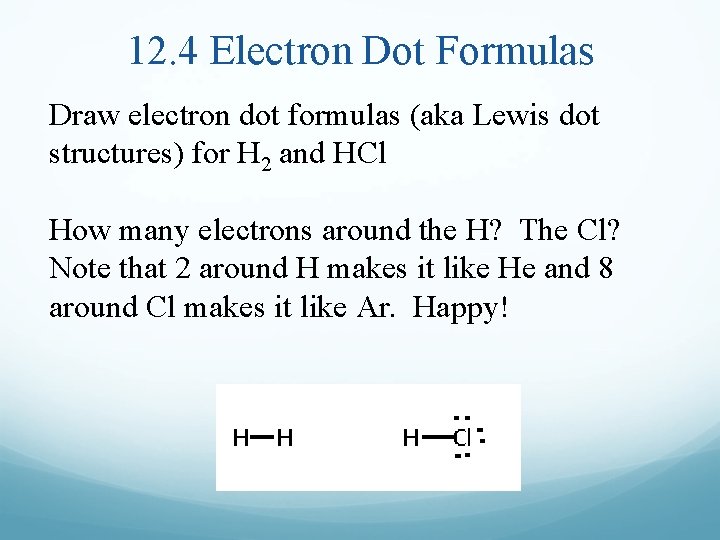
12. 4 Electron Dot Formulas Draw electron dot formulas (aka Lewis dot structures) for H 2 and HCl How many electrons around the H? The Cl? Note that 2 around H makes it like He and 8 around Cl makes it like Ar. Happy!
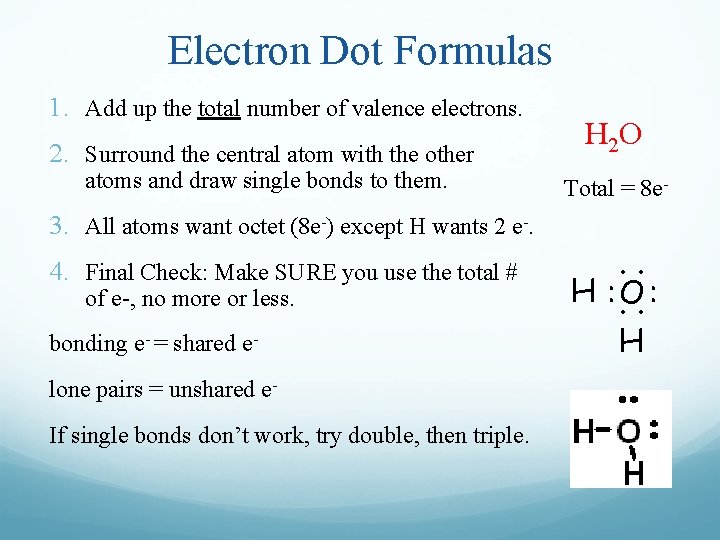
Electron Dot Formulas 1. Add up the total number of valence electrons. 2. Surround the central atom with the other atoms and draw single bonds to them. 3. All atoms want octet (8 e-) except H wants 2 e-. 4. Final Check: Make SURE you use the total # of e-, no more or less. bonding e- = shared elone pairs = unshared e. If single bonds don’t work, try double, then triple. H 2 O Total = 8 e- . . H : O. . : H
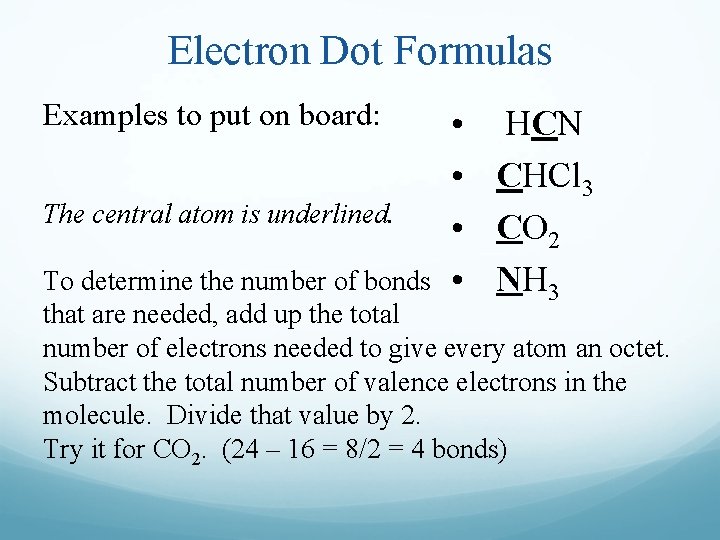
Electron Dot Formulas Examples to put on board: The central atom is underlined. • HCN • CHCl 3 • CO 2 • NH 3 To determine the number of bonds that are needed, add up the total number of electrons needed to give every atom an octet. Subtract the total number of valence electrons in the molecule. Divide that value by 2. Try it for CO 2. (24 – 16 = 8/2 = 4 bonds)
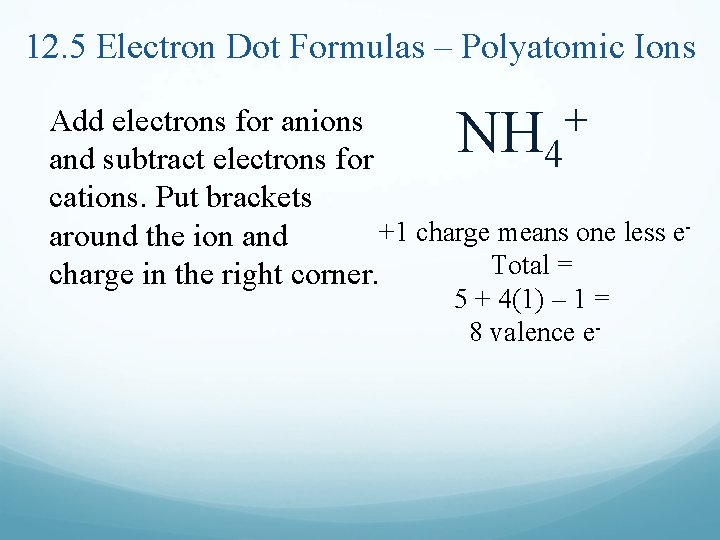
12. 5 Electron Dot Formulas – Polyatomic Ions NH Add electrons for anions + 4 and subtract electrons for cations. Put brackets +1 charge means one less earound the ion and Total = charge in the right corner. 5 + 4(1) – 1 = 8 valence e-
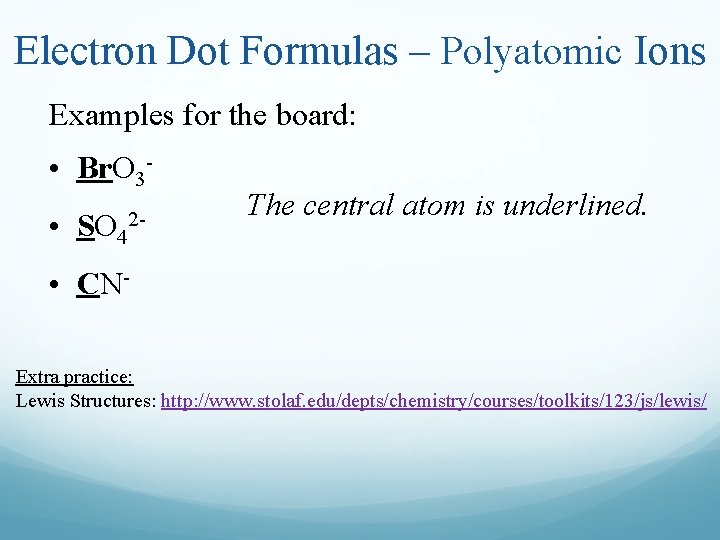
Electron Dot Formulas – Polyatomic Ions Examples for the board: • Br. O 3 • SO 42 - The central atom is underlined. • CNExtra practice: Lewis Structures: http: //www. stolaf. edu/depts/chemistry/courses/toolkits/123/js/lewis/
12. 10 Valence Shell Electron Pair Repulsion - VSEPR • Electron pairs (bonded and lone pairs) repel each other and move as far away from each other as possible. (like charges repel) • Molecular Shape or Geometry – the 3 D arrangement of atoms in a molecule. • Print out Shape Table from the web page
Electron Dot Formulas - Practice Draw Lewis Structures for the following molecules (central atom is underlined). HCN CO 2 CH 2 O SO 2 CH 4 NH 4+ NH 3 H 2 O
12. 4 Electron Dot Formulas How do you know if you need double or triple bonds? 1) Can use trial and error: • Give every atom an octet and count electrons. If more than the total valence electrons, try a double bond. 2) Can use a formula to calculate number of bonds: • # bonds in molecule = # e- needed to give every atom (except H) octet - Total # valence electrons; divide by 2 for number of bonds. (Try CO 2, CH 2 O)
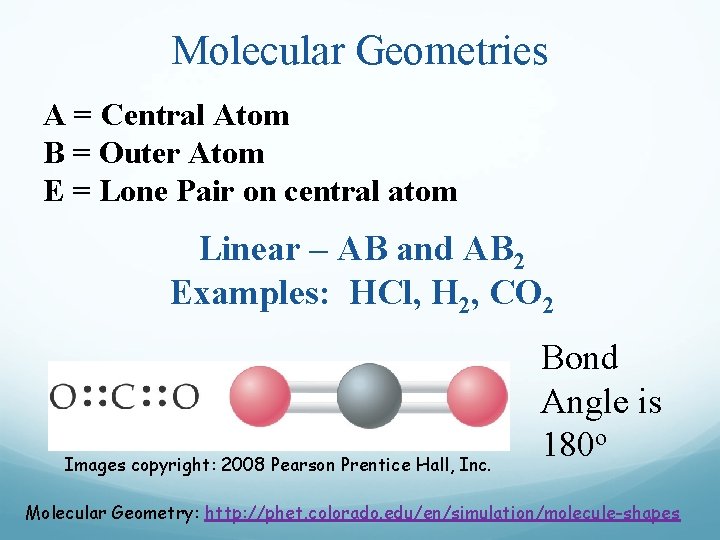
Molecular Geometries A = Central Atom B = Outer Atom E = Lone Pair on central atom Linear – AB and AB 2 Examples: HCl, H 2, CO 2 Images copyright: 2008 Pearson Prentice Hall, Inc. Bond Angle is 180 o Molecular Geometry: http: //phet. colorado. edu/en/simulation/molecule-shapes
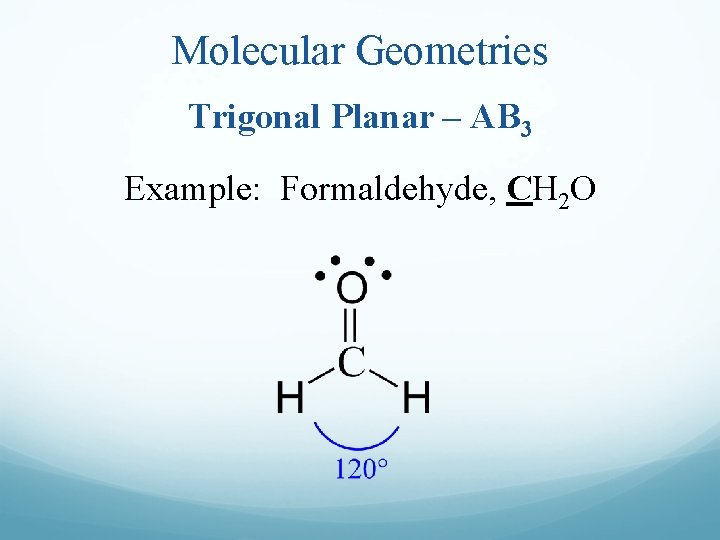
Molecular Geometries Trigonal Planar – AB 3 Example: Formaldehyde, CH 2 O
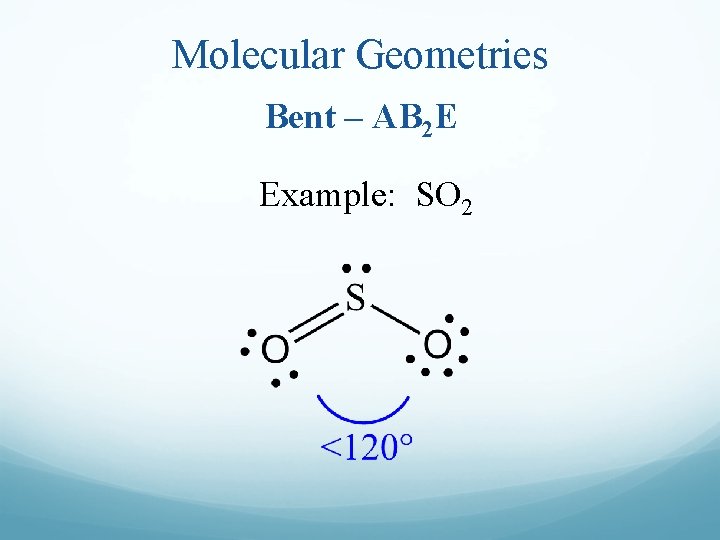
Molecular Geometries Bent – AB 2 E Example: SO 2
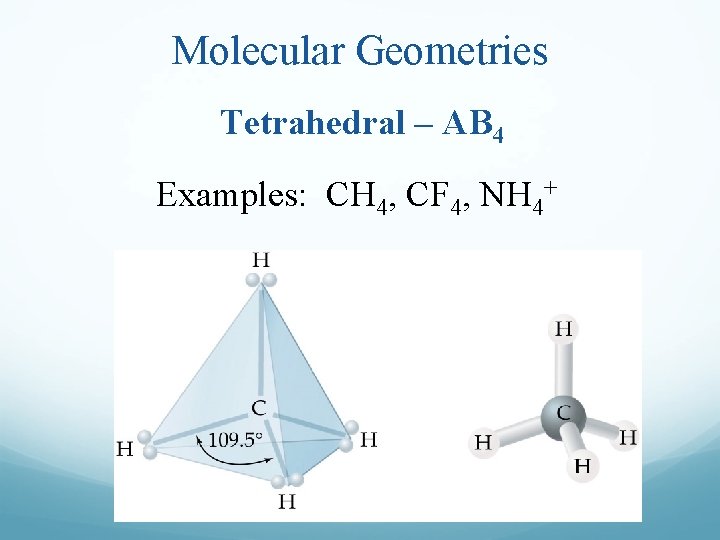
Molecular Geometries Tetrahedral – AB 4 Examples: CH 4, CF 4, NH 4+
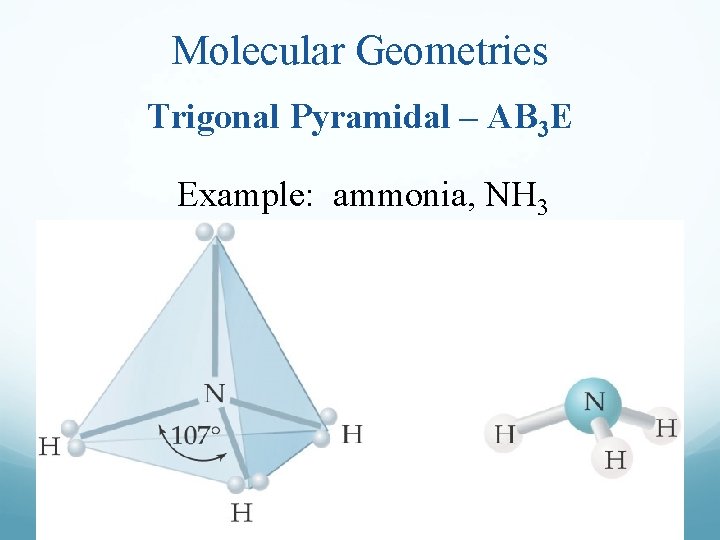
Molecular Geometries Trigonal Pyramidal – AB 3 E Example: ammonia, NH 3
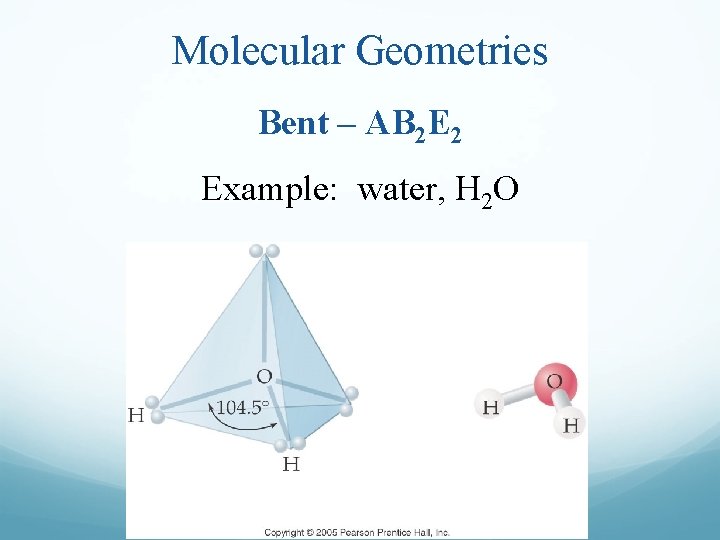
Molecular Geometries Bent – AB 2 E 2 Example: water, H 2 O
Summary Given the formula of any molecule or polyatomic ion you should be able to Draw the Electron dot structure Determine the shape and bond angles Get used to the Table of Shapes online – you will get to use it on the exam over this chapter!!! Practice: PH 3 and ozone O 3
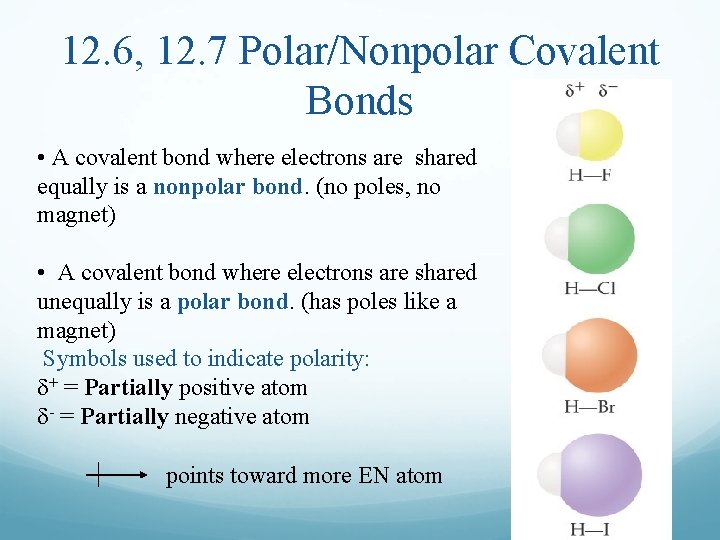
12. 6, 12. 7 Polar/Nonpolar Covalent Bonds • A covalent bond where electrons are shared equally is a nonpolar bond. (no poles, no magnet) • A covalent bond where electrons are shared unequally is a polar bond. (has poles like a magnet) Symbols used to indicate polarity: d+ = Partially positive atom d- = Partially negative atom points toward more EN atom
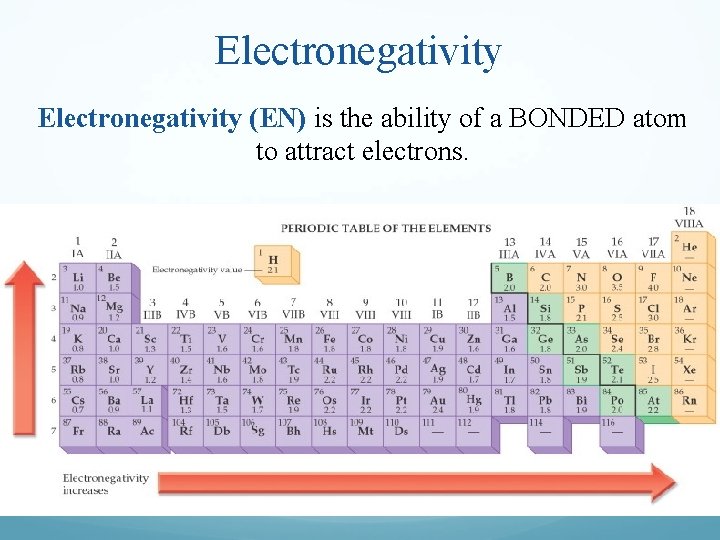
Electronegativity (EN) is the ability of a BONDED atom to attract electrons.
Electronegativity The atoms in ions are completely +1, +2, -3, -2…. Polar bonds make the atoms just a little bit + and (about +0. 001 and -0. 001 - these are called partial charges). So ions are WAY more + and – than polar covalent bonded atoms. Ionic bond Na-Cl is completely +1 and -1. Polar Covalent bond N-F is a little bit d+ and d-. Which atom is which?
Electronegativity Noble Gases don’t have EN. Why? ? Noble gases don’t BOND (very easily)! So values are hard to measure. What is the atom with the highest EN? ? ? F. F pulls electrons closer than anything! F is an electron hog. Nothing holds electrons tighter than F.
Nonpolar Covalent Bonds • When an atom is bonded to itself, that bond is nonpolar because the electrons are shared equally between them. • Diatomic molecules have nonpolar covalent bonds. Examples: H 2, N 2, F 2, O 2, I 2, Cl 2 , Br 2 • Note C and H are about the SAME in EN so also make nonpolar covalent bonds. Examples: C-H bond in CH 4
Polar Covalent Bonds • In general, when two different nonmetal atoms are bonded, the bond is polar because the more EN atom pulls the electrons closer so they are shared unequally. Examples of polar bonds: C-O, H-F, S-F, C-N
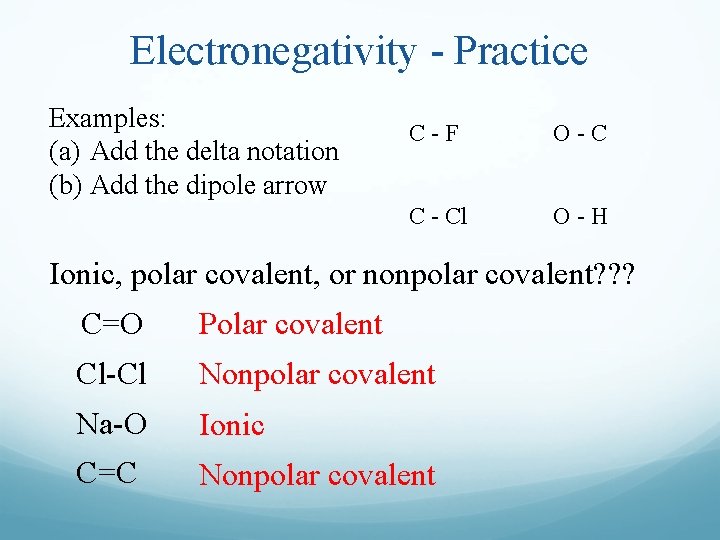
Electronegativity - Practice Examples: (a) Add the delta notation (b) Add the dipole arrow C-F O-C C - Cl O-H Ionic, polar covalent, or nonpolar covalent? ? ? C=O Polar covalent Cl-Cl Nonpolar covalent Na-O Ionic C=C Nonpolar covalent
Polarity Review This is really important and will come up later again and again. Think of this as a tug-of-war for bonded electrons. The more EN atom pulls electrons closer. Since eare negative, that makes the more EN atom a little bit d-. By default the other atom is a little bit d+. The bond is thus polar. If the atoms have the same EN, like C and H, then there is no EN difference and the bond is nonpolar.
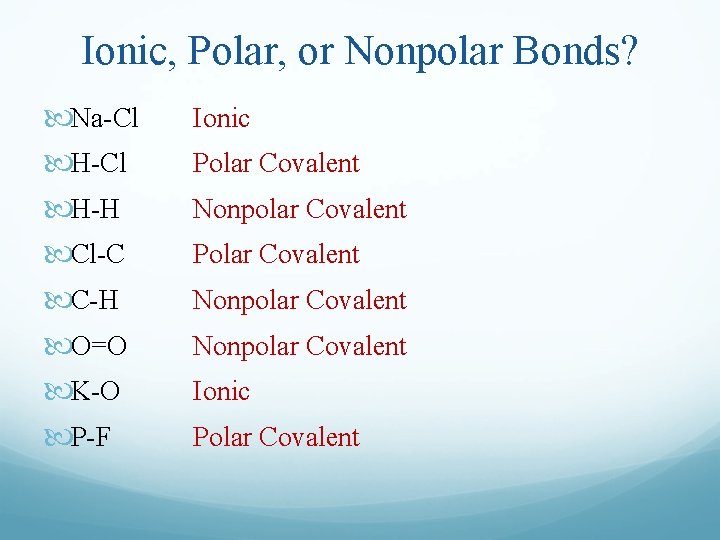
Ionic, Polar, or Nonpolar Bonds? Na-Cl H-H Cl-C C-H O=O K-O P-F Ionic Polar Covalent Nonpolar Covalent Ionic Polar Covalent
Metallic Bonding Pure metals have a freely moving “sea of electrons”. The electrons are shared among all the metal atoms. This is why they conduct heat and electricity so easily.
12. 10 Polarity of Molecules All nonpolar bonds = nonpolar molecule. Polar bonds that do cancel out (symmetrical) = nonpolar molecule. Polar bonds that don’t cancel out (nonsymmetrical) = polar molecule. Molecules with one or two lone electron pairs (e. g. , NH 3). Molecules in which the outer atoms are not the same (e. g. , CF 2 H 2).
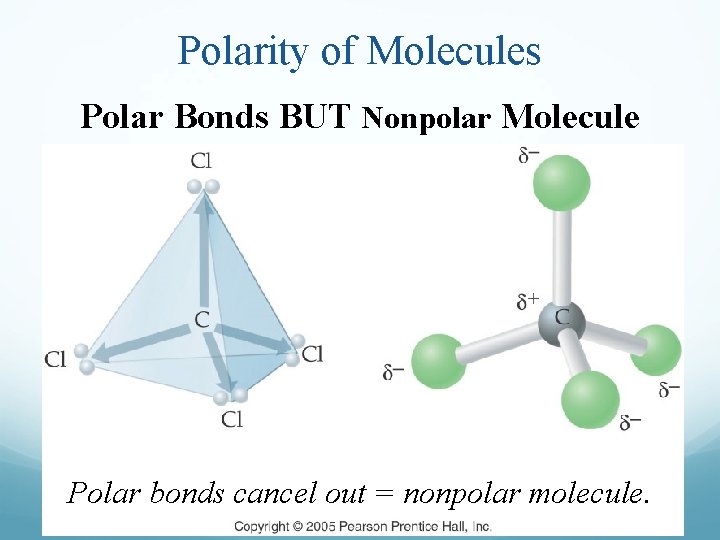
Polarity of Molecules Polar Bonds BUT Nonpolar Molecule Polar bonds cancel out = nonpolar molecule.
Polarity Practice For the following molecules: 1) Draw the electron dot structure, 2) determine shape, 3) determine if bonds are polar and 4) if molecule is polar. Water Ammonia Carbon dioxide We skipped sections 8 and 9 in this chapter!
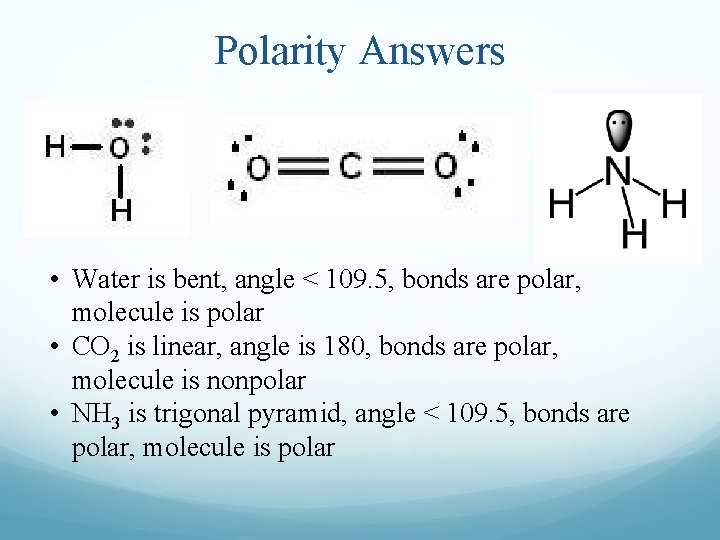
Polarity Answers • Water is bent, angle < 109. 5, bonds are polar, molecule is polar • CO 2 is linear, angle is 180, bonds are polar, molecule is nonpolar • NH 3 is trigonal pyramid, angle < 109. 5, bonds are polar, molecule is polar
Polarity Summary Ionic charges only apply to ionic compounds. Like Na+ Cl- ions in salt. In water, H 2 O, the H is NOT +1 and the O is NOT -2. It is a covalent not ionic compound.
Geometries, Interesting Facts Why care about molecular shape? Well look at what cis-platin can do thanks to its shape! http: //www. youtube. com/watch? v=Wq_up 2 u. QRDo &feature=related Antioxidants and free radicals – what are they? Free radicals are when a molecule has an unpaired electron. They are considered bad for you. http: //www. youtube. com/watch? v=KVyjmt 10 CH 0& feature=related
Chapter 12 Self-Test, p. 373 Try 1 -6, 10, 12, 14 (shape only), 16 -17 (don’t worry about when it says electron geometry, worry about shape) Answers in Appendix J
Chapter 12 Quiz For PF 3 (central atom is underlined), 1) Draw the Lewis Structure 2) Determine the molecular geometry 3) Determine polarity of bonds 4) Determine polarity of the molecule
- Slides: 44