
Chapter 12 Branding Section 12 1 Product Branding
Chapter 12 Branding
Section 12. 1 Product Branding
Learning Objectives • 12. 1 -1 Describe elements of a brand. • 12. 1 -2 Define three types of product brands. Copyright Goodheart-Willcox Co. , Inc. May not be posted to a publicly accessible website.
Key Terms • • • brand name logo trade character tagline jingle metaphor brand promise perception national brand private-label brand generic brand Copyright Goodheart-Willcox Co. , Inc. May not be posted to a publicly accessible website.
Essential Question How do marketers distinguish their brands from the competition? Copyright Goodheart-Willcox Co. , Inc. May not be posted to a publicly accessible website.
Elements of a Brand • A brand is a name, term, or design that sets a product or business apart from its competition – A result of everything a customer sees, hears, and experiences about a company or product – Created through tangible and intangible elements Copyright Goodheart-Willcox Co. , Inc. May not be posted to a publicly accessible website.
Elements of a Brand (Continued) • The tangible elements of a brand are its name, graphic design elements, packaging, and tagline or slogan – Can be seen and heard – Often the first experience a consumer has with a product Copyright Goodheart-Willcox Co. , Inc. May not be posted to a publicly accessible website.
Elements of a Brand (Continued) • Name – A brand name is the name given to a product consisting of words, numbers, or letters that can be read and spoken – Choosing the right one can guide the product strategy and other marketing mix decisions Copyright Goodheart-Willcox Co. , Inc. May not be posted to a publicly accessible website.
Elements of a Brand (Continued) • Graphic design elements – A logo is the picture, design, or graphic image that represents a brand • Also called a brand mark • Can be a symbol or the name of the company or product – A trade character is an animal, a real or fictional person, or an object used to advertise a good or service Copyright Goodheart-Willcox Co. , Inc. May not be posted to a publicly accessible website.
Elements of a Brand (Continued) • Packaging – Should reinforce the brand image – Choices that might affect buying behavior are part of the marketing function – Includes labeling • Some contain safety precautions • Describes the product • Verifies facts, such as contents, nutritional information, and weight • A grade is a rating of the quality of agricultural food products Copyright Goodheart-Willcox Co. , Inc. May not be posted to a publicly accessible website.
Elements of a Brand (Continued) • A tagline is a phrase or sentence that summarizes an essential part of the product or business – Also called a slogan – A tagline or slogan set to music is called a jingle – A metaphor is a word or phrase for one thing used in reference to a very different thing in order to suggest a similarity • A way to enhance the perceived value of a product • Value is the relative worth of something to a person Copyright Goodheart-Willcox Co. , Inc. May not be posted to a publicly accessible website.
Elements of a Brand (Continued) • Intangible elements of a brand include the implied promise of the brand, the consistency of the brand, and customer perceptions of the brand image – Hard to measure – Image is the idea that people have about someone or something Copyright Goodheart-Willcox Co. , Inc. May not be posted to a publicly accessible website.
Elements of a Brand (Continued) • A brand promiseis a statement made by an organization to its customers that tells customers what they can expect from its products • Brand consistency means that the good or service is the same whenever and wherever you buy it • Perception is the mental image a person has about something – Formed from personal experience – Formed by hearing experiences of others – Formed by how a company promotes the brand Copyright Goodheart-Willcox Co. , Inc. May not be posted to a publicly accessible website.
Product Brand Types (Continued) • A national brandis one created by a manufacturer for its own products – Also called a manufacturer’s brand – The most familiar type of brand to consumers – Examples: Ritz and Cover Girl Copyright Goodheart-Willcox Co. , Inc. May not be posted to a publicly accessible website.
Product Brand Types (Continued) • Private-label brandsare products owned by and created specifically for large retailers – Sold by only one retailer – Example: Abercrombie Copyright Goodheart-Willcox Co. , Inc. May not be posted to a publicly accessible website.
Product Brand Types (Continued) • A consumer product that lacks a widely recognized name or logo is a generic brand – Not advertised – Not immediately obvious who manufactures it – Products are made and sold for less Copyright Goodheart-Willcox Co. , Inc. May not be posted to a publicly accessible website.
Section 12. 1 Review 1. What is the difference between the tangible and intangible elements of a brand? The tangible elements of a brand are its name, graphic design elements, packaging, and tagline or slogan. These are the brand elements that can be seen and heard. Intangible elements of a brand include the implied promise of the brand, the consistency of the brand, and customer perceptions of the brand image. Intangible elements are hard to measure because they cannot be seen or heard. Copyright Goodheart-Willcox Co. , Inc. May not be posted to a publicly accessible website.
Section 12. 1 Review (Continued) 2. Identify functions of labeling. The function of label information is to verify facts about the product, such as contents, nutritional information, and weight. Some packaging and labeling contain safety precautions and directions to prevent injury to the user. Copyright Goodheart-Willcox Co. , Inc. May not be posted to a publicly accessible website.
Section 12. 1 Review (Continued) 3. How are perceptions of brand image formed? The perceptions of brand image are formed in three ways: personal experience, hearing the experiences of others, and how a brand is promoted. 4. List three types of product brands. National, private label, and generic. Copyright Goodheart-Willcox Co. , Inc. May not be posted to a publicly accessible website.
Section 12. 1 Review (Continued) 5. Which product brand type is likely the most familiar to consumers? National brands are probably the most familiar to consumers because they are carried by many large and small retail stores. Copyright Goodheart-Willcox Co. , Inc. May not be posted to a publicly accessible website.
Section 12. 2 Brand Identity and Protection
Learning Objectives • 12. 2 -1 Explain brand identity. • 12. 2 -2 Define branding strategies. • 12. 2 -3 Identify ways in which a company can protect its brand. Copyright Goodheart-Willcox Co. , Inc. May not be posted to a publicly accessible website.
Key Terms • • • brand identity brand equity brand loyalty branding strategy brand extension co-branding brand licensing intellectual property trademark service mark Copyright Goodheart-Willcox Co. , Inc. May not be posted to a publicly accessible website.
Essential Question How can brand identity influence consumer buying decisions? Copyright Goodheart-Willcox Co. , Inc. May not be posted to a publicly accessible website.
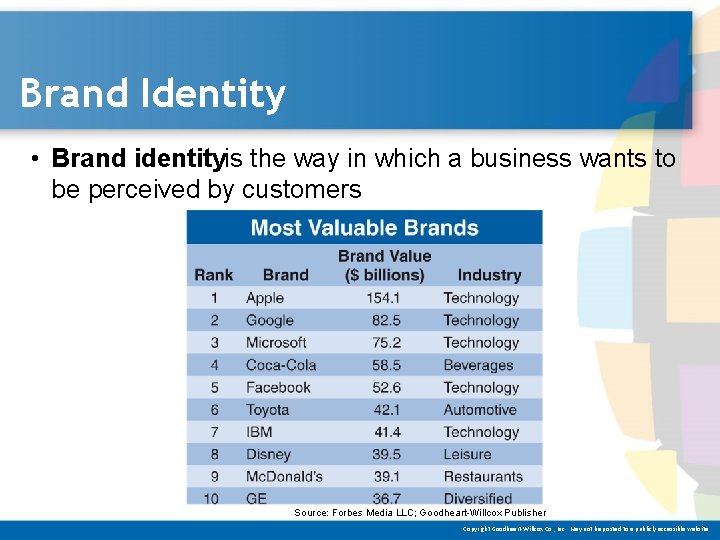
Brand Identity • Brand identityis the way in which a business wants to be perceived by customers Source: Forbes Media LLC; Goodheart-Willcox Publisher Copyright Goodheart-Willcox Co. , Inc. May not be posted to a publicly accessible website.
Brand Identity (Continued) • Brand equityis the value of having a well-known brand name • Marketers hope to achieve the following goals: – Create a unique brand identity – Contribute to the positive image of the brand – Inspire brand loyalty and repeat sales Copyright Goodheart-Willcox Co. , Inc. May not be posted to a publicly accessible website.
Brand Identity (Continued) • Unique brands – A benefit is the ability of a product to satisfy a need – Key is creating products and promotions that appeal to the needs and wants of the target market Copyright Goodheart-Willcox Co. , Inc. May not be posted to a publicly accessible website.
Brand Identity (Continued) • Positive brand images – Corporate social responsibility is the actions of a business to further social good – Some large corporations buy the naming rights for sports stadiums, convention centers, and other public places to show their support for a community Copyright Goodheart-Willcox Co. , Inc. May not be posted to a publicly accessible website.
Brand Identity (Continued) • Brand loyaltyis customer dedication to a certain brand of product – Occurs when a good, service, or business consistently meets customer needs and expectations – Excellent customer service is vital Copyright Goodheart-Willcox Co. , Inc. May not be posted to a publicly accessible website.
Branding Strategies • A branding strategyis a plan to develop a brand in a way that supports the goals of the business – Brand extensionis using an established brand name on different products in a product mix – Co-branding combines the products of one or more manufacturers in the creation of a product – Brand licensingis leasing a brand name for use by another business under the specifications of an agreement Copyright Goodheart-Willcox Co. , Inc. May not be posted to a publicly accessible website.
Branding Strategies • A branding strategyis a plan to develop a brand in a way that supports the goals of the business – Brand extension – Co-branding – Brand licensing Copyright Goodheart-Willcox Co. , Inc. May not be posted to a publicly accessible website.
Branding Strategies • Brand extensionis using an established brand name on different products in a product mix – Benefit: creates new marketing opportunities, leading to higher sales and profit for company – Risk: brand can appear too thin or if one product fails, the entire brand can suffer Copyright Goodheart-Willcox Co. , Inc. May not be posted to a publicly accessible website.
Branding Strategies • Co-branding combines the products of one or more manufacturers in the creation of a product – Works well when two companies each have a high level of brand recognition • Brand licensingis leasing a brand name for use by another business under the specifications of an agreement Copyright Goodheart-Willcox Co. , Inc. May not be posted to a publicly accessible website.
Brand Protection • A brand is considered the intellectual property of its owner and should be protected from theft – Valuable only if competitors cannot copy it – Intellectual propertyis something that comes from a person’s mind, such as an idea, an invention, or a process Copyright Goodheart-Willcox Co. , Inc. May not be posted to a publicly accessible website.
Brand Protection (Continued) • A trademark protects taglines, names, graphics, symbols, or any unique method used to identify a product or company • A service mark is similar to a trademark, but it identifies a service, rather than a product Copyright Goodheart-Willcox Co. , Inc. May not be posted to a publicly accessible website.
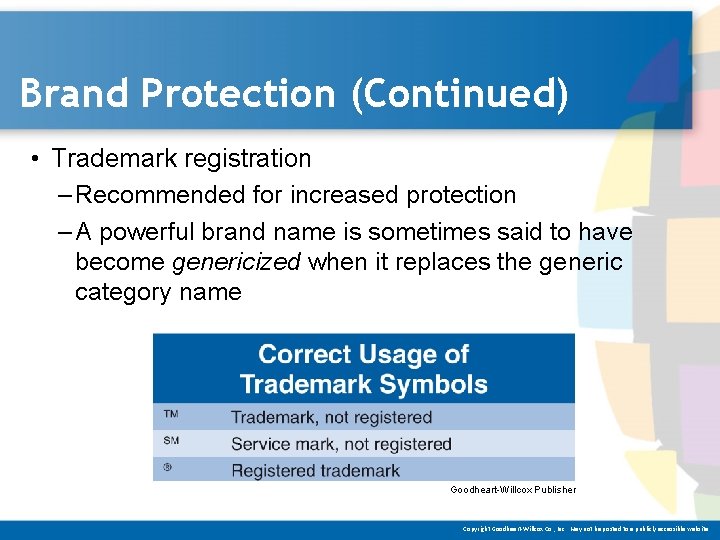
Brand Protection (Continued) • Trademark registration – Recommended for increased protection – A powerful brand name is sometimes said to have become genericized when it replaces the generic category name Goodheart-Willcox Publisher Copyright Goodheart-Willcox Co. , Inc. May not be posted to a publicly accessible website.
Section 12. 2 Review 1. What is the key to a unique brand? The key to a unique brand is creating products and promotions that appeal to the needs and wants of the target market. Copyright Goodheart-Willcox Co. , Inc. May not be posted to a publicly accessible website.
Section 12. 2 Review (Continued) 2. How can a company develop a positive brand image? One way to accomplish this goal is to align the brand with a positive message. Many companies visibly participate in community and charitable events. Some large corporations buy the naming rights for sports stadiums, convention centers, and other public places to show their support for a community. Copyright Goodheart-Willcox Co. , Inc. May not be posted to a publicly accessible website.
Section 12. 2 Review (Continued) 3. What are the benefits and risks of brand extension? If customers have any type of negative experience, the chance for a repeat purchase drops drastically. People who have had bad experiences with a product or company often discuss their dissatisfaction with other people. This is how negative perceptions about a brand can spread quickly and become hard to change. Copyright Goodheart-Willcox Co. , Inc. May not be posted to a publicly accessible website.
Section 12. 2 Review (Continued) 4. What is the difference between a trademark and a service mark? A trademark protects taglines, names, graphics, symbols, or any unique method used to identify a product or company. A service mark is similar to a trademark, but it identifies a service, rather than a product. Copyright Goodheart-Willcox Co. , Inc. May not be posted to a publicly accessible website.
Section 12. 2 Review (Continued) 5. What is a benefit of registering a trademark? Once a trademark or service mark has been registered, the symbol ® can be used with the mark. This symbol notifies the public that the creator claims exclusive rights to the brand its use. Copyright Goodheart-Willcox Co. , Inc. May not be posted to a publicly accessible website.
- Slides: 42