
Chapter 12 Big Data with Map Reduce Dr
Chapter 12 Big Data with Map / Reduce Dr. Steffen Herbold herbold@cs. uni-goettingen. de Introduction to Data Science https: //sherbold. github. io/intro-to-data-science
Outline • Overview • Map. Reduce • Apache Hadoop • Apache Spark • Summary Introduction to Data Science https: //sherbold. github. io/intro-to-data-science

Repetition: Definition of Big Data What are the innovative forms of information processing? Introduction to Data Science https: //sherbold. github. io/intro-to-data-science
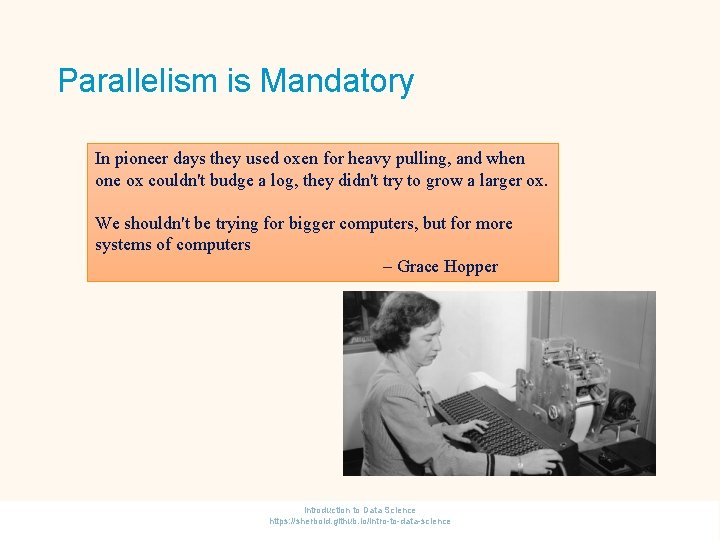
Parallelism is Mandatory In pioneer days they used oxen for heavy pulling, and when one ox couldn't budge a log, they didn't try to grow a larger ox. We shouldn't be trying for bigger computers, but for more systems of computers – Grace Hopper Introduction to Data Science https: //sherbold. github. io/intro-to-data-science
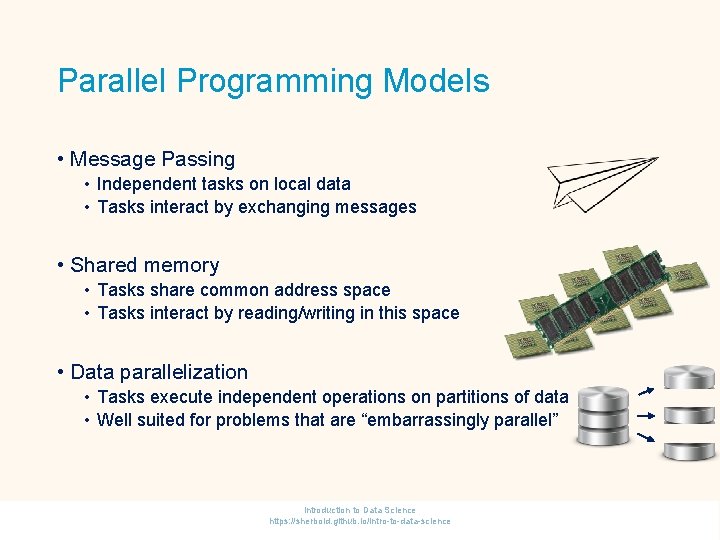
Parallel Programming Models • Message Passing • Independent tasks on local data • Tasks interact by exchanging messages • Shared memory • Tasks share common address space • Tasks interact by reading/writing in this space • Data parallelization • Tasks execute independent operations on partitions of data • Well suited for problems that are “embarrassingly parallel” Introduction to Data Science https: //sherbold. github. io/intro-to-data-science

Traditional Infrastructures Database or Storage Area Network (SAN) Data storage Compute cluster … Result / Insight Introduction to Data Science https: //sherbold. github. io/intro-to-data-science Compute Nodes
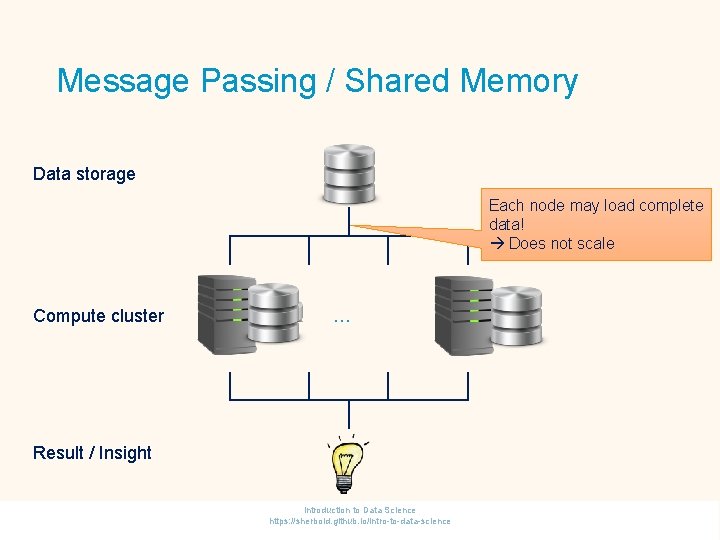
Message Passing / Shared Memory Data storage Each node may load complete data! Does not scale Compute cluster … Result / Insight Introduction to Data Science https: //sherbold. github. io/intro-to-data-science
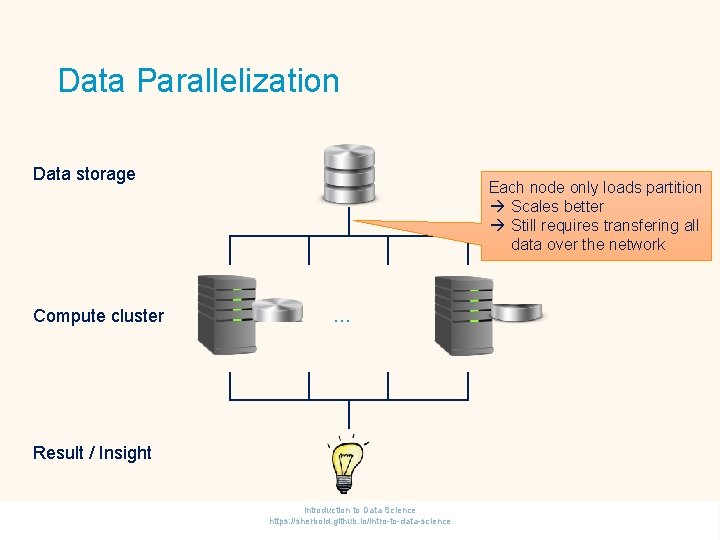
Data Parallelization Data storage Compute cluster Each node only loads partition Scales better Still requires transfering all data over the network … Result / Insight Introduction to Data Science https: //sherbold. github. io/intro-to-data-science
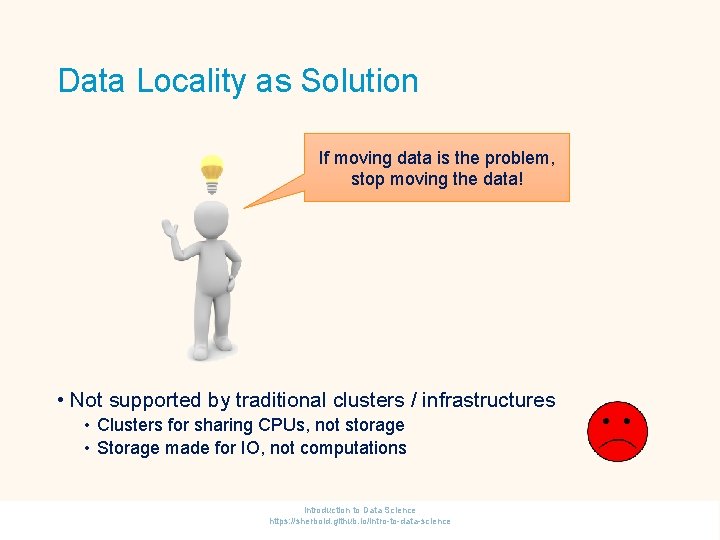
Data Locality as Solution If moving data is the problem, stop moving the data! • Not supported by traditional clusters / infrastructures • Clusters for sharing CPUs, not storage • Storage made for IO, not computations Introduction to Data Science https: //sherbold. github. io/intro-to-data-science
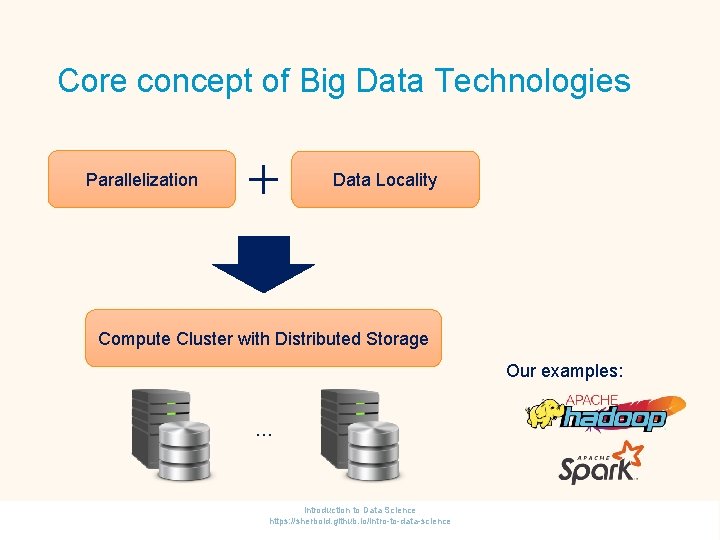
Core concept of Big Data Technologies Parallelization Data Locality Compute Cluster with Distributed Storage Our examples: … Introduction to Data Science https: //sherbold. github. io/intro-to-data-science
Outline • Overview • Map. Reduce • Apache Hadoop • Apache Spark • Summary Introduction to Data Science https: //sherbold. github. io/intro-to-data-science
Map. Reduce • Programming model for data parallelization • Published in 2004 by Google • map() and reduce() functions for data processing • Based on transformations of key-value pairs • shuffle() function for arranging intermediate results • Distribution via master/worker paradigm • Supports high availability / recoverability • Discussed together with hadoop Dean, Jeffrey, and Sanjay Ghemawat. "Map. Reduce: simplified data processing on large clusters. " Communications of the ACM, 51. 1 (2008): 107 -113. Introduction to Data Science https: //sherbold. github. io/intro-to-data-science
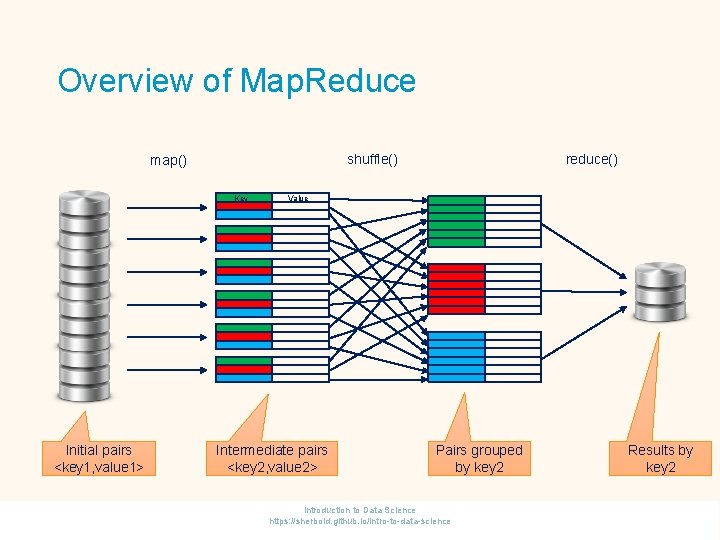
Overview of Map. Reduce shuffle() map() Key Initial pairs <key 1, value 1> reduce() Value Intermediate pairs <key 2, value 2> Pairs grouped by key 2 Introduction to Data Science https: //sherbold. github. io/intro-to-data-science Results by key 2
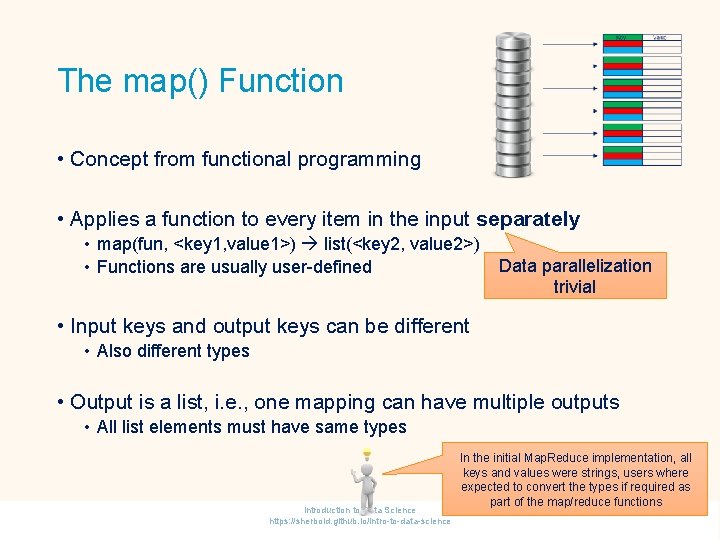
The map() Function • Concept from functional programming • Applies a function to every item in the input separately • map(fun, <key 1, value 1>) list(<key 2, value 2>) • Functions are usually user-defined Data parallelization trivial • Input keys and output keys can be different • Also different types • Output is a list, i. e. , one mapping can have multiple outputs • All list elements must have same types Introduction to Data Science https: //sherbold. github. io/intro-to-data-science In the initial Map. Reduce implementation, all keys and values were strings, users where expected to convert the types if required as part of the map/reduce functions
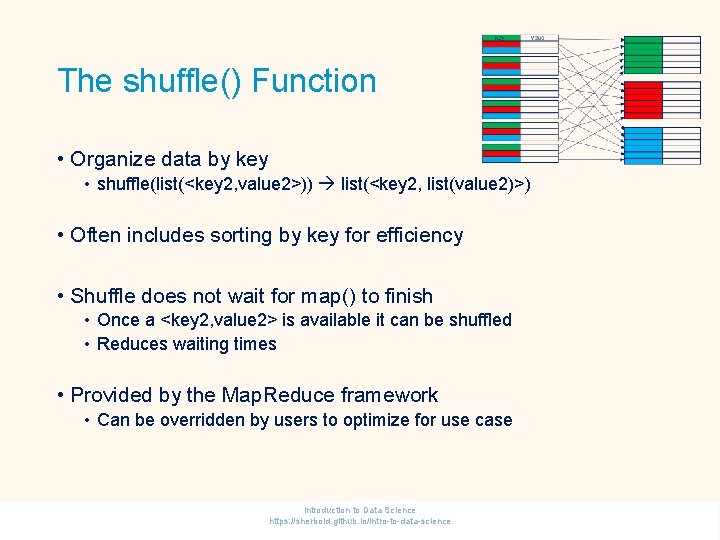
The shuffle() Function • Organize data by key • shuffle(list(<key 2, value 2>)) list(<key 2, list(value 2)>) • Often includes sorting by key for efficiency • Shuffle does not wait for map() to finish • Once a <key 2, value 2> is available it can be shuffled • Reduces waiting times • Provided by the Map. Reduce framework • Can be overridden by users to optimize for use case Introduction to Data Science https: //sherbold. github. io/intro-to-data-science
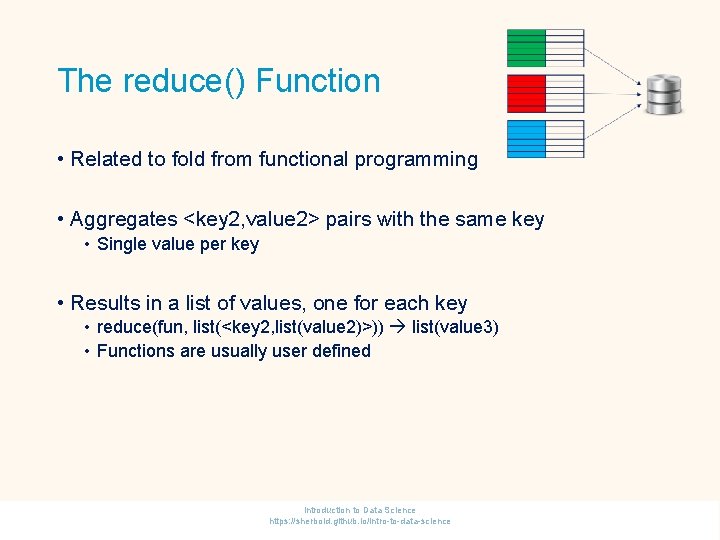
The reduce() Function • Related to fold from functional programming • Aggregates <key 2, value 2> pairs with the same key • Single value per key • Results in a list of values, one for each key • reduce(fun, list(<key 2, list(value 2)>)) list(value 3) • Functions are usually user defined Introduction to Data Science https: //sherbold. github. io/intro-to-data-science
Parallelization with Map. Reduce • Input can be read in chunks • Parallelism for creation of initial key-value pairs • map() can be computed for each key-value pair independently • Parallelism potential only limited by amount of data • shuffle() can start working as soon as first key-value pair is processed • Limits waiting times • reduce() can run in parallel for different keys • Need not wait for map to complete • Can already start when all results for a key are available Introduction to Data Science https: //sherbold. github. io/intro-to-data-science
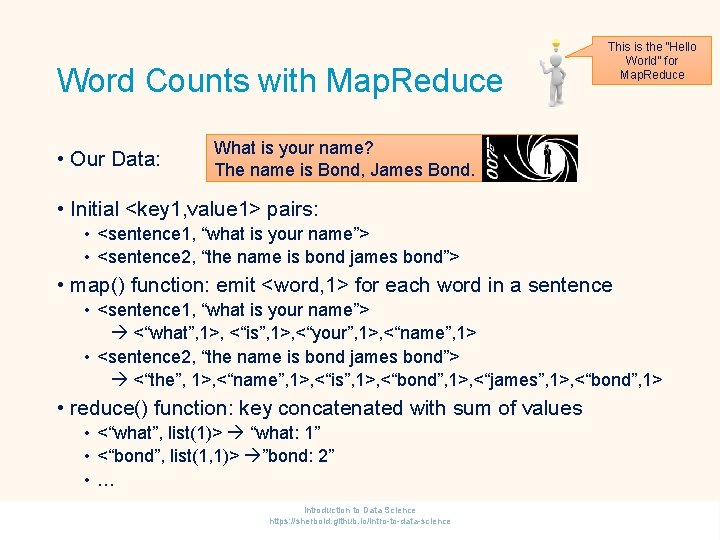
Word Counts with Map. Reduce • Our Data: This is the “Hello World” for Map. Reduce What is your name? The name is Bond, James Bond. • Initial <key 1, value 1> pairs: • <sentence 1, “what is your name”> • <sentence 2, “the name is bond james bond”> • map() function: emit <word, 1> for each word in a sentence • <sentence 1, “what is your name”> <“what”, 1>, <“is”, 1>, <“your”, 1>, <“name”, 1> • <sentence 2, “the name is bond james bond”> <“the”, 1>, <“name”, 1>, <“is”, 1>, <“bond”, 1>, <“james”, 1>, <“bond”, 1> • reduce() function: key concatenated with sum of values • <“what”, list(1)> “what: 1” • <“bond”, list(1, 1)> ”bond: 2” • … Introduction to Data Science https: //sherbold. github. io/intro-to-data-science
Outline • Overview • Map. Reduce • Apache Hadoop • Apache Spark • Summary Introduction to Data Science https: //sherbold. github. io/intro-to-data-science
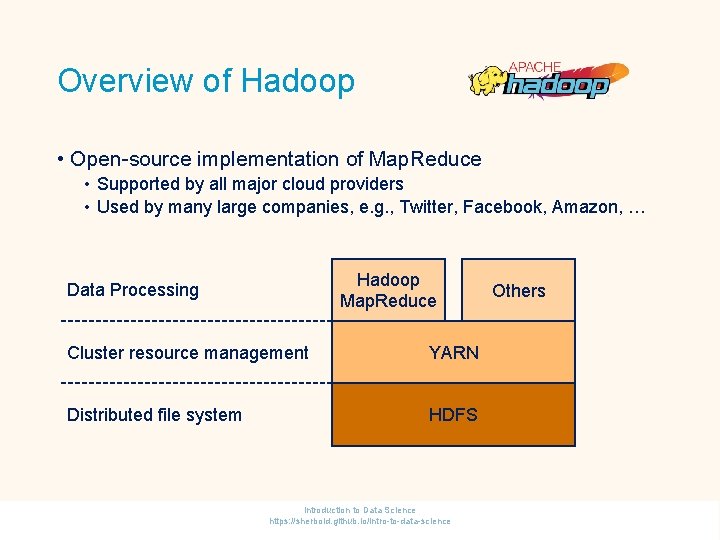
Overview of Hadoop • Open-source implementation of Map. Reduce • Supported by all major cloud providers • Used by many large companies, e. g. , Twitter, Facebook, Amazon, … Hadoop Map. Reduce Data Processing Cluster resource management YARN Distributed file system HDFS Introduction to Data Science https: //sherbold. github. io/intro-to-data-science Others
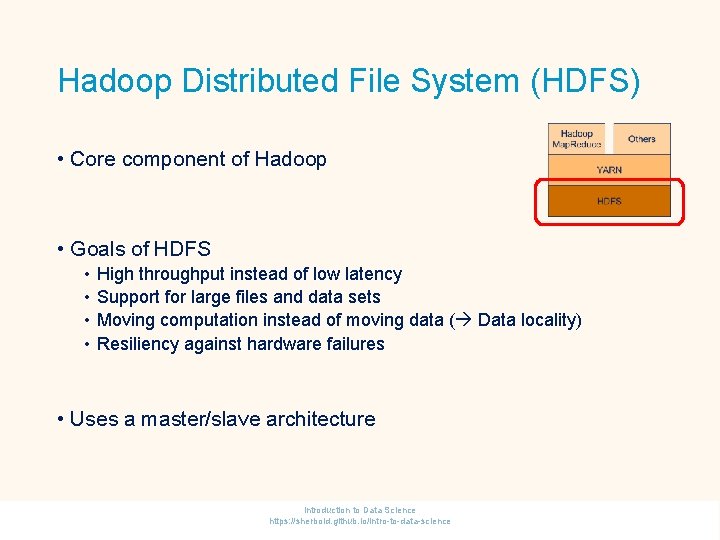
Hadoop Distributed File System (HDFS) • Core component of Hadoop • Goals of HDFS • • High throughput instead of low latency Support for large files and data sets Moving computation instead of moving data ( Data locality) Resiliency against hardware failures • Uses a master/slave architecture Introduction to Data Science https: //sherbold. github. io/intro-to-data-science
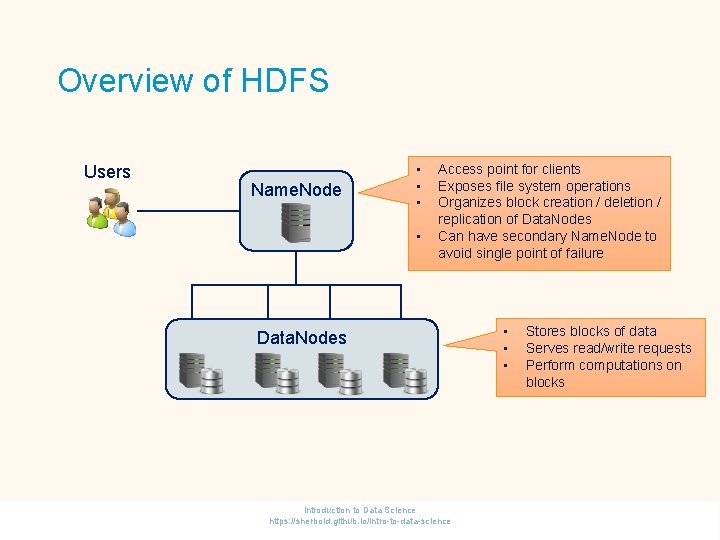
Overview of HDFS Users Name. Node • • Access point for clients Exposes file system operations Organizes block creation / deletion / replication of Data. Nodes Can have secondary Name. Node to avoid single point of failure Data. Nodes Introduction to Data Science https: //sherbold. github. io/intro-to-data-science • • • Stores blocks of data Serves read/write requests Perform computations on blocks
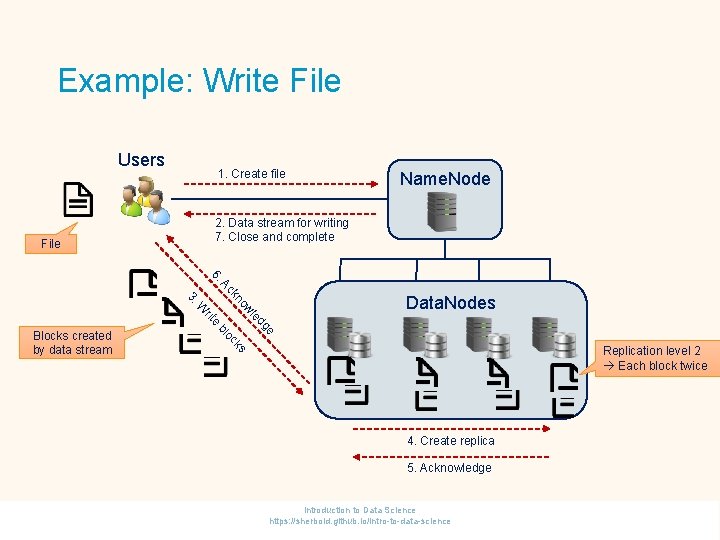
Example: Write File Users 1. Create file Name. Node 2. Data stream for writing 7. Close and complete File 6. Ac kn e k oc bl e dg rit le ow W 3. Replication level 2 Each block twice s Blocks created by data stream Data. Nodes 4. Create replica 5. Acknowledge Introduction to Data Science https: //sherbold. github. io/intro-to-data-science
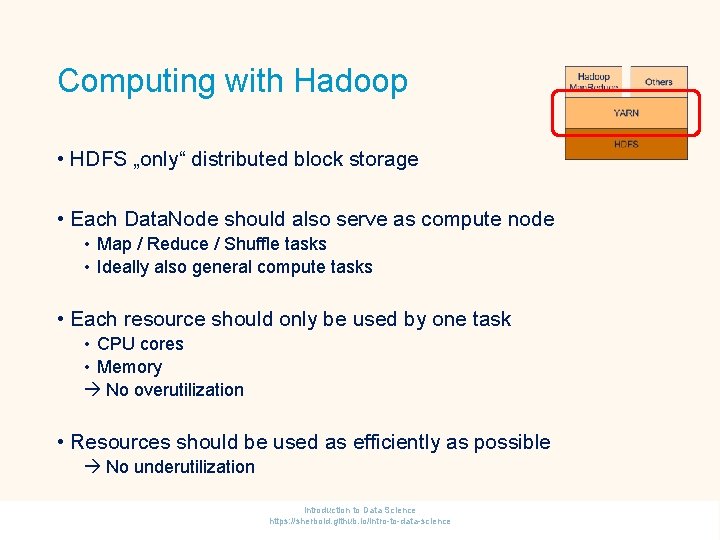
Computing with Hadoop • HDFS „only“ distributed block storage • Each Data. Node should also serve as compute node • Map / Reduce / Shuffle tasks • Ideally also general compute tasks • Each resource should only be used by one task • CPU cores • Memory No overutilization • Resources should be used as efficiently as possible No underutilization Introduction to Data Science https: //sherbold. github. io/intro-to-data-science
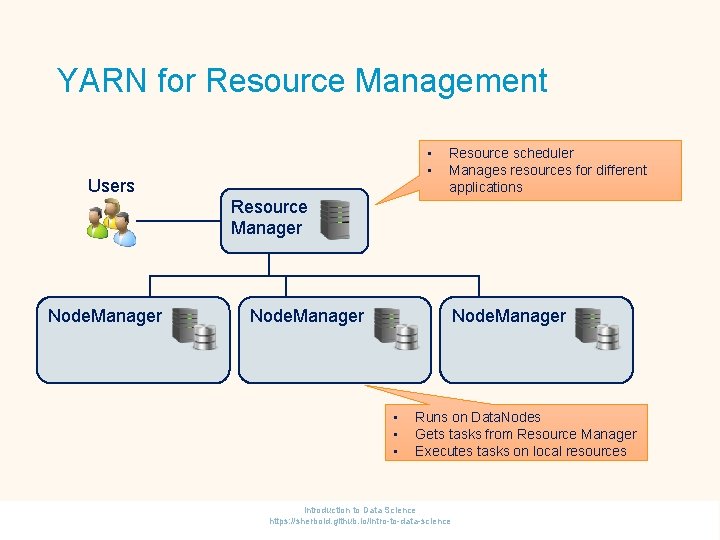
YARN for Resource Management • • Users Resource scheduler Manages resources for different applications Resource Manager Node. Manager • • • Runs on Data. Nodes Gets tasks from Resource Manager Executes tasks on local resources Introduction to Data Science https: //sherbold. github. io/intro-to-data-science
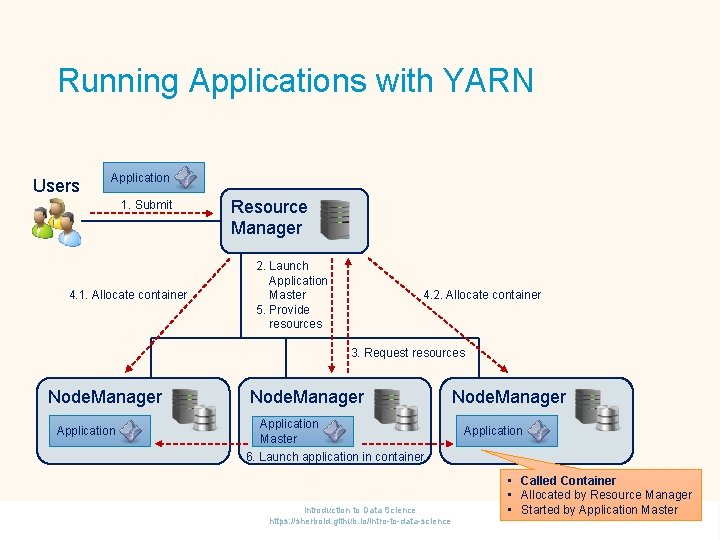
Running Applications with YARN Users Application 1. Submit 4. 1. Allocate container Resource Manager 2. Launch Application Master 5. Provide resources 4. 2. Allocate container 3. Request resources Node. Manager Application Master 6. Launch application in container Introduction to Data Science https: //sherbold. github. io/intro-to-data-science Node. Manager Application • Called Container • Allocated by Resource Manager • Started by Application Master
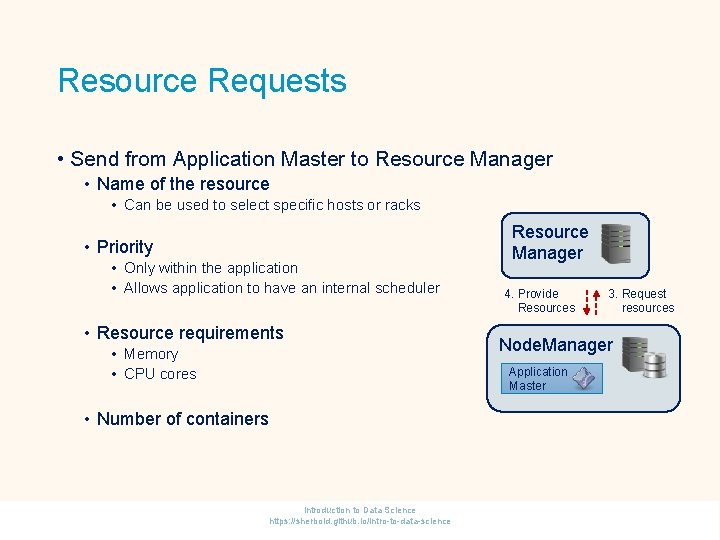
Resource Requests • Send from Application Master to Resource Manager • Name of the resource • Can be used to select specific hosts or racks • Priority • Only within the application • Allows application to have an internal scheduler • Resource requirements • Memory • CPU cores Resource Manager 4. Provide Resources Node. Manager Application Master • Number of containers Introduction to Data Science https: //sherbold. github. io/intro-to-data-science 3. Request resources
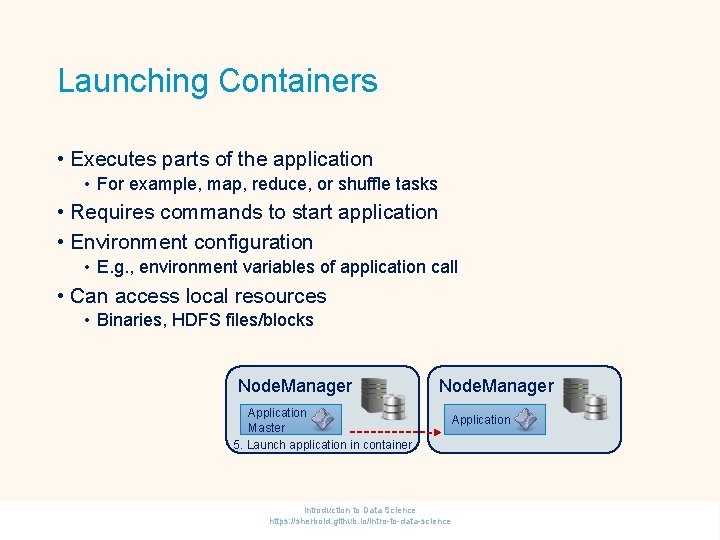
Launching Containers • Executes parts of the application • For example, map, reduce, or shuffle tasks • Requires commands to start application • Environment configuration • E. g. , environment variables of application call • Can access local resources • Binaries, HDFS files/blocks Node. Manager Application Master 5. Launch application in container Introduction to Data Science https: //sherbold. github. io/intro-to-data-science Application
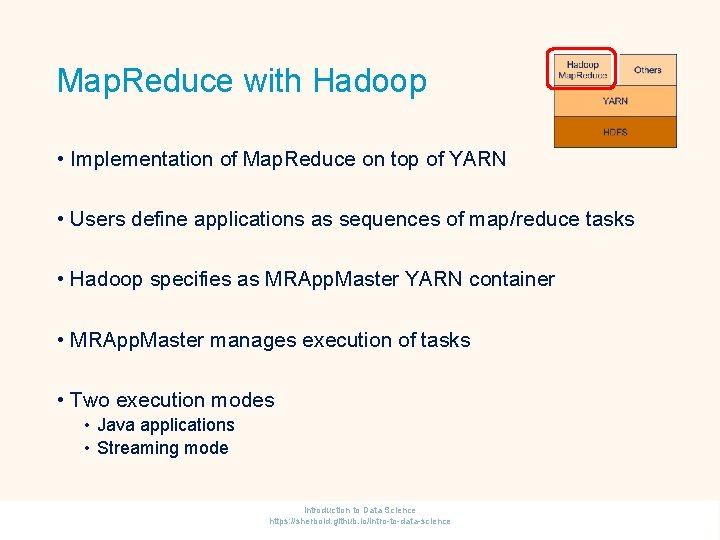
Map. Reduce with Hadoop • Implementation of Map. Reduce on top of YARN • Users define applications as sequences of map/reduce tasks • Hadoop specifies as MRApp. Master YARN container • MRApp. Master manages execution of tasks • Two execution modes • Java applications • Streaming mode Introduction to Data Science https: //sherbold. github. io/intro-to-data-science
Java Applications • Map. Reduce applications defined by Jobs programmatically • Job class used to • • Specify input Register mapper Register reducer Specify output • Mapper and reducer tasks defined by extending classes • Compiled Jar is submitted to resource manager for execution Introduction to Data Science https: //sherbold. github. io/intro-to-data-science
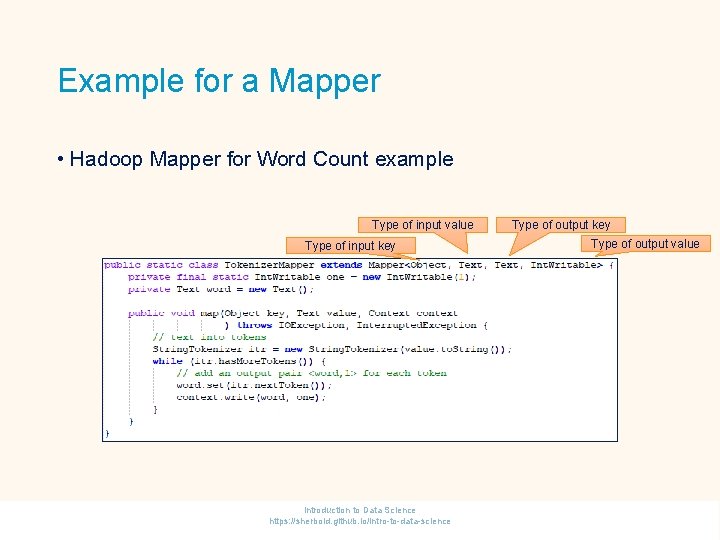
Example for a Mapper • Hadoop Mapper for Word Count example Type of input value Type of input key Introduction to Data Science https: //sherbold. github. io/intro-to-data-science Type of output key Type of output value
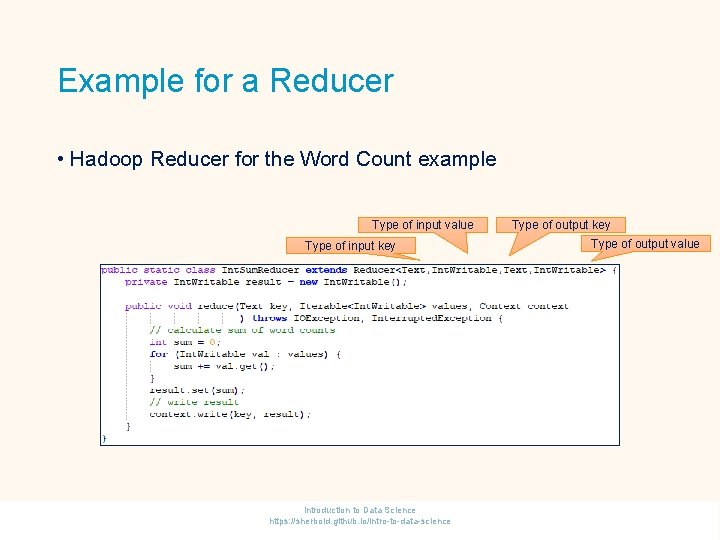
Example for a Reducer • Hadoop Reducer for the Word Count example Type of input value Type of input key Introduction to Data Science https: //sherbold. github. io/intro-to-data-science Type of output key Type of output value
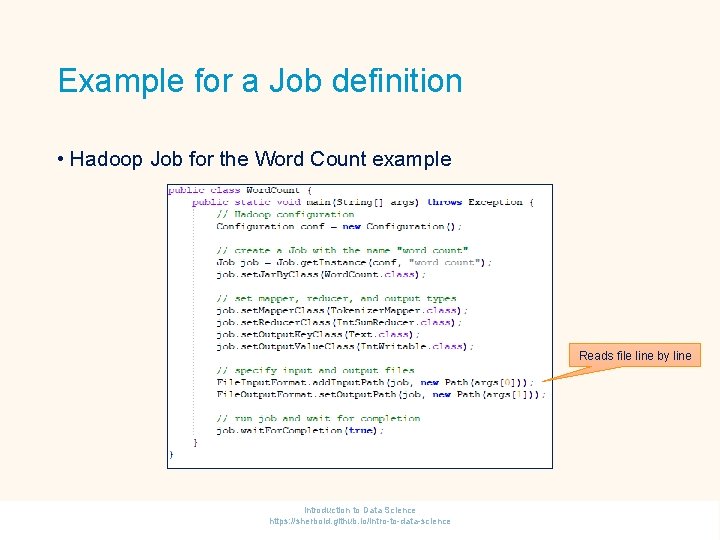
Example for a Job definition • Hadoop Job for the Word Count example Reads file line by line Introduction to Data Science https: //sherbold. github. io/intro-to-data-science
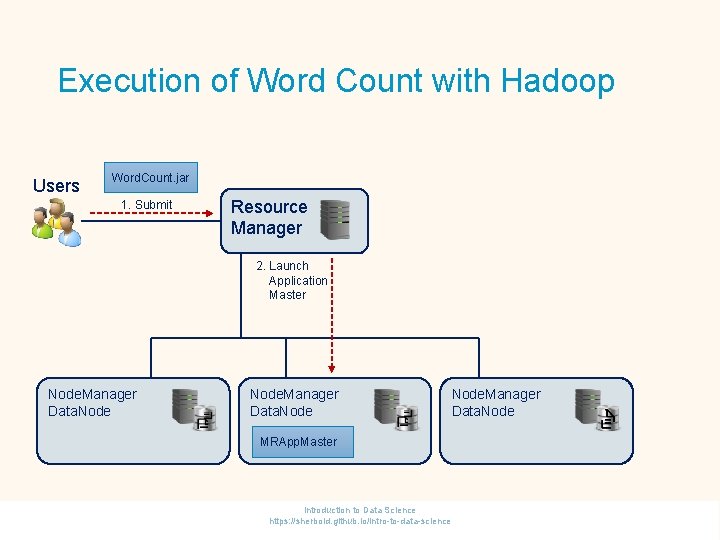
Execution of Word Count with Hadoop Users Word. Count. jar 1. Submit Resource Manager 2. Launch Application Master Node. Manager Data. Node MRApp. Master Introduction to Data Science https: //sherbold. github. io/intro-to-data-science Node. Manager Data. Node
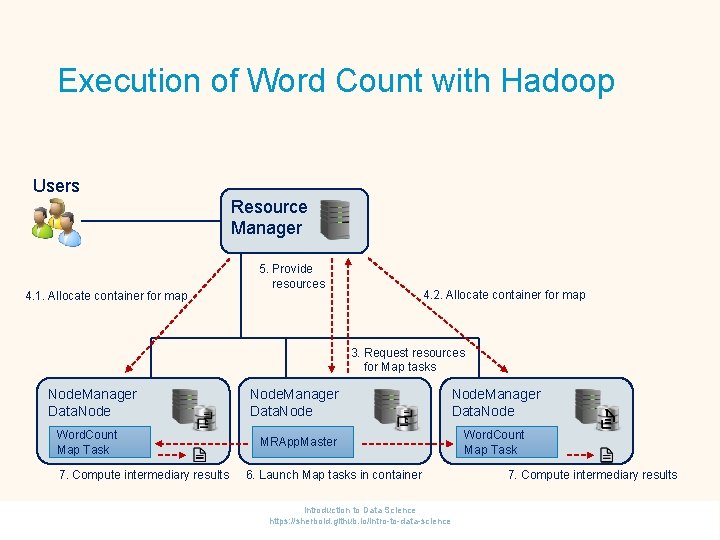
Execution of Word Count with Hadoop Users Resource Manager 4. 1. Allocate container for map 5. Provide resources 4. 2. Allocate container for map 3. Request resources for Map tasks Node. Manager Data. Node Word. Count Map Task 7. Compute intermediary results Node. Manager Data. Node MRApp. Master 6. Launch Map tasks in container Introduction to Data Science https: //sherbold. github. io/intro-to-data-science Node. Manager Data. Node Word. Count Map Task 7. Compute intermediary results
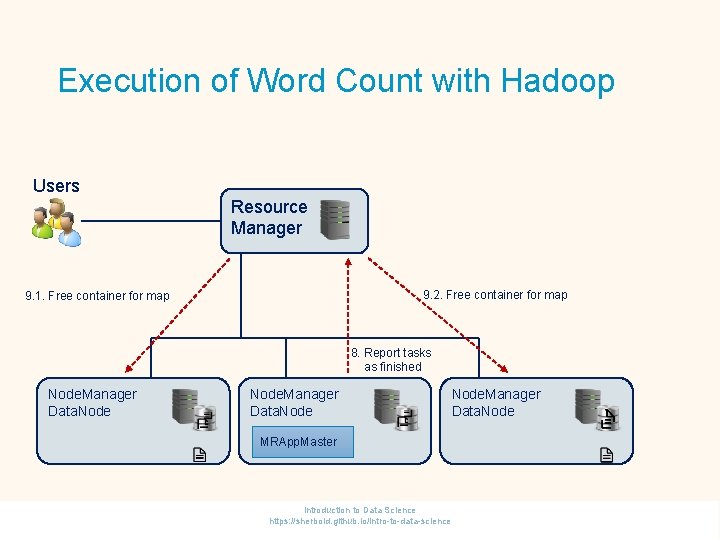
Execution of Word Count with Hadoop Users Resource Manager 9. 2. Free container for map 9. 1. Free container for map 8. Report tasks as finished Node. Manager Data. Node MRApp. Master Introduction to Data Science https: //sherbold. github. io/intro-to-data-science Node. Manager Data. Node
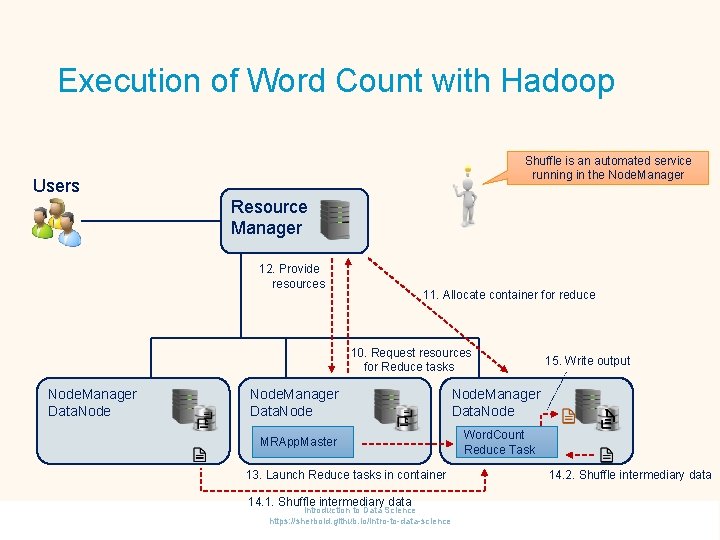
Execution of Word Count with Hadoop Shuffle is an automated service running in the Node. Manager Users Resource Manager 12. Provide resources 11. Allocate container for reduce 10. Request resources for Reduce tasks Node. Manager Data. Node MRApp. Master 13. Launch Reduce tasks in container 14. 1. Shuffle intermediary data Introduction to Data Science https: //sherbold. github. io/intro-to-data-science 15. Write output Node. Manager Data. Node Word. Count Reduce Task 14. 2. Shuffle intermediary data
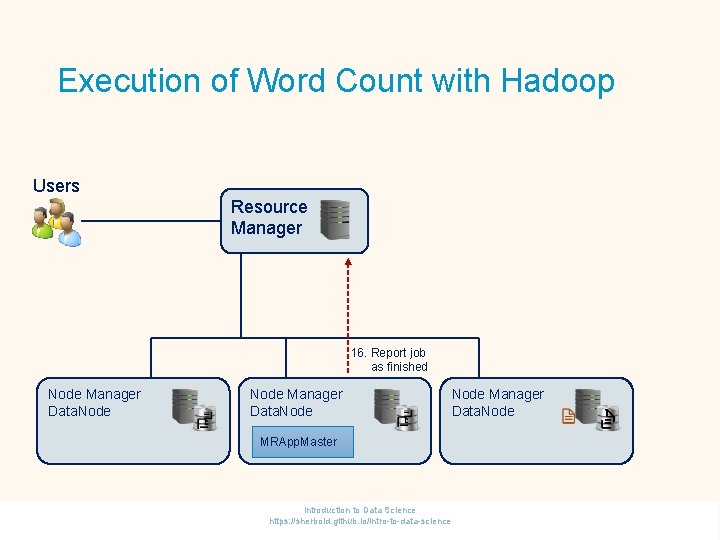
Execution of Word Count with Hadoop Users Resource Manager 16. Report job as finished Node Manager Data. Node MRApp. Master Introduction to Data Science https: //sherbold. github. io/intro-to-data-science Node Manager Data. Node
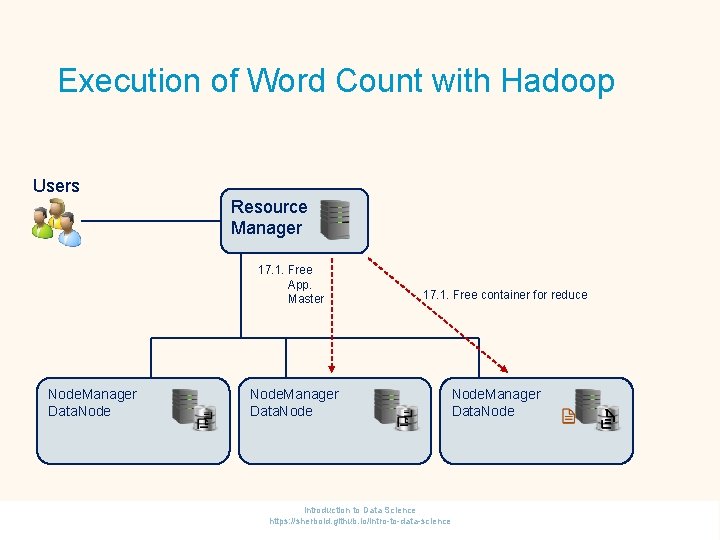
Execution of Word Count with Hadoop Users Resource Manager 17. 1. Free App. Master Node. Manager Data. Node 17. 1. Free container for reduce Node. Manager Data. Node Introduction to Data Science https: //sherbold. github. io/intro-to-data-science Node. Manager Data. Node
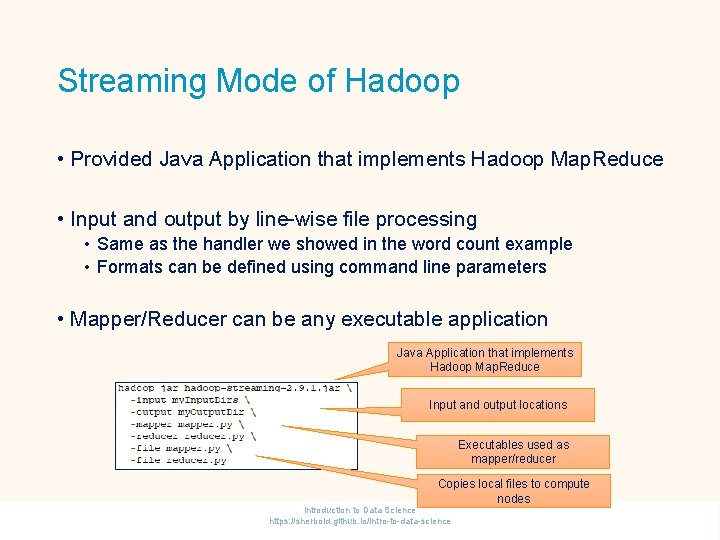
Streaming Mode of Hadoop • Provided Java Application that implements Hadoop Map. Reduce • Input and output by line-wise file processing • Same as the handler we showed in the word count example • Formats can be defined using command line parameters • Mapper/Reducer can be any executable application Java Application that implements Hadoop Map. Reduce Input and output locations Executables used as mapper/reducer Copies local files to compute nodes Introduction to Data Science https: //sherbold. github. io/intro-to-data-science
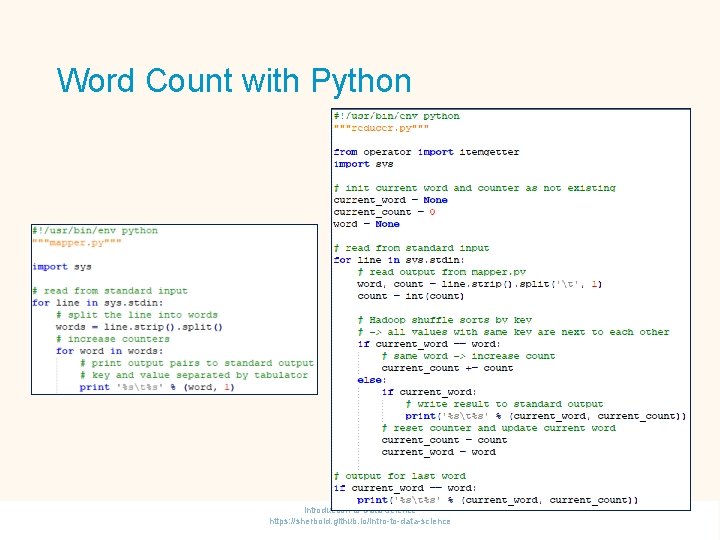
Word Count with Python Introduction to Data Science https: //sherbold. github. io/intro-to-data-science
Additional Important Parts of Hadoop • Combiner • Reducer function that runs locally before shuffling the data to another node • Often same as reducer, but not always • Requires functions to be chainable / idempotent • Can reduce network traffic • Example: • Word count reducer can also be used as combiner • The shuffled pairs would not all have a count of 1 anymore, but the word counts of the data of that node • Map. Reduce Job History Server • Collects information about the history of Map. Reduce jobs • Log files, start/end times, job state • Can be used by users to see status ob their jobs Introduction to Data Science https: //sherbold. github. io/intro-to-data-science
Limitations of Hadoop • Multiple Map and/or Reduce steps require multiple jobs • Can still be defined in a single Java file • Output of one job can be input of another job • Jobs can have dependencies, e. g. , one waiting for the completion of other jobs • Dependencies must be modeled by the programmer • All communication between jobs via the file system • Bad for multiple computations on the same data, e. g. , chained map functions Introduction to Data Science https: //sherbold. github. io/intro-to-data-science
Outline • Overview • Map. Reduce • Apache Hadoop • Apache Spark • Summary Introduction to Data Science https: //sherbold. github. io/intro-to-data-science
Apache Spark • Engine for large-scale data processing • Designed to resolve limitations of Hadoop for data analysis • Supports in-memory analysis • Good support for iterative algorithms • Supports arbitrary combinations of Map and Reduce tasks • Users do not need to care about specific jobs and their dependencies Introduction to Data Science https: //sherbold. github. io/intro-to-data-science
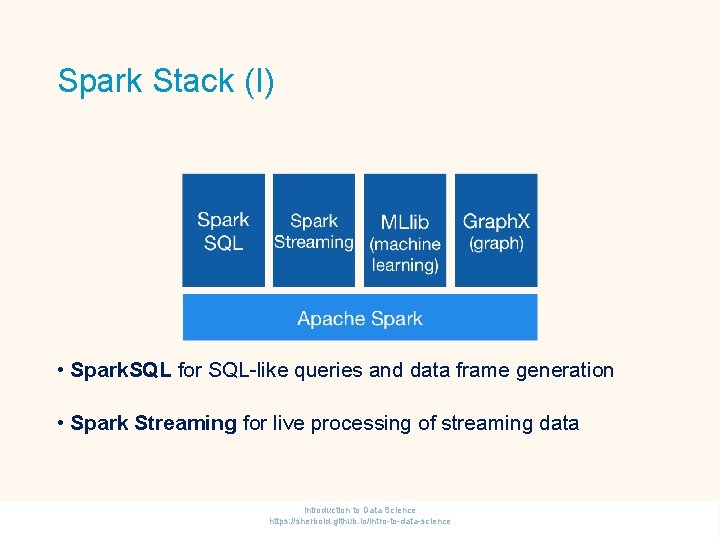
Spark Stack (I) • Spark. SQL for SQL-like queries and data frame generation • Spark Streaming for live processing of streaming data Introduction to Data Science https: //sherbold. github. io/intro-to-data-science
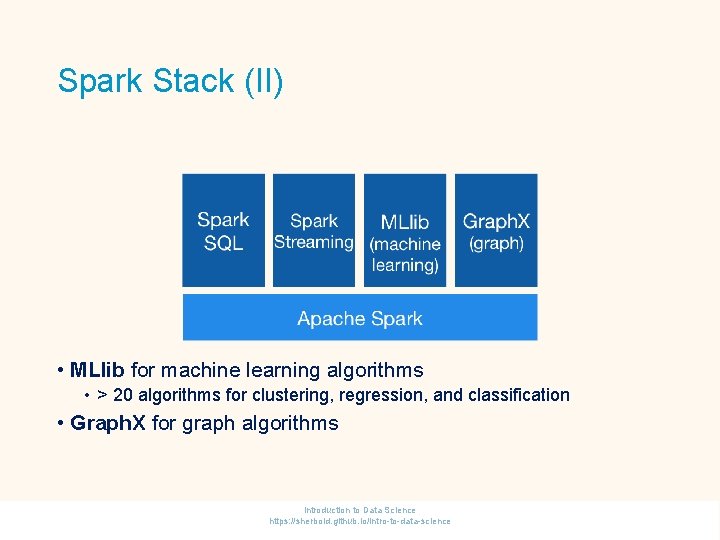
Spark Stack (II) • MLlib for machine learning algorithms • > 20 algorithms for clustering, regression, and classification • Graph. X for graph algorithms Introduction to Data Science https: //sherbold. github. io/intro-to-data-science
Data Structures used by Spark • Not a file system like Hadoop, instead two important in-memory data structures • Resilient Distributed Dataset (RDD) • • Abstraction layer for data operations Immutable partitions of elements All elements in a RDD can be processed in parallel Support map, reduce, filtering, user-defined functions, and persistence • Data frame • Higher abstraction built on RDDs • Similar to R / pandas data frames • Usually generated using the Spark. SQL API Introduction to Data Science https: //sherbold. github. io/intro-to-data-science
Infrastructures to Execute Apache Spark • Spark allows setup of clusters for computing • Not the standard way to use Spark • Compatible with many existing infrastructures instead • Computing • Hadoop/YARN and Apache Mesos • Storage • Hadoop/HDFS, Cassandra, HBase, Mongo. DB, … Introduction to Data Science https: //sherbold. github. io/intro-to-data-science
Programming with Apache Spark • Natively implemented in Scala • JVM language with type inference and functional programming concepts • Also provides APIs for • Java • Python (Py. Spark) • R (Spark. R) Introduction to Data Science https: //sherbold. github. io/intro-to-data-science
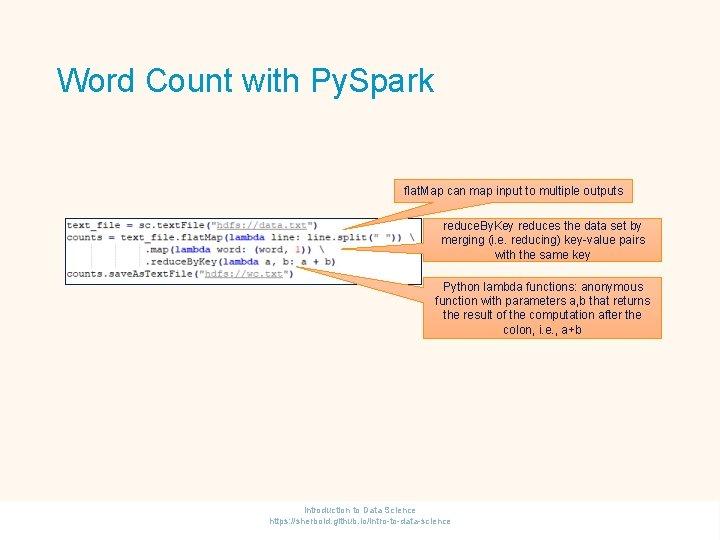
Word Count with Py. Spark flat. Map can map input to multiple outputs reduce. By. Key reduces the data set by merging (i. e. reducing) key-value pairs with the same key Python lambda functions: anonymous function with parameters a, b that returns the result of the computation after the colon, i. e. , a+b Introduction to Data Science https: //sherbold. github. io/intro-to-data-science
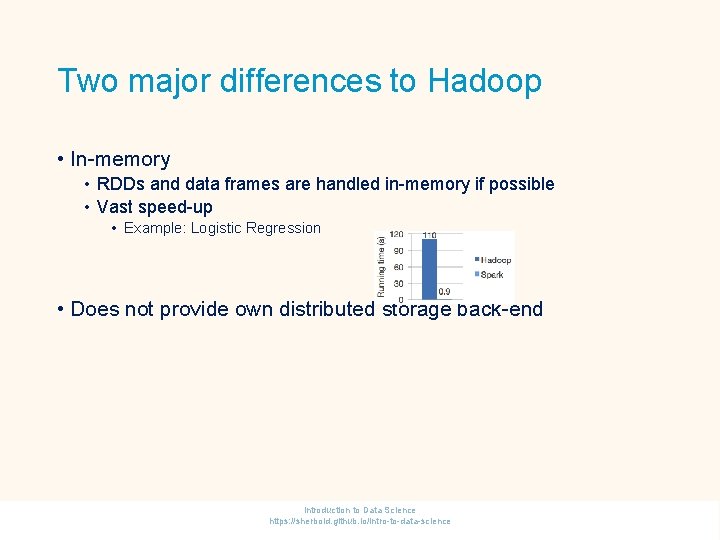
Two major differences to Hadoop • In-memory • RDDs and data frames are handled in-memory if possible • Vast speed-up • Example: Logistic Regression • Does not provide own distributed storage back-end Introduction to Data Science https: //sherbold. github. io/intro-to-data-science
Spark Ecosystem • Different execution modes • Large open source community • Many technologies on top of Spark • https: //spark-packages. org/ • Still rapidly developing • Core concepts stable • 2. 4. 0 release this fall • 3. 0. 0 release planned for next year Introduction to Data Science https: //sherbold. github. io/intro-to-data-science
Outline • Overview • Map. Reduce • Apache Hadoop • Apache Spark • Summary Introduction to Data Science https: //sherbold. github. io/intro-to-data-science
Summary • Big data processing requires dedicated infrastructures • Moving data not feasible • Move computation to data • Map. Reduce as programming model for big data processing • Apache Hadoop as big data framework • HDFS distributed and reliable file system • YARN for resource management • Provides a Map. Reduce framework • Apache Spark for in-memory computations with big data • Compatible with different infrastructures, including Hadoop • Provides API for machine learning Introduction to Data Science https: //sherbold. github. io/intro-to-data-science
- Slides: 55