
Chapter 12 Bernoulli and Energy Equations Self Reading
Chapter 12: Bernoulli and Energy Equations Self Reading Assignment: Topic 12 -1 12 -2 Title Page No. The Bernoulli Equation 466 Limitation of Bernoulli Equation 471 Application of Bernoulli Equation 474 Energy Analysis of Steady Flow 478
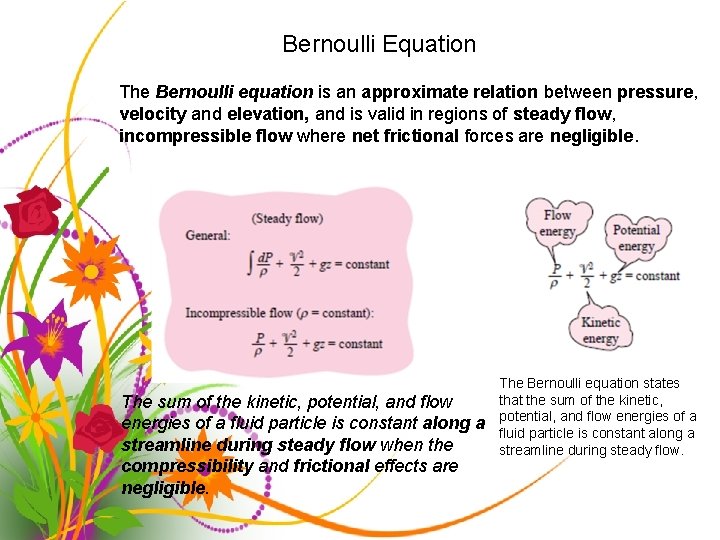
Bernoulli Equation The Bernoulli equation is an approximate relation between pressure, velocity and elevation, and is valid in regions of steady flow, incompressible flow where net frictional forces are negligible. The sum of the kinetic, potential, and flow energies of a fluid particle is constant along a streamline during steady flow when the compressibility and frictional effects are negligible. The Bernoulli equation states that the sum of the kinetic, potential, and flow energies of a fluid particle is constant along a streamline during steady flow.
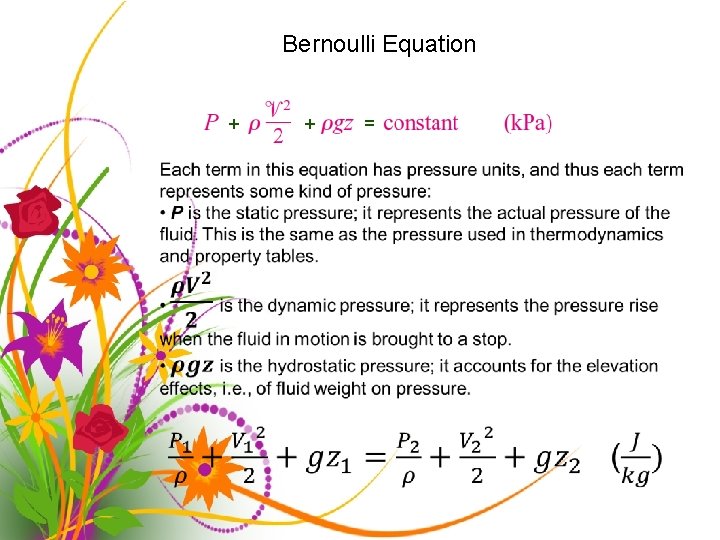
Bernoulli Equation + + =
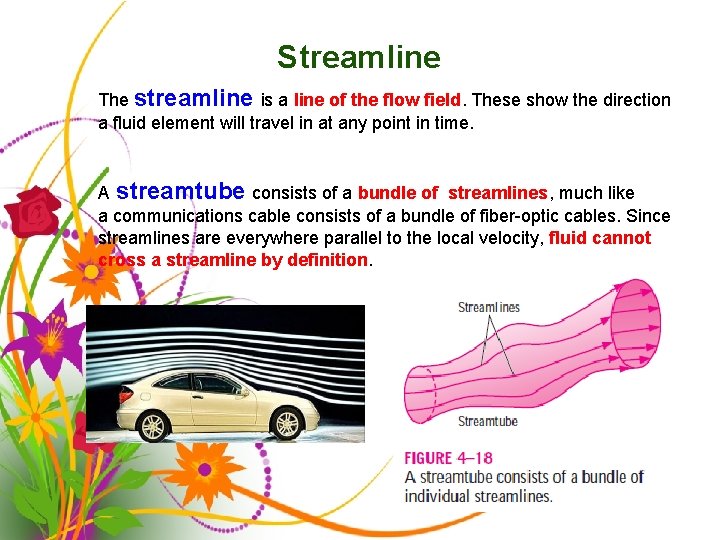
Streamline The streamline is a line of the flow field. These show the direction a fluid element will travel in at any point in time. A streamtube consists of a bundle of streamlines, much like a communications cable consists of a bundle of fiber-optic cables. Since streamlines are everywhere parallel to the local velocity, fluid cannot cross a streamline by definition.
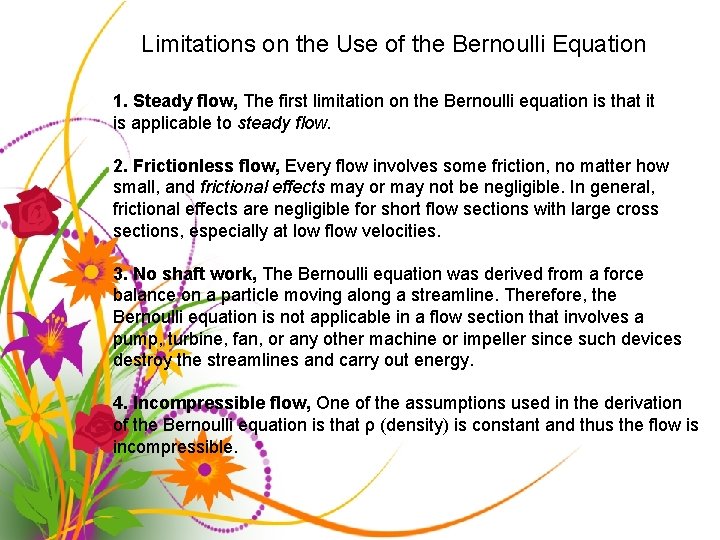
Limitations on the Use of the Bernoulli Equation 1. Steady flow, The first limitation on the Bernoulli equation is that it is applicable to steady flow. 2. Frictionless flow, Every flow involves some friction, no matter how small, and frictional effects may or may not be negligible. In general, frictional effects are negligible for short flow sections with large cross sections, especially at low flow velocities. 3. No shaft work, The Bernoulli equation was derived from a force balance on a particle moving along a streamline. Therefore, the Bernoulli equation is not applicable in a flow section that involves a pump, turbine, fan, or any other machine or impeller since such devices destroy the streamlines and carry out energy. 4. Incompressible flow, One of the assumptions used in the derivation of the Bernoulli equation is that ρ (density) is constant and thus the flow is incompressible.
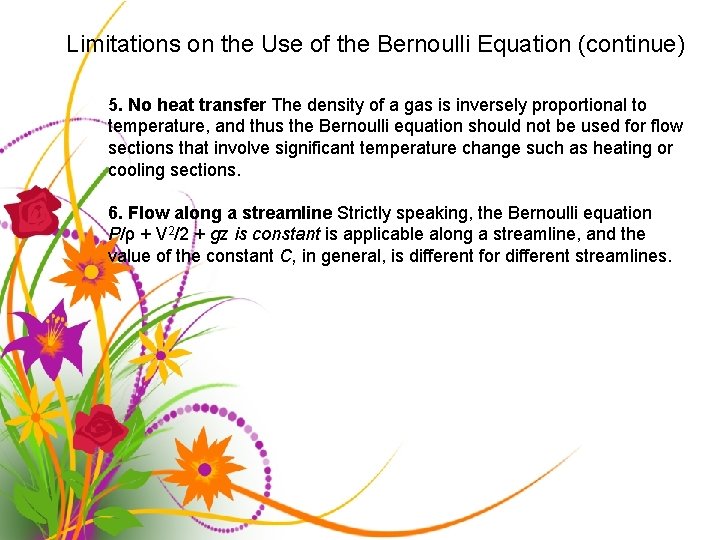
Limitations on the Use of the Bernoulli Equation (continue) 5. No heat transfer The density of a gas is inversely proportional to temperature, and thus the Bernoulli equation should not be used for flow sections that involve significant temperature change such as heating or cooling sections. 6. Flow along a streamline Strictly speaking, the Bernoulli equation P/ρ + V 2/2 + gz is constant is applicable along a streamline, and the value of the constant C, in general, is different for different streamlines.
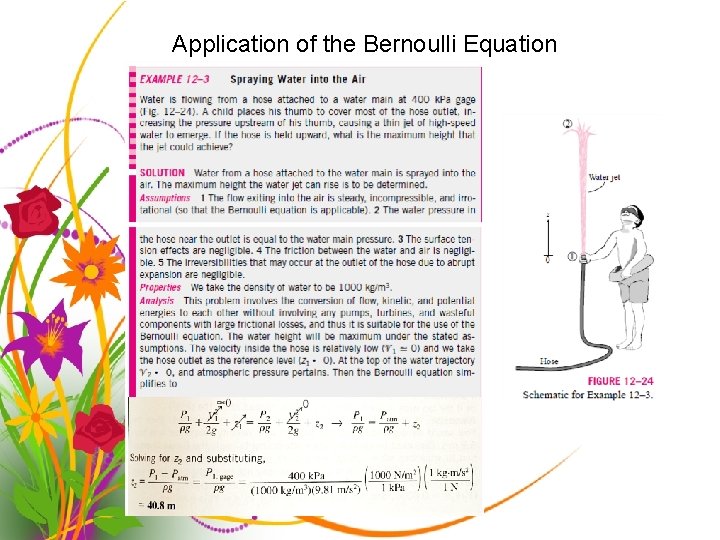
Application of the Bernoulli Equation
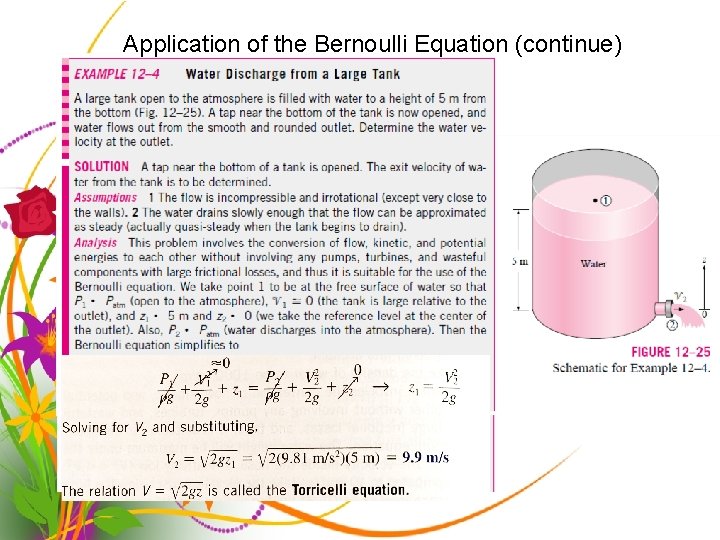
Application of the Bernoulli Equation (continue)

Application of the Bernoulli Equation (continue)
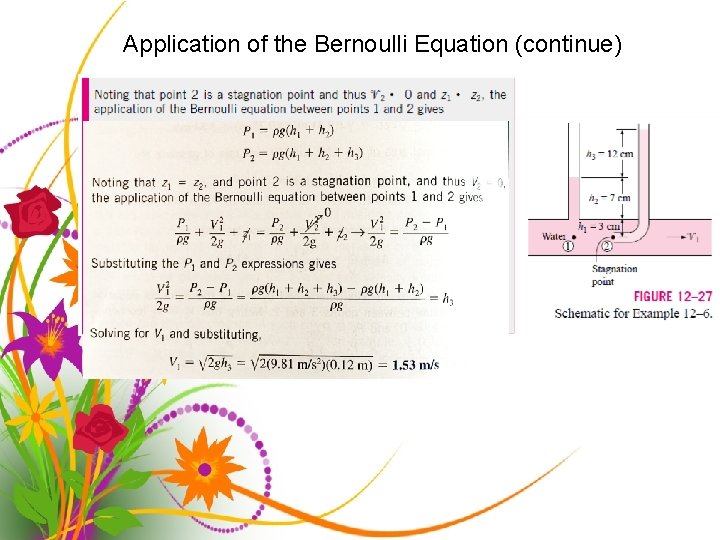
Application of the Bernoulli Equation (continue)
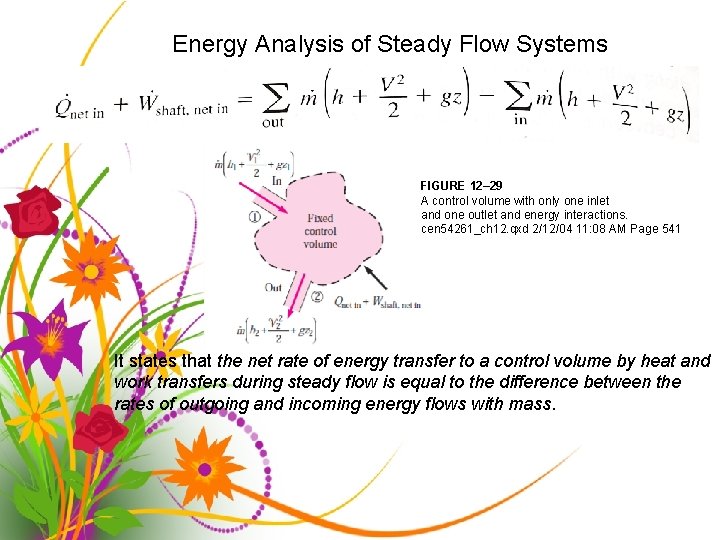
Energy Analysis of Steady Flow Systems FIGURE 12– 29 A control volume with only one inlet and one outlet and energy interactions. cen 54261_ch 12. qxd 2/12/04 11: 08 AM Page 541 It states that the net rate of energy transfer to a control volume by heat and work transfers during steady flow is equal to the difference between the rates of outgoing and incoming energy flows with mass.
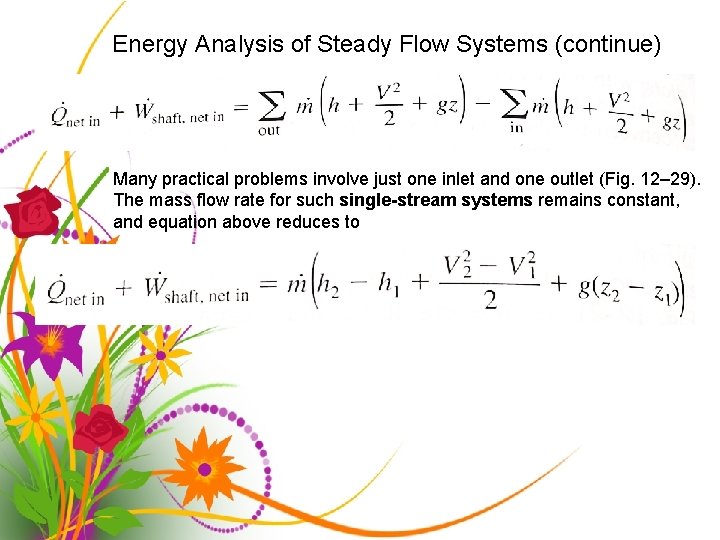
Energy Analysis of Steady Flow Systems (continue) Many practical problems involve just one inlet and one outlet (Fig. 12– 29). The mass flow rate for such single-stream systems remains constant, and equation above reduces to

Homework Will discuss during next class on 18 Feb 2019 1) 12 -17 2) 12 -22 3) 12 -23 4) 12 -31 5) 12 -34 Study Smart & Do your homework
- Slides: 13