
Chapter 12 Banking Industry Structure and Competition Time
Chapter 12 Banking Industry: Structure and Competition
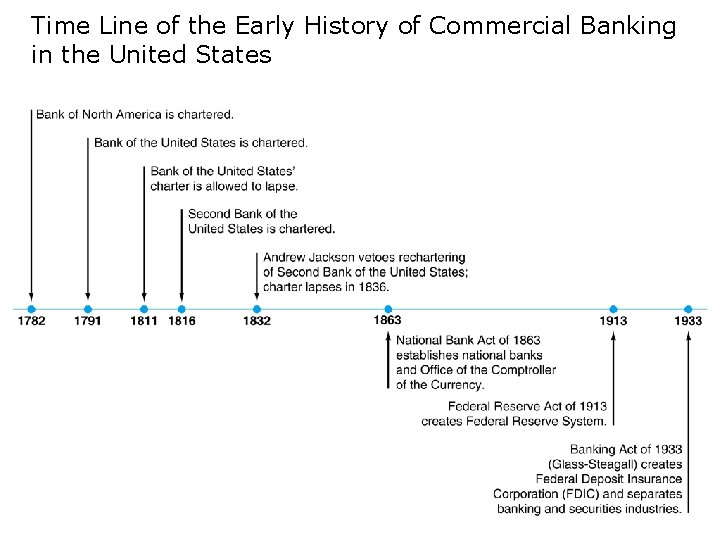
Time Line of the Early History of Commercial Banking in the United States

Primary Supervisory Responsibility of Bank Regulatory Agencies • Federal Reserve and state banking authorities: state banks that are members of the Federal Reserve System. • Fed also regulates bank holding companies. • FDIC: Insures state banks that are not Fed members. • State banking authorities: In charge of chartering, regulation, examination and supervision of state banks.
Financial Innovation and the Growth of the “Shadow Banking System” • Financial innovation is driven by the desire to earn profits • A change in the financial environment will stimulate a search by financial institutions for innovations that are likely to be profitable – Financial engineering
Responses to Changes in Demand Conditions: Interest Rate Volatility • Adjustable-rate mortgages – Flexible interest rates keep profits high when rates rise – Lower initial interest rates make them attractive to home buyers • Financial Derivatives – Ability to hedge interest rate risk
Responses to Changes in Supply Conditions: Information Technology • Bank credit and debit cards – Improved computer technology lowers transaction costs • Electronic banking – ATM, home banking, and virtual banking
Responses to Changes in Supply Conditions: Information Technology • Securitization – To transform otherwise illiquid financial assets into marketable capital market securities. – Securitization played an especially prominent role in the development of the subprime mortgage market in the mid 2000 s.
Avoidance of Regulations: Loophole Mining • Reserve requirements act as a tax on deposits
Financial Innovation and the Decline of Traditional Banking • As a source of funds for borrowers, market share has fallen • Commercial banks’ share of total financial intermediary assets has fallen • No decline in overall profitability • Increase in income from off-balance-sheet activities
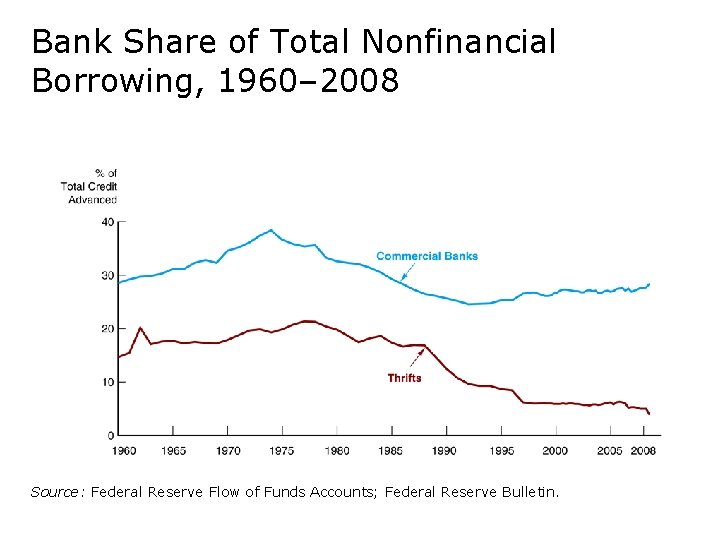
Bank Share of Total Nonfinancial Borrowing, 1960– 2008 Source: Federal Reserve Flow of Funds Accounts; Federal Reserve Bulletin.
Banks’ Responses • Expand into new and riskier areas of lending – Commercial real estate loans – Corporate takeovers and leveraged buyouts • Pursue off-balance-sheet activities – Non-interest income
Bank Consolidation and Nationwide Banking • The number of banks has declined over the last 25 years – Bank failures and consolidation. – Economies of scale and scope from information technology. • Results may be not only a smaller number of banks but a shift in assets to much larger banks.
Benefits and Costs of Bank Consolidation • Benefits – Increased competition, driving inefficient banks out of business – Increased efficiency also from economies of scale – Lower probability of bank failure from more diversified portfolios • Costs – Elimination of community banks may lead to less lending to small business – Banks expanding into new areas may take increased risks and fail
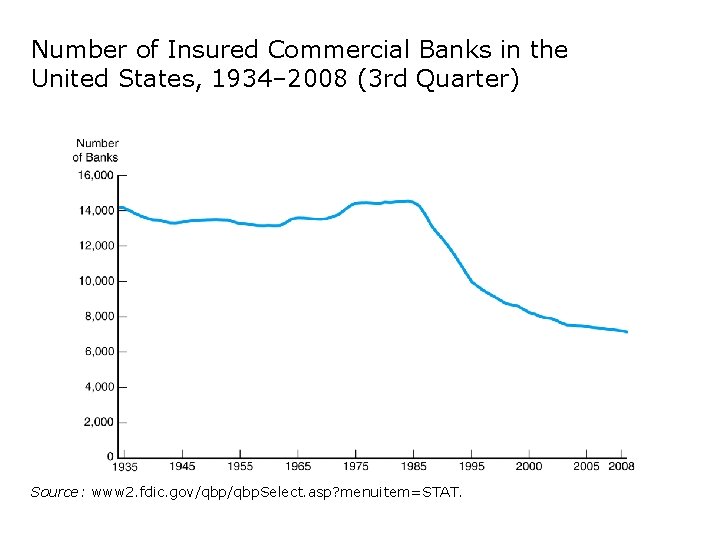
Number of Insured Commercial Banks in the United States, 1934– 2008 (3 rd Quarter) Source: www 2. fdic. gov/qbp. Select. asp? menuitem=STAT.
International Banking • Rapid growth – Growth in international trade and multinational corporations – Global investment banking is very profitable – Ability to tap into the Eurodollar market
Eurodollar Market • Dollar-denominated deposits held in banks outside of the U. S. • Most widely used currency in international trade • Offshore deposits not subject to regulations • Important source of funds for U. S. banks
Foreign Banks in the U. S. • Agency office of the foreign bank – Can lend and transfer fund in the U. S. – Cannot accept deposits from domestic residents – Not subject to regulations • Subsidiary U. S. bank – Subject to U. S. regulations – Owned by a foreign bank
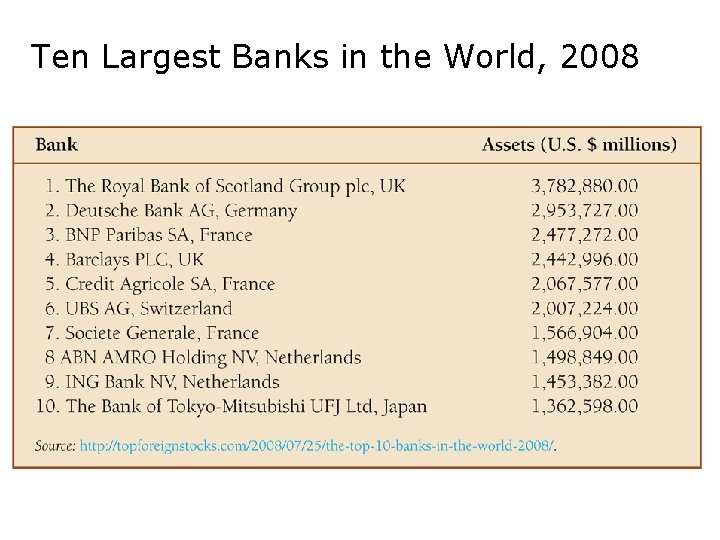
Ten Largest Banks in the World, 2008
- Slides: 18