
CHAPTER 12 APROKARYOTES Objectives How are prokaryotes divided

CHAPTER 12 APROKARYOTES
Objectives ■ How are prokaryotes divided? ■ How do bacteria grow and reproduce? ■ How do bacteria interact with people and the environment?

12. 1 - DOMAIN ARCHAEA
Domain Archaea ■ World of prokaryotes: Archaea and Bacteria – Archaea- prokaryotes that can act as decomposers, live in extreme environments – USED to be considered same domain as bacteria… BUT THEY WERE WRONG!!

Domain Archaea ■ Several Key differences between bacteria & archaea – Archaea- found in extreme environments Bacteria- would die – Archaea- cell walls contain isoprene Bacteria- cell walls contain peptidoglycan – Both go through transcription and translation, but… slightly different
Exploring Archaea ■ Different types: – Thermophiles■ Live in hot environments ■ “Thermo”- heat, ”phile”- to like ■ Example: Pyrococcus furiosus- live near hydrothermal vents in ocean floor, die if temperature falls below boiling
Exploring Archaea ■ Different types: – Halophiles ■ Live in salty environments ■ “Halo”- chemistry: halogens, found in salt, ”phile”- to like ■ Example: Halobacterium salinarum- found in salt-cured ham

Exploring Archaea ■ Different types: – Acidophiles ■ Live in acidic environments (p. H < 7) p. H 1 or 2 , ■ “Acid”- …. acids, ”phile”- to like ■ Example: Sulfolobus acidocaldarius- found in hot, acidic springs at Yellowstone National Park
Exploring Archaea ■ Different types: – Methanogens ■ ■ Largest group Live in places like swamps and intestines Produce methane gas Example: Methanosarcina mazei- found in swamps, sometimes mistaken for algae
12. 2 - DOMAIN BACTERIA
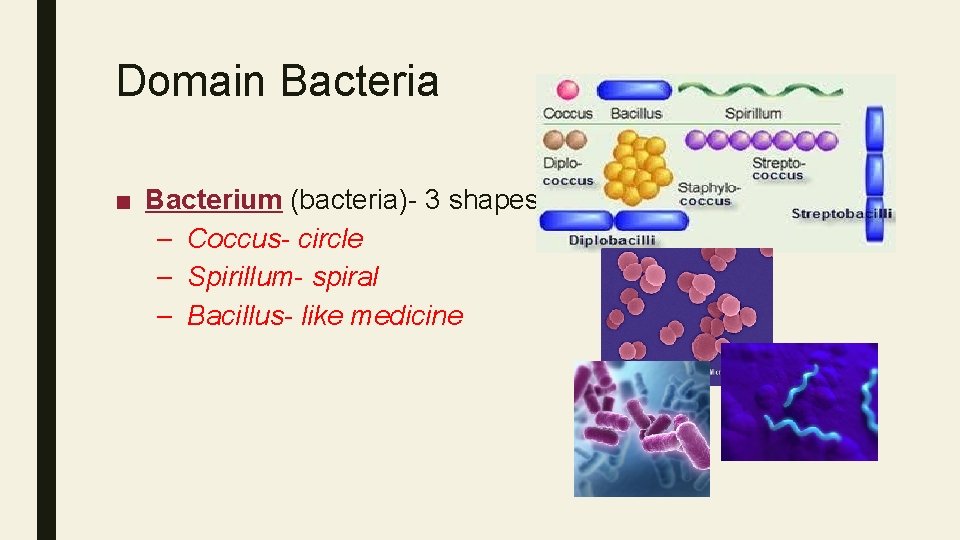
Domain Bacteria ■ Bacterium (bacteria)- 3 shapes – Coccus- circle – Spirillum- spiral – Bacillus- like medicine
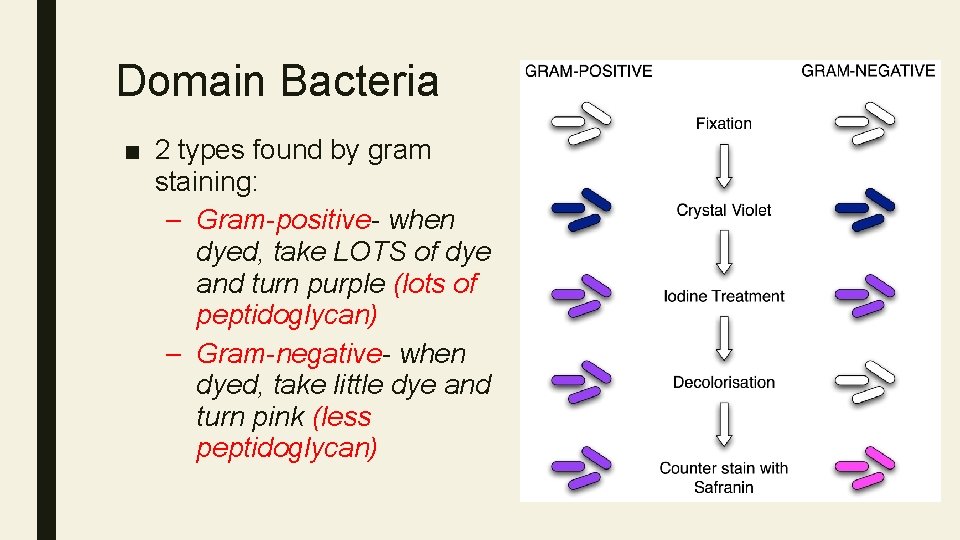
Domain Bacteria ■ 2 types found by gram staining: – Gram-positive- when dyed, take LOTS of dye and turn purple (lots of peptidoglycan) – Gram-negative- when dyed, take little dye and turn pink (less peptidoglycan)
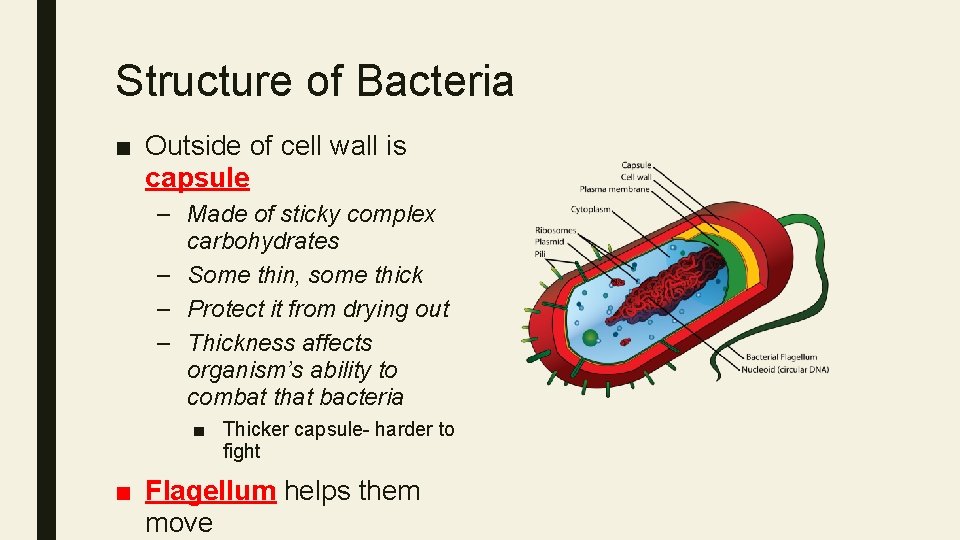
Structure of Bacteria ■ Outside of cell wall is capsule – Made of sticky complex carbohydrates – Some thin, some thick – Protect it from drying out – Thickness affects organism’s ability to combat that bacteria ■ Thicker capsule- harder to fight ■ Flagellum helps them move
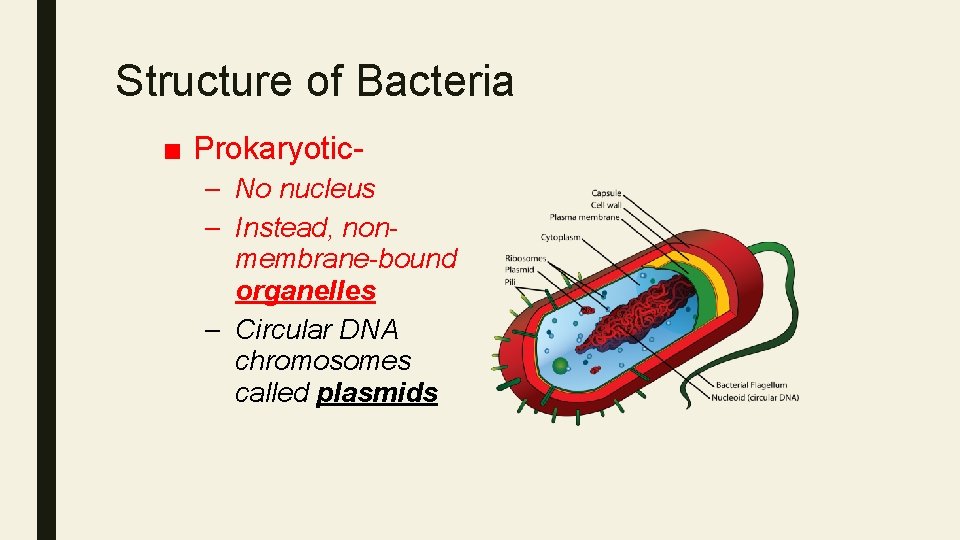
Structure of Bacteria ■ Prokaryotic– No nucleus – Instead, nonmembrane-bound organelles – Circular DNA chromosomes called plasmids
12. 3 REPRODUCTION AND GENETIC TRANSFER IN BACTERIA
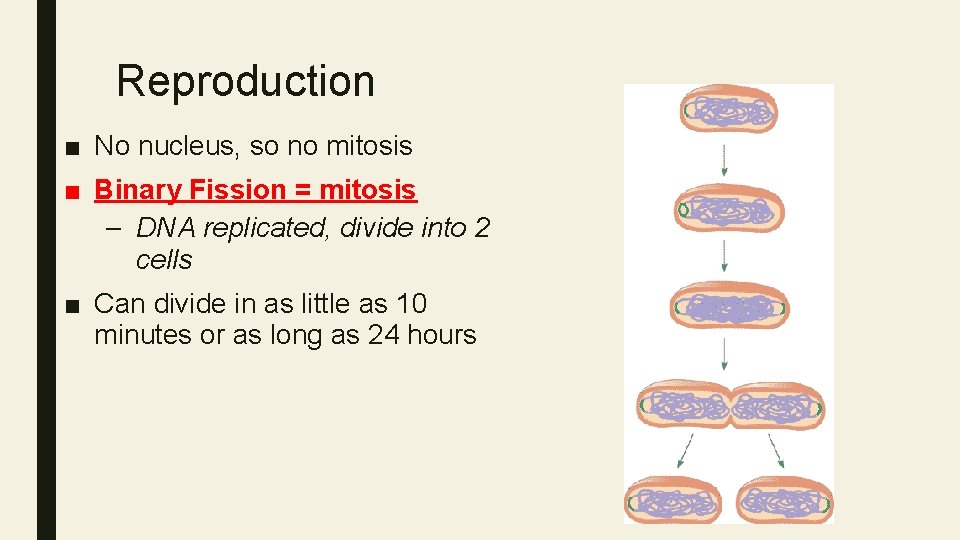
Reproduction ■ No nucleus, so no mitosis ■ Binary Fission = mitosis – DNA replicated, divide into 2 cells ■ Can divide in as little as 10 minutes or as long as 24 hours
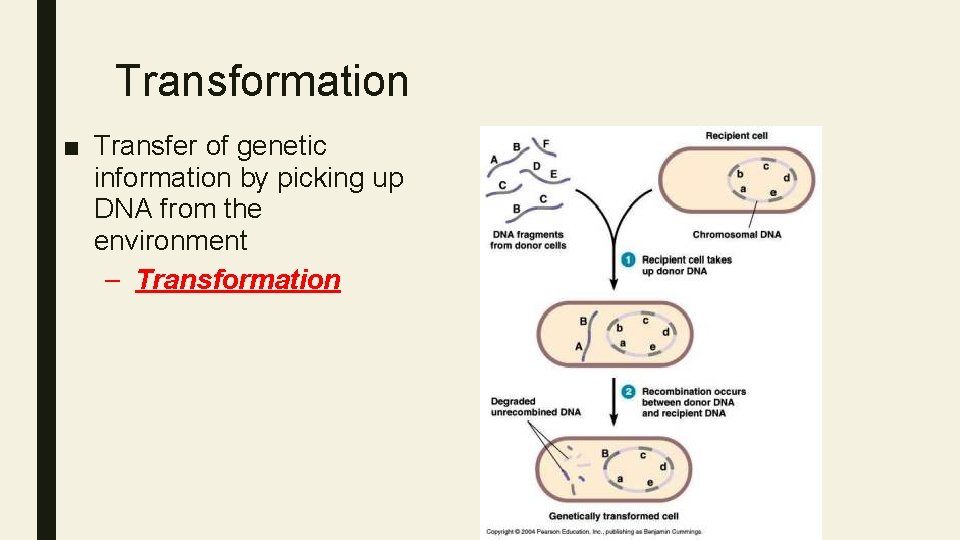
Transformation ■ Transfer of genetic information by picking up DNA from the environment – Transformation
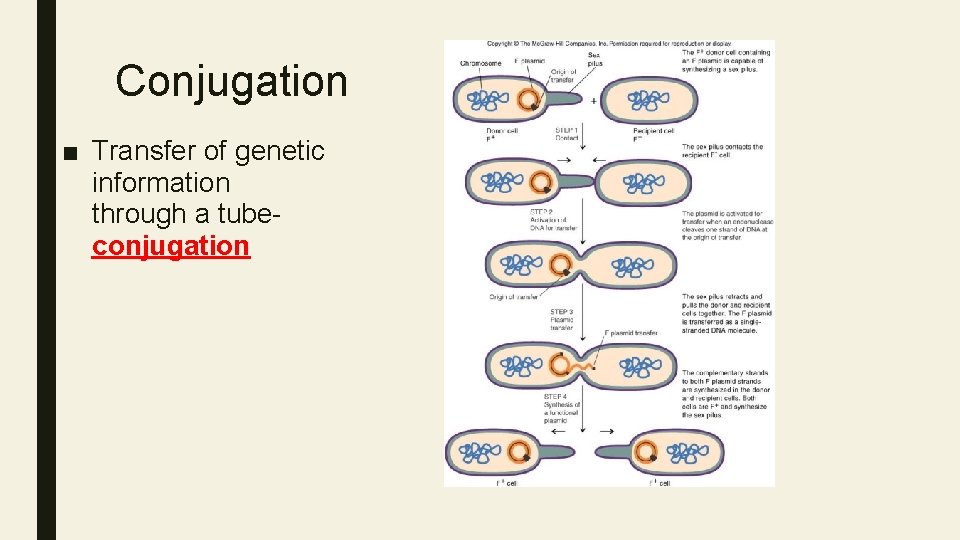
Conjugation ■ Transfer of genetic information through a tubeconjugation
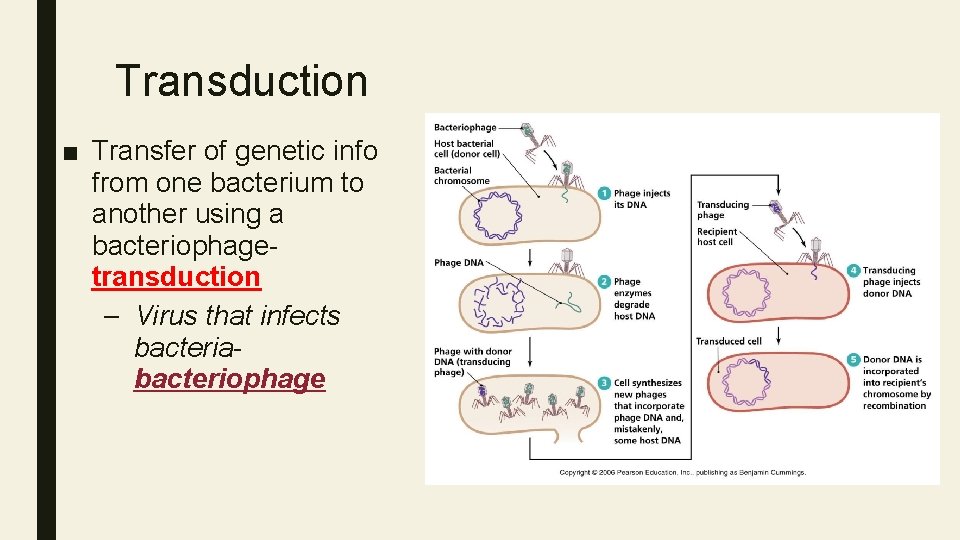
Transduction ■ Transfer of genetic info from one bacterium to another using a bacteriophagetransduction – Virus that infects bacteriabacteriophage
12. 4 - HOW BACTERIA FUNCTION IN THE ENVIRONMENT
Good Bacteria ■ Microbiome- DNA from microorganisms that live on and in a living organism – Microbiota- bacteria in your microbiome – Heterotrophic – Help with digestion, remove toxins, create vitamins, etc – Probiotics- microbial samples you can eat!!
Good Bacteria ■ Antibiotics can kill the good bacteria in your stomach – Makes it easier for opportunistic pathogens (ones that normally could not cause disease) to get you sick – ONLY USE ANTIBIOTICS WHEN NECESSARY!!!! ■ Not for colds ■ Only when you cannot fight off infection by yourself
Good Bacteria ■ Decomposers- bacteria that get their energy from dead and decaying matter – Make sure dead things don’t stay there for very long
Bad Bacteria ■ Pathogens- things that cause disease and make you sick – Microbiome & immune system help protect you – SO many good bacteria, but also lots of bad bacteria
Bad Bacteria ■ Some good and bad – Escherichia coli (E. coli) ■ Some help make vitamin K, fight off pathogens ■ Some give you diarrhea and dehydration ■ Some helpful in one person but pathogen in another!
Bad Bacteria ■ Some not usually pathogen, but not good (nuisance) – Serratia marcescens ■ Grow & reproduce in moist environment ■ Looks pink ■ Grows in showers and bathrooms
- Slides: 26