
Chapter 12 Alcohols from Carbonyl Compounds OxidationReduction and
Chapter 12 Alcohols from Carbonyl Compounds: Oxidation-Reduction and Organometallic Compounds Chapter 12
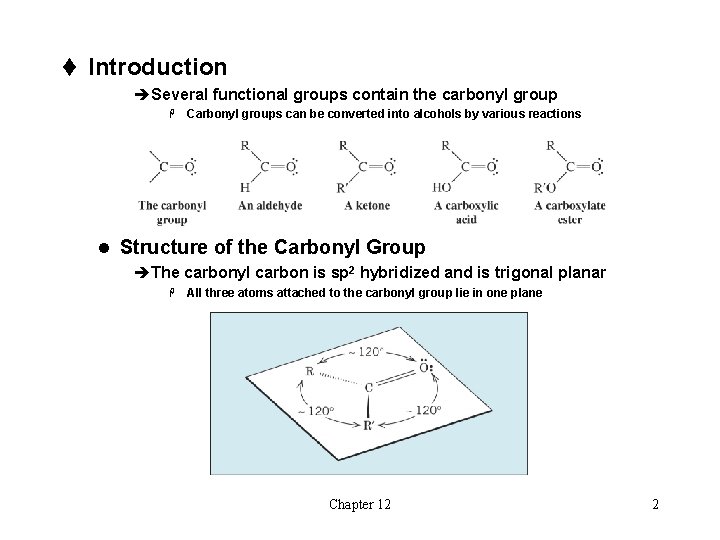
t Introduction èSeveral functional groups contain the carbonyl group H Carbonyl groups can be converted into alcohols by various reactions l Structure of the Carbonyl Group èThe carbonyl carbon is sp 2 hybridized and is trigonal planar H All three atoms attached to the carbonyl group lie in one plane Chapter 12 2
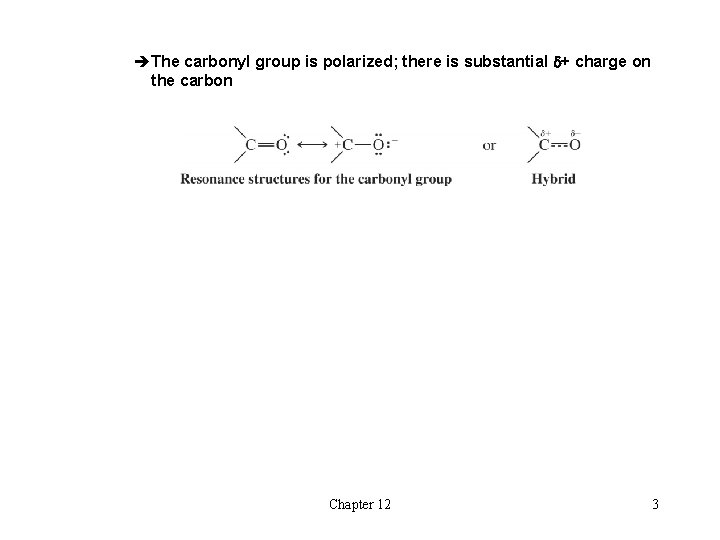
èThe carbonyl group is polarized; there is substantial d+ charge on the carbon Chapter 12 3
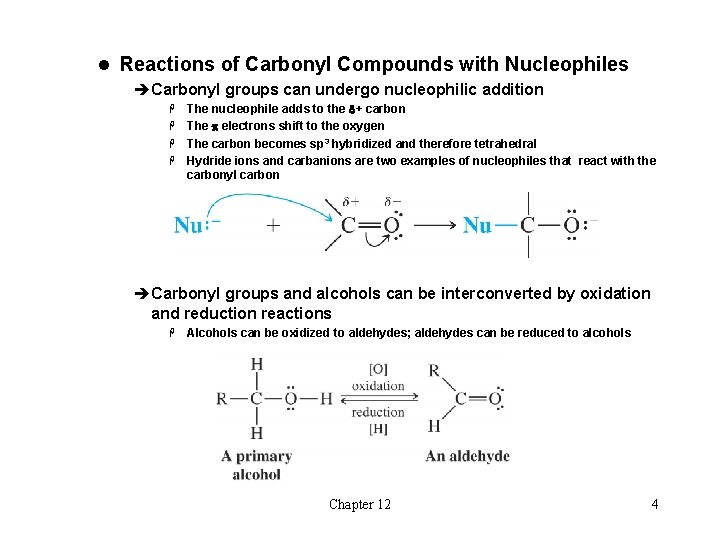
l Reactions of Carbonyl Compounds with Nucleophiles èCarbonyl groups can undergo nucleophilic addition The nucleophile adds to the d+ carbon H The p electrons shift to the oxygen H The carbon becomes sp 3 hybridized and therefore tetrahedral H Hydride ions and carbanions are two examples of nucleophiles that react with the carbonyl carbon H èCarbonyl groups and alcohols can be interconverted by oxidation and reduction reactions H Alcohols can be oxidized to aldehydes; aldehydes can be reduced to alcohols Chapter 12 4
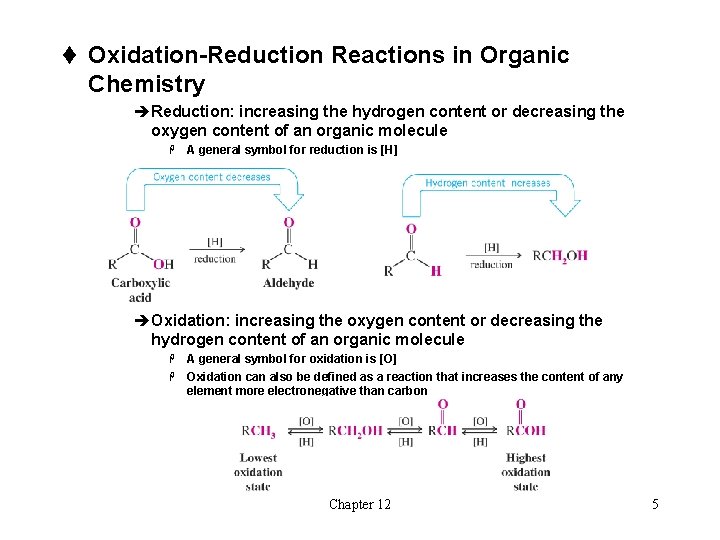
t Oxidation-Reduction Reactions in Organic Chemistry èReduction: increasing the hydrogen content or decreasing the oxygen content of an organic molecule H A general symbol for reduction is [H] èOxidation: increasing the oxygen content or decreasing the hydrogen content of an organic molecule A general symbol for oxidation is [O] H Oxidation can also be defined as a reaction that increases the content of any element more electronegative than carbon H Chapter 12 5
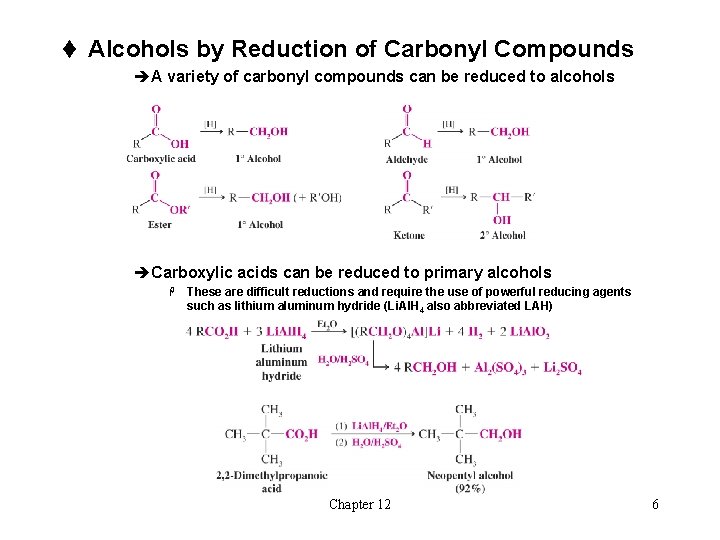
t Alcohols by Reduction of Carbonyl Compounds èA variety of carbonyl compounds can be reduced to alcohols èCarboxylic acids can be reduced to primary alcohols H These are difficult reductions and require the use of powerful reducing agents such as lithium aluminum hydride (Li. Al. H 4 also abbreviated LAH) Chapter 12 6
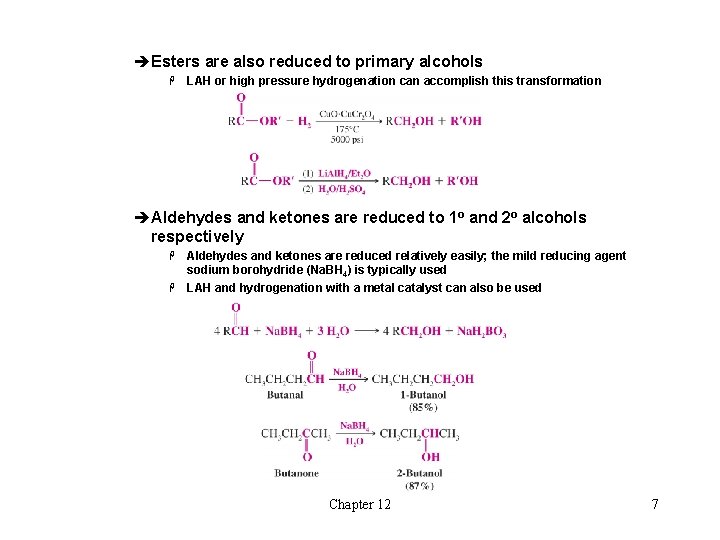
èEsters are also reduced to primary alcohols H LAH or high pressure hydrogenation can accomplish this transformation èAldehydes and ketones are reduced to 1 o and 2 o alcohols respectively Aldehydes and ketones are reduced relatively easily; the mild reducing agent sodium borohydride (Na. BH 4) is typically used H LAH and hydrogenation with a metal catalyst can also be used H Chapter 12 7
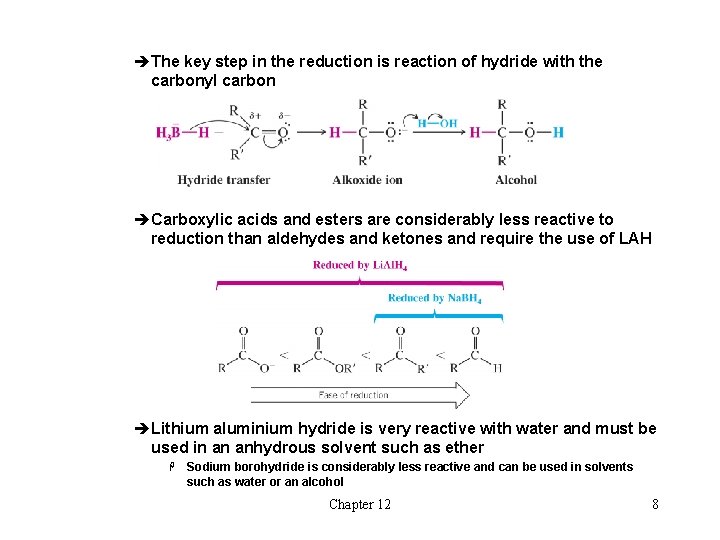
èThe key step in the reduction is reaction of hydride with the carbonyl carbon èCarboxylic acids and esters are considerably less reactive to reduction than aldehydes and ketones and require the use of LAH èLithium aluminium hydride is very reactive with water and must be used in an anhydrous solvent such as ether H Sodium borohydride is considerably less reactive and can be used in solvents such as water or an alcohol Chapter 12 8
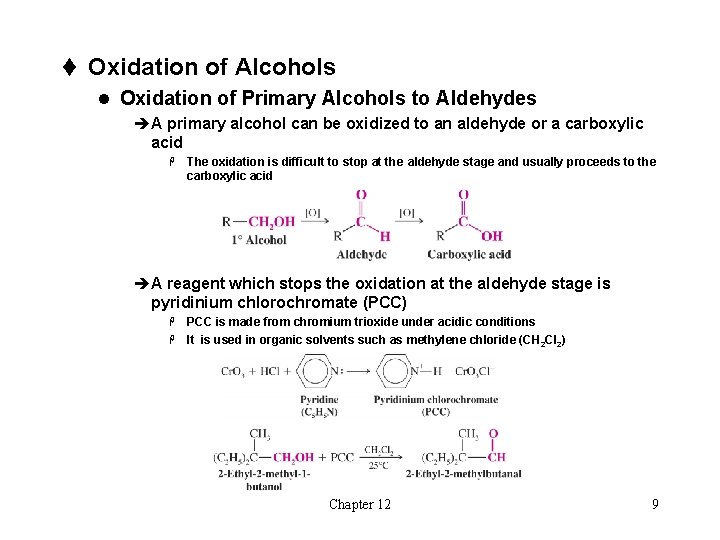
t Oxidation of Alcohols l Oxidation of Primary Alcohols to Aldehydes èA primary alcohol can be oxidized to an aldehyde or a carboxylic acid H The oxidation is difficult to stop at the aldehyde stage and usually proceeds to the carboxylic acid èA reagent which stops the oxidation at the aldehyde stage is pyridinium chlorochromate (PCC) PCC is made from chromium trioxide under acidic conditions H It is used in organic solvents such as methylene chloride (CH 2 Cl 2) H Chapter 12 9
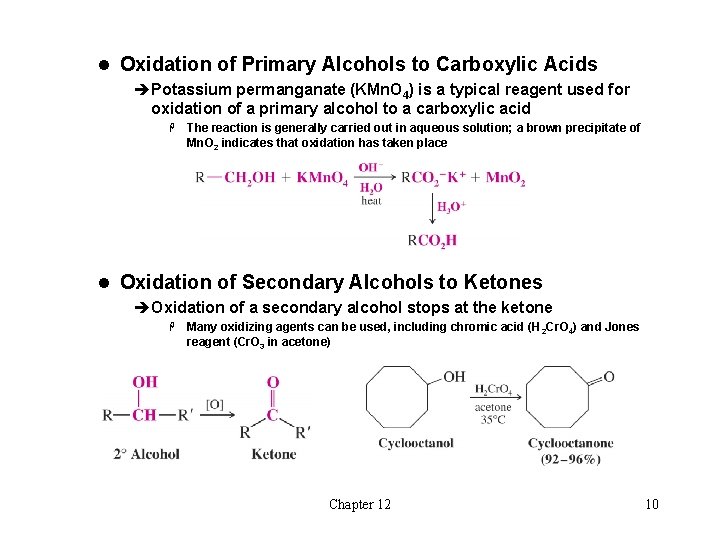
l Oxidation of Primary Alcohols to Carboxylic Acids èPotassium permanganate (KMn. O 4) is a typical reagent used for oxidation of a primary alcohol to a carboxylic acid H The reaction is generally carried out in aqueous solution; a brown precipitate of Mn. O 2 indicates that oxidation has taken place l Oxidation of Secondary Alcohols to Ketones èOxidation of a secondary alcohol stops at the ketone H Many oxidizing agents can be used, including chromic acid (H 2 Cr. O 4) and Jones reagent (Cr. O 3 in acetone) Chapter 12 10

l Mechanism of Chromate Oxidation èStep 1: A chromate ester is formed from the alcohol hydroxyl èStep 2: An elimination reaction occurs by removal of a hydrogen atom from the alcohol carbon and departure of the chromium group with a pair of electrons. Chapter 12 11

èAldehydes form hydrates in water H An aldehyde hydrate can react to form a chromate ester which can subsequently undergo elimination to produce a carboxylic acid èPyridinium chlorochromate reactions are run in anhydrous methylene chloride and the aldehyde cannot form a hydrate H The oxidation of a primary alcohol therefore stops at the aldehyde stage èTertiary alcohols can form the chromate ester but cannot eliminate because they have no hydrogen on the alcohol carbon H Tertiary alcohols are therefore not oxidized by chromium based reagents Chapter 12 12
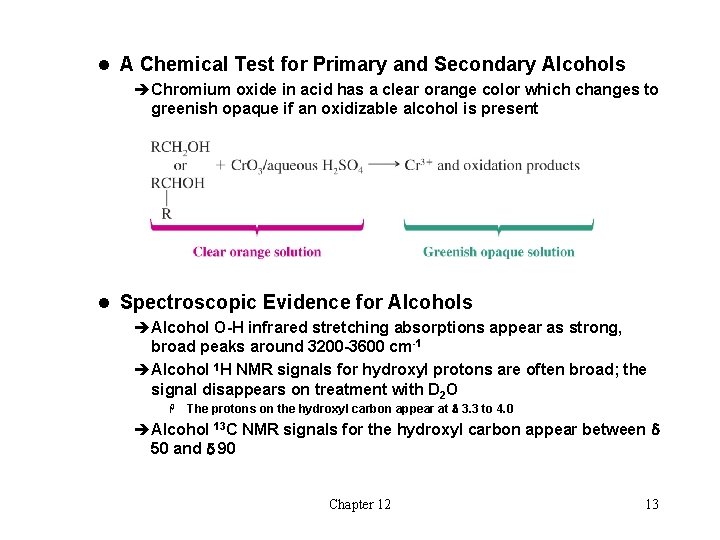
l A Chemical Test for Primary and Secondary Alcohols èChromium oxide in acid has a clear orange color which changes to greenish opaque if an oxidizable alcohol is present l Spectroscopic Evidence for Alcohols èAlcohol O-H infrared stretching absorptions appear as strong, broad peaks around 3200 -3600 cm-1 èAlcohol 1 H NMR signals for hydroxyl protons are often broad; the signal disappears on treatment with D 2 O H The protons on the hydroxyl carbon appear at d 3. 3 to 4. 0 èAlcohol 13 C NMR signals for the hydroxyl carbon appear between d 50 and d 90 Chapter 12 13
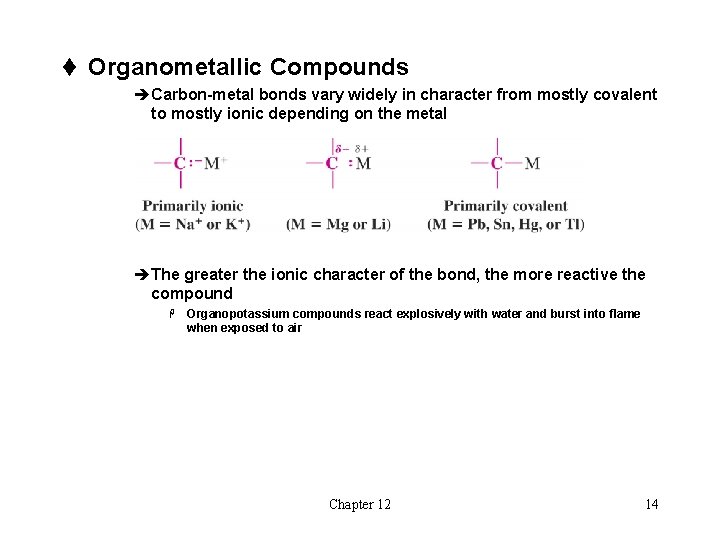
t Organometallic Compounds èCarbon-metal bonds vary widely in character from mostly covalent to mostly ionic depending on the metal èThe greater the ionic character of the bond, the more reactive the compound H Organopotassium compounds react explosively with water and burst into flame when exposed to air Chapter 12 14
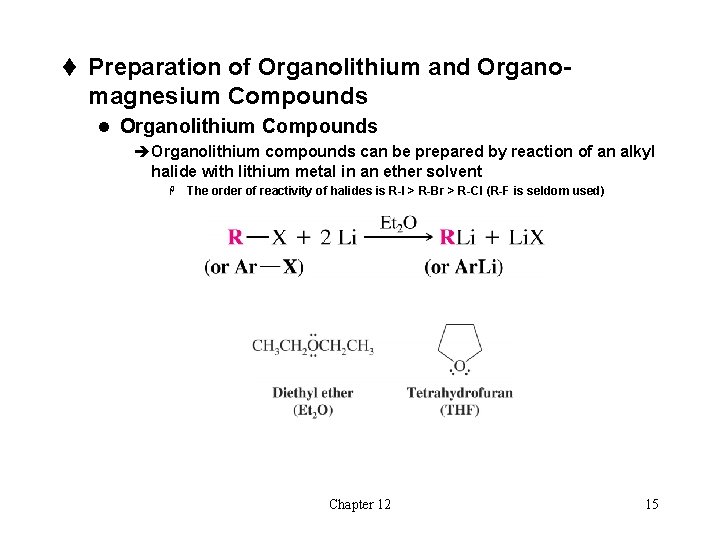
t Preparation of Organolithium and Organo- magnesium Compounds l Organolithium Compounds èOrganolithium compounds can be prepared by reaction of an alkyl halide with lithium metal in an ether solvent H The order of reactivity of halides is R-I > R-Br > R-Cl (R-F is seldom used) Chapter 12 15
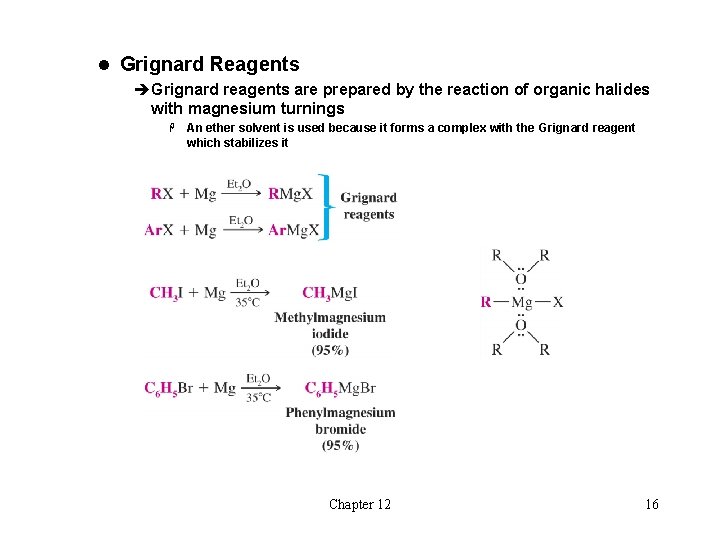
l Grignard Reagents èGrignard reagents are prepared by the reaction of organic halides with magnesium turnings H An ether solvent is used because it forms a complex with the Grignard reagent which stabilizes it Chapter 12 16
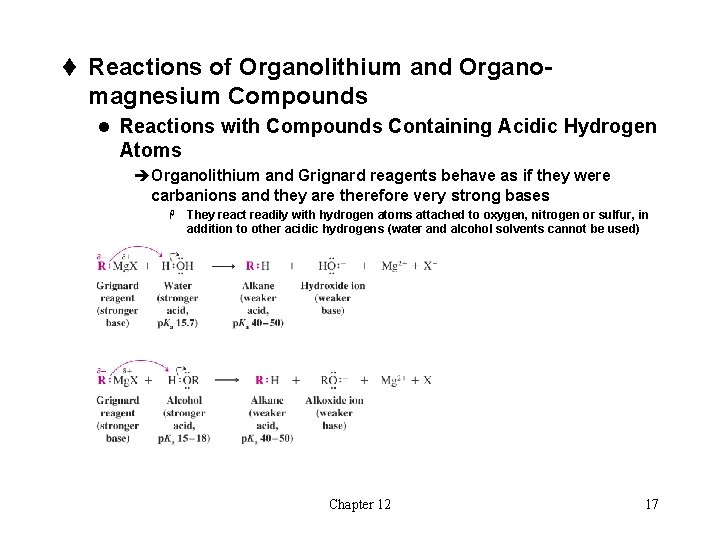
t Reactions of Organolithium and Organo- magnesium Compounds l Reactions with Compounds Containing Acidic Hydrogen Atoms èOrganolithium and Grignard reagents behave as if they were carbanions and they are therefore very strong bases H They react readily with hydrogen atoms attached to oxygen, nitrogen or sulfur, in addition to other acidic hydrogens (water and alcohol solvents cannot be used) Chapter 12 17
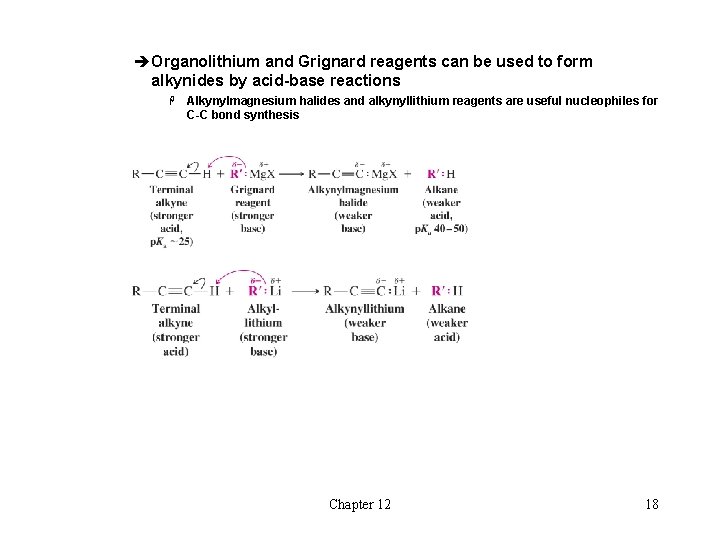
èOrganolithium and Grignard reagents can be used to form alkynides by acid-base reactions H Alkynylmagnesium halides and alkynyllithium reagents are useful nucleophiles for C-C bond synthesis Chapter 12 18
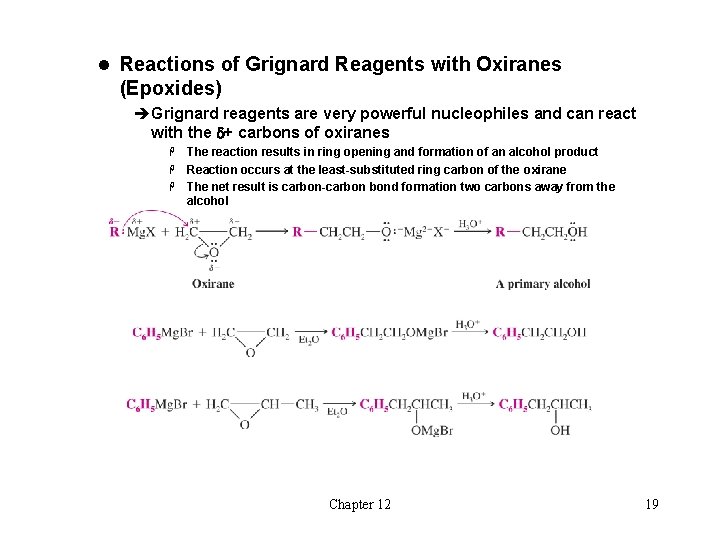
l Reactions of Grignard Reagents with Oxiranes (Epoxides) èGrignard reagents are very powerful nucleophiles and can react with the d+ carbons of oxiranes The reaction results in ring opening and formation of an alcohol product H Reaction occurs at the least-substituted ring carbon of the oxirane H The net result is carbon-carbon bond formation two carbons away from the alcohol H Chapter 12 19
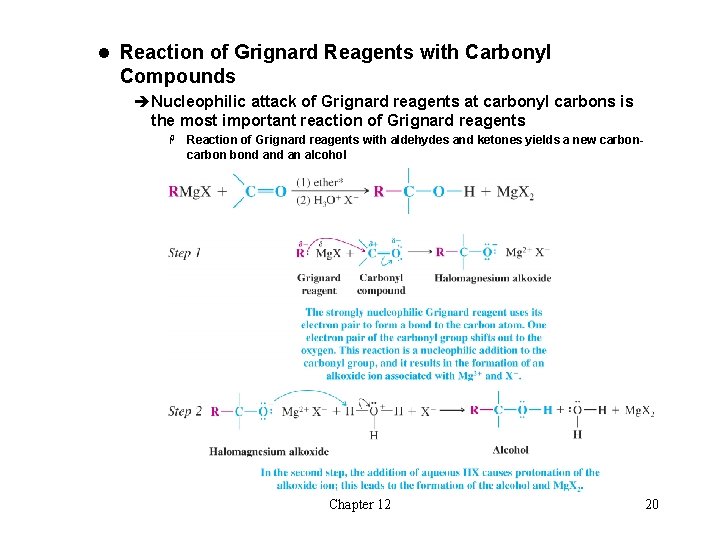
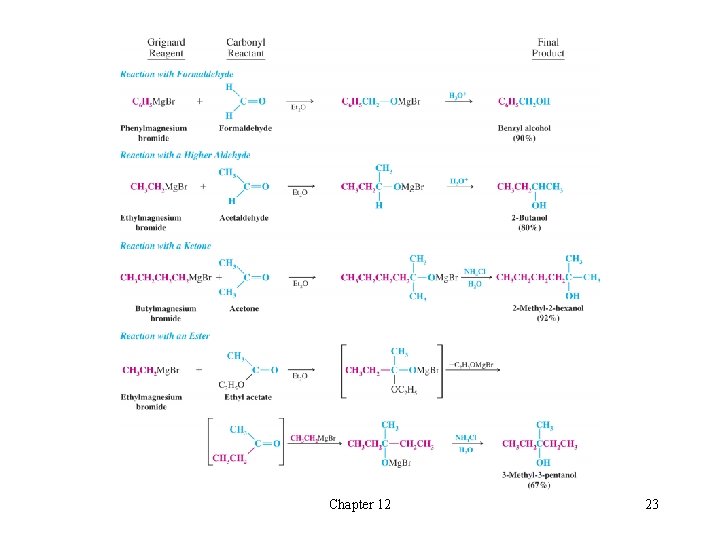
l Reaction of Grignard Reagents with Carbonyl Compounds èNucleophilic attack of Grignard reagents at carbonyl carbons is the most important reaction of Grignard reagents H Reaction of Grignard reagents with aldehydes and ketones yields a new carbon bond an alcohol Chapter 12 20
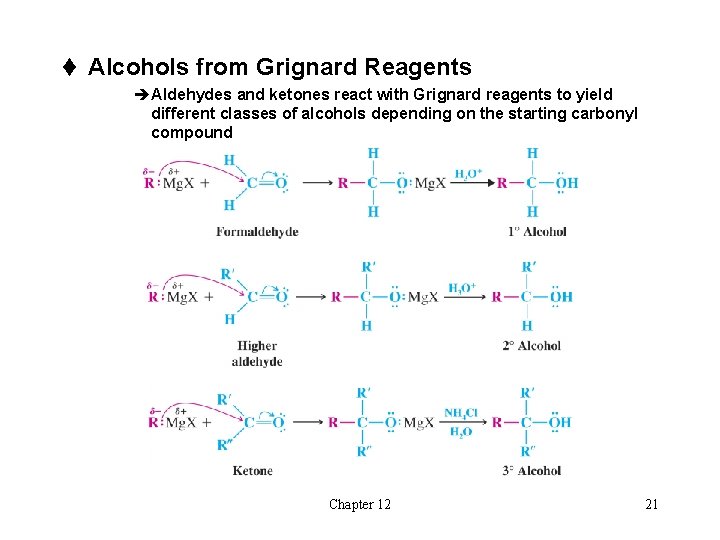
t Alcohols from Grignard Reagents èAldehydes and ketones react with Grignard reagents to yield different classes of alcohols depending on the starting carbonyl compound Chapter 12 21
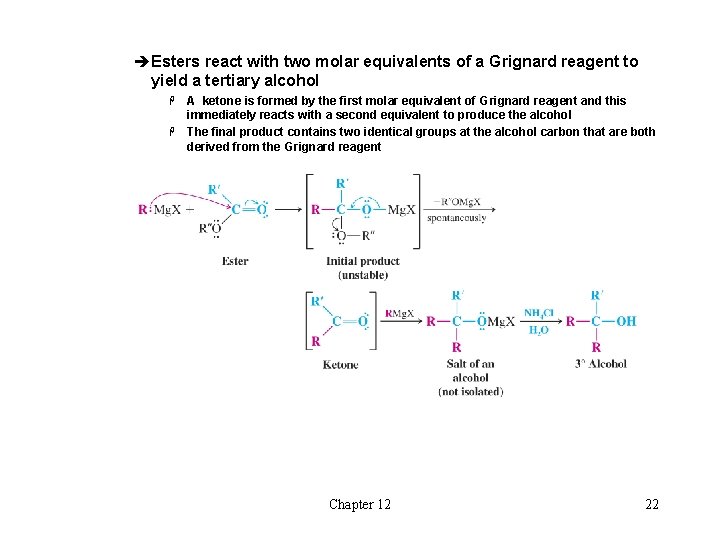
èEsters react with two molar equivalents of a Grignard reagent to yield a tertiary alcohol A ketone is formed by the first molar equivalent of Grignard reagent and this immediately reacts with a second equivalent to produce the alcohol H The final product contains two identical groups at the alcohol carbon that are both derived from the Grignard reagent H Chapter 12 22
Chapter 12 23
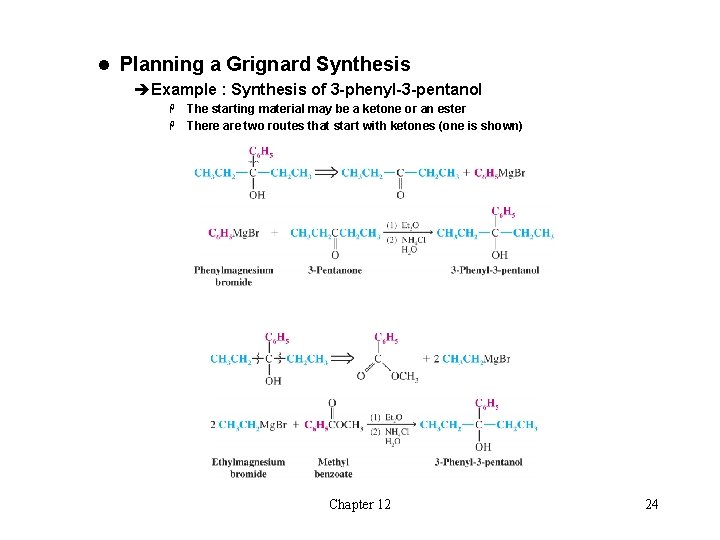
l Planning a Grignard Synthesis èExample : Synthesis of 3 -phenyl-3 -pentanol The starting material may be a ketone or an ester H There are two routes that start with ketones (one is shown) H Chapter 12 24
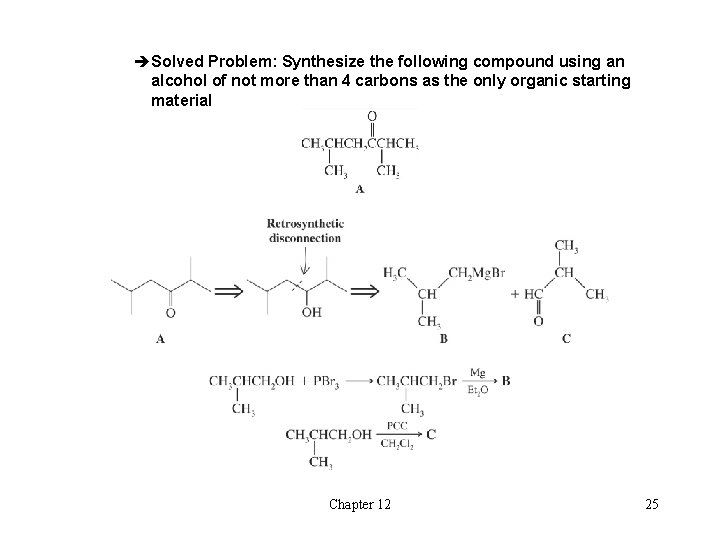
èSolved Problem: Synthesize the following compound using an alcohol of not more than 4 carbons as the only organic starting material Chapter 12 25
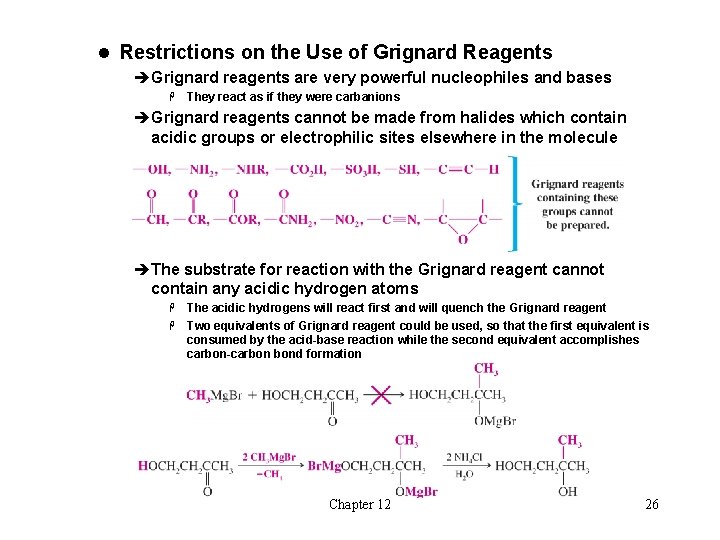
l Restrictions on the Use of Grignard Reagents èGrignard reagents are very powerful nucleophiles and bases H They react as if they were carbanions èGrignard reagents cannot be made from halides which contain acidic groups or electrophilic sites elsewhere in the molecule èThe substrate for reaction with the Grignard reagent cannot contain any acidic hydrogen atoms The acidic hydrogens will react first and will quench the Grignard reagent H Two equivalents of Grignard reagent could be used, so that the first equivalent is consumed by the acid-base reaction while the second equivalent accomplishes carbon-carbon bond formation H Chapter 12 26
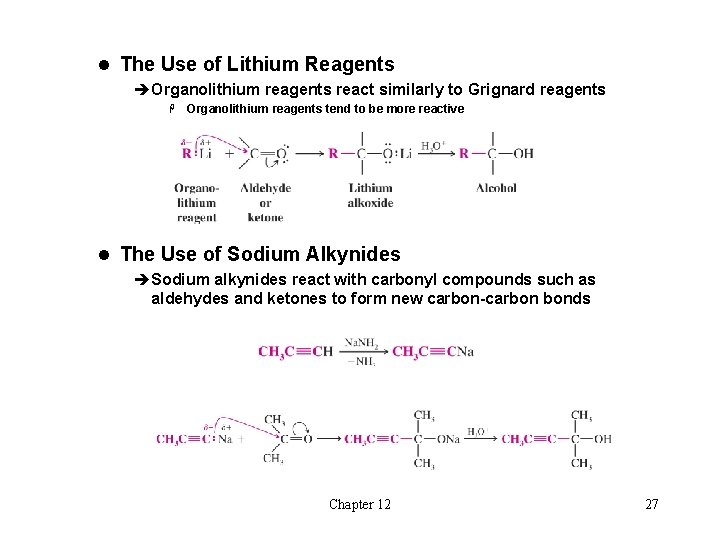
l The Use of Lithium Reagents èOrganolithium reagents react similarly to Grignard reagents H Organolithium reagents tend to be more reactive l The Use of Sodium Alkynides èSodium alkynides react with carbonyl compounds such as aldehydes and ketones to form new carbon-carbon bonds Chapter 12 27
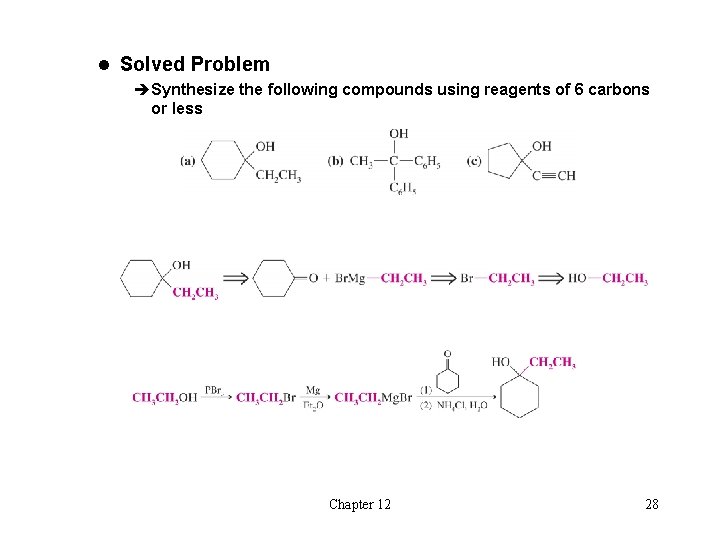
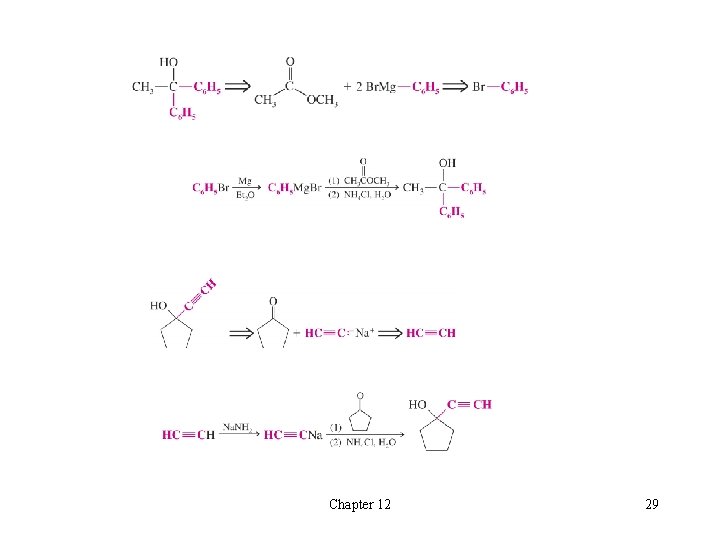
l Solved Problem èSynthesize the following compounds using reagents of 6 carbons or less Chapter 12 28
Chapter 12 29
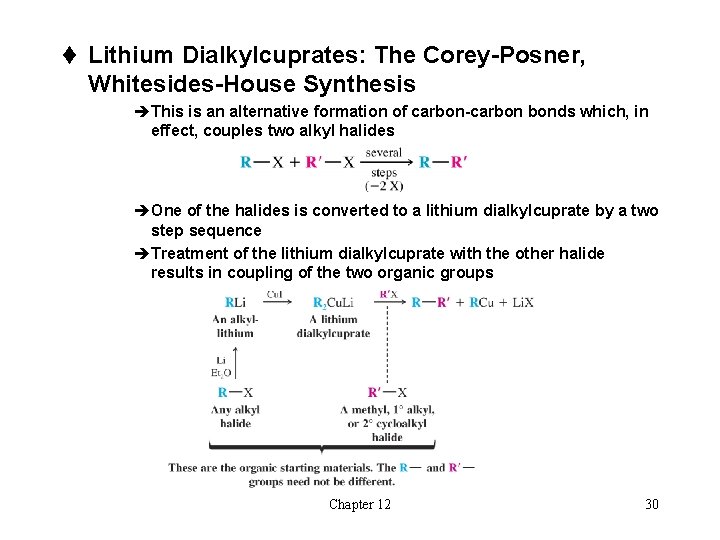
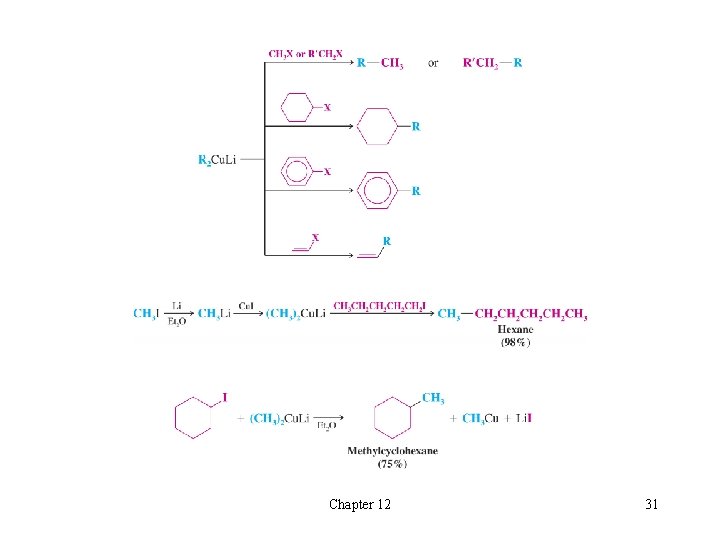
t Lithium Dialkylcuprates: The Corey-Posner, Whitesides-House Synthesis èThis is an alternative formation of carbon-carbon bonds which, in effect, couples two alkyl halides èOne of the halides is converted to a lithium dialkylcuprate by a two step sequence èTreatment of the lithium dialkylcuprate with the other halide results in coupling of the two organic groups Chapter 12 30
Chapter 12 31
- Slides: 31