
Chapter 12 Acids and Bases 12 1 The
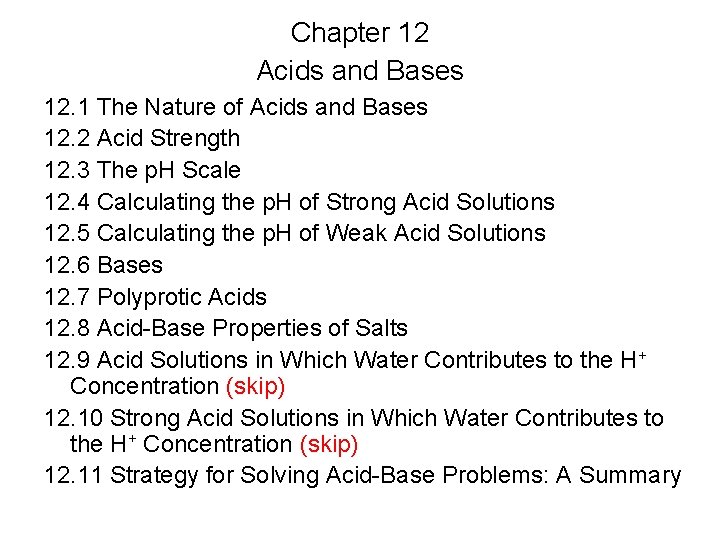
Chapter 12 Acids and Bases 12. 1 The Nature of Acids and Bases 12. 2 Acid Strength 12. 3 The p. H Scale 12. 4 Calculating the p. H of Strong Acid Solutions 12. 5 Calculating the p. H of Weak Acid Solutions 12. 6 Bases 12. 7 Polyprotic Acids 12. 8 Acid-Base Properties of Salts 12. 9 Acid Solutions in Which Water Contributes to the H+ Concentration (skip) 12. 10 Strong Acid Solutions in Which Water Contributes to the H+ Concentration (skip) 12. 11 Strategy for Solving Acid-Base Problems: A Summary
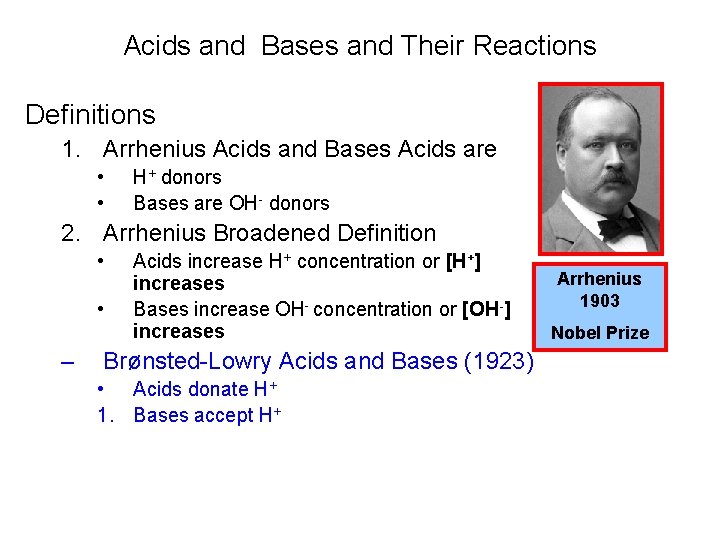
Acids and Bases and Their Reactions Definitions 1. Arrhenius Acids and Bases Acids are • • H+ donors Bases are OH- donors 2. Arrhenius Broadened Definition • • – Acids increase H+ concentration or [H+] increases Bases increase OH- concentration or [OH-] increases Brønsted-Lowry Acids and Bases (1923) • Acids donate H+ 1. Bases accept H+ Arrhenius 1903 Nobel Prize

Acids-Bases Brønsted-Lowry Acids and Bases A Brønsted-Lowry acid is a substance that can donate a hydrogen ion (aka H+, proton). A Brønsted-Lowry base is a substance that can accept a hydrogen ion. Acids and bases occur as conjugate acid base pairs.
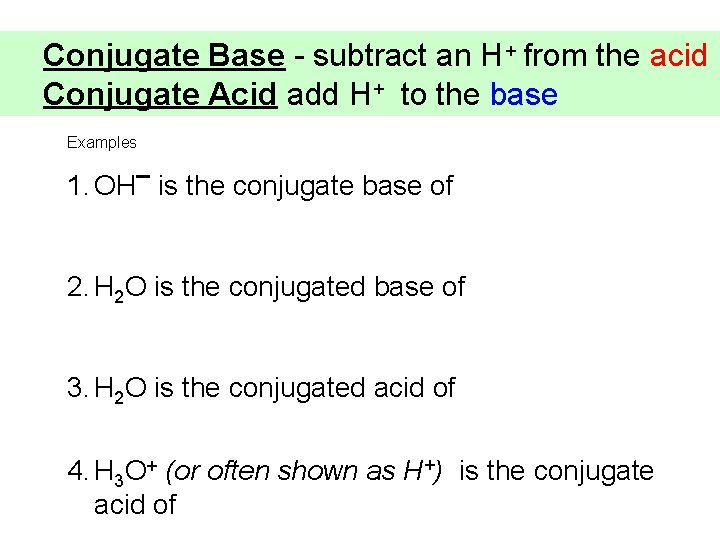
Conjugate Base - subtract an H+ from the acid Conjugate Acid add H+ to the base Examples 1. OH– is the conjugate base of 2. H 2 O is the conjugated base of 3. H 2 O is the conjugated acid of 4. H 3 O+ (or often shown as H+) is the conjugate acid of
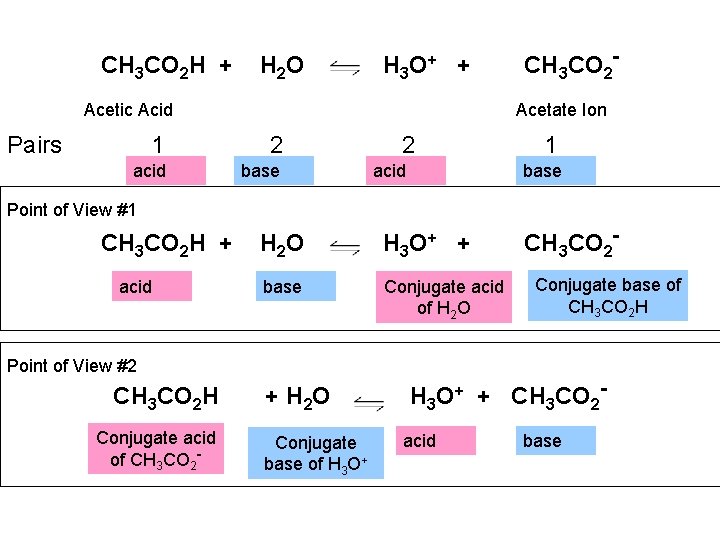
CH 3 CO 2 H + H 2 O H 3 O+ + CH 3 CO 2 Acetic Acid Pairs Acetate Ion 1 2 acid base 2 acid 1 base Point of View #1 CH 3 CO 2 H + H 2 O H 3 O+ + CH 3 CO 2 acid base Conjugate acid of H 2 O Conjugate base of CH 3 CO 2 H Point of View #2 CH 3 CO 2 H + H 2 O H 3 O+ + CH 3 CO 2 - Conjugate acid of CH 3 CO 2 - Conjugate base of H 3 O+ acid base
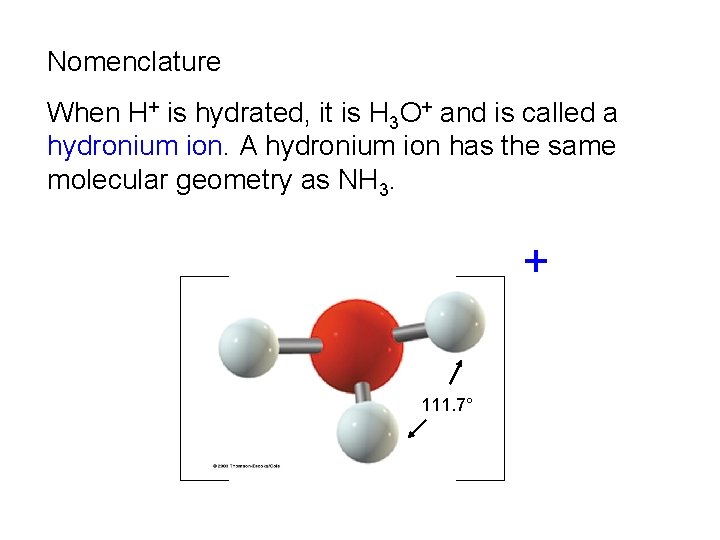
Nomenclature When H+ is hydrated, it is H 3 O+ and is called a hydronium ion. A hydronium ion has the same molecular geometry as NH 3. + 111. 7°
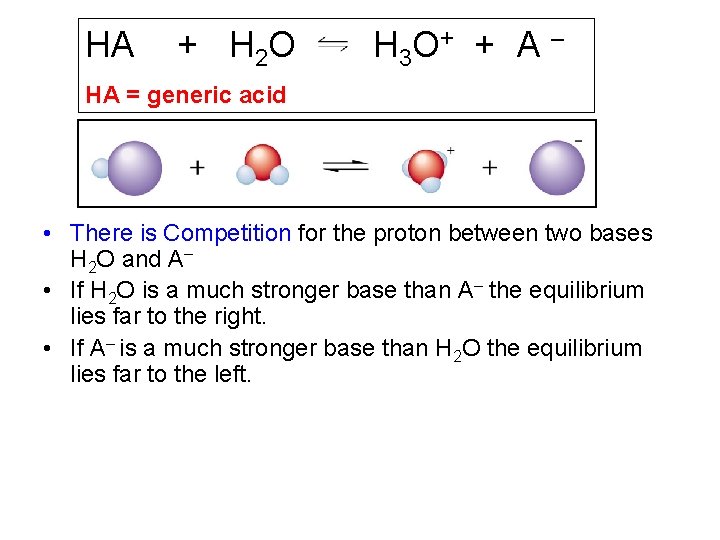
HA + H 2 O H 3 O + + A – HA = generic acid • There is Competition for the proton between two bases H 2 O and A– • If H 2 O is a much stronger base than A– the equilibrium lies far to the right. • If A– is a much stronger base than H 2 O the equilibrium lies far to the left.

Acid Strength: graphical representation of the behavior of acids of different strengths in aqueous solution. A strong acid: equilibrium lies far to the right HA + H 2 O H 3 O + + A – A weak acid: equilibrium lies far to the left HA + H 2 O H 3 O + + A – A weak acid yields a relatively strong conjugate base
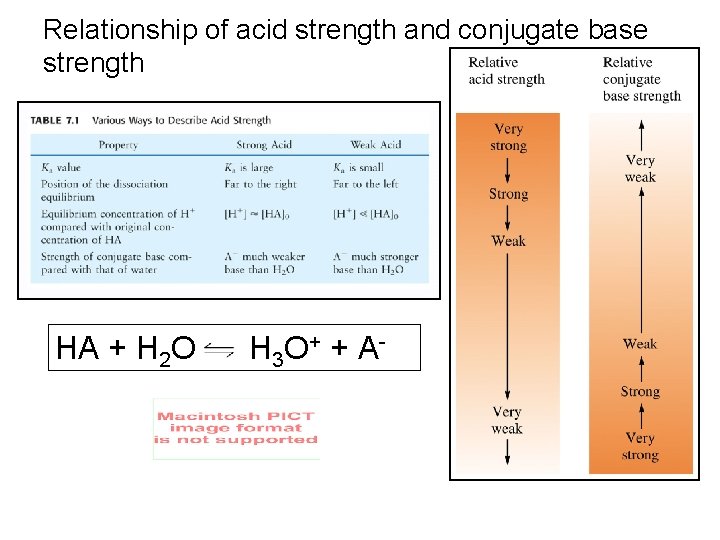
Relationship of acid strength and conjugate base strength HA + H 2 O H 3 O + + A -
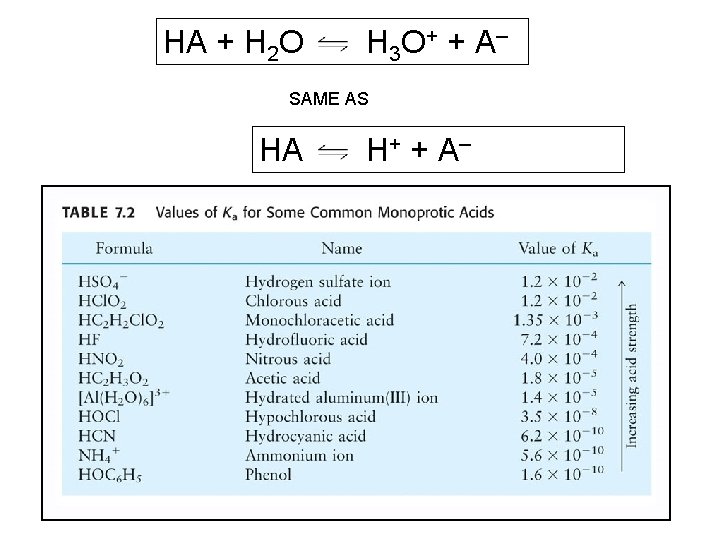
HA + H 2 O H 3 O + + A – SAME AS HA H+ + A –
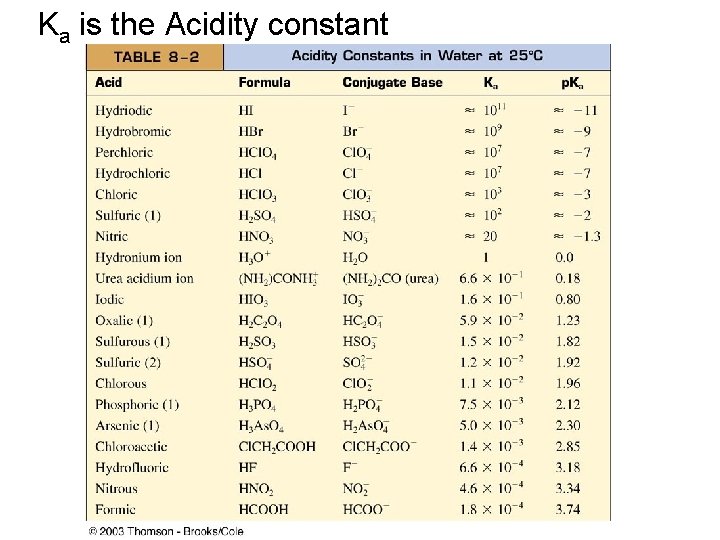
Ka is the Acidity constant
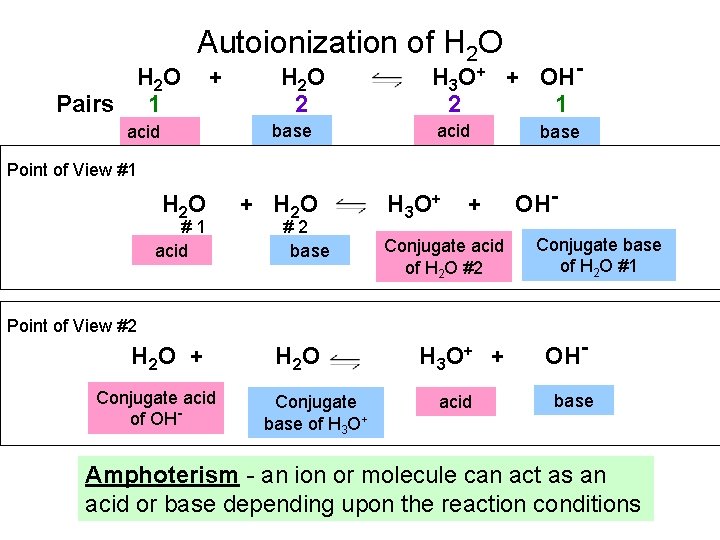
Autoionization of H 2 O + H 2 O H 3 O+ + OH Pairs 1 2 1 base acid base Point of View #1 H 2 O + H 2 O H 3 O+ + OH- #1 acid #2 base Point of View #2 H 2 O + Conjugate acid of OH- H 2 O Conjugate base of H 3 O+ Conjugate acid of H 2 O #2 Conjugate base of H 2 O #1 H 3 O+ + OHacid base Amphoterism - an ion or molecule can act as an acid or base depending upon the reaction conditions
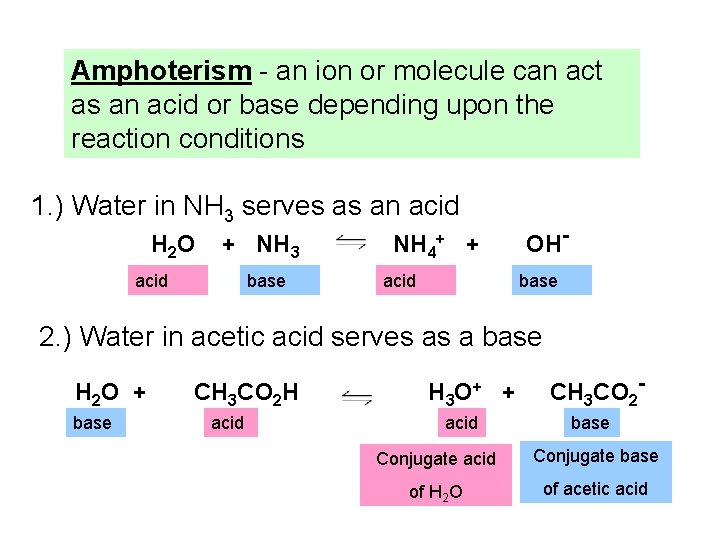
Amphoterism - an ion or molecule can act as an acid or base depending upon the reaction conditions 1. ) Water in NH 3 serves as an acid H 2 O + NH 3 NH 4+ + OH- acid base 2. ) Water in acetic acid serves as a base H 2 O + CH 3 CO 2 H H 3 O+ + CH 3 CO 2 base acid base Conjugate acid Conjugate base of H 2 O of acetic acid
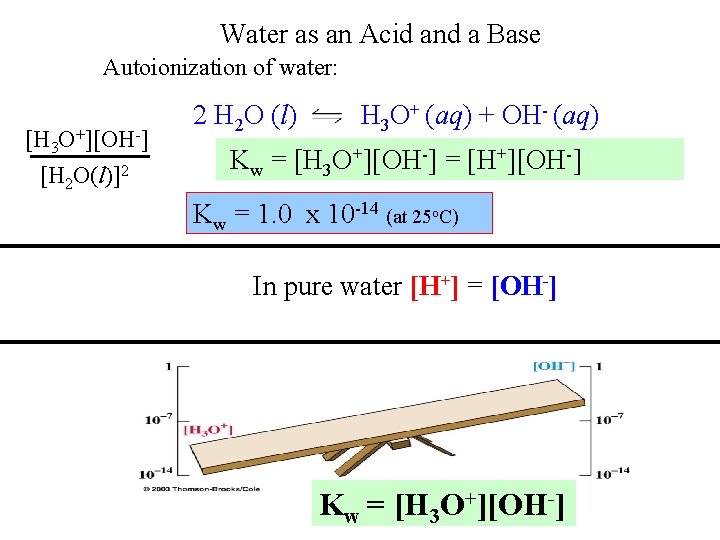
Water as an Acid and a Base Autoionization of water: [H 3 O+][OH-] [H 2 O(l)]2 2 H 2 O (l) H 3 O+ (aq) + OH- (aq) Kw = [H 3 O+][OH-] = [H+][OH-] Kw = 1. 0 x 10 -14 (at 25 o. C) In pure water [H+] = [OH-] Kw = [H 3 O+][OH-]
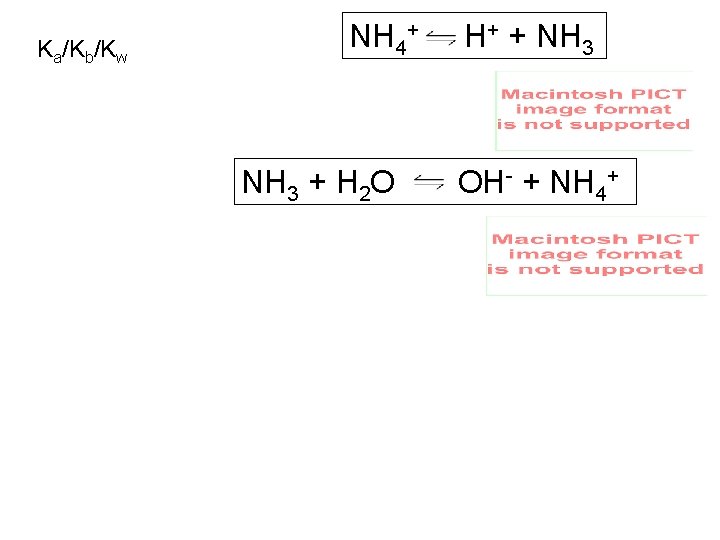
Ka/Kb/Kw NH 4+ NH 3 + H 2 O H+ + NH 3 OH- + NH 4+
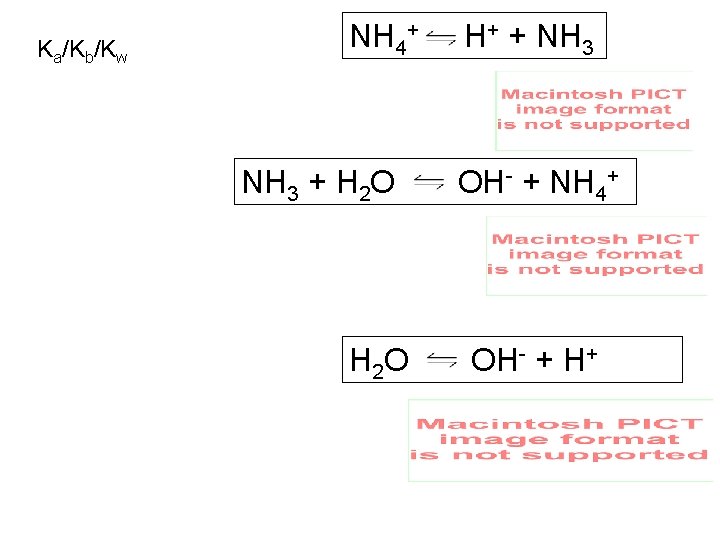
Ka/Kb/Kw NH 4+ NH 3 + H 2 O H+ + NH 3 OH- + NH 4+ OH- + H+
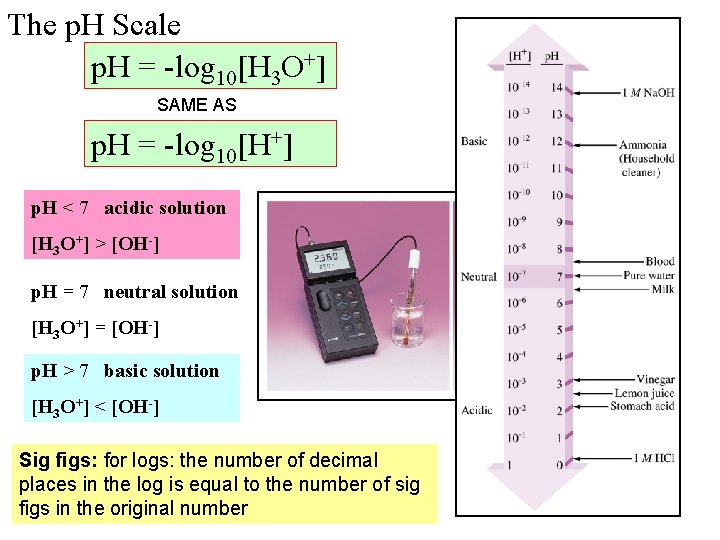
The p. H Scale p. H = -log 10[H 3 O+] SAME AS p. H = -log 10[H+] p. H < 7 acidic solution [H 3 O+] > [OH-] p. H = 7 neutral solution [H 3 O+] = [OH-] p. H > 7 basic solution [H 3 O+] < [OH-] Sig figs: for logs: the number of decimal places in the log is equal to the number of sig figs in the original number
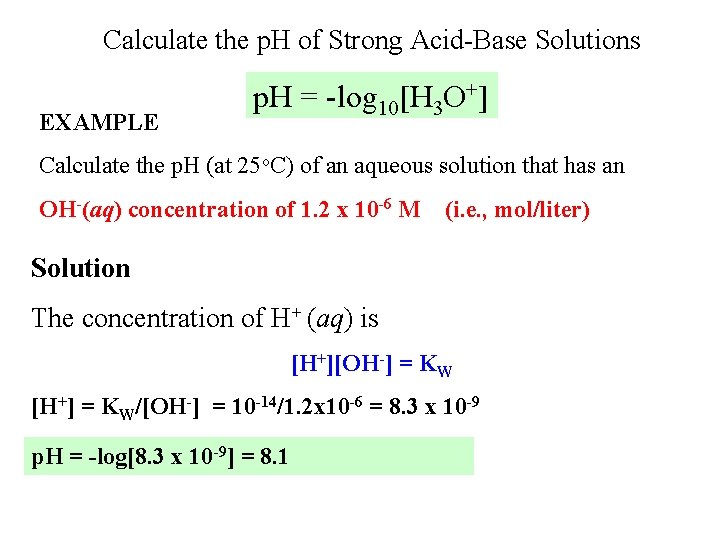
Calculate the p. H of Strong Acid-Base Solutions EXAMPLE p. H = -log 10[H 3 O+] Calculate the p. H (at 25 o. C) of an aqueous solution that has an OH-(aq) concentration of 1. 2 x 10 -6 M (i. e. , mol/liter) Solution The concentration of H+ (aq) is [H+][OH-] = KW [H+] = KW/[OH-] = 10 -14/1. 2 x 10 -6 = 8. 3 x 10 -9 p. H = -log[8. 3 x 10 -9] = 8. 1
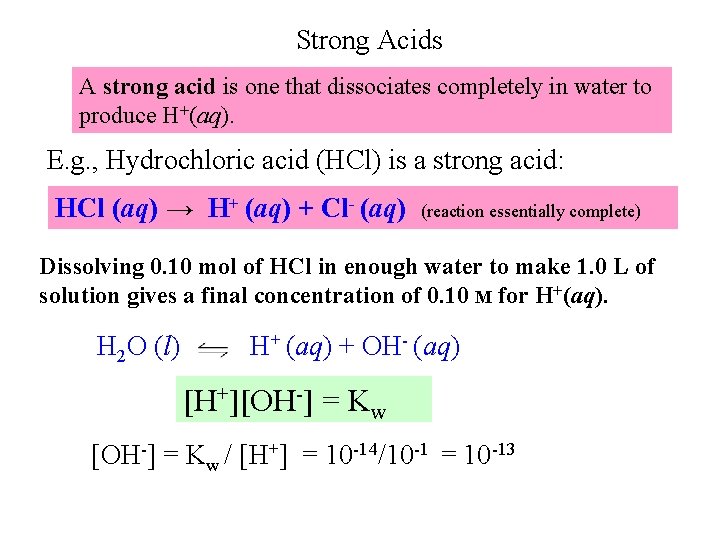
Strong Acids A strong acid is one that dissociates completely in water to produce H+(aq). E. g. , Hydrochloric acid (HCl) is a strong acid: HCl (aq) → H+ (aq) + Cl- (aq) (reaction essentially complete) Dissolving 0. 10 mol of HCl in enough water to make 1. 0 L of solution gives a final concentration of 0. 10 M for H+(aq). H 2 O (l) H+ (aq) + OH- (aq) [H+][OH-] = Kw / [H+] = 10 -14/10 -1 = 10 -13
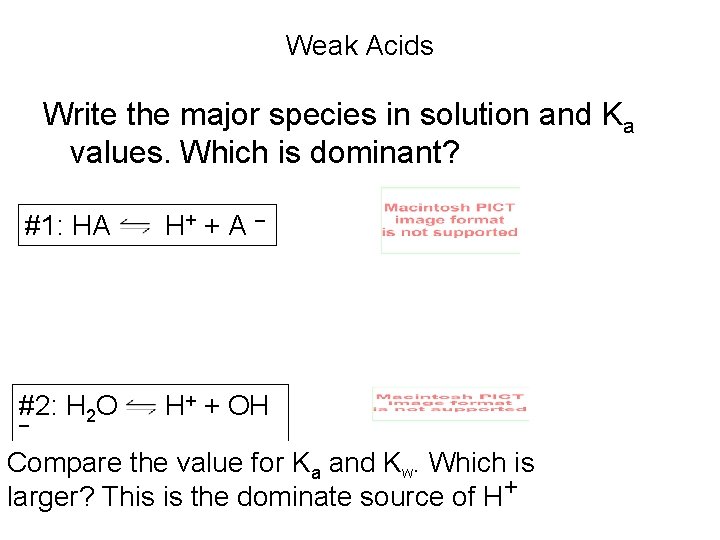
Weak Acids Write the major species in solution and Ka values. Which is dominant? #1: HA H+ + A – #2: H 2 O H+ + OH – Compare the value for Ka and Kw. Which is larger? This is the dominate source of H+
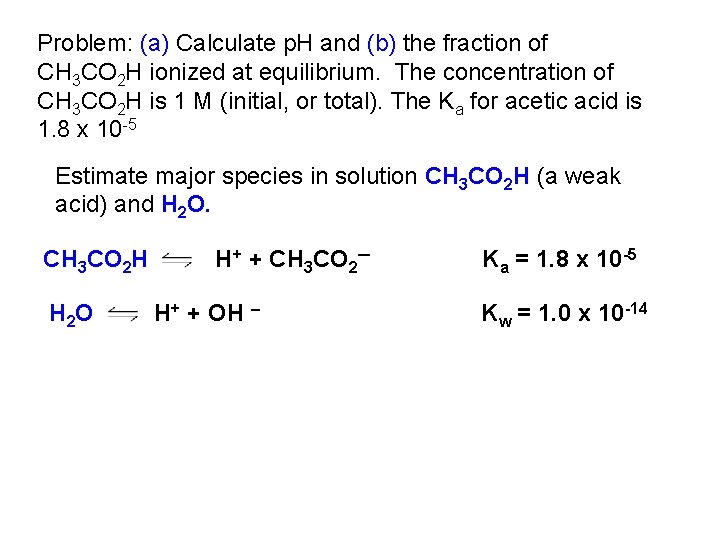
Problem: (a) Calculate p. H and (b) the fraction of CH 3 CO 2 H ionized at equilibrium. The concentration of CH 3 CO 2 H is 1 M (initial, or total). The Ka for acetic acid is 1. 8 x 10 -5 Estimate major species in solution CH 3 CO 2 H (a weak acid) and H 2 O. CH 3 CO 2 H H+ + CH 3 CO 2─ H 2 O H+ + OH – K -5 = 1. 8 x 10 a Kw = 1. 0 x 10 -14
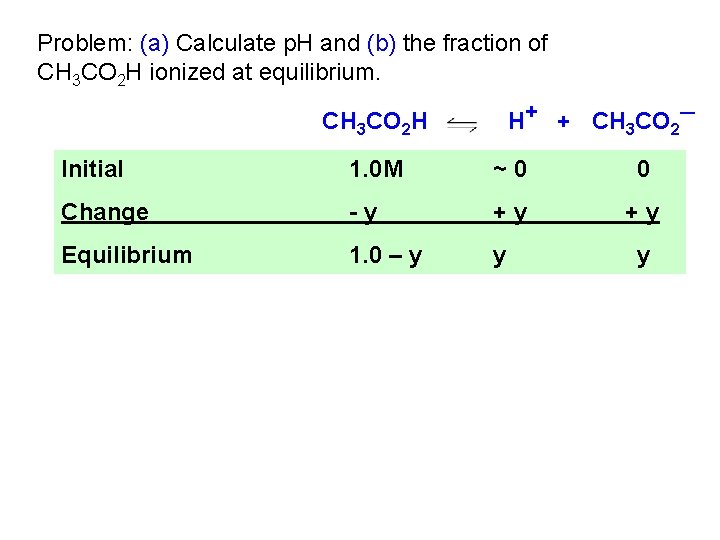
Problem: (a) Calculate p. H and (b) the fraction of CH 3 CO 2 H ionized at equilibrium. CH 3 CO 2 H H+ + CH 3 CO 2─ Initial 1. 0 M ~ 0 Change - y + y Equilibrium 1. 0 – y y 0 + y y
Problem: (a) Calculate p. H and (b) the fraction of CH 3 CO 2 H ionized at equilibrium. CH 3 CO 2 H H+ + CH 3 CO 2─ Initial 1. 0 M ~ 0 Change - y + y Equilibrium 1. 0 – y y 0 + y y
Problem: (a) Calculate p. H and (b) the fraction of CH 3 CO 2 H ionized at equilibrium. CH 3 CO 2 H H+ + CH 3 CO 2─ Initial 1. 0 M ~ 0 Change - y + y Equilibrium 1. 0 – y y 0 + y y
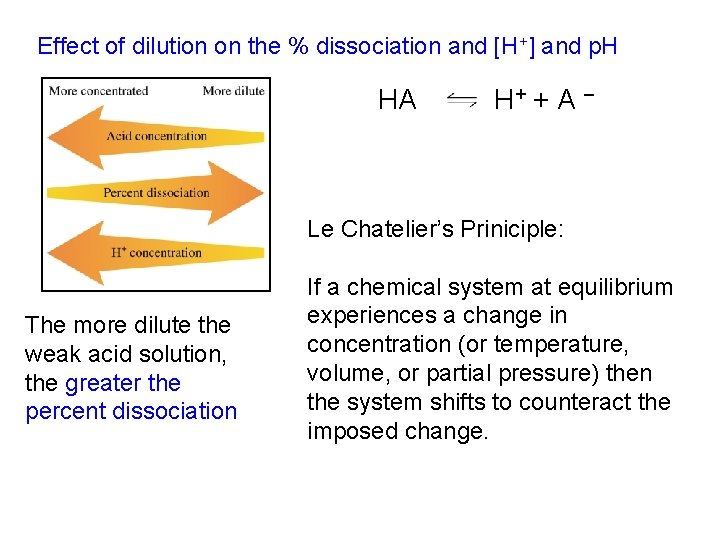
Effect of dilution on the % dissociation and [H+] and p. H HA H+ + A – Le Chatelier’s Priniciple: The more dilute the weak acid solution, the greater the percent dissociation If a chemical system at equilibrium experiences a change in concentration (or temperature, volume, or partial pressure) then the system shifts to counteract the imposed change.
Strong Bases A strong base reacts water to Strongcompletely Acids and with Bases produce OH-(aq) ions. Sodium hydroxide (Na. OH) is a strong base: Others are KOH–, NH 2– (amide ion) and H– (Hydride ion) Na. OH (s) → Na+ (aq) + OH- (aq) (reaction essentially complete) Dissolving 0. 10 mol of Na. OH in enough water to make 1. 0 L of solution gives a final concentration of 0. 10 M for OH- (aq). From this you can calculate p. H and p. OH. [H+][OH-] = Kw [H+] = Kw/[OH-] =10 -14/10 -1 = 10 -13 [OH-] = 10 -1 [H+] = 10 -13 p. OH = 1 p. H = 13
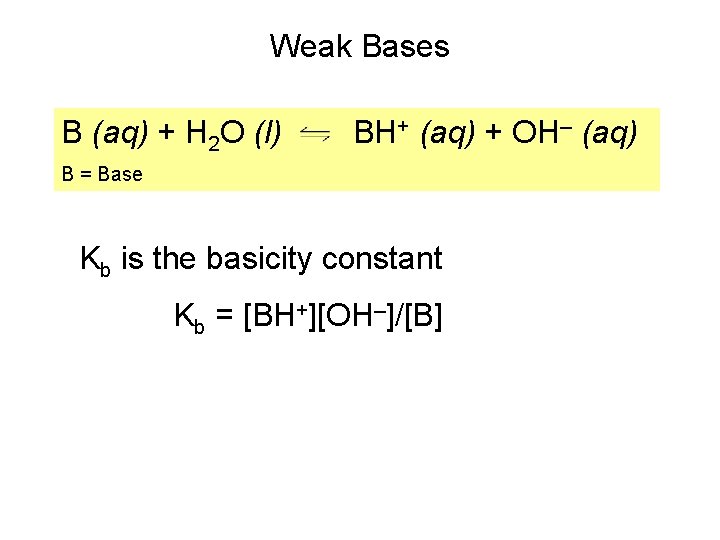
Weak Bases B (aq) + H 2 O (l) BH+ (aq) + OH– (aq) B = Base Kb is the basicity constant Kb = [BH+][OH–]/[B]
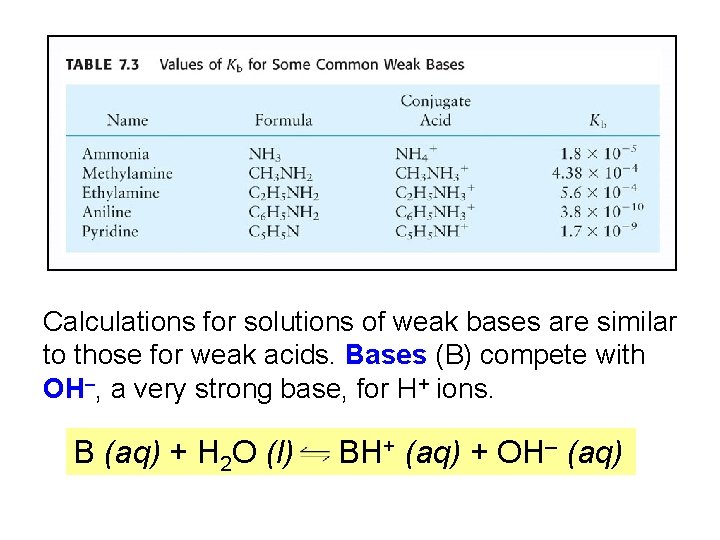
Calculations for solutions of weak bases are similar to those for weak acids. Bases (B) compete with OH–, a very strong base, for H+ ions. B (aq) + H 2 O (l) BH+ (aq) + OH– (aq)
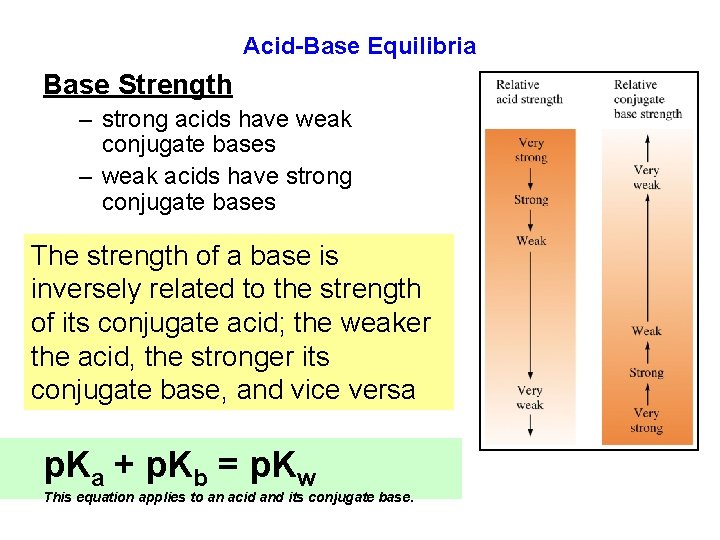
Acid-Base Equilibria Base Strength – strong acids have weak conjugate bases – weak acids have strong conjugate bases The strength of a base is inversely related to the strength of its conjugate acid; the weaker the acid, the stronger its conjugate base, and vice versa p. Ka + p. Kb = p. Kw This equation applies to an acid and its conjugate base.
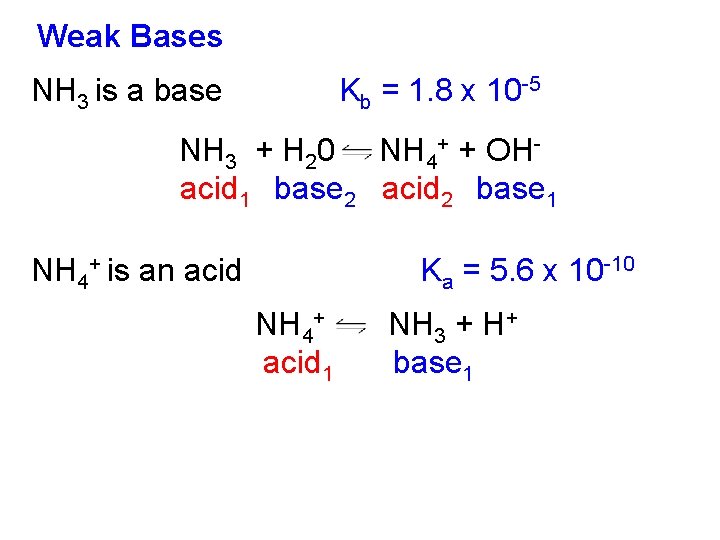
Weak Bases NH 3 is a base Kb = 1. 8 x 10 -5 NH 3 + H 20 NH 4+ + OHacid 1 base 2 acid 2 base 1 NH 4+ is an acid Ka = 5. 6 x 10 -10 NH 4+ acid 1 NH 3 + H+ base 1
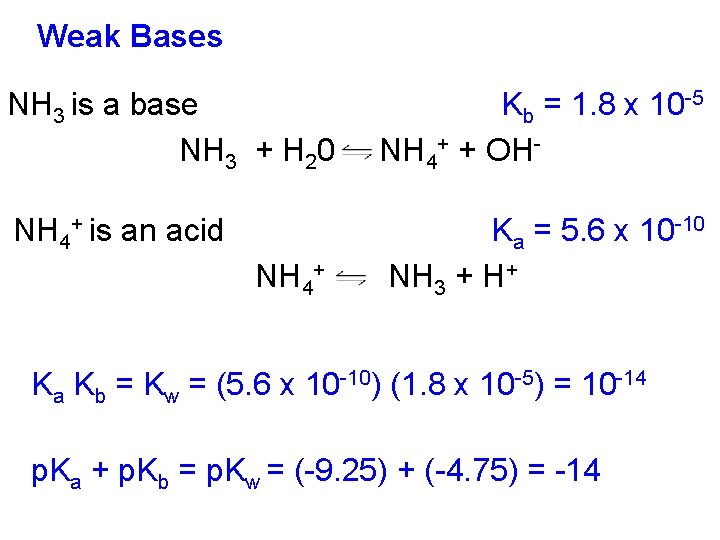
Weak Bases NH 3 is a base NH 3 + H 20 Kb = 1. 8 x 10 -5 NH 4+ + OH- NH 4+ is an acid Ka = 5. 6 x 10 -10 NH 3 + H+ NH 4+ Ka Kb = Kw = (5. 6 x 10 -10) (1. 8 x 10 -5) = 10 -14 p. Ka + p. Kb = p. Kw = (-9. 25) + (-4. 75) = -14
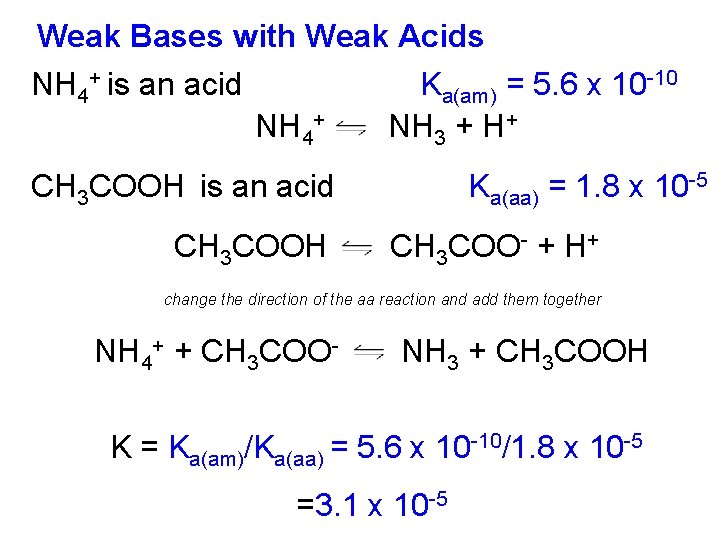
Weak Bases with Weak Acids NH 4+ is an acid NH 4+ Ka(am) = 5. 6 x 10 -10 NH 3 + H+ CH 3 COOH is an acid CH 3 COOH Ka(aa) = 1. 8 x 10 -5 CH 3 COO- + H+ change the direction of the aa reaction and add them together NH 4+ + CH 3 COO- NH 3 + CH 3 COOH K = Ka(am)/Ka(aa) = 5. 6 x 10 -10/1. 8 x 10 -5 =3. 1 x 10 -5
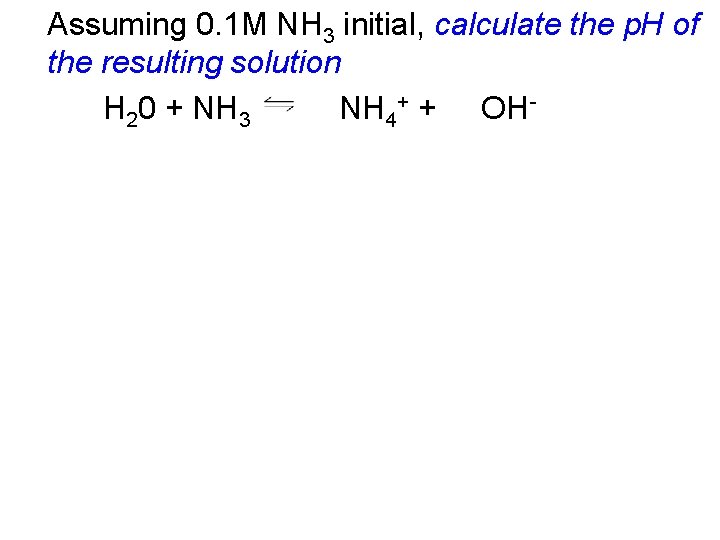
Assuming 0. 1 M NH 3 initial, calculate the p. H of the resulting solution H 20 + NH 3 NH 4+ + OH-
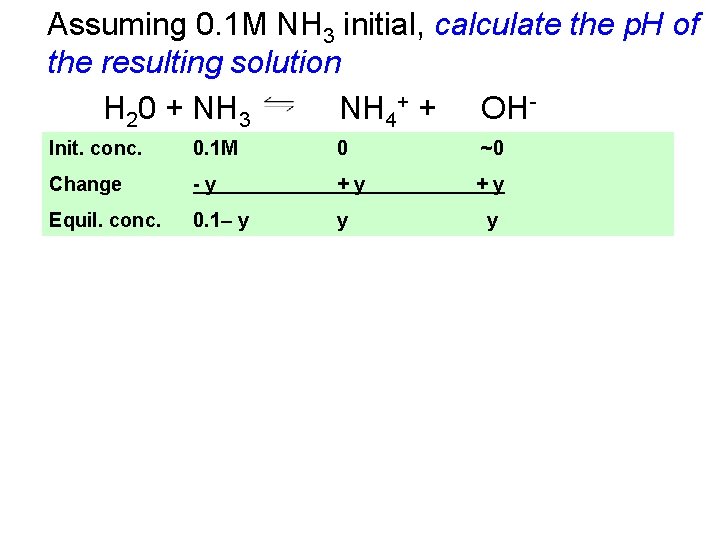
Assuming 0. 1 M NH 3 initial, calculate the p. H of the resulting solution H 20 + NH 3 NH 4+ + OHInit. conc. 0. 1 M 0 Change - y + y Equil. conc. 0. 1– y y ~0 + y y
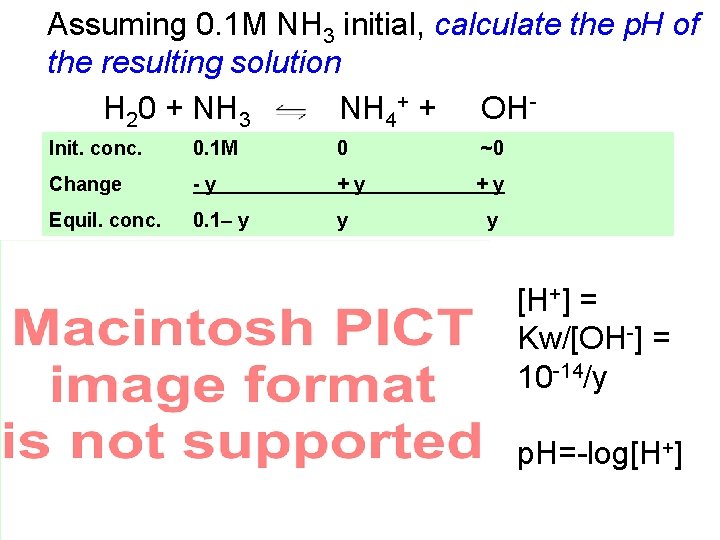
Assuming 0. 1 M NH 3 initial, calculate the p. H of the resulting solution H 20 + NH 3 NH 4+ + OHInit. conc. 0. 1 M 0 Change - y + y Equil. conc. 0. 1– y y ~0 + y y [H+] = Kw/[OH-] = 10 -14/y p. H=-log[H+]
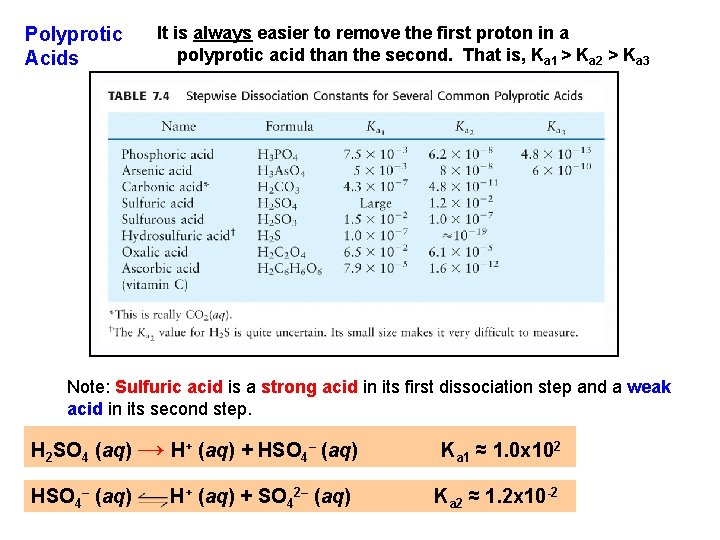
Polyprotic Acids It is always easier to remove the first proton in a polyprotic acid than the second. That is, Ka 1 > Ka 2 > Ka 3 Note: Sulfuric acid is a strong acid in its first dissociation step and a weak acid in its second step. H 2 SO 4 (aq) → H+ (aq) + HSO 4– (aq) Ka 1 ≈ 1. 0 x 102 HSO 4– (aq) H+ (aq) + SO 42– (aq) Ka 2 ≈ 1. 2 x 10 -2
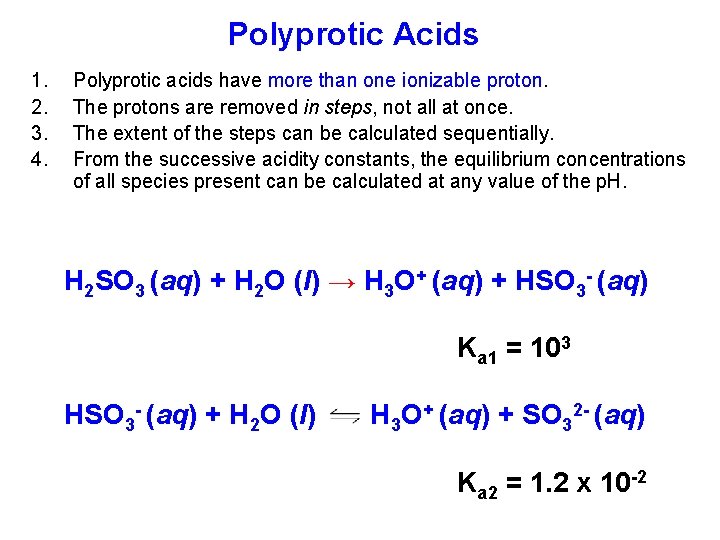
Polyprotic Acids 1. 2. 3. 4. Polyprotic acids have more than one ionizable proton. The protons are removed in steps, not all at once. The extent of the steps can be calculated sequentially. From the successive acidity constants, the equilibrium concentrations of all species present can be calculated at any value of the p. H. H 2 SO 3 (aq) + H 2 O (l) → H 3 O+ (aq) + HSO 3 - (aq) Ka 1 = 103 HSO 3 - (aq) + H 2 O (l) H 3 O+ (aq) + SO 32 - (aq) Ka 2 = 1. 2 x 10 -2
Polyprotic Acids • p. H calculations for solutions of Polyprotic acids appear complicated, most common cases (with weak acids) are surprising straightforward. • Setup equations, K values, set up ICE type table, assume dissociation is small (check assumption) and solve. • For typical weak Polyprotic acids. Ka 1 >> Ka 2 >> Ka 3 • The first dissociation step dominates the H+ concentration and thus the p. H
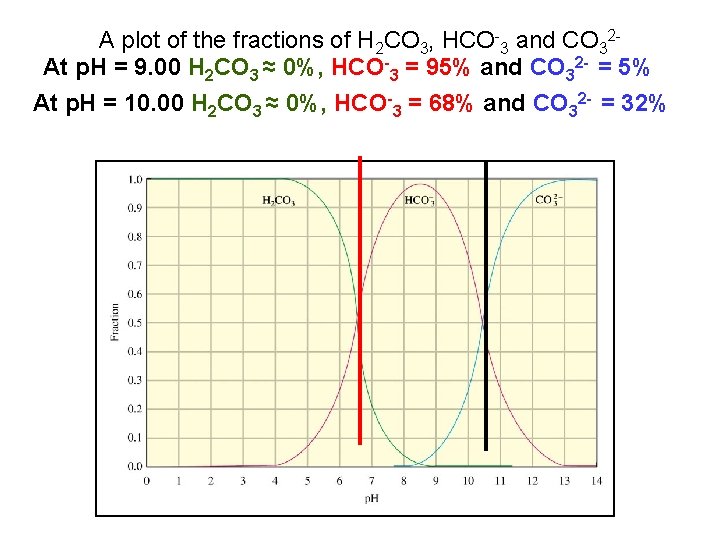
A plot of the fractions of H 2 CO 3, HCO-3 and CO 32 At p. H = 9. 00 H 2 CO 3 ≈ 0%, HCO-3 = 95% and CO 32 - = 5% At p. H = 10. 00 H 2 CO 3 ≈ 0%, HCO-3 = 68% and CO 32 - = 32%
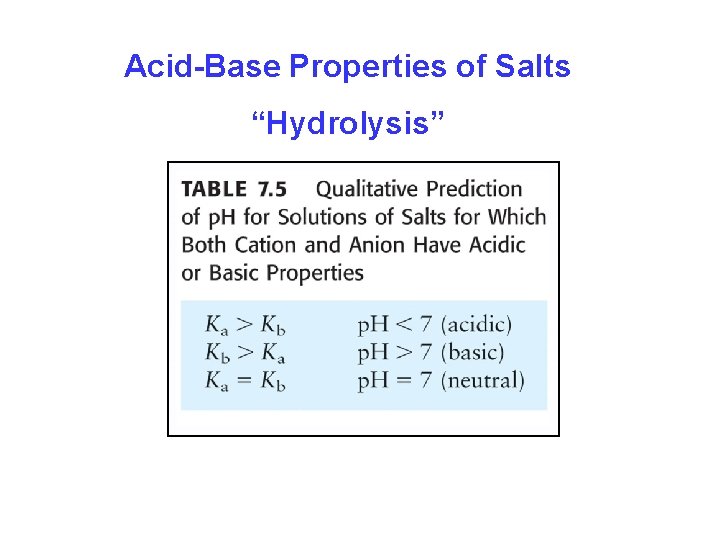
Acid-Base Properties of Salts “Hydrolysis”
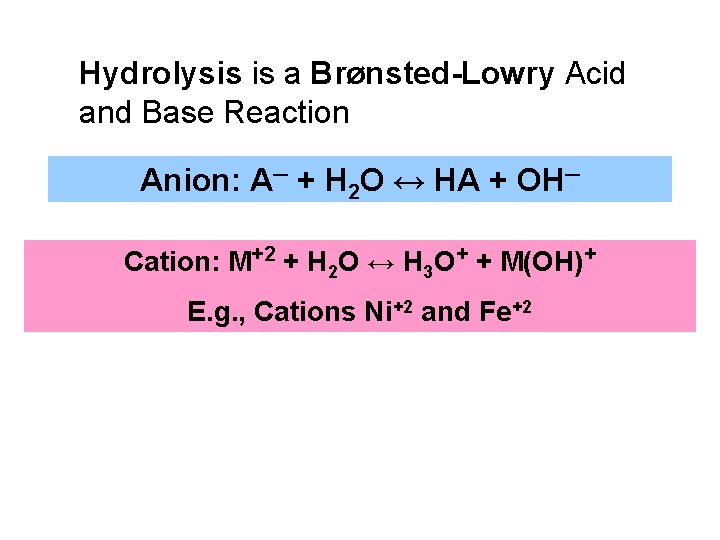
Hydrolysis is a Brønsted-Lowry Acid and Base Reaction Anion: A─ + H 2 O ↔ HA + OH─ Cation: M+2 + H 2 O ↔ H 3 O+ + M(OH)+ E. g. , Cations Ni+2 and Fe+2
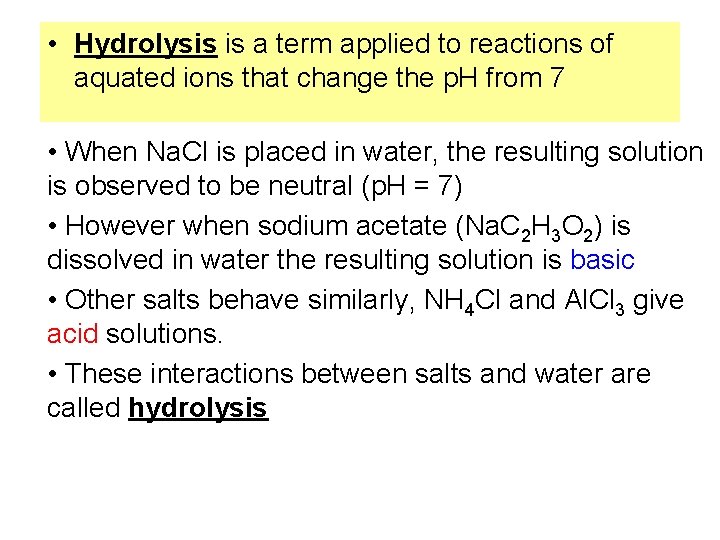
• Hydrolysis is a term applied to reactions of aquated ions that change the p. H from 7 • When Na. Cl is placed in water, the resulting solution is observed to be neutral (p. H = 7) • However when sodium acetate (Na. C 2 H 3 O 2) is dissolved in water the resulting solution is basic • Other salts behave similarly, NH 4 Cl and Al. Cl 3 give acid solutions. • These interactions between salts and water are called hydrolysis
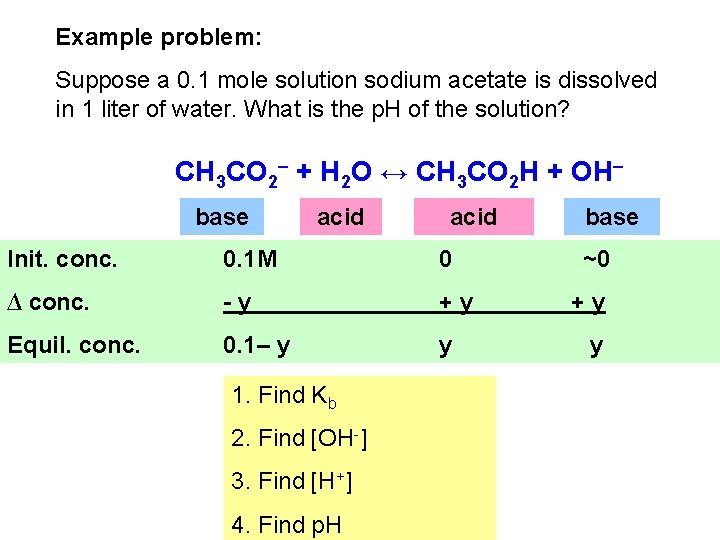
Example problem: Suppose a 0. 1 mole solution sodium acetate is dissolved in 1 liter of water. What is the p. H of the solution? CH 3 CO 2– + H 2 O ↔ CH 3 CO 2 H + OH– base acid Init. conc. 0. 1 M 0 ∆ conc. - y + y Equil. conc. 0. 1– y y 1. Find Kb 2. Find [OH-] 3. Find [H+] 4. Find p. H base ~0 + y y
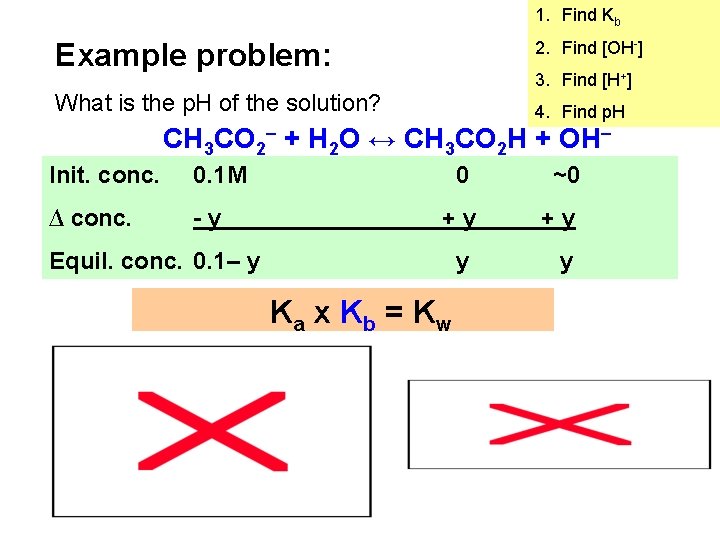
1. Find Kb 2. Find [OH-] Example problem: 3. Find [H+] What is the p. H of the solution? CH 3 CO 2– + H 2 O ↔ CH 3 CO 2 4. Find p. H H + OH– Init. conc. 0. 1 M 0 ∆ conc. - y + y Equil. conc. 0. 1– y y Ka x Kb = Kw ~0 y
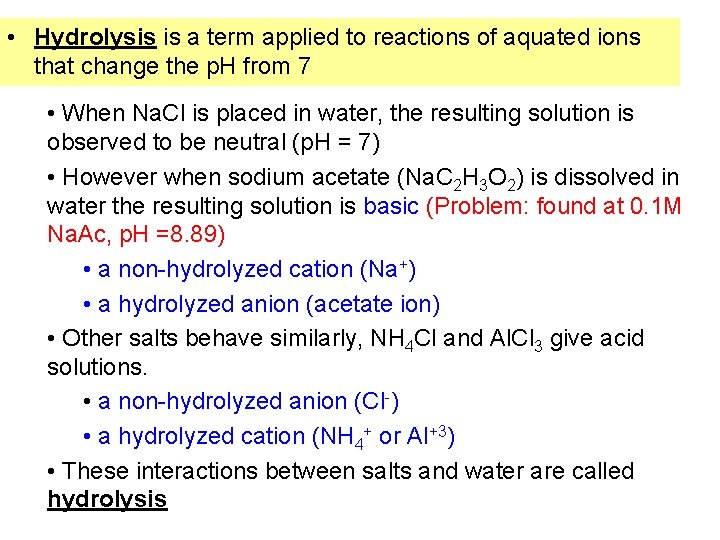
• Hydrolysis is a term applied to reactions of aquated ions that change the p. H from 7 • When Na. Cl is placed in water, the resulting solution is observed to be neutral (p. H = 7) • However when sodium acetate (Na. C 2 H 3 O 2) is dissolved in water the resulting solution is basic (Problem: found at 0. 1 M Na. Ac, p. H =8. 89) • a non-hydrolyzed cation (Na+) • a hydrolyzed anion (acetate ion) • Other salts behave similarly, NH 4 Cl and Al. Cl 3 give acid solutions. • a non-hydrolyzed anion (Cl-) • a hydrolyzed cation (NH 4+ or Al+3) • These interactions between salts and water are called hydrolysis
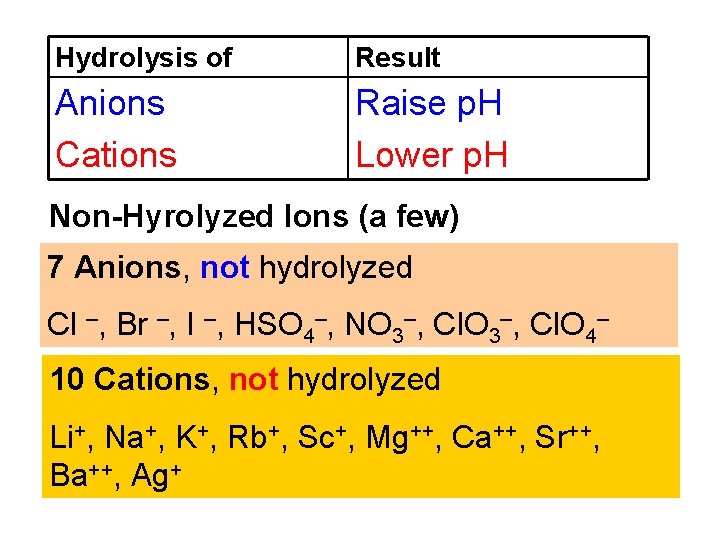
Hydrolysis of Result Anions Cations Raise p. H Lower p. H Non-Hyrolyzed Ions (a few) 7 Anions, not hydrolyzed Cl –, Br –, I –, HSO 4–, NO 3–, Cl. O 4– 10 Cations, not hydrolyzed Li+, Na+, K+, Rb+, Sc+, Mg++, Ca++, Sr++, Ba++, Ag+
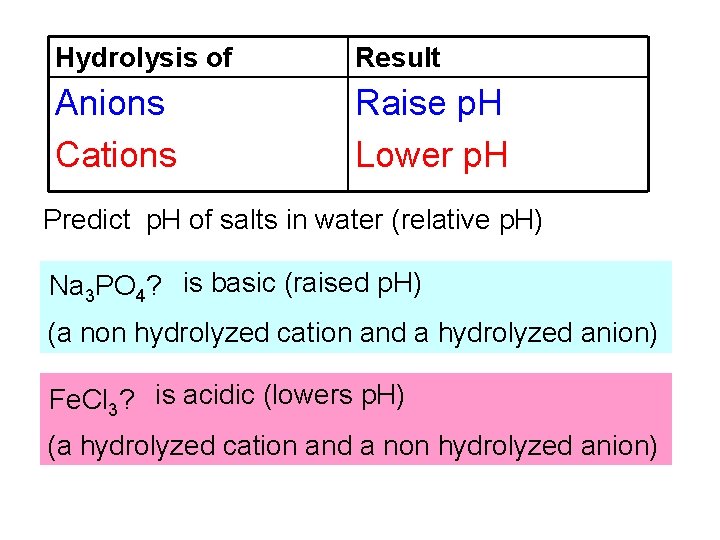
Hydrolysis of Result Anions Cations Raise p. H Lower p. H Predict p. H of salts in water (relative p. H) Na 33 PO 44? is basic (raised p. H) (a non hydrolyzed cation and a hydrolyzed anion) Fe. Cl 33? is acidic (lowers p. H) (a hydrolyzed cation and a non hydrolyzed anion)
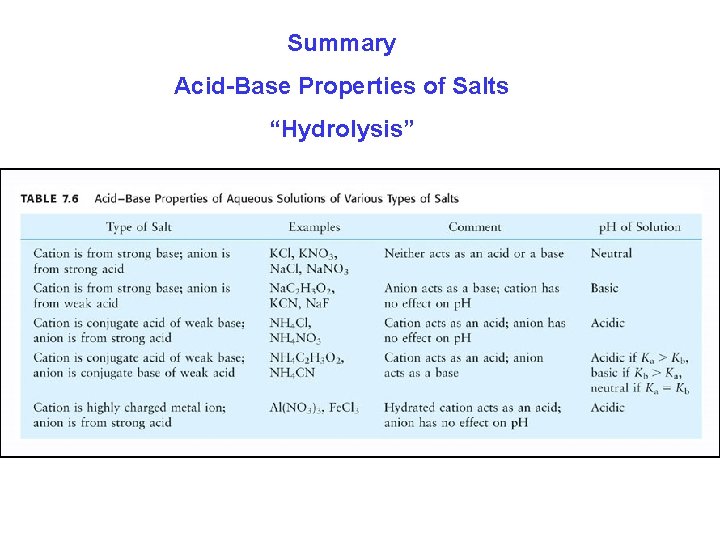
Summary Acid-Base Properties of Salts “Hydrolysis”
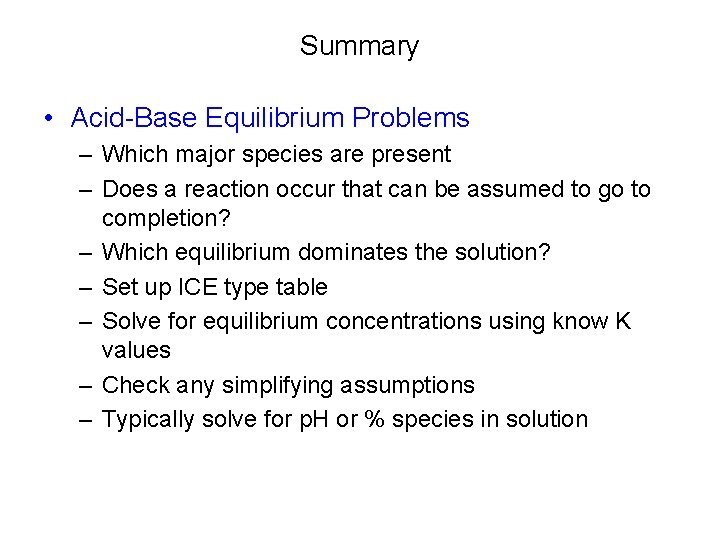
Summary • Acid-Base Equilibrium Problems – Which major species are present – Does a reaction occur that can be assumed to go to completion? – Which equilibrium dominates the solution? – Set up ICE type table – Solve for equilibrium concentrations using know K values – Check any simplifying assumptions – Typically solve for p. H or % species in solution
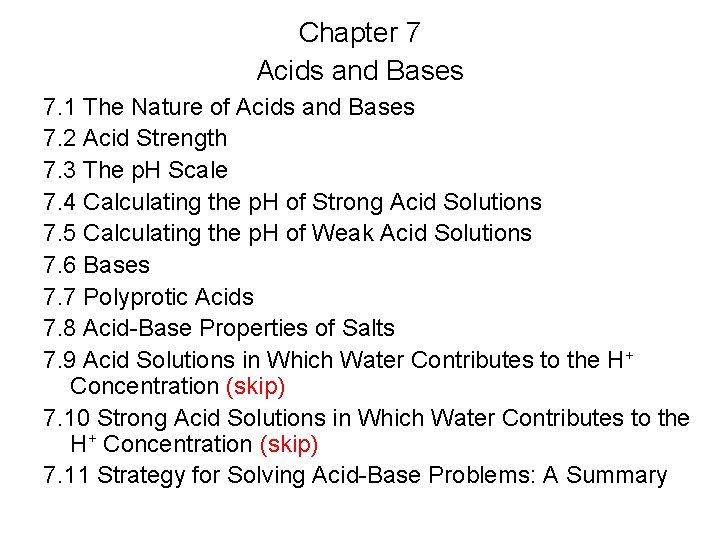
Chapter 7 Acids and Bases 7. 1 The Nature of Acids and Bases 7. 2 Acid Strength 7. 3 The p. H Scale 7. 4 Calculating the p. H of Strong Acid Solutions 7. 5 Calculating the p. H of Weak Acid Solutions 7. 6 Bases 7. 7 Polyprotic Acids 7. 8 Acid-Base Properties of Salts 7. 9 Acid Solutions in Which Water Contributes to the H+ Concentration (skip) 7. 10 Strong Acid Solutions in Which Water Contributes to the H+ Concentration (skip) 7. 11 Strategy for Solving Acid-Base Problems: A Summary
- Slides: 50