
Chapter 12 4 DNA Mutations What Are Mutations

- Slides: 27
Chapter 12 -4 DNA Mutations
What Are Mutations? • Changes in the nucleotide sequence of DNA • May occur in somatic cells (body cells) aren’t passed to offspring • May occur in gametes (eggs & sperm) and can be passed to offspring
Mutations Helpful or Harmful? • Mutations happen regularly • Almost all mutations are neutral (no effect) • Some can be harmful • Some can even be helpful! • Many mutations are repaired by enzymes
What causes mutations? • Chemicals, UV radiation and viruses can cause mutations • Some types of skin cancers and leukemia result from somatic mutations (harmful). • Some mutations cause genetic variation which may improve an organism’s survival (beneficial)
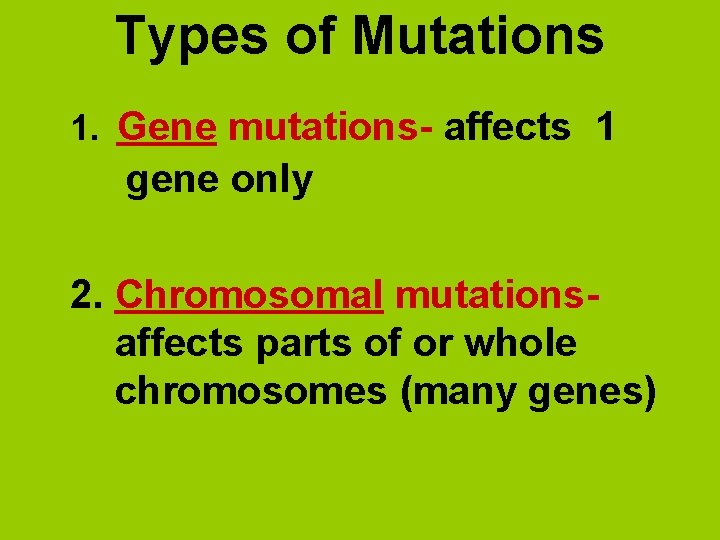
Types of Mutations 1. Gene mutations- affects 1 gene only 2. Chromosomal mutationsaffects parts of or whole chromosomes (many genes)
Gene Mutations • Change in the nucleotide sequence of a gene • May only involve a change in one nucleotide • May be due to copying errors, chemicals, viruses, etc.
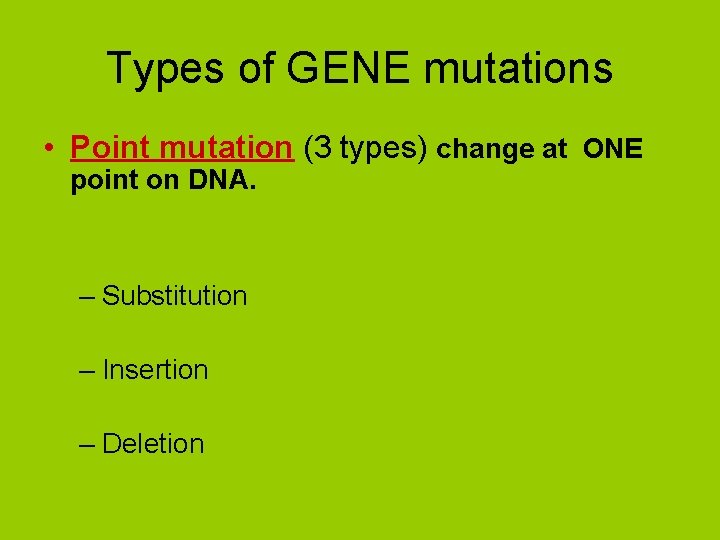
Types of GENE mutations • Point mutation (3 types) change at ONE point on DNA. – Substitution – Insertion – Deletion
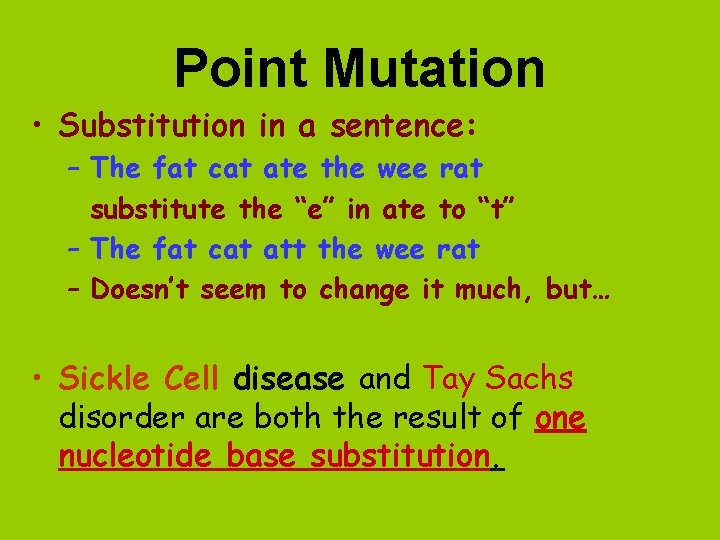
Point Mutation • Substitution in a sentence: – The fat cat ate the wee rat substitute the “e” in ate to “t” – The fat cat att the wee rat – Doesn’t seem to change it much, but… • Sickle Cell disease and Tay Sachs disorder are both the result of one nucleotide base substitution.
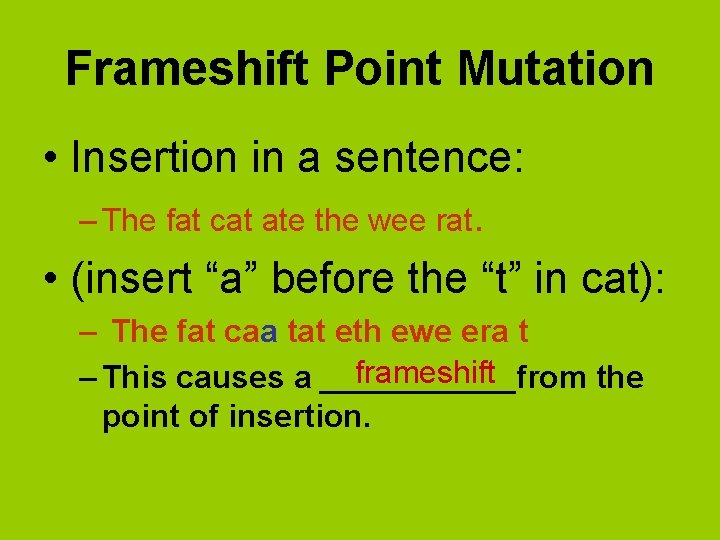
Frameshift Point Mutation • Insertion in a sentence: – The fat cat ate the wee rat. • (insert “a” before the “t” in cat): – The fat caa tat eth ewe era t frameshift – This causes a ______from the point of insertion.
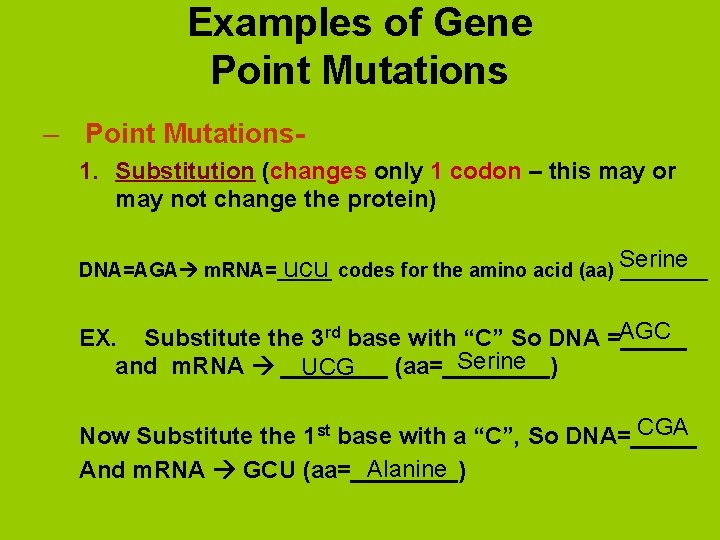
Examples of Gene Point Mutations – Point Mutations 1. Substitution (changes only 1 codon – this may or may not change the protein) DNA=AGA m. RNA=_____ ucu codes for the amino acid (aa) Serine AGC EX. Substitute the 3 rd base with “C” So DNA =_____ Serine and m. RNA ____ (aa=____) UCG CGA Now Substitute the 1 st base with a “C”, So DNA=_____ Alanine And m. RNA GCU (aa=____)
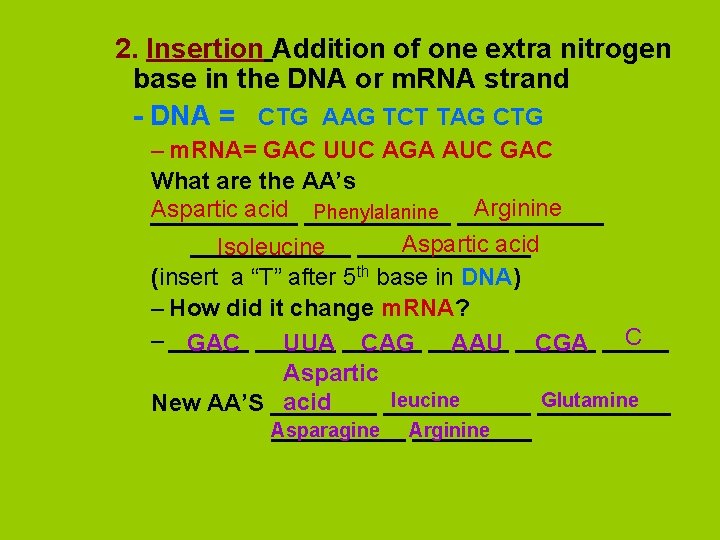
2. Insertion Addition of one extra nitrogen base in the DNA or m. RNA strand - DNA = CTG AAG TCT TAG CTG – m. RNA= GAC UUC AGA AUC GAC What are the AA’s Arginine Aspartic acid ______ Phenylalanine ___________ Aspartic acid ______ Isoleucine _______ (insert a “T” after 5 th base in DNA) – How did it change m. RNA? C – ______ GAC ______ UUA ______ CAG ______ AAU ______ CGA _____ Aspartic leucine Glutamine acid New AA’S ___________ Asparagine _____ Arginine _____
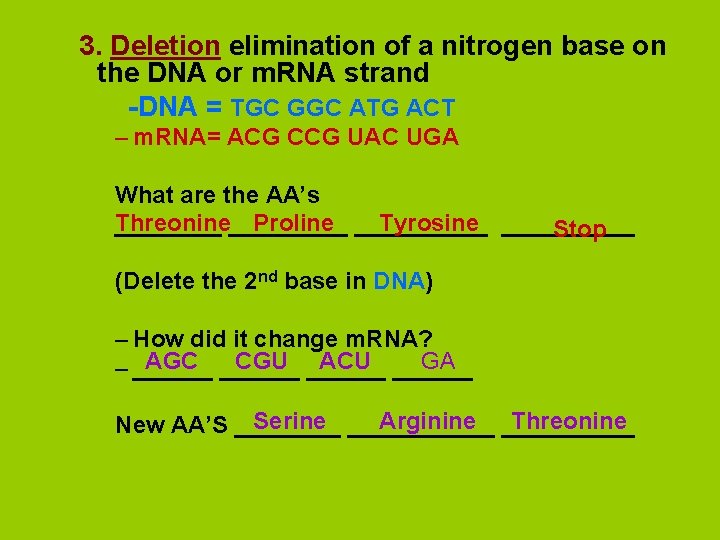
3. Deletion elimination of a nitrogen base on the DNA or m. RNA strand -DNA = TGC GGC ATG ACT – m. RNA= ACG CCG UAC UGA What are the AA’s Threonine Proline _____ Tyrosine _________ Stop (Delete the 2 nd base in DNA) – How did it change m. RNA? AGC ______ CGU ______ ACU ______ GA – ______ Serine ______ Arginine _____ Threonine New AA’S ____
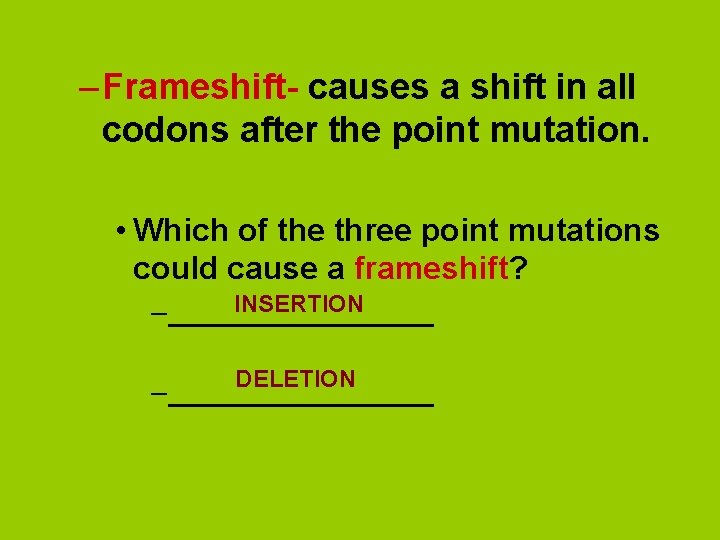
– Frameshift- causes a shift in all codons after the point mutation. • Which of the three point mutations could cause a frameshift? INSERTION – _________ DELETION – _________
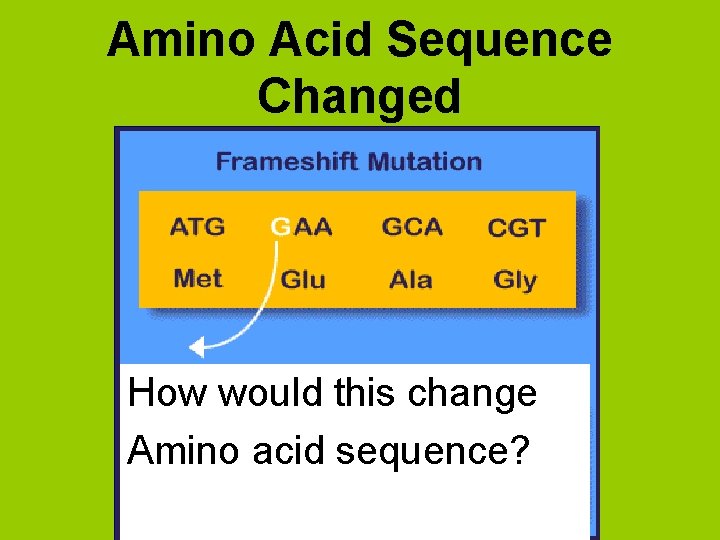
Amino Acid Sequence Changed How would this change Amino acid sequence?
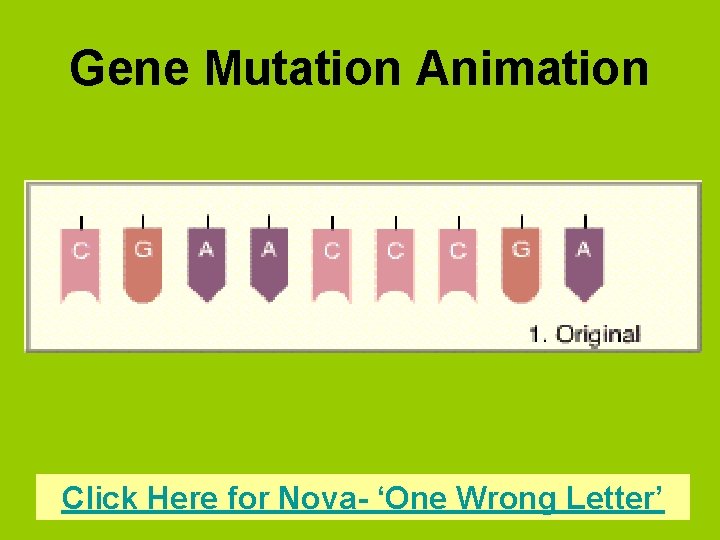
Gene Mutation Animation Click Here for Nova- ‘One Wrong Letter’
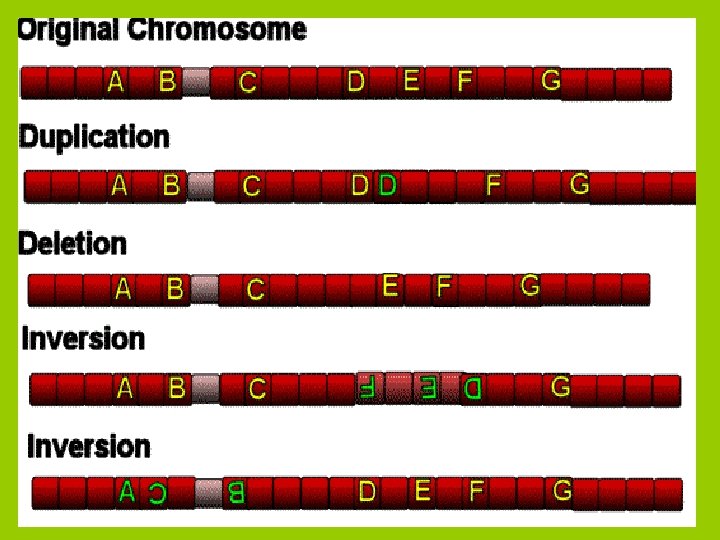
Chromosome Mutations • May Involve: – The loss or gain of part of a chromosome – Changing the structure of a chromosome
Types: – Deletion – Inversion – Translocation – Nondisjunction – Duplication
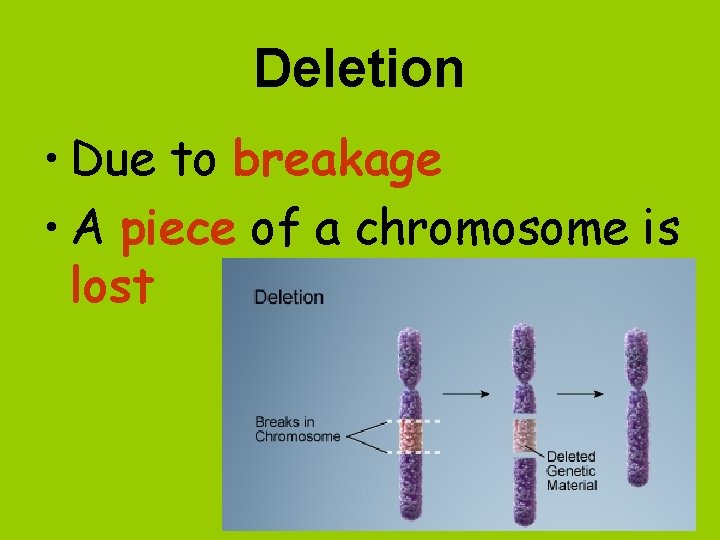
Deletion • Due to breakage • A piece of a chromosome is lost
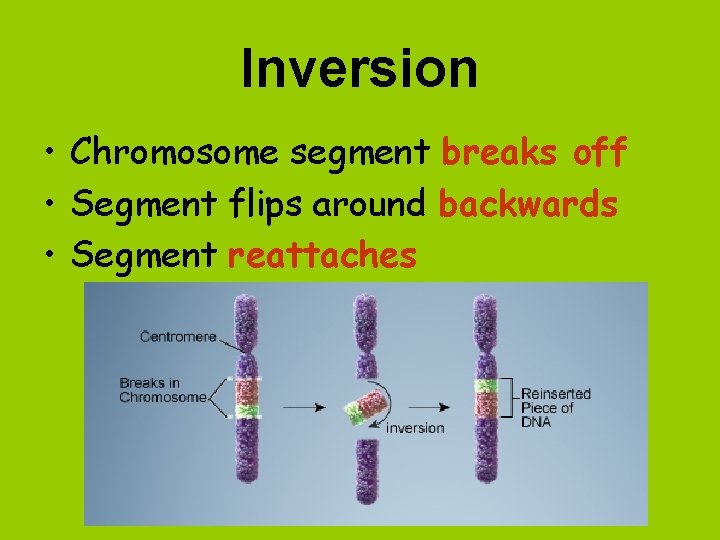
Inversion • Chromosome segment breaks off • Segment flips around backwards • Segment reattaches
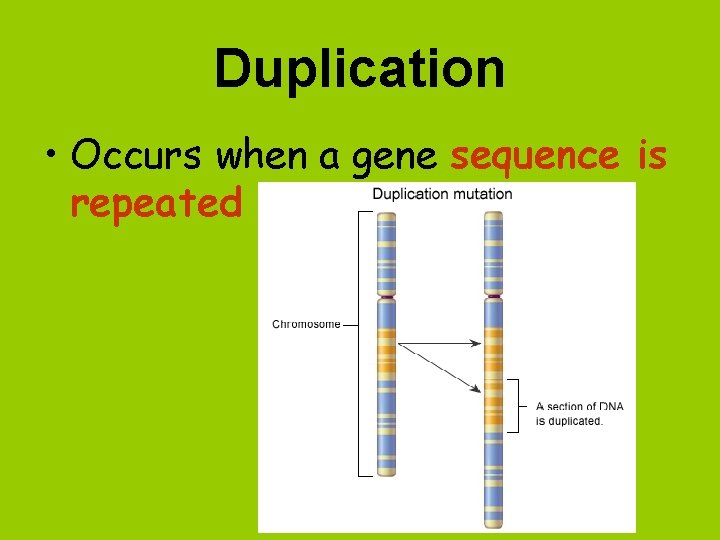
Duplication • Occurs when a gene sequence is repeated
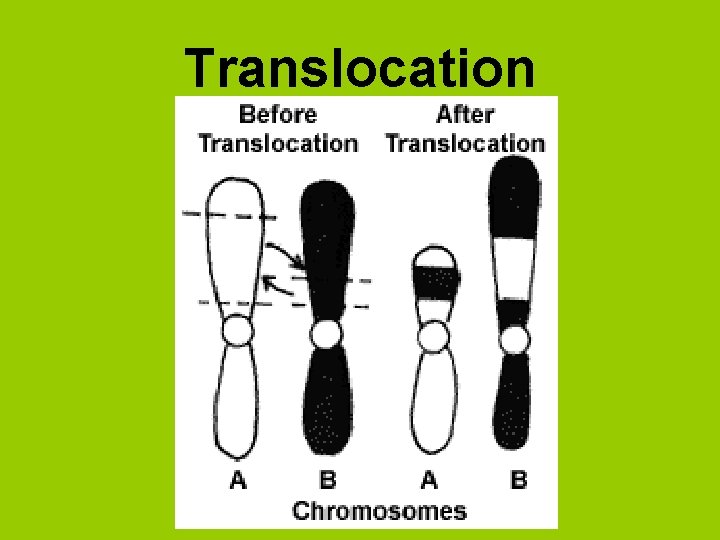
Translocation • Involves two chromosomes that aren’t homologous (pair of chromosomes that code for the same traits) • Part of one chromosome is transferred to another chromosome
Translocation
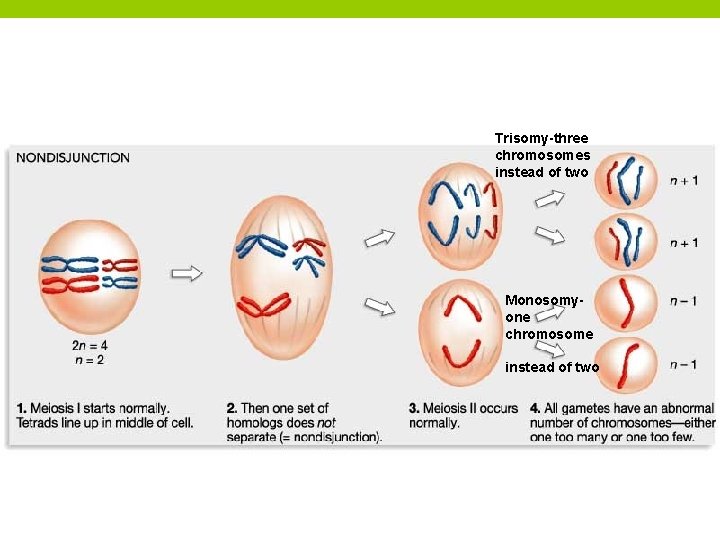
Nondisjunction • Failure of chromosomes to separate during meiosis • Causes gamete to have too many or too few chromosomes
Trisomy-three chromosomes instead of two Monosomyone chromosome instead of two
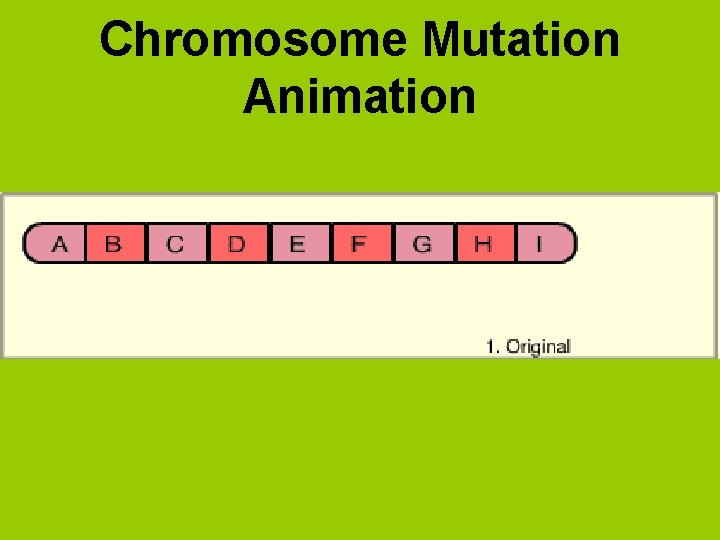
Chromosome Mutation Animation