
Chapter 12 13 States of Matter and Temperature

- Slides: 46
Chapter 12 & 13 States of Matter and Temperature
Vocabulary List n n n n n Thermodynamics Thermal Energy Kinetic-molecular Theory Temperature Absolute Zero Thermometer Conduction Convection Radiation Specific Heat n n n Calorimeter Calorimetry Melting Point Boiling Point Evaporation Condensation Sublimation Deposition Ionization Deionization Entropy
Standards n SP 3: Students will evaluate the forms and transformations of energy. F - Analyze the relationship between temperature, internal energy, and work done in a physical system.
Journal #41 n What makes an object hot or cold? n What changes about that object might be observed while it goes from cold to hot? n What are some ways to detect the temperature of an object?
Thermodynamics n Thermal – The study of heat Energy – the overall energy of motion of the particles that make up an object. Represented by the symbol Q and measured in Joules
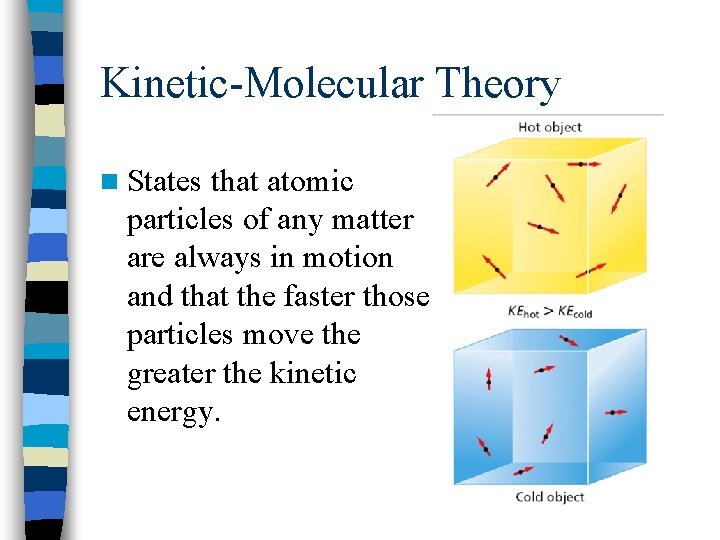
Kinetic-Molecular Theory n States that atomic particles of any matter are always in motion and that the faster those particles move the greater the kinetic energy.
Temperature n Temperature –the measure of an objects thermal energy. SI Unit is Kelvin (K) and is scalar. – It does NOT depend on the number of particles in the object, only the average KE of those particles. – There does not seem to be an upper limit to temperature, but there is a definite lower limit to the amount of thermal energy (it can’t be negative). – When thermal energy reaches 0, an object is at absolute zero and the particles have completely stopped moving.
Temperature n Thermometer – a device that measures temperature usually by coming to a thermal equilibrium with that object. n Thermometers usually work based on the rules of thermal expansion, that is, when most objects are heated, they expand.
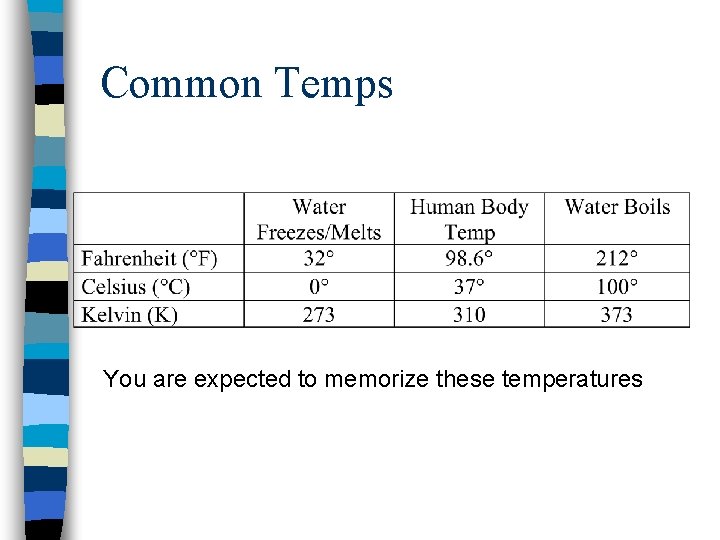
Common Temps You are expected to memorize these temperatures
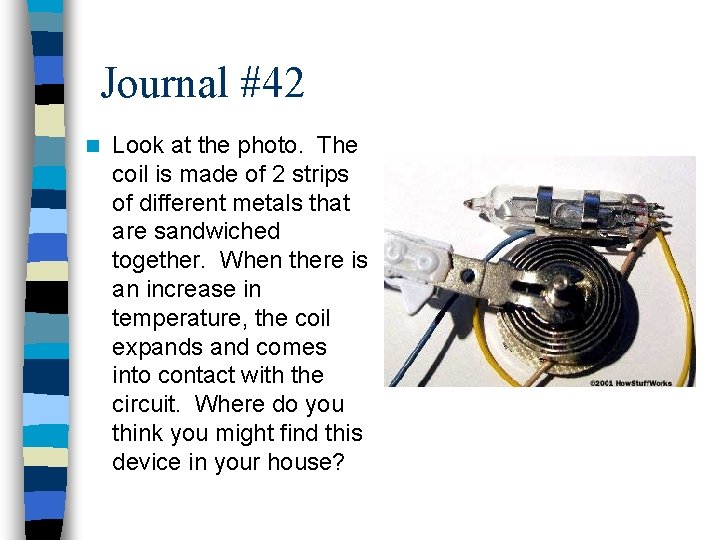
Journal #42 n Look at the photo. The coil is made of 2 strips of different metals that are sandwiched together. When there is an increase in temperature, the coil expands and comes into contact with the circuit. Where do you think you might find this device in your house?
Bimetallic Strip Demo n Pay attention to the demonstration and record your observations in your notebook. n Supplies used: – Bimetallic Strip – Bunsen Burner – Water Bath
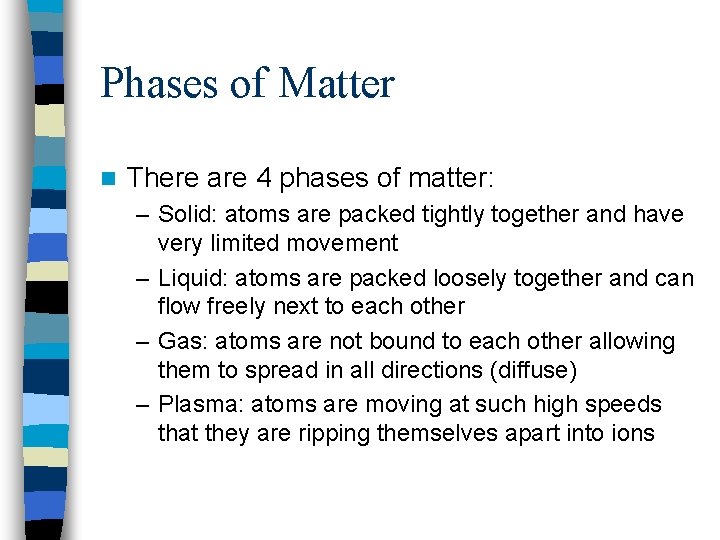
Phases of Matter n There are 4 phases of matter: – Solid: atoms are packed tightly together and have very limited movement – Liquid: atoms are packed loosely together and can flow freely next to each other – Gas: atoms are not bound to each other allowing them to spread in all directions (diffuse) – Plasma: atoms are moving at such high speeds that they are ripping themselves apart into ions
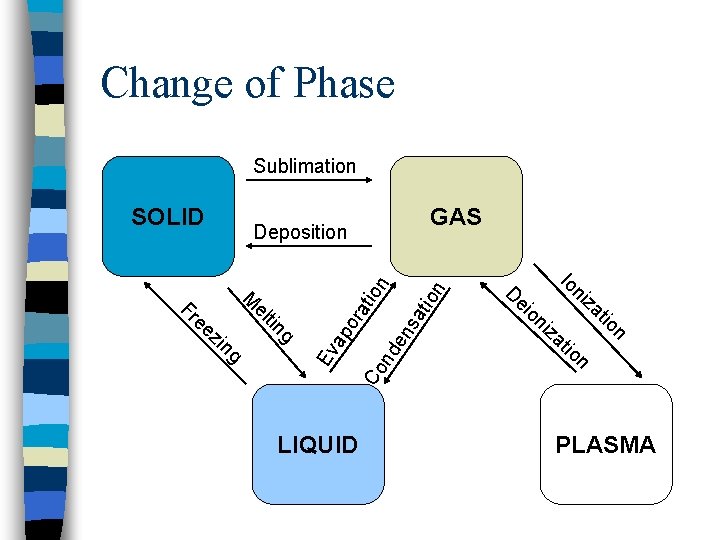
Change of Phase Sublimation SOLID GAS ati en s nd g Co in g tin ap o ez el Ev Fr e ra ti M LIQUID on on Deposition D ei Io on ni iz at io za tio n n PLASMA
Heat n Heat – thermal energy that flows between two objects as a result of a difference in temperature. n Heat can be transferred by 3 common methods: – Conduction – Convection – Radiation
Conduction n Conduction is the transfer of energy through direct contact. n Examples: – Touching a hot pan with your skin – Frying an egg on a hot skillet – Putting ice directly on a burn to cool it
Convection – the transfer of energy through currents of fluids. Hot fluids rise and cooler fluids sink. The movement of the fluids creates convection currents with a distinct pattern. n Examples: n – Smoke rising above a fire – The way that water boils up then rolls outward – Using an oven to heat the air around the food
Radiation – the transfer of energy through electromagnetic waves. This is the only type that does not involve matter, meaning it can happen in a vacuum. n Examples: n – The energy the Earth receives from the sun – The heat you feel when you stand NEXT to a fire – The focusing of light rays with a magnifying glass to start a fire
Conductors and Insulators n Heat travels best in substances we label as conductors. – Examples include most metals, which is why we cook in metal pots and pans n Heat travels poorly in substances we label as insulators. – Examples include anything that makes use of empty space; Styrofoam, vacuums, etc.
Journal #43 Why do people wear dark colors in the winter and light colors in the fall? Explain this phenomenon with science using what we have learned recently.
Specific Heat n Some objects are easier to heat than others… why? n Think of the first day of summer vacation at the pool. The sun may get the furniture and concrete very warm, but the water in the pool is still quite cool compared to the surroundings.
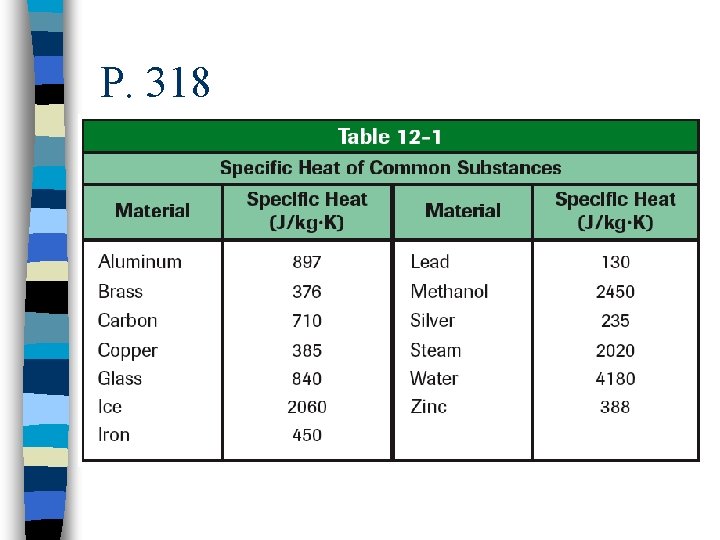
Specific Heat When heat flows into an object, its thermal energy increases, and so does its temperature. n The amount of the increase depends on the mass of the object and the material from which the object is made. n The specific heat (C) of a material is the amount of energy that must be added to 1 -kg of the material to raise the temperature by 1 C (or 1 Kelvin). n A chart of common specific heats is on P. 318. n
P. 318
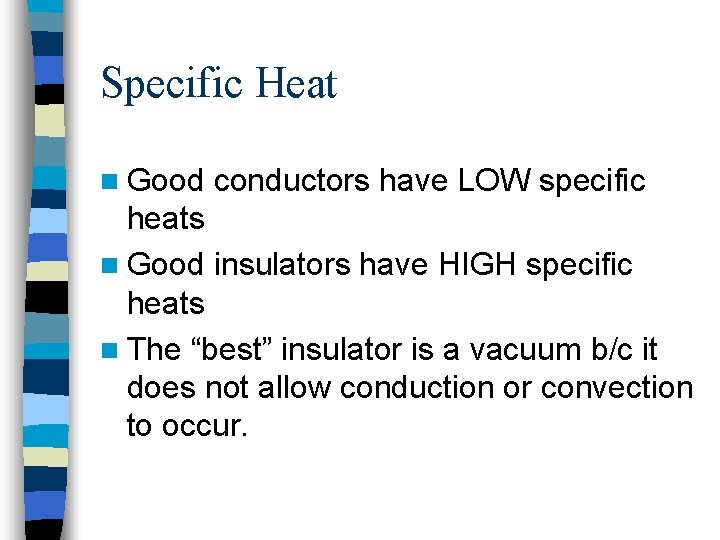
Specific Heat n Good conductors have LOW specific heats n Good insulators have HIGH specific heats n The “best” insulator is a vacuum b/c it does not allow conduction or convection to occur.
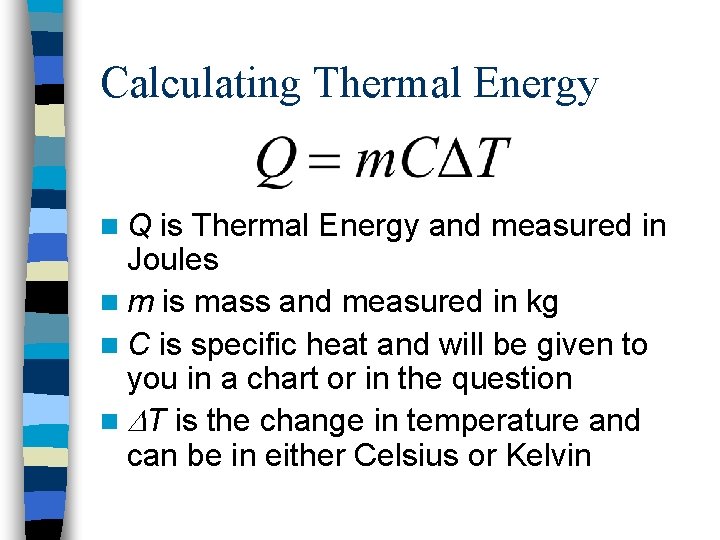
Calculating Thermal Energy n. Q is Thermal Energy and measured in Joules n m is mass and measured in kg n C is specific heat and will be given to you in a chart or in the question n T is the change in temperature and can be in either Celsius or Kelvin
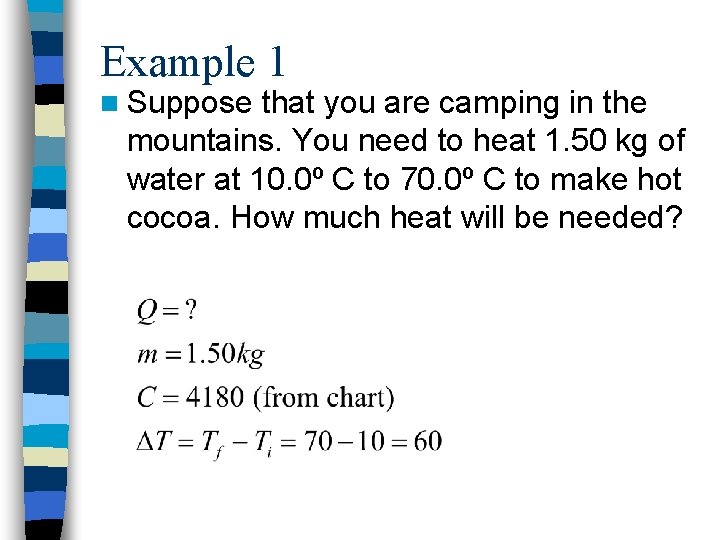
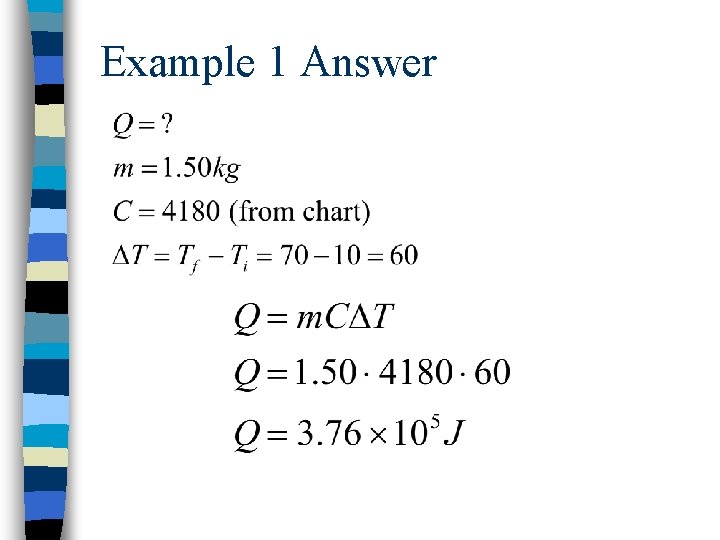
Example 1 n Suppose that you are camping in the mountains. You need to heat 1. 50 kg of water at 10. 0º C to 70. 0º C to make hot cocoa. How much heat will be needed?
Example 1 Answer
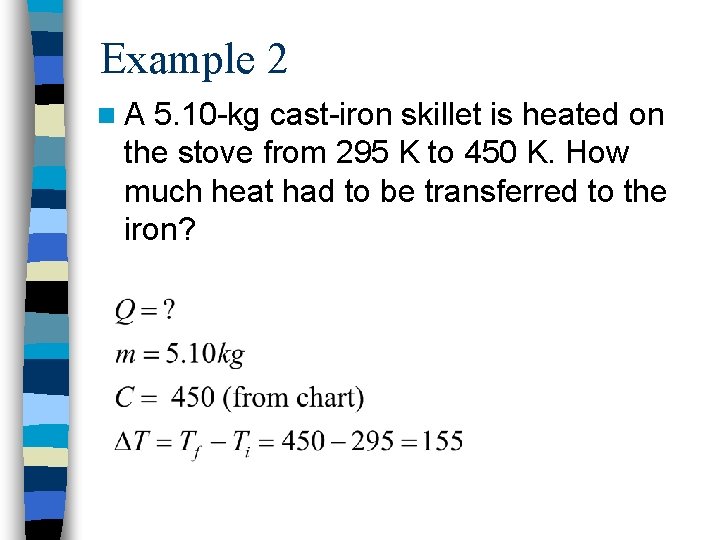
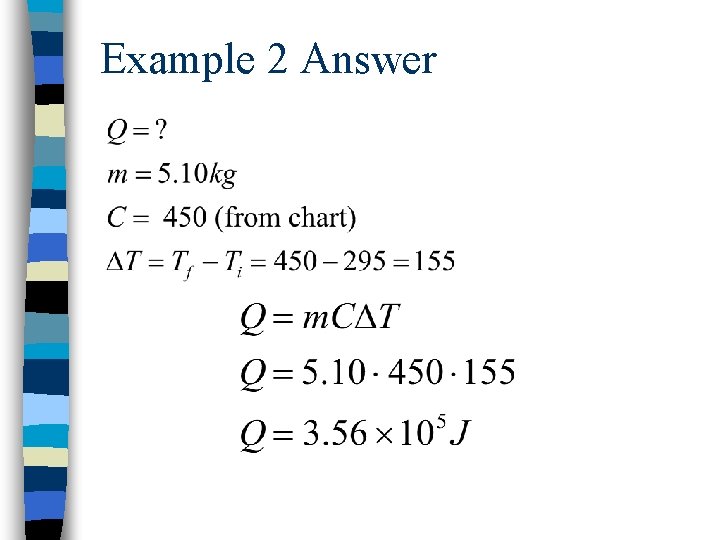
Example 2 n. A 5. 10 -kg cast-iron skillet is heated on the stove from 295 K to 450 K. How much heat had to be transferred to the iron?
Example 2 Answer
Homework n We will review in class on Wednesday – P. 319 #3 – P. 336 #52, 53 n You are expected to do a left-hand line-up and convert to SI units at minimum.
Journal #44 n 1 kg of copper, aluminum, and iron, which have been heated to 450 K, are dropped into three pails that contain the same amount of water at room temperature. n How will the temperature of the water in the three pails compare when they reach thermal equilibrium? Why?
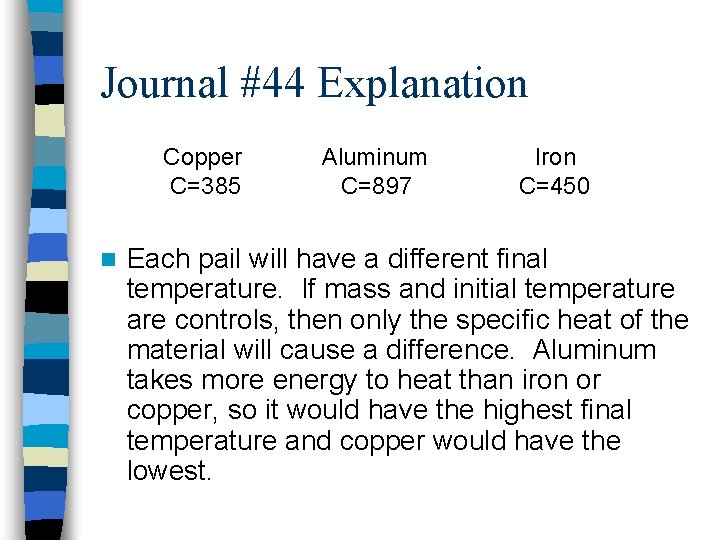
Journal #44 Explanation Copper C=385 n Aluminum C=897 Iron C=450 Each pail will have a different final temperature. If mass and initial temperature are controls, then only the specific heat of the material will cause a difference. Aluminum takes more energy to heat than iron or copper, so it would have the highest final temperature and copper would have the lowest.
Pre-Lab Info (part of notes) n Upon completion, you should know the answers to these questions: – What is specific heat? – How can it be determined experimentally? – What does it mean if a substance has a high or low specific heat?
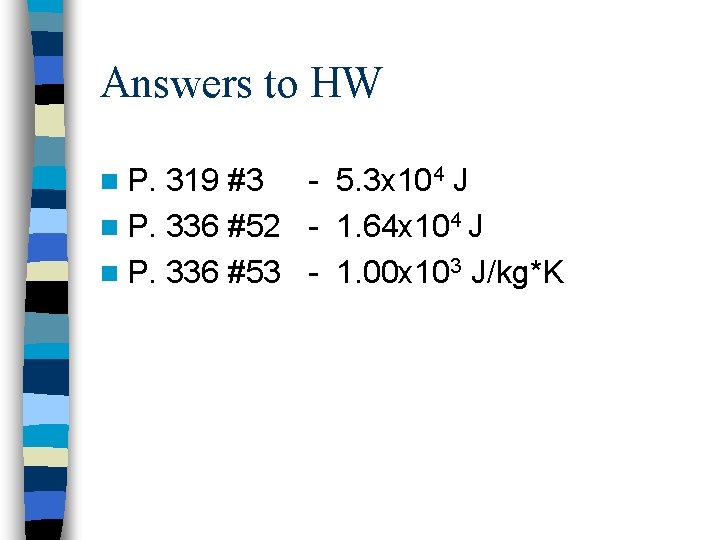
Answers to HW n P. 319 #3 - 5. 3 x 10⁴ J n P. 336 #52 - 1. 64 x 104 J n P. 336 #53 - 1. 00 x 103 J/kg*K
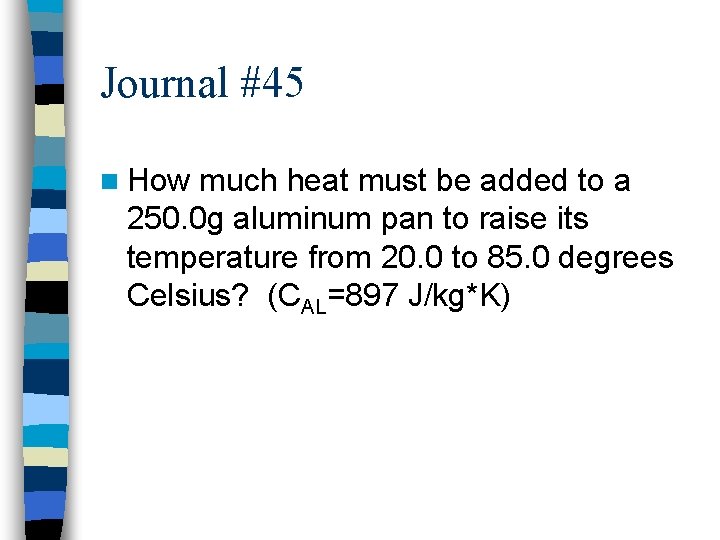
Journal #45 n How much heat must be added to a 250. 0 g aluminum pan to raise its temperature from 20. 0 to 85. 0 degrees Celsius? (CAL=897 J/kg*K)
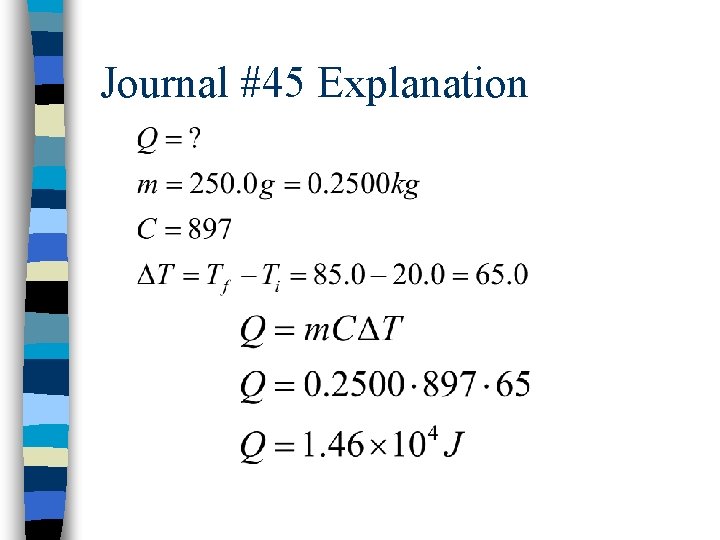
Journal #45 Explanation
Journal #46 n What is the coldest that water can be? (trick question? ) n What is the hottest that water can be? (trick question? )
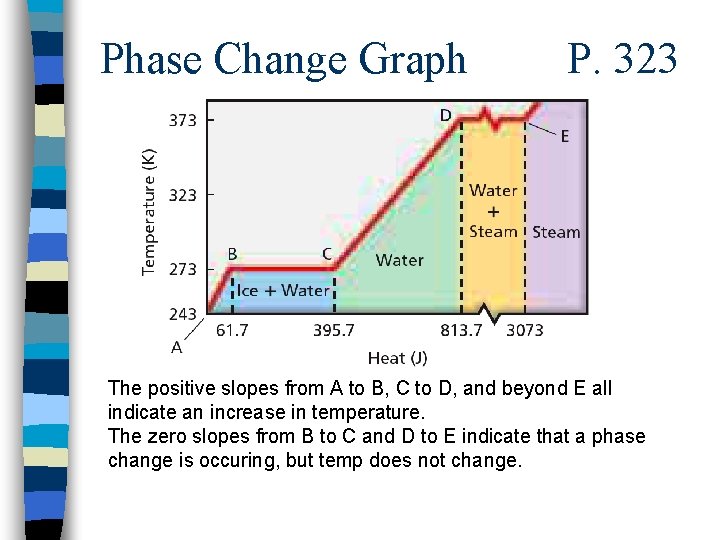
Energy of a phase change n When a substance undergoes a phase change, special calculations must be done to account for the energy that is absorbed or released. – From a solid to a liquid (or vice versa), this energy is called the heat of fusion. – From a liquid to a gas (or vice versa), this energy is called the heat of vaporization.
Phase Change Graph P. 323 The positive slopes from A to B, C to D, and beyond E all indicate an increase in temperature. The zero slopes from B to C and D to E indicate that a phase change is occuring, but temp does not change.
Journal #47 n In terms of physics, what makes one object “hotter” than another?
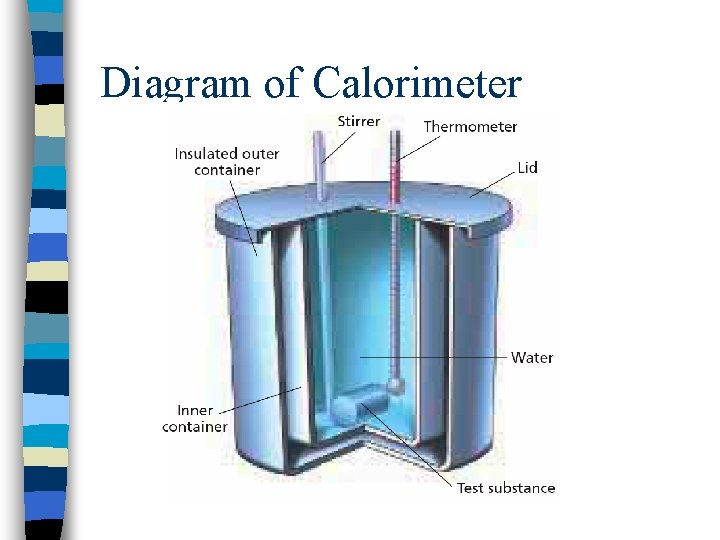
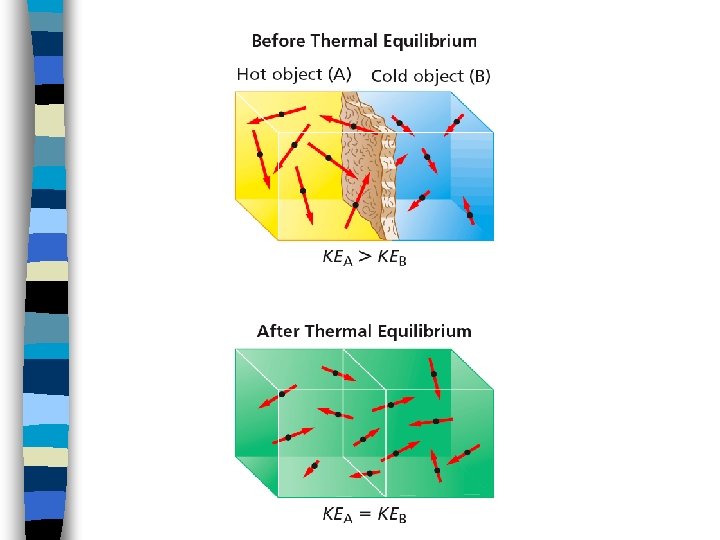
Calorimetry If two objects have different temperatures and are brought into contact with each other, there will be a transfer of energy from one to the other until they reach a thermal equilibrium, meaning that they have the same temperature. n For this to be possible, the heat lost by one object is gained by the other. n The mathematical process used to find the solution to this type of question is called calorimetry. n
Diagram of Calorimeter
Calorimetry It is possible to calculate the final temperature of two substances after they are mixed if you know the amount of thermal energy they possess before they are mixed. n This follows the rules of conservation of energy because energy will be transferred from the warmer to the cooler object. n The final temperature MUST fall between the two original temperatures. If not, you have made an error. n
1 st Law of Thermodynamics n. A restatement of the conservation of energy, states that the total increase in thermal energy of a system is the sum of the work done on it or the heat added to it. n Basically, energy can’t be created, it must be transferred from some other place.
2 nd Law of Thermodynamics n States that natural processes go in a direction that maintains or increases the total entropy of the universe. That is, all things will become more and more disordered unless some action is taken to keep the ordered. n Entropy – a measure of the disorder of a system
Entropy n Examples of Entropy – You clean your bedroom and within days it is messy again. – An abandoned house will slowly have paint fade and peal, shingles warp, weeds grow, etc. – You light a match and the smoke (and smell) spread out through the entire room.