
CHAPTER 12 12 1 DNA Griffith and Transformation
![Chargaff’s Rules – the percentage of guanine [G] and cytosine [C] bases are almost](https://slidetodoc.com/presentation_image_h2/5da89b10a731c9aade31b08a18140495/image-16.jpg "Chargaff’s Rules – the percentage of guanine [G] and cytosine [C] bases are almost")
- Slides: 26
CHAPTER 12
12 -1 DNA
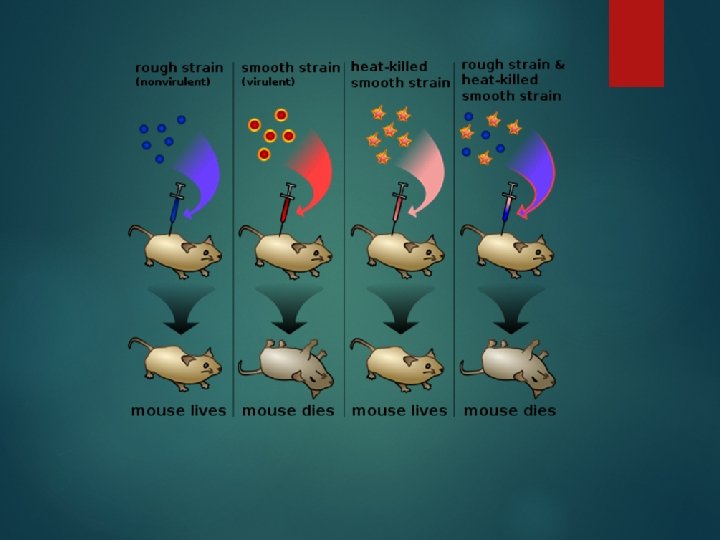
Griffith and Transformation In 1928, a British scientist Frederick Griffith was trying to figure out how certain types of bacteria produce pneumonia. He isolated two different strains of pneumonia bacteria from mice. Both strains grew, but only one caused pneumonia. The two strains looks very different: The harmless one produced colonies with rough edges. The one that cause pneumonia grew into smooth colonies.
Griffith’s experiments When Griffith injected mice with the diseasecausing strain of bacteria, the mice developed pneumonia and died. When mice were injected with the harmless strain, they didn’t get sick at all. He then found that if he heated up the dangerous bacteria to kill them and injected it into the mice, the mice lived.
Transformation In his next experiment, Griffith mixed his heat -killed, disease causing bacteria with live, harmless ones and injected the mixture into mice. By themselves, neither should have made the mice sick, but the mice developed pneumonia with this mixture. The dead mice’s lungs were filled with the diseasecausing bacteria. The heat-killed bacteria had somehow passed their disease-causing ability to the harmless strain.
Transformation – when one strain of bacteria changes permanently into another
Griffith believed that when the live, harmless bacteria and the heat-killed bacteria were mixed, something was transferred from the heat-killed cells into the live cells. He believed that factor must contain information that could change harmless bacteria into disease-causing ones. Also, since the ability to cause disease was inherited by the transformed bacteria’s offspring, the transforming factor might be a gene.
Avery and DNA In 1944, a group of scientist led by Oswald Avery decided to repeat Griffith’s work to see which molecule in the heat-killed bacteria was most important for transformation.
Avery and other scientists discovered that the DNA stores and transmits the genetic information from one generation of an organism to the next.
The Hershey-Chase Experiment When a bacteriophage enters a bacterium, the virus attaches to the surface of the cell and injects its genetic information into it. The viral genes act to produce many new bacteriophages, and they gradually destroy the bacterium. When the cell splits open, hundreds of new viruses burst out.
Radioactive Markers Hershey and Chase wanted to know if the protein or the DNA from the virus entered the infected cell, so they could learn if genes are made of protein or DNA. They concluded that the genetic material of the bacteriophage was DNA, not protein.
The Structure of DNA Scientist wondered how DNA did the three things that it does: carry information from one generation to the next, determine the heritable characteristics of organisms, be easily copied
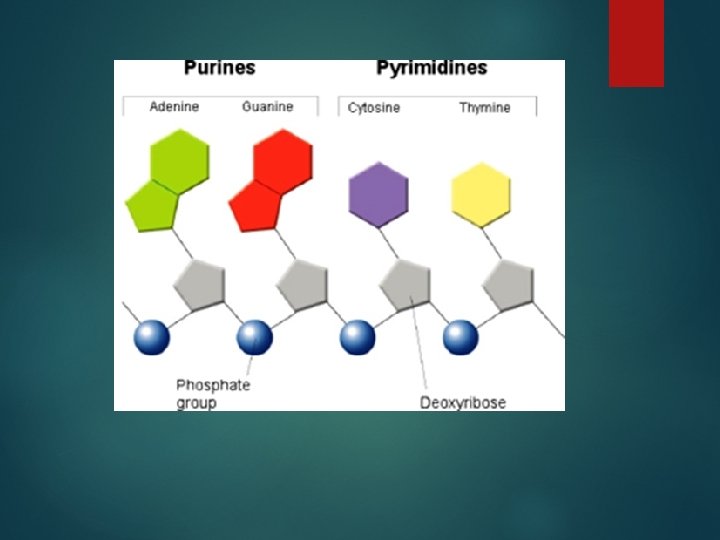
DNA is a long molecule made up of units called nucleotides Each nucleotide is made up of 3 parts: a 5 carbon sugar called deoxyribose, a phosphate group, and a nitrogenous base There are four kinds of nitrogenous bases in DNA: adenine & guanine (purines) and cytosine & thymine (pyrimidines)
Chargaff’s Rules – the percentage of guanine [G] and cytosine [C] bases are almost equal in any sample of DNA. Also, the percentages of adenine [A] and thymine [T] are almost equal [G] = [C] and [A] = [T]
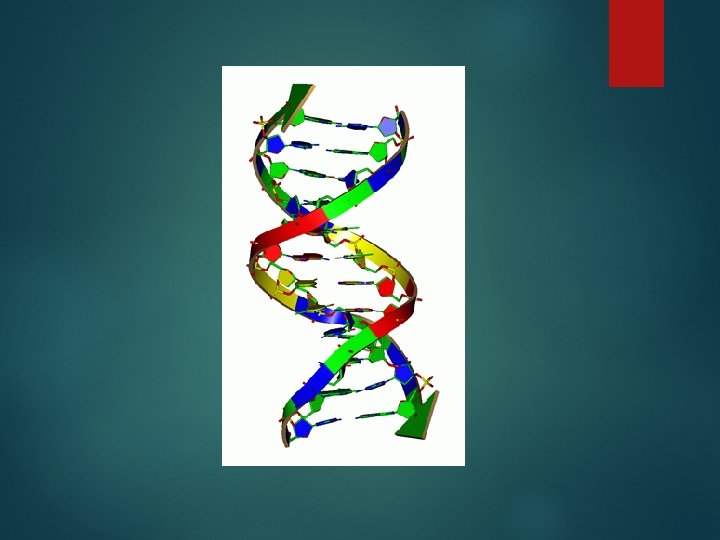
The Double Helix Francis Crick, a physicist, and James Watson, a biologist, figured out that the structure of DNA is a double helix, in which two strands were wound around each other
Base Pairing – explained Chargaff’s rules. For every adenine in a double-stranded DNA molecule, there had to be exactly one thymine molecule; for each cytosine molecule there was one guanine molecule
12 -2 CHROMOSOMES AND DNA REPLICATION
DNA and Chromosomes Prokaryotic cells do not have nuclei and many organelles that a eukaryotic cell has. Their DNA molecules are located in the cytoplasm. Most have a single circular DNA molecule that contains nearly all of the cell’s genetic information. Eukaryotic DNA is found in the nucleus and is much more complicated.
DNA Length DNA molecules are very long. A DNA molecule must be folded into a space only onethousandth (1/1, 000) of its length.
Chromosome Structure Eukaryotic chromosomes contain DNA and protein tightly packed together to form a substance called chromatin Chromatin consists of DNA that is tightly coiled around proteins called histones. Together, the DNA and histone molecules form a beadlike structure called a nucleosome. They are very tightly packed together.
DNA Replication The double helix structure of DNA explains how DNA could be copied (replicated). Each strand can be used to make the other strand, and is called complementary. If you separate the two strands, you can reconstruct the base sequence of the other strand. The sites where separation and replication occur are called replication forks
Duplicating DNA Before a cell divides, it duplicates its DNA. This is called replication. During DNA replication, the DNA molecule separates into two strands, then produces two new complementary strands following the rules of base pairing. Each strand of the double helix of DNA serves as a model for the new strand.
How Replication Occurs DNA replication is carried out by a series of enzymes. These enzymes “unzip” a molecule of DNA. The main enzyme involved in DNA replication is called DNA polymerase. It joins individual nucleotides to produce a DNA molecule.