
Chapter 11 Windows Vista This chapter is based
Chapter 11 : Windows Vista This chapter is based on n Tanenbaum OS/3 E book slides n And also from Chapter 21 slides of the book: “Operating Systems (Third Edition)”, Deitel and Choffnes Prentice Hall, 2004 1
Chapter 11 : Windows Vista n n n n n History Programming Windows Vista Operating System Structure Process and Thread Management Thread Scheduling Memory Management Input/Output in Vista NTFS Security Interprocess Communication 2
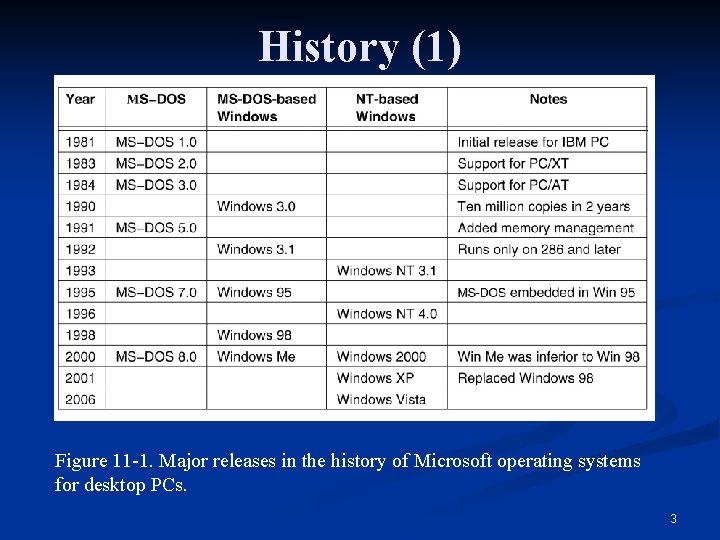
History (1) Figure 11 -1. Major releases in the history of Microsoft operating systems for desktop PCs. 3
History (2) n n n 1976 Bill Gates and Paul Allen founded Microsoft 1981 MS-DOS 1. 0 (Known as CP/M) n 16 -bit addressing n 8 KB memory resident code 1985 Windows 1. 0 n First Microsoft GUI operating system 1990 Windows 3. 1 and Windows for Workgroups 3. 1 n Added network support (LANs) 1992 Windows NT 3. 1 n NTFS n 32 -bit addressing 1995 Windows 95 n 32 -bit addressing n Direct. X n Simulates direct access to hardware through API 4
History (3) n n n 1996 Windows NT 4. 0 n Moved graphics driver into kernel 1998 Windows 98 n Bundled Internet Explorer into operating system 2000 Windows ME n Does not boot in DOS mode 2000 Windows 2000 n Active Directory n Database of users, computers and services 2001 Windows XP n 64 -bit support 2006 Windows Vista 5
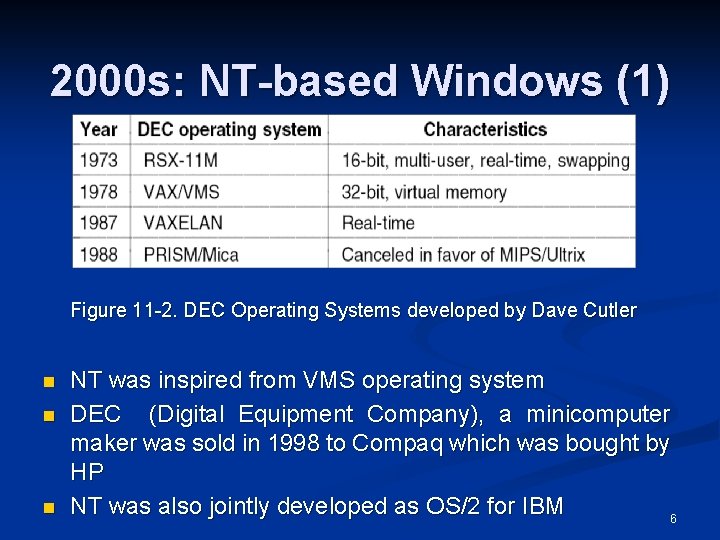
2000 s: NT-based Windows (1) Figure 11 -2. DEC Operating Systems developed by Dave Cutler n n n NT was inspired from VMS operating system DEC (Digital Equipment Company), a minicomputer maker was sold in 1998 to Compaq which was bought by HP NT was also jointly developed as OS/2 for IBM 6
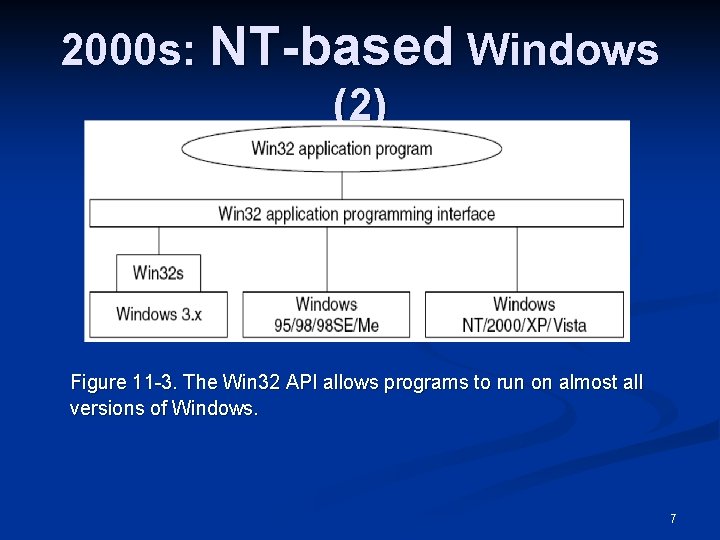
• 2000 s: NT-based Windows (2) Figure 11 -3. The Win 32 API allows programs to run on almost all versions of Windows. 7
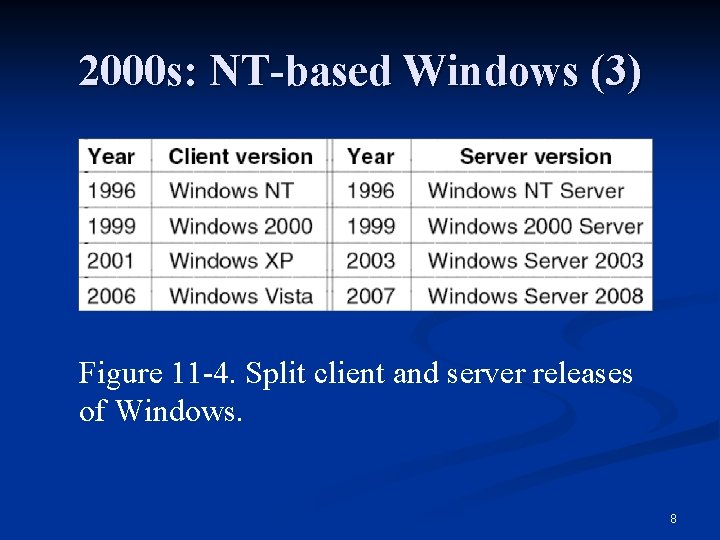
2000 s: NT-based Windows (3) Figure 11 -4. Split client and server releases of Windows. 8
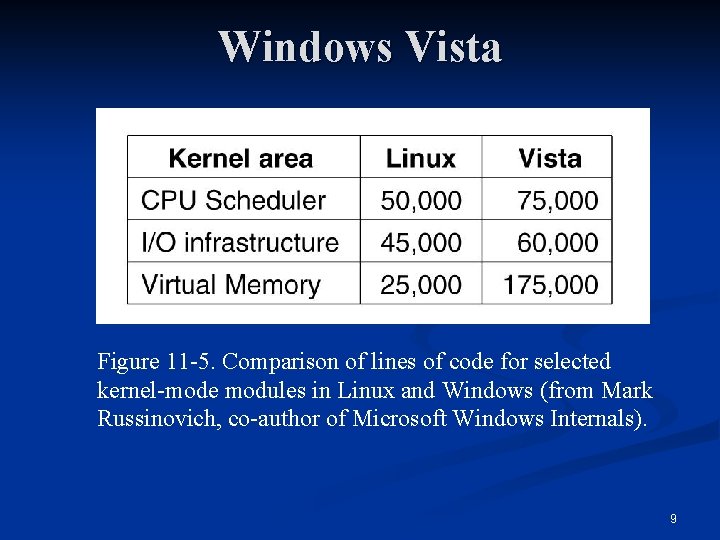
Windows Vista Figure 11 -5. Comparison of lines of code for selected kernel-mode modules in Linux and Windows (from Mark Russinovich, co-author of Microsoft Windows Internals). 9
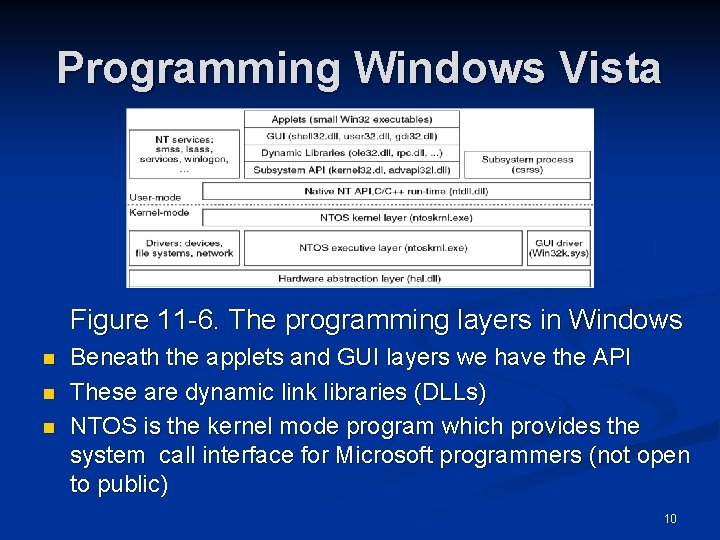
Programming Windows Vista Figure 11 -6. The programming layers in Windows n n n Beneath the applets and GUI layers we have the API These are dynamic link libraries (DLLs) NTOS is the kernel mode program which provides the system call interface for Microsoft programmers (not open to public) 10
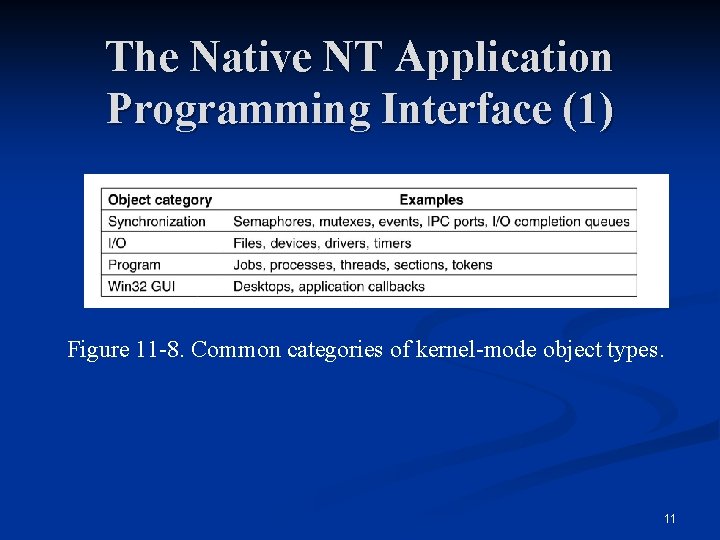
The Native NT Application Programming Interface (1) Figure 11 -8. Common categories of kernel-mode object types. 11
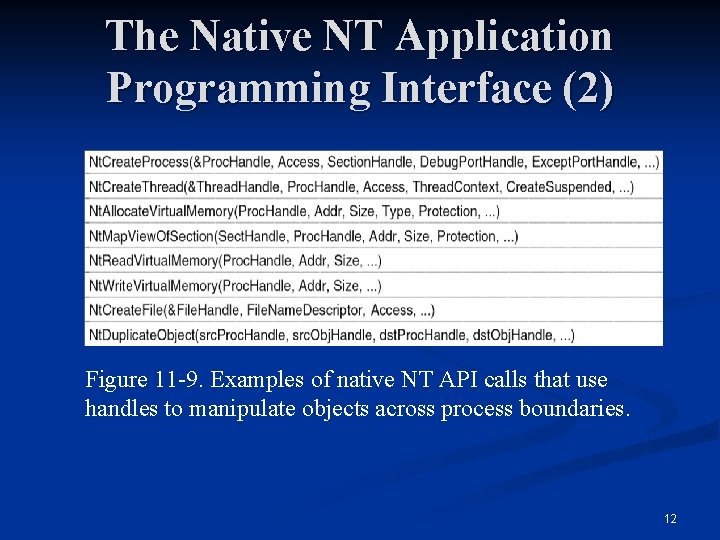
The Native NT Application Programming Interface (2) Figure 11 -9. Examples of native NT API calls that use handles to manipulate objects across process boundaries. 12
The Win 32 Application Programming Interface n n Win 32 API – interface for developing applications Fully documented and publicly disclosed The API is a library of procedures that either wrap (use and call somehow) the native NT system calls or do the work themselves Two special execution environments are also provided n n n WOW 32 (Windows-on-Windows) which is used on 32 -bit x 86 systems to run 16 -bit Windows 3. x applications by mapping system calls and parameters between the 16 -bit and 32 -bit worlds WOW 64 does the same thing for 32 -bit applications to work on x 64 systems Previously there were OS 2 and POSIX environments but not anymore 13
The Win 32 Application Programming Interface Figure 11 -10. Examples of Win 32 API calls and the native NT API calls that they wrap. 14
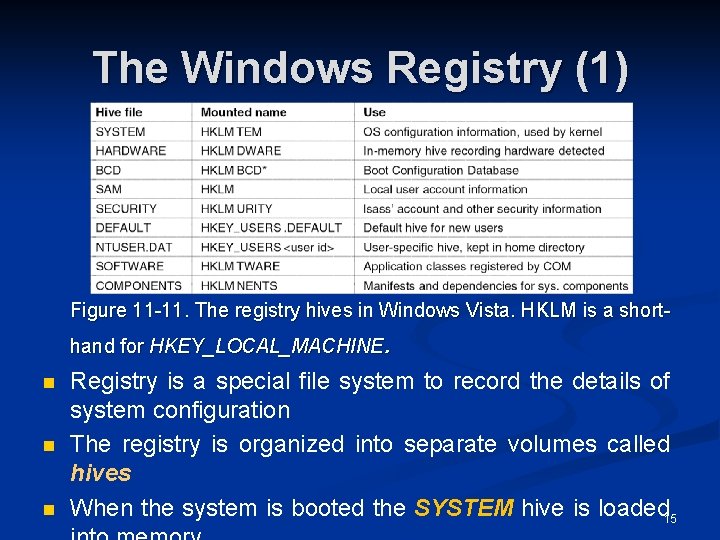
The Windows Registry (1) Figure 11 -11. The registry hives in Windows Vista. HKLM is a short- . hand for HKEY_LOCAL_MACHINE n n n Registry is a special file system to record the details of system configuration The registry is organized into separate volumes called hives When the system is booted the SYSTEM hive is loaded 15
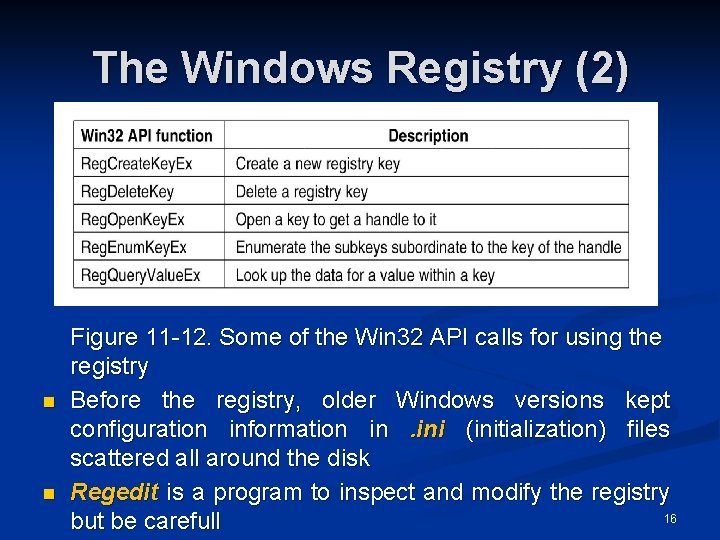
The Windows Registry (2) n n Figure 11 -12. Some of the Win 32 API calls for using the registry Before the registry, older Windows versions kept configuration information in. ini (initialization) files scattered all around the disk Regedit is a program to inspect and modify the registry 16 but be carefull
Operating System Structure Figure 11 -13. Windows kernel-mode organization. 17
Operating System Kernel n n n The system library (ntdll. dll) executing at user-mode contains compiler run-time and low-level libraries NTOS kernel layer: thread scheduling, synchronization abstractions, trap handlers, interrupts etc. NTOS executive layer contains the services such as management services for virtual memory, cache, I/O etc. HAL (Hardware Abstraction Layer) n Interacts with hardware, drives device components on main board n Abstracts hardware specifics that differ between systems of the same architecture (such as different CPUs) Device drivers are used for any kernel-mode activities which are not a part of NTOS or HAL (such as file 18 system, network protocols and antivirus software)
Booting Windows Vista n n On power on, BIOS loads a small bootstrap loader found at the beginning of the disk drive partitions Bootstrap loader loads Boot. Mgr program from the root directory If hibernated or in stand-by mode Win. Resume. exe is loaded If not Winload. exe is loaded for a fresh boot. This program loads: n n n Ntoskrnl. exe Hal. dll SYSTEM hive Win 32 k. sys (kernel-mode parts of Win 32 subsystem Other boot drivers 19
Process and Thread Management n Processes (containers for threads. PEB- Process n n n Processes (containers for threads. PEB- Process Environment Block) Threads (Basic scheduling unit. Normally executes in user-mode. TEB – Thread Environment Block) Jobs n n n Group processes together as a unit Manage resources consumed by these processes (e. g. , CPU time, memory consumption, etc. ) Terminate all processes at once 20
Process and Thread Organization n Fibers n n n Unit of execution (like a thread) Scheduled by thread that creates them, not microkernel. Thread must convert itself into a fiber to create fibers Advantage is in switching: Thread switching requires entry and exit to kernel. A fiber switch saves and restores a few registers withou changing modes at all Used rarely 21
Process and Thread Organization n Thread pools Worker threads that sleep waiting for work items n Each process gets a thread pool n Useful in certain situations n n Fulfilling client requests n Asynchronous I/O n Combining several threads that sleep most of the time n Memory overhead and less control for the programmer 22
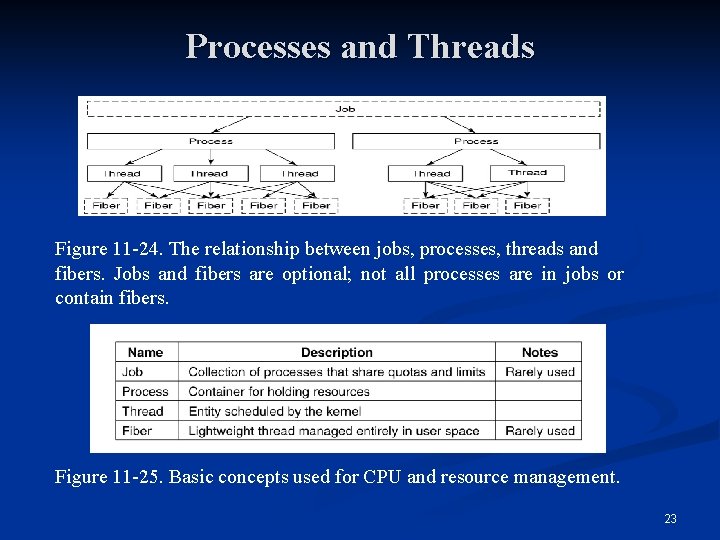
Processes and Threads Figure 11 -24. The relationship between jobs, processes, threads and fibers. Jobs and fibers are optional; not all processes are in jobs or contain fibers. Figure 11 -25. Basic concepts used for CPU and resource management. 23
Thread Synchronization n Dispatcher objects n Event object n Signaled when event occurs; n unsignaled either when one thread awakens or all threads awaken (choice determined by event’s creator) n Mutex object n One owner n Acquire – unsignaled; release – signaled n Semaphore object n Counting semaphore n Signaled while count > 0; unsignaled when count 0 n Can be acquired multiple times by same thread 24
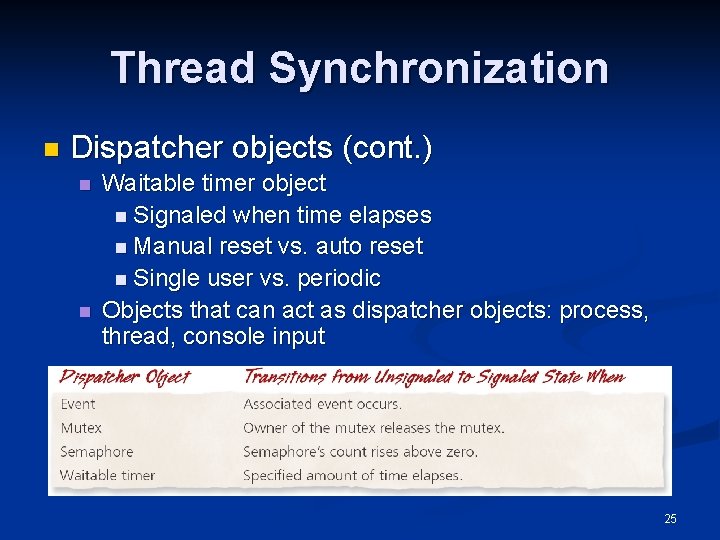
Thread Synchronization n Dispatcher objects (cont. ) n n Waitable timer object n Signaled when time elapses n Manual reset vs. auto reset n Single user vs. periodic Objects that can act as dispatcher objects: process, thread, console input 25
Thread Synchronization n Kernel mode locks n n n Fast mutex n n Spin lock Queued spin lock n More efficient than spin lock n Guarantees FIFO ordering of requests Like a mutex, but more efficient Cannot specify maximum wait time Reacquisition by owning thread causes deadlock Kernel mode locks (cont. ) n Executive resource lock n n n One lock holder in exclusive mode Many lock holders in shared mode Good for readers and writers 26
Thread Synchronization n Other synchronization tools n n Critical section object n Like a mutex, but only for threads of the same process n Faster than a mutex n No maximum wait time Timer-queue timer n Waitable timer objects combined with a thread pool Interlocked variable access n Atomic operations on variables Interlocked singly-linked lists n Atomic insertion and deletion 27
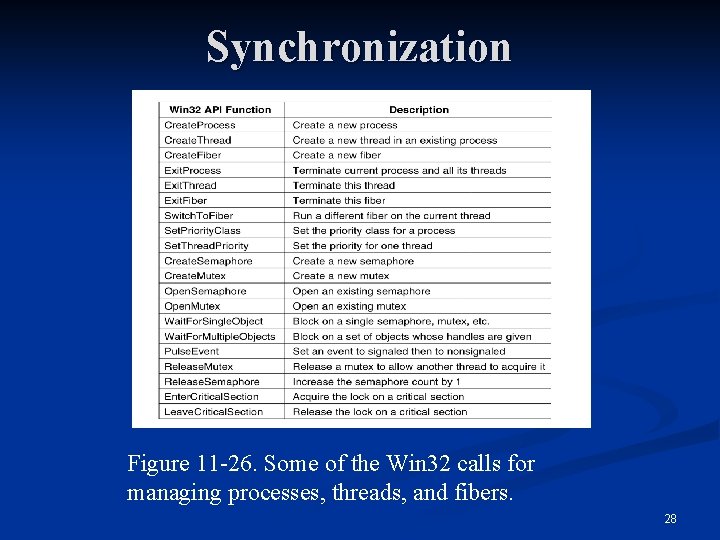
Synchronization Figure 11 -26. Some of the Win 32 calls for managing processes, threads, and fibers. 28
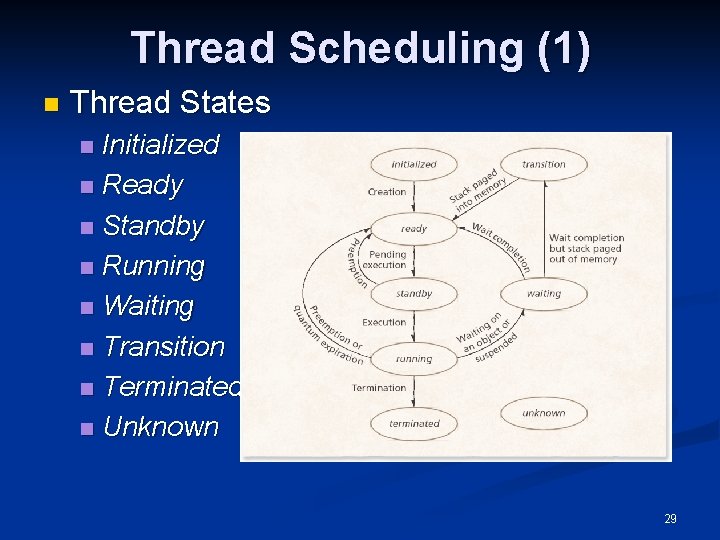
Thread Scheduling (1) n Thread States Initialized n Ready n Standby n Running n Waiting n Transition n Terminated n Unknown n 29
Thread Scheduling (2) n Windows kernel does not have a central scheduling thread. Instead, when a thread can not run any more, the thread enters kernel-mode and calls into the scheduler itself to see which thread to switch to 30
Thread Scheduling (3) n The following conditions cause the currently running thread to execute the scheduler code: n The currently running thread blocks on a semaphore, mutex, event, I/O, etc. n The thread signals an object (e. g. , does an up on a semaphore or causes an event to be signaled). n The quantum expires. n The scheduler is also called under two other conditions: n An I/O operation completes. n A timed wait expires. 31
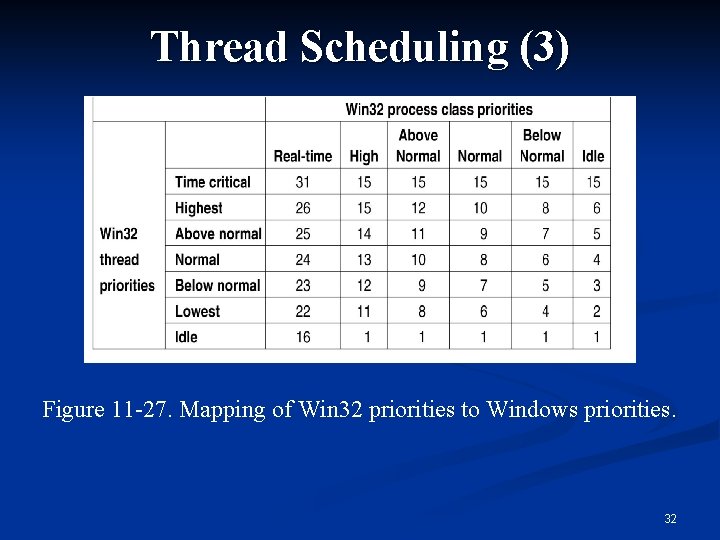
Thread Scheduling (3) Figure 11 -27. Mapping of Win 32 priorities to Windows priorities. 32
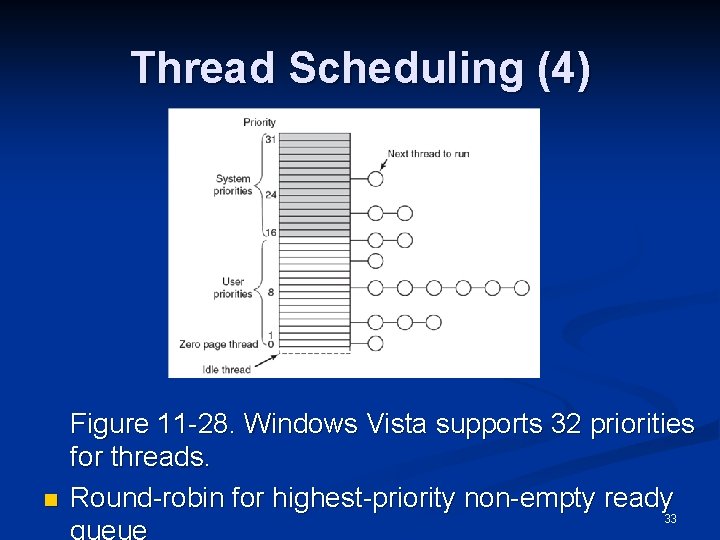
Thread Scheduling (4) n Figure 11 -28. Windows Vista supports 32 priorities for threads. Round-robin for highest-priority non-empty ready 33
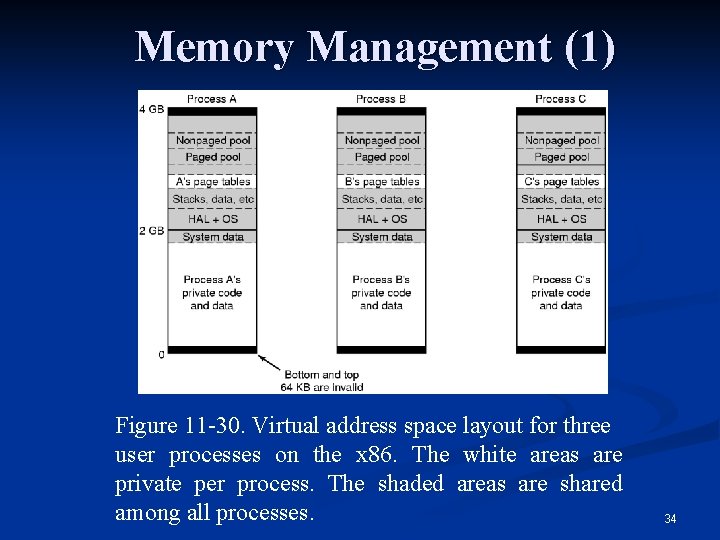
Memory Management (1) Figure 11 -30. Virtual address space layout for three user processes on the x 86. The white areas are private per process. The shaded areas are shared among all processes. 34
Memory Management (2) n n n Bottom and top 64 KB are intentionally unmapped 64 KB – 2 GB: User’s private code and data 2 GB – 4 GB (less 64 KB) : Operating system kernel virtual memory containing code, data, paged and nonpaged pools as well as process page table. Kernel virtual memory is shared by all processes and is only accessible while running in kernel mode For x 86 and x 64 systems virtual address space 35
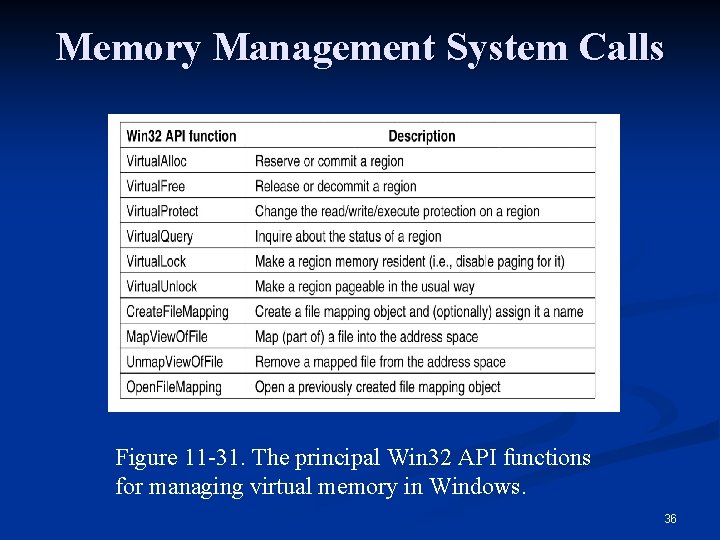
Memory Management System Calls Figure 11 -31. The principal Win 32 API functions for managing virtual memory in Windows. 36
Implementation of Memory Management Figure 11 -32. Mapped regions with their shadow pages on disk. The lib. dll file mapped into two address spaces at same time. 37
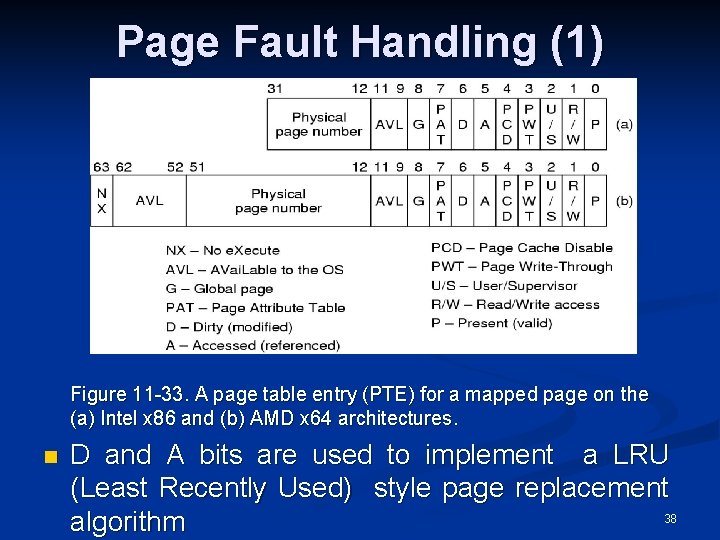
Page Fault Handling (1) Figure 11 -33. A page table entry (PTE) for a mapped page on the (a) Intel x 86 and (b) AMD x 64 architectures. n D and A bits are used to implement a LRU (Least Recently Used) style page replacement 38 algorithm
Page Fault Handling (2) n Each page fault can be considered as being in one of five categories: n n n The page referenced is not committed (program error – page has not been assigned to a process or in memory). Attempted access to a page in violation of the permissions (program error). A shared copy-on-write page was about to be modified. The stack needs to grow. The page referenced is committed but not currently mapped in (normal page fault in a paged system). 39
Page Replacement Algorithm (1) The working set concept is used n Each process (not each thread) has a working set n Each working set has two parameters: n A minimum size (initally 20 to 50 pages) n A maximum size (initially 45 to 345 pages) n Every process starts with the same minimum and maximum but these bounds can change over time n 40
Page Replacement Algorithm (2) n n n Working sets only come into play when physical memory gets low Otherwise, processes can exceed the maximum of their working set The working set manager runs periodically based on a timer and does the following: n n n When lots of memory is available, it uses the access bits to compute an age for each page When memory gets tight, the working set is fixed and oldest pages are replaced when a new page is needed When memory is tight, the working sets are trimmed below their maximum by removing the oldest pages 41
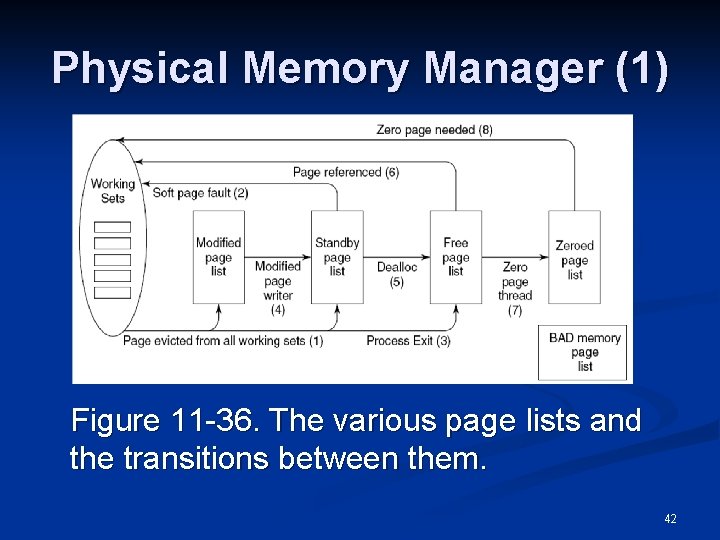
Physical Memory Manager (1) Figure 11 -36. The various page lists and the transitions between them. 42
Physical Memory Manager (2) 1. 2. 3. Pages removed from a working set are put on either modified page list or standby page list (pages which are not modified) The pages on these two lists are in memory so if a page fault occurs and one of these pages is needed, they are put back to the working set with no disk I/O (A soft page fault) When a process exits all nonshared pages of the working set, modified pages 43
Physical Memory Manager (3) 4. 5. 6. 7. 8. A modified page writer thread wakes up periodically and writes modified pages to disk and move them to the standby list if there are not enough clean pages When a page is not needed by a process, it goes to the free page list At a page fault (hard fault) a free page is taken from the free page list Whenever the CPU is idle, a lowest priority thread, the Zero. Page thread resets free pages to zeros and puts them on zeroed page list When a zeroed page is needed for security reasons, pages are taken from the zeroed page list 44
Input/Output in Vista n The I/O system consists of Plug-and-play services n The power manager n The Input/Output manager n Device drivers n 45
Plug-and-Play Services Buses such as PCI, USB, EIDE, and SATA had been designed in such a way that the plug-and-play manager can send a request to each slot and ask the device there to identify itself n After identification Pn. P manager allocates hardware resources, such as interrupt levels, locates the appropriate drivers, and loads them into memory n As each driver is loaded, a driver object is created n 46
Power Manager The power manager adjusts the power state of the I/O devices to reduce system power consumption when devices are not in use n This is very important when laptops are on battery power n Two special modes of power saving: n Hibernation mode: all of the physical memory is copied to disk and power consumption is reduced to a minimum level n Standby mode: power is reduced to the lowest 47 n
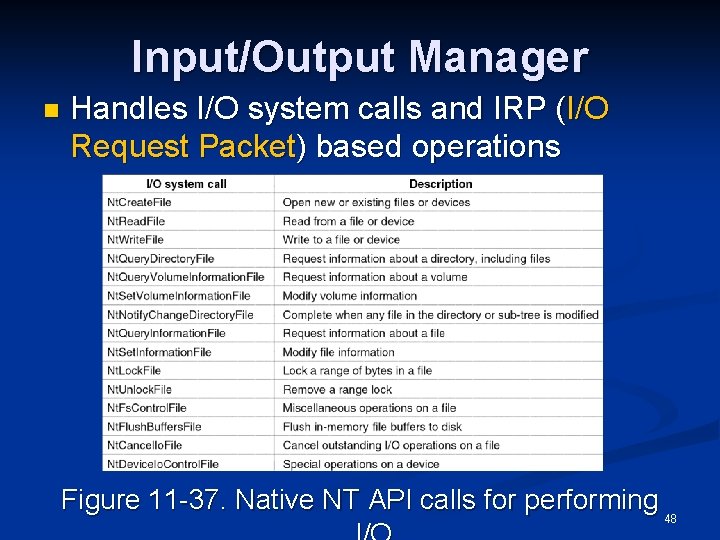
Input/Output Manager n Handles I/O system calls and IRP (I/O Request Packet) based operations Figure 11 -37. Native NT API calls for performing 48
Device Drivers All drivers must conform to the WDM (Windows Driver Model) standarts for compatibility reasons with the older windows versions n Devices in Windows are represented by device objects which are used to represent n Hardware, such as buses n Software abstractions like file systems, network protocol engines and kernel extensions, like antivirus filter drivers 49 n
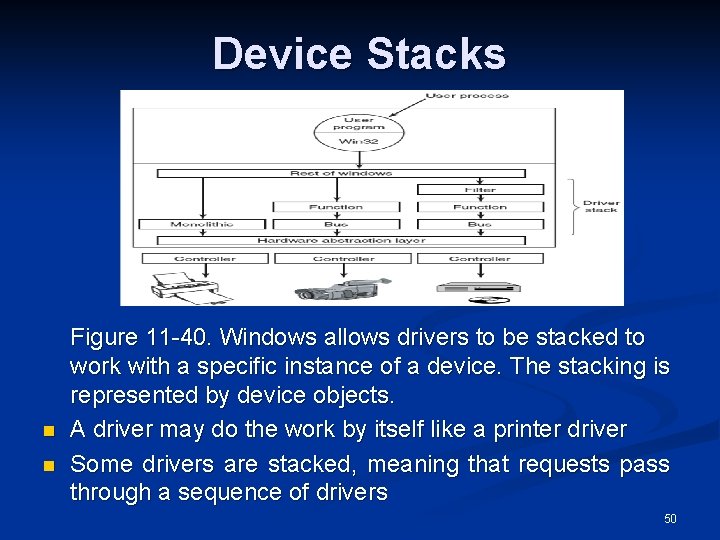
Device Stacks n n Figure 11 -40. Windows allows drivers to be stacked to work with a specific instance of a device. The stacking is represented by device objects. A driver may do the work by itself like a printer driver Some drivers are stacked, meaning that requests pass through a sequence of drivers 50
File Systems n Three driver layers n Volume drivers n n n File system drivers n n Low level drivers Interact with data storage hardware devices NTFS FAT 16 (16 bit disk addresses with disk partitions at the most 2 GB) FAT 32 (32 bit disk addresses and supports partitions up to 2 TB, not secure and used mainly for transportable media, such as flash disks, nowadays File system filter drivers n n n Perform high-level functions Virus scanning Encryption 51
File System Drivers n Typical Disk I/O User-mode thread passes file handle to object manager n Object manager passes file pointer to file system driver n File system driver passes request to device driver stack n Eventually request reaches disk n Disk performs requested I/O n 52
NTFS n NTFS overview Windows NT file system n More secure than FAT n Scales well to large disks n n Cluster size depends on disk size n 64 -bit file pointers n Can address up to 16 exabytes of disk Multiple data streams n Compression and encryption n 53
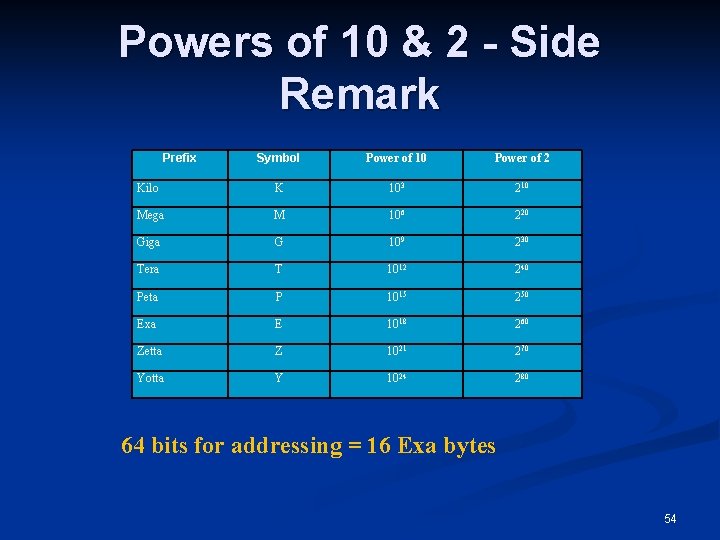
Powers of 10 & 2 - Side Remark Prefix Symbol Power of 10 Power of 2 Kilo K 103 210 Mega M 106 220 Giga G 109 230 Tera T 1012 240 Peta P 1015 250 Exa E 1018 260 Zetta Z 1021 270 Yotta Y 1024 280 64 bits for addressing = 16 Exa bytes 54
File System Structure Each NTFS volume (e. g. , disk partition) contains files, directories, bitmaps, and other data structures n Each volume is organized as a linear sequence of blocks (called as clusters) usually 4 KB in size (can be 512 bytes to 64 KB) and pointed by 64 bit pointers n The main data structure in each volume is the MFT (Master File Table) which is a linear sequence of 1 KB records n 55
NTFS Master File Table (1) n n Each MFT record describes one file or directory and contains file attributes (file name, block addresses, timestamps etc. ) The MFT is a file itself and can be placed anywhere within the volume thus eliminating the problem of defective sectors in the first track MFT can grow dynamically up to a maximum size of 248 records The first 16 MFT records are reserved for NTFS metadata files which contain volume related system data to describe the volume 56
NTFS Master File Table (2) 57
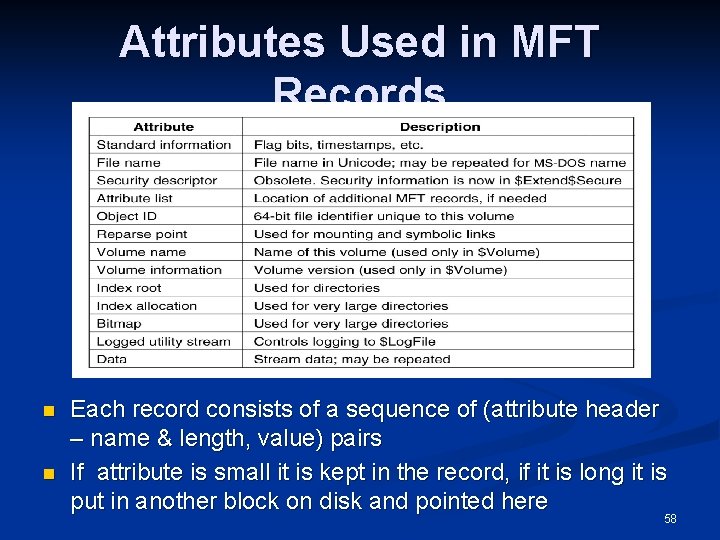
Attributes Used in MFT Records n n Each record consists of a sequence of (attribute header – name & length, value) pairs If attribute is small it is kept in the record, if it is long it is put in another block on disk and pointed here 58
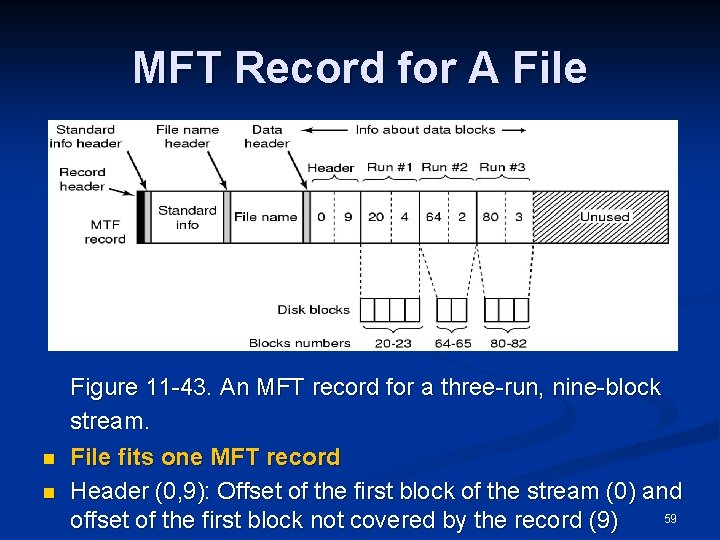
MFT Record for A File n n Figure 11 -43. An MFT record for a three-run, nine-block stream. File fits one MFT record Header (0, 9): Offset of the first block of the stream (0) and 59 offset of the first block not covered by the record (9)
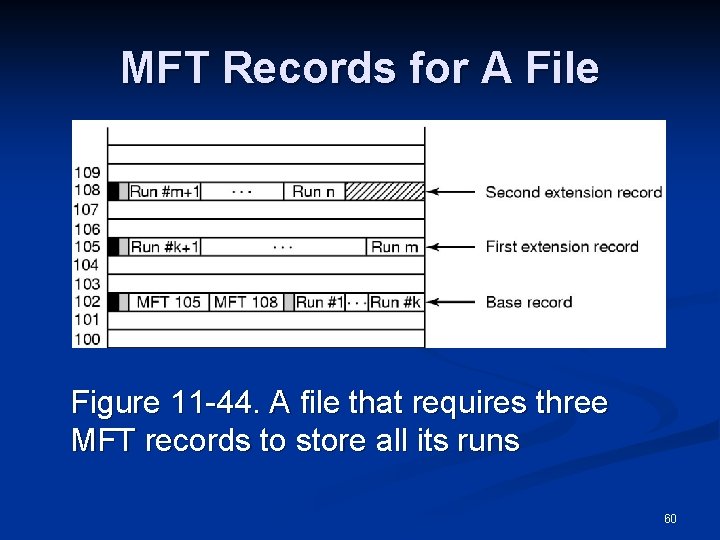
MFT Records for A File Figure 11 -44. A file that requires three MFT records to store all its runs 60
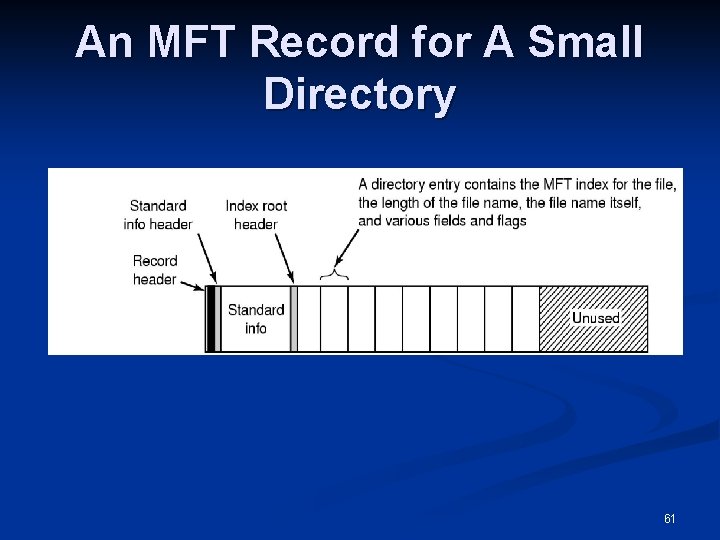
An MFT Record for A Small Directory 61
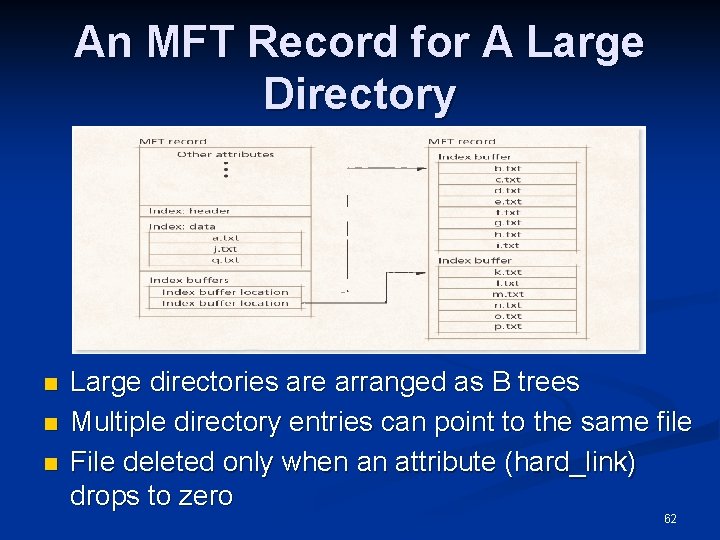
An MFT Record for A Large Directory n n n Large directories are arranged as B trees Multiple directory entries can point to the same file File deleted only when an attribute (hard_link) drops to zero 62
File Compression Transforms file to take less space on disk n Lempel-Ziv Compression Algorithm n Transparent n Applications access files using standard API calls n System compresses and decompresses files n Applications unaware if file compressed n n The compression algorithm considers 16 consecutive blocks n If the compressed form takes less than 16 blocks then the compression is applied else 63
File Encryption Protects files from illicit access n Encryption performed in compression units n Keys n Public key / private key encryption n Recovery key given to system administrator n n In case user forgets password Encrypted versions of keys stored on disk n Decrypted keys stored in non-paged pool n 64
Security n n n Security properties inherited from the original security design of NT: Secure login with anti-spoofing measures (prevents login screen to be imitated) Discretionary access controls (owner has the rights) Privileged access controls (superuser can override) Address space protection per process New pages must be zeroed before being mapped in 65
Interprocess Communication n Data oriented n n Pipes Mailslots (message queues) Shared memory Procedure oriented / object oriented n n Remote procedure calls Microsoft COM (Component Object-Model) objects Clipboard GUI drag-and-drop capability 66
Pipes n Manipulated with file system calls n n Pipe server n n Process that creates pipe Pipe clients n n Read Write Open Processes that connect to pipe Modes n n n Read: pipe server receives data from pipe clients Write: pipe server sends data to pipe clients Duplex: pipe server sends and receives data 67
Pipes n Anonymous Pipes n n n Unidirectional Between local processes Synchronous Pipe handles, usually passed through inheritance Named Pipes n Unidirectional or bidirectional Between local or remote processes Synchronous or asynchronous Opened by name Byte stream vs. message stream n Default mode vs. write-through n n mode 68
Mailslots Mailslot server: creates mailslot n Mailslot clients: send messages to mailslot n Communication n n n Unidirectional No acknowledgement of receipt Local or remote communication Implemented as files Two modes n Datagram: for small messages n Server Message Block (SMB): for large messages 69
Other Features Cookie management n Certificates n Trusted Internet Zones n Automatic Update n Notifies users of security patches n Can download and install patches automatically n 70
- Slides: 70