
CHAPTER 11 THE PRESIDENT Who Can Become President
CHAPTER 11: THE PRESIDENT
Who Can Become President? • Article II, Section 1, of the Constitution sets forth the qualifications for presidential candidates. The two major limitations are age, minimum of 35, and being a naturalborn citizen, thus eliminating naturalized citizens. While these minimal requirements would seem to allow most people the opportunity to be a candidate for president only a few individuals have had a realistic chance. Of the 43 individuals who have served as president all have been white males and only one, John Kennedy, was not a Protestant. Furthermore, all have held positions of leadership and have been affiliated with a major political party prior to their election. Because of the strength of the two major political parties it would seem unlikely that an individual would be elected president without the nomination of one of the two major parties. As females and ethnic minorities assume more positions of power within the two major parties they will have a better opportunity of being a candidate for their party nomination.
The Process Of Becoming President • As explained in detail in Chapter 9 of the textbook, the election process for control of the White House is a complex procedure. Because of the two-party system in the United States, it would be exceedingly difficult for someone to be elected without the nomination of one of the two major parties. The parties each nominate their candidate at a National Party Convention in the summer preceding the November election. Yet potential nominees typically begin campaigning several years before the election. In order to gain the nomination of either of the two major parties, a candidate must receive a majority of the votes cast by delegates at the national convention of the party. Once the candidate has received the nomination he or she must win a majority of the votes cast in the Electoral College (which is not necessarily a majority of the popular vote).
The Process Of Becoming President • The Electoral College is a safety net provided in the Constitution to protect the country against “mob rule. ” Each state’s allocation of electors is determined by their congressional representation (that is, the number of members of the House, plus two more for their Senators). As in the House of Representatives, the Electoral College can be controlled by the most populous states. The electors are decided in most states on a winner take system, with the candidate who receives the plurality of votes winning. Thus, it is possible for a candidate to lose the popular vote but still win election as president, as was the case in 2000. Usually, however, the electoral vote serves to exaggerate the successful candidate’s margin of victory.
The Process Of Becoming President • It is possible for no candidate to receive a majority of the votes cast in the Electoral College. When this occurs the House of Representatives elects the president. This happened twice, the last time was 1824. As long as there are only two candidates it is unlikely that neither would receive a simple majority of electoral votes, although there could be a tie (269 -269). If no candidate receives a majority of the electoral votes, the House will elect the president by voting by state for a candidate. This would mean that California, which has 52 representatives, would get one vote and Wyoming which has one representative would receive one vote. In order to win such an election a candidate must receive a majority of the votes cast by state.
The Process Of Becoming President • In the event that no presidential candidate receives a majority of electoral votes it would be unlikely that a vice presidential candidate would receive a majority of electoral votes. If no vice presidential candidate receives a majority of electoral votes the Senate elects the vice president. The last time this occurred was 1836 when Richard M. Johnson, the Democratic vice presidential candidate, did not receive a majority of the electoral votes. A significant number of electors chose not to support the Democratic vice presidential candidate because of a rumored sexual scandal involving Johnson. The Senate elected Johnson as the vice president regardless of the scandal.
The Process Of Becoming President • As was evidenced in the 2000 election, there was outrage, particularly on the part of supporters of Al Gore, as a result of the 2000 elections. Most of the protest, however, came as a result of vote fraud claims in the state of Florida, which determined the outcome of the election in the Electoral College. In spite of the fact that Gore won the popular vote and Bush won the electoral vote, there was relative acceptance of the outcome, and the role the Electoral College plays in electing the president. As was pointed out in 2000, changing the way the president is elected would be very difficult. An amendment to the Constitution would have to be proposed by Congress and then it would have to be ratified by 3/4 of the states. Although this could transpire, it would require overwhelming support in Congress and from state legislatures. While many Americans have requested such an alteration in the Constitution it seems unlikely that such a change will be made in the near future.
The Many Roles of the President • Over time the institution of the presidency has evolved into numerous formal and informal roles. One role is Chief of State. In this position, the president performs the role of the ceremonial head of state. As head of state the president is afforded a status of symbolic royalty. In most countries the head of state is not the leader of government, but is a separate position like the queen in England or the president in France.
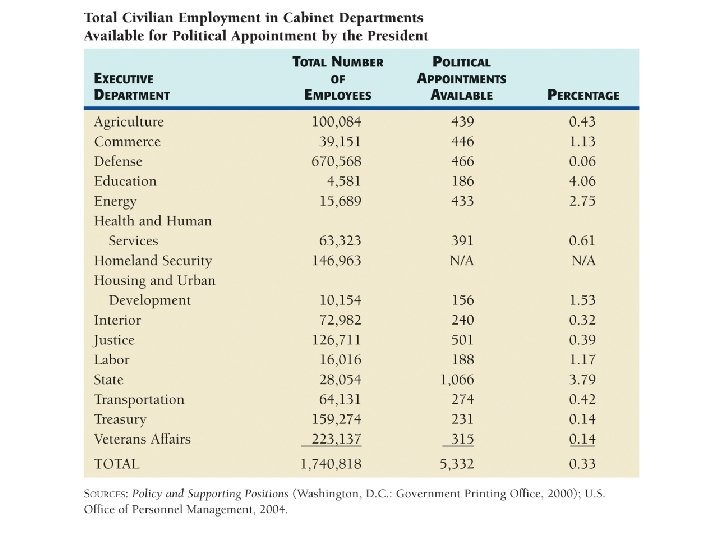
The Many Roles of the President • The president also functions as the Chief Executive. In this position, the president is leader of government in the executive branch. This position requires that the president administer the laws of the country. He is therefore the head of the bureaucracy and is responsible for selecting all high-ranking officers of the government who are not elected.
The Many Roles of the President • The president also is Commander-in-Chief, or the head of the military. This has become a position that has more power and responsibility than most people can comprehend. Clearly the authors of the Constitution did not intend, nor could they have foreseen, the president possessing the amount of power that the head of the military now has at his disposal. As the military power of the United States increases so too does the power of the president. This power has greatly influenced the role that every modern president has had to assume in world affairs.
The Many Roles of the President • As Chief Diplomat the president has the responsibility for setting the direction of foreign policy. The president determines which countries the United States will recognize. He will also propose treaties, although 2/3 of the Senate must approve of such action before the treaty is effective. The president can also make international agreements with the heads of foreign governments. These actions are called executive agreements and they do not require the approval of the Senate.
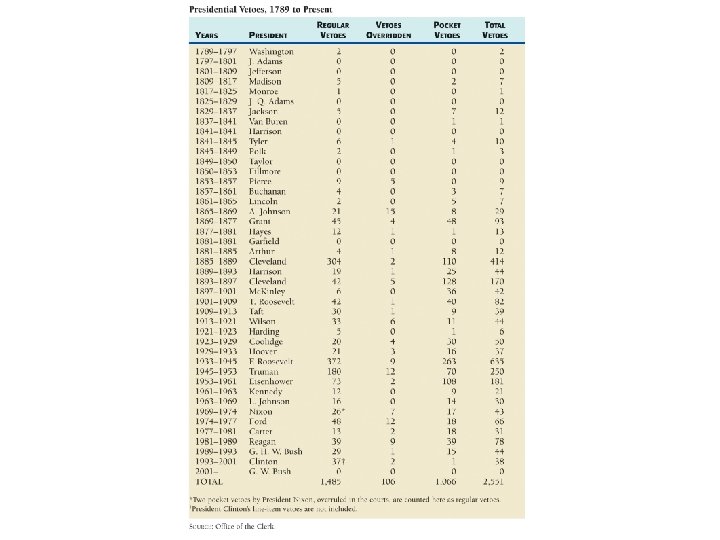
The Many Roles of the President • Some of the powers the president has as Chief Legislator are prescribed in the Constitution. In this role the president is the initiator of a legislative agenda for congressional action. The president gives a State of the Union message to Congress each year. Frequently this speech is used to outline the president’s legislative agenda. If Congress decides to ignore the agenda, the president may attempt to stop legislation by use of the veto, although it is possible for Congress to override the veto with a 2/3 majority in each chamber. In 1996 Congress enacted legislation that allowed the president to use the line-item veto on bills of revenue. In 1998, the Supreme Court ruled the line-item veto unconstitutional. This law could have had a dramatic impact on the legislative process.
The Many Roles of the President • Other presidential powers include powers that Congress has bestowed on the president by statute (statutory powers) and those that are considered inherent powers. Statutory powers include Congressional legislation like the War Powers Resolution, which confines presidential use of force. Inherent powers are those powers the head of government needs to fulfill his duties, as prescribed vaguely in the Constitution. An example of inherent powers is the emergency power used by the president in times of war.
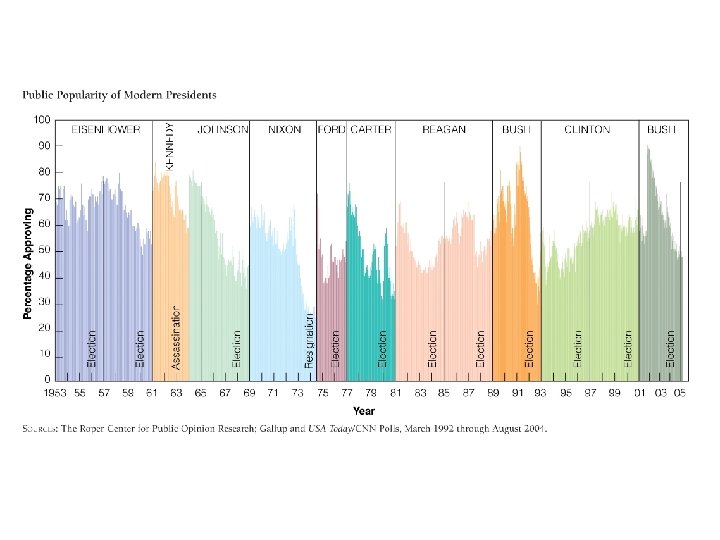
The President As Party Chief and Super Politician • As the roles of the president have evolved the institution of the presidency has gained considerable power and responsibility. In the twentieth century presidents have been expected to take an active role in setting an agenda for both domestic and foreign policy. In order to gain the enactment of the specific proposals the president has had to rely on his role as the leader of his political party and his ability to mobilize public support for his agenda. If the president is of the same party that has control of both houses of Congress it is easier for him to work with Congress on his legislative agenda. When the opposition party controls Congress, the president has a more difficult task in gaining the enactment of his proposals. How much success the president has is, in part, influenced by the public support for the president as measured in public opinion polls. When the president presents an idea to Congress, he may “go public” in an attempt to generate support for his proposal. He is also likely to rely on specific constituencies to contact Congress requesting the enactment of the policy. If the president is not successful in persuading Congress to enact his agenda he will have a difficult task in seeking reelection, or if he is in his second term of office he will have a difficult time in accomplishing his overall goals.
The President As Party Chief and Super Politician • Increasingly, many party members see the president as chief campaigner and chief fundraiser. Typically, candidates for Congress and even state offices rely on the president’s ability to generate contributions t help fund their campaigns. The president also is expected to “go on the stump” and campaign for politicians of his party up for election. This is particularly true of incumbent members of the House and Senate who are members of the president’s party. Frequently, this is beneficial for candidates. But during the 2000 presidential campaign, Vice President Al Gore recognized the need to distance himself from President Clinton negative personal baggage, while keeping his links to the administration responsible for a period of strong economic growth.
Special Uses of Presidential Power • • Emergency powers can be used during periods of national crisis. The United States Supreme Court enunciated these powers in the case of United States v. Curtis-Wright Export Corporation in 1936. These powers are rarely used by presidents and when they are used it is most likely to occur in times of war. Executive orders are rules or regulations issued by the president that have the same effect as a law. This power allows the president to take action within a congressionally proscribed area that results in specific policy directive.
Special Uses of Presidential Power • Executive privilege is the right of the president, or a member of his administration, to refuse to provide Congress with information. This is a legitimate action that is based on the separation of powers. There are limits to this type of claim as was demonstrated in the case of United States v. Nixon in 1974, which held that executive privilege cannot be used to prevent evidence from being heard in criminal proceedings.
Special Uses of Presidential Power • The impoundment of funds is the refusal to spend money appropriated by Congress for a specific item. Many presidents have taken this action and there was little disapproval from Congress prior to President Nixon’s impoundment in 1973. Congressional response to this impoundment was enactment of The Budget and Impoundment Act of 1974, which required the president to spend the money appropriated by Congress. In 1975 (after President Nixon had resigned from office) the Supreme Court held that the president must spend money appropriated by Congress, unless Congress approved of the impoundment.
Abuses of Executive Power and Impeachment • Article I, Section 2, gives the House the sole power of impeachment. If a majority of the members of the House vote to impeach an officer of the United States, the Senate will conduct a trial of impeachment. If two-thirds of the Senators vote for conviction the officer is removed from office. There have been less than 25 impeachments in the history of the United States and of this number only two were presidents. The House impeached Andrew Johnson, who took office after the assassination of President Lincoln. The Senate conducted a trial of impeachment but did not vote to convict the president. President Nixon resigned his position in the face of a vote on impeachment by the House in 1974. President Bill Clinton was impeached by the House of Representatives on charges he lied to a federal grand jury regarding his affair with White House intern Monica Lewinsky, and on obstruction of justice. The Senate did not convict President Clinton. The concept of impeachment is important because without this power there would be little the public or other governmental officials could do if a person was taking action that could be considered criminal. On the other hand this power could be abused and lead to the political impeachment of officers of the United States. Since the adoption of the Constitution this has been a seldom -used power.
The Executive Organization • The structural organization of the executive branch was not outlined in detail by the founding fathers. All the Constitution provides for is a president and a vice president. The remaining structure was left to the discretion of the president and Congress. This lack of constitutional structure has allowed the executive branch to be as flexible as Congress and the president have desired. If the structure had been written into the Constitution, any alteration in structure would have required an amendment.
The Executive Organization • By far the largest growth within the executive branch has occurred in the twentieth century. Prior to the administration of Franklin Roosevelt, the size of the executive branch was less than half its current size. But Roosevelt’s administration, overburdened in its attempts to administer its New Deal programs, increased the size of federal bureaucracy to accommodate its new responsibilities. Chapter 12 of the textbook will focus on the federal bureaucracy; the following represents the organization of those who formally advise the president. – The cabinet - the 13 department secretaries and the attorney general who meet to receive directives from the president, provide the president with information from their area of specialization, and to advise the president on matters of state.
The Executive Organization – The Executive Office of the President - nine staff agencies that assist the president in performing the duties of the executive branch. • • • White House Office Council of Economic Advisers National Security Council Office of the United States Trade Representative Council of Environmental Quality Office of Management and Budget Office of Science and Technology Policy Office of Administration Office of Policy Development
The Executive Organization • In addition to formal advice, the president may rely on the advice of individuals who are not in the executive branch organization. President Kennedy selected his brother Robert Kennedy as the attorney general and he relied heavily on the advice of his brother. During the Johnson administration Congress enacted legislation that prohibits the president from selecting family members to serve in formal executive positions. This has not stopped presidents from seeking the advice of family members. President Carter and President Reagan admitted that they often sought the advice of their spouse when making important decisions. President Clinton formed a task force headed by his wife, Hillary Rodham Clinton, to address the issue of health care. In addition to family members the president may also rely on the advice from close friends who do not hold a seat in government. These advisors are called the “kitchen cabinet. ” This type of informal advice may be more important to a president than the advice he receives from the formal executive structure.
The Vice Presidency • Traditionally the presidential candidate selects a vice presidential candidate who will appeal to voters. This usually means the presidential candidate will select someone who is from a different geographical area and who has different constituency strengths. Sometimes candidates also will select a running mate with a different philosophical perspective. Examples include: Richard Nixon, a moderate from California, selecting Spiro Agnew, a conservative from Maryland; Jimmy Carter, a moderate from Georgia selecting Walter Mondale, a liberal from Minnesota; Ronald Reagan, a conservative from California selecting George Bush, a moderate from Texas; and George H. W. Bush, selecting Dan Quayle, a conservative from Indiana.
The Vice Presidency • Selecting the running mate on the basis of how well he or she would serve in a particular capacity would be a major break with tradition. It would probably mean that the presidential candidate was not primarily concerned with the impact the vice presidential candidate would have on the election. Since the major objective of the presidential candidate is to be elected it would seem unlikely that the decision of whom to select as a running mate would not be a political decision. President Clinton did break with tradition in selecting Al Gore as his running mate. Both men were from the South and both were considered to be moderates within the Democratic party.
The Vice Presidency • Usually the presidential candidate selects someone who will help to balance the ticket. While this may help to win the election, it presents some problems once the president has been elected. The president is now faced with a vice president who has taken significantly different positions on major policy issues. Ronald Reagan selected a running mate who was his chief rival for the Republican nomination. When campaigning against Reagan, George H. W. Bush referred to Reagan’s economic views as “voodoo economics. ” Within nine months of making this statement Bush was sworn into office as the vice president to President Reagan. Al Gore chose Connecticut Senator Joe Lieberman as his running mate, despite the fact that Gore and Lieberman had opposing views on school vouchers (Lieberman favored them, Gore did not). Once elected the vice president is relegated to perform the tasks assigned by the president, which in most cases are insignificant.
The Vice Presidency • While the vice president has few formal obligations, there is one major obligation that can occur: replacing the president if the president resigns, dies, or is incapable of performing the duties of president. On eight occasions the vice president has replaced the president. Other than Nixon’s resignation, all have been due to the death of the president. When the vice president replaces the president, he becomes the new president with all of the powers and duties as if he had been elected. One major flaw with this system was that once the vice president became president there was no vice president. On the first seven occasions when a vice president became president there was no way for the president to select a vice president. After President Kennedy was assassinated and Vice President Johnson became the new president, Congress began to work on an amendment that would eliminate this problem.
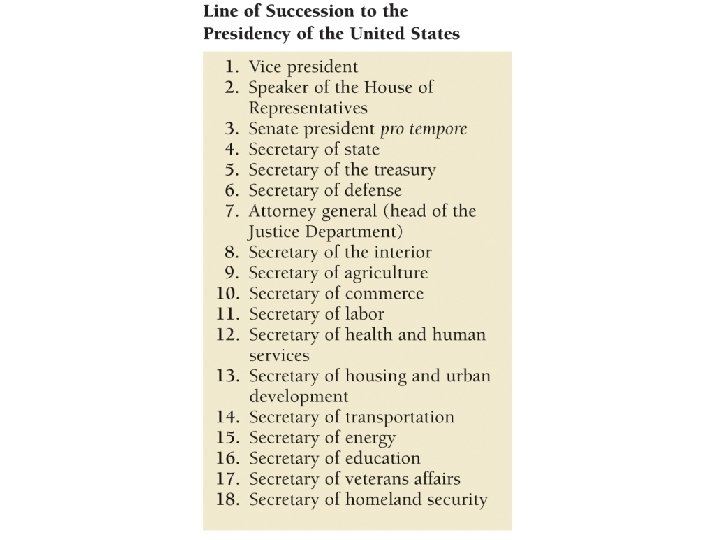
The Vice Presidency • The Twenty-fifth Amendment was ratified in 1967 and was used twice in the next seven years. This amendment states that a vice president replacing a president is the new president and can nominate a new vice president. If a majority of both houses of Congress approve of the nominee the individual will be sworn into office as the new vice president. One of the members of the House who supported this amendment was Carl Albert, who would become the next Speaker of the House. In 1973 the vice president, Spiro Agnew, resigned. President Nixon nominated the Minority Leader of the House, Gerald Ford and he was confirmed by both houses of Congress. In August of 1974 President Nixon resigned and was replaced by Ford. Had the Twenty-fifth Amendment not been ratified Ford could not have become vice president. This would have meant that Carl Albert, the Speaker of the House, would have had to replace Nixon as president. Although it is possible Nixon would not have resigned if Ford was not the vice president, it is interesting to speculate as to what would have occurred without the new amendment.
The Vice Presidency • One of the more controversial provisions in the Twenty-fifth Amendment concerns the ability of the president to perform his normal duties. If the vice president and a majority of the principal officers of the executive departments (Cabinet) indicate to the leaders of Congress that the president is not capable of performing the duties of the office, the vice president shall assume power as the acting president. Under what circumstances would the Cabinet and vice president submit such a letter to Congress? Had this amendment been a part of the Constitution when President Woodrow Wilson had a stroke it would have placed the vice president and the cabinet in a difficult position. If they had voted to replace the president, they would have been criticized for seeking the executive power. If they had not voted to replace the president, they would have been criticized for failing to take action. To date this provision of the Twenty-fifth Amendment has not been used. If it is, it could prove a controversial time in the life of the nation.
- Slides: 33