
Chapter 11 THE NERVOUS SYSTEM THE BRAIN CRANIAL
Chapter 11 THE NERVOUS SYSTEM: THE BRAIN, CRANIAL NERVES, AUTONOMIC NERVOUS SYSTEM, AND THE SPECIAL SENSES © 2012 Delmar Cengage Learning. All Rights Reserved. May not be scanned, copied, duplicated, or posted to a publicly accessible website, in whole or in part.
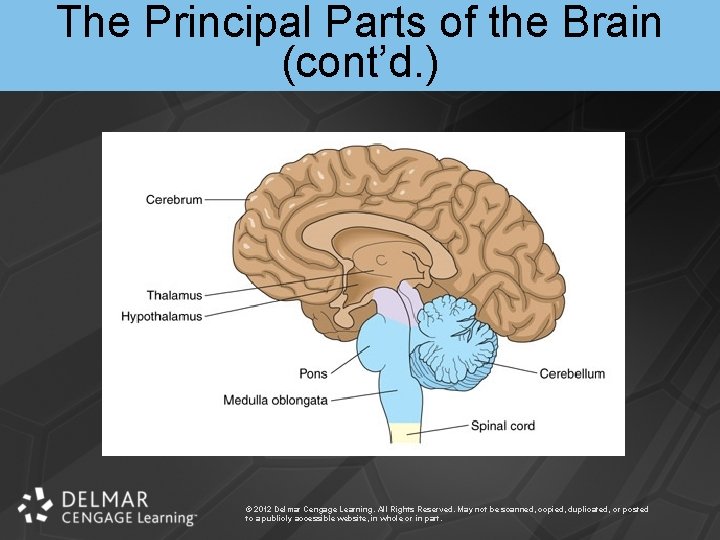
Introduction • Brain is divided into four main parts – Brainstem: controls breathing, heartbeat rates and reactions to auditory and visual stimuli – Diencephalon: controls homeostasis – Cerebrum: controls intellectual processes and emotions – Cerebellum: maintains body posture and balance © 2012 Delmar Cengage Learning. All Rights Reserved. May not be scanned, copied, duplicated, or posted to a publicly accessible website, in whole or in part.
THE PRINCIPAL PARTS OF THE BRAIN © 2012 Delmar Cengage Learning. All Rights Reserved. May not be scanned, copied, duplicated, or posted to a publicly accessible website, in whole or in part.
The Principal Parts of the Brain (cont’d. ) • Main parts: brainstem, diencephalon, cerebrum and cerebellum • Protection – Cranial bones – Meninges – Cerebrospinal fluid © 2012 Delmar Cengage Learning. All Rights Reserved. May not be scanned, copied, duplicated, or posted to a publicly accessible website, in whole or in part.
The Principal Parts of the Brain (cont’d. ) • Ventricles – Interventricular foramen © 2012 Delmar Cengage Learning. All Rights Reserved. May not be scanned, copied, duplicated, or posted to a publicly accessible website, in whole or in part.
The Principal Parts of the Brain (cont’d. ) © 2012 Delmar Cengage Learning. All Rights Reserved. May not be scanned, copied, duplicated, or posted to a publicly accessible website, in whole or in part.
THE ANATOMY AND FUNCTIONS OF THE BRAINSTEM © 2012 Delmar Cengage Learning. All Rights Reserved. May not be scanned, copied, duplicated, or posted to a publicly accessible website, in whole or in part.
The Anatomy and Functions of the Brainstem (cont’d. ) • Medulla oblongata – Ascending and descending tracts – Connect spinal cord with the brain – Some tracts cross over in medulla – Reticular formation: controls consciousness – Reflex centers © 2012 Delmar Cengage Learning. All Rights Reserved. May not be scanned, copied, duplicated, or posted to a publicly accessible website, in whole or in part.
The Anatomy and Functions of the Brainstem (cont’d. ) • Pons varolii – Connects spinal cord with brain – Connects parts of brain with each other – Helps control breathing © 2012 Delmar Cengage Learning. All Rights Reserved. May not be scanned, copied, duplicated, or posted to a publicly accessible website, in whole or in part.
The Anatomy and Functions of the Brainstem (cont’d. ) • Midbrain – Ventral cerebral peduncles: convey impulses from cortex to pons and spinal cord – Dorsal tectum: reflex center – Controls movement of head and eyeball (visual stimuli) – Controls movement of head and trunk (auditory stimuli) © 2012 Delmar Cengage Learning. All Rights Reserved. May not be scanned, copied, duplicated, or posted to a publicly accessible website, in whole or in part.
THE ANATOMY AND FUNCTIONS OF THE DIENCEPHALON © 2012 Delmar Cengage Learning. All Rights Reserved. May not be scanned, copied, duplicated, or posted to a publicly accessible website, in whole or in part.
The Anatomy and Functions of the Diencephalon (cont’d. ) • Optic tracts • Mamillary bodies: memory and emotional responses • Thalamus – Relay station for sensory impulses – Interpretation center for pain, temperature and touch © 2012 Delmar Cengage Learning. All Rights Reserved. May not be scanned, copied, duplicated, or posted to a publicly accessible website, in whole or in part.
The Anatomy and Functions of the Diencephalon (cont’d. ) • Epithalamus: contains pineal gland • Hypothalamus: homeostasis – Controls and integrates autonomic nervous system – Receives sensory impulses from internal organs – Controls pituitary gland links endocrine and nervous systems © 2012 Delmar Cengage Learning. All Rights Reserved. May not be scanned, copied, duplicated, or posted to a publicly accessible website, in whole or in part.
THE CEREBRUM: STRUCTURE AND FUNCTION © 2012 Delmar Cengage Learning. All Rights Reserved. May not be scanned, copied, duplicated, or posted to a publicly accessible website, in whole or in part.
The Cerebrum: Structure and Function (cont’d. ) © 2012 Delmar Cengage Learning. All Rights Reserved. May not be scanned, copied, duplicated, or posted to a publicly accessible website, in whole or in part.
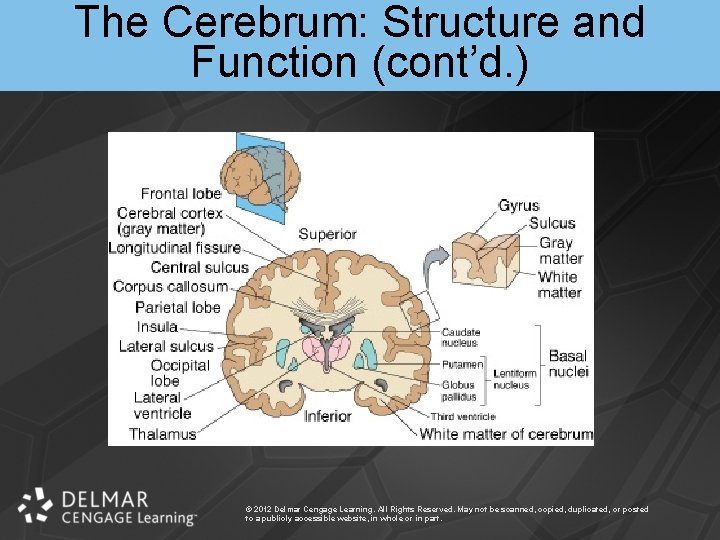
The Cerebrum: Structure and Function (cont’d. ) • Cerebral cortex: gray matter surface • Longitudinal fissure separates two hemispheres • Gyri: folds • Sulci: grooves • Corpus callosum: bridge connecting two hemispheres © 2012 Delmar Cengage Learning. All Rights Reserved. May not be scanned, copied, duplicated, or posted to a publicly accessible website, in whole or in part.
The Cerebrum: Structure and Function (cont’d. ) • Surface of the cortex – Motor areas control muscular movements – Sensory areas interpret sensory impulses – Association areas process emotions and intellect © 2012 Delmar Cengage Learning. All Rights Reserved. May not be scanned, copied, duplicated, or posted to a publicly accessible website, in whole or in part.
The Cerebrum: Structure and Function (cont’d. ) • Cerebral hemispheres – Frontal lobe: muscle movement, moods, aggression, smell, motivation – Parietal lobe: touch, pain, balance, taste, temperature – Temporal lobe: hearing, smell, memory, abstract thought, judgment – Occipital lobe: vision © 2012 Delmar Cengage Learning. All Rights Reserved. May not be scanned, copied, duplicated, or posted to a publicly accessible website, in whole or in part.
THE CEREBELLUM: STRUCTURE AND FUNCTION © 2012 Delmar Cengage Learning. All Rights Reserved. May not be scanned, copied, duplicated, or posted to a publicly accessible website, in whole or in part.
The Cerebellum: Structure and Function (cont’d. ) • Butterfly-shaped • Two partially separated hemispheres connected by vermis • Functions – Coordinating muscular movements – Maintaining posture – Maintaining balance © 2012 Delmar Cengage Learning. All Rights Reserved. May not be scanned, copied, duplicated, or posted to a publicly accessible website, in whole or in part.
THE AUTONOMIC NERVOUS SYSTEM © 2012 Delmar Cengage Learning. All Rights Reserved. May not be scanned, copied, duplicated, or posted to a publicly accessible website, in whole or in part.
The Autonomic Nervous System (cont’d. ) • • • Subdivision of efferent PNS Functions without conscious effort Regulates functions of internal organs Assists in maintaining homeostasis Helps deal with emergency situations © 2012 Delmar Cengage Learning. All Rights Reserved. May not be scanned, copied, duplicated, or posted to a publicly accessible website, in whole or in part.
The Autonomic Nervous System (cont’d. ) • Sympathetic – Energy and stressful situations – Increases heartbeat and breathing rates – Neurotransmitters: acetylcholine and norepinephrine © 2012 Delmar Cengage Learning. All Rights Reserved. May not be scanned, copied, duplicated, or posted to a publicly accessible website, in whole or in part.
The Autonomic Nervous System (cont’d. ) • Parasympathetic – Restores body to nonstressful state – Neurotransmitter: acetylcholine – Stimulates digestion, urination and defecation © 2012 Delmar Cengage Learning. All Rights Reserved. May not be scanned, copied, duplicated, or posted to a publicly accessible website, in whole or in part.
THE 12 CRANIAL NERVES AND THEIR FUNCTIONS © 2012 Delmar Cengage Learning. All Rights Reserved. May not be scanned, copied, duplicated, or posted to a publicly accessible website, in whole or in part.
The 12 Cranial Nerves and Their Functions (cont’d. ) • (I) Olfactory: smell • (II) Optic: sight • (III) Oculomotor: movement of eyeball, constriction of pupil • (IV) Trochlear: movement of eyeball © 2012 Delmar Cengage Learning. All Rights Reserved. May not be scanned, copied, duplicated, or posted to a publicly accessible website, in whole or in part.
The 12 Cranial Nerves and Their Functions (cont’d. ) • (V) Trigeminal: chewing, sensations in teeth • (VI) Abducens: movement of eyeball • (VII) Facial: facial expression, taste, tear and salivary glands • (VIII) Vestibulocochlear: equilibrium, hearing © 2012 Delmar Cengage Learning. All Rights Reserved. May not be scanned, copied, duplicated, or posted to a publicly accessible website, in whole or in part.
The 12 Cranial Nerves and Their Functions (cont’d. ) • (IX) Glossopharyngeal: swallowing, taste, salivary glands • (X) Vagus: certain muscle movements, sensory impulses • (XI) Accessory: swallowing, head movement • (XII) Hypoglossal: swallowing, speech © 2012 Delmar Cengage Learning. All Rights Reserved. May not be scanned, copied, duplicated, or posted to a publicly accessible website, in whole or in part.
THE SPECIAL SENSES © 2012 Delmar Cengage Learning. All Rights Reserved. May not be scanned, copied, duplicated, or posted to a publicly accessible website, in whole or in part.
The Sense of Smell • Molecules in air dissolve in nasal mucus • Bipolar sensory neurons transfer chemical impulse • Olfactory bulbs receive impulse • Impulse sent to olfactory cortex • Odor variety dependent on brain interpretation © 2012 Delmar Cengage Learning. All Rights Reserved. May not be scanned, copied, duplicated, or posted to a publicly accessible website, in whole or in part.
The Sense of Taste • Taste buds on tongue, palate and pharynx • Taste bud cell types – Exterior capsule: epithelial cells – Interior: taste cells • Taste depends on chemicals dissolved in saliva • Taste influenced by olfactory sensations © 2012 Delmar Cengage Learning. All Rights Reserved. May not be scanned, copied, duplicated, or posted to a publicly accessible website, in whole or in part.
The Sense of Sight • Eyes protected by eyelids and eyelashes • Tears – Lubricate the eyes – Contain bacteriolytic lysozyme enzyme – Contain salt and gamma globulin © 2012 Delmar Cengage Learning. All Rights Reserved. May not be scanned, copied, duplicated, or posted to a publicly accessible website, in whole or in part.
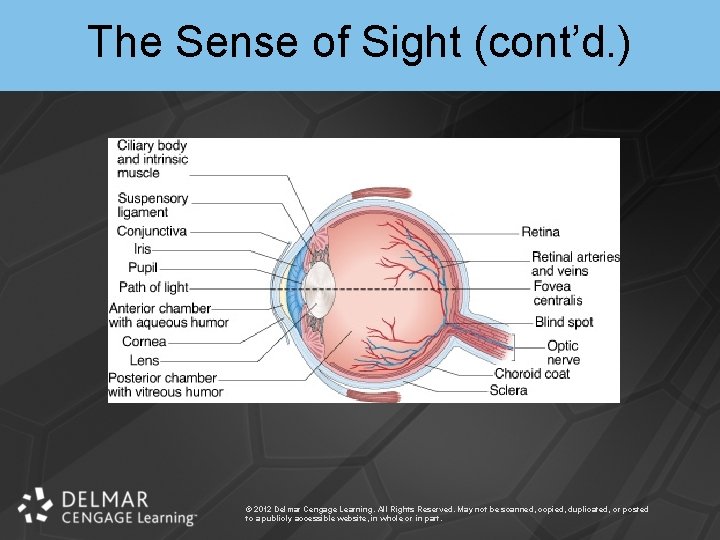
The Sense of Sight (cont’d. ) © 2012 Delmar Cengage Learning. All Rights Reserved. May not be scanned, copied, duplicated, or posted to a publicly accessible website, in whole or in part.
Animation – Vision Click Here to Play Vision Animation © 2012 Delmar Cengage Learning. All Rights Reserved. May not be scanned, copied, duplicated, or posted to a publicly accessible website, in whole or in part.
The Sense of Hearing and Equilibrium • Outer ear – Auricle: external, visible, flexible part – External auditory meatus • Lined with hair and ceruminous glands – Tympanic membrane: vibrates in response to sound © 2012 Delmar Cengage Learning. All Rights Reserved. May not be scanned, copied, duplicated, or posted to a publicly accessible website, in whole or in part.
The Sense of Hearing and Equilibrium (cont’d. ) • Middle ear – Auditory ossicles: malleus, incus and stapes – Openings: oval and round windows – Eustachian tube: equalizes pressure © 2012 Delmar Cengage Learning. All Rights Reserved. May not be scanned, copied, duplicated, or posted to a publicly accessible website, in whole or in part.
The Sense of Hearing and Equilibrium (cont’d. ) • Inner ear – Cochlea: hearing – Equilibrium • Static: vestibule • Kinetic: semicircular canals © 2012 Delmar Cengage Learning. All Rights Reserved. May not be scanned, copied, duplicated, or posted to a publicly accessible website, in whole or in part.
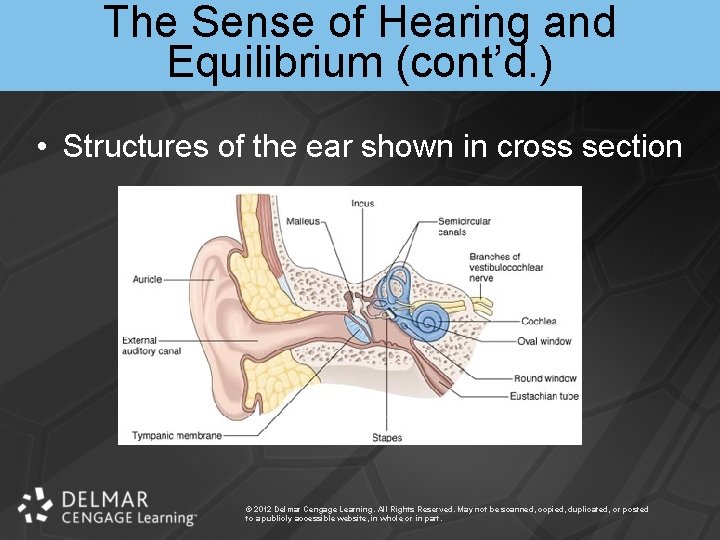
The Sense of Hearing and Equilibrium (cont’d. ) • Structures of the ear shown in cross section © 2012 Delmar Cengage Learning. All Rights Reserved. May not be scanned, copied, duplicated, or posted to a publicly accessible website, in whole or in part.
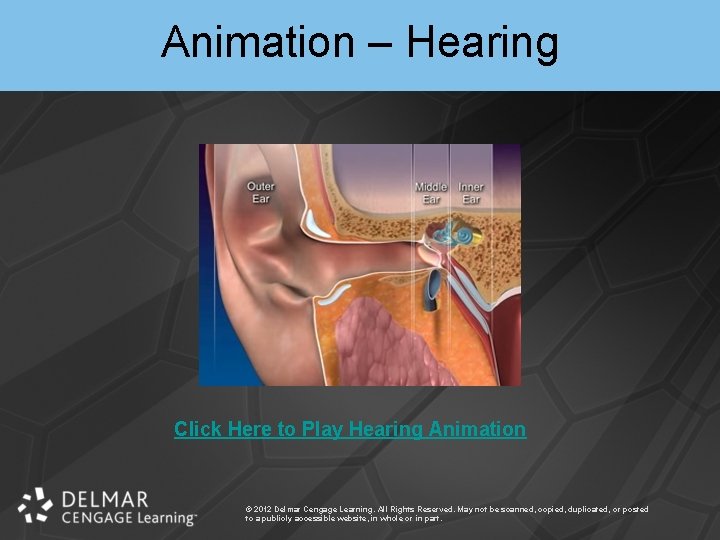
Animation – Hearing Click Here to Play Hearing Animation © 2012 Delmar Cengage Learning. All Rights Reserved. May not be scanned, copied, duplicated, or posted to a publicly accessible website, in whole or in part.
Summary • Named the principal parts of the brain • Discussed the functions of the major parts of the brain • Named the 12 cranial nerves • Discussed the role of the autonomic nervous system and its divisions © 2012 Delmar Cengage Learning. All Rights Reserved. May not be scanned, copied, duplicated, or posted to a publicly accessible website, in whole or in part.
Summary (cont’d. ) • Described the special senses and the organs involved © 2012 Delmar Cengage Learning. All Rights Reserved. May not be scanned, copied, duplicated, or posted to a publicly accessible website, in whole or in part.
- Slides: 41