
Chapter 11 The Muscular System 1 2012 Pearson

- Slides: 51
Chapter 11 The Muscular System 1 © 2012 Pearson Education, Inc.
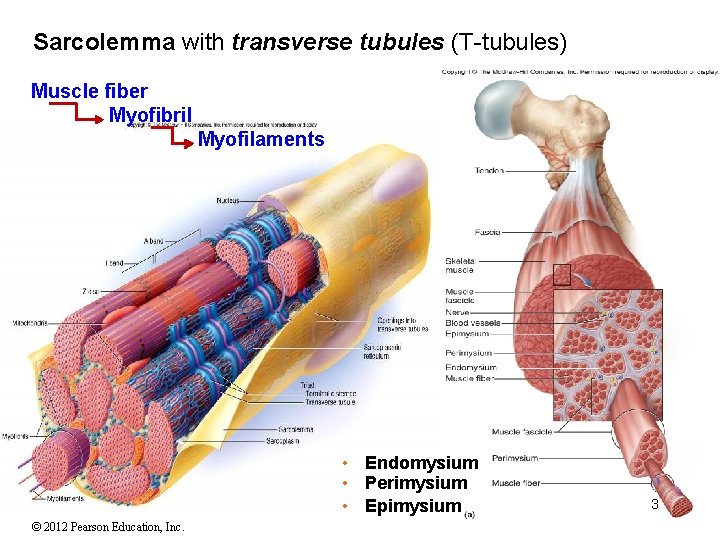
The Muscular System consists only Muscle cell approximately 600 human skeletal muscles • Muscle organization affects power, range, and speed of muscle movement. • The muscle cell is called a fiber. • Sarcolemma - cell membrane • Transverse T-tubules membrane invaginations • Sarcoplasm: cytoplasm • Sarcoplasmic reticulum (SR): Similar in structure to smooth endoplasmic reticulum • Forms chambers (terminal cisternae) attached to T tubules that contain concentrations of Ca 2+ • Triad formed by one T tubule and two terminal cisternae • Myofibrils: rod-like unit of a muscle cell; contain contractile proteins • Myofilaments –Thick and Thin contractile proteins responsible for muscle contraction • Endomysium – CT around each myofiber • Perimysium - surrounds fascicle 2 • Epimysium - covers whole muscle belly © 2012 Pearson Education, Inc.
Sarcolemma with transverse tubules (T-tubules) Muscle fiber Myofibril Myofilaments • Endomysium • Perimysium • Epimysium © 2012 Pearson Education, Inc. 3
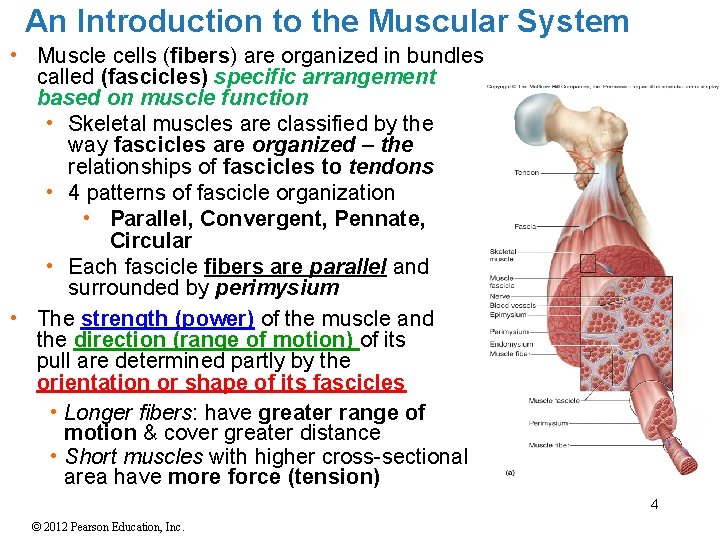
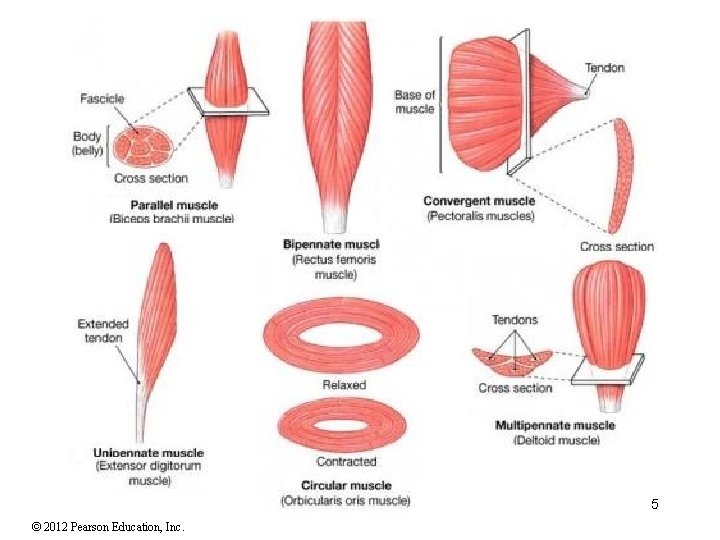
An Introduction to the Muscular System • Muscle cells (fibers) are organized in bundles called (fascicles) specific arrangement based on muscle function • Skeletal muscles are classified by the way fascicles are organized – the relationships of fascicles to tendons • 4 patterns of fascicle organization • Parallel, Convergent, Pennate, Circular • Each fascicle fibers are parallel and surrounded by perimysium • The strength (power) of the muscle and the direction (range of motion) of its pull are determined partly by the orientation or shape of its fascicles • Longer fibers: have greater range of motion & cover greater distance • Short muscles with higher cross-sectional area have more force (tension) 4 © 2012 Pearson Education, Inc.
5 © 2012 Pearson Education, Inc.
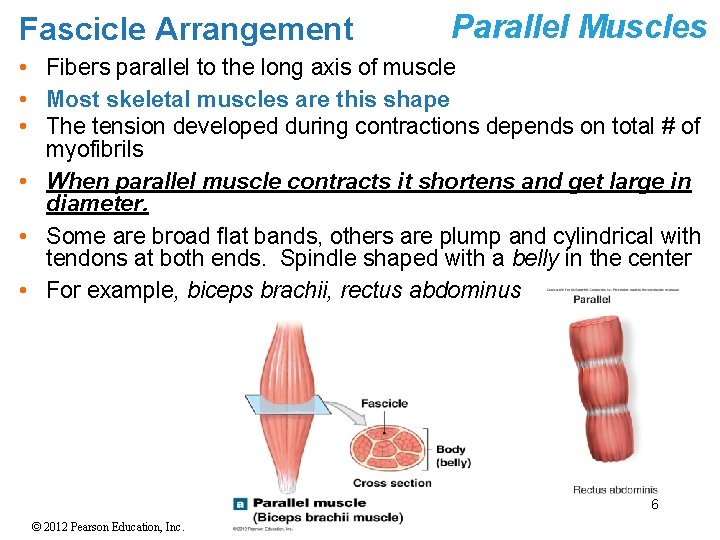
Fascicle Arrangement Parallel Muscles • Fibers parallel to the long axis of muscle • Most skeletal muscles are this shape • The tension developed during contractions depends on total # of myofibrils • When parallel muscle contracts it shortens and get large in diameter. • Some are broad flat bands, others are plump and cylindrical with tendons at both ends. Spindle shaped with a belly in the center • For example, biceps brachii, rectus abdominus 6 © 2012 Pearson Education, Inc.
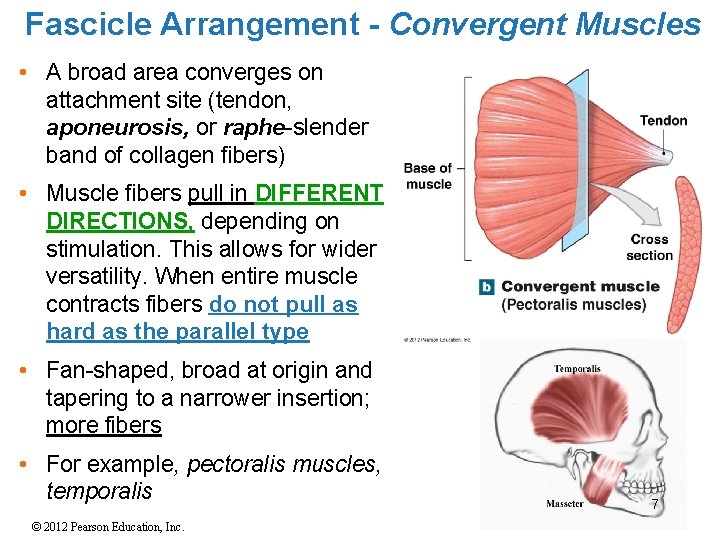
Fascicle Arrangement - Convergent Muscles • A broad area converges on attachment site (tendon, aponeurosis, or raphe-slender band of collagen fibers) • Muscle fibers pull in DIFFERENT DIRECTIONS, depending on stimulation. This allows for wider versatility. When entire muscle contracts fibers do not pull as hard as the parallel type • Fan-shaped, broad at origin and tapering to a narrower insertion; more fibers • For example, pectoralis muscles, temporalis © 2012 Pearson Education, Inc. 7
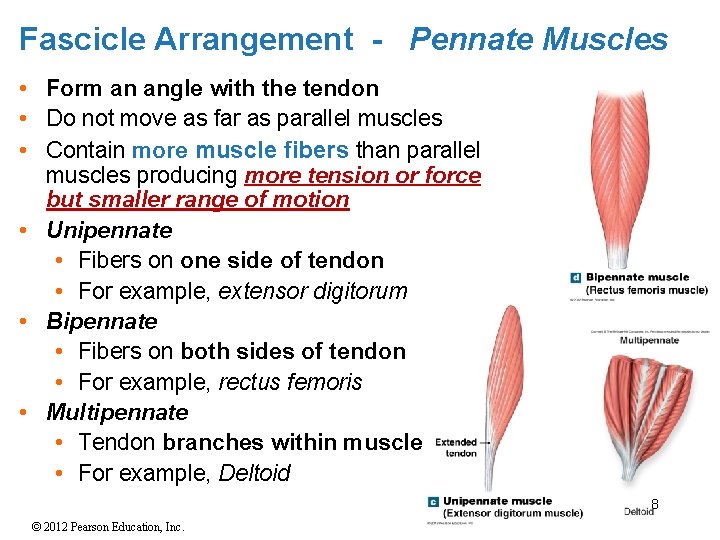
Fascicle Arrangement - Pennate Muscles • Form an angle with the tendon • Do not move as far as parallel muscles • Contain more muscle fibers than parallel muscles producing more tension or force but smaller range of motion • Unipennate • Fibers on one side of tendon • For example, extensor digitorum • Bipennate • Fibers on both sides of tendon • For example, rectus femoris • Multipennate • Tendon branches within muscle • For example, Deltoid 8 © 2012 Pearson Education, Inc.
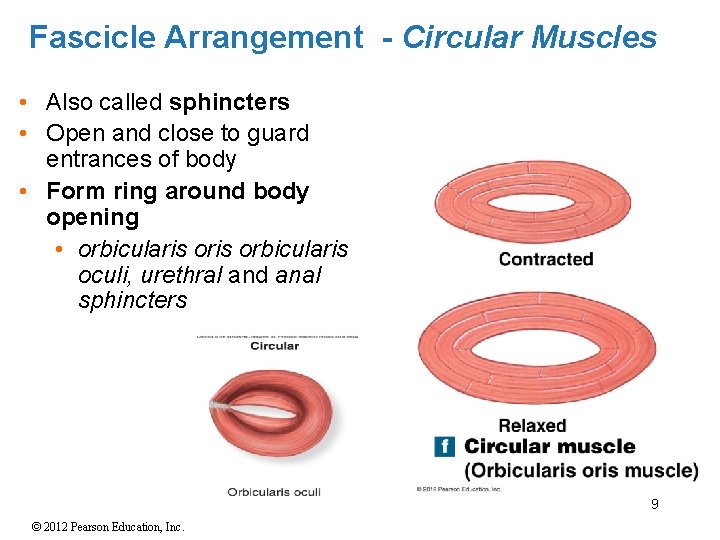
Fascicle Arrangement - Circular Muscles • Also called sphincters • Open and close to guard entrances of body • Form ring around body opening • orbicularis oculi, urethral and anal sphincters 9 © 2012 Pearson Education, Inc.
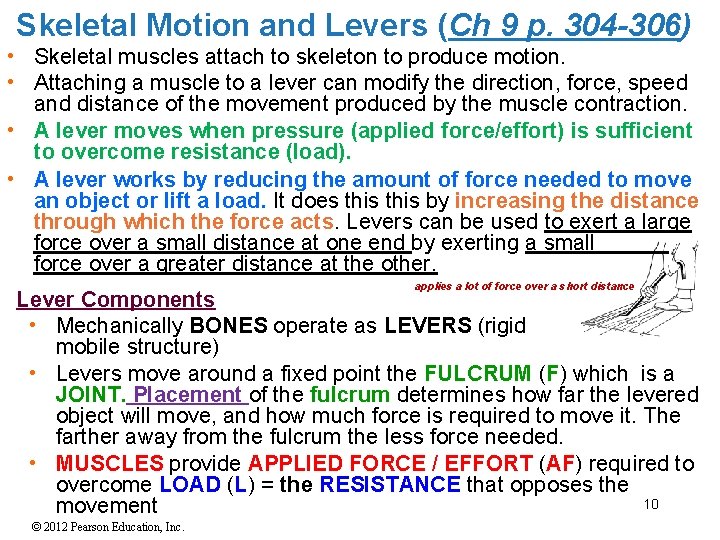
Skeletal Motion and Levers (Ch 9 p. 304 -306) • Skeletal muscles attach to skeleton to produce motion. • Attaching a muscle to a lever can modify the direction, force, speed and distance of the movement produced by the muscle contraction. • A lever moves when pressure (applied force/effort) is sufficient to overcome resistance (load). • A lever works by reducing the amount of force needed to move an object or lift a load. It does this by increasing the distance through which the force acts. Levers can be used to exert a large force over a small distance at one end by exerting a small force over a greater distance at the other. applies a lot of force over a short distance Lever Components • Mechanically BONES operate as LEVERS (rigid mobile structure) • Levers move around a fixed point the FULCRUM (F) which is a JOINT. Placement of the fulcrum determines how far the levered object will move, and how much force is required to move it. The farther away from the fulcrum the less force needed. • MUSCLES provide APPLIED FORCE / EFFORT (AF) required to overcome LOAD (L) = the RESISTANCE that opposes the 10 movement © 2012 Pearson Education, Inc.
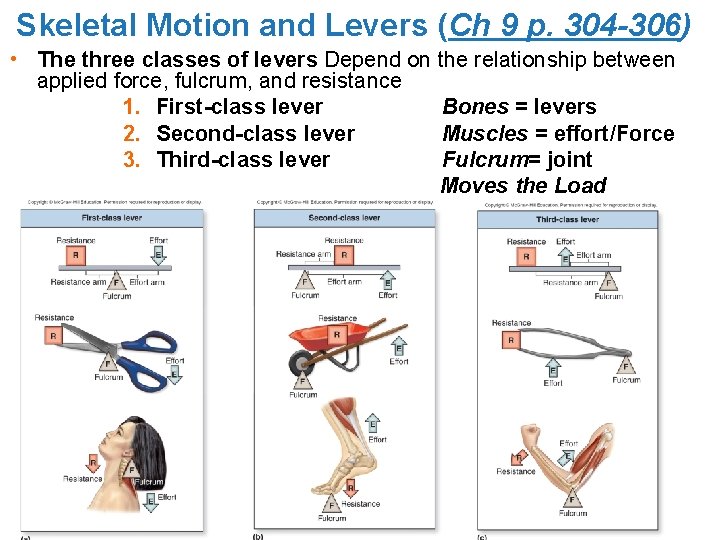
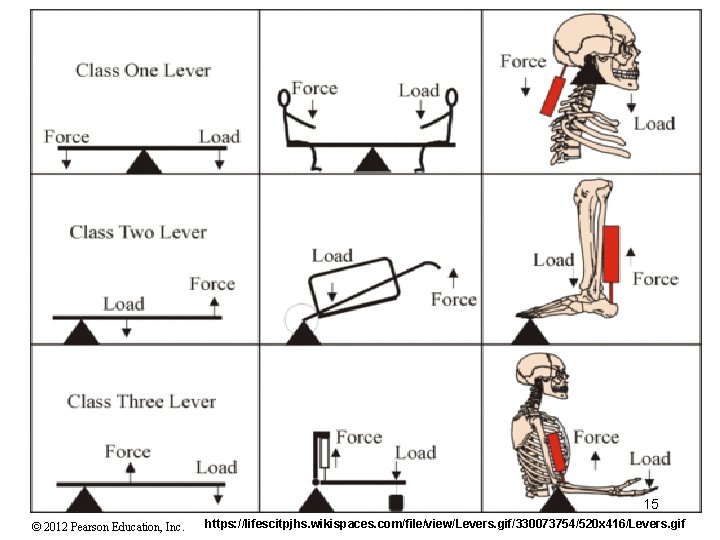
Skeletal Motion and Levers (Ch 9 p. 304 -306) • The three classes of levers Depend on the relationship between applied force, fulcrum, and resistance 1. First-class lever Bones = levers 2. Second-class lever Muscles = effort/Force 3. Third-class lever Fulcrum= joint Moves the Load 11 © 2012 Pearson Education, Inc.
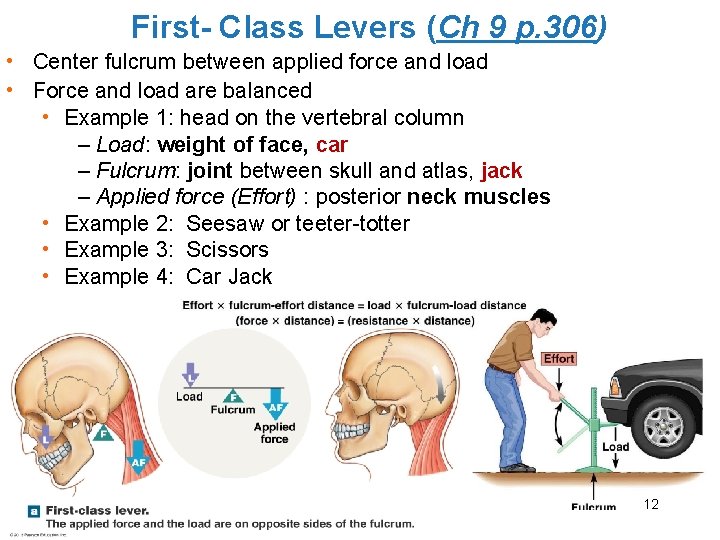
First- Class Levers (Ch 9 p. 306) • Center fulcrum between applied force and load • Force and load are balanced • Example 1: head on the vertebral column – Load: weight of face, car – Fulcrum: joint between skull and atlas, jack – Applied force (Effort) : posterior neck muscles • Example 2: Seesaw or teeter-totter • Example 3: Scissors • Example 4: Car Jack 12 © 2012 Pearson Education, Inc.
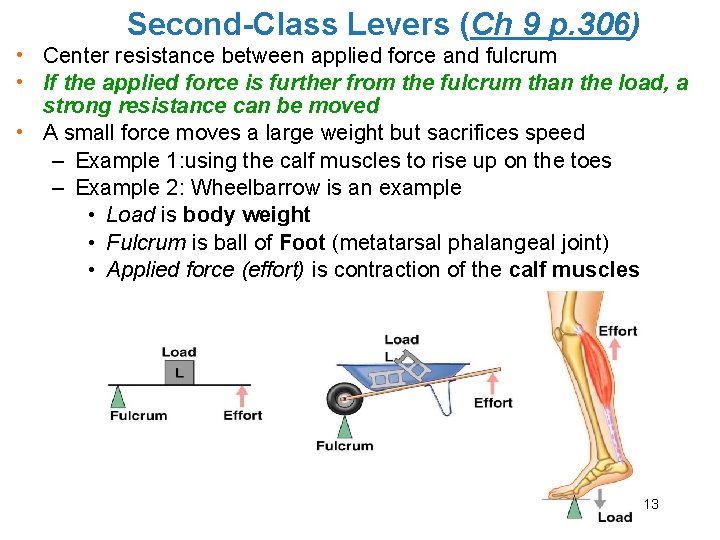
Second-Class Levers (Ch 9 p. 306) • Center resistance between applied force and fulcrum • If the applied force is further from the fulcrum than the load, a strong resistance can be moved • A small force moves a large weight but sacrifices speed – Example 1: using the calf muscles to rise up on the toes – Example 2: Wheelbarrow is an example • Load is body weight • Fulcrum is ball of Foot (metatarsal phalangeal joint) • Applied force (effort) is contraction of the calf muscles 13 © 2012 Pearson Education, Inc.
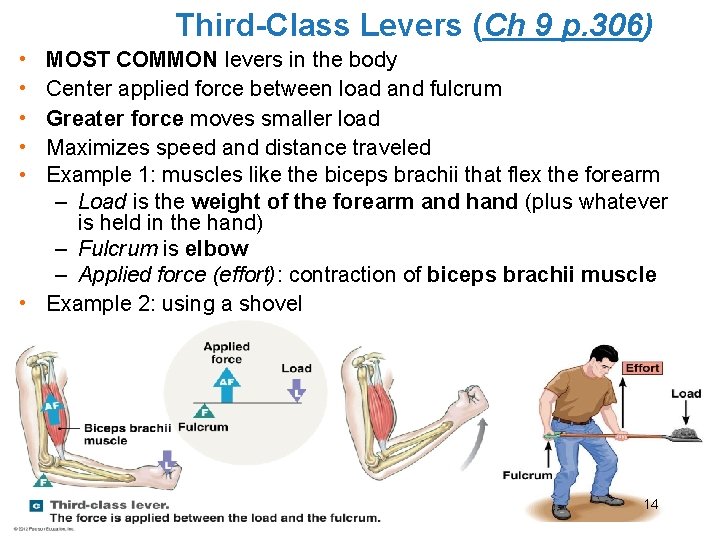
Third-Class Levers (Ch 9 p. 306) • • • MOST COMMON levers in the body Center applied force between load and fulcrum Greater force moves smaller load Maximizes speed and distance traveled Example 1: muscles like the biceps brachii that flex the forearm – Load is the weight of the forearm and hand (plus whatever is held in the hand) – Fulcrum is elbow – Applied force (effort): contraction of biceps brachii muscle • Example 2: using a shovel 14 © 2012 Pearson Education, Inc.
15 © 2012 Pearson Education, Inc. https: //lifescitpjhs. wikispaces. com/file/view/Levers. gif/330073754/520 x 416/Levers. gif
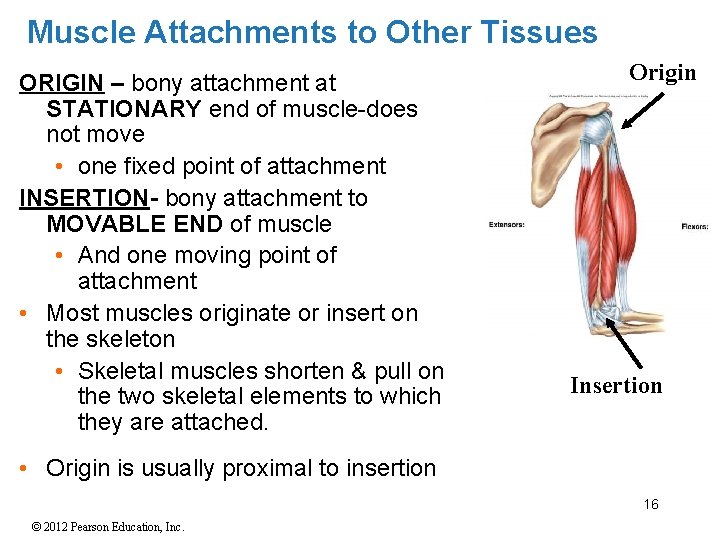
Muscle Attachments to Other Tissues ORIGIN – bony attachment at STATIONARY end of muscle-does not move • one fixed point of attachment INSERTION- bony attachment to MOVABLE END of muscle • And one moving point of attachment • Most muscles originate or insert on the skeleton • Skeletal muscles shorten & pull on the two skeletal elements to which they are attached. Origin Insertion • Origin is usually proximal to insertion 16 © 2012 Pearson Education, Inc.
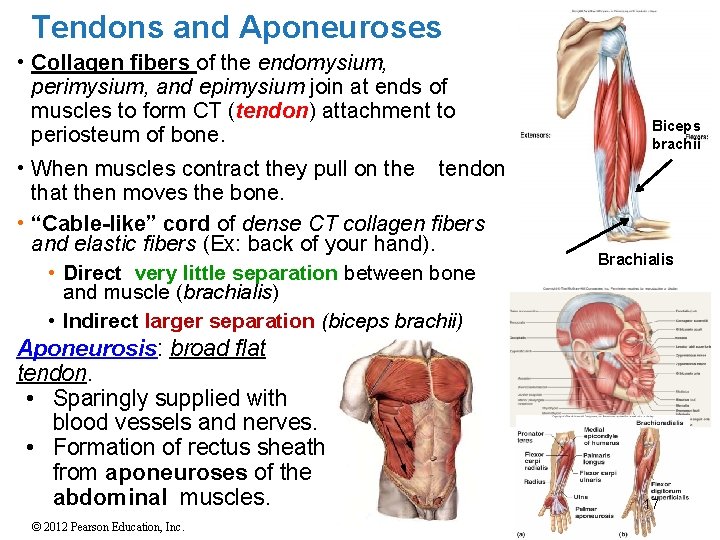
Tendons and Aponeuroses • Collagen fibers of the endomysium, perimysium, and epimysium join at ends of muscles to form CT (tendon) attachment to periosteum of bone. • When muscles contract they pull on the tendon that then moves the bone. • “Cable-like” cord of dense CT collagen fibers and elastic fibers (Ex: back of your hand). • Direct very little separation between bone Biceps brachii Brachialis and muscle (brachialis) • Indirect larger separation (biceps brachii) Aponeurosis: broad flat tendon. • Sparingly supplied with blood vessels and nerves. • Formation of rectus sheath from aponeuroses of the abdominal muscles. © 2012 Pearson Education, Inc. 17
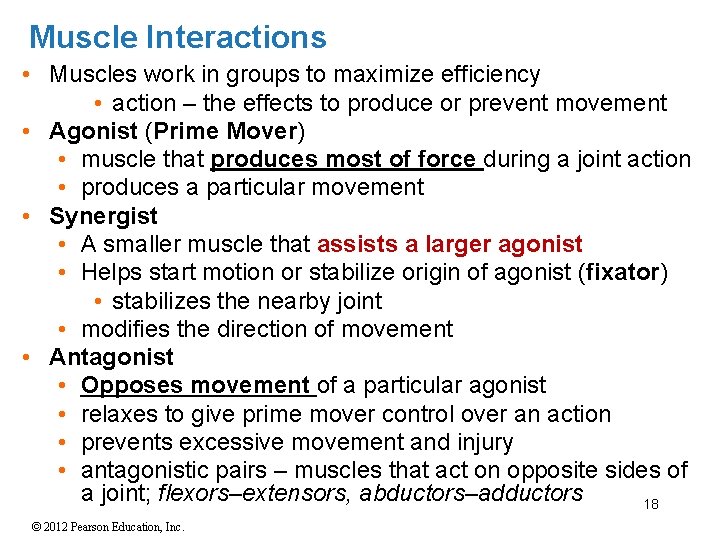
Muscle Interactions • Muscles work in groups to maximize efficiency • action – the effects to produce or prevent movement • Agonist (Prime Mover) • muscle that produces most of force during a joint action • produces a particular movement • Synergist • A smaller muscle that assists a larger agonist • Helps start motion or stabilize origin of agonist (fixator) • stabilizes the nearby joint • modifies the direction of movement • Antagonist • Opposes movement of a particular agonist • relaxes to give prime mover control over an action • prevents excessive movement and injury • antagonistic pairs – muscles that act on opposite sides of a joint; flexors–extensors, abductors–adductors 18 © 2012 Pearson Education, Inc.
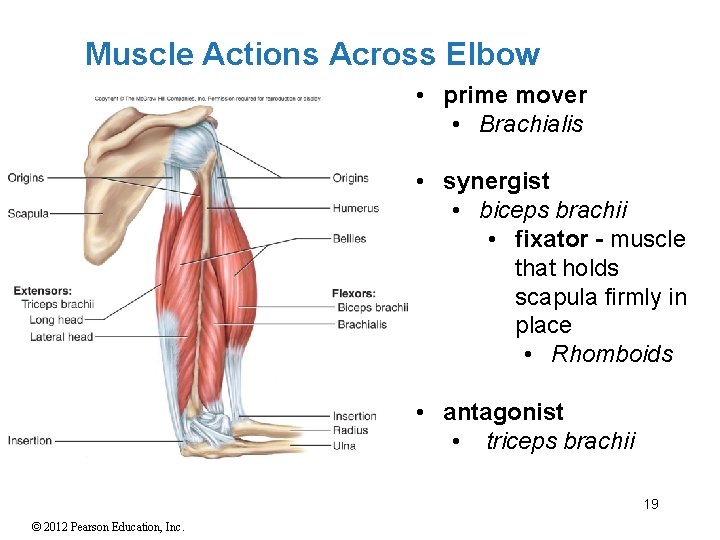
Muscle Actions Across Elbow • prime mover • Brachialis • synergist • biceps brachii • fixator - muscle that holds scapula firmly in place • Rhomboids • antagonist • triceps brachii 19 © 2012 Pearson Education, Inc.
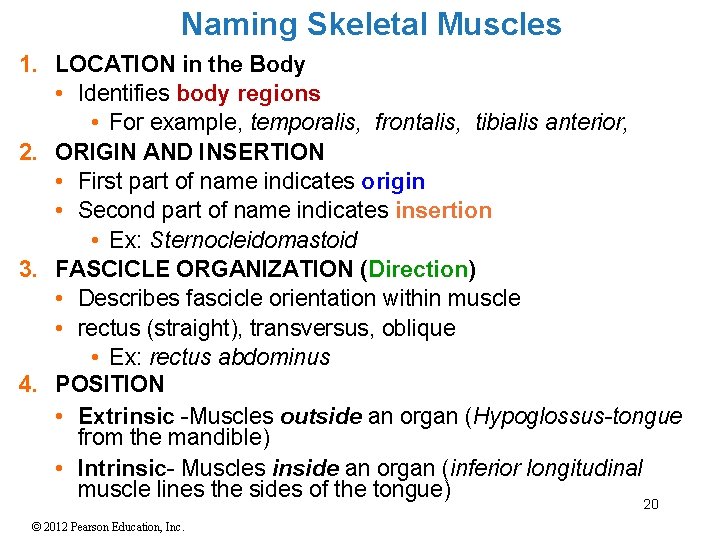
Naming Skeletal Muscles 1. LOCATION in the Body • Identifies body regions • For example, temporalis, frontalis, tibialis anterior, 2. ORIGIN AND INSERTION • First part of name indicates origin • Second part of name indicates insertion • Ex: Sternocleidomastoid 3. FASCICLE ORGANIZATION (Direction) • Describes fascicle orientation within muscle • rectus (straight), transversus, oblique • Ex: rectus abdominus 4. POSITION • Extrinsic -Muscles outside an organ (Hypoglossus-tongue from the mandible) • Intrinsic- Muscles inside an organ (inferior longitudinal muscle lines the sides of the tongue) 20 © 2012 Pearson Education, Inc.
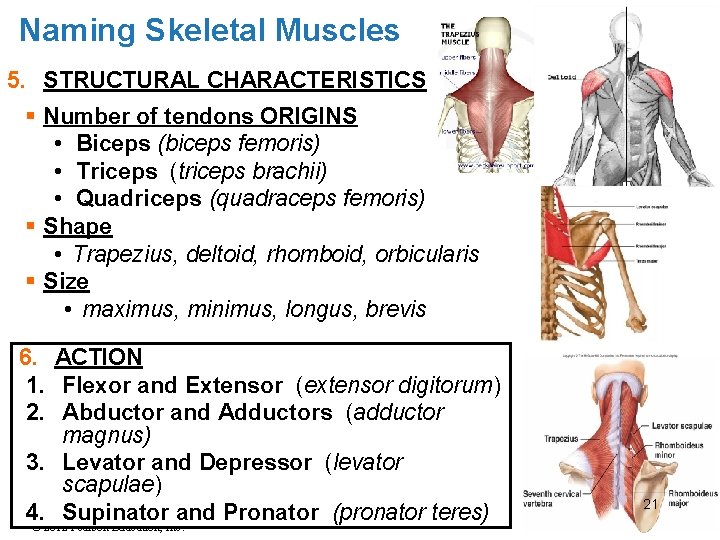
Naming Skeletal Muscles 5. STRUCTURAL CHARACTERISTICS § Number of tendons ORIGINS • Biceps (biceps femoris) • Triceps (triceps brachii) • Quadriceps (quadraceps femoris) § Shape • Trapezius, deltoid, rhomboid, orbicularis § Size • maximus, minimus, longus, brevis 6. ACTION 1. Flexor and Extensor (extensor digitorum) 2. Abductor and Adductors (adductor magnus) 3. Levator and Depressor (levator scapulae) 4. Supinator and Pronator (pronator teres) © 2012 Pearson Education, Inc. 21
Naming Exercises • Extensor carpi radialis longus • Biceps brachii • Adductor longus • Occipitalis • Orbicularis oris • Quadriceps femoris • Gluteus maximus • Rectus abdominus 22 © 2012 Pearson Education, Inc.
Naming Skeletal Muscles Terms Indicating Specific Regions of the Body • • • • Abdominis (abdomen) Brachialis (brachium) Carpi (wrist) Cleido-/-clavius Cutaneous (skin) Femoris (femur) Radialis (radius) Scapularis (scapula) Temporalis (temples) Thoracis (thoracic region) Tibialis (tibia) Sartorius (like a tailor) Buccinator (trumpeter) • • • Costalis (ribs) Glosso-/-glossal (tongue) Inguinal (groin) Oculo- (eye) Oris (mouth) Popliteus (posterior knee) Uro- (urinary) Gracilis (slender) Latissimus (widest Vastus (great) Major (larger) Minor (smaller) 23 © 2012 Pearson Education, Inc.
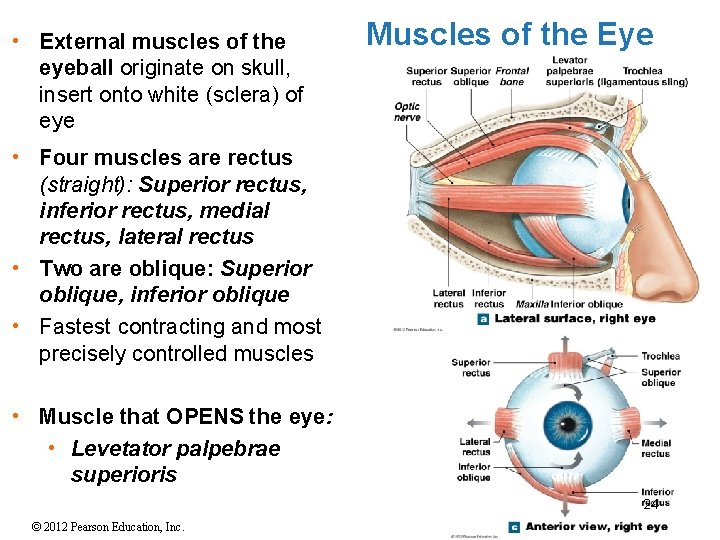
• External muscles of the eyeball originate on skull, insert onto white (sclera) of eye Muscles of the Eye • Four muscles are rectus (straight): Superior rectus, inferior rectus, medial rectus, lateral rectus • Two are oblique: Superior oblique, inferior oblique • Fastest contracting and most precisely controlled muscles • Muscle that OPENS the eye: • Levetator palpebrae superioris 24 © 2012 Pearson Education, Inc.
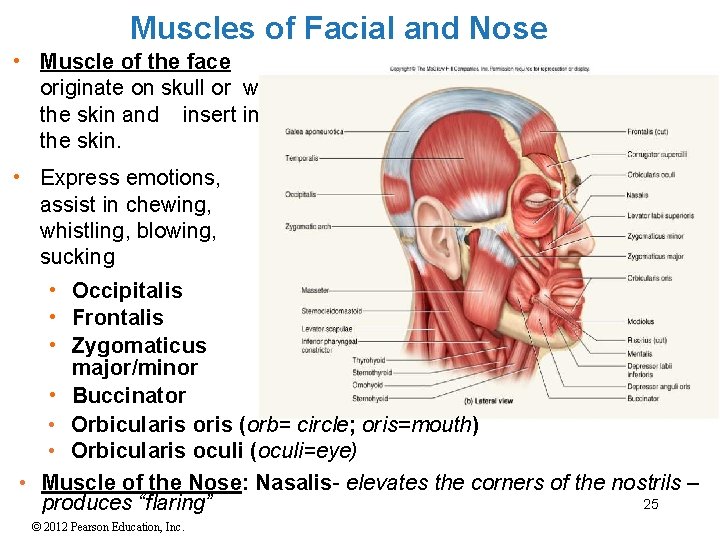
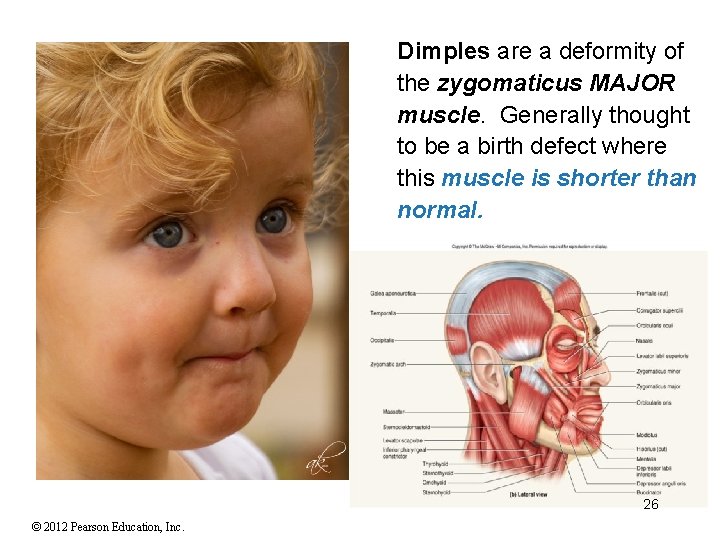
Muscles of Facial and Nose • Muscle of the face originate on skull or within the skin and insert into the skin. • Express emotions, assist in chewing, whistling, blowing, sucking • Occipitalis • Frontalis • Zygomaticus major/minor • Buccinator • Orbicularis oris (orb= circle; oris=mouth) • Orbicularis oculi (oculi=eye) • Muscle of the Nose: Nasalis- elevates the corners of the nostrils – 25 produces “flaring” © 2012 Pearson Education, Inc.
Dimples are a deformity of the zygomaticus MAJOR muscle. Generally thought to be a birth defect where this muscle is shorter than normal. 26 © 2012 Pearson Education, Inc.
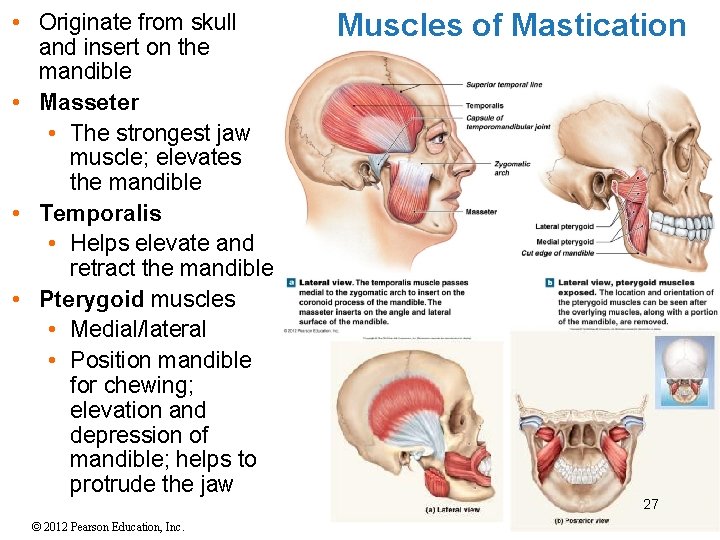
• Originate from skull and insert on the mandible • Masseter • The strongest jaw muscle; elevates the mandible • Temporalis • Helps elevate and retract the mandible • Pterygoid muscles • Medial/lateral • Position mandible for chewing; elevation and depression of mandible; helps to protrude the jaw © 2012 Pearson Education, Inc. Muscles of Mastication 27
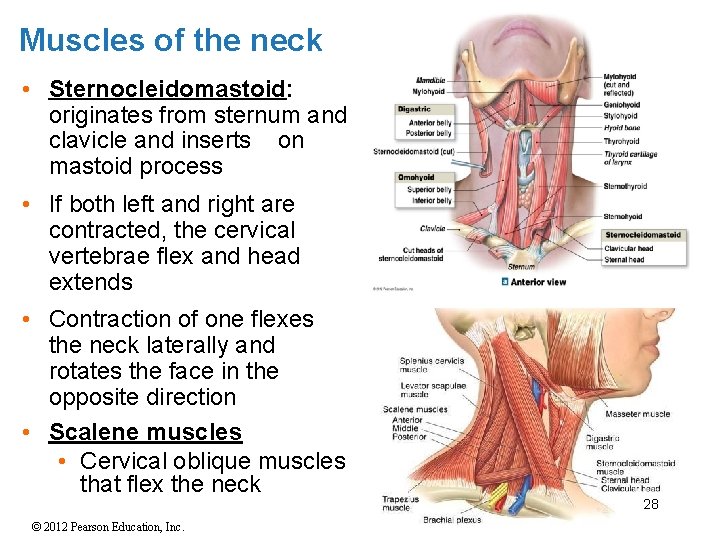
Muscles of the neck • Sternocleidomastoid: originates from sternum and clavicle and inserts on mastoid process • If both left and right are contracted, the cervical vertebrae flex and head extends • Contraction of one flexes the neck laterally and rotates the face in the opposite direction • Scalene muscles • Cervical oblique muscles that flex the neck © 2012 Pearson Education, Inc. 28
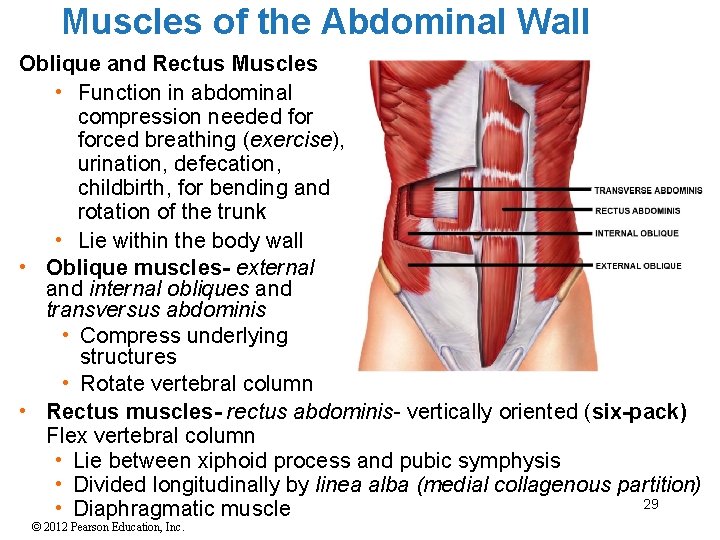
Muscles of the Abdominal Wall Oblique and Rectus Muscles • Function in abdominal compression needed forced breathing (exercise), urination, defecation, childbirth, for bending and rotation of the trunk • Lie within the body wall • Oblique muscles- external and internal obliques and transversus abdominis • Compress underlying structures • Rotate vertebral column • Rectus muscles- rectus abdominis- vertically oriented (six-pack) Flex vertebral column • Lie between xiphoid process and pubic symphysis • Divided longitudinally by linea alba (medial collagenous partition) 29 • Diaphragmatic muscle © 2012 Pearson Education, Inc.
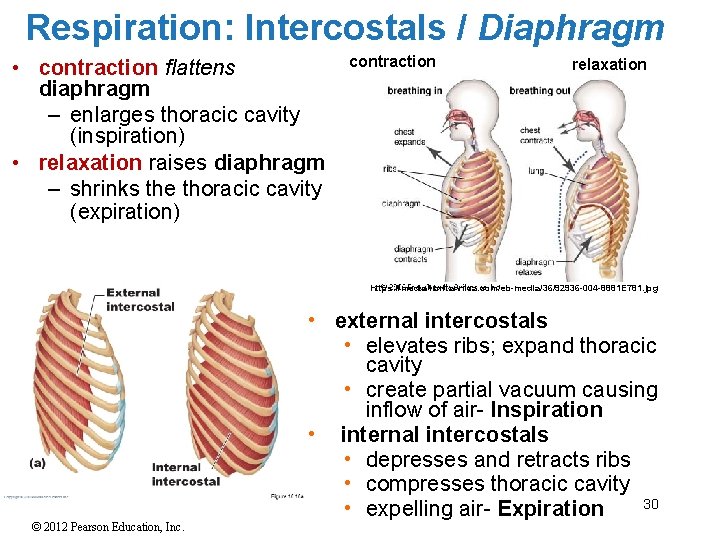
Respiration: Intercostals / Diaphragm • contraction flattens diaphragm – enlarges thoracic cavity (inspiration) • relaxation raises diaphragm – shrinks the thoracic cavity (expiration) contraction relaxation https: //media 1. britannica. com/eb-media/36/92936 -004 -8881 E 781. jpg © 2012 Pearson Education, Inc. • external intercostals • elevates ribs; expand thoracic cavity • create partial vacuum causing inflow of air- Inspiration • internal intercostals • depresses and retracts ribs • compresses thoracic cavity 30 • expelling air- Expiration
Muscles of the Shoulders and Upper Limbs 1. Muscles that position the PECTORAL GIRDLE • trapzius, rhomboid, levator scapulae, serratus anterior, pectoralis minor 2. Muscles that move the ARM • deltoid, teres major and minor, pectoralis major, latissimus dorsi, • Muscles involved in SHOULDER rotation • the Rotator Cuff 3. Muscles that move the FOREARM AND HAND • Extensors- Mainly on posterior and lateral surfaces of arm • Flexors- Mainly on anterior and medial surface 4. Muscles that move the HAND FINGERS 31 © 2012 Pearson Education, Inc.
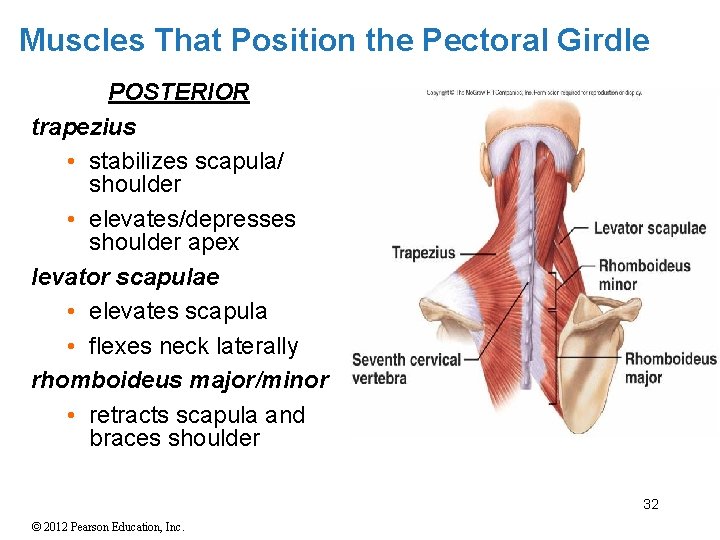
Muscles That Position the Pectoral Girdle POSTERIOR trapezius • stabilizes scapula/ shoulder • elevates/depresses shoulder apex levator scapulae • elevates scapula • flexes neck laterally rhomboideus major/minor • retracts scapula and braces shoulder 32 © 2012 Pearson Education, Inc.
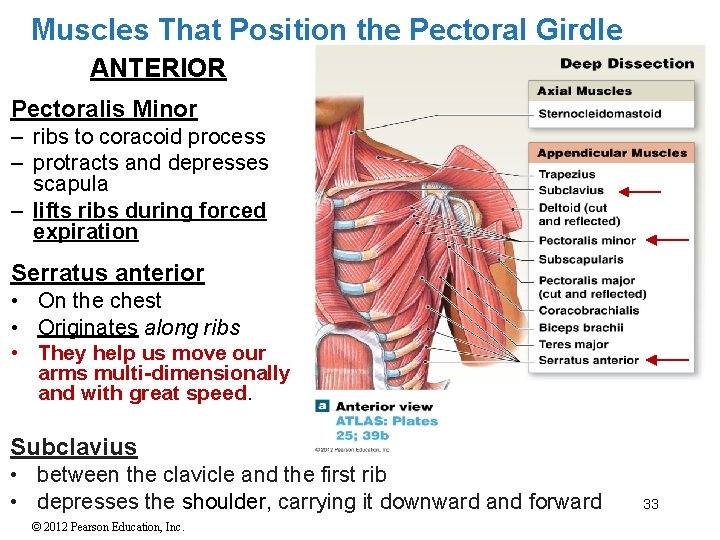
Muscles That Position the Pectoral Girdle ANTERIOR Pectoralis Minor – ribs to coracoid process – protracts and depresses scapula – lifts ribs during forced expiration Serratus anterior • On the chest • Originates along ribs • They help us move our arms multi-dimensionally and with great speed. Subclavius • between the clavicle and the first rib • depresses the shoulder, carrying it downward and forward © 2012 Pearson Education, Inc. 33
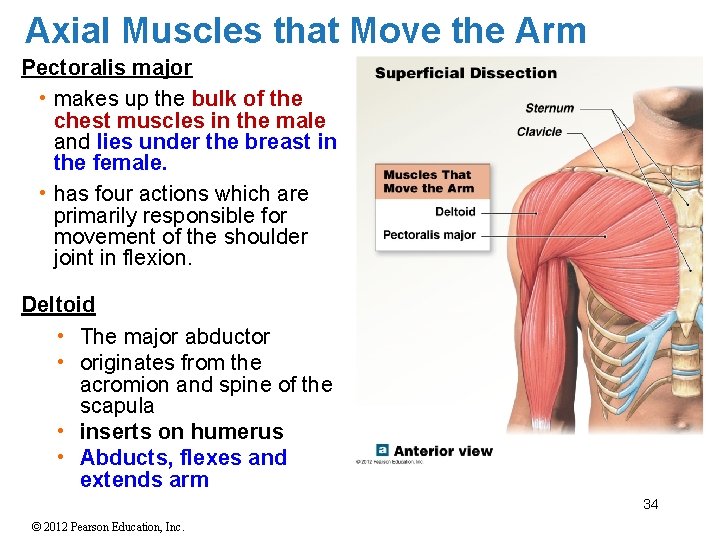
Axial Muscles that Move the Arm Pectoralis major • makes up the bulk of the chest muscles in the male and lies under the breast in the female. • has four actions which are primarily responsible for movement of the shoulder joint in flexion. Deltoid • The major abductor • originates from the acromion and spine of the scapula • inserts on humerus • Abducts, flexes and extends arm 34 © 2012 Pearson Education, Inc.
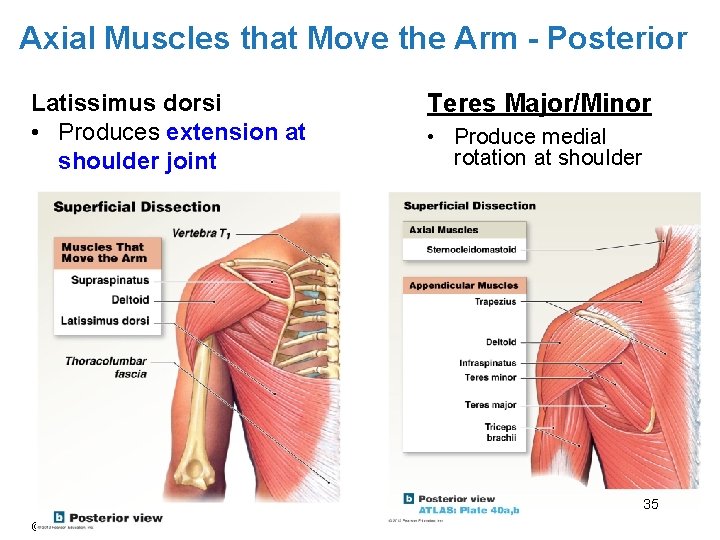
Axial Muscles that Move the Arm - Posterior Latissimus dorsi • Produces extension at shoulder joint Teres Major/Minor • Produce medial rotation at shoulder 35 © 2012 Pearson Education, Inc.
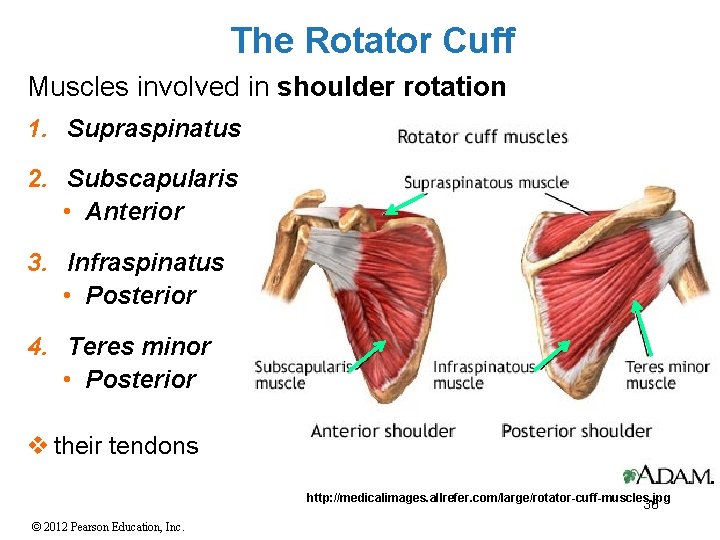
The Rotator Cuff Muscles involved in shoulder rotation 1. Supraspinatus 2. Subscapularis • Anterior 3. Infraspinatus • Posterior 4. Teres minor • Posterior v their tendons http: //medicalimages. allrefer. com/large/rotator-cuff-muscles. jpg 36 © 2012 Pearson Education, Inc.
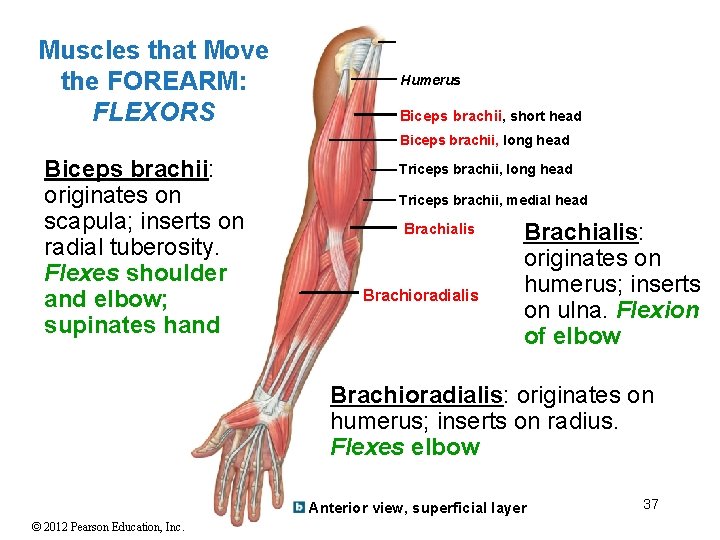
Muscles that Move the FOREARM: FLEXORS Humerus Biceps brachii, short head Biceps brachii, long head Biceps brachii: originates on scapula; inserts on radial tuberosity. Flexes shoulder and elbow; supinates hand Triceps brachii, long head Triceps brachii, medial head Brachialis Brachioradialis Brachialis: originates on humerus; inserts on ulna. Flexion of elbow Brachioradialis: originates on humerus; inserts on radius. Flexes elbow Anterior view, superficial layer © 2012 Pearson Education, Inc. 37
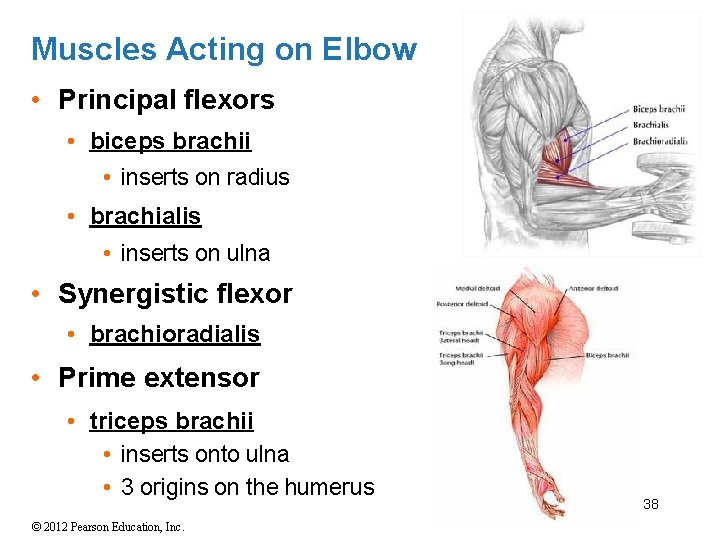
Muscles Acting on Elbow • Principal flexors • biceps brachii • inserts on radius • brachialis • inserts on ulna • Synergistic flexor • brachioradialis • Prime extensor • triceps brachii • inserts onto ulna • 3 origins on the humerus © 2012 Pearson Education, Inc. 38
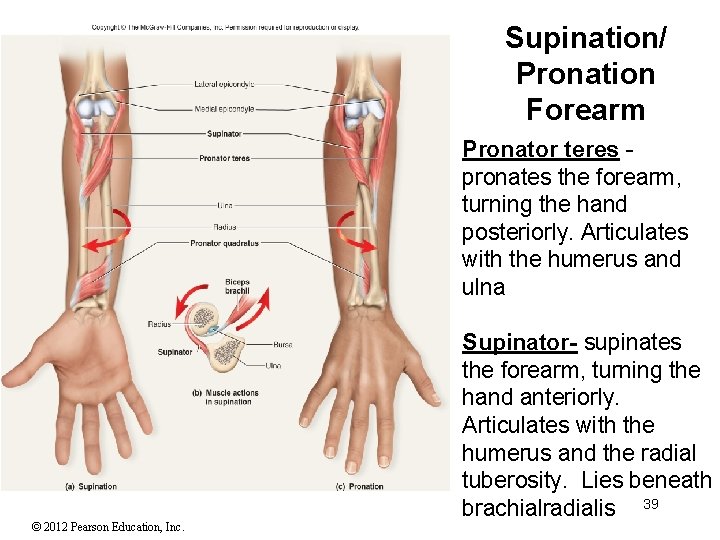
Supination/ Pronation Forearm Pronator teres pronates the forearm, turning the hand posteriorly. Articulates with the humerus and ulna © 2012 Pearson Education, Inc. Supinator- supinates the forearm, turning the hand anteriorly. Articulates with the humerus and the radial tuberosity. Lies beneath brachialradialis 39
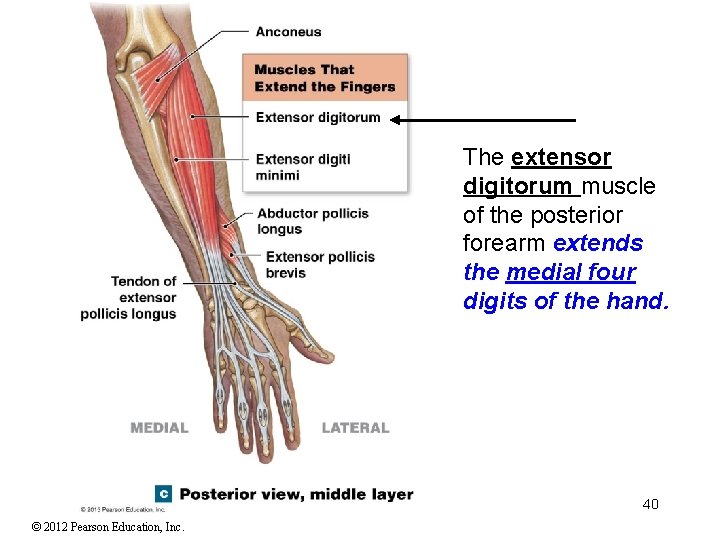
The extensor digitorum muscle of the posterior forearm extends the medial four digits of the hand. 40 © 2012 Pearson Education, Inc.
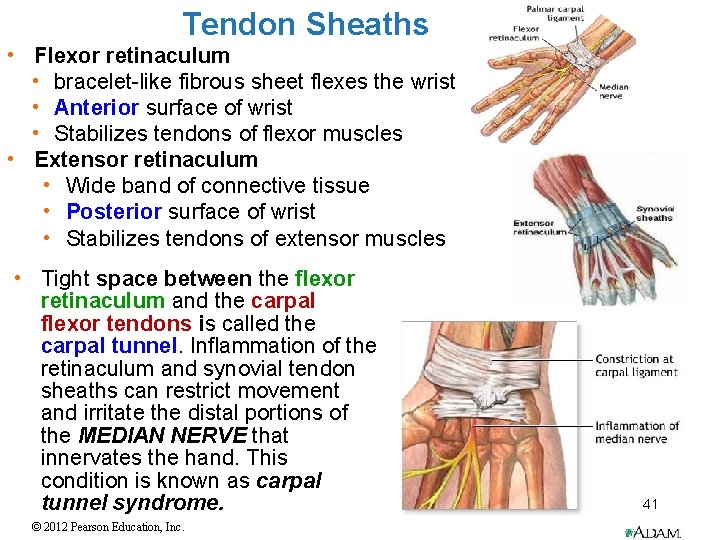
Tendon Sheaths • Flexor retinaculum • bracelet-like fibrous sheet flexes the wrist • Anterior surface of wrist • Stabilizes tendons of flexor muscles • Extensor retinaculum • Wide band of connective tissue • Posterior surface of wrist • Stabilizes tendons of extensor muscles • Tight space between the flexor retinaculum and the carpal flexor tendons is called the carpal tunnel. Inflammation of the retinaculum and synovial tendon sheaths can restrict movement and irritate the distal portions of the MEDIAN NERVE that innervates the hand. This condition is known as carpal tunnel syndrome. © 2012 Pearson Education, Inc. 41
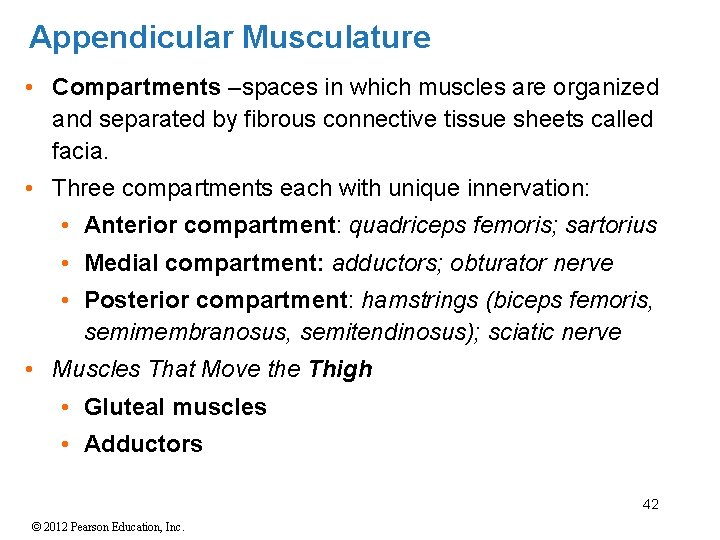
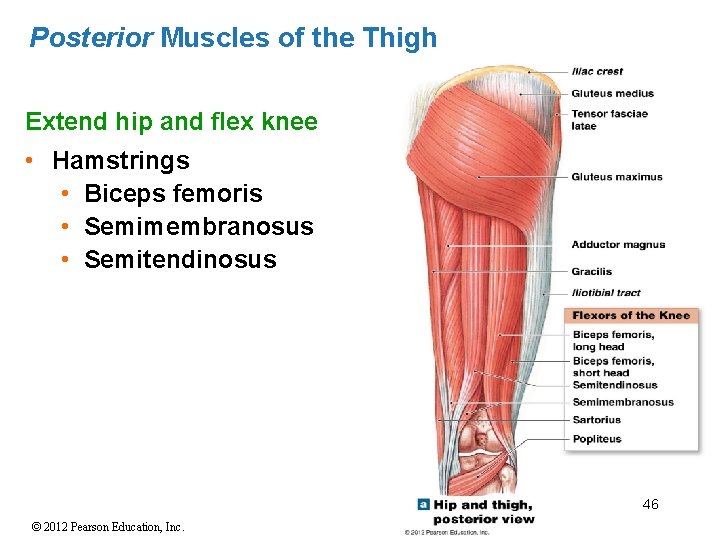
Appendicular Musculature • Compartments –spaces in which muscles are organized and separated by fibrous connective tissue sheets called facia. • Three compartments each with unique innervation: • Anterior compartment: quadriceps femoris; sartorius • Medial compartment: adductors; obturator nerve • Posterior compartment: hamstrings (biceps femoris, semimembranosus, semitendinosus); sciatic nerve • Muscles That Move the Thigh • Gluteal muscles • Adductors 42 © 2012 Pearson Education, Inc.
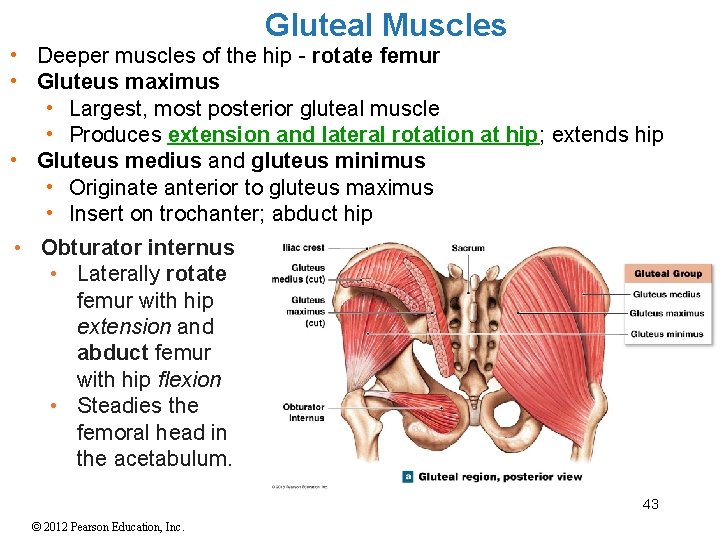
Gluteal Muscles • Deeper muscles of the hip - rotate femur • Gluteus maximus • Largest, most posterior gluteal muscle • Produces extension and lateral rotation at hip; extends hip • Gluteus medius and gluteus minimus • Originate anterior to gluteus maximus • Insert on trochanter; abduct hip • Obturator internus • Laterally rotate femur with hip extension and abduct femur with hip flexion • Steadies the femoral head in the acetabulum. 43 © 2012 Pearson Education, Inc.
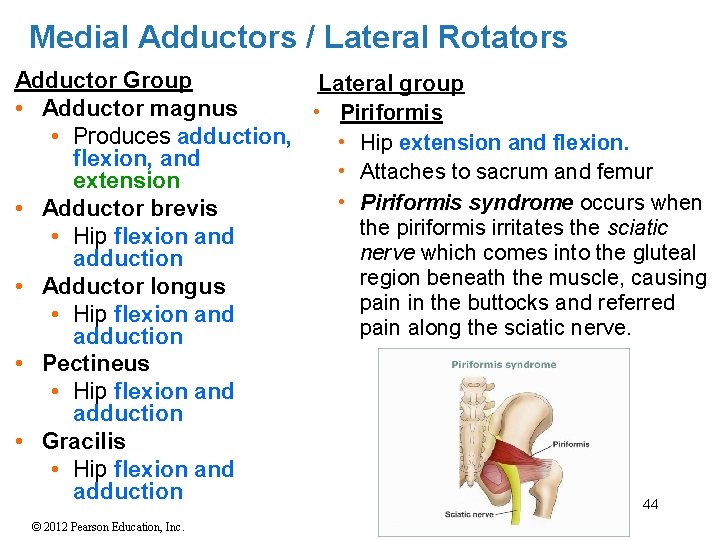
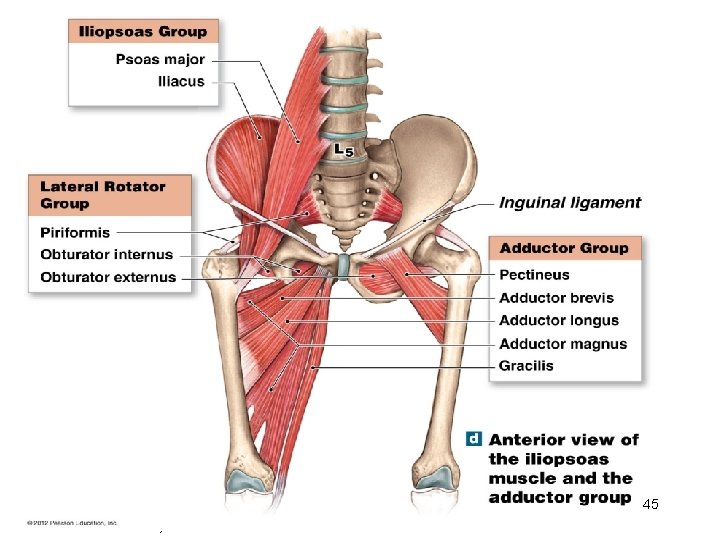
Medial Adductors / Lateral Rotators Adductor Group Lateral group • Adductor magnus • Piriformis • Produces adduction, • Hip extension and flexion, and • Attaches to sacrum and femur extension • Piriformis syndrome occurs when • Adductor brevis the piriformis irritates the sciatic • Hip flexion and nerve which comes into the gluteal adduction region beneath the muscle, causing • Adductor longus pain in the buttocks and referred • Hip flexion and pain along the sciatic nerve. adduction • Pectineus • Hip flexion and adduction • Gracilis • Hip flexion and adduction 44 © 2012 Pearson Education, Inc.
45 © 2012 Pearson Education, Inc.
Posterior Muscles of the Thigh Extend hip and flex knee • Hamstrings • Biceps femoris • Semimembranosus • Semitendinosus 46 © 2012 Pearson Education, Inc.
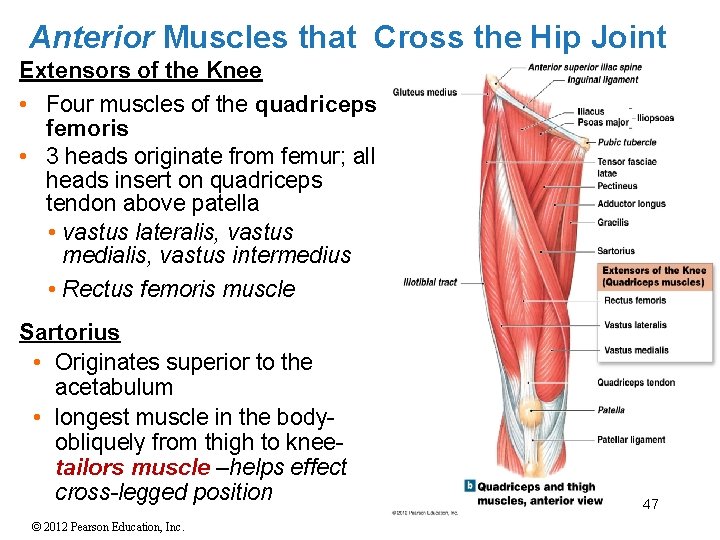
Anterior Muscles that Cross the Hip Joint Extensors of the Knee • Four muscles of the quadriceps femoris • 3 heads originate from femur; all heads insert on quadriceps tendon above patella • vastus lateralis, vastus medialis, vastus intermedius • Rectus femoris muscle Sartorius • Originates superior to the acetabulum • longest muscle in the bodyobliquely from thigh to kneetailors muscle –helps effect cross-legged position © 2012 Pearson Education, Inc. 47
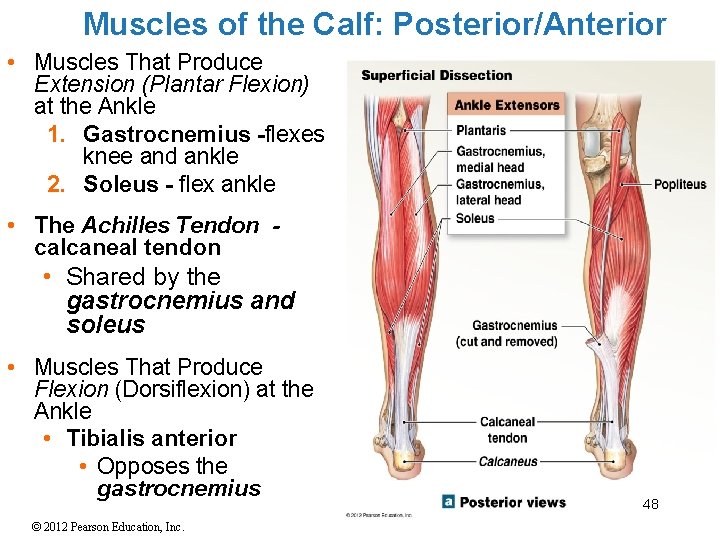
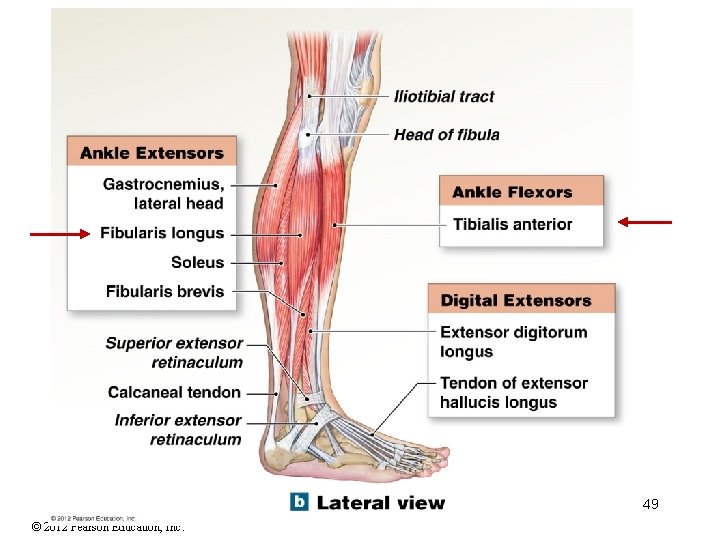
Muscles of the Calf: Posterior/Anterior • Muscles That Produce Extension (Plantar Flexion) at the Ankle 1. Gastrocnemius -flexes knee and ankle 2. Soleus - flex ankle • The Achilles Tendon calcaneal tendon • Shared by the gastrocnemius and soleus • Muscles That Produce Flexion (Dorsiflexion) at the Ankle • Tibialis anterior • Opposes the gastrocnemius © 2012 Pearson Education, Inc. 48
49 © 2012 Pearson Education, Inc.
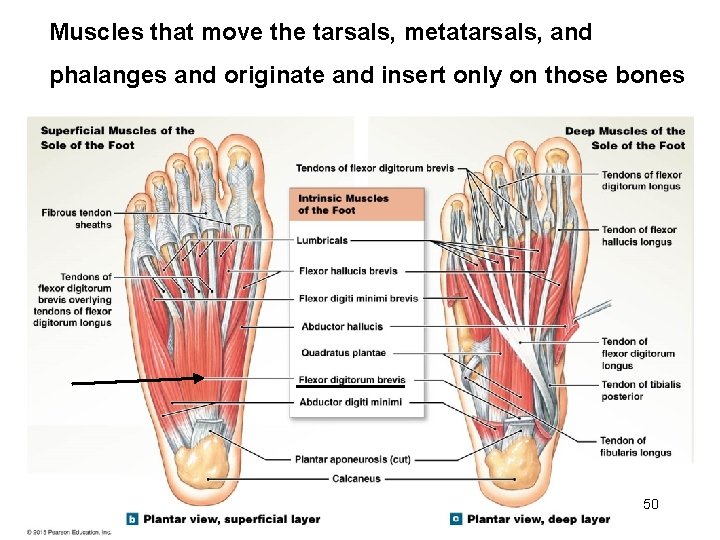
Muscles that move the tarsals, metatarsals, and phalanges and originate and insert only on those bones 50 © 2012 Pearson Education, Inc.
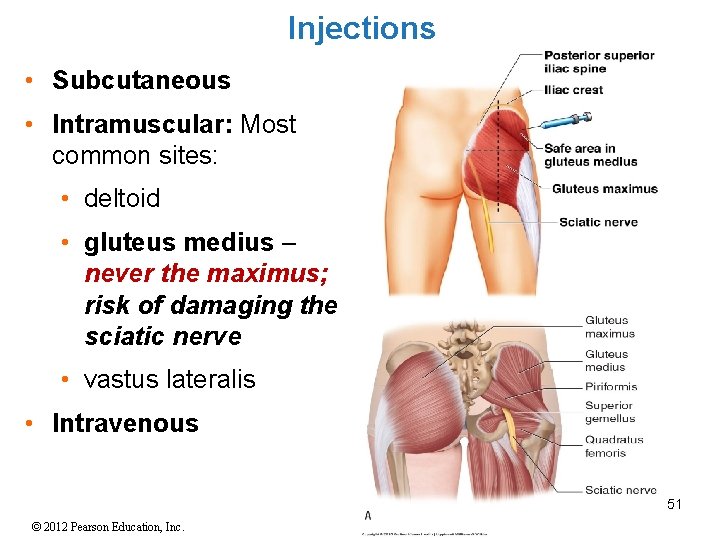
Injections • Subcutaneous • Intramuscular: Most common sites: • deltoid • gluteus medius – never the maximus; risk of damaging the sciatic nerve • vastus lateralis • Intravenous 51 © 2012 Pearson Education, Inc.