
Chapter 11 The financial statements of sole traders

- Slides: 9
Chapter 11 The financial statements of sole traders Copyright D O'Donoghue 1
Financial statements of Sole traders Contents: 1. Review of financial statements 1. Balance sheet 2. Income statement 2. Steps in preparing the financial statements 3. A comprehensive worked example 4. Profit as an estimate Copyright D O'Donoghue 2
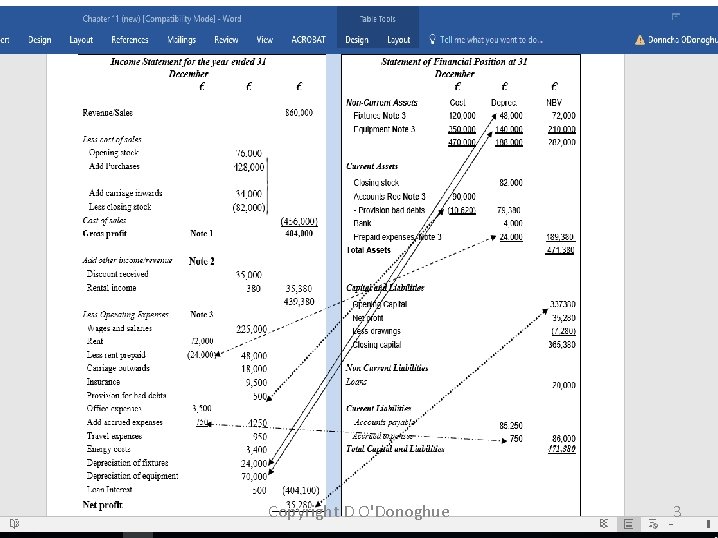
Copyright D O'Donoghue 3
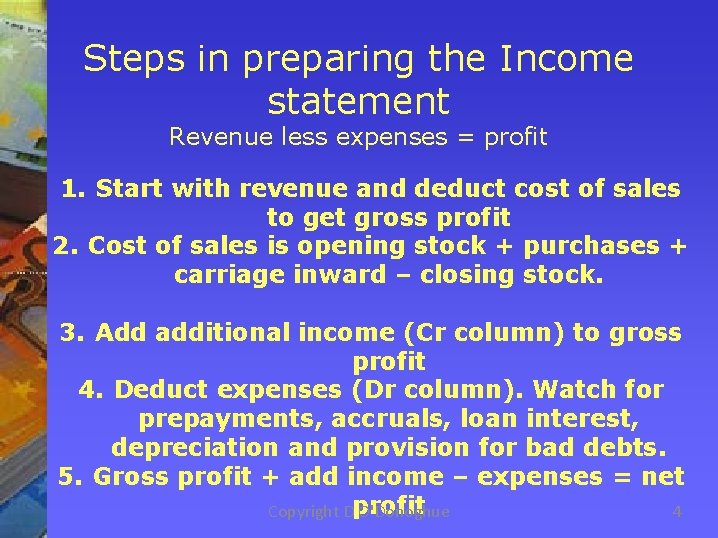
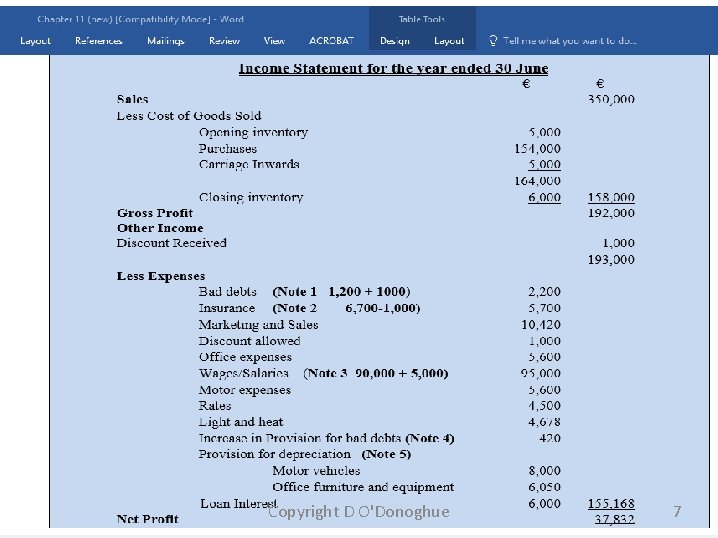
Steps in preparing the Income statement Revenue less expenses = profit 1. Start with revenue and deduct cost of sales to get gross profit 2. Cost of sales is opening stock + purchases + carriage inward – closing stock. 3. Add additional income (Cr column) to gross profit 4. Deduct expenses (Dr column). Watch for prepayments, accruals, loan interest, depreciation and provision for bad debts. 5. Gross profit + add income – expenses = net Copyright Dprofit O'Donoghue 4
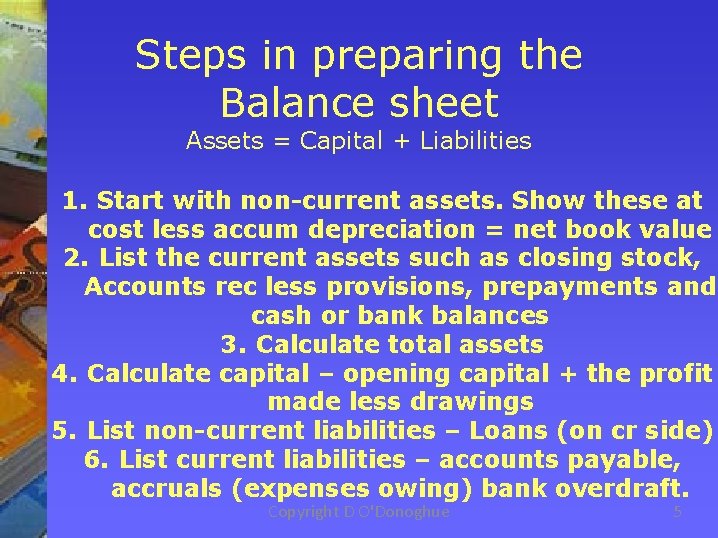
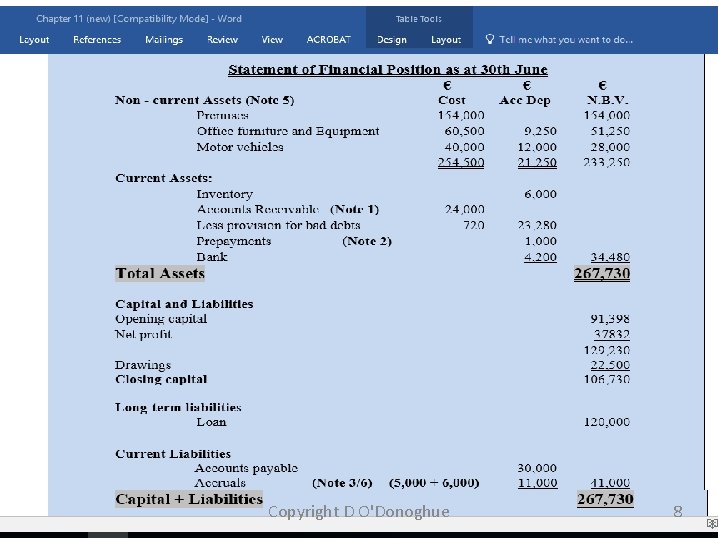
Steps in preparing the Balance sheet Assets = Capital + Liabilities 1. Start with non-current assets. Show these at cost less accum depreciation = net book value 2. List the current assets such as closing stock, Accounts rec less provisions, prepayments and cash or bank balances 3. Calculate total assets 4. Calculate capital – opening capital + the profit made less drawings 5. List non-current liabilities – Loans (on cr side) 6. List current liabilities – accounts payable, accruals (expenses owing) bank overdraft. Copyright D O'Donoghue 5
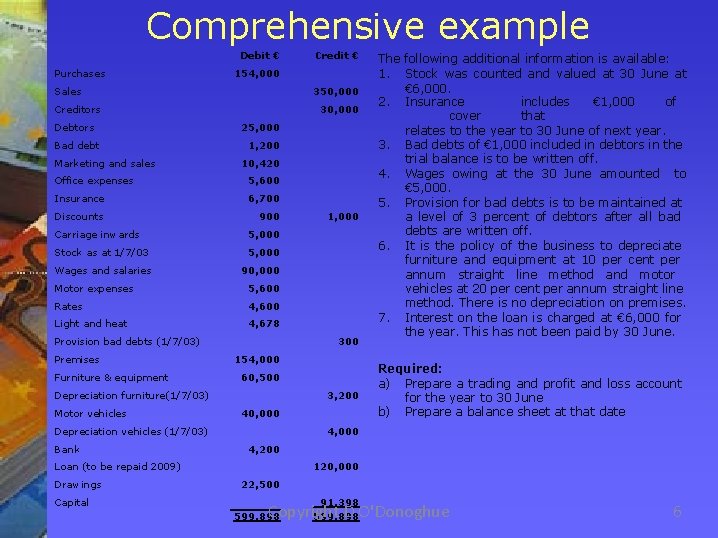
Comprehensive example Debit € Purchases 154, 000 Sales 350, 000 Creditors Debtors Bad debt Marketing and sales 30, 000 25, 000 1, 200 10, 420 Office expenses 5, 600 Insurance 6, 700 Discounts 900 Carriage inwards 5, 000 Stock as at 1/7/03 5, 000 Wages and salaries 90, 000 Motor expenses 5, 600 Rates 4, 600 Light and heat 4, 678 Provision bad debts (1/7/03) Premises Furniture & equipment 154, 000 60, 500 3, 200 40, 000 Depreciation vehicles (1/7/03) Bank Capital The following additional information is available: 1. Stock was counted and valued at 30 June at € 6, 000. 2. Insurance includes € 1, 000 of cover that relates to the year to 30 June of next year. 3. Bad debts of € 1, 000 included in debtors in the trial balance is to be written off. 4. Wages owing at the 30 June amounted to € 5, 000. 5. Provision for bad debts is to be maintained at a level of 3 percent of debtors after all bad debts are written off. 6. It is the policy of the business to depreciate furniture and equipment at 10 per cent per annum straight line method and motor vehicles at 20 per cent per annum straight line method. There is no depreciation on premises. 7. Interest on the loan is charged at € 6, 000 for the year. This has not been paid by 30 June. Required: a) Prepare a trading and profit and loss account for the year to 30 June b) Prepare a balance sheet at that date 4, 000 4, 200 Loan (to be repaid 2009) Drawings 1, 000 300 Depreciation furniture(1/7/03) Motor vehicles Credit € 120, 000 22, 500 91, 398 Copyright D O'Donoghue 599, 898 6
Income Statement Copyright D O'Donoghue 7
Copyright D O'Donoghue 8
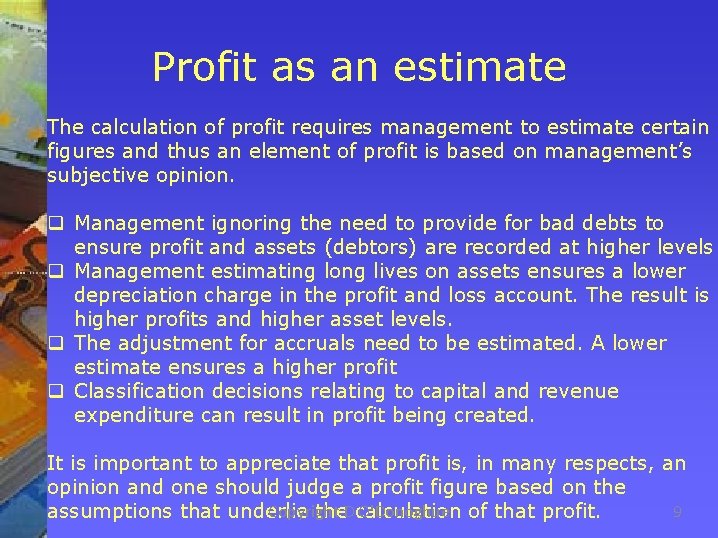
Profit as an estimate The calculation of profit requires management to estimate certain figures and thus an element of profit is based on management’s subjective opinion. q Management ignoring the need to provide for bad debts to ensure profit and assets (debtors) are recorded at higher levels q Management estimating long lives on assets ensures a lower depreciation charge in the profit and loss account. The result is higher profits and higher asset levels. q The adjustment for accruals need to be estimated. A lower estimate ensures a higher profit q Classification decisions relating to capital and revenue expenditure can result in profit being created. It is important to appreciate that profit is, in many respects, an opinion and one should judge a profit figure based on the Copyright O'Donoghue of that profit. 9 assumptions that underlie the. D calculation