
Chapter 11 The DeepSea Floor The deepsea floor
- Slides: 17
Chapter 11 The Deep-Sea Floor The deep-sea floor descends sharply down continental slopes to the dark, cold, and featureless abyssal plains, punctuated only by a scattering of tectonically active ridges, rises, and trenches. Copyright © 2004 Jones and Bartlett Publishers
Chapter 11 Living Conditions on the Deep-Sea Floor §Most of the seafloor is covered with thick accumulations of fine sediment particles, mineralized skeletal remains of planktonic organisms, known as oozes, that accumulate very slowly (about 1 cm/1000 yr).
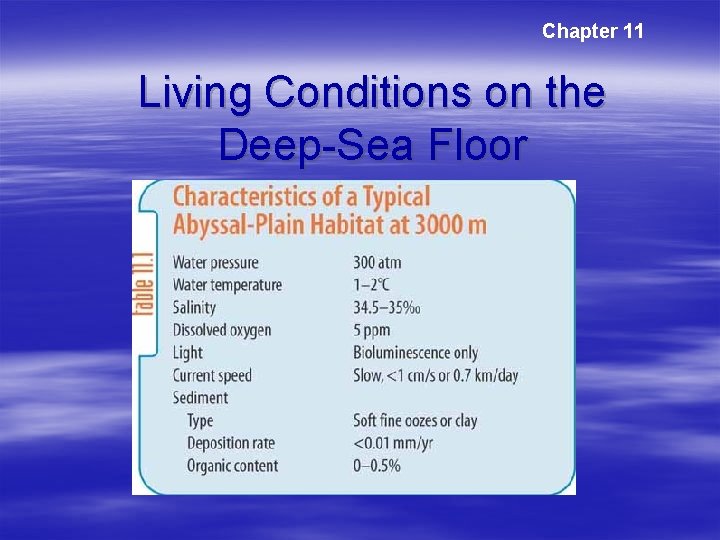
Chapter 11 Living Conditions on the Deep-Sea Floor
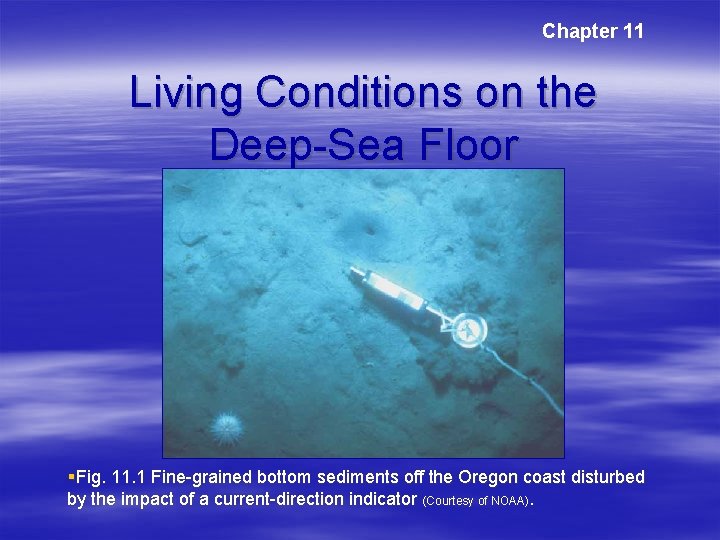
Chapter 11 Living Conditions on the Deep-Sea Floor §Fig. 11. 1 Fine-grained bottom sediments off the Oregon coast disturbed by the impact of a current-direction indicator (Courtesy of NOAA).
Chapter 11 Transfer of Oxygen and Energy to the Deep Sea §The diffusion and sinking of cold dense water masses are the chief mechanisms of O 2 transport into the deep sea, §Dissolved O 2 is slowly diminished by animals and bacteria, leaving an O 2 minimum zone at intermediate depths. §Below this zone, dissolved O 2 gradually increases to just above the sea bottom.
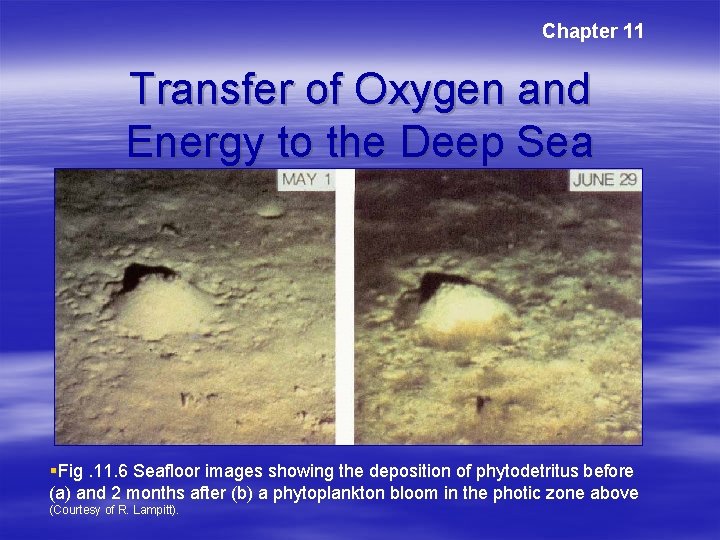
Chapter 11 Transfer of Oxygen and Energy to the Deep Sea §Food for deep-sea benthic communities sinks from above at rates that are tightly coupled with primary productivity at the sunlit surface.
Chapter 11 Transfer of Oxygen and Energy to the Deep Sea §Fig. 11. 6 Seafloor images showing the deposition of phytodetritus before (a) and 2 months after (b) a phytoplankton bloom in the photic zone above (Courtesy of R. Lampitt).
Chapter 11 Life on Abyssal Plains §A shift in dominant taxonomic groups occurs in deeper water – echinoderms, polychaete worms, pycnogonids, and isopod and amphipod crustaceans become abundant – mollusks and sea stars decline in number.
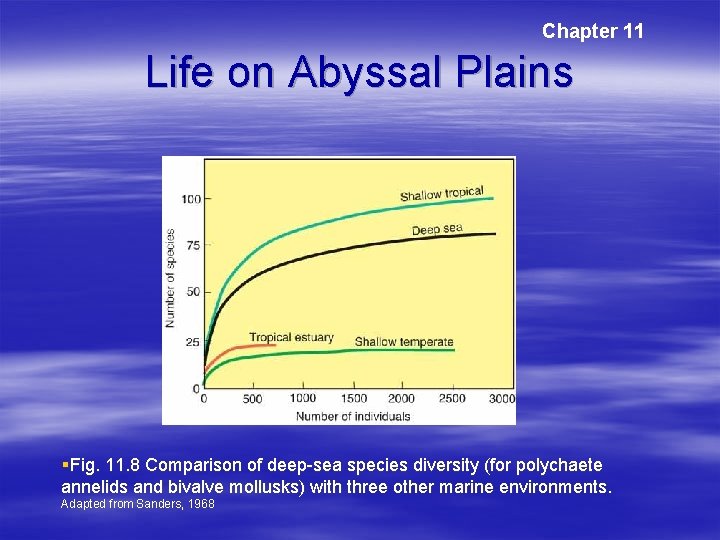
Chapter 11 Life on Abyssal Plains §Although both density and biomass of organisms decline markedly at greater depths, species diversity on abyssal plains is comparable with or even exceeds that of softbottom communities in shallow inshore waters.
Chapter 11 Life on Abyssal Plains §Fig. 11. 8 Comparison of deep-sea species diversity (for polychaete annelids and bivalve mollusks) with three other marine environments. Adapted from Sanders, 1968
Chapter 11 Life on Abyssal Plains §Most benthic animals in the deep sea are infaunal deposit feeders, extracting nourishment from the sediment in much the same manner as earthworms. §Croppers have merged the roles of predator and deposit feeder by preying heavily on populations of smaller deposit feeders and bacteria.
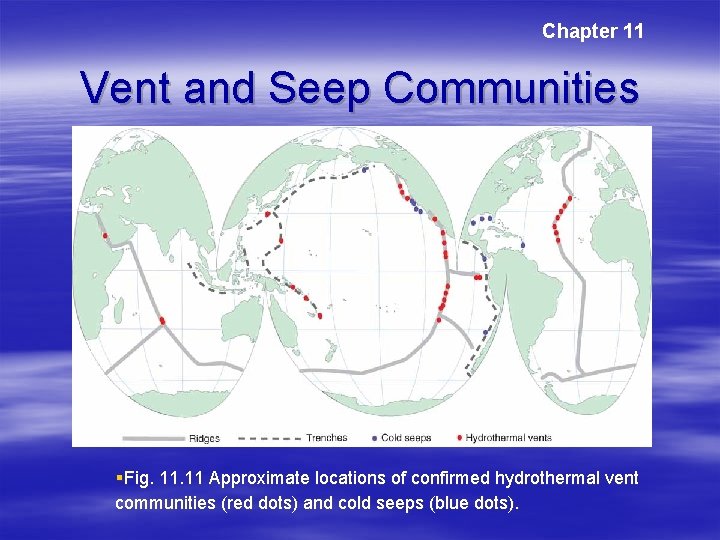
Chapter 11 Vent and Seep Communities Deep-sea hot springs, recently discovered along the axes of ridge and rise systems, support unique communities of deep-sea animals and bacteria.
Chapter 11 Vent and Seep Communities §Fig. 11 Approximate locations of confirmed hydrothermal vent communities (red dots) and cold seeps (blue dots).
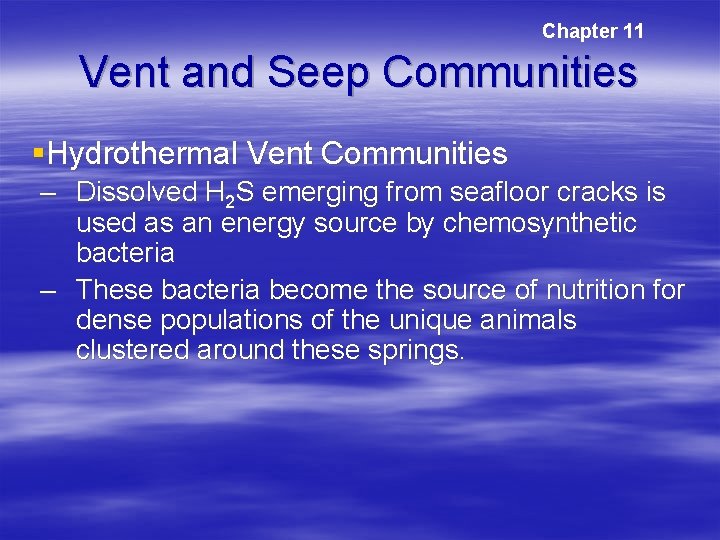
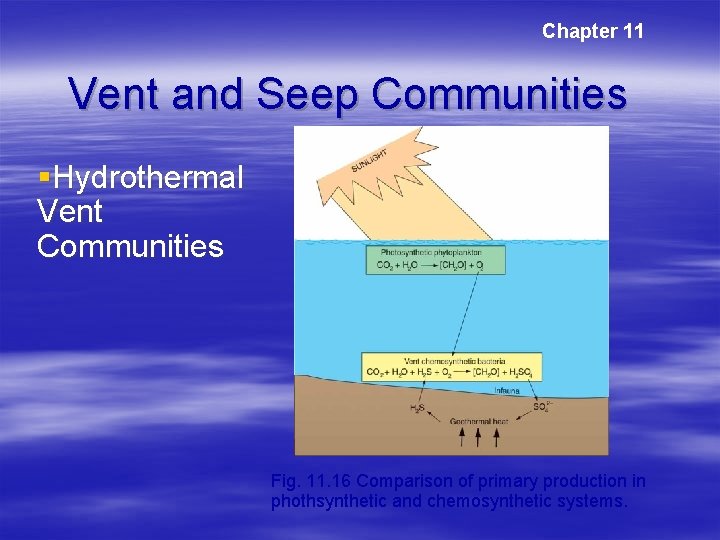
Chapter 11 Vent and Seep Communities §Hydrothermal Vent Communities – Dissolved H 2 S emerging from seafloor cracks is used as an energy source by chemosynthetic bacteria – These bacteria become the source of nutrition for dense populations of the unique animals clustered around these springs.
Chapter 11 Vent and Seep Communities §Hydrothermal Vent Communities Fig. 11. 16 Comparison of primary production in phothsynthetic and chemosynthetic systems.
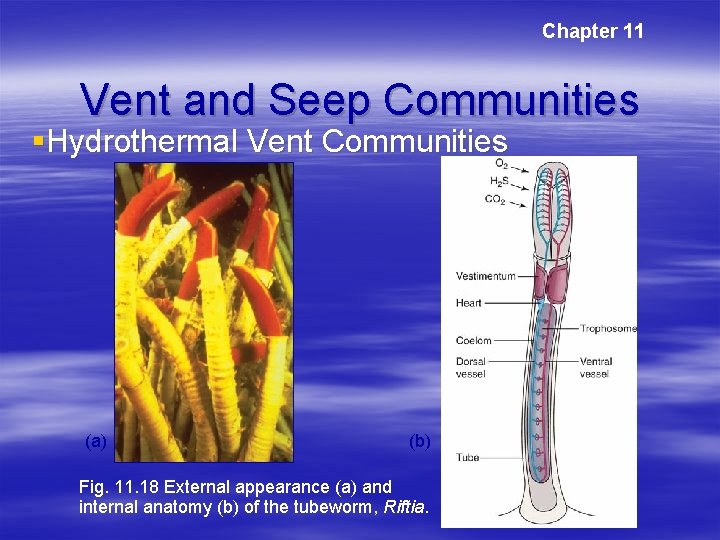
Chapter 11 Vent and Seep Communities §Hydrothermal Vent Communities (a) (b) Fig. 11. 18 External appearance (a) and internal anatomy (b) of the tubeworm, Riftia.
Chapter 11 Vent and Seep Communities §Cold-Seep Communities – Densely populated animal communities dependent on chemosynthetic bacteria, include § cold-water brine seeps § methane seeps § earthquake-disturbed sediments of deep-sea fans