
Chapter 11 The Ancient Hebrews and the Origins
Chapter 11 The Ancient Hebrews and the Origins of Judaism
11. 1: Introduction • Hebrews were the founders of Judaism o Basic laws are recorded in the Torah • The first five books of the Hebrew Bible (Old Testament) o Four major Hebrew leaders • Abraham • Moses • David • Solomon
11. 2: What We Know About the Ancient Hebrews • Torah o Used to understand the history of the Jewish people and the development of Judaism • Early History o Abraham • Lived in Ur • Around 1950 BCE, migrated with his clan to Caanan
o 1800 BCE: Hebrews moved to Egypt • Left because of famine • Eventually became slaves o Moses • Led the Hebrews in their escape from Egypt o Wandered the wilderness for 40 years o Israel • By 1000 BCE, kingdom of Israel set up under King David’s rule and his son’s, King Solomon • David forged Hebrews into one united nation • Solomon built a temple in Jerusalem
11. 3: Important Hebrew Leaders • Abraham o “Father of the Hebrews” o Introduced the central belief that there is only one God • New idea at the time o Was told by God to move his family from Mesopotamia to Caanan o He was promised by God that he would father a great nation • His descendants became known as the Jewish people

• Moses o Considered the greatest leader of the Hebrews o Lead his people out of slavery in Egypt o Told the Hebrews that God would lead them to the “promised land” in exchange for their faithful obedience o Gave Judaism its fundamental laws • Ten Commandments o Laws engraved on two stone tablets o Became the foundation for Judaism
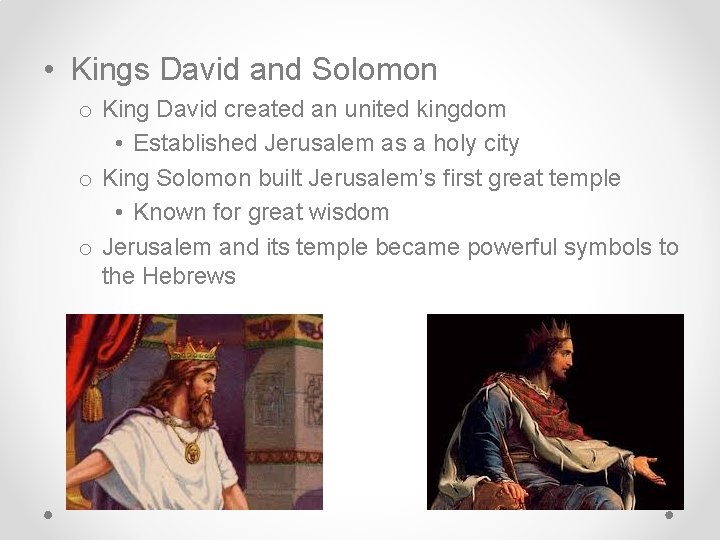
• Kings David and Solomon o King David created an united kingdom • Established Jerusalem as a holy city o King Solomon built Jerusalem’s first great temple • Known for great wisdom o Jerusalem and its temple became powerful symbols to the Hebrews
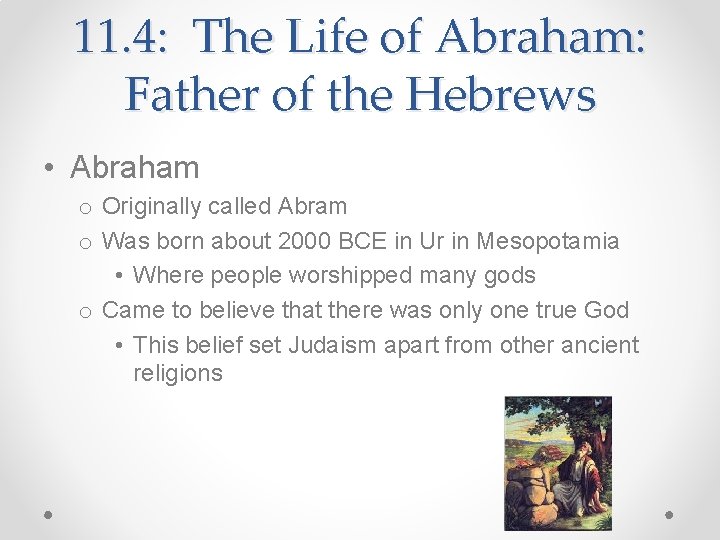
11. 4: The Life of Abraham: Father of the Hebrews • Abraham o Originally called Abram o Was born about 2000 BCE in Ur in Mesopotamia • Where people worshipped many gods o Came to believe that there was only one true God • This belief set Judaism apart from other ancient religions
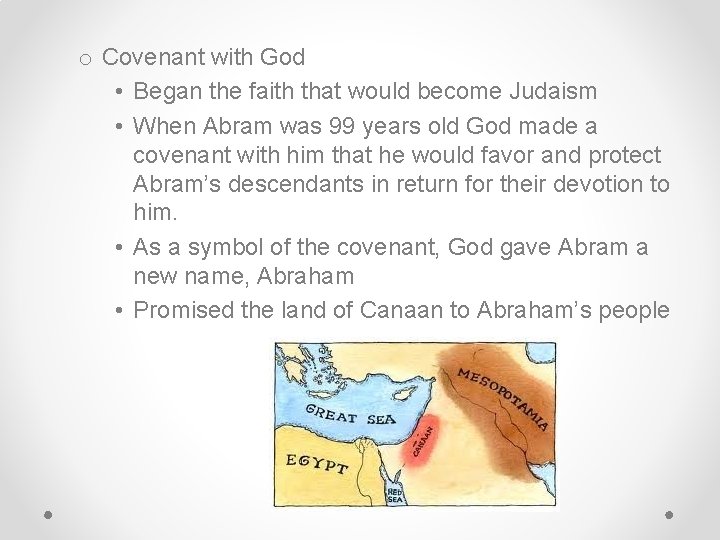
o Covenant with God • Began the faith that would become Judaism • When Abram was 99 years old God made a covenant with him that he would favor and protect Abram’s descendants in return for their devotion to him. • As a symbol of the covenant, God gave Abram a new name, Abraham • Promised the land of Canaan to Abraham’s people
o Abraham’s Sacrifice • Normal sacrifices were made such as sheep • Torah states that God tested Abraham by telling him to sacrifice his son Isaac (born late in Abraham’s life). o Even though Abraham loved his son, his devotion to God was complete o At the last minute, God sent an angel to stop Abraham from killing his son o Abraham proved his faith and obedience • According to the Torah, God kept his promise which led to the 12 tribes descended from Abraham’s grandson, Jacob (named Israel by an angel of God).
11. 5 The Life Moses: Leader and Prophet • Exodus from Egypt o By 1250 BCE, a large group of Abraham’s descendants were living in Egypt. o The Torah says that the Hebrews “increased in number and became very powerful”. o The pharaoh feared their power and turned them into slaves. o God heard the cries of the enslaved Hebrews and sent Moses to the pharaoh.
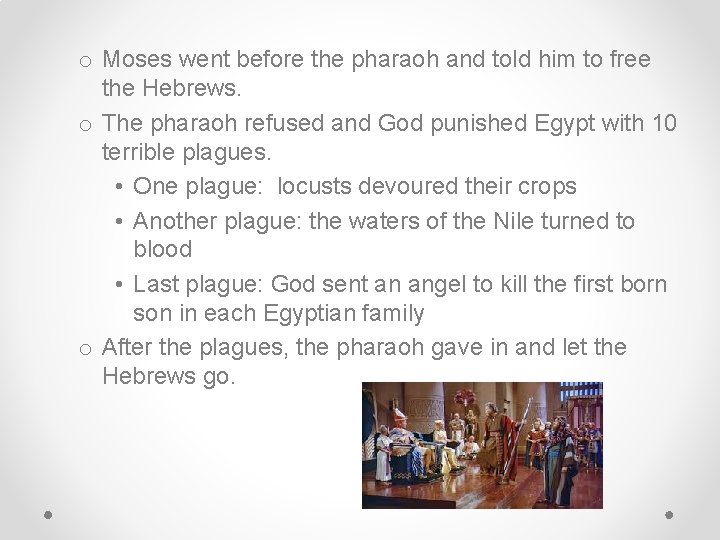
o Moses went before the pharaoh and told him to free the Hebrews. o The pharaoh refused and God punished Egypt with 10 terrible plagues. • One plague: locusts devoured their crops • Another plague: the waters of the Nile turned to blood • Last plague: God sent an angel to kill the first born son in each Egyptian family o After the plagues, the pharaoh gave in and let the Hebrews go.
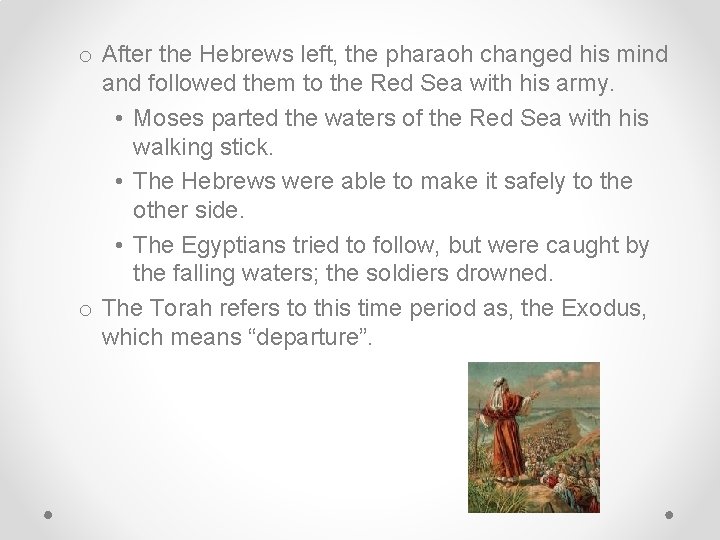
o After the Hebrews left, the pharaoh changed his mind and followed them to the Red Sea with his army. • Moses parted the waters of the Red Sea with his walking stick. • The Hebrews were able to make it safely to the other side. • The Egyptians tried to follow, but were caught by the falling waters; the soldiers drowned. o The Torah refers to this time period as, the Exodus, which means “departure”.
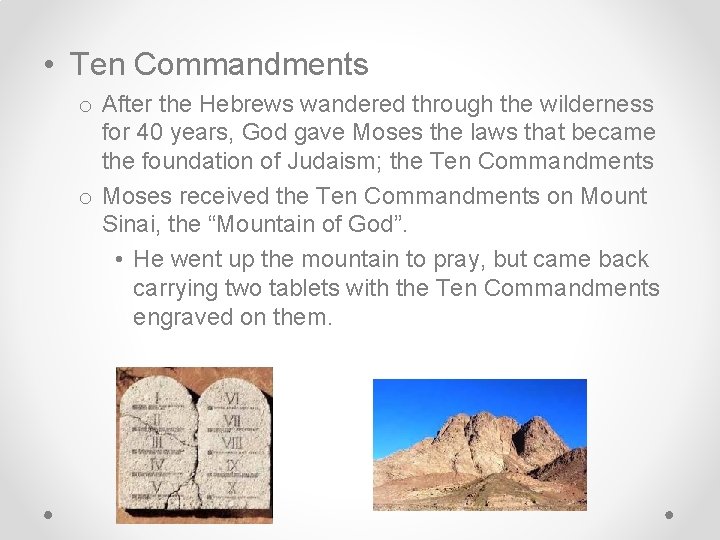
• Ten Commandments o After the Hebrews wandered through the wilderness for 40 years, God gave Moses the laws that became the foundation of Judaism; the Ten Commandments o Moses received the Ten Commandments on Mount Sinai, the “Mountain of God”. • He went up the mountain to pray, but came back carrying two tablets with the Ten Commandments engraved on them.
o Some of the commandments spelled out the Hebrew’s duties to God. • “You shall not have no other God before me” • This was in response to the Hebrews beginning to worship other gods during their wanderings. • The commandment reminded them of their promise to worship only one God. o Another commandment told them to set aside one day a week for rest and worship; the Sabbath o Other commandments laid down basic moral laws (laws about right and wrong) • “You shall honor your father and mother”.
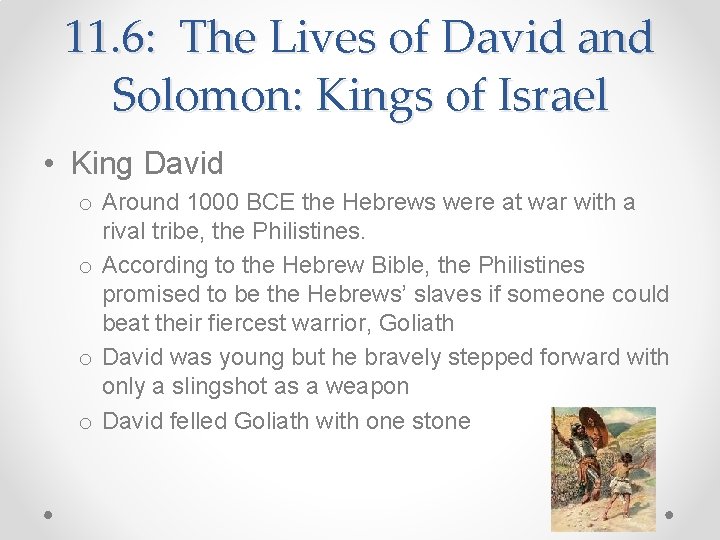
11. 6: The Lives of David and Solomon: Kings of Israel • King David o Around 1000 BCE the Hebrews were at war with a rival tribe, the Philistines. o According to the Hebrew Bible, the Philistines promised to be the Hebrews’ slaves if someone could beat their fiercest warrior, Goliath o David was young but he bravely stepped forward with only a slingshot as a weapon o David felled Goliath with one stone
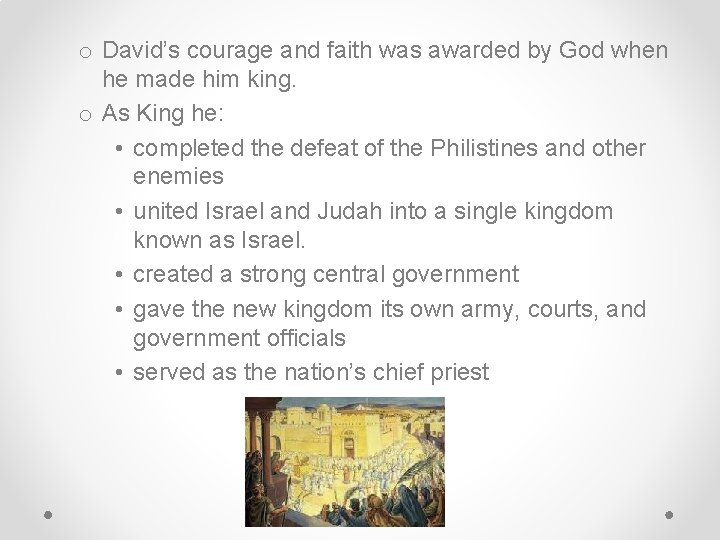
o David’s courage and faith was awarded by God when he made him king. o As King he: • completed the defeat of the Philistines and other enemies • united Israel and Judah into a single kingdom known as Israel. • created a strong central government • gave the new kingdom its own army, courts, and government officials • served as the nation’s chief priest
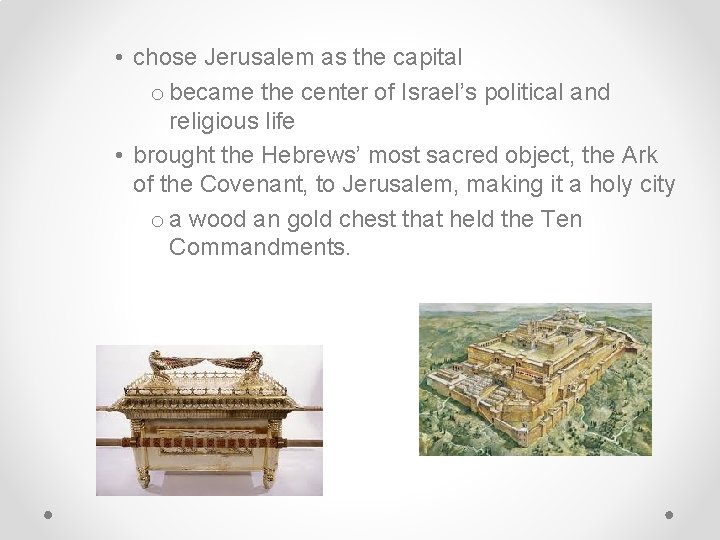
• chose Jerusalem as the capital o became the center of Israel’s political and religious life • brought the Hebrews’ most sacred object, the Ark of the Covenant, to Jerusalem, making it a holy city o a wood an gold chest that held the Ten Commandments.
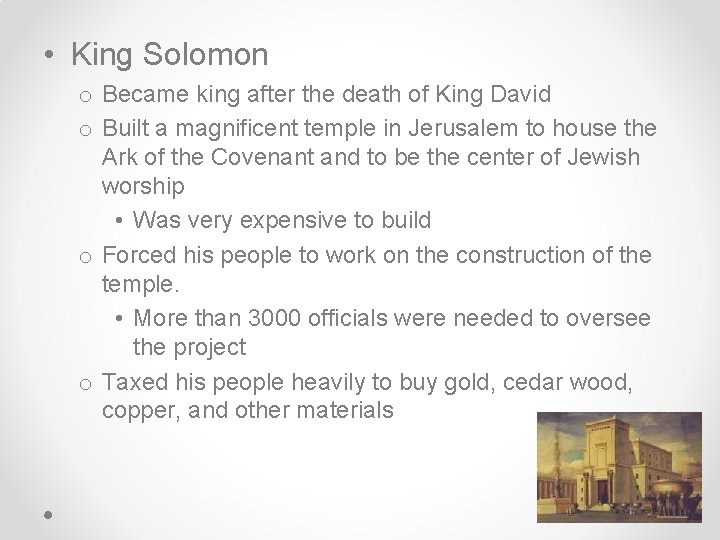
• King Solomon o Became king after the death of King David o Built a magnificent temple in Jerusalem to house the Ark of the Covenant and to be the center of Jewish worship • Was very expensive to build o Forced his people to work on the construction of the temple. • More than 3000 officials were needed to oversee the project o Taxed his people heavily to buy gold, cedar wood, copper, and other materials
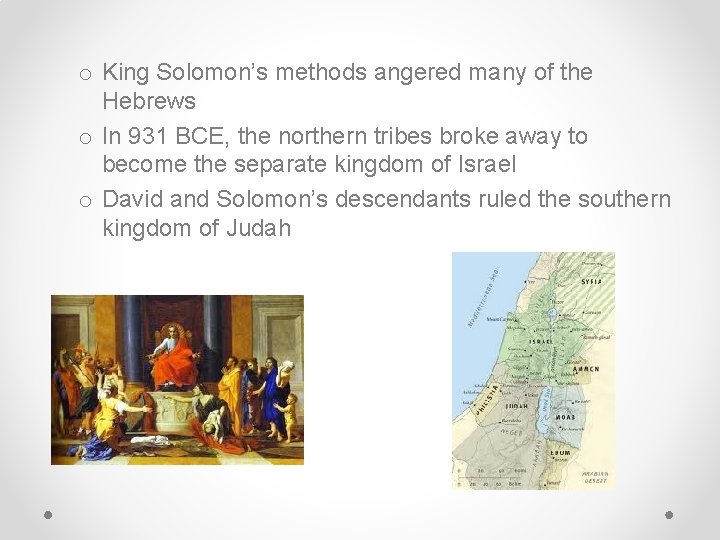
o King Solomon’s methods angered many of the Hebrews o In 931 BCE, the northern tribes broke away to become the separate kingdom of Israel o David and Solomon’s descendants ruled the southern kingdom of Judah
- Slides: 20