
Chapter 11 Structure Objectives You should be able
Chapter 11 Structure
Objectives You should be able to describe: • Structures • Arrays of Structures • Structures as Function Arguments • Dynamic Structure Allocation • Common Programming Errors 2
Structures • Arrays make it possible to access list of data of same data type usingle variable name • Need different mechanism to store information of varying types in one data structure – Mailing list data – Parts inventory data 3
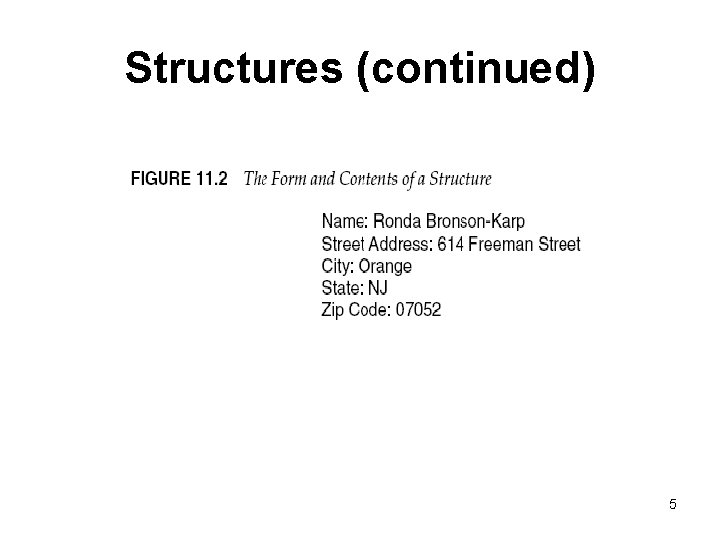
Structures (continued) • Structure: Data structure that stores different types of data under single name – A structure is class that has no methods – All variables of class are public (default) – Example: Figure 11. 2 • Creating and using a structure requires two steps: – Declaration – Assigning values 4
Structures (continued) 5

Structures (continued) • Structure declaration: List the data types, data names and arrangements of data items • Example: Birth structure consists of three data items or fields called structure members struct { int month; int day; int year; } birth; 6
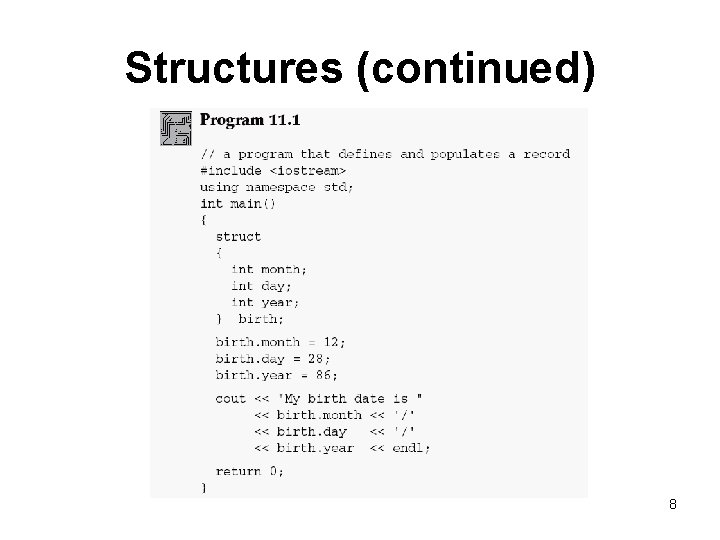
Structures (continued) • Populating the structure: Assigning data values to data items of a structure – Data structure members accessed by giving the structure name and individual data item name separated by period • Period called member access operator (dot operator) • Example: birth. month refers to the first member of birth structure – Program 11. 1 assigns values to individual members of birth structure 7
Structures (continued) 8
Structures (continued) • Output produced by program 11. 1: My Birth date is 12/28/86 • Format of structure definition is flexible: The following is valid struct {int month; int day; int year; } birth; • Multiple variables can be declared in the same statement struct {int month; int day; int year; } birth, current; – Creates two structures of the same form • birth. day, birth. month, birth. year • current. day, current. month, current. year 9
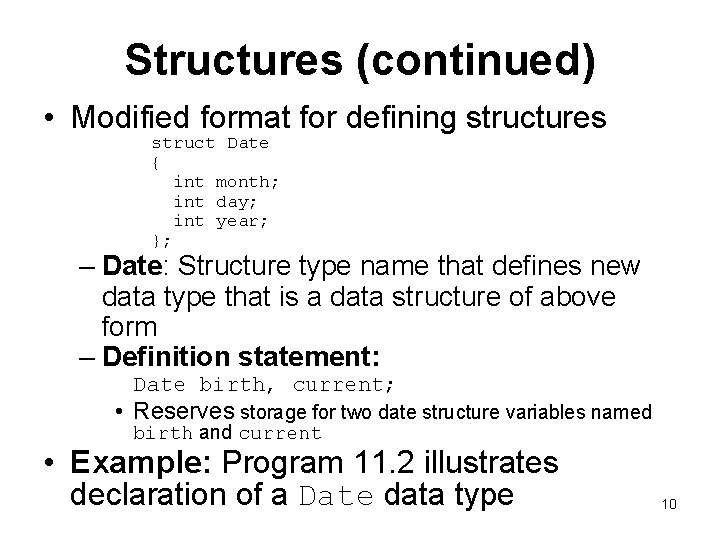
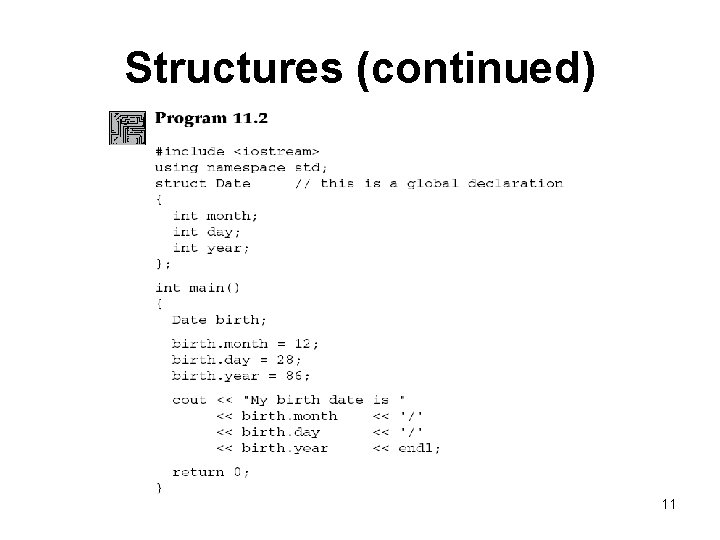
Structures (continued) • Modified format for defining structures struct Date { int month; int day; int year; }; – Date: Structure type name that defines new data type that is a data structure of above form – Definition statement: Date birth, current; • Reserves storage for two date structure variables named birth and current • Example: Program 11. 2 illustrates declaration of a Date data type 10
Structures (continued) 11
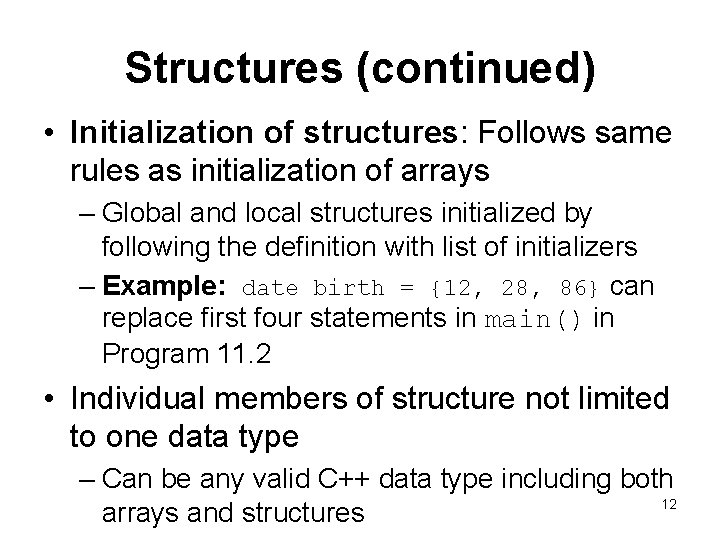
Structures (continued) • Initialization of structures: Follows same rules as initialization of arrays – Global and local structures initialized by following the definition with list of initializers – Example: date birth = {12, 28, 86} can replace first four statements in main() in Program 11. 2 • Individual members of structure not limited to one data type – Can be any valid C++ data type including both 12 arrays and structures
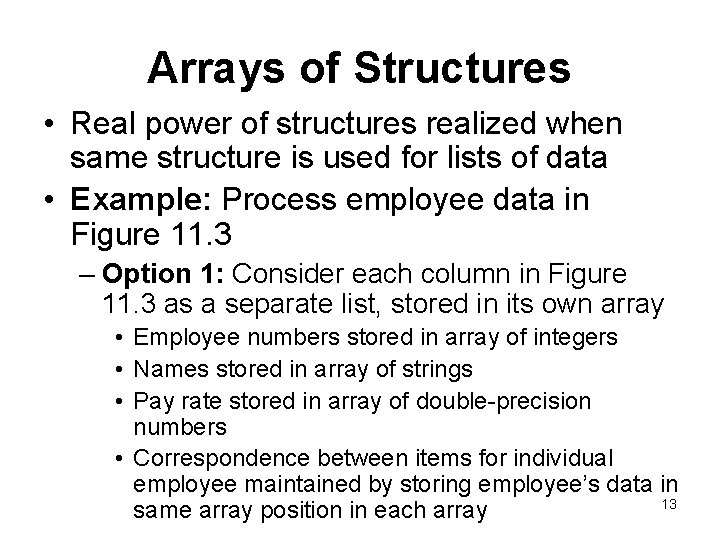
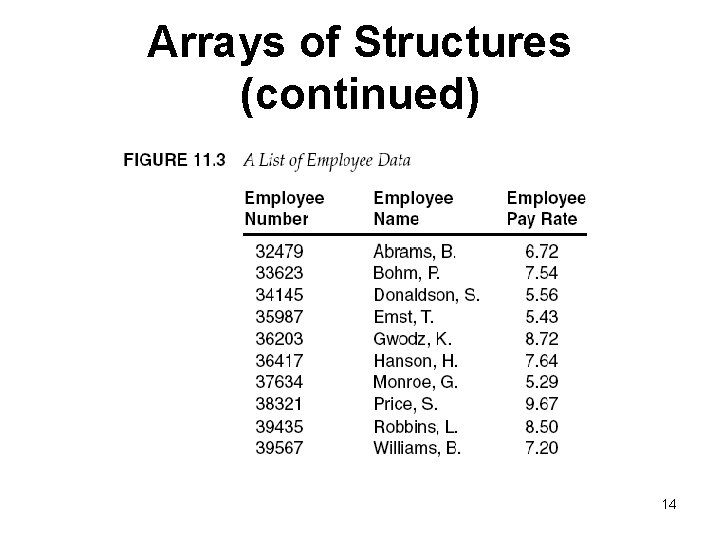
Arrays of Structures • Real power of structures realized when same structure is used for lists of data • Example: Process employee data in Figure 11. 3 – Option 1: Consider each column in Figure 11. 3 as a separate list, stored in its own array • Employee numbers stored in array of integers • Names stored in array of strings • Pay rate stored in array of double-precision numbers • Correspondence between items for individual employee maintained by storing employee’s data in 13 same array position in each array
Arrays of Structures (continued) 14
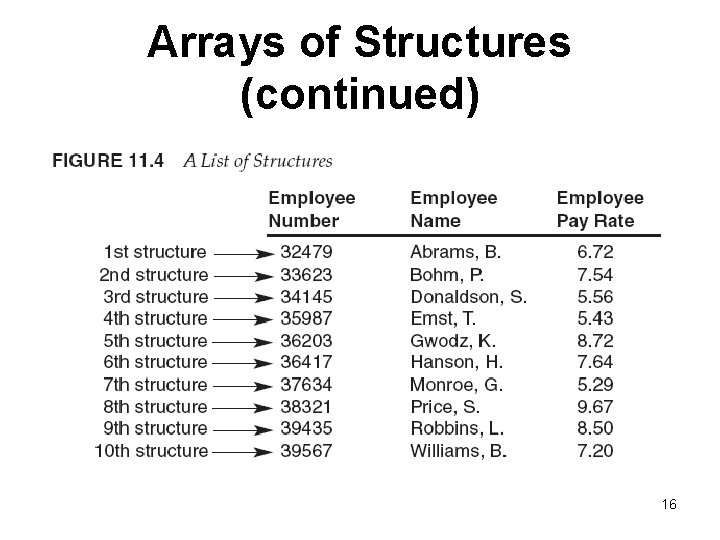
Arrays of Structures (continued) • Option 1 is not a good choice – Items related to single employee constitute a natural organization of data into structures • Better option: Use structure shown in Figure 11. 4 – Data can be processed as single array of ten structures – Maintains integrity of the data organization as a record 15
Arrays of Structures (continued) 16
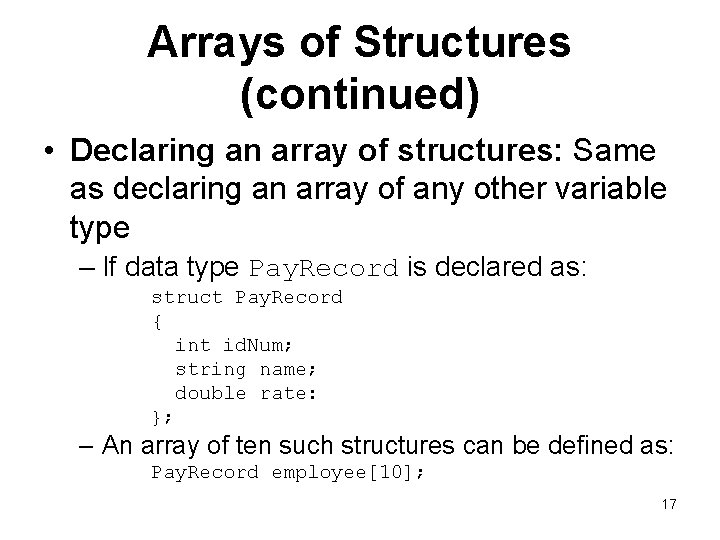
Arrays of Structures (continued) • Declaring an array of structures: Same as declaring an array of any other variable type – If data type Pay. Record is declared as: struct Pay. Record { int id. Num; string name; double rate: }; – An array of ten such structures can be defined as: Pay. Record employee[10]; 17
![Arrays of Structures (continued) • Referencing an item in an array of structures: employee[0].](http://slidetodoc.com/presentation_image_h/03c496006df2d4af48a38d3ef51ae7a6/image-18.jpg "Arrays of Structures (continued) • Referencing an item in an array of structures: employee[0].")
Arrays of Structures (continued) • Referencing an item in an array of structures: employee[0]. rate refers to rate member of the first employee structure in employee array • Including structures as elements of array makes it possible to process list of structures using standard array programming techniques • Program 11. 3 displays first five employee 18 records illustrated in Figure 11. 4

Structures as Function Arguments • Individual structure members are passed to a function in same manner as a scalar variable • Example: Given the structure definition struct { int id. Num; double pay. Rate; double hours; } emp; the statement display (emp. id. Num); passes a copy of the structure member emp. id. Num to a function named 19 display()
Structures as Function Arguments (continued) • Passing complete copies of all members of structure to a function – Include name of structure as argument • Example: The function call calc. Net(emp); passes a copy of the complete emp structure to calc. Net() – A declaration must be made to receive structure 20
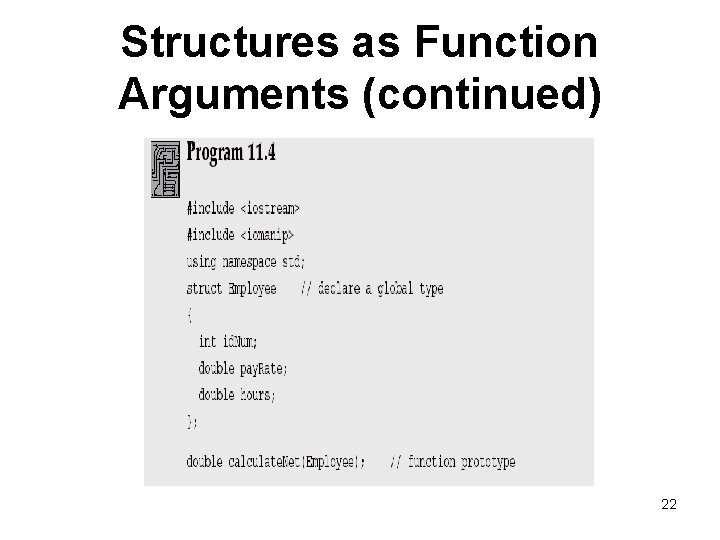
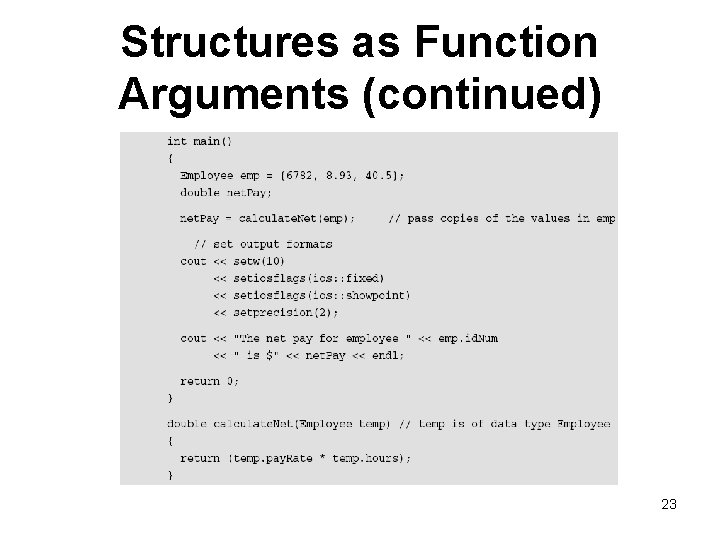
Structures as Function Arguments (continued) • Example: Program 11. 4 declares a global data type for Employee structure • This type is then used by both main() and calc. Net() functions to define specific structures with names emp and temp • The output produced by Program 11. 4 is The net pay for employee 6782 is $361. 66 21
Structures as Function Arguments (continued) 22
Structures as Function Arguments (continued) 23
Structures as Function Arguments (continued) • In Program 11. 4, both main() and calc. Net() use the Employee data type • The variables defined in main() and calc. Net() are different structures – Changes to local temp variable in calc. Net() are not reflected in emp variable of main() • Same structure variable name could have been used in both functions with no ambiguity – Both structure variables are local to their respective functions 24

Passing a Pointer • Using a pointer requires modifications to Program 11. 4: – Call to calc. Net(): calc. Net(&emp); – calc. Net() function definition: calc. Net(Employee *pt) • Example: Program 11. 4 a – Declares pt as a pointer to structure of type Employee – pt receives starting address of structure whenever calc. Net() is called – calc. Net() uses pt to access members of 25 structure
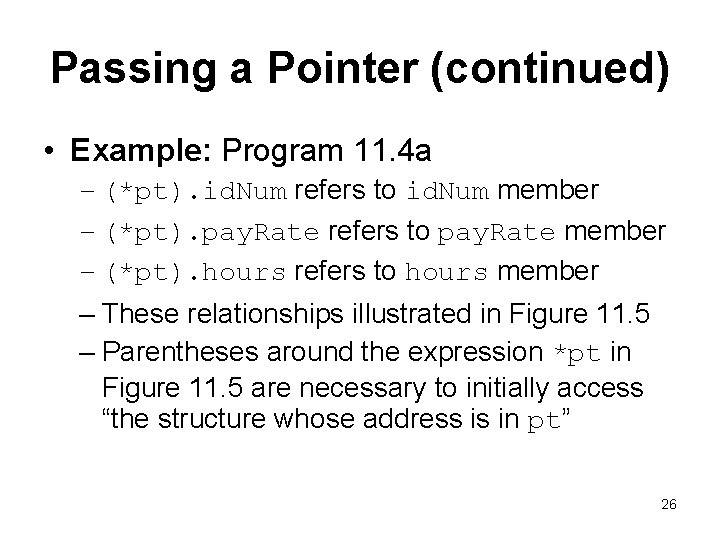
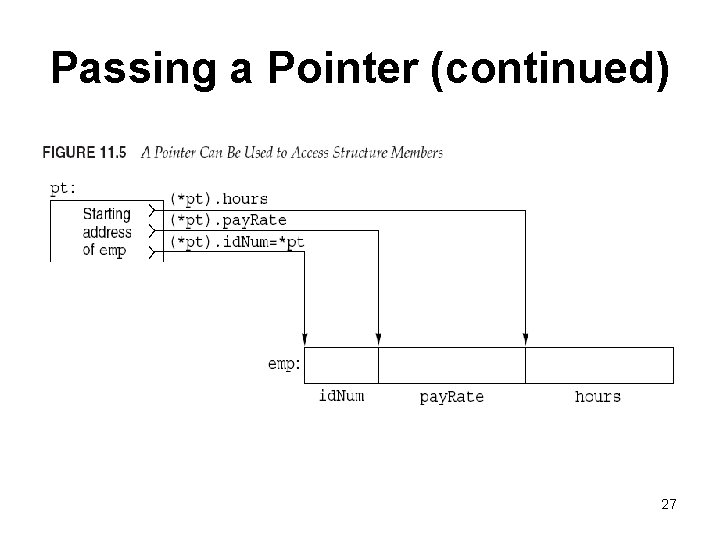
Passing a Pointer (continued) • Example: Program 11. 4 a – (*pt). id. Num refers to id. Num member – (*pt). pay. Rate refers to pay. Rate member – (*pt). hours refers to hours member – These relationships illustrated in Figure 11. 5 – Parentheses around the expression *pt in Figure 11. 5 are necessary to initially access “the structure whose address is in pt” 26
Passing a Pointer (continued) 27
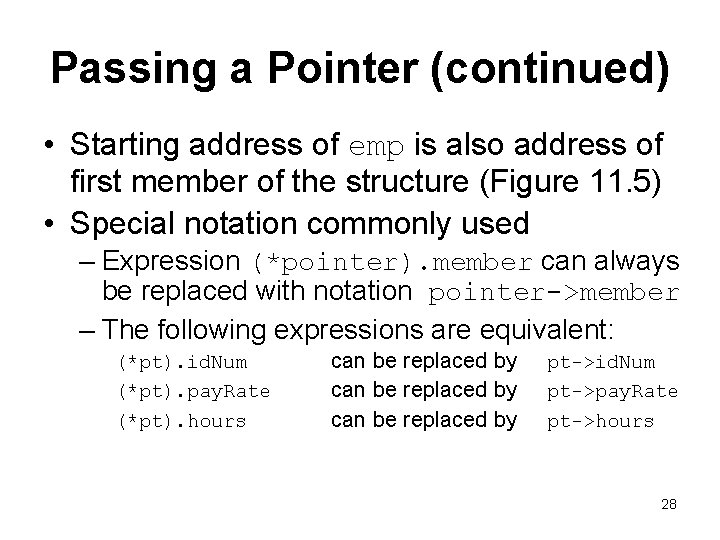
Passing a Pointer (continued) • Starting address of emp is also address of first member of the structure (Figure 11. 5) • Special notation commonly used – Expression (*pointer). member can always be replaced with notation pointer->member – The following expressions are equivalent: (*pt). id. Num (*pt). pay. Rate (*pt). hours can be replaced by pt->id. Num pt->pay. Rate pt->hours 28
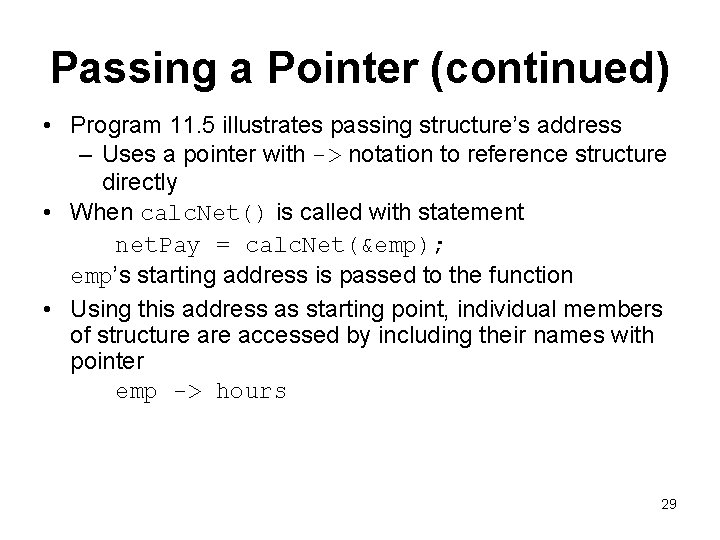
Passing a Pointer (continued) • Program 11. 5 illustrates passing structure’s address – Uses a pointer with -> notation to reference structure directly • When calc. Net() is called with statement net. Pay = calc. Net(&emp); emp’s starting address is passed to the function • Using this address as starting point, individual members of structure accessed by including their names with pointer emp -> hours 29
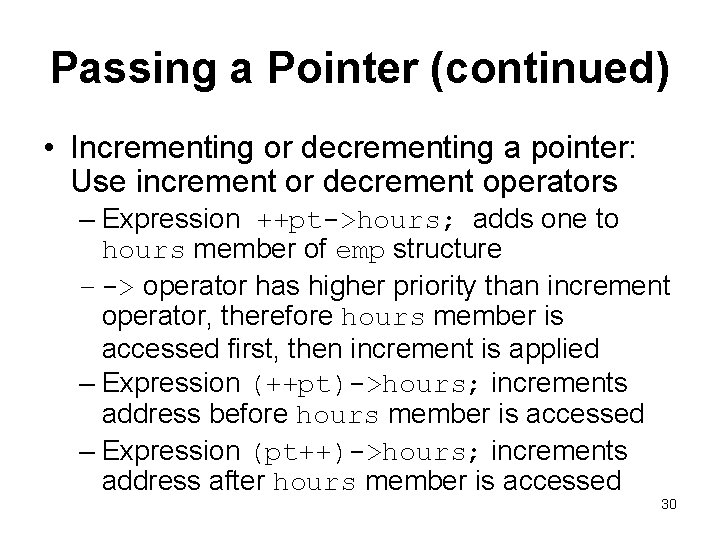
Passing a Pointer (continued) • Incrementing or decrementing a pointer: Use increment or decrement operators – Expression ++pt->hours; adds one to hours member of emp structure – -> operator has higher priority than increment operator, therefore hours member is accessed first, then increment is applied – Expression (++pt)->hours; increments address before hours member is accessed – Expression (pt++)->hours; increments address after hours member is accessed 30
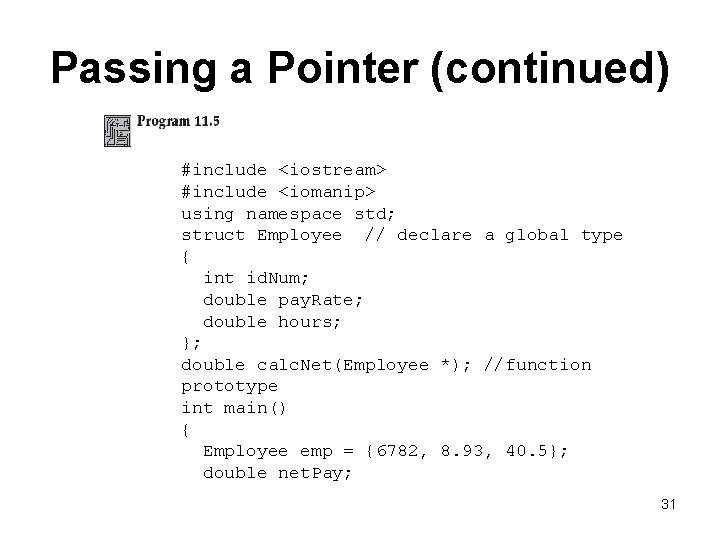
Passing a Pointer (continued) #include <iostream> #include <iomanip> using namespace std; struct Employee // declare a global type { int id. Num; double pay. Rate; double hours; }; double calc. Net(Employee *); //function prototype int main() { Employee emp = {6782, 8. 93, 40. 5}; double net. Pay; 31
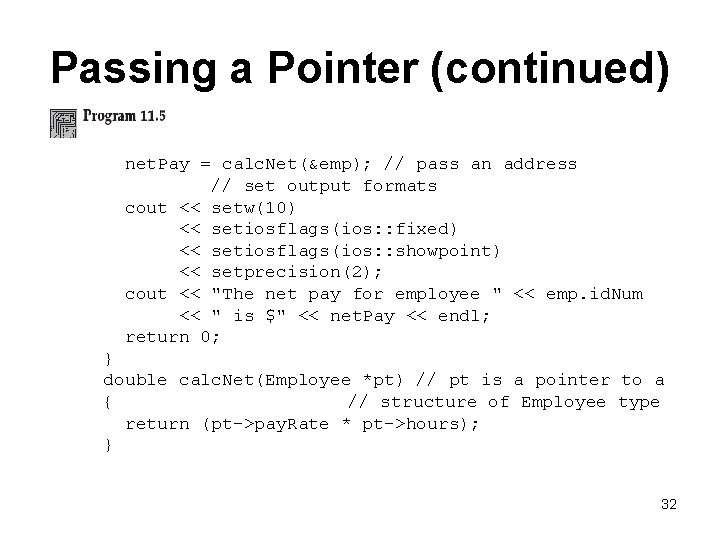
Passing a Pointer (continued) net. Pay = calc. Net(&emp); // pass an address // set output formats cout << setw(10) << setiosflags(ios: : fixed) << setiosflags(ios: : showpoint) << setprecision(2); cout << "The net pay for employee " << emp. id. Num << " is $" << net. Pay << endl; return 0; } double calc. Net(Employee *pt) // pt is a pointer to a { // structure of Employee type return (pt->pay. Rate * pt->hours); } 32
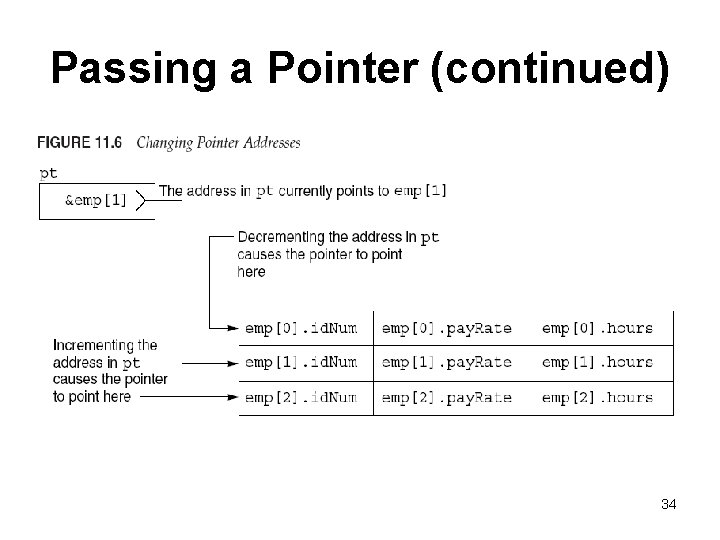
Passing a Pointer (continued) • Example (Fig 11. 6): Array of three structures of type employee with address of emp[1] stored in the pointer variable pt – Expression ++pt changes address in pt to starting address of emp[2] – Expression --pt changes address in pt to starting address of emp[0] 33
Passing a Pointer (continued) 34
Returning Structures • Structure handling functions receive direct access to structure by receiving structure reference or address – Equivalent to pass by reference – Changes to structure made in function • Functions can also return separate structure – Must declare function appropriately and alert calling function to type of data being returned 35
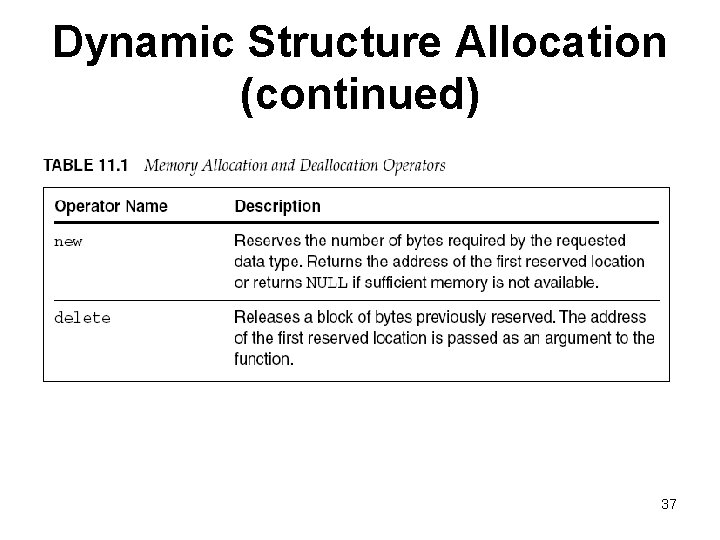
Dynamic Structure Allocation • Dynamic allocation of memory especially useful for lists of structures – Permits lists to expand contract as records are added or deleted • Additional storage space: Use new operator and indicate amount of storage needed – Expression new(int) or new int requests enough space to store integer number 36
Dynamic Structure Allocation (continued) 37
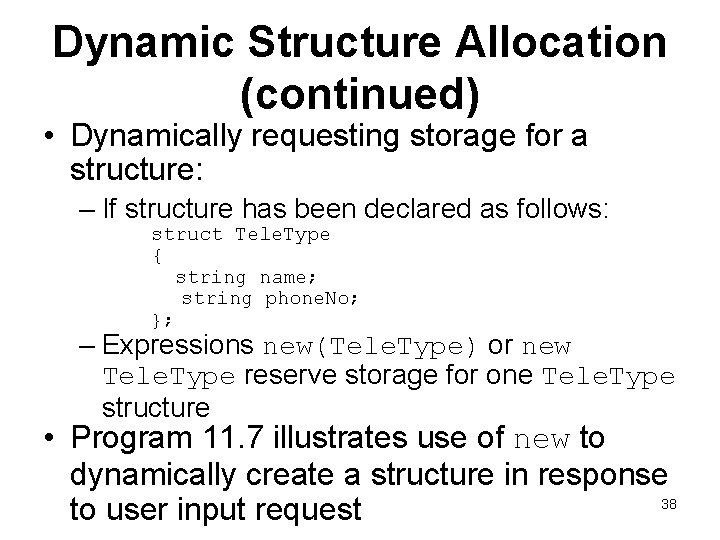
Dynamic Structure Allocation (continued) • Dynamically requesting storage for a structure: – If structure has been declared as follows: struct Tele. Type { string name; string phone. No; }; – Expressions new(Tele. Type) or new Tele. Type reserve storage for one Tele. Type structure • Program 11. 7 illustrates use of new to dynamically create a structure in response 38 to user input request

Dynamic Structure Allocation (continued) • Example: Program 11. 7 – Two variables declared in main() • key declared as a character variable • rec. Point declared as pointer to structure of the Tele. Type type – If user enters y in response to first prompt in main(), a call to new is made for memory to store structure – Address loaded into rec. Point can be used to access newly created structure 39
Dynamic Structure Allocation (continued) • Example: Program 11. 7 – The function populate() prompts user for data to fill structure • The argument passed to populate() in main() is pointer rec. Point – The dis. One() function displays contents of newly created and populated structure • Address passed to disp. One() is same address that was passed to populate() 40
Common Programming Errors • Trying to use a structure, as a complete entity, in a relational expression – Individual members of structure can be compared, but not entire structure • Using pointer in relation to structure and not indicating proper data type 41
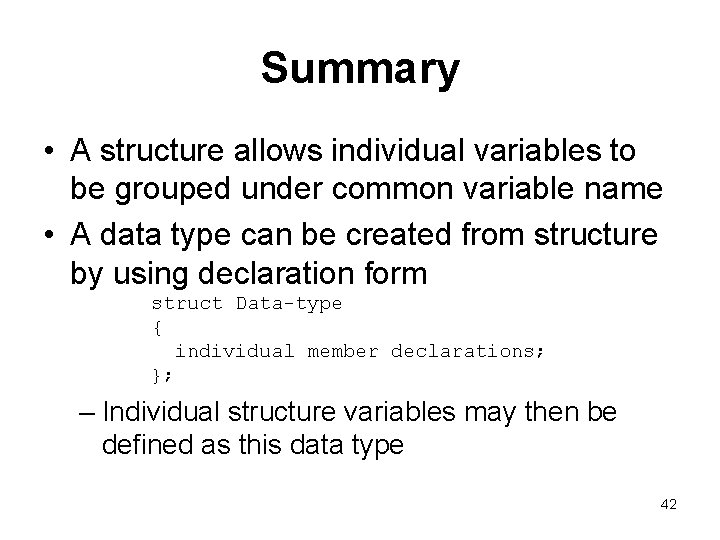
Summary • A structure allows individual variables to be grouped under common variable name • A data type can be created from structure by using declaration form struct Data-type { individual member declarations; }; – Individual structure variables may then be defined as this data type 42
Summary (continued) • Structures are useful as elements of arrays • Complete structures can be function arguments – Called function receives copy of each element in structure – The address of structure may also be passed, either as reference or as pointer • Structure members can be any C++ data type, including other structures, arrays, and pointers 43
- Slides: 43