
Chapter 11 Structure and Function of Invertebrates Table
Chapter 11 Structure and Function of Invertebrates Table of Contents 11. 1 What Chapter Preview is an Animal? 11. 2 What 11. 1 Sponges is anand Animal? Cnidarians 11. 3 Sponges 11. 2 Worms and Mollusks Cnidarians 11. 4 Worms 11. 3 Arthropods and Mollusks 11. 5 Arthropods 11. 4 Echinoderms 11. 5 Echinoderms
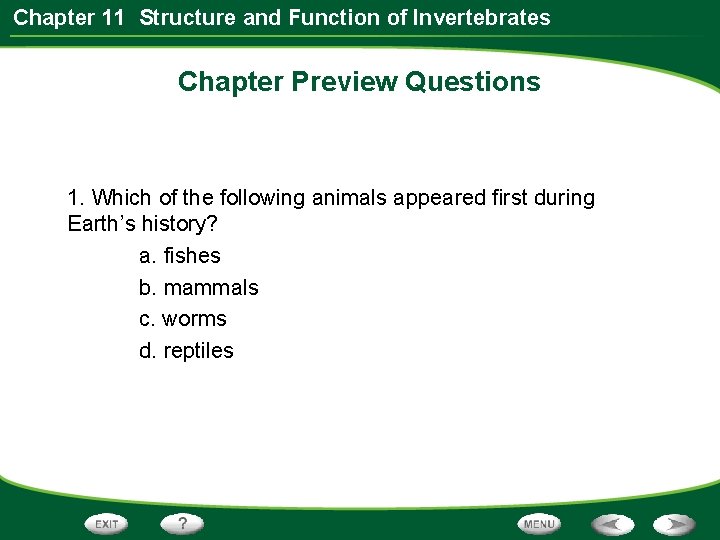
Chapter 11 Structure and Function of Invertebrates Chapter Preview Questions 1. Which of the following animals appeared first during Earth’s history? a. fishes b. mammals c. worms d. reptiles
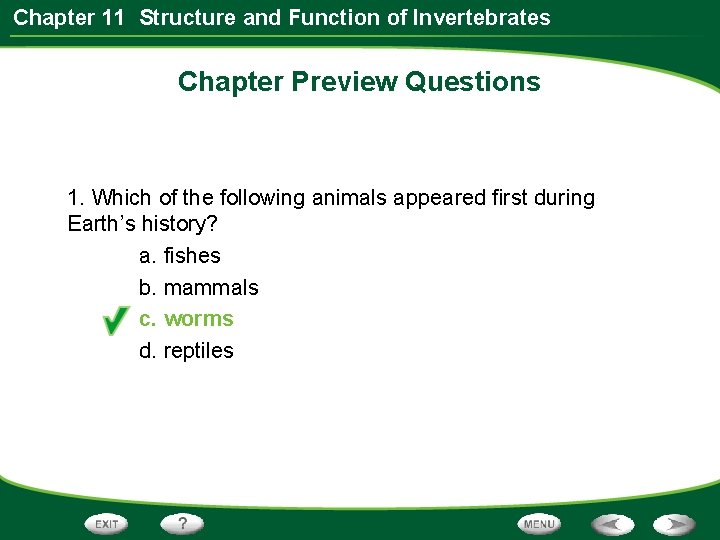
Chapter 11 Structure and Function of Invertebrates Chapter Preview Questions 1. Which of the following animals appeared first during Earth’s history? a. fishes b. mammals c. worms d. reptiles
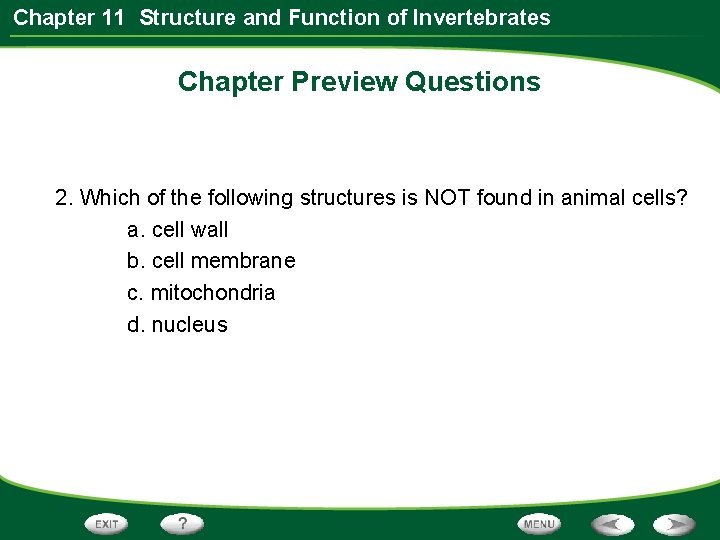
Chapter 11 Structure and Function of Invertebrates Chapter Preview Questions 2. Which of the following structures is NOT found in animal cells? a. cell wall b. cell membrane c. mitochondria d. nucleus
Chapter 11 Structure and Function of Invertebrates Chapter Preview Questions 2. Which of the following structures is NOT found in animal cells? a. cell wall b. cell membrane c. mitochondria d. nucleus
Chapter 11 Structure and Function of Invertebrates Chapter Preview Questions 3. If an animal reproduces asexually, it a. has two parent organisms. b. undergoes conjugation. c. is genetically identical to its offspring. d. inherits two different sets of alleles.
Chapter 11 Structure and Function of Invertebrates Chapter Preview Questions 3. If an animal reproduces asexually, it a. has two parent organisms. b. undergoes conjugation. c. is genetically identical to its offspring. d. inherits two different sets of alleles.
Chapter 11 Structure and Function of Invertebrates Chapter Preview Questions 4. If an animal has specialized tissues and organs, the animal’s cells have undergone a. photosynthesis. b. osmosis. c. selective breeding. d. differentiation.
Chapter 11 Structure and Function of Invertebrates Chapter Preview Questions 4. If an animal has specialized tissues and organs, the animal’s cells have undergone a. photosynthesis. b. osmosis. c. selective breeding. d. differentiation.
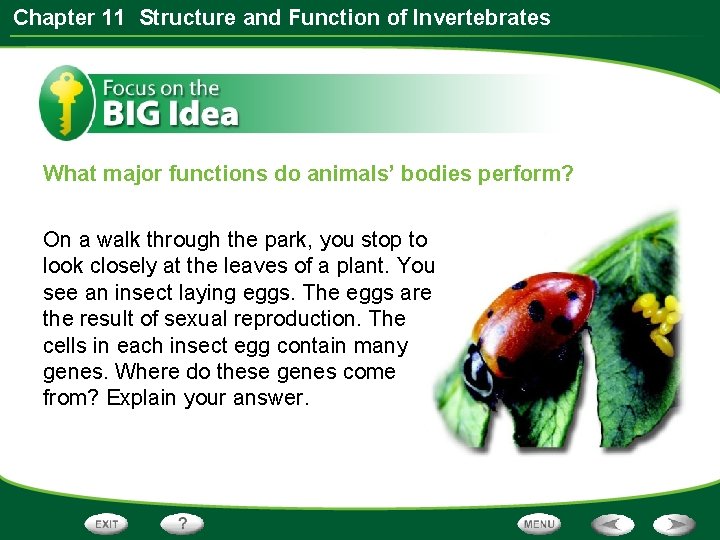
Chapter 11 Structure and Function of Invertebrates What major functions do animals’ bodies perform? On a walk through the park, you stop to look closely at the leaves of a plant. You see an insect laying eggs. The eggs are the result of sexual reproduction. The cells in each insect egg contain many genes. Where do these genes come from? Explain your answer.
Chapter 11 Structure and Function of Invertebrates Use Clues to Determine Meaning What a polyp is The animals called cnidarians have two different body plans. One form looks something like a vase. The vase-shaped body plan is called a polyp. A polypís mouth opens at the top and its tentacles spread out from around the mouth. Additional information about a polyp
Chapter 11 Structure and Function of Invertebrates Apply It! 1. In your own words, what is the meaning of polyp? Sample: A polyp is a vase-shaped cnidarian. 2. What sentence contains the definition of polyp? Sentence 3 3. What other clues help you understand the meaning of polyp? The last sentence tells me it has a mouth that opens at the top and is surrounded by spreading tentacles.
Chapter 11 Structure and Function of Invertebrates End of Chapter Preview
Chapter 11 Structure and Function of Invertebrates Section 1: What is an Animal? How are animal bodies typically organized? What are the four major functions of animals? What is symmetry? How are animals classified?
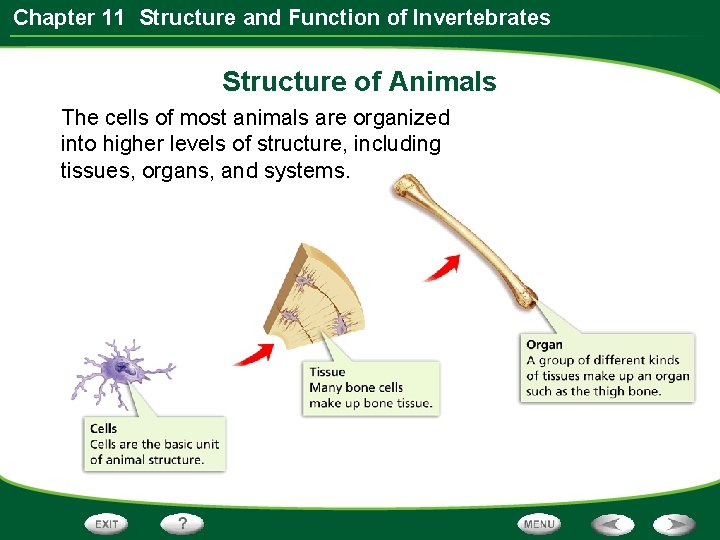
Chapter 11 Structure and Function of Invertebrates Structure of Animals The cells of most animals are organized into higher levels of structure, including tissues, organs, and systems.
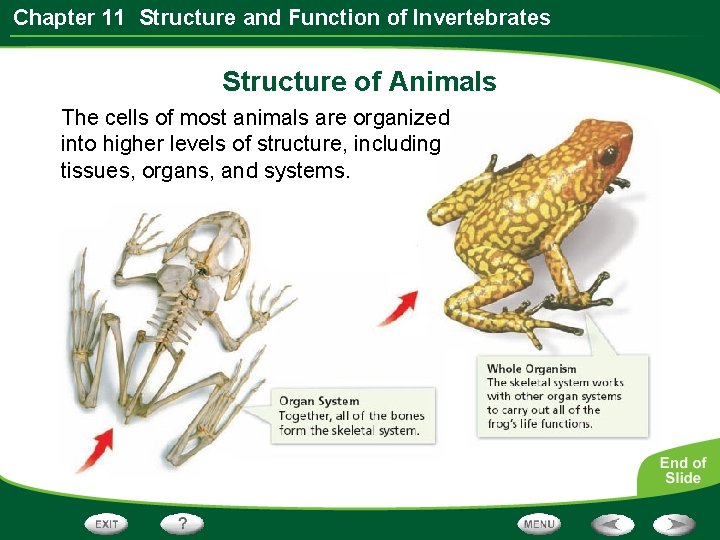
Chapter 11 Structure and Function of Invertebrates Structure of Animals The cells of most animals are organized into higher levels of structure, including tissues, organs, and systems.
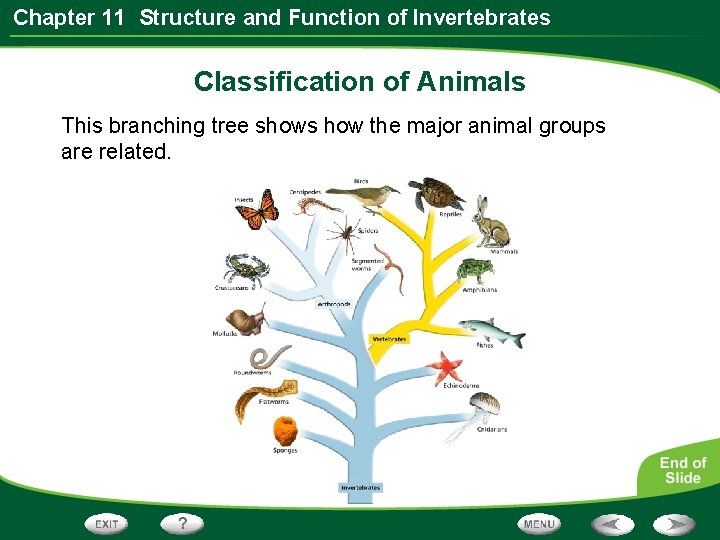
Chapter 11 Structure and Function of Invertebrates Classification of Animals This branching tree shows how the major animal groups are related.
Chapter 11 Structure and Function of Invertebrates Links on the Animal Kingdom Click the Sci. Links button for links on the animal kingdom.
Chapter 11 Structure and Function of Invertebrates The Animal Kingdom Click the Video button to watch a movie about the animal kingdom.
Chapter 11 Structure and Function of Invertebrates End of Section: What Is an Animal?
Chapter 11 Structure and Function of Invertebrates Section 2: Sponges and Cnidarians? What are the main characteristics of sponges? What are the main characteristics of cnidarians?
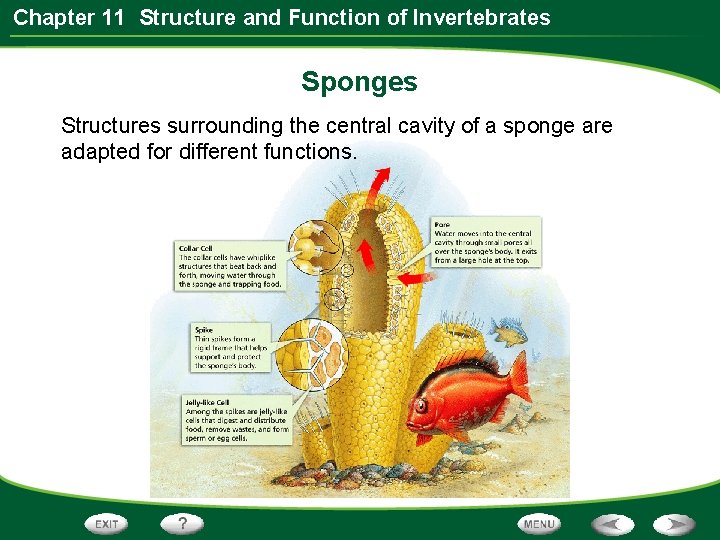
Chapter 11 Structure and Function of Invertebrates Sponges Structures surrounding the central cavity of a sponge are adapted for different functions.
Chapter 11 Structure and Function of Invertebrates Structure of a Sponge Activity Click the Active Art button to open a browser window and access Active Art about the structure of a sponge.
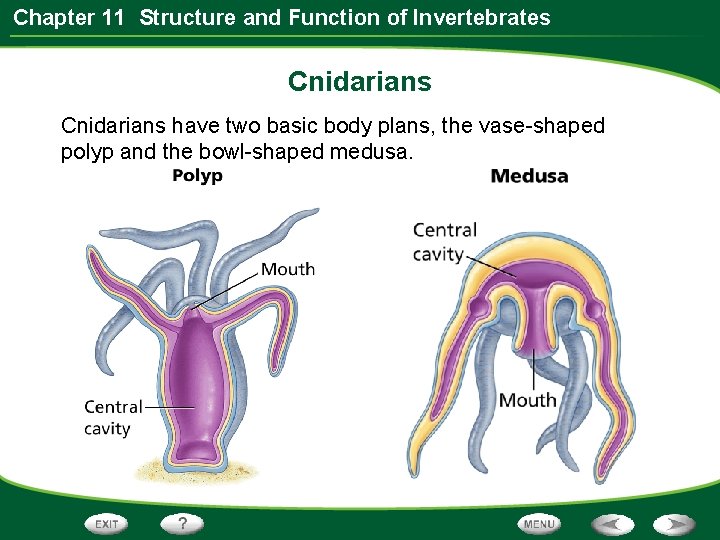
Chapter 11 Structure and Function of Invertebrates Cnidarians have two basic body plans, the vase-shaped polyp and the bowl-shaped medusa.
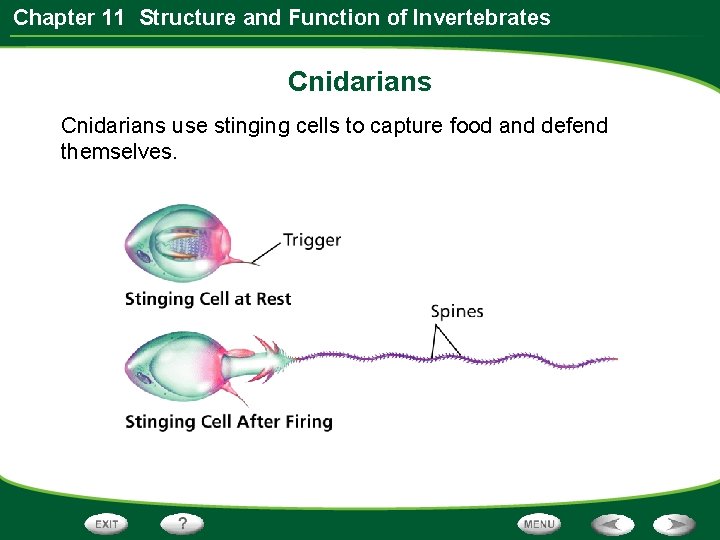
Chapter 11 Structure and Function of Invertebrates Cnidarians use stinging cells to capture food and defend themselves.
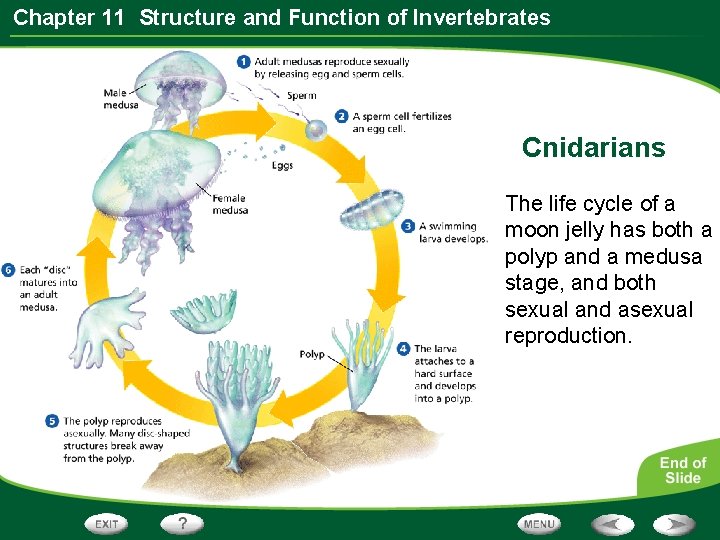
Chapter 11 Structure and Function of Invertebrates Cnidarians The life cycle of a moon jelly has both a polyp and a medusa stage, and both sexual and asexual reproduction.
Chapter 11 Structure and Function of Invertebrates Click the Video button to watch a movie about invertebrates.

Chapter 11 Structure and Function of Invertebrates End of Section: Sponges and Cnidarians
Chapter 11 Structure and Function of Invertebrates Section 3: Worms and Mollusks What are the main characteristics of worms? What are the main characteristics of each phylum of worms? What are the main characteristics of mollusks? What are eth main groups of mollusks?
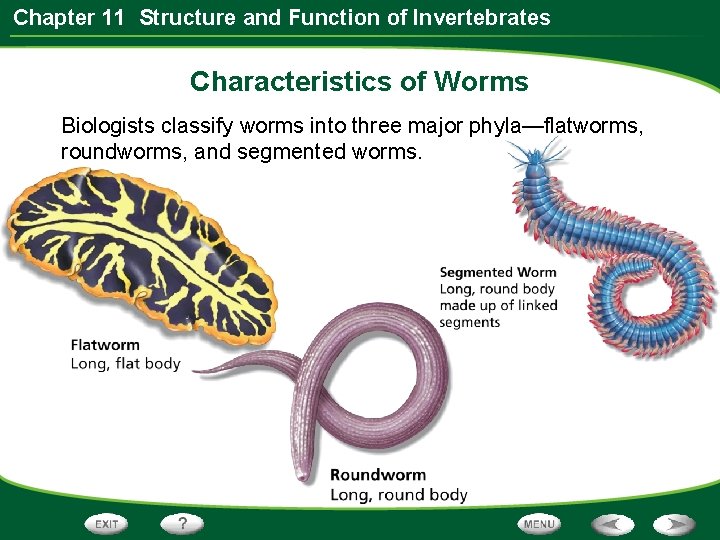
Chapter 11 Structure and Function of Invertebrates Characteristics of Worms Biologists classify worms into three major phyla—flatworms, roundworms, and segmented worms.
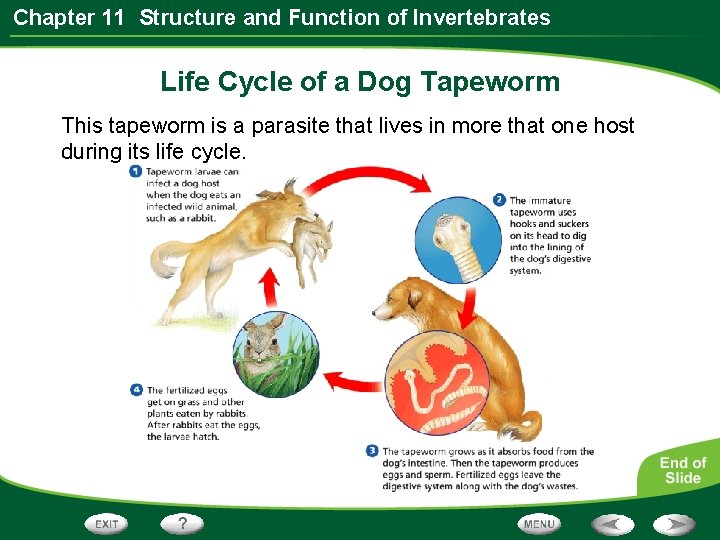
Chapter 11 Structure and Function of Invertebrates Life Cycle of a Dog Tapeworm This tapeworm is a parasite that lives in more that one host during its life cycle.
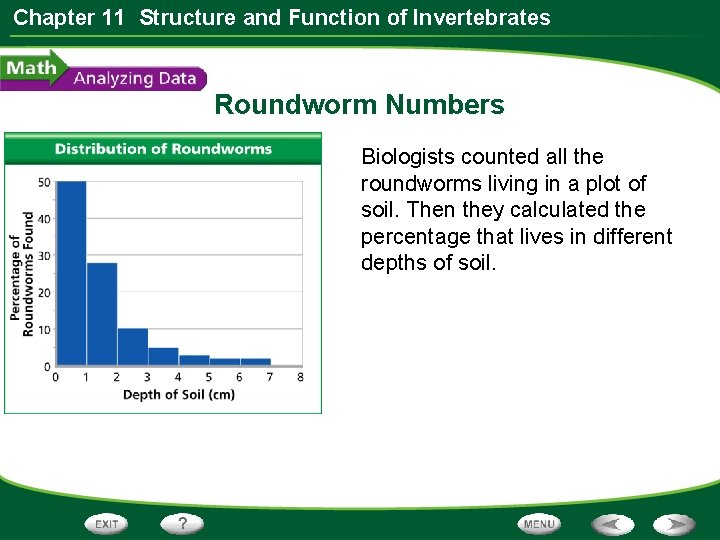
Chapter 11 Structure and Function of Invertebrates Roundworm Numbers Biologists counted all the roundworms living in a plot of soil. Then they calculated the percentage that lives in different depths of soil.
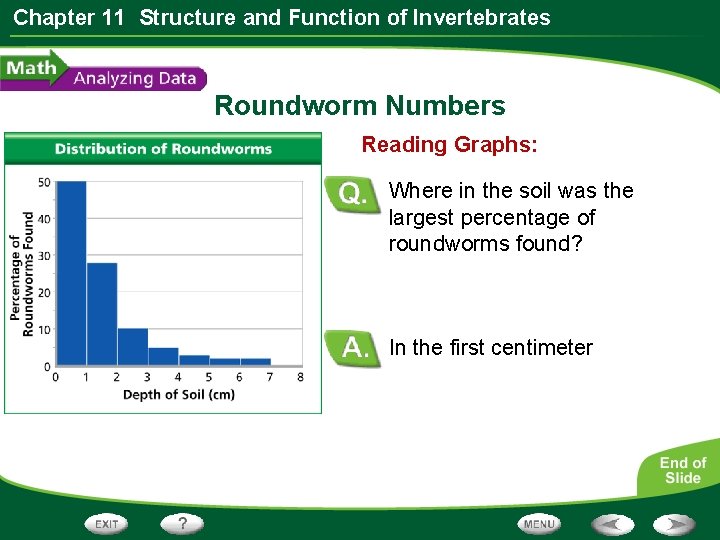
Chapter 11 Structure and Function of Invertebrates Roundworm Numbers Reading Graphs: Where in the soil was the largest percentage of roundworms found? In the first centimeter
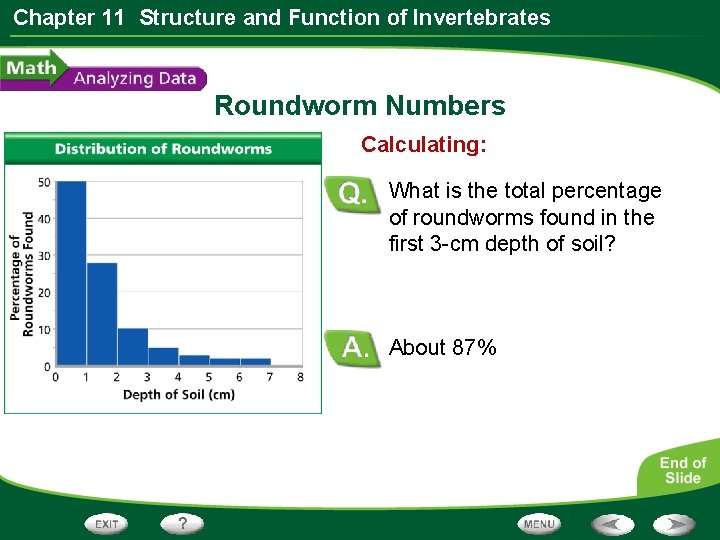
Chapter 11 Structure and Function of Invertebrates Roundworm Numbers Calculating: What is the total percentage of roundworms found in the first 3 -cm depth of soil? About 87%
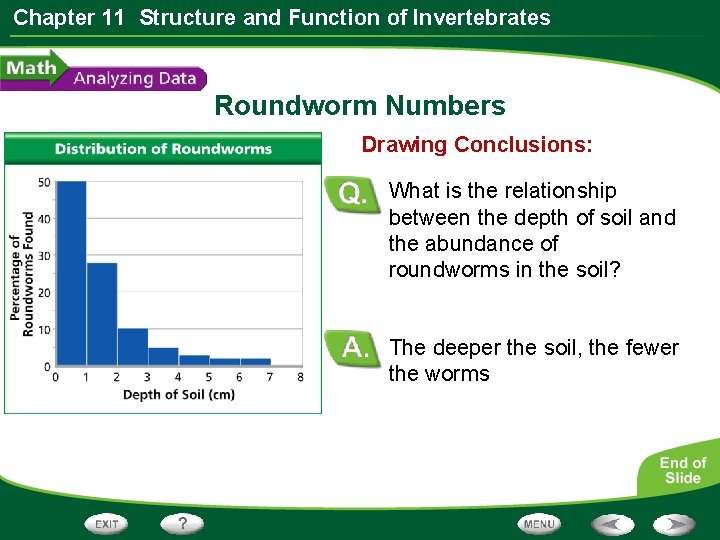
Chapter 11 Structure and Function of Invertebrates Roundworm Numbers Drawing Conclusions: What is the relationship between the depth of soil and the abundance of roundworms in the soil? The deeper the soil, the fewer the worms
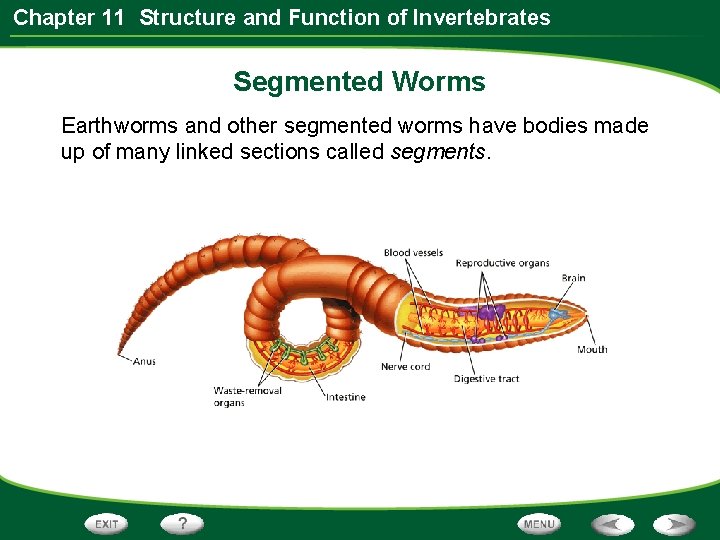
Chapter 11 Structure and Function of Invertebrates Segmented Worms Earthworms and other segmented worms have bodies made up of many linked sections called segments.
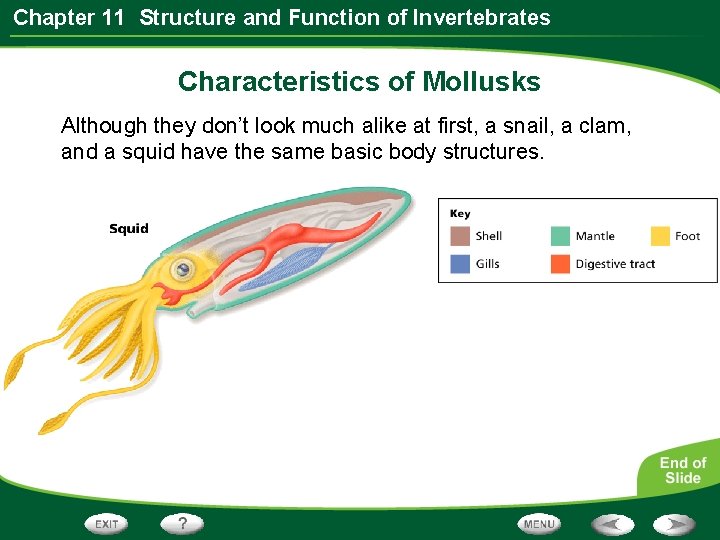
Chapter 11 Structure and Function of Invertebrates Characteristics of Mollusks Although they don’t look much alike at first, a snail, a clam, and a squid have the same basic body structures.
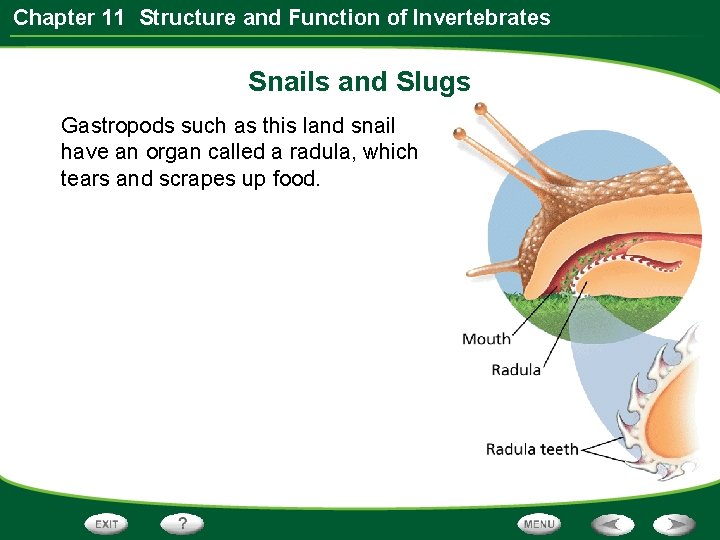
Chapter 11 Structure and Function of Invertebrates Snails and Slugs Gastropods such as this land snail have an organ called a radula, which tears and scrapes up food.
Chapter 11 Structure and Function of Invertebrates More on Worms Click the PHSchool. com button for an activity about worms.
Chapter 11 Structure and Function of Invertebrates End of Section: Worms and Mollusks
Chapter 11 Structure and Function of Invertebrates Section 4: Arthropods What are the general characteristics of arthropods? What are the distinguishing structures of crustaceans, arachnids, centipedes and millipedes, and insects?
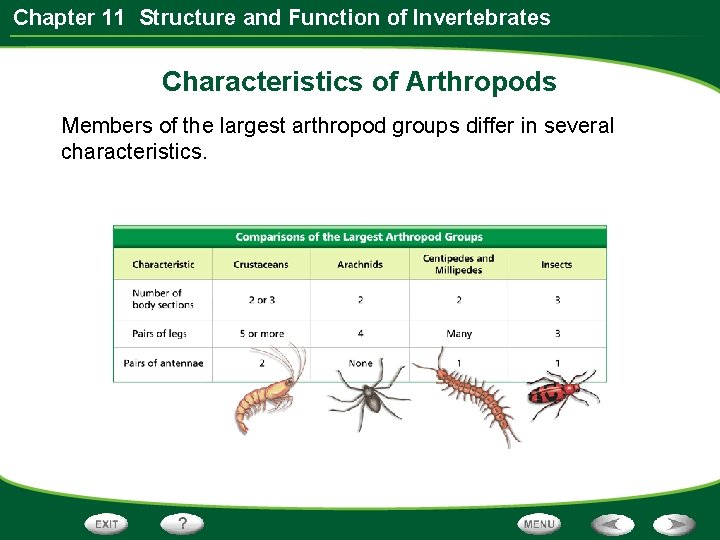
Chapter 11 Structure and Function of Invertebrates Characteristics of Arthropods Members of the largest arthropod groups differ in several characteristics.
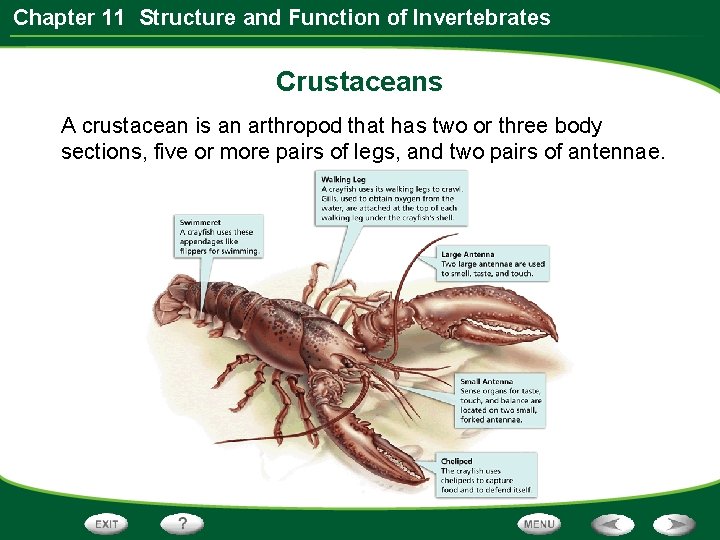
Chapter 11 Structure and Function of Invertebrates Crustaceans A crustacean is an arthropod that has two or three body sections, five or more pairs of legs, and two pairs of antennae.

Chapter 11 Structure and Function of Invertebrates Body Structure Insects are arthropods with three body sections, six legs, one pair of antennae, and usually one or two pairs of wings.
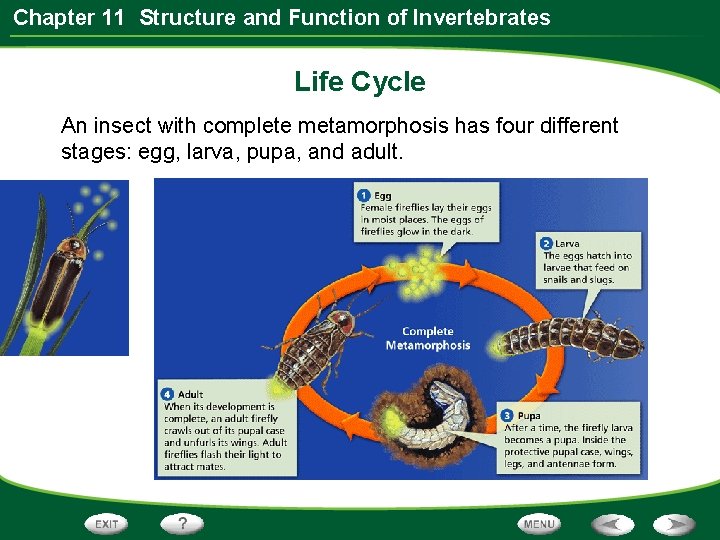
Chapter 11 Structure and Function of Invertebrates Life Cycle An insect with complete metamorphosis has four different stages: egg, larva, pupa, and adult.

Chapter 11 Structure and Function of Invertebrates Life Cycle An insect with gradual metamorphosis has no distinct larval stage. An egg hatches into a stage called a nymph, which usually looks like the adult insect without wings.
Chapter 11 Structure and Function of Invertebrates Links on Arthropods Click the Sci. Links button for links on arthropods.
Chapter 11 Structure and Function of Invertebrates Insect Adaptations Click the Video button to watch a movie about insect adaptations.
Chapter 11 Structure and Function of Invertebrates End of Section: Arthropods
Chapter 11 Structure and Function of Invertebrates Section 5: Echinoderms What are the main characteristics of echinoderms? What are the major groups of echinoderms?
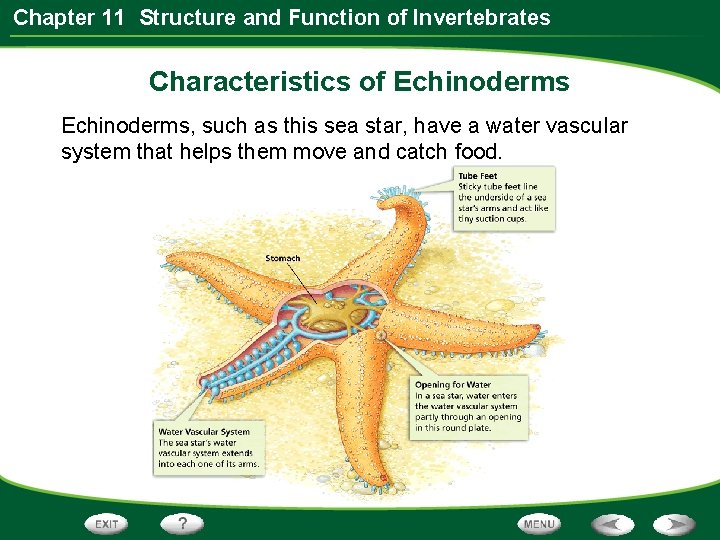
Chapter 11 Structure and Function of Invertebrates Characteristics of Echinoderms, such as this sea star, have a water vascular system that helps them move and catch food.
Chapter 11 Structure and Function of Invertebrates Water Vascular System Activity Click the Active Art button to open a browser window and access Active Art about the water vascular system.
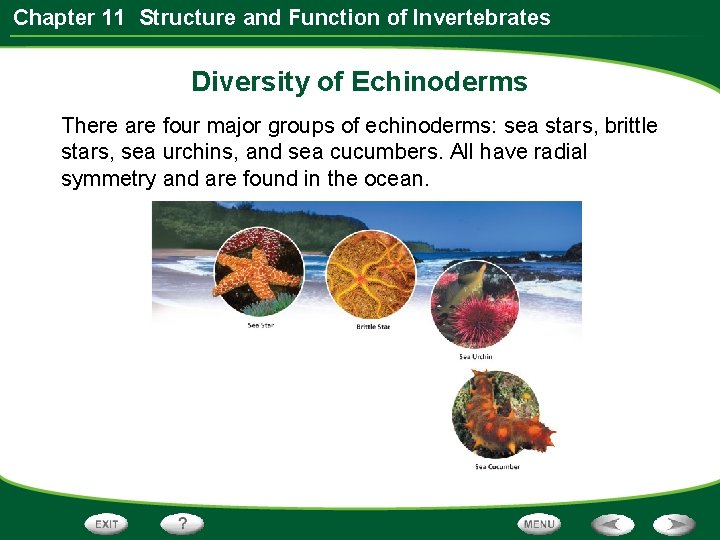
Chapter 11 Structure and Function of Invertebrates Diversity of Echinoderms There are four major groups of echinoderms: sea stars, brittle stars, sea urchins, and sea cucumbers. All have radial symmetry and are found in the ocean.
Chapter 11 Structure and Function of Invertebrates End of Section: Echinoderms
Chapter 11 Structure and Function of Invertebrates Quick. Take Quiz Click to start quiz.
- Slides: 55