
CHAPTER 11 Stoichiometry 11 4 Solving Stoichiometric Problems
CHAPTER 11 Stoichiometry 11. 4 Solving Stoichiometric Problems
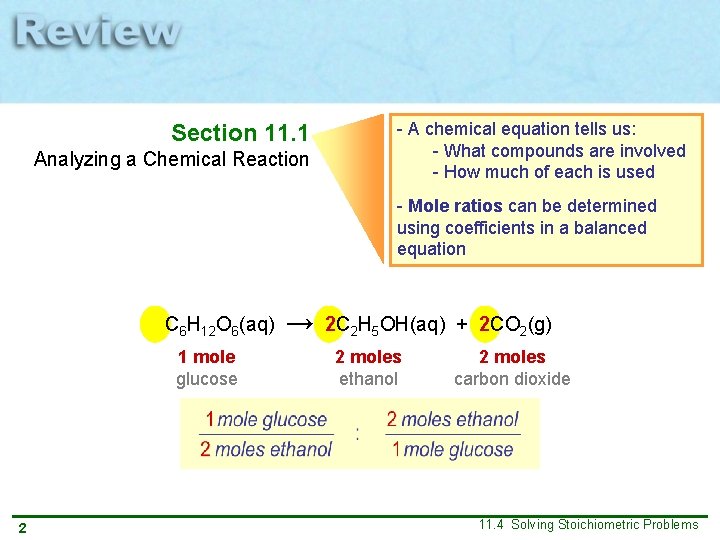
Section 11. 1 Analyzing a Chemical Reaction - A chemical equation tells us: - What compounds are involved - How much of each is used - Mole ratios can be determined using coefficients in a balanced equation C 6 H 12 O 6(aq) 1 mole glucose 2 → 2 C 2 H 5 OH(aq) + 2 CO 2(g) 2 moles ethanol 2 moles carbon dioxide 11. 4 Solving Stoichiometric Problems
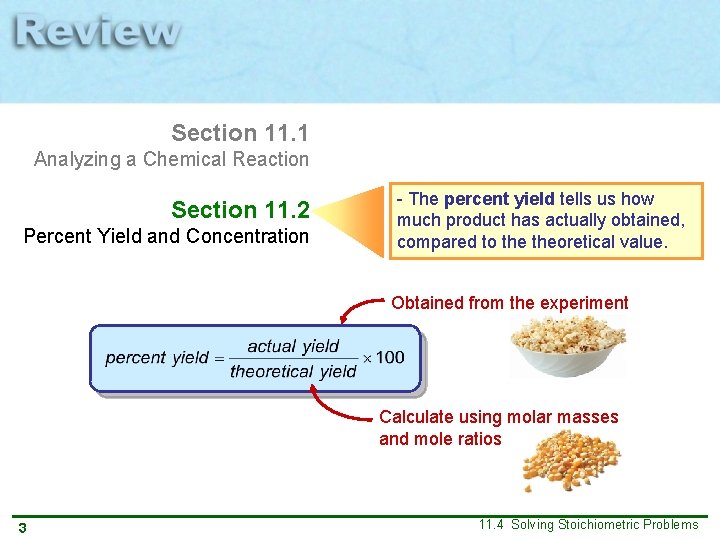
Section 11. 1 Analyzing a Chemical Reaction Section 11. 2 Percent Yield and Concentration - The percent yield tells us how much product has actually obtained, compared to theoretical value. Obtained from the experiment Calculate using molar masses and mole ratios 3 11. 4 Solving Stoichiometric Problems
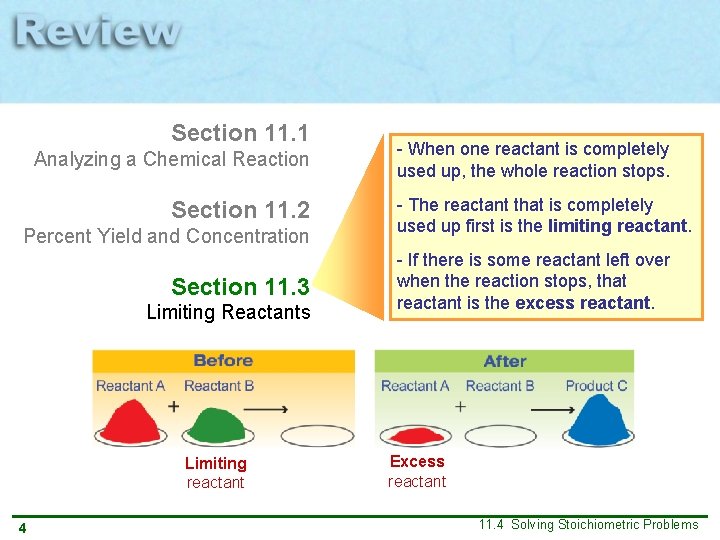
Section 11. 1 Analyzing a Chemical Reaction Section 11. 2 Percent Yield and Concentration Section 11. 3 Limiting Reactants Limiting reactant 4 - When one reactant is completely used up, the whole reaction stops. - The reactant that is completely used up first is the limiting reactant. - If there is some reactant left over when the reaction stops, that reactant is the excess reactant. Excess reactant 11. 4 Solving Stoichiometric Problems
Section 11. 1 Analyzing a Chemical Reaction Section 11. 2 Percent Yield and Concentration Section 11. 3 Limiting Reactants Section 11. 4 Solving Stoichiometric Problems Use what we’ve learned to answer these questions: - What is the limiting reactant? - What is theoretical yield? - What is the percent yield? - How much excess reactant is left? - How much reactant is used if it’s in a solution? 5 11. 4 Solving Stoichiometric Problems
Section 11. 1 Analyzing a Chemical Reaction Section 11. 2 Percent Yield and Concentration Section 11. 3 Limiting Reactants Section 11. 4 Solving Stoichiometric Problems Use what we’ve learned to answer these questions: - What is the limiting reactant? - What is theoretical yield? - What is the percent yield? - How much excess reactant is left? - How much reactant is used if it’s in a solution? 6 11. 4 Solving Stoichiometric Problems
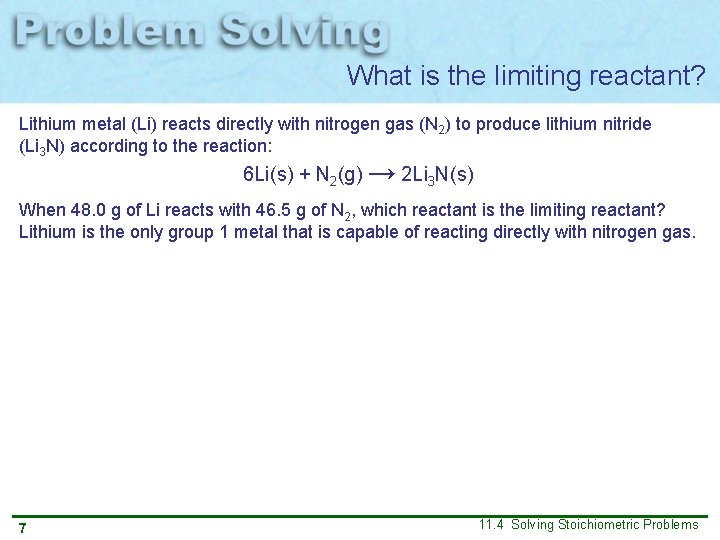
What is the limiting reactant? Lithium metal (Li) reacts directly with nitrogen gas (N 2) to produce lithium nitride (Li 3 N) according to the reaction: 6 Li(s) + N 2(g) → 2 Li 3 N(s) When 48. 0 g of Li reacts with 46. 5 g of N 2, which reactant is the limiting reactant? Lithium is the only group 1 metal that is capable of reacting directly with nitrogen gas. 7 11. 4 Solving Stoichiometric Problems
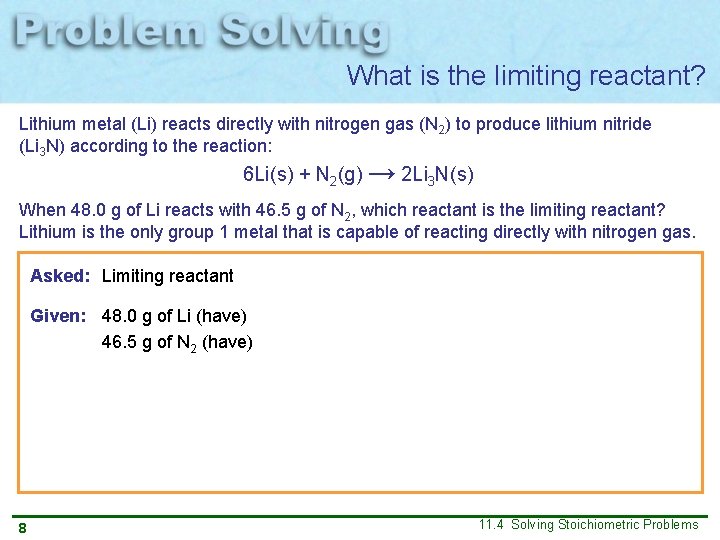
What is the limiting reactant? Lithium metal (Li) reacts directly with nitrogen gas (N 2) to produce lithium nitride (Li 3 N) according to the reaction: 6 Li(s) + N 2(g) → 2 Li 3 N(s) When 48. 0 g of Li reacts with 46. 5 g of N 2, which reactant is the limiting reactant? Lithium is the only group 1 metal that is capable of reacting directly with nitrogen gas. Asked: Limiting reactant Given: 48. 0 g of Li (have) 46. 5 g of N 2 (have) 8 11. 4 Solving Stoichiometric Problems
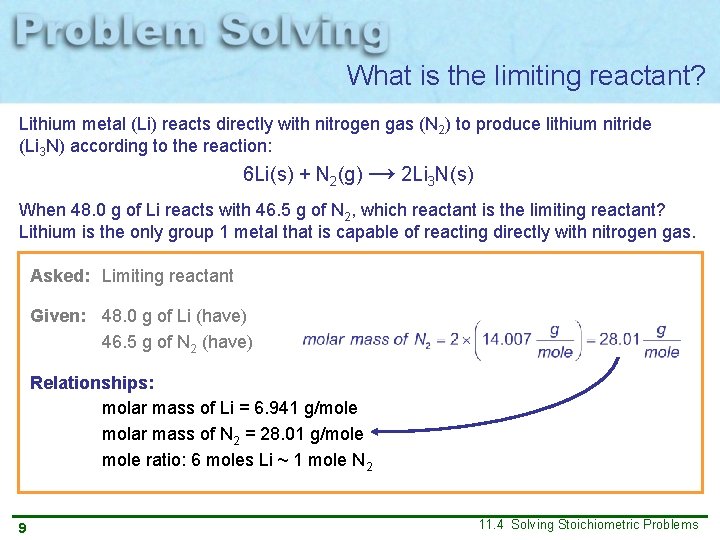
What is the limiting reactant? Lithium metal (Li) reacts directly with nitrogen gas (N 2) to produce lithium nitride (Li 3 N) according to the reaction: 6 Li(s) + N 2(g) → 2 Li 3 N(s) When 48. 0 g of Li reacts with 46. 5 g of N 2, which reactant is the limiting reactant? Lithium is the only group 1 metal that is capable of reacting directly with nitrogen gas. Asked: Limiting reactant Given: 48. 0 g of Li (have) 46. 5 g of N 2 (have) Relationships: molar mass of Li = 6. 941 g/mole molar mass of N 2 = 28. 01 g/mole ratio: 6 moles Li ~ 1 mole N 2 9 11. 4 Solving Stoichiometric Problems
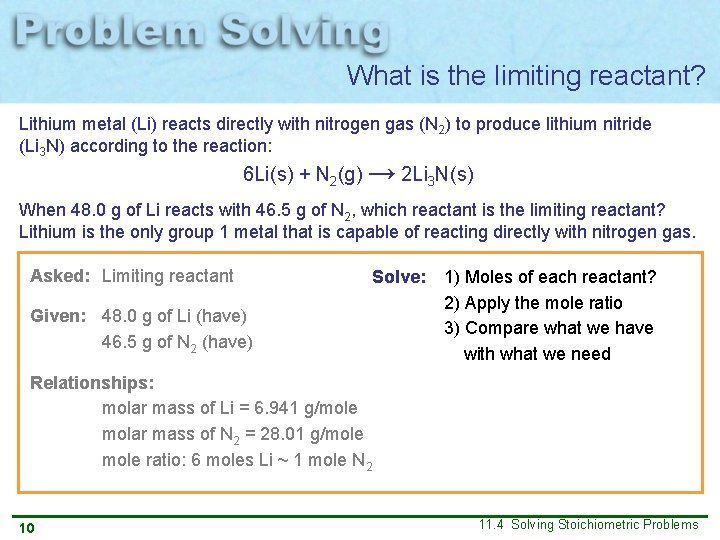
What is the limiting reactant? Lithium metal (Li) reacts directly with nitrogen gas (N 2) to produce lithium nitride (Li 3 N) according to the reaction: 6 Li(s) + N 2(g) → 2 Li 3 N(s) When 48. 0 g of Li reacts with 46. 5 g of N 2, which reactant is the limiting reactant? Lithium is the only group 1 metal that is capable of reacting directly with nitrogen gas. Asked: Limiting reactant Solve: Given: 48. 0 g of Li (have) 46. 5 g of N 2 (have) 1) Moles of each reactant? 2) Apply the mole ratio 3) Compare what we have with what we need Relationships: molar mass of Li = 6. 941 g/mole molar mass of N 2 = 28. 01 g/mole ratio: 6 moles Li ~ 1 mole N 2 10 11. 4 Solving Stoichiometric Problems
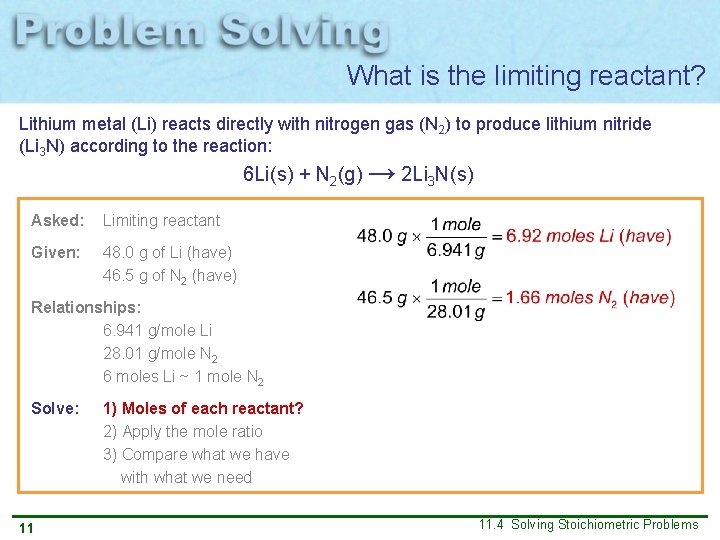
What is the limiting reactant? Lithium metal (Li) reacts directly with nitrogen gas (N 2) to produce lithium nitride (Li 3 N) according to the reaction: 6 Li(s) + N 2(g) → 2 Li 3 N(s) Asked: Limiting reactant Given: 48. 0 g of Li (have) 46. 5 g of N 2 (have) Relationships: 6. 941 g/mole Li 28. 01 g/mole N 2 6 moles Li ~ 1 mole N 2 Solve: 11 1) Moles of each reactant? 2) Apply the mole ratio 3) Compare what we have with what we need 11. 4 Solving Stoichiometric Problems
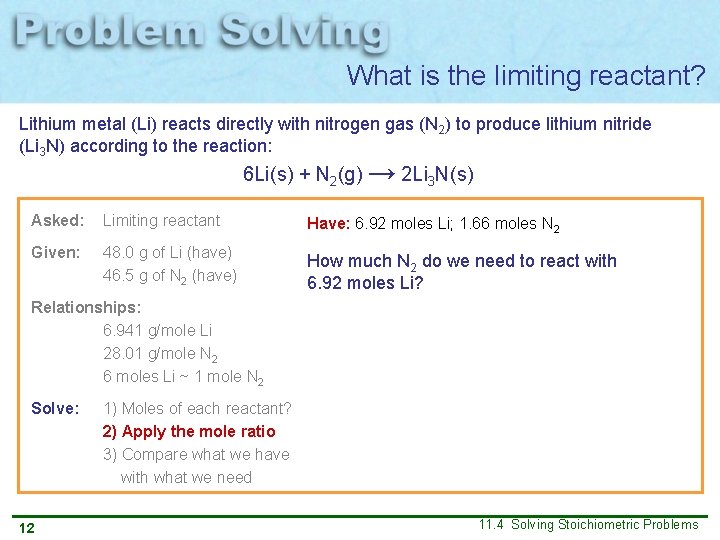
What is the limiting reactant? Lithium metal (Li) reacts directly with nitrogen gas (N 2) to produce lithium nitride (Li 3 N) according to the reaction: 6 Li(s) + N 2(g) → 2 Li 3 N(s) Asked: Limiting reactant Have: 6. 92 moles Li; 1. 66 moles N 2 Given: 48. 0 g of Li (have) 46. 5 g of N 2 (have) How much N 2 do we need to react with 6. 92 moles Li? Relationships: 6. 941 g/mole Li 28. 01 g/mole N 2 6 moles Li ~ 1 mole N 2 Solve: 12 1) Moles of each reactant? 2) Apply the mole ratio 3) Compare what we have with what we need 11. 4 Solving Stoichiometric Problems
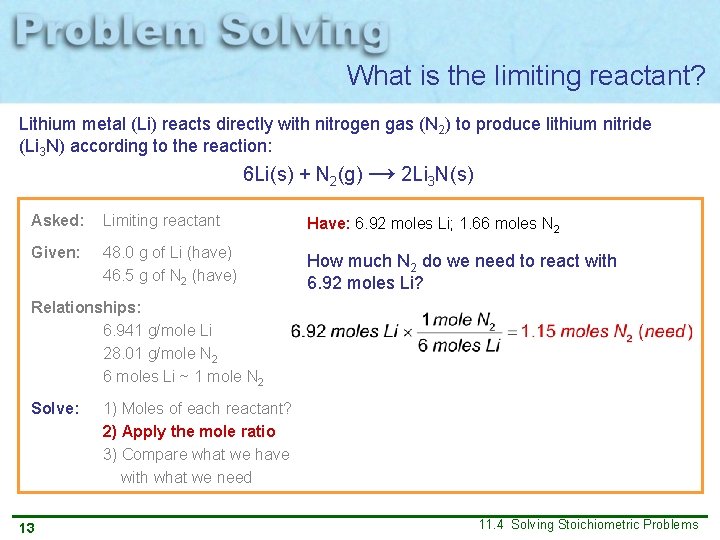
What is the limiting reactant? Lithium metal (Li) reacts directly with nitrogen gas (N 2) to produce lithium nitride (Li 3 N) according to the reaction: 6 Li(s) + N 2(g) → 2 Li 3 N(s) Asked: Limiting reactant Have: 6. 92 moles Li; 1. 66 moles N 2 Given: 48. 0 g of Li (have) 46. 5 g of N 2 (have) How much N 2 do we need to react with 6. 92 moles Li? Relationships: 6. 941 g/mole Li 28. 01 g/mole N 2 6 moles Li ~ 1 mole N 2 Solve: 13 1) Moles of each reactant? 2) Apply the mole ratio 3) Compare what we have with what we need 11. 4 Solving Stoichiometric Problems
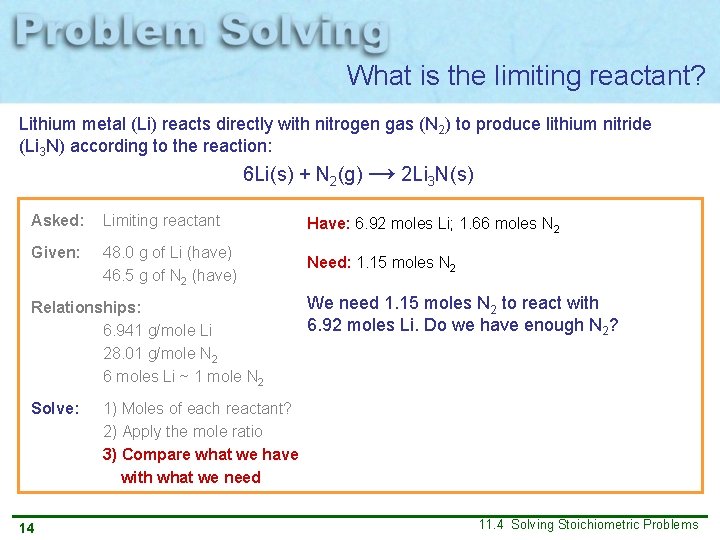
What is the limiting reactant? Lithium metal (Li) reacts directly with nitrogen gas (N 2) to produce lithium nitride (Li 3 N) according to the reaction: 6 Li(s) + N 2(g) → 2 Li 3 N(s) Asked: Limiting reactant Have: 6. 92 moles Li; 1. 66 moles N 2 Given: 48. 0 g of Li (have) 46. 5 g of N 2 (have) Need: 1. 15 moles N 2 Relationships: 6. 941 g/mole Li 28. 01 g/mole N 2 6 moles Li ~ 1 mole N 2 Solve: 14 We need 1. 15 moles N 2 to react with 6. 92 moles Li. Do we have enough N 2? 1) Moles of each reactant? 2) Apply the mole ratio 3) Compare what we have with what we need 11. 4 Solving Stoichiometric Problems
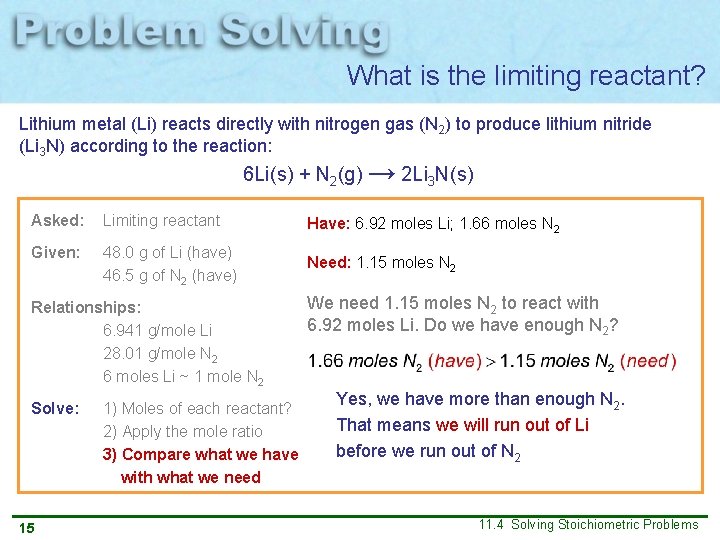
What is the limiting reactant? Lithium metal (Li) reacts directly with nitrogen gas (N 2) to produce lithium nitride (Li 3 N) according to the reaction: 6 Li(s) + N 2(g) → 2 Li 3 N(s) Asked: Limiting reactant Have: 6. 92 moles Li; 1. 66 moles N 2 Given: 48. 0 g of Li (have) 46. 5 g of N 2 (have) Need: 1. 15 moles N 2 Relationships: 6. 941 g/mole Li 28. 01 g/mole N 2 6 moles Li ~ 1 mole N 2 Solve: 15 1) Moles of each reactant? 2) Apply the mole ratio 3) Compare what we have with what we need We need 1. 15 moles N 2 to react with 6. 92 moles Li. Do we have enough N 2? Yes, we have more than enough N 2. That means we will run out of Li before we run out of N 2 11. 4 Solving Stoichiometric Problems
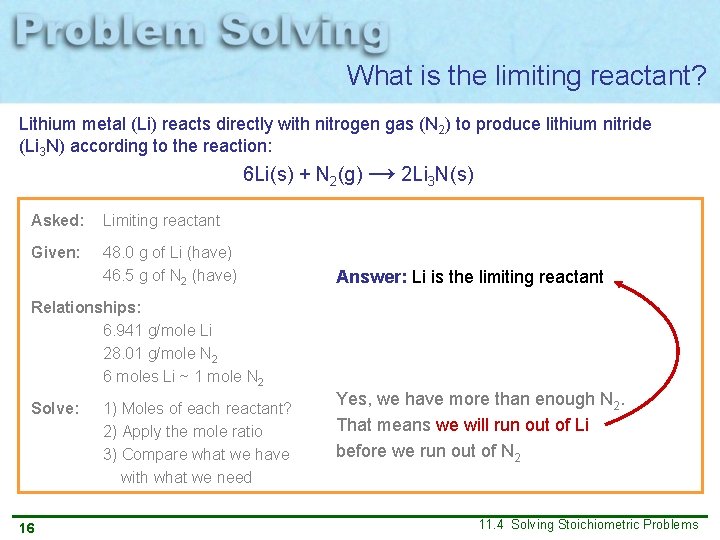
What is the limiting reactant? Lithium metal (Li) reacts directly with nitrogen gas (N 2) to produce lithium nitride (Li 3 N) according to the reaction: 6 Li(s) + N 2(g) → 2 Li 3 N(s) Asked: Limiting reactant Given: 48. 0 g of Li (have) 46. 5 g of N 2 (have) Answer: Li is the limiting reactant Relationships: 6. 941 g/mole Li 28. 01 g/mole N 2 6 moles Li ~ 1 mole N 2 Solve: 16 1) Moles of each reactant? 2) Apply the mole ratio 3) Compare what we have with what we need Yes, we have more than enough N 2. That means we will run out of Li before we run out of N 2 11. 4 Solving Stoichiometric Problems
Section 11. 1 Analyzing a Chemical Reaction Section 11. 2 Percent Yield and Concentration Section 11. 3 Limiting Reactants Section 11. 4 Solving Stoichiometric Problems Use what we’ve learned to answer these questions: - What is the limiting reactant? - What is theoretical yield? - What is the percent yield? - How much excess reactant is left? - How much reactant is used if it’s in a solution? 17 11. 4 Solving Stoichiometric Problems
What is theoretical yield? Lithium metal (Li) reacts directly with nitrogen gas (N 2) to produce lithium nitride (Li 3 N) according to the reaction: 6 Li(s) + N 2(g) → 2 Li 3 N(s) How much lithium nitride (Li. N 3) can be produced from this reaction? 18 11. 4 Solving Stoichiometric Problems
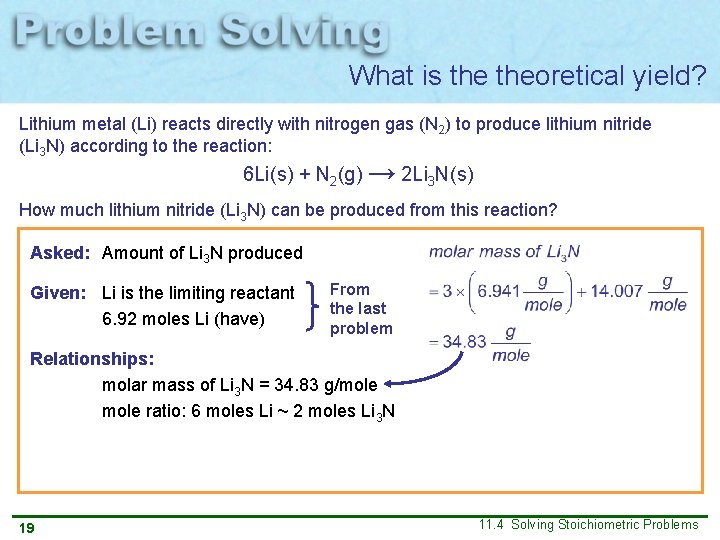
What is theoretical yield? Lithium metal (Li) reacts directly with nitrogen gas (N 2) to produce lithium nitride (Li 3 N) according to the reaction: 6 Li(s) + N 2(g) → 2 Li 3 N(s) How much lithium nitride (Li 3 N) can be produced from this reaction? Asked: Amount of Li 3 N produced Given: Li is the limiting reactant 6. 92 moles Li (have) From the last problem Relationships: molar mass of Li 3 N = 34. 83 g/mole ratio: 6 moles Li ~ 2 moles Li 3 N 19 11. 4 Solving Stoichiometric Problems
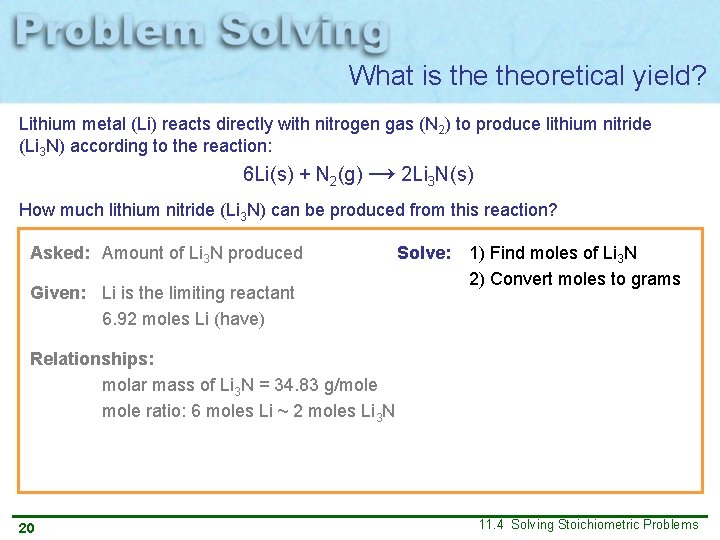
What is theoretical yield? Lithium metal (Li) reacts directly with nitrogen gas (N 2) to produce lithium nitride (Li 3 N) according to the reaction: 6 Li(s) + N 2(g) → 2 Li 3 N(s) How much lithium nitride (Li 3 N) can be produced from this reaction? Asked: Amount of Li 3 N produced Given: Li is the limiting reactant 6. 92 moles Li (have) Solve: 1) Find moles of Li 3 N 2) Convert moles to grams Relationships: molar mass of Li 3 N = 34. 83 g/mole ratio: 6 moles Li ~ 2 moles Li 3 N 20 11. 4 Solving Stoichiometric Problems
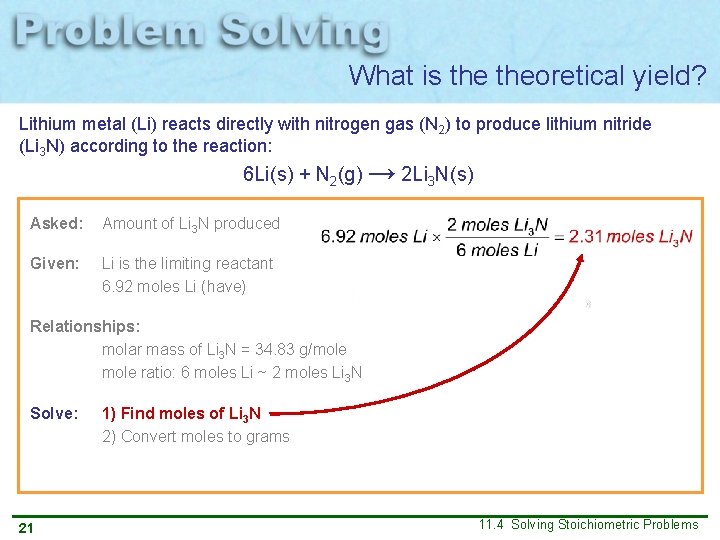
What is theoretical yield? Lithium metal (Li) reacts directly with nitrogen gas (N 2) to produce lithium nitride (Li 3 N) according to the reaction: 6 Li(s) + N 2(g) → 2 Li 3 N(s) Asked: Amount of Li 3 N produced Given: Li is the limiting reactant 6. 92 moles Li (have) Relationships: molar mass of Li 3 N = 34. 83 g/mole ratio: 6 moles Li ~ 2 moles Li 3 N Solve: 21 1) Find moles of Li 3 N 2) Convert moles to grams 11. 4 Solving Stoichiometric Problems
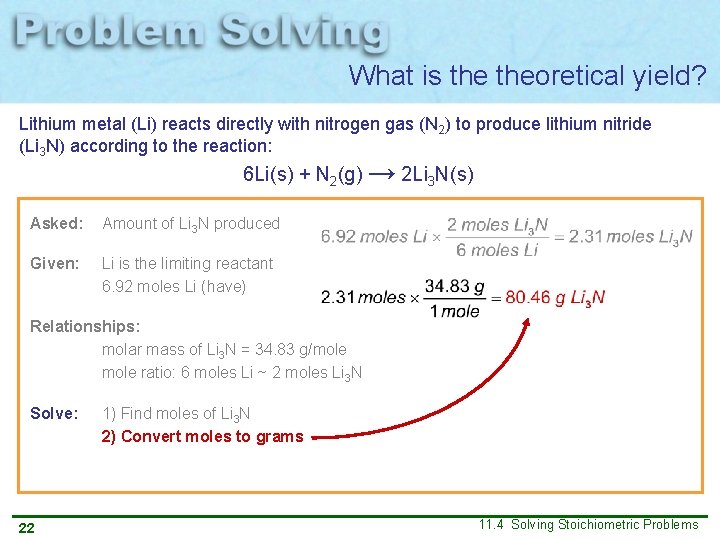
What is theoretical yield? Lithium metal (Li) reacts directly with nitrogen gas (N 2) to produce lithium nitride (Li 3 N) according to the reaction: 6 Li(s) + N 2(g) → 2 Li 3 N(s) Asked: Amount of Li 3 N produced Given: Li is the limiting reactant 6. 92 moles Li (have) Relationships: molar mass of Li 3 N = 34. 83 g/mole ratio: 6 moles Li ~ 2 moles Li 3 N Solve: 22 1) Find moles of Li 3 N 2) Convert moles to grams 11. 4 Solving Stoichiometric Problems
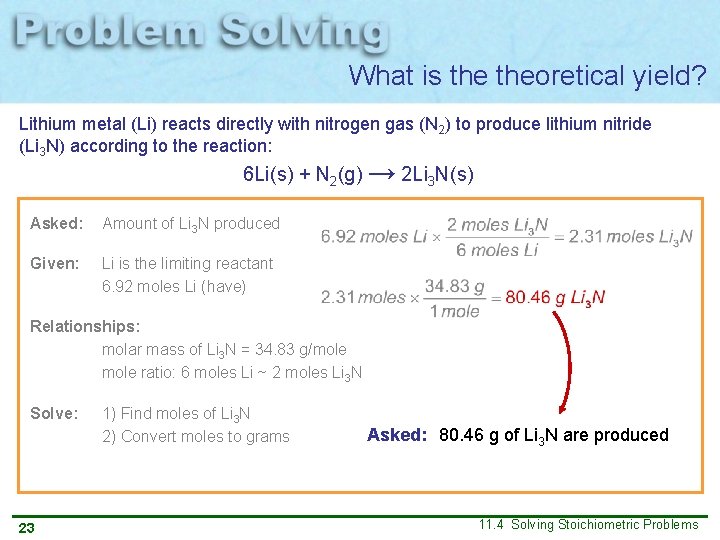
What is theoretical yield? Lithium metal (Li) reacts directly with nitrogen gas (N 2) to produce lithium nitride (Li 3 N) according to the reaction: 6 Li(s) + N 2(g) → 2 Li 3 N(s) Asked: Amount of Li 3 N produced Given: Li is the limiting reactant 6. 92 moles Li (have) Relationships: molar mass of Li 3 N = 34. 83 g/mole ratio: 6 moles Li ~ 2 moles Li 3 N Solve: 23 1) Find moles of Li 3 N 2) Convert moles to grams Asked: 80. 46 g of Li 3 N are produced 11. 4 Solving Stoichiometric Problems
Section 11. 1 Analyzing a Chemical Reaction Section 11. 2 Percent Yield and Concentration Section 11. 3 Limiting Reactants Section 11. 4 Solving Stoichiometric Problems Use what we’ve learned to answer these questions: - What is the limiting reactant? - What is theoretical yield? - What is the percent yield? - How much excess reactant is left? - How much reactant is used if it’s in a solution? 24 11. 4 Solving Stoichiometric Problems
What is the percent yield? Lithium metal (Li) reacts directly with nitrogen gas (N 2) to produce lithium nitride (Li 3 N) according to the reaction: 6 Li(s) + N 2(g) → 2 Li 3 N(s) Calculate the percent yield of an experiment that actually produced 62. 5 g of Li 3 N. 25 11. 4 Solving Stoichiometric Problems
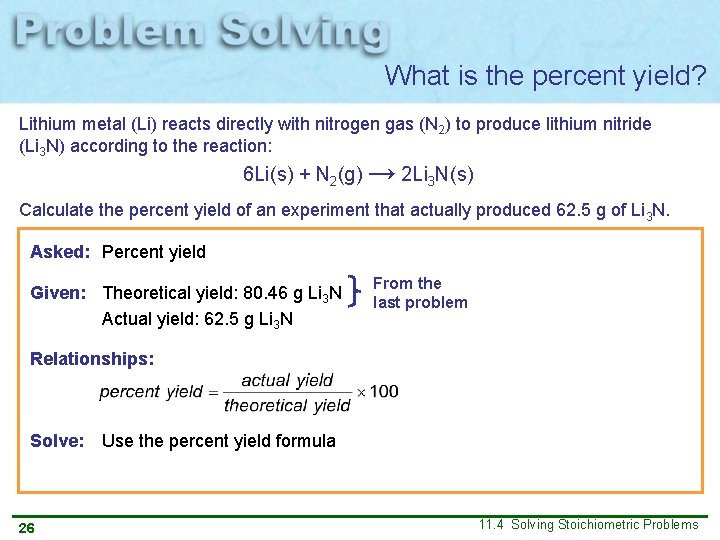
What is the percent yield? Lithium metal (Li) reacts directly with nitrogen gas (N 2) to produce lithium nitride (Li 3 N) according to the reaction: 6 Li(s) + N 2(g) → 2 Li 3 N(s) Calculate the percent yield of an experiment that actually produced 62. 5 g of Li 3 N. Asked: Percent yield Given: Theoretical yield: 80. 46 g Li 3 N Actual yield: 62. 5 g Li 3 N From the last problem Relationships: Solve: 26 Use the percent yield formula 11. 4 Solving Stoichiometric Problems
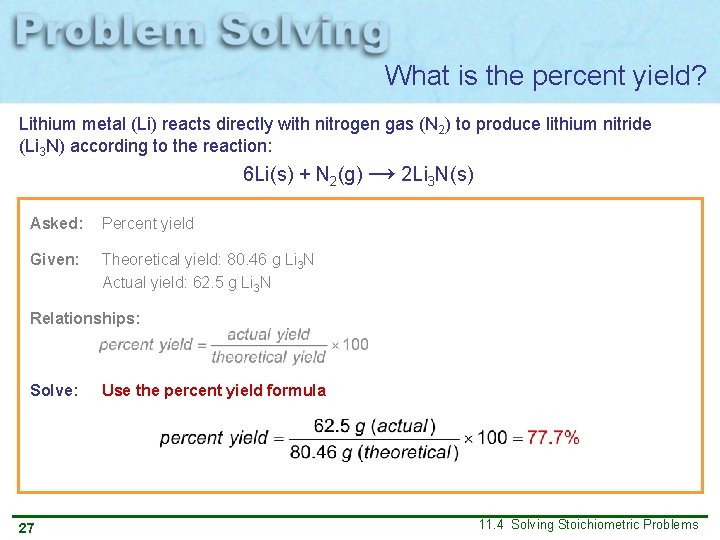
What is the percent yield? Lithium metal (Li) reacts directly with nitrogen gas (N 2) to produce lithium nitride (Li 3 N) according to the reaction: 6 Li(s) + N 2(g) → 2 Li 3 N(s) Asked: Percent yield Given: Theoretical yield: 80. 46 g Li 3 N Actual yield: 62. 5 g Li 3 N Relationships: Solve: 27 Use the percent yield formula 11. 4 Solving Stoichiometric Problems
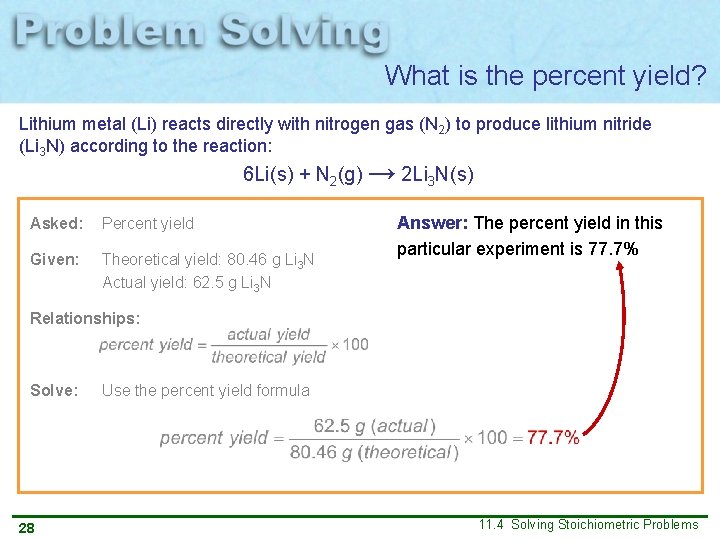
What is the percent yield? Lithium metal (Li) reacts directly with nitrogen gas (N 2) to produce lithium nitride (Li 3 N) according to the reaction: 6 Li(s) + N 2(g) → 2 Li 3 N(s) Asked: Percent yield Given: Theoretical yield: 80. 46 g Li 3 N Actual yield: 62. 5 g Li 3 N Answer: The percent yield in this particular experiment is 77. 7% Relationships: Solve: 28 Use the percent yield formula 11. 4 Solving Stoichiometric Problems
Section 11. 1 Analyzing a Chemical Reaction Section 11. 2 Percent Yield and Concentration Section 11. 3 Limiting Reactants Section 11. 4 Solving Stoichiometric Problems Use what we’ve learned to answer these questions: - What is the limiting reactant? - What is theoretical yield? - What is the percent yield? - How much excess reactant is left? - How much reactant is used if it’s in a solution? 29 11. 4 Solving Stoichiometric Problems
What is left? Lithium metal (Li) reacts directly with nitrogen gas (N 2) to produce lithium nitride (Li 3 N) according to the reaction: 6 Li(s) + N 2(g) → 2 Li 3 N(s) How much of the excess reactant remains after the limiting reactant is completely consumed? 30 11. 4 Solving Stoichiometric Problems
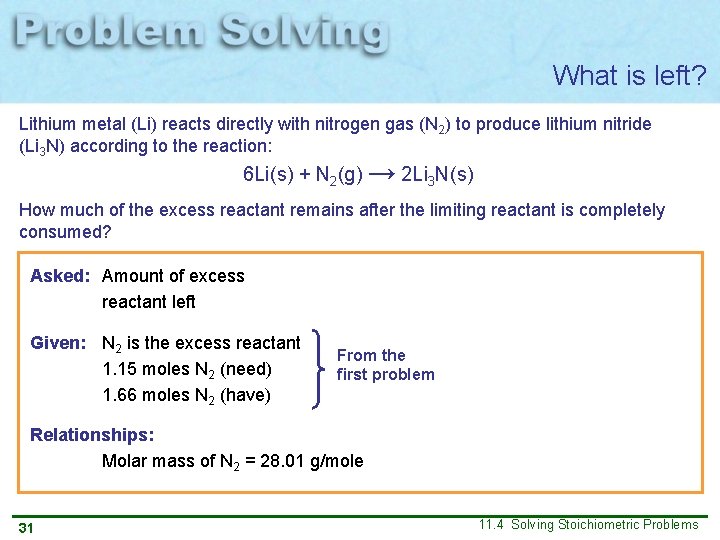
What is left? Lithium metal (Li) reacts directly with nitrogen gas (N 2) to produce lithium nitride (Li 3 N) according to the reaction: 6 Li(s) + N 2(g) → 2 Li 3 N(s) How much of the excess reactant remains after the limiting reactant is completely consumed? Asked: Amount of excess reactant left Given: N 2 is the excess reactant 1. 15 moles N 2 (need) 1. 66 moles N 2 (have) From the first problem Relationships: Molar mass of N 2 = 28. 01 g/mole 31 11. 4 Solving Stoichiometric Problems
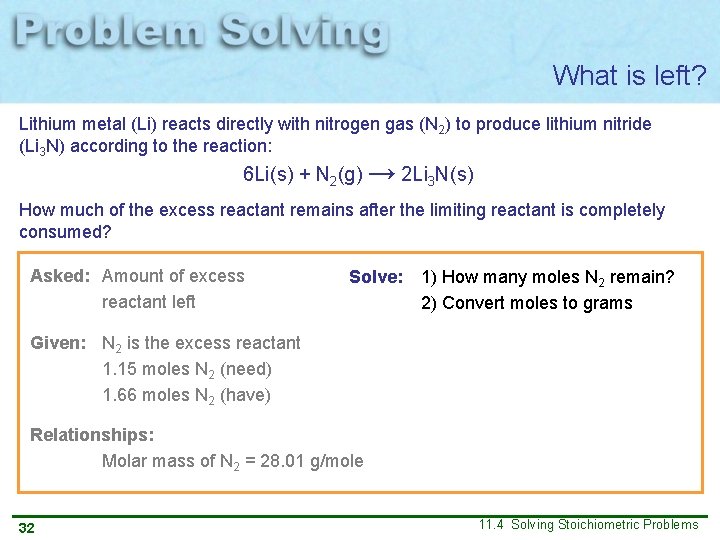
What is left? Lithium metal (Li) reacts directly with nitrogen gas (N 2) to produce lithium nitride (Li 3 N) according to the reaction: 6 Li(s) + N 2(g) → 2 Li 3 N(s) How much of the excess reactant remains after the limiting reactant is completely consumed? Asked: Amount of excess reactant left Solve: 1) How many moles N 2 remain? 2) Convert moles to grams Given: N 2 is the excess reactant 1. 15 moles N 2 (need) 1. 66 moles N 2 (have) Relationships: Molar mass of N 2 = 28. 01 g/mole 32 11. 4 Solving Stoichiometric Problems
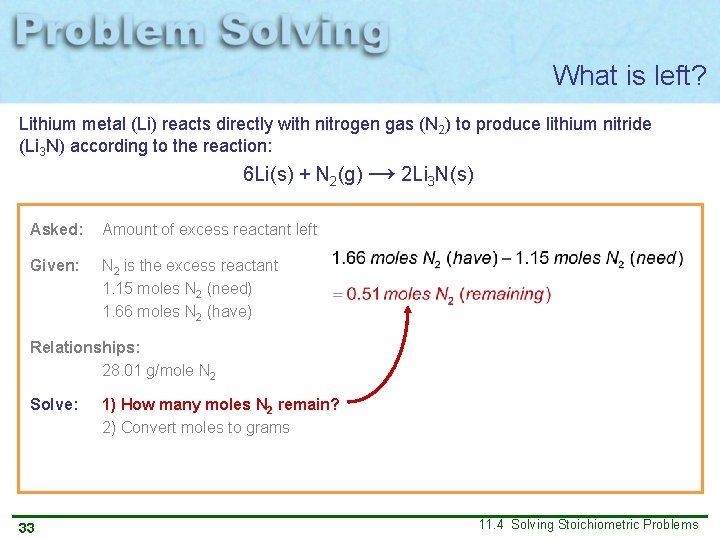
What is left? Lithium metal (Li) reacts directly with nitrogen gas (N 2) to produce lithium nitride (Li 3 N) according to the reaction: 6 Li(s) + N 2(g) → 2 Li 3 N(s) Asked: Amount of excess reactant left Given: N 2 is the excess reactant 1. 15 moles N 2 (need) 1. 66 moles N 2 (have) Relationships: 28. 01 g/mole N 2 Solve: 33 1) How many moles N 2 remain? 2) Convert moles to grams 11. 4 Solving Stoichiometric Problems
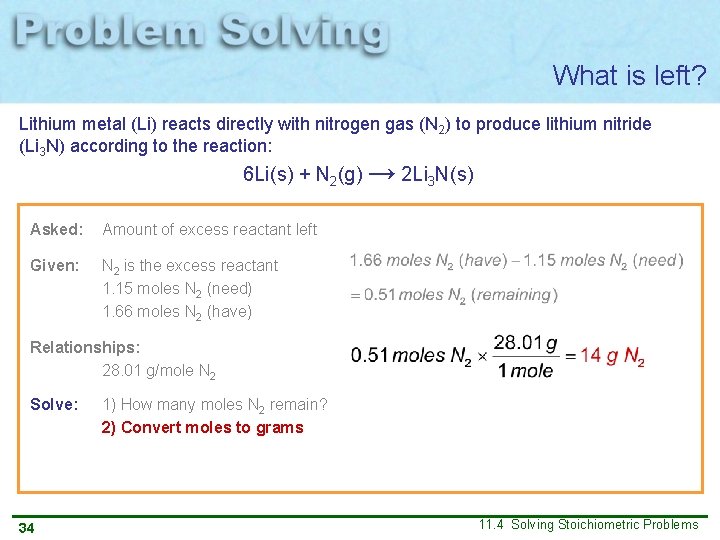
What is left? Lithium metal (Li) reacts directly with nitrogen gas (N 2) to produce lithium nitride (Li 3 N) according to the reaction: 6 Li(s) + N 2(g) → 2 Li 3 N(s) Asked: Amount of excess reactant left Given: N 2 is the excess reactant 1. 15 moles N 2 (need) 1. 66 moles N 2 (have) Relationships: 28. 01 g/mole N 2 Solve: 34 1) How many moles N 2 remain? 2) Convert moles to grams 11. 4 Solving Stoichiometric Problems
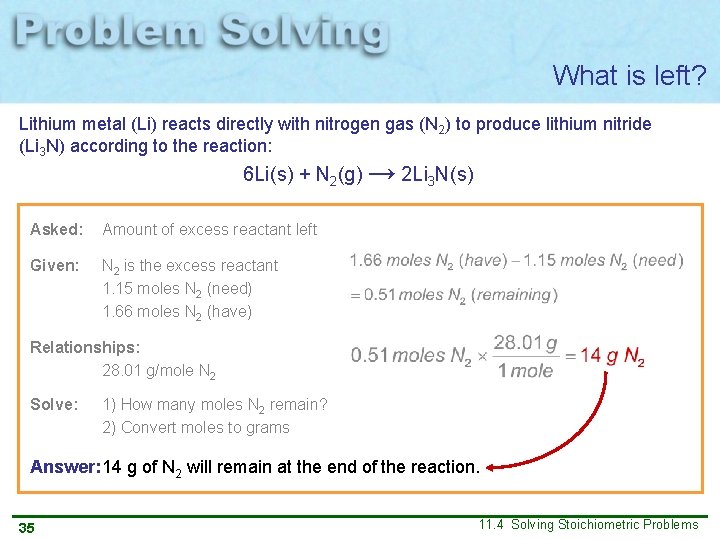
What is left? Lithium metal (Li) reacts directly with nitrogen gas (N 2) to produce lithium nitride (Li 3 N) according to the reaction: 6 Li(s) + N 2(g) → 2 Li 3 N(s) Asked: Amount of excess reactant left Given: N 2 is the excess reactant 1. 15 moles N 2 (need) 1. 66 moles N 2 (have) Relationships: 28. 01 g/mole N 2 Solve: 1) How many moles N 2 remain? 2) Convert moles to grams Answer: 14 g of N 2 will remain at the end of the reaction. 35 11. 4 Solving Stoichiometric Problems
Section 11. 1 Analyzing a Chemical Reaction Section 11. 2 Percent Yield and Concentration Section 11. 3 Limiting Reactants Section 11. 4 Solving Stoichiometric Problems Use what we’ve learned to answer these questions: - What is the limiting reactant? - What is theoretical yield? - What is the percent yield? - How much excess reactant is left? - How much reactant is used if it’s in a solution? 36 11. 4 Solving Stoichiometric Problems
![Reactants in solution The concentration of Cu 2+ ions [found as Cu. SO 4(aq)]](http://slidetodoc.com/presentation_image_h2/291db74bc5a6a9c5c4d0ee71e67113e8/image-37.jpg "Reactants in solution The concentration of Cu 2+ ions [found as Cu. SO 4(aq)]")
Reactants in solution The concentration of Cu 2+ ions [found as Cu. SO 4(aq)] in the water discharged from an industrial plant is found by adding an excess of sodium sulfide (Na 2 S) solution to 1. 0 L of the contaminated water. What is the concentration of Cu. SO 4 in the water if 0. 021 g of Cu. S precipitate is formed? The reaction is: Cu. SO 4(aq) + Na 2 S(aq) → Na 2 SO 4(aq) + Cu. S(s) 37 11. 4 Solving Stoichiometric Problems
![Reactants in solution The concentration of Cu 2+ ions [found as Cu. SO 4(aq)]](http://slidetodoc.com/presentation_image_h2/291db74bc5a6a9c5c4d0ee71e67113e8/image-38.jpg "Reactants in solution The concentration of Cu 2+ ions [found as Cu. SO 4(aq)]")
Reactants in solution The concentration of Cu 2+ ions [found as Cu. SO 4(aq)] in the water discharged from an industrial plant is found by adding an excess of sodium sulfide (Na 2 S) solution to 1. 0 L of the contaminated water. What is the concentration of Cu. SO 4 in the water if 0. 021 g of Cu. S precipitate is formed? The reaction is: Cu. SO 4(aq) + Na 2 S(aq) → Na 2 SO 4(aq) + Cu. S(s) Asked: Concentration of Cu. SO 4(aq) Given: 1. 0 L of solution is tested 0. 021 g Cu. S (formed) Relationships: Molar mass of Cu. S = 95. 61 g/mole Mole ratio: 1 mole Cu. SO 4 ~ 1 mole Cu. S 38 11. 4 Solving Stoichiometric Problems
![Reactants in solution The concentration of Cu 2+ ions [found as Cu. SO 4(aq)]](http://slidetodoc.com/presentation_image_h2/291db74bc5a6a9c5c4d0ee71e67113e8/image-39.jpg "Reactants in solution The concentration of Cu 2+ ions [found as Cu. SO 4(aq)]")
Reactants in solution The concentration of Cu 2+ ions [found as Cu. SO 4(aq)] in the water discharged from an industrial plant is found by adding an excess of sodium sulfide (Na 2 S) solution to 1. 0 L of the contaminated water. What is the concentration of Cu. SO 4 in the water if 0. 021 g of Cu. S precipitate is formed? The reaction is: Cu. SO 4(aq) + Na 2 S(aq) → Na 2 SO 4(aq) + Cu. S(s) Asked: Concentration of Cu. SO 4(aq) Solve: Given: 1. 0 L of solution is tested 0. 021 g Cu. S (formed) 1) How many moles of Cu. S? 2) How many moles of Cu. SO 4? 3) What is the concentration of Cu. SO 4? Relationships: Molar mass of Cu. S = 95. 61 g/mole Mole ratio: 1 mole Cu. SO 4 ~ 1 mole Cu. S 39 11. 4 Solving Stoichiometric Problems
![Reactants in solution The concentration of Cu 2+ ions [found as Cu. SO 4(aq)]](http://slidetodoc.com/presentation_image_h2/291db74bc5a6a9c5c4d0ee71e67113e8/image-40.jpg "Reactants in solution The concentration of Cu 2+ ions [found as Cu. SO 4(aq)]")
Reactants in solution The concentration of Cu 2+ ions [found as Cu. SO 4(aq)] in the water discharged from an industrial plant is found by adding an excess of sodium sulfide (Na 2 S) solution to 1. 0 L of the contaminated water. The reaction is: Cu. SO 4(aq) + Na 2 S(aq) → Na 2 SO 4(aq) + Cu. S(s) Asked: Concentration of Cu. SO 4(aq) Given: 1. 0 L of solution is tested 0. 021 g Cu. S (formed) Relationships: 95. 61 g/mole Cu. S 1 mole Cu. SO 4 ~ 1 mole Cu. S Solve: 40 1) How many moles of Cu. S? 2) How many moles of Cu. SO 4? 3) What is the concentration of Cu. SO 4? 11. 4 Solving Stoichiometric Problems
![Reactants in solution The concentration of Cu 2+ ions [found as Cu. SO 4(aq)]](http://slidetodoc.com/presentation_image_h2/291db74bc5a6a9c5c4d0ee71e67113e8/image-41.jpg "Reactants in solution The concentration of Cu 2+ ions [found as Cu. SO 4(aq)]")
Reactants in solution The concentration of Cu 2+ ions [found as Cu. SO 4(aq)] in the water discharged from an industrial plant is found by adding an excess of sodium sulfide (Na 2 S) solution to 1. 0 L of the contaminated water. The reaction is: Cu. SO 4(aq) + Na 2 S(aq) → Na 2 SO 4(aq) + Cu. S(s) Asked: Concentration of Cu. SO 4(aq) Given: 1. 0 L of solution is tested 0. 021 g Cu. S (formed) Have: Relationships: 95. 61 g/mole Cu. S 1 mole Cu. SO 4 ~ 1 mole Cu. S Solve: 41 1) How many moles of Cu. S? 2) How many moles of Cu. SO 4? 3) What is the concentration of Cu. SO 4? 11. 4 Solving Stoichiometric Problems
![Reactants in solution The concentration of Cu 2+ ions [found as Cu. SO 4(aq)]](http://slidetodoc.com/presentation_image_h2/291db74bc5a6a9c5c4d0ee71e67113e8/image-42.jpg "Reactants in solution The concentration of Cu 2+ ions [found as Cu. SO 4(aq)]")
Reactants in solution The concentration of Cu 2+ ions [found as Cu. SO 4(aq)] in the water discharged from an industrial plant is found by adding an excess of sodium sulfide (Na 2 S) solution to 1. 0 L of the contaminated water. The reaction is: Cu. SO 4(aq) + Na 2 S(aq) → Na 2 SO 4(aq) + Cu. S(s) Asked: Concentration of Cu. SO 4(aq) Given: 1. 0 L of solution is tested 0. 021 g Cu. S (formed) Have: Relationships: 95. 61 g/mole Cu. S 1 mole Cu. SO 4 ~ 1 mole Cu. S Solve: 42 1) How many moles of Cu. S? 2) How many moles of Cu. SO 4? 3) What is the concentration of Cu. SO 4? 11. 4 Solving Stoichiometric Problems
![Reactants in solution The concentration of Cu 2+ ions [found as Cu. SO 4(aq)]](http://slidetodoc.com/presentation_image_h2/291db74bc5a6a9c5c4d0ee71e67113e8/image-43.jpg "Reactants in solution The concentration of Cu 2+ ions [found as Cu. SO 4(aq)]")
Reactants in solution The concentration of Cu 2+ ions [found as Cu. SO 4(aq)] in the water discharged from an industrial plant is found by adding an excess of sodium sulfide (Na 2 S) solution to 1. 0 L of the contaminated water. The reaction is: Cu. SO 4(aq) + Na 2 S(aq) → Na 2 SO 4(aq) + Cu. S(s) Asked: Concentration of Cu. SO 4(aq) Given: 1. 0 L of solution is tested 0. 021 g Cu. S (formed) Answer: The concentration of Cu. SO 4 is 2. 20 x 10 -4 M. Relationships: 95. 61 g/mole Cu. S 1 mole Cu. SO 4 ~ 1 mole Cu. S Solve: 43 1) How many moles of Cu. S? 2) How many moles of Cu. SO 4? 3) What is the concentration of Cu. SO 4? 11. 4 Solving Stoichiometric Problems
![Reactants in solution The concentration of Cu 2+ ions [found as Cu. SO 4(aq)]](http://slidetodoc.com/presentation_image_h2/291db74bc5a6a9c5c4d0ee71e67113e8/image-44.jpg "Reactants in solution The concentration of Cu 2+ ions [found as Cu. SO 4(aq)]")
Reactants in solution The concentration of Cu 2+ ions [found as Cu. SO 4(aq)] in the water discharged from an industrial plant is found by adding an excess of sodium sulfide (Na 2 S) solution to 1. 0 L of the contaminated water. The reaction is: Cu. SO 4(aq) + Na 2 S(aq) → Na 2 SO 4(aq) + Cu. S(s) Discussion: If the legal limit is 5. 0 x 10 -4 M of Cu 2+, is the industrial plant following the environmental guidelines? 44 Answer: The concentration of Cu. SO 4 is 2. 20 x 10 -4 M. 11. 4 Solving Stoichiometric Problems
![Reactants in solution The concentration of Cu 2+ ions [found as Cu. SO 4(aq)]](http://slidetodoc.com/presentation_image_h2/291db74bc5a6a9c5c4d0ee71e67113e8/image-45.jpg "Reactants in solution The concentration of Cu 2+ ions [found as Cu. SO 4(aq)]")
Reactants in solution The concentration of Cu 2+ ions [found as Cu. SO 4(aq)] in the water discharged from an industrial plant is found by adding an excess of sodium sulfide (Na 2 S) solution to 1. 0 L of the contaminated water. The reaction is: Cu. SO 4(aq) + Na 2 S(aq) → Na 2 SO 4(aq) + Cu. S(s) Discussion: If the legal limit is 5. 0 x 10 -4 M of Cu 2+, is the industrial plant following the environmental guidelines? Answer: The concentration of Cu. SO 4 is 2. 20 x 10 -4 M. Yes, because 2. 20 x 10 -4 M is less than the legal limit. Cu. SO 4(aq) → Cu 2+(aq) + SO 42–(aq) 45 11. 4 Solving Stoichiometric Problems
Section 11. 1 Analyzing a Chemical Reaction Section 11. 2 Percent Yield and Concentration Section 11. 3 Limiting Reactants Section 11. 4 Solving Stoichiometric Problems Use what we’ve learned to answer these questions: - What is the limiting reactant? - What is theoretical yield? - What is the percent yield? - How much excess reactant is left? - How much reactant is used if it’s in a solution? 46 11. 4 Solving Stoichiometric Problems
- Slides: 46