
Chapter 11 Social Network Analysis Crime Mapping and

- Slides: 12
Chapter 11: Social Network Analysis, Crime Mapping, and Big Data
Learning Objectives 11 -1: Understand how social network analysis and crime mapping can be used for intelligence-led policing as well as basic research. 11 -2: Describe the different research questions crime mapping can answer. 11 -3: Understand how computer technology has ushered in our ability to analyze big data and the effects this had on criminal justice-related research. 11 -4: Be able to see connection between research and investigative policing. Bachman, The Practice of Research in Criminology and Criminal Justice 7 e. SAGE Publishing, 2020. 3
Social Network Analysis • This method has increasingly been used. • Social networks are types of relationships. • These networks can be analyzed as a form of relational data. – Contacts, connections, attachments, and ties that relate one unit to the next Bachman, The Practice of Research in Criminology and Criminal Justice 7 e. SAGE Publishing, 2020. 4
Social Network Analysis • Sociograms are graphs used to represent social relationships. • The social sciences generally call the basic units in a graph “nodes. ” • Nodes are connected by relations. Bachman, The Practice of Research in Criminology and Criminal Justice 7 e. SAGE Publishing, 2020. 5
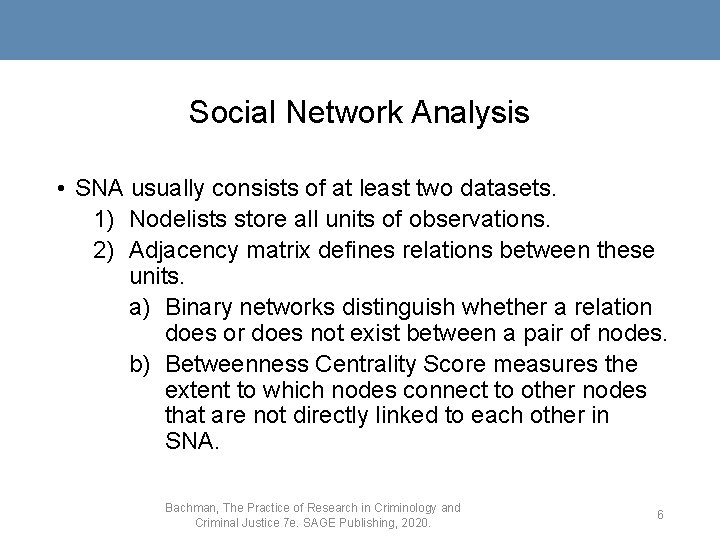
Social Network Analysis • SNA usually consists of at least two datasets. 1) Nodelists store all units of observations. 2) Adjacency matrix defines relations between these units. a) Binary networks distinguish whether a relation does or does not exist between a pair of nodes. b) Betweenness Centrality Score measures the extent to which nodes connect to other nodes that are not directly linked to each other in SNA. Bachman, The Practice of Research in Criminology and Criminal Justice 7 e. SAGE Publishing, 2020. 6
Crime Mapping • Used to identify the spatial distribution of crime along with the social indicators such as poverty and social disorganization that are similarly distributed across areas • Geographic information system (GIS) has made crime mapping increasingly available. Bachman, The Practice of Research in Criminology and Criminal Justice 7 e. SAGE Publishing, 2020. 7
Crime Mapping • Three main functions: 1) Provides visual and statistical analyses 2) Allows for the linkage of crime data to other data sources 3) Provides maps to visually communicate analysis results Bachman, The Practice of Research in Criminology and Criminal Justice 7 e. SAGE Publishing, 2020. 8
Crime Mapping • Crime mapping is being used by the majority of urban law enforcement agencies to identify crime hot spots. • Hot spots are geospatial locations where crimes are more likely to occur compared to other areas. Bachman, The Practice of Research in Criminology and Criminal Justice 7 e. SAGE Publishing, 2020. 9
Big Data • A somewhat vague term • Used to describe large and rapidly changing datasets and the analytic techniques used to extract information from them • Simply defined as a very large dataset Bachman, The Practice of Research in Criminology and Criminal Justice 7 e. SAGE Publishing, 2020. 10
Ethical Issues When Using Big Data • Subject confidentiality is a key concern. – Whenever possible, all information that could identify individuals should be removed from the records to be analyzed. • Political concerns intersect with ethical practice in secondary data analyses. • Potential invasions of privacy and unwarranted suspicions are enormous. Bachman, The Practice of Research in Criminology and Criminal Justice 7 e. SAGE Publishing, 2020. 11
Open-Access Student Resources • • • Quizzes e. Flashcards SAGE journal articles Multimedia resources URL Bachman, The Practice of Research in Criminology and Criminal Justice 7 e. SAGE Publishing, 2020. 12