
Chapter 11 Section 3 pg 432 Pascals Principle


- Slides: 17
Chapter 11 Section 3 – pg 432 Pascal’s Principle
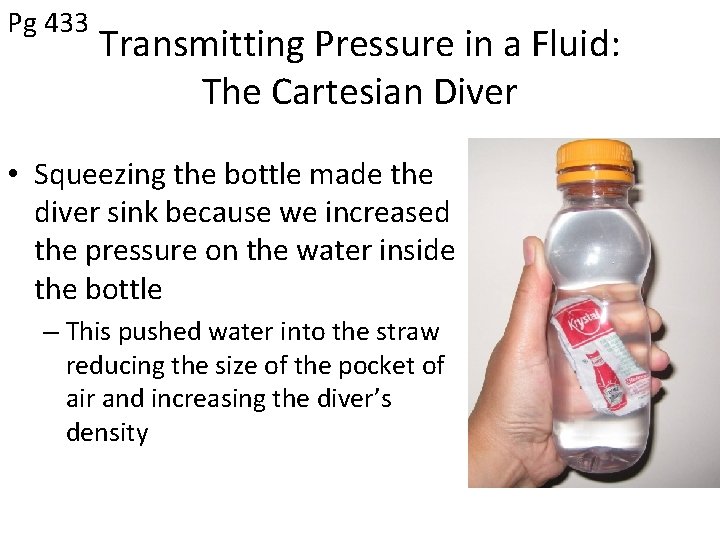
Pg 433 Transmitting Pressure in a Fluid: The Cartesian Diver • Squeezing the bottle made the diver sink because we increased the pressure on the water inside the bottle – This pushed water into the straw reducing the size of the pocket of air and increasing the diver’s density
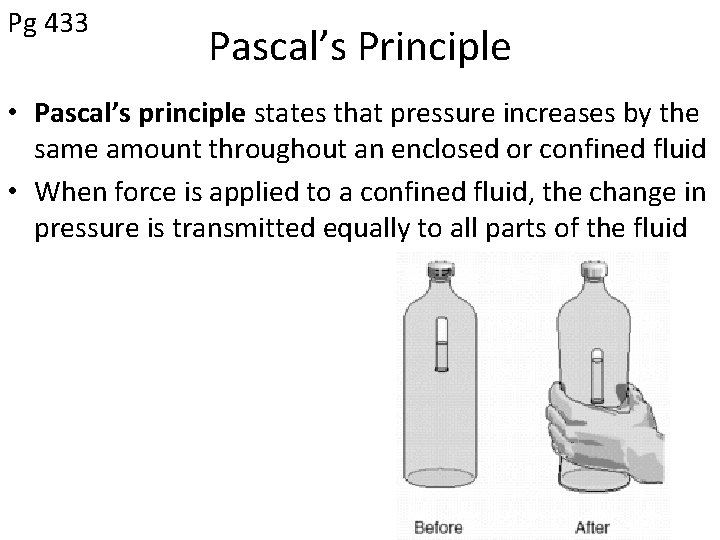
Pg 433 Pascal’s Principle • Pascal’s principle states that pressure increases by the same amount throughout an enclosed or confined fluid • When force is applied to a confined fluid, the change in pressure is transmitted equally to all parts of the fluid
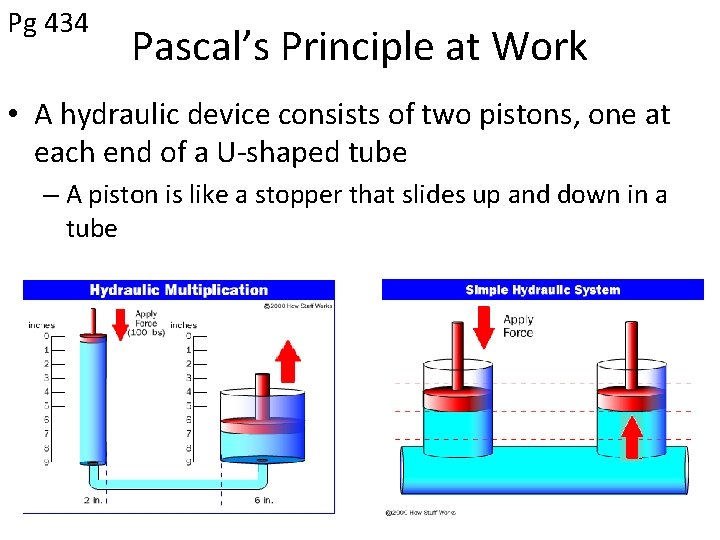
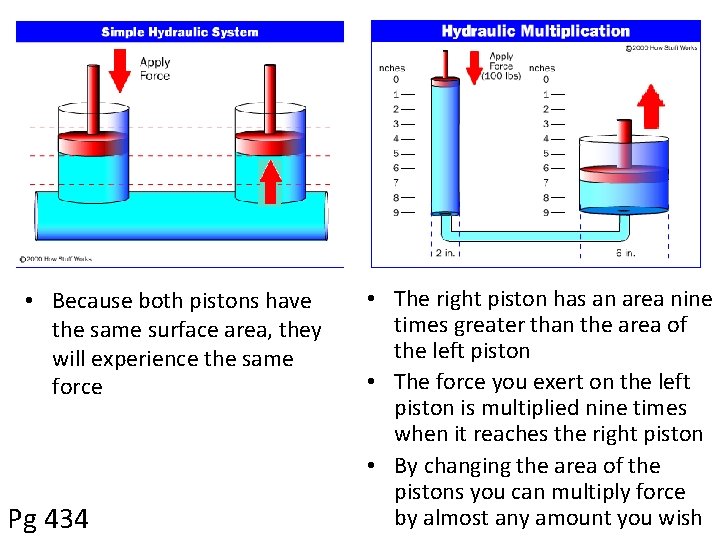
Pg 434 Pascal’s Principle at Work • A hydraulic device consists of two pistons, one at each end of a U-shaped tube – A piston is like a stopper that slides up and down in a tube
• Because both pistons have the same surface area, they will experience the same force Pg 434 • The right piston has an area nine times greater than the area of the left piston • The force you exert on the left piston is multiplied nine times when it reaches the right piston • By changing the area of the pistons you can multiply force by almost any amount you wish
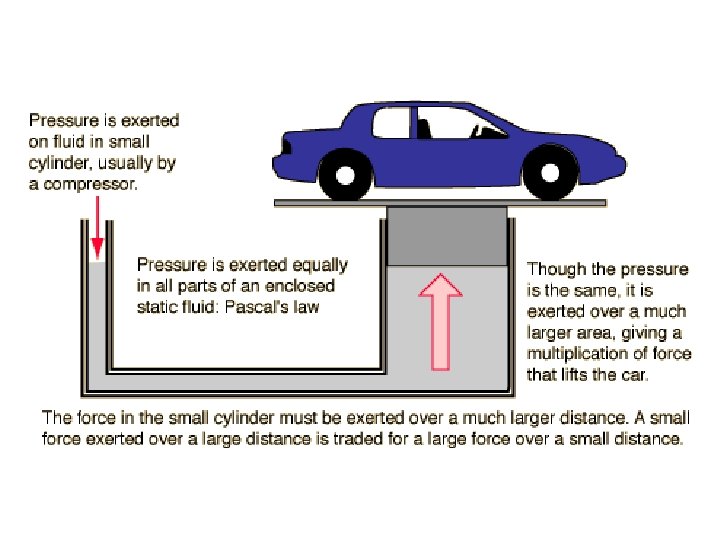
Pg 435 Hydraulic Systems • A hydraulic system uses liquids to transmit pressure and multiply force in a confined fluid • A hydraulic system multiplies force applying the force to a small surface area. The increase in pressure is then transmitted to another part of the confined fluid, which pushes on a larger surface area.
Pg 435 Hydraulic Lifts
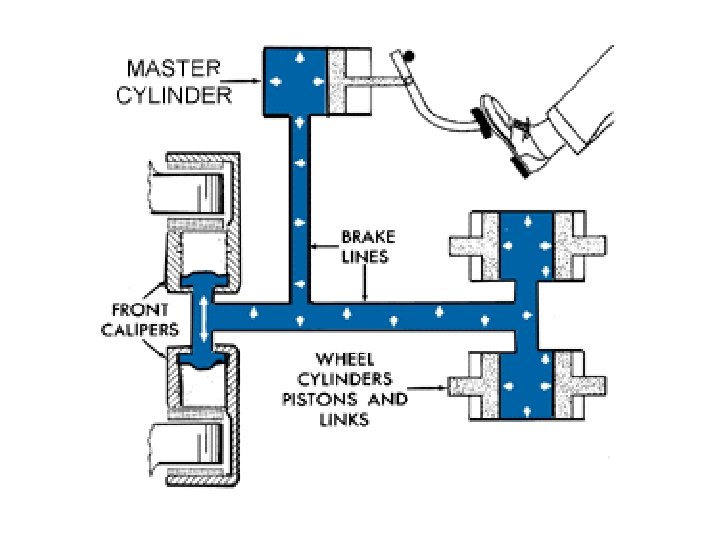
Pg 436 Hydraulic Brakes • The brake system of a car is a hydraulic system – When a driver pushes down on a brake pedal, they are pushing on a small piston – This piston exerts pressure on the brake fluid. – The increased pressure is transmitted through the fluid in the brake lines to larger pistons within each wheel – Each of these pistons pushes on a brake pad • Because the brake system multiplies force, a person can stop a large car with only a light push on the brake pedal
Chapter 11 Section 3 Homework pg 436
1 A. According to Pascal’s principle, how is pressure transmitted in a fluid?
1 B. How does Pascal’s principle help explain the behavior of the Cartesian diver?
1 C. Suppose you apply a 10 -N force to a 10 cm 2 piston in a hydraulic device. If the force is transmitted to another piston with an area of 100 cm 2, by how much will the force be multiplied? Hint: 100 is 10 times bigger than 10
2 A. What is a hydraulic system?
2 B. How does a hydraulic system work?
2 C. Describe what happens in the brake system of a car from the time a driver steps on the brake pedal to the time the car stops.