
Chapter 11 Section 2 The Gas Laws Objectives
Chapter 11 Section 2 The Gas Laws Objectives • Use the kinetic-molecular theory to explain the relationships between gas volume, temperature and pressure. • Use Boyle’s law to calculate volume-pressure changes at constant temperature. Chapter menu Resources Copyright © by Holt, Rinehart and Winston. All rights reserved.
Chapter 11 Section 2 The Gas Laws Boyle’s Law: Pressure-Volume Relationship • Robert Boyle discovered that doubling the pressure on a sample of gas at constant temperature reduces its volume by one-half. • This is explained by the kinetic-molecular theory: • The pressure of a gas is caused by moving molecules hitting the container walls. • If the volume of a gas is decreased, more collisions will occur, and the pressure will therefore increase. • Likewise, if the volume of a gas is increased, less collisions will occur, and the pressure will decrease. Chapter menu Resources Copyright © by Holt, Rinehart and Winston. All rights reserved.
Chapter 11 Visual Concepts Examples of Boyle’s Law • http: //www. physics-chemistryinteractive-flashanimation. com/matter_change_ state_measurement_mass_volu me/pressure_volume_boyle_ma riotte_law_ideal_gas_closed_sy stem_MCQ. htm • https: //pages. uor egon. edu/tgreenb o/boyles_law. html Chapter menu Resources Copyright © by Holt, Rinehart and Winston. All rights reserved.
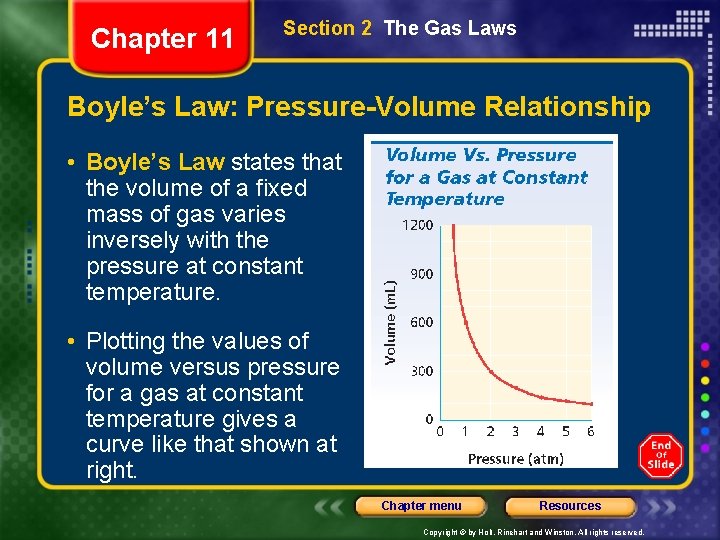
Chapter 11 Section 2 The Gas Laws Boyle’s Law: Pressure-Volume Relationship • Boyle’s Law states that the volume of a fixed mass of gas varies inversely with the pressure at constant temperature. • Plotting the values of volume versus pressure for a gas at constant temperature gives a curve like that shown at right. Chapter menu Resources Copyright © by Holt, Rinehart and Winston. All rights reserved.
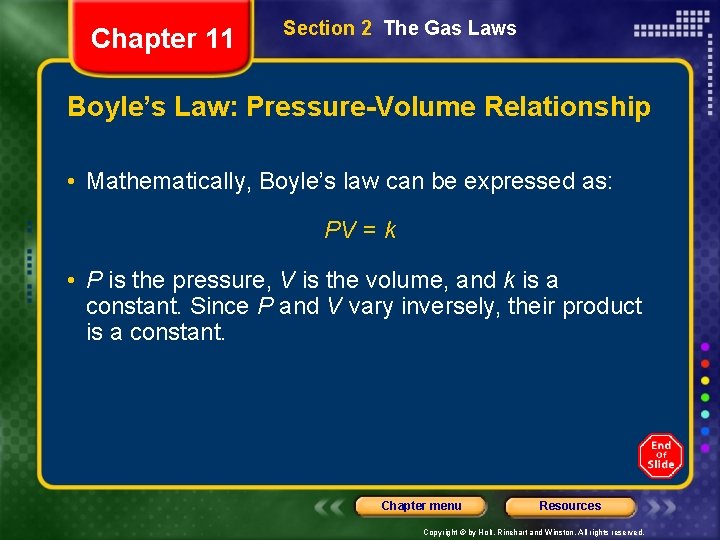
Chapter 11 Section 2 The Gas Laws Boyle’s Law: Pressure-Volume Relationship • Mathematically, Boyle’s law can be expressed as: PV = k • P is the pressure, V is the volume, and k is a constant. Since P and V vary inversely, their product is a constant. Chapter menu Resources Copyright © by Holt, Rinehart and Winston. All rights reserved.
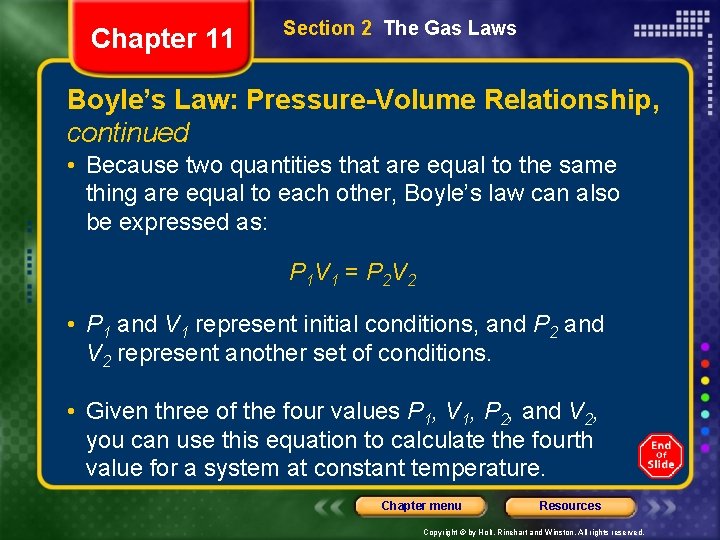
Chapter 11 Section 2 The Gas Laws Boyle’s Law: Pressure-Volume Relationship, continued • Because two quantities that are equal to the same thing are equal to each other, Boyle’s law can also be expressed as: P 1 V 1 = P 2 V 2 • P 1 and V 1 represent initial conditions, and P 2 and V 2 represent another set of conditions. • Given three of the four values P 1, V 1, P 2, and V 2, you can use this equation to calculate the fourth value for a system at constant temperature. Chapter menu Resources Copyright © by Holt, Rinehart and Winston. All rights reserved.
Chapter 11 Section 2 The Gas Laws Boyle’s Law: Pressure-Volume Relationship, continued Sample Problem C A sample of oxygen gas has a volume of 150. 0 m. L when its pressure is 0. 947 atm. What will the volume of the gas be at a pressure of 0. 987 atm if the temperature remains constant? Chapter menu Resources Copyright © by Holt, Rinehart and Winston. All rights reserved.
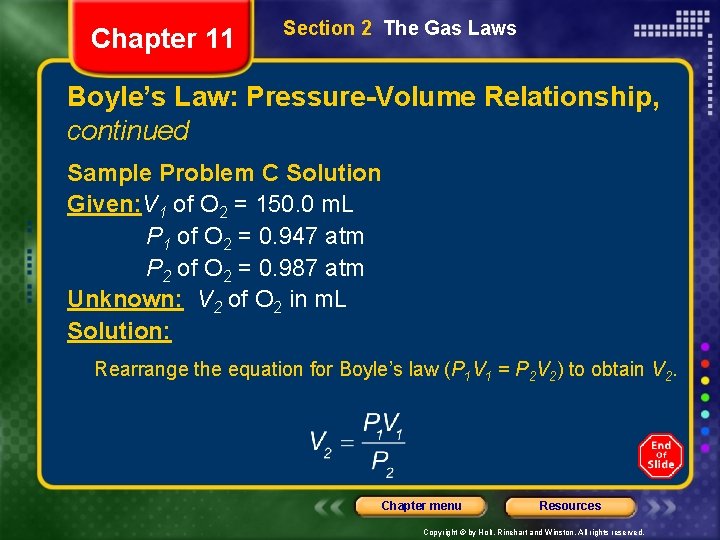
Chapter 11 Section 2 The Gas Laws Boyle’s Law: Pressure-Volume Relationship, continued Sample Problem C Solution Given: V 1 of O 2 = 150. 0 m. L P 1 of O 2 = 0. 947 atm P 2 of O 2 = 0. 987 atm Unknown: V 2 of O 2 in m. L Solution: Rearrange the equation for Boyle’s law (P 1 V 1 = P 2 V 2) to obtain V 2. Chapter menu Resources Copyright © by Holt, Rinehart and Winston. All rights reserved.
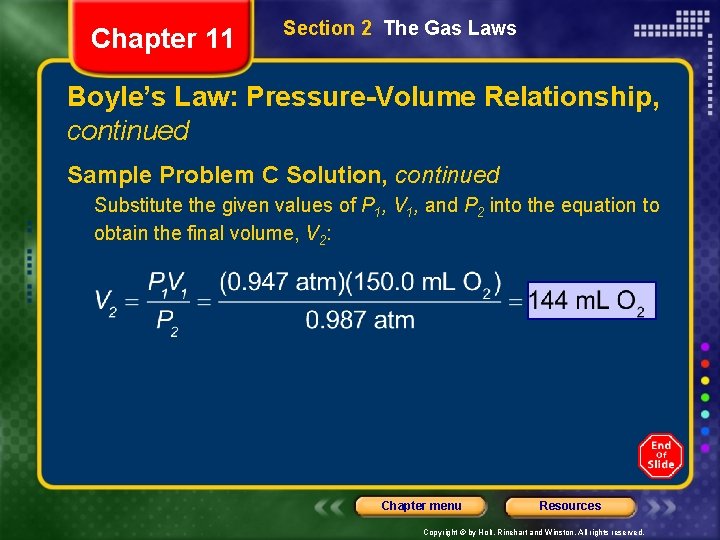
Chapter 11 Section 2 The Gas Laws Boyle’s Law: Pressure-Volume Relationship, continued Sample Problem C Solution, continued Substitute the given values of P 1, V 1, and P 2 into the equation to obtain the final volume, V 2: Chapter menu Resources Copyright © by Holt, Rinehart and Winston. All rights reserved.
Chapter 11 Section 2 The Gas Laws Objectives, continued • Use the kinetic-molecular theory to explain the relationships between gas volume, temperature and pressure. • Use Charles’s law to calculate volume-temperature changes at constant pressure. Chapter menu Resources Copyright © by Holt, Rinehart and Winston. All rights reserved.
Chapter 11 Section 2 The Gas Laws Charles’s Law: Volume-Temperature Relationship, continued • If pressure is constant, gases expand when heated. • When the temperature increases, the volume of a fixed number of gas molecules must increase if the pressure is to stay constant. • At the higher temperature, the gas molecules move faster. They collide with the walls of the container more frequently and with more force. • The volume of a flexible container must then increase in order for the pressure to remain the same. Chapter menu Resources Copyright © by Holt, Rinehart and Winston. All rights reserved.
Chapter 11 Visual Concepts Charles’s Law • https: //pages. uoregon. edu/tgre enbo/charles_law. html • https: //teachchemistry. org/perio dical/issues/november-2015/gas -laws Chapter menu Resources Copyright © by Holt, Rinehart and Winston. All rights reserved.
Chapter 11 Section 2 The Gas Laws Charles’s Law: Volume-Temperature Relationship, continued • The quantitative relationship between volume and temperature was discovered by the French scientist Jacques Charles in 1787. • Charles found that the volume changes by 1/273 of the original volume for each Celsius degree, at constant pressure and at an initial temperature of 0°C. • The temperature – 273. 15°C is referred to as absolute zero, and is given a value of zero in the Kelvin temperature scale. The relationship between the two temperature scales is K = 273. 15 + °C. Chapter menu Resources Copyright © by Holt, Rinehart and Winston. All rights reserved.
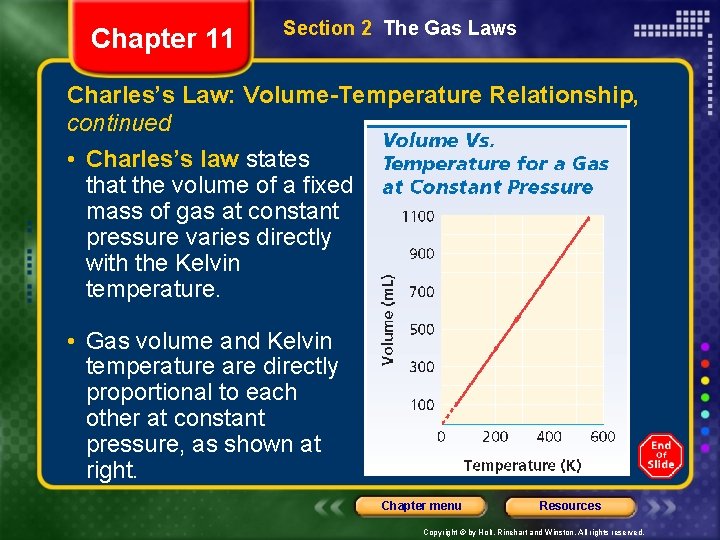
Chapter 11 Section 2 The Gas Laws Charles’s Law: Volume-Temperature Relationship, continued • Charles’s law states that the volume of a fixed mass of gas at constant pressure varies directly with the Kelvin temperature. • Gas volume and Kelvin temperature are directly proportional to each other at constant pressure, as shown at right. Chapter menu Resources Copyright © by Holt, Rinehart and Winston. All rights reserved.
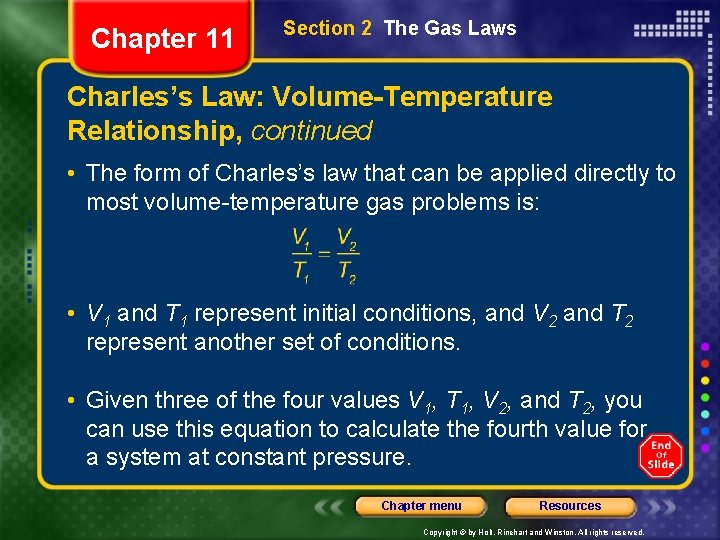
Chapter 11 Section 2 The Gas Laws Charles’s Law: Volume-Temperature Relationship, continued • The form of Charles’s law that can be applied directly to most volume-temperature gas problems is: • V 1 and T 1 represent initial conditions, and V 2 and T 2 represent another set of conditions. • Given three of the four values V 1, T 1, V 2, and T 2, you can use this equation to calculate the fourth value for a system at constant pressure. Chapter menu Resources Copyright © by Holt, Rinehart and Winston. All rights reserved.
Chapter 11 Section 2 The Gas Laws Charles’s Law: Volume-Temperature Relationship, continued Sample Problem D A sample of neon gas occupies a volume of 752 m. L at 25°C. What volume will the gas occupy at 50°C if the pressure remains constant? Chapter menu Resources Copyright © by Holt, Rinehart and Winston. All rights reserved.
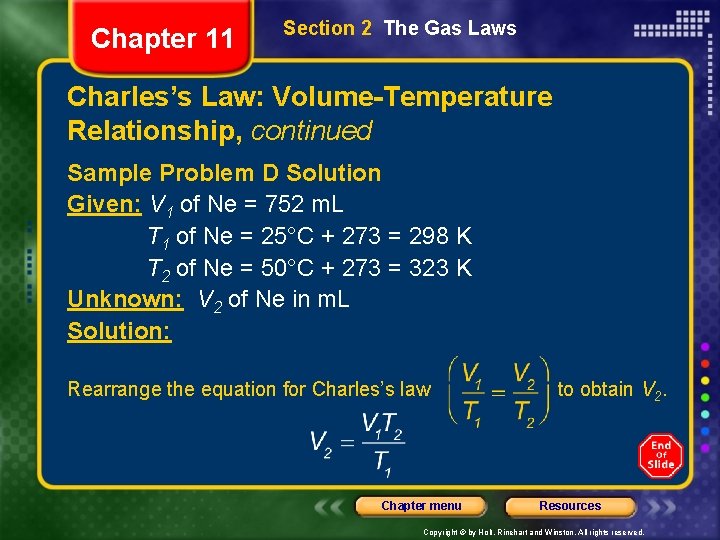
Chapter 11 Section 2 The Gas Laws Charles’s Law: Volume-Temperature Relationship, continued Sample Problem D Solution Given: V 1 of Ne = 752 m. L T 1 of Ne = 25°C + 273 = 298 K T 2 of Ne = 50°C + 273 = 323 K Unknown: V 2 of Ne in m. L Solution: Rearrange the equation for Charles’s law Chapter menu to obtain V 2. Resources Copyright © by Holt, Rinehart and Winston. All rights reserved.
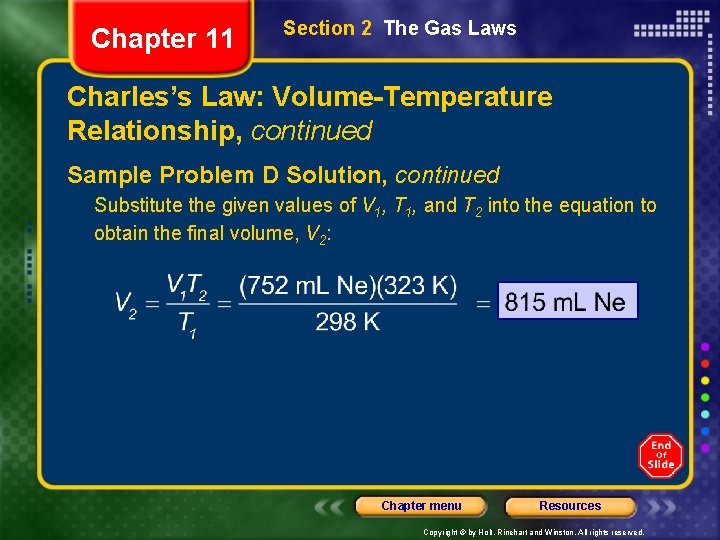
Chapter 11 Section 2 The Gas Laws Charles’s Law: Volume-Temperature Relationship, continued Sample Problem D Solution, continued Substitute the given values of V 1, T 1, and T 2 into the equation to obtain the final volume, V 2: Chapter menu Resources Copyright © by Holt, Rinehart and Winston. All rights reserved.
Chapter 11 Section 2 The Gas Laws Objectives, continued • Use the kinetic-molecular theory to explain the relationships between gas volume, temperature and pressure. • Use Gay-Lussac’s law to calculate pressuretemperature changes at constant volume. Chapter menu Resources Copyright © by Holt, Rinehart and Winston. All rights reserved.
Chapter 11 Section 2 The Gas Laws Gay-Lussac’s Law: Pressure-Temperature Relationship • At constant volume, the pressure of a gas increases with increasing temperature. • Gas pressure is the result of collisions of molecules with container walls. • The energy and frequency of collisions depend on the average kinetic energy of molecules. • Because the Kelvin temperature depends directly on average kinetic energy, pressure is directly proportional to Kelvin temperature. Chapter menu Resources Copyright © by Holt, Rinehart and Winston. All rights reserved.
Chapter 11 Visual Concepts Gay-Lussac’s Law • https: //teachchemistry. org/perio dical/issues/november-2015/gas -laws Chapter menu Resources Copyright © by Holt, Rinehart and Winston. All rights reserved.
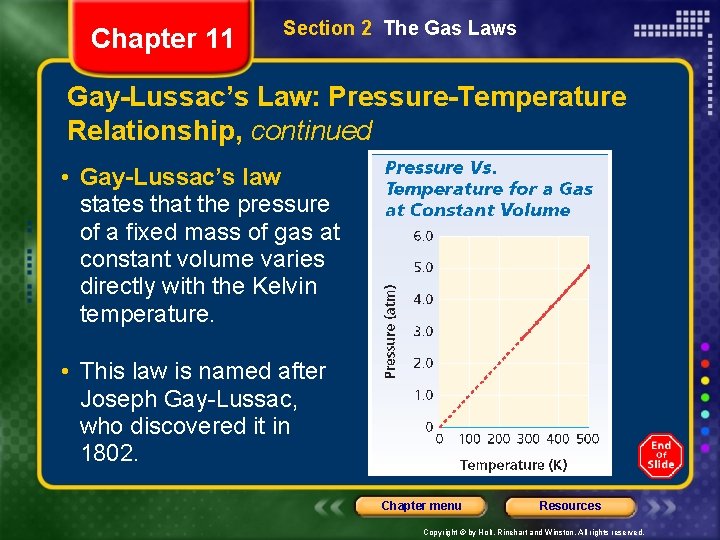
Chapter 11 Section 2 The Gas Laws Gay-Lussac’s Law: Pressure-Temperature Relationship, continued • Gay-Lussac’s law states that the pressure of a fixed mass of gas at constant volume varies directly with the Kelvin temperature. • This law is named after Joseph Gay-Lussac, who discovered it in 1802. Chapter menu Resources Copyright © by Holt, Rinehart and Winston. All rights reserved.
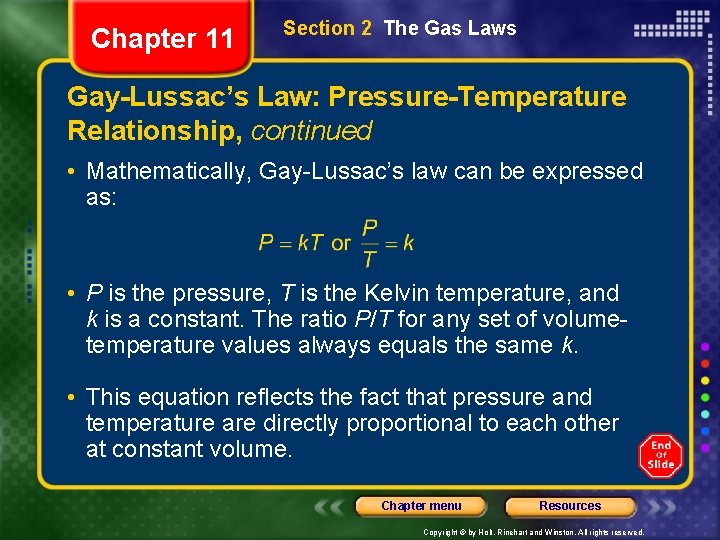
Chapter 11 Section 2 The Gas Laws Gay-Lussac’s Law: Pressure-Temperature Relationship, continued • Mathematically, Gay-Lussac’s law can be expressed as: • P is the pressure, T is the Kelvin temperature, and k is a constant. The ratio P/T for any set of volumetemperature values always equals the same k. • This equation reflects the fact that pressure and temperature are directly proportional to each other at constant volume. Chapter menu Resources Copyright © by Holt, Rinehart and Winston. All rights reserved.
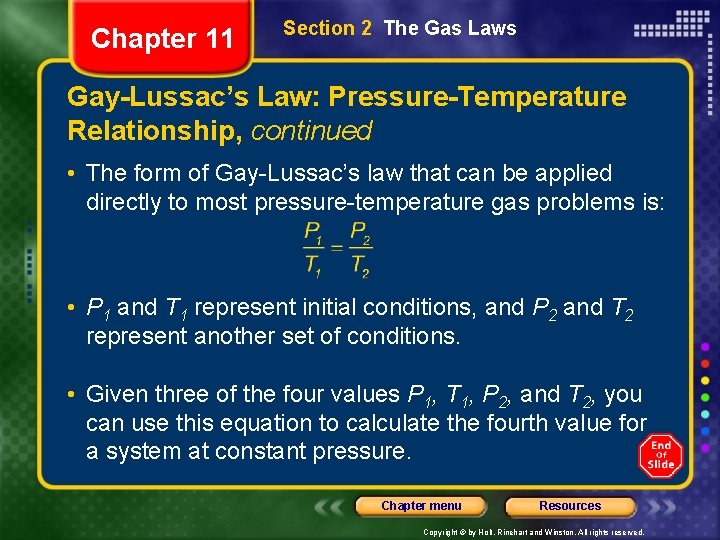
Chapter 11 Section 2 The Gas Laws Gay-Lussac’s Law: Pressure-Temperature Relationship, continued • The form of Gay-Lussac’s law that can be applied directly to most pressure-temperature gas problems is: • P 1 and T 1 represent initial conditions, and P 2 and T 2 represent another set of conditions. • Given three of the four values P 1, T 1, P 2, and T 2, you can use this equation to calculate the fourth value for a system at constant pressure. Chapter menu Resources Copyright © by Holt, Rinehart and Winston. All rights reserved.
Chapter 11 Visual Concepts Equation for Gay-Lussac’s Law Click below to watch the Visual Concept Chapter menu Resources Copyright © by Holt, Rinehart and Winston. All rights reserved.
Chapter 11 Section 2 The Gas Laws Gay-Lussac’s Law: Volume-Temperature Relationship, continued Sample Problem E The gas in a container is at a pressure of 3. 00 atm at 25°C. Directions on the container warn the user not to keep it in a place where the temperature exceeds 52°C. What would the gas pressure in the container be at 52°C? Chapter menu Resources Copyright © by Holt, Rinehart and Winston. All rights reserved.
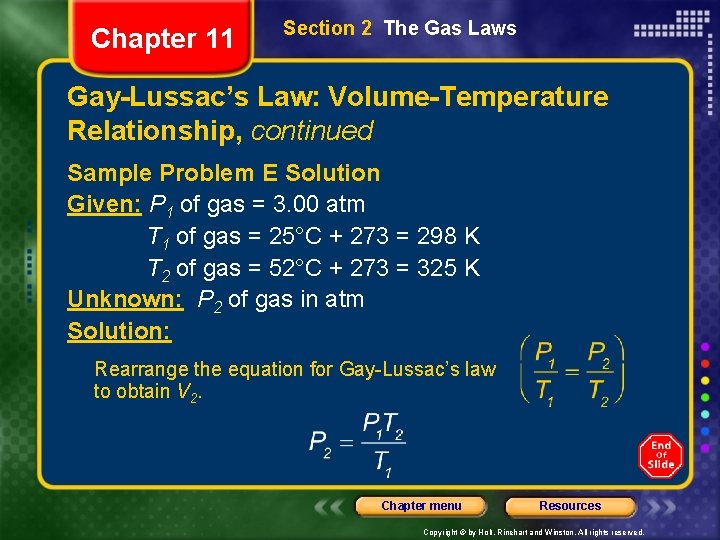
Chapter 11 Section 2 The Gas Laws Gay-Lussac’s Law: Volume-Temperature Relationship, continued Sample Problem E Solution Given: P 1 of gas = 3. 00 atm T 1 of gas = 25°C + 273 = 298 K T 2 of gas = 52°C + 273 = 325 K Unknown: P 2 of gas in atm Solution: Rearrange the equation for Gay-Lussac’s law to obtain V 2. Chapter menu Resources Copyright © by Holt, Rinehart and Winston. All rights reserved.
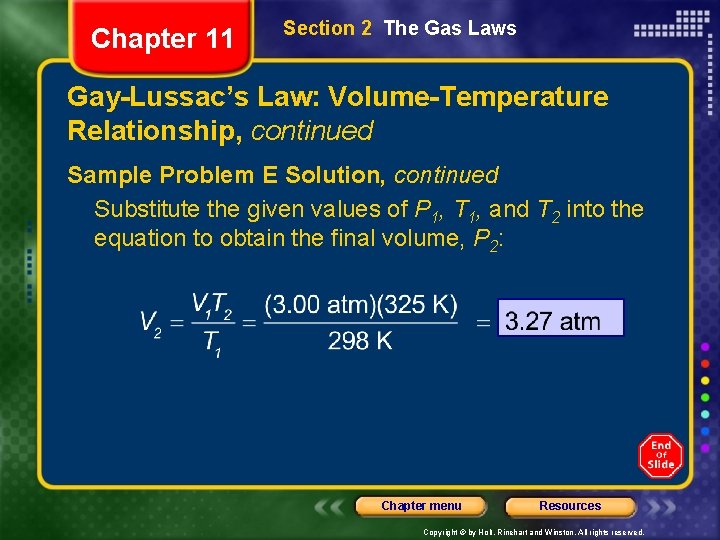
Chapter 11 Section 2 The Gas Laws Gay-Lussac’s Law: Volume-Temperature Relationship, continued Sample Problem E Solution, continued Substitute the given values of P 1, T 1, and T 2 into the equation to obtain the final volume, P 2: Chapter menu Resources Copyright © by Holt, Rinehart and Winston. All rights reserved.
Chapter 11 Section 2 The Gas Laws Objectives, continued • Use the kinetic-molecular theory to explain the relationships between gas volume, temperature and pressure. • Use the combined gas law to calculate volumetemperature-pressure changes. Chapter menu Resources Copyright © by Holt, Rinehart and Winston. All rights reserved.
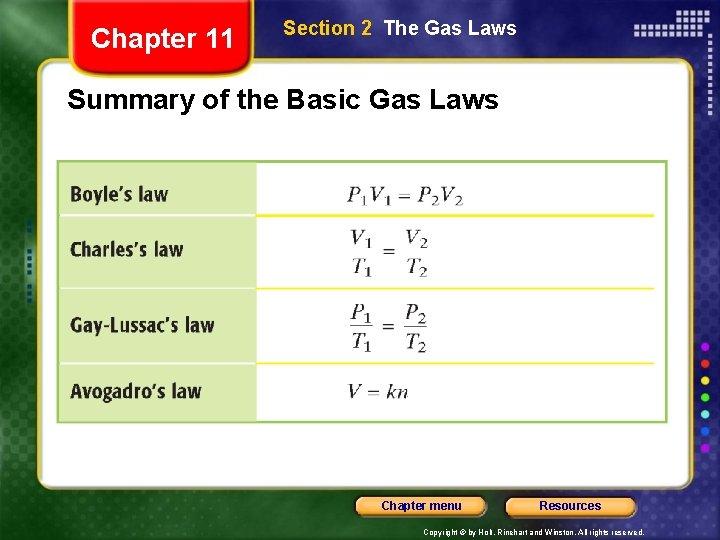
Chapter 11 Section 2 The Gas Laws Summary of the Basic Gas Laws Chapter menu Resources Copyright © by Holt, Rinehart and Winston. All rights reserved.
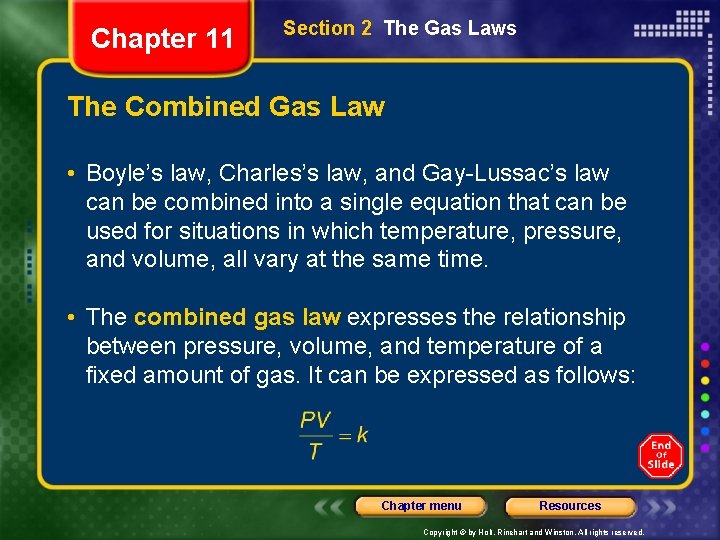
Chapter 11 Section 2 The Gas Laws The Combined Gas Law • Boyle’s law, Charles’s law, and Gay-Lussac’s law can be combined into a single equation that can be used for situations in which temperature, pressure, and volume, all vary at the same time. • The combined gas law expresses the relationship between pressure, volume, and temperature of a fixed amount of gas. It can be expressed as follows: Chapter menu Resources Copyright © by Holt, Rinehart and Winston. All rights reserved.
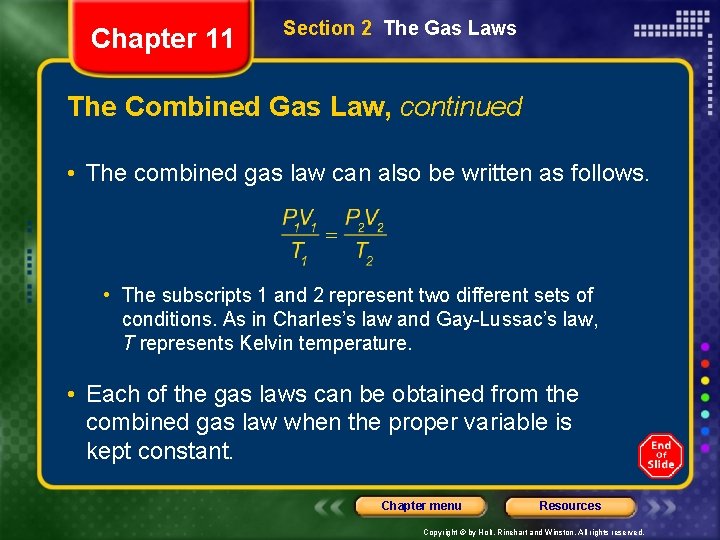
Chapter 11 Section 2 The Gas Laws The Combined Gas Law, continued • The combined gas law can also be written as follows. • The subscripts 1 and 2 represent two different sets of conditions. As in Charles’s law and Gay-Lussac’s law, T represents Kelvin temperature. • Each of the gas laws can be obtained from the combined gas law when the proper variable is kept constant. Chapter menu Resources Copyright © by Holt, Rinehart and Winston. All rights reserved.
Chapter 11 Visual Concepts Combined Gas Law • https: //ch 301. cm. utexas. edu/si mulations/gaslaws/Gas. Law. Simulator. swf Chapter menu Resources Copyright © by Holt, Rinehart and Winston. All rights reserved.
Chapter 11 Section 2 The Gas Laws The Combined Gas Law, continued Sample Problem F A helium-filled balloon has a volume of 50. 0 L at 25°C and 1. 08 atm. What volume will it have at 0. 855 atm and 10. 0°C? Chapter menu Resources Copyright © by Holt, Rinehart and Winston. All rights reserved.
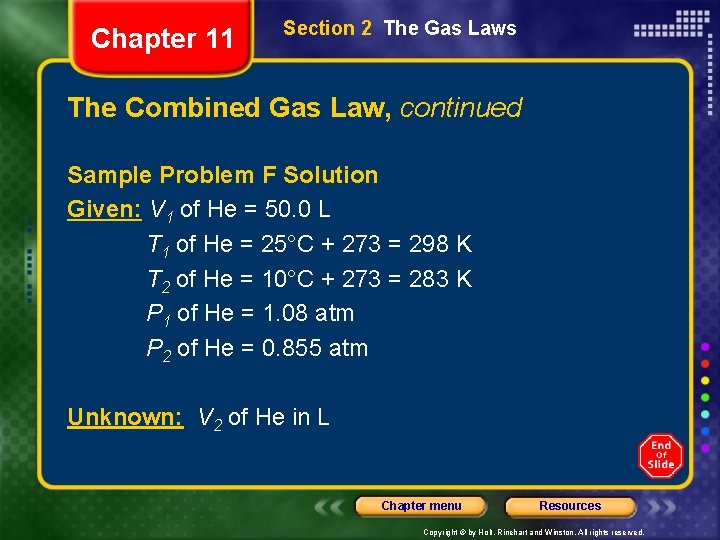
Chapter 11 Section 2 The Gas Laws The Combined Gas Law, continued Sample Problem F Solution Given: V 1 of He = 50. 0 L T 1 of He = 25°C + 273 = 298 K T 2 of He = 10°C + 273 = 283 K P 1 of He = 1. 08 atm P 2 of He = 0. 855 atm Unknown: V 2 of He in L Chapter menu Resources Copyright © by Holt, Rinehart and Winston. All rights reserved.
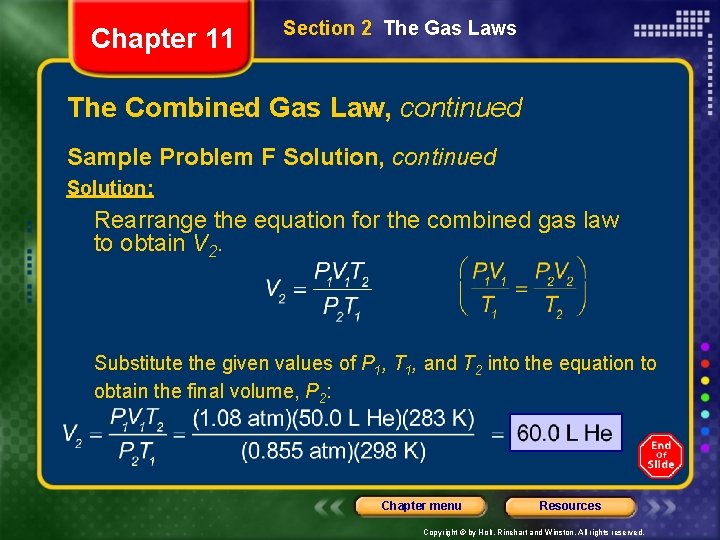
Chapter 11 Section 2 The Gas Laws The Combined Gas Law, continued Sample Problem F Solution, continued Solution: Rearrange the equation for the combined gas law to obtain V 2. Substitute the given values of P 1, T 1, and T 2 into the equation to obtain the final volume, P 2: Chapter menu Resources Copyright © by Holt, Rinehart and Winston. All rights reserved.
End of Chapter 11 Show Chapter menu Resources Copyright © by Holt, Rinehart and Winston. All rights reserved.
Chapter 11 Standardized Test Preparation Multiple Choice 1. Pressure can be measured in A. grams. B. meters. C. pascals. D. liters. Chapter menu Resources Copyright © by Holt, Rinehart and Winston. All rights reserved.
Chapter 11 Standardized Test Preparation Multiple Choice 1. Pressure can be measured in A. grams. B. meters. C. pascals. D. liters. Chapter menu Resources Copyright © by Holt, Rinehart and Winston. All rights reserved.
Chapter 11 Standardized Test Preparation Multiple Choice 2. A sample of oxygen gas has a volume of 150 m. L when its pressure is 0. 923 atm. If the pressure is increased to 0. 987 atm and the temperature remains constant, what will the new volume be? A. 140 m. L B. 160 m. L C. 200 m. L D. 240 m. L Chapter menu Resources Copyright © by Holt, Rinehart and Winston. All rights reserved.
Chapter 11 Standardized Test Preparation Multiple Choice 2. A sample of oxygen gas has a volume of 150 m. L when its pressure is 0. 923 atm. If the pressure is increased to 0. 987 atm and the temperature remains constant, what will the new volume be? A. 140 m. L B. 160 m. L C. 200 m. L D. 240 m. L Chapter menu Resources Copyright © by Holt, Rinehart and Winston. All rights reserved.
Chapter 11 Standardized Test Preparation Multiple Choice 4. A sample of gas in a closed container at a temperature of 100. 0°C and 3. 0 atm is heated to 300. 0°C. What is the pressure of the gas at the higher temperature? A. 35 atm B. 4. 6 atm C. 59 atm D. 9. 0 atm Chapter menu Resources Copyright © by Holt, Rinehart and Winston. All rights reserved.
Chapter 11 Standardized Test Preparation Multiple Choice 4. A sample of gas in a closed container at a temperature of 100. 0°C and 3. 0 atm is heated to 300. 0°C. What is the pressure of the gas at the higher temperature? A. 35 atm B. 4. 6 atm C. 59 atm D. 9. 0 atm Chapter menu Resources Copyright © by Holt, Rinehart and Winston. All rights reserved.
Chapter 11 Standardized Test Preparation Short Answer 8. Give a molecular explanation for the observation that the pressure of a gas increases when the gas volume is decreased. Chapter menu Resources Copyright © by Holt, Rinehart and Winston. All rights reserved.
Chapter 11 Standardized Test Preparation Short Answer 8. Give a molecular explanation for the observation that the pressure of a gas increases when the gas volume is decreased. Answer: The molecules are closer together, so they strike the walls of the container more often. Chapter menu Resources Copyright © by Holt, Rinehart and Winston. All rights reserved.
Chapter 11 Standardized Test Preparation Short Answer 9. The graph on the next slide shows a plot of volume versus pressure for a particular gas sample at constant pressure. Answer the following questions by referring to the graph. No calculation is necessary. a. What is the volume of this gas sample at standard pressure? b. What is the volume of this gas sample at 4. 0 atm pressure? c. At what pressure would this gas sample occupy a volume of 5. 0 L? Chapter menu Resources Copyright © by Holt, Rinehart and Winston. All rights reserved.
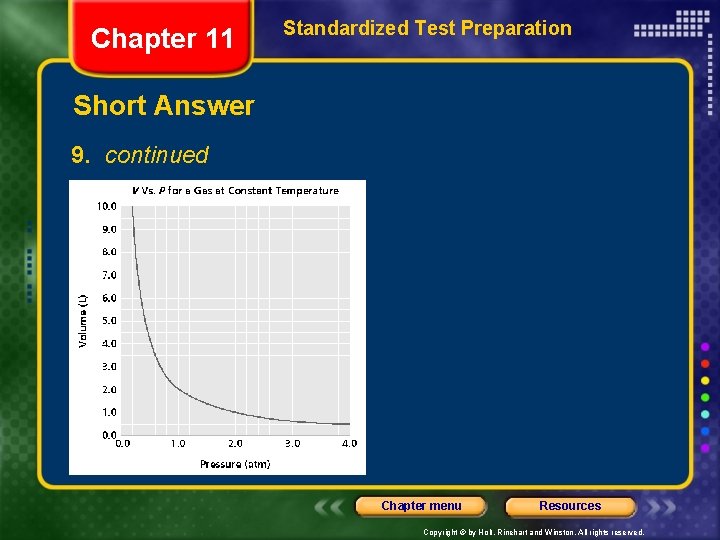
Chapter 11 Standardized Test Preparation Short Answer 9. continued Chapter menu Resources Copyright © by Holt, Rinehart and Winston. All rights reserved.
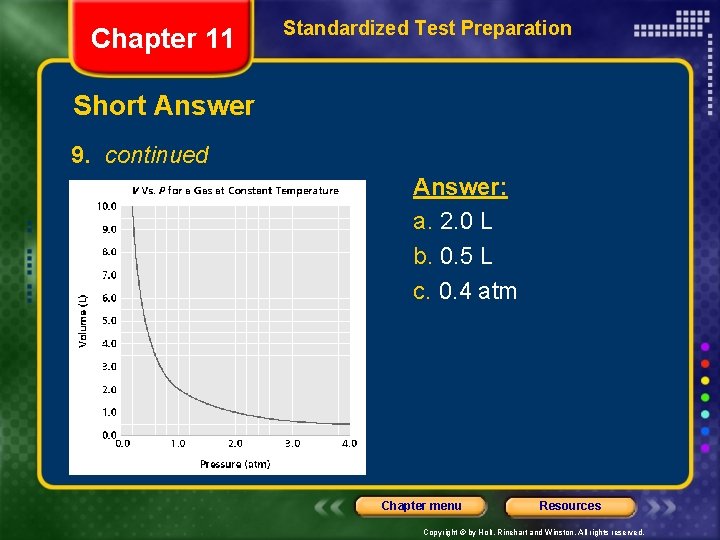
Chapter 11 Standardized Test Preparation Short Answer 9. continued Answer: a. 2. 0 L b. 0. 5 L c. 0. 4 atm Chapter menu Resources Copyright © by Holt, Rinehart and Winston. All rights reserved.
Chapter 11 Standardized Test Preparation Extended Response 10. Refer to the plot in question 9. Suppose the same gas sample were heated to a higher temperature and a new graph of V versus P were plotted. Would the new plot be identical to this one? If not, how would it differ? Chapter menu Resources Copyright © by Holt, Rinehart and Winston. All rights reserved.
Chapter 11 Standardized Test Preparation Extended Response 10. Refer to the plot in question 9. Suppose the same gas sample were heated to a higher temperature and a new graph of V versus P were plotted. Would the new plot be identical to this one? If not, how would it differ? Answer: The plot would not be identical to this one. It would have a similar shape, but would appear higher on the graph. This is because at any pressure, the volume would be higher at the higher temperature. Chapter menu Resources Copyright © by Holt, Rinehart and Winston. All rights reserved.
- Slides: 50