
Chapter 11 Rome Republic to Empire 1 Romulus
Chapter 11 Rome: Republic to Empire 1
Romulus and Remus • Twins of legend • Rome founded by Romulus 753 B. C. E. • Indo-European migrants ca. 2000 B. C. E. • Appearance of bronze metallurgy ca. 1800 B. C. E. ; iron ca. 900 B. C. E. The Etruscans • Originally from Anatolia • Colonized Po River valley to Naples region • Society declined, late sixth century B. C. E. • Greek maritime attacks • Celtic invasions from north 2
The Kingdom of Rome • Roman overthrow of last Etruscan king, 509 B. C. E. • Roman forum built • Republican constitution • Executive: two consuls • Senate Establishment of the Republic • Monarchy through seventh to sixth century B. C. E. • Streets, temples, public buildings • Major center of trade routes 3
Conflicts between Patricians and Plebeians • Patricians: aristocrats • Plebeians: commoners • Major class conflict, fifth century B. C. E. • Plebeians allowed to elect tribunes for representation • Rights expanded through third century B. C. E. • Constitution allowed for dictators to be appointed in times of crisis 4
The Expansion of the Republic • Domination of Etruscans in central Italy • Seized access to iron industry, fifth to fourth century B. C. E. • Expansion via military threat and incentives • Tax exemptions • Trade privileges • Citizenship The Punic Wars • Conflict with Carthage, 264– 146 B. C. E. • Three major wars over Sicilian grain supply • Later conflict with declining Hellenistic empires • Rome dominated Mediterranean by middle of second century B. C. E. 5
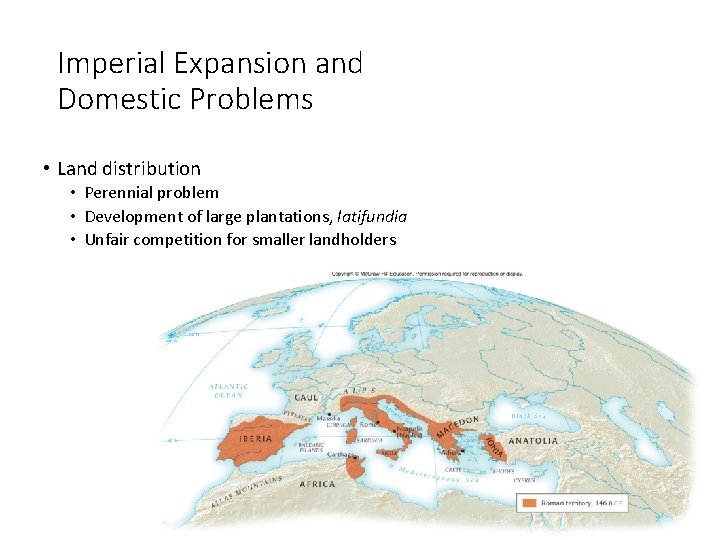
Imperial Expansion and Domestic Problems • Land distribution • Perennial problem • Development of large plantations, latifundia • Unfair competition for smaller landholders 6
The Gracchi Brothers • Tiberius and Gaius • Attempted to limit land holdings of aristocrats • Tiberius assassinated; Gaius executed • Development of private armies made up of landless peasants • Gaius Marius (with reformers) • Lucius Cornelius Sulla (with aristocrats) Civil War • Rome taken by Gaius Marius, 87 B. C. E. • Driven out by Lucius Cornelius Sulla, 83 B. C. E. • Reign of terror followed 7
The Foundation of Empire • Nephew of Marius, Julius Caesar • Escaped Sulla’s terror • Relatively young; well-timed trip abroad • Active role in Roman politics as member of First Triumvirate • Public spectacles; victories in Gaul; rising popularity • Caesar turned army toward Rome, 49 B. C. E. • Named self dictator for life, 46 B. C. E. 8
Caesar’s Policies • Centralized military, governance under personal control • Redistribution of land to war veterans, other allies • Major building projects to reduce urban unemployment • Extended citizenship to provinces • Aristocrats alienated by Caesar’s rule • Caesar assassinated, 44 B. C. E. 9
Augustus • Civil conflict following death of Caesar • Power belonged to Octavian • Octavian’s defeat of Mark Antony and Cleopatra • Took title of Augustus, 27 B. C. E. Augustus’s Administration • Monarchy disguised as a republic • Increasing centralization of political, military power • Stabilized empire • Death of Augustus, 14 C. E. 10
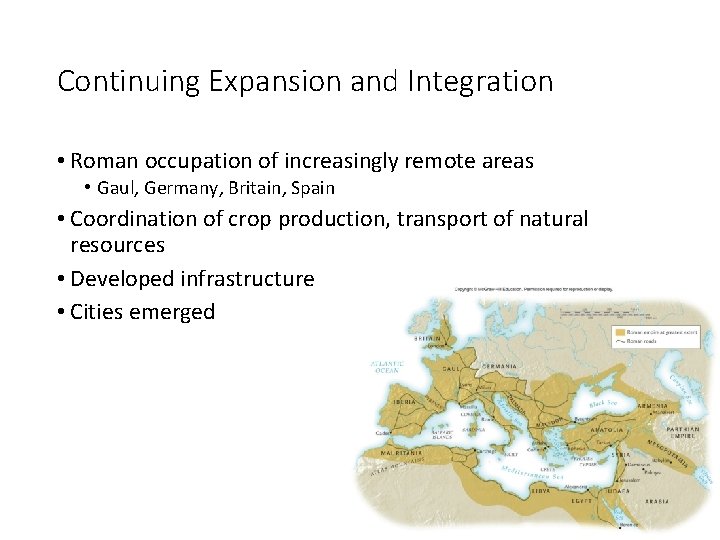
Continuing Expansion and Integration • Roman occupation of increasingly remote areas • Gaul, Germany, Britain, Spain • Coordination of crop production, transport of natural resources • Developed infrastructure • Cities emerged 11
The Pax Romana • “Roman peace” beginning with reign of Augustus • Persisted for two and a half centuries • Facilitated trade, communication • Roman roads • Curbs, drainage • Flat paving stones, milestones • Postal service • Sea lanes throughout Mediterranean Sea, Black Sea 12
Roman Law • Twelve Tables, 449 B. C. E. • Adapted to diverse populations under Roman rule • Innocent until proven guilty • Right to challenge accusers in court Commercial Agriculture and Trade • Latifundia: production for export • Increasing regional specialization • Integration of empire-wide economy • Periplus maris erythraei: “sailing itinerary of the Red Sea” 13
The City of Rome • Tremendous cash flow • Taxes, tribute, spoils, commerce • Massive construction projects • Statuary, monumental architecture, aqueducts • Use of concrete, invented by Roman engineers Roman Cities and Their Attractions • Imported goods • Underground sewage • Circus Maximus • Accommodated 250, 000 spectators • Roman Colosseum • Seating for 50, 000 • Mock naval battles • Gladiatorial games 14
Family and Society • Paterfamilias: “father of the family” • Right to arrange marriages, sell children into slavery • Women not allowed to inherit property • Enforcement inconsistent Wealth and Social Change • Newly rich rivaled old nobility • Poverty also becoming considerable problem • Imperial authorities sought to distract with “bread and circuses” (Juvenal) 15
Slavery • Second century C. E. , slaves estimated at one-third of empire’s population • Customary manumission at age 30 • Agricultural work, quarries, mines • Chain labor • Several large-scale revolts • Most serious under Spartacus, 73 B. C. E. 16
Roman Deities • Polytheistic • Major gods • Tutelary deities • Absorption of gods from other cultures Cicero and Stoicism • Marcus Tullius Cicero (106– 43 B. C. E. ) • Major orator, writer • Influenced by Greek thought • Proponent of Stoicism 17
Religions of Salvation • Reflected political and social conditions of Hellenistic period • Appeal: sense of purpose, promise of glorious future existence Mithraism • From Zoroastrian myth: god of sun, light • Roman version emphasized strength, courage, discipline • Women not admitted • Appealed to military • Cult of Isis also popular • Among cults that made place for both men and women 18
The Jews and the Empire • Jewish monotheism at odds with most ancient cultures • Refusal to recognize state gods • Several Jewish rebellions against overlords • Romans ultimately crushed Jewish self-governance in Jewish War (66– 70 C. E. ) 19
Jesus of Nazareth • Jewish teacher • Moral code, reputation for miracle-working • Romans feared instigation of rebellion; crucified Jesus’ Early Followers • Belief in Jesus’ resurrection, divine nature • Title Christ: “anointed one” • Teachings recorded in New Testament • Paul of Tarsus • Extended teachings far beyond Jewish circles • Traveled widely throughout Roman empire • Missionary activity 20
Early Christian Communities • Local leaders: bishops • Regional variation in doctrine and ritual • Nature of resurrection • Role of women • Gradual acceptance of core texts The Growth of Early Christianity • Roman campaigns of persecution • Yet dramatic expansion of Christianity • Especially with dispossessed, disfranchised classes • Urban poor • Women 21
- Slides: 21