
Chapter 11 Rolling Torque and Angular Momentum Rolling

- Slides: 39
Chapter 11 Rolling, Torque, and Angular Momentum
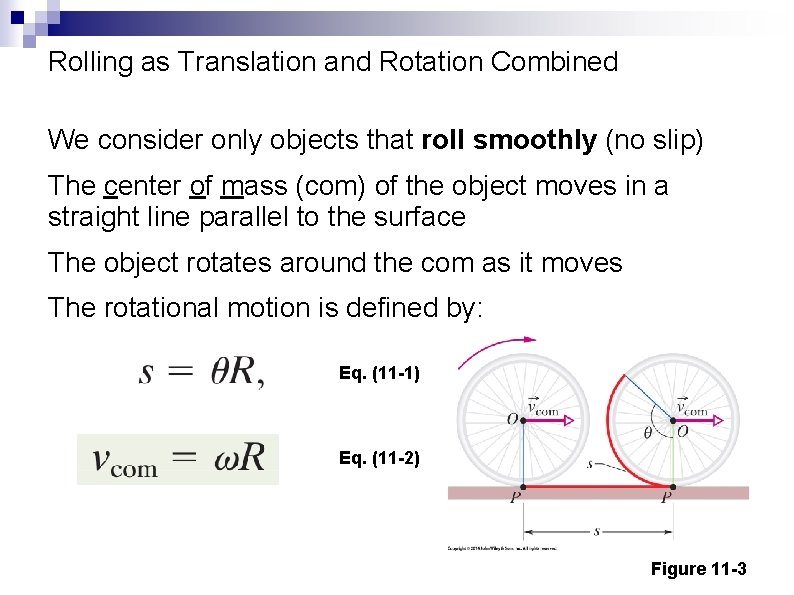
Rolling as Translation and Rotation Combined We consider only objects that roll smoothly (no slip) The center of mass (com) of the object moves in a straight line parallel to the surface The object rotates around the com as it moves The rotational motion is defined by: Eq. (11 -1) Eq. (11 -2) Figure 11 -3
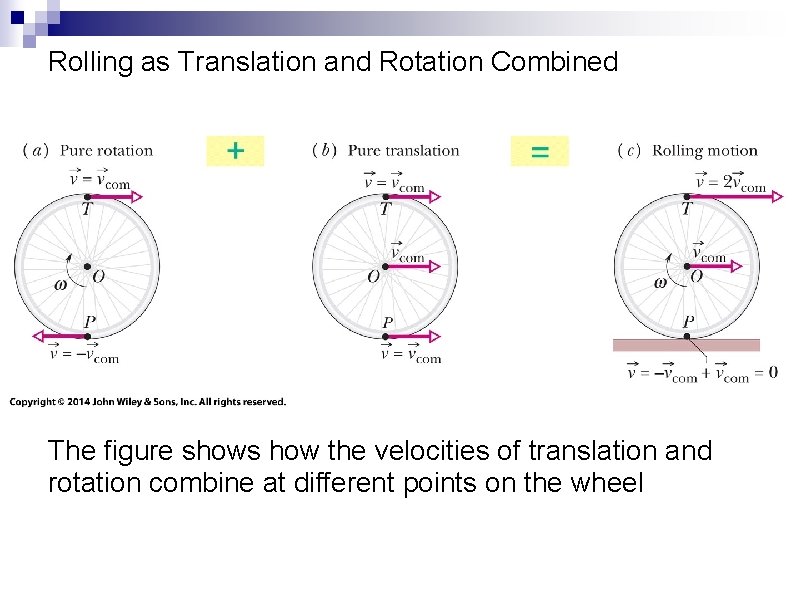
Rolling as Translation and Rotation Combined The figure shows how the velocities of translation and rotation combine at different points on the wheel
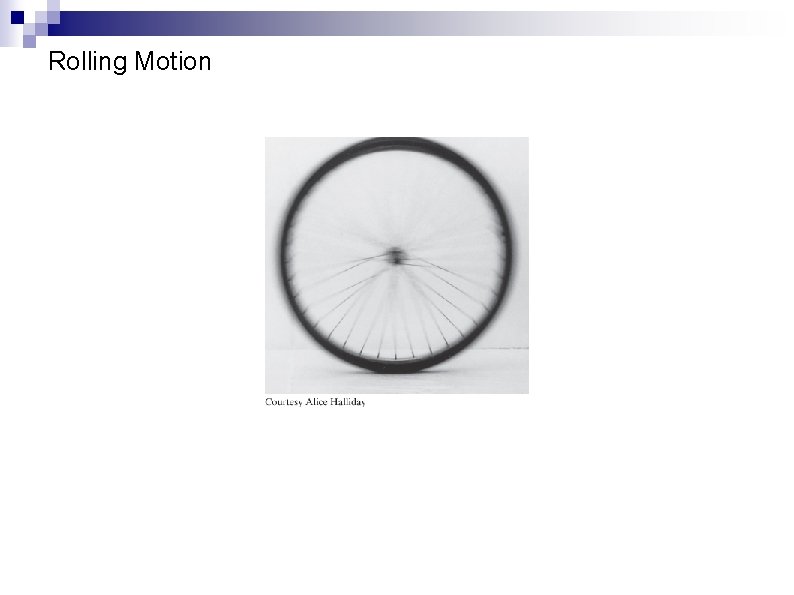
Rolling Motion
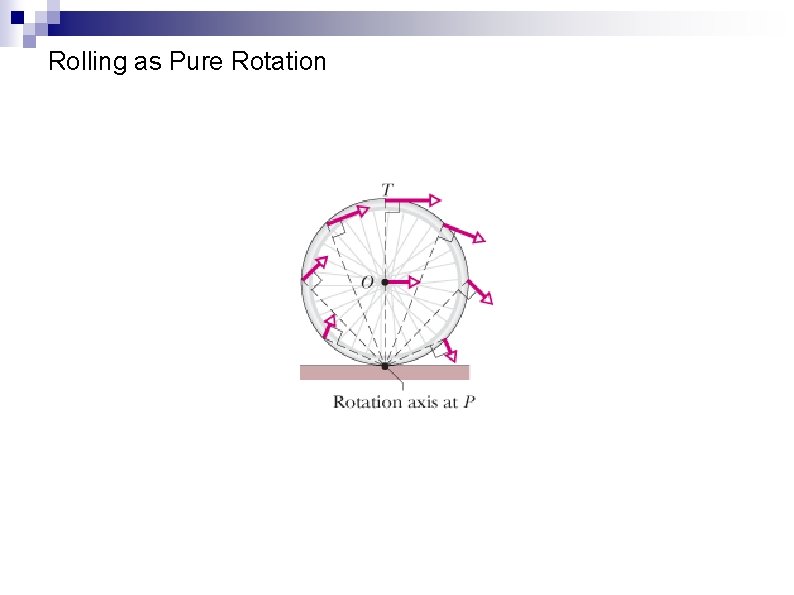
Rolling as Pure Rotation
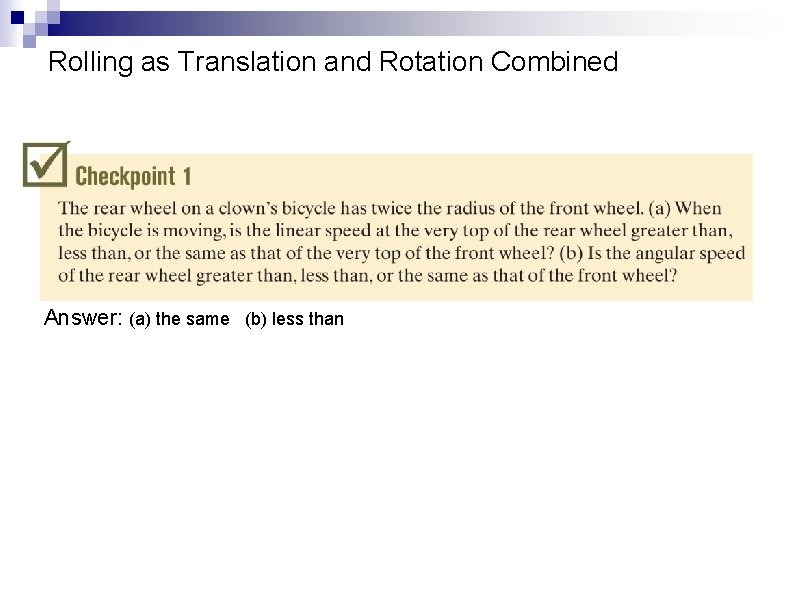
Rolling as Translation and Rotation Combined Answer: (a) the same (b) less than
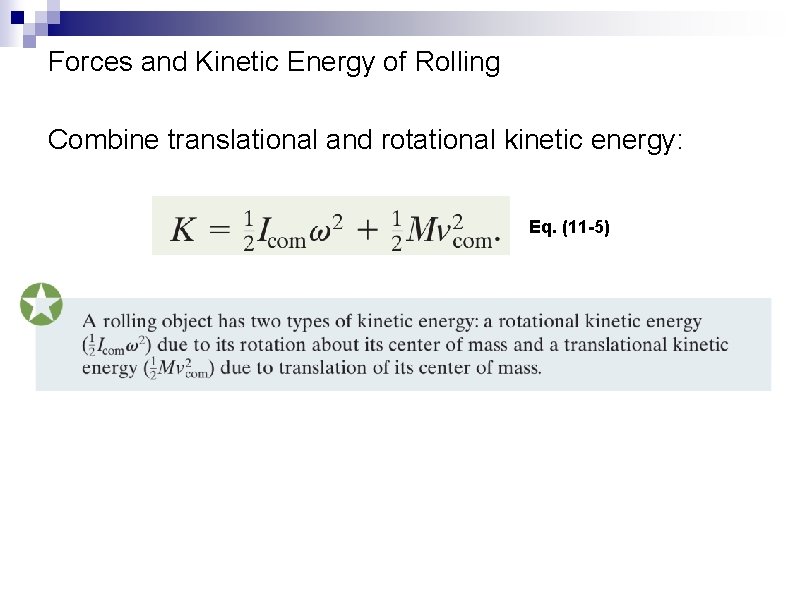
Forces and Kinetic Energy of Rolling Combine translational and rotational kinetic energy: Eq. (11 -5)
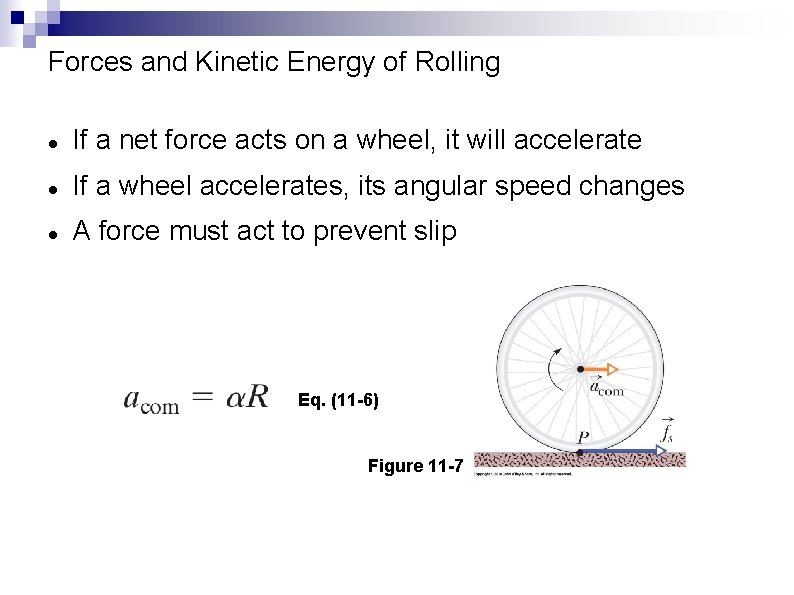
Forces and Kinetic Energy of Rolling If a net force acts on a wheel, it will accelerate If a wheel accelerates, its angular speed changes A force must act to prevent slip Eq. (11 -6) Figure 11 -7
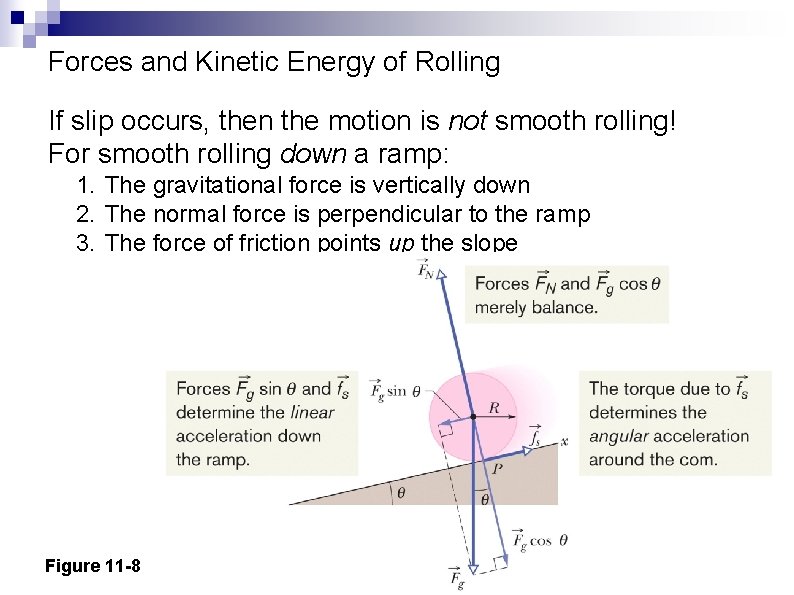
Forces and Kinetic Energy of Rolling If slip occurs, then the motion is not smooth rolling! For smooth rolling down a ramp: 1. The gravitational force is vertically down 2. The normal force is perpendicular to the ramp 3. The force of friction points up the slope Figure 11 -8
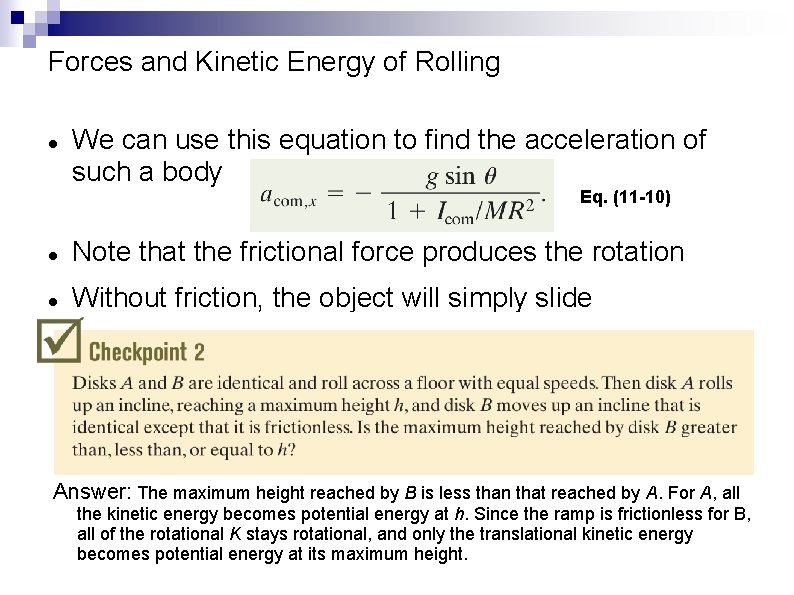
Forces and Kinetic Energy of Rolling We can use this equation to find the acceleration of such a body Eq. (11 -10) Note that the frictional force produces the rotation Without friction, the object will simply slide Answer: The maximum height reached by B is less than that reached by A. For A, all the kinetic energy becomes potential energy at h. Since the ramp is frictionless for B, all of the rotational K stays rotational, and only the translational kinetic energy becomes potential energy at its maximum height.
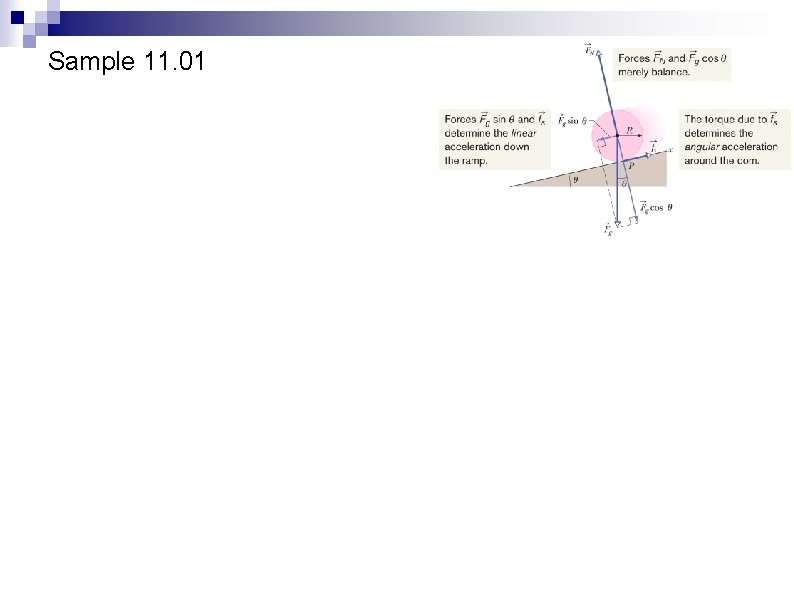
Sample 11. 01
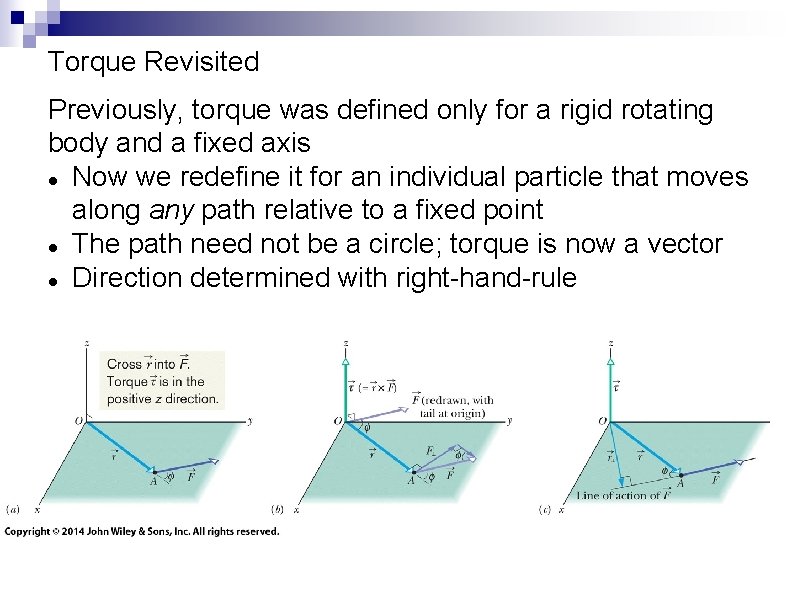
Torque Revisited Previously, torque was defined only for a rigid rotating body and a fixed axis Now we redefine it for an individual particle that moves along any path relative to a fixed point The path need not be a circle; torque is now a vector Direction determined with right-hand-rule
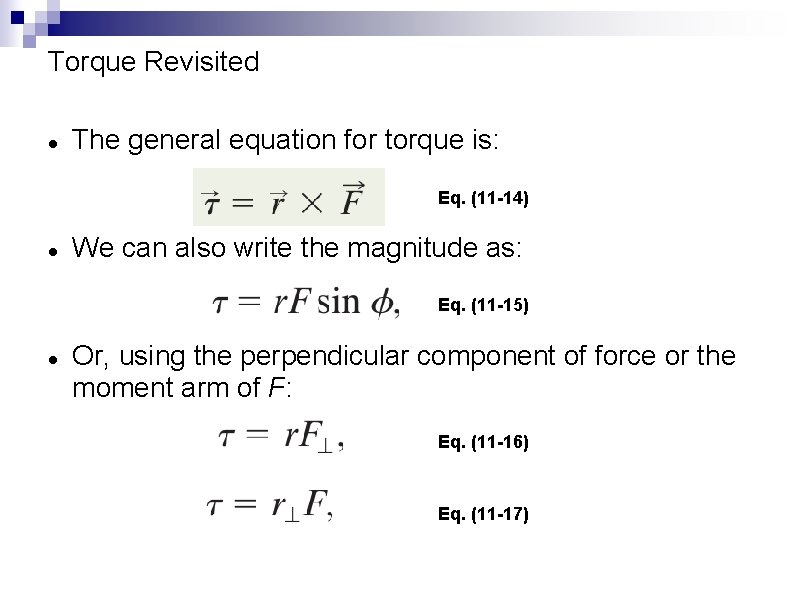
Torque Revisited The general equation for torque is: Eq. (11 -14) We can also write the magnitude as: Eq. (11 -15) Or, using the perpendicular component of force or the moment arm of F: Eq. (11 -16) Eq. (11 -17)
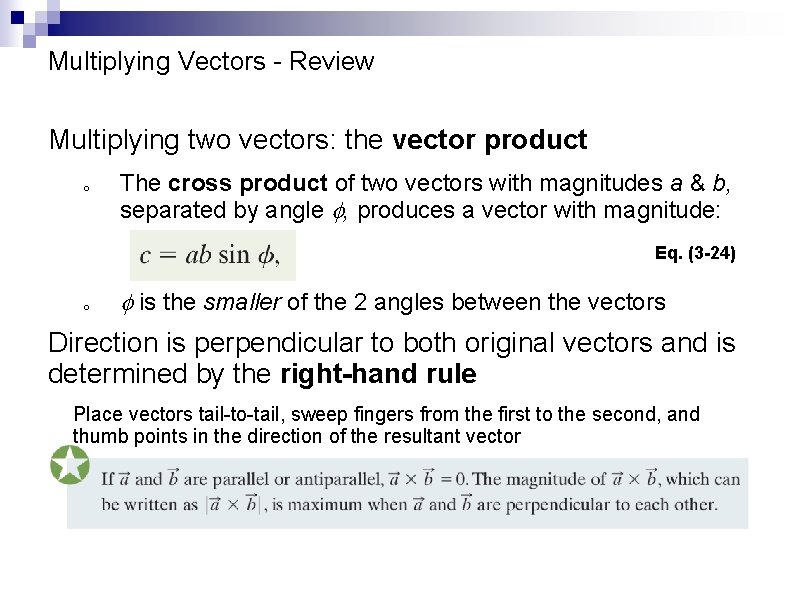
Multiplying Vectors - Review Multiplying two vectors: the vector product o The cross product of two vectors with magnitudes a & b, separated by angle f, produces a vector with magnitude: Eq. (3 -24) o f is the smaller of the 2 angles between the vectors Direction is perpendicular to both original vectors and is determined by the right-hand rule Place vectors tail-to-tail, sweep fingers from the first to the second, and thumb points in the direction of the resultant vector © 2014 John Wiley & Sons, Inc. All rights reserved.
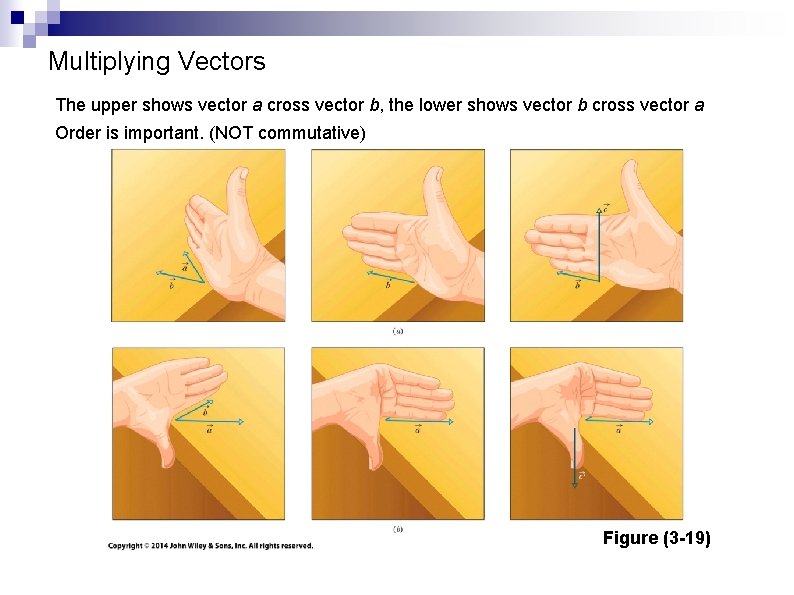
Multiplying Vectors The upper shows vector a cross vector b, the lower shows vector b cross vector a Order is important. (NOT commutative) Figure (3 -19) © 2014 John Wiley & Sons, Inc. All rights reserved.
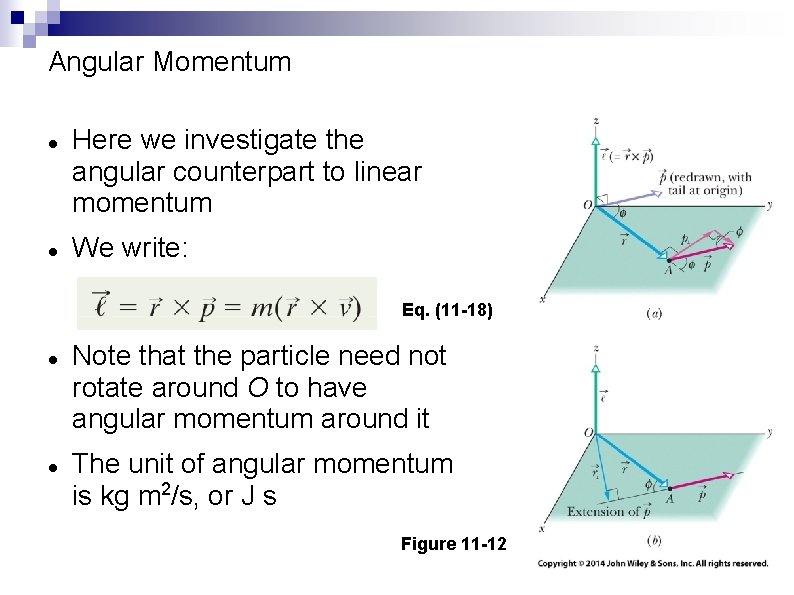
Angular Momentum Here we investigate the angular counterpart to linear momentum We write: Eq. (11 -18) Note that the particle need not rotate around O to have angular momentum around it The unit of angular momentum is kg m 2/s, or J s Figure 11 -12
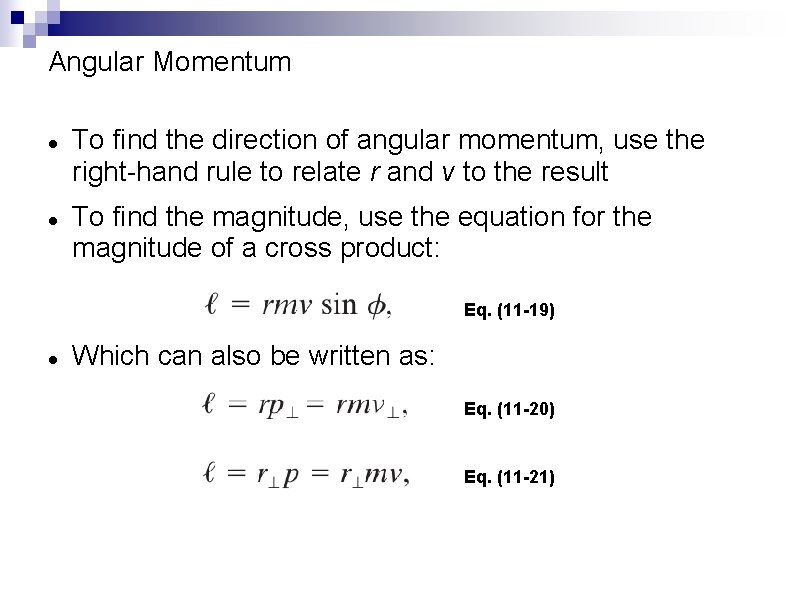
Angular Momentum To find the direction of angular momentum, use the right-hand rule to relate r and v to the result To find the magnitude, use the equation for the magnitude of a cross product: Eq. (11 -19) Which can also be written as: Eq. (11 -20) Eq. (11 -21)
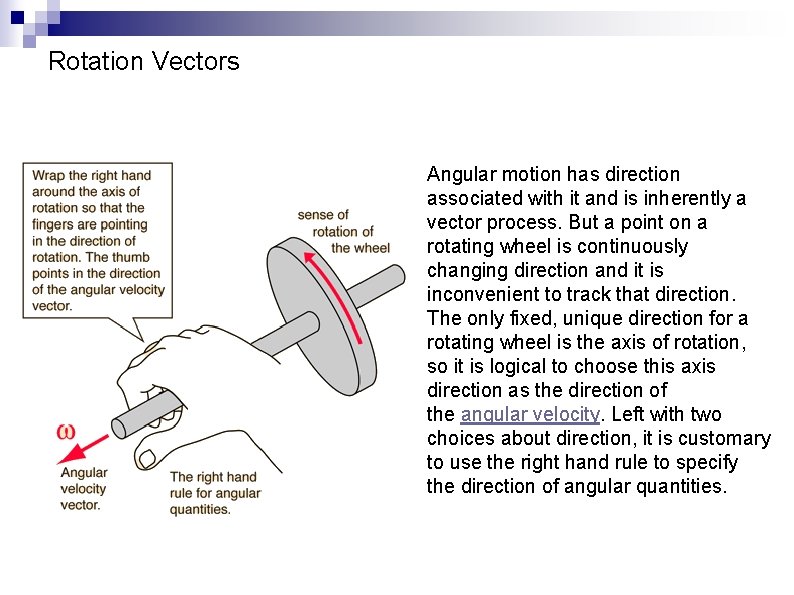
Rotation Vectors Angular motion has direction associated with it and is inherently a vector process. But a point on a rotating wheel is continuously changing direction and it is inconvenient to track that direction. The only fixed, unique direction for a rotating wheel is the axis of rotation, so it is logical to choose this axis direction as the direction of the angular velocity. Left with two choices about direction, it is customary to use the right hand rule to specify the direction of angular quantities.
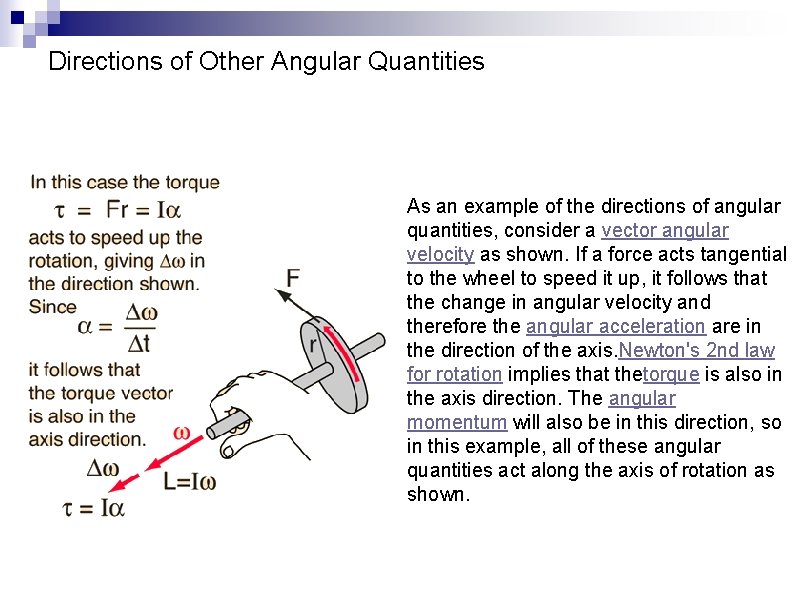
Directions of Other Angular Quantities As an example of the directions of angular quantities, consider a vector angular velocity as shown. If a force acts tangential to the wheel to speed it up, it follows that the change in angular velocity and therefore the angular acceleration are in the direction of the axis. Newton's 2 nd law for rotation implies that thetorque is also in the axis direction. The angular momentum will also be in this direction, so in this example, all of these angular quantities act along the axis of rotation as shown.
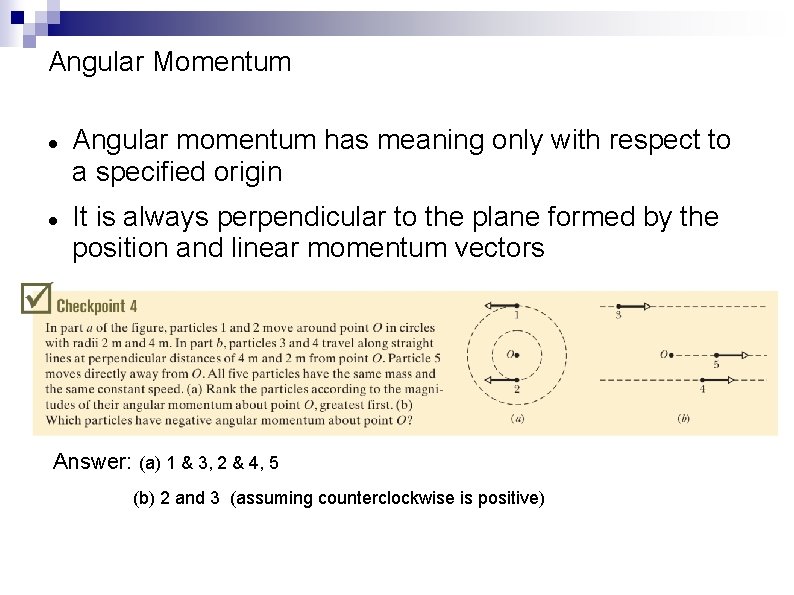
Angular Momentum Angular momentum has meaning only with respect to a specified origin It is always perpendicular to the plane formed by the position and linear momentum vectors Answer: (a) 1 & 3, 2 & 4, 5 (b) 2 and 3 (assuming counterclockwise is positive)
Sample Problem 11. 03
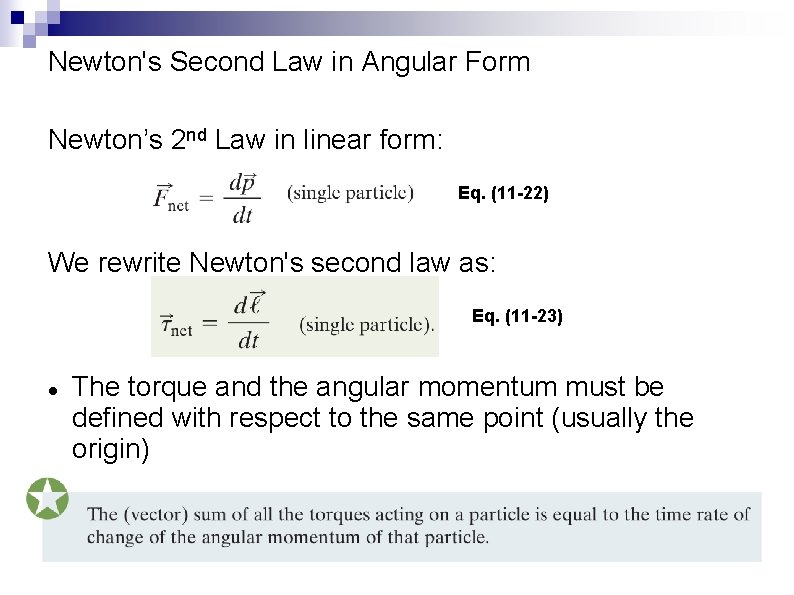
Newton's Second Law in Angular Form Newton’s 2 nd Law in linear form: Eq. (11 -22) We rewrite Newton's second law as: Eq. (11 -23) The torque and the angular momentum must be defined with respect to the same point (usually the origin)
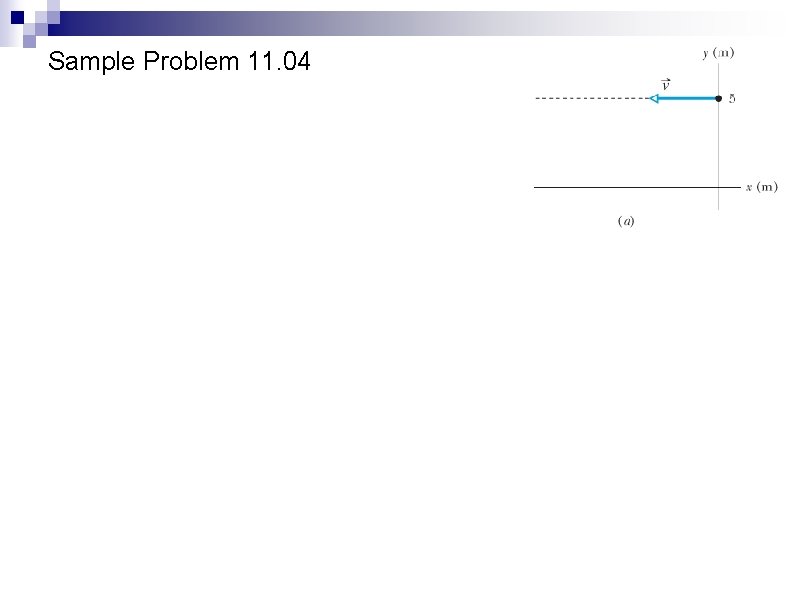
Sample Problem 11. 04
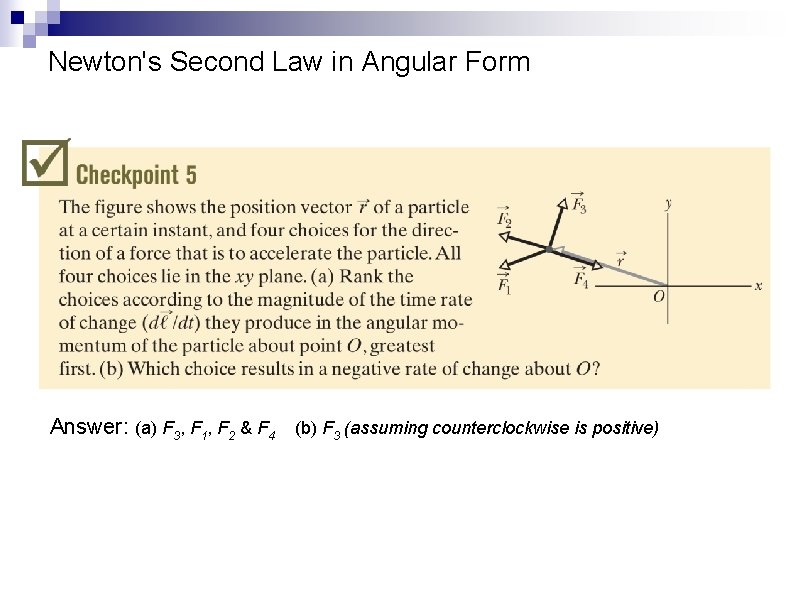
Newton's Second Law in Angular Form Answer: (a) F 3, F 1, F 2 & F 4 (b) F 3 (assuming counterclockwise is positive)
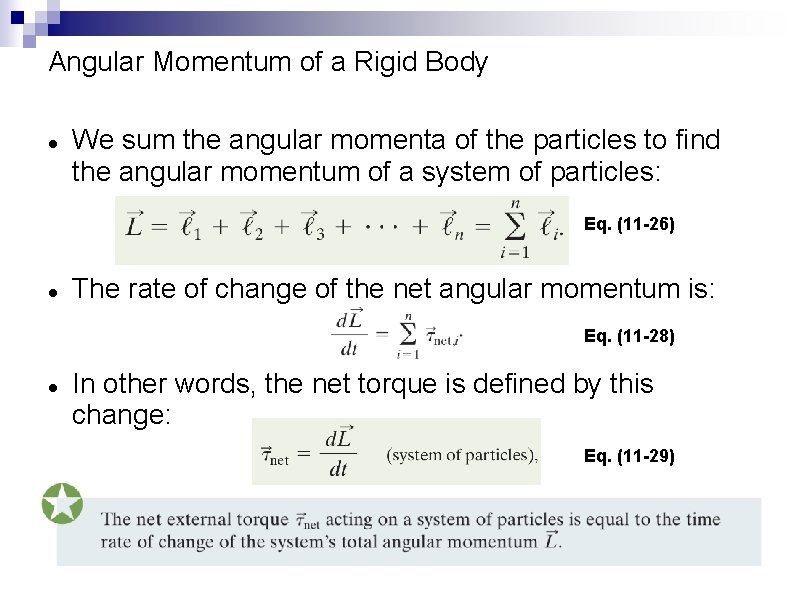
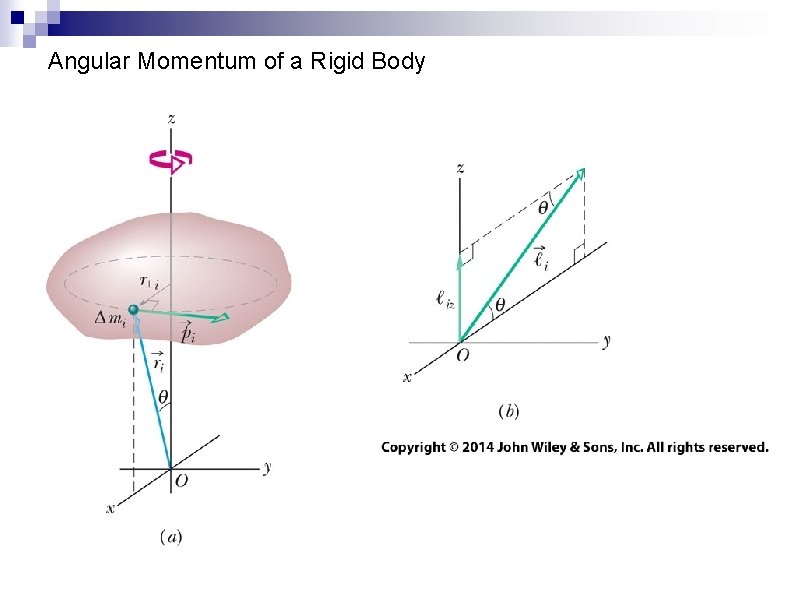
Angular Momentum of a Rigid Body We sum the angular momenta of the particles to find the angular momentum of a system of particles: Eq. (11 -26) The rate of change of the net angular momentum is: Eq. (11 -28) In other words, the net torque is defined by this change: Eq. (11 -29)
Angular Momentum of a Rigid Body
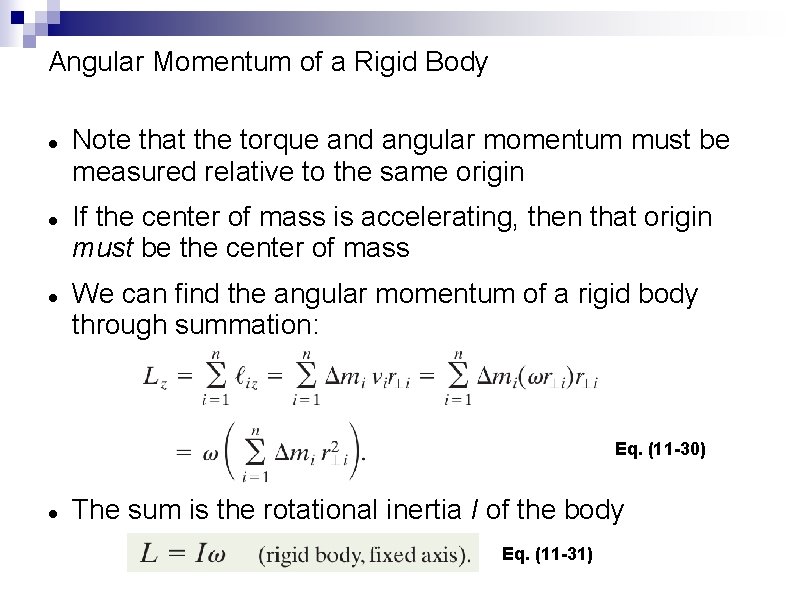
Angular Momentum of a Rigid Body Note that the torque and angular momentum must be measured relative to the same origin If the center of mass is accelerating, then that origin must be the center of mass We can find the angular momentum of a rigid body through summation: Eq. (11 -30) The sum is the rotational inertia I of the body Eq. (11 -31)
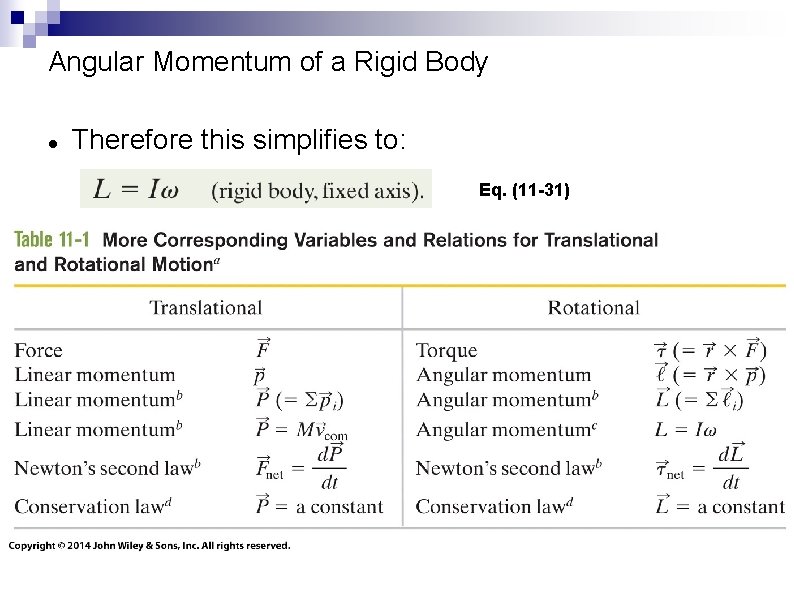
Angular Momentum of a Rigid Body Therefore this simplifies to: Eq. (11 -31)
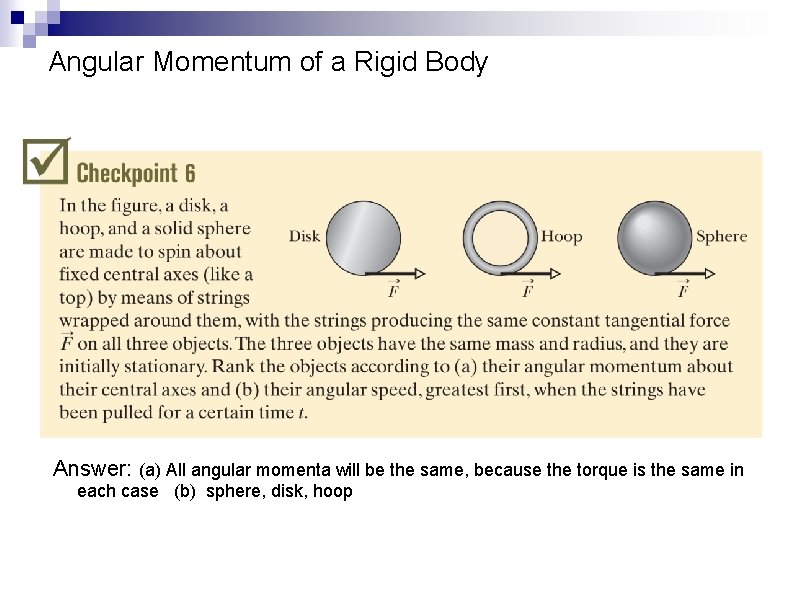
Angular Momentum of a Rigid Body Answer: (a) All angular momenta will be the same, because the torque is the same in each case (b) sphere, disk, hoop
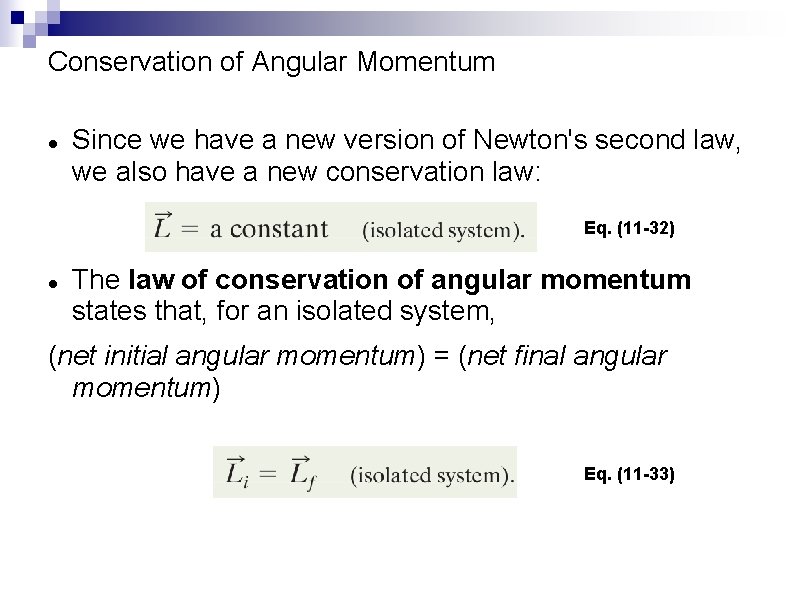
Conservation of Angular Momentum Since we have a new version of Newton's second law, we also have a new conservation law: Eq. (11 -32) The law of conservation of angular momentum states that, for an isolated system, (net initial angular momentum) = (net final angular momentum) Eq. (11 -33)
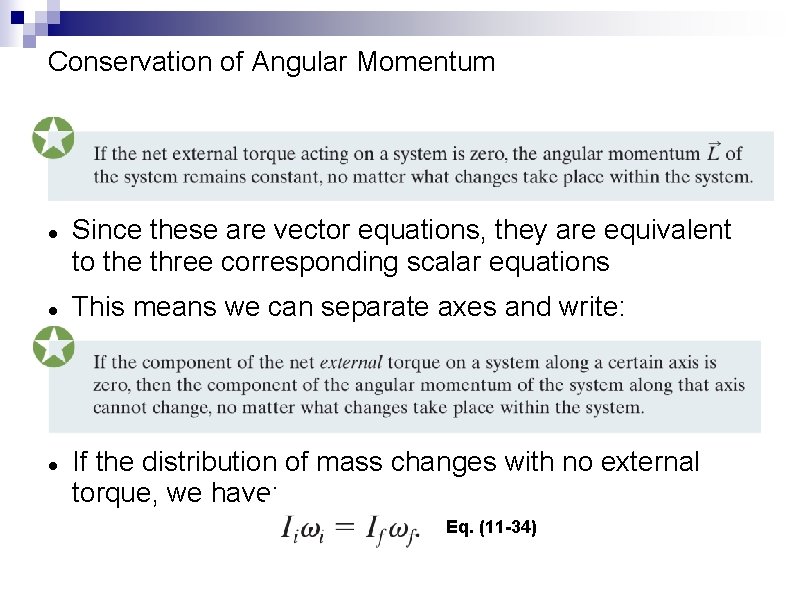
Conservation of Angular Momentum Since these are vector equations, they are equivalent to the three corresponding scalar equations This means we can separate axes and write: If the distribution of mass changes with no external torque, we have: Eq. (11 -34)
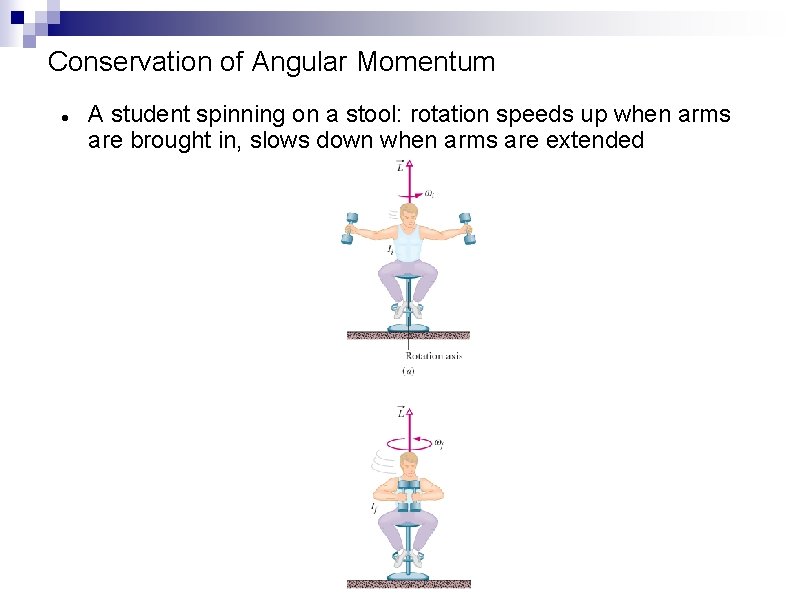
Conservation of Angular Momentum A student spinning on a stool: rotation speeds up when arms are brought in, slows down when arms are extended
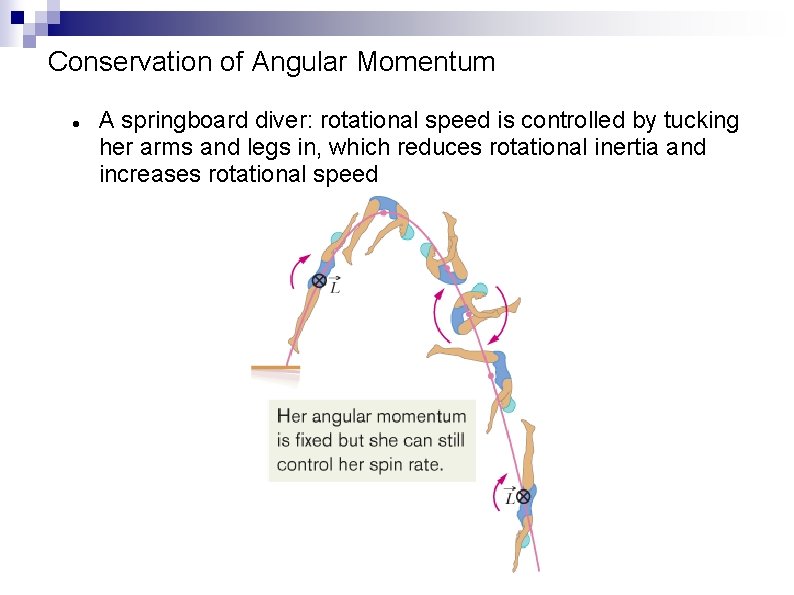
Conservation of Angular Momentum A springboard diver: rotational speed is controlled by tucking her arms and legs in, which reduces rotational inertia and increases rotational speed
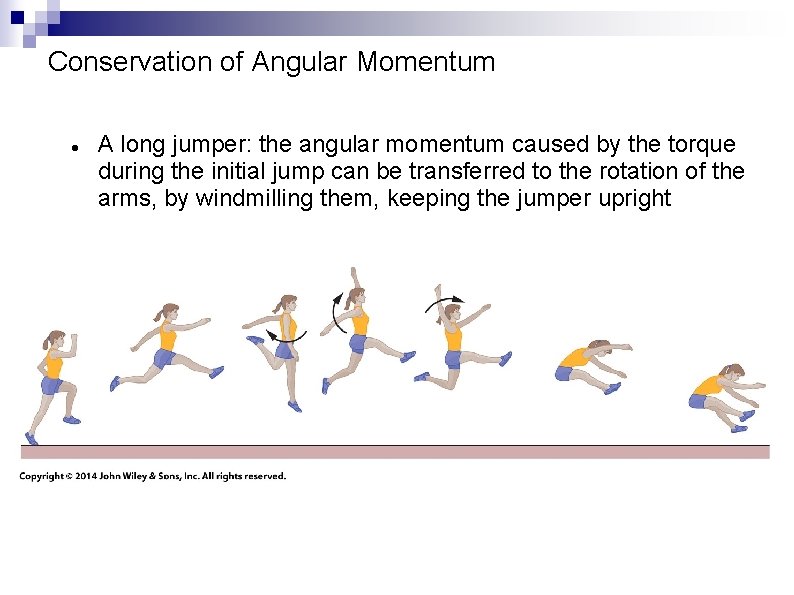
Conservation of Angular Momentum A long jumper: the angular momentum caused by the torque during the initial jump can be transferred to the rotation of the arms, by windmilling them, keeping the jumper upright
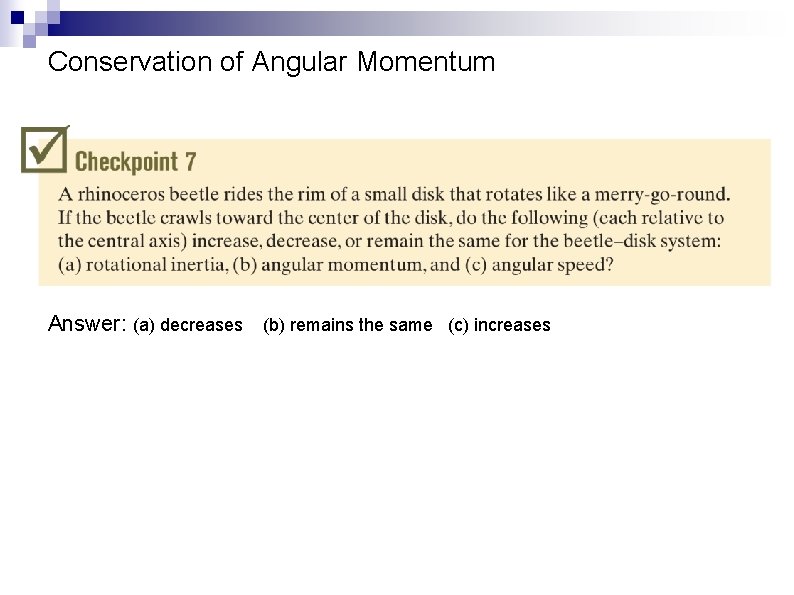
Conservation of Angular Momentum Answer: (a) decreases (b) remains the same (c) increases
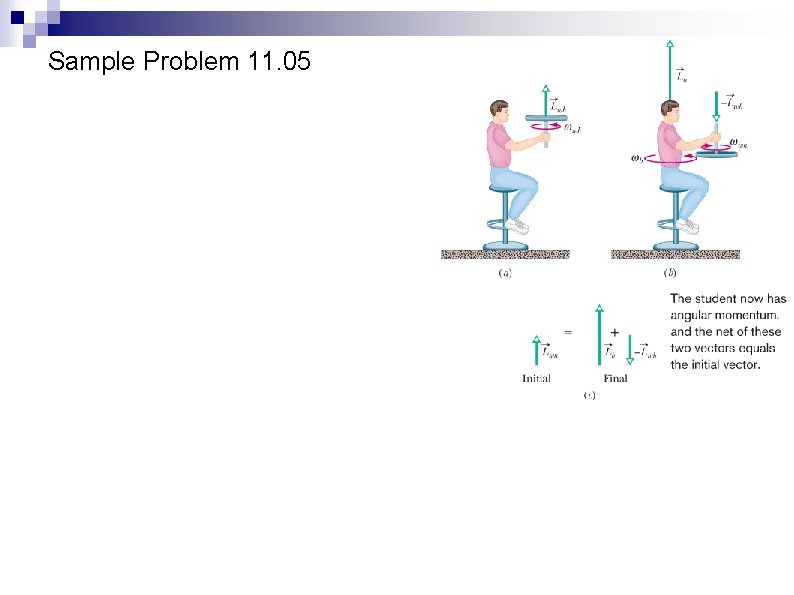
Sample Problem 11. 05
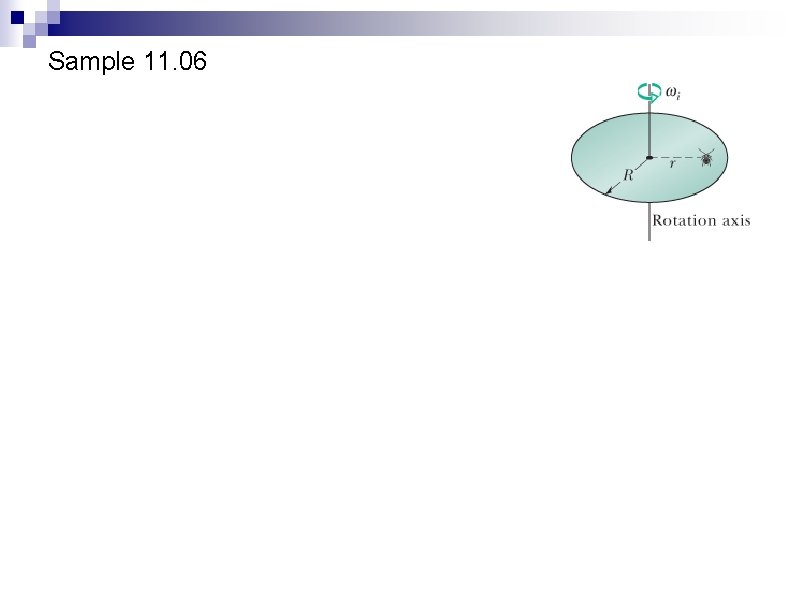
Sample 11. 06
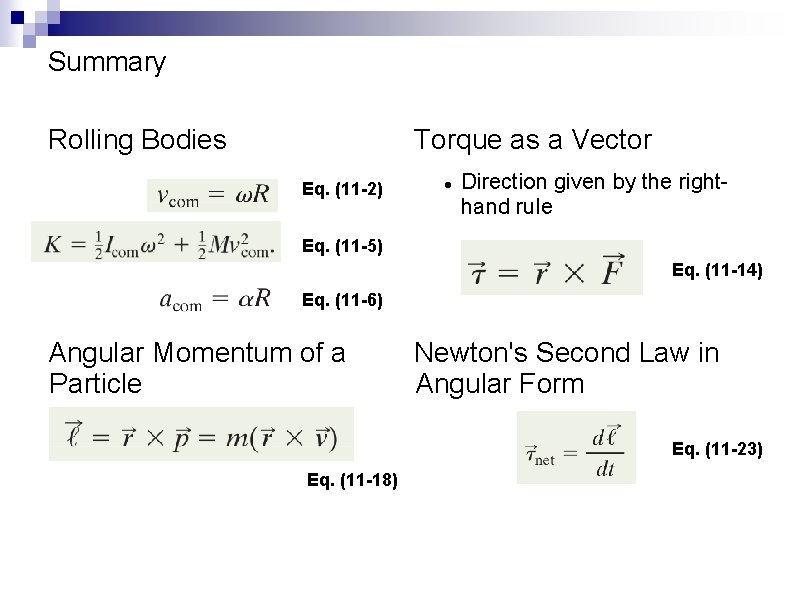
Summary Rolling Bodies Torque as a Vector Eq. (11 -2) Direction given by the righthand rule Eq. (11 -5) Eq. (11 -14) Eq. (11 -6) Angular Momentum of a Particle Newton's Second Law in Angular Form Eq. (11 -23) Eq. (11 -18)
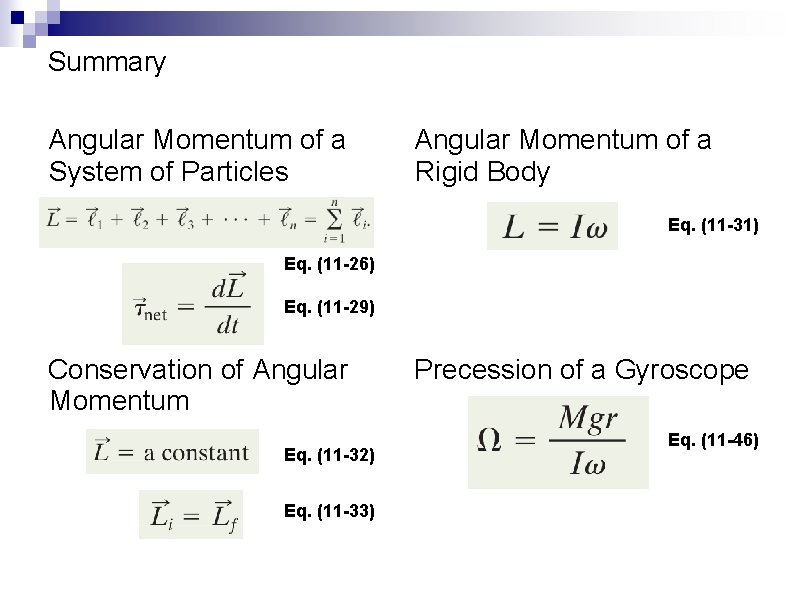
Summary Angular Momentum of a System of Particles Angular Momentum of a Rigid Body Eq. (11 -31) Eq. (11 -26) Eq. (11 -29) Conservation of Angular Momentum Eq. (11 -32) Eq. (11 -33) Precession of a Gyroscope Eq. (11 -46)