
Chapter 11 RF cavities for particle accelerators Rdiger




- Slides: 18
Chapter 11 RF cavities for particle accelerators Rüdiger Schmidt (CERN) – Darmstadt TU - 2011 –Version E 2. 2
Accelerating structures in linear and circular accelerators • Acceleration cavity (cavity) • Analogy between oscillating circuit and cavity • Cylindrical cavity • Shunt impedance and quality factor 2
Acceleration in the cylindrical cavity. T=0 (accelerating phase) (100 MHz) 2 a z E(z) E 0 g z 3
Linear and circular accelerators Linear accelerator: Acceleration by traveling once through many RF Circular accelerator: Acceleration by travelling many times through few RF cavities 4
Analogy between cavity and oscillating circuit C L R A simple RF accelerator would work with a capacitor (with an opening for the beam) and a coil in parallel to the capacitor. The energy oscillates between electric and magnetic field. L R 5
Analogy between cavity and oscillating circuit Oscillating circuit with capacitor, coil and resistance. C L R 6
For a frequency of 100 MHz, a typical value for an accelerator, the inductance of the coil and the capacity of the condenser must be chosen very small. Example:
From oscillating circuit to the cavity C C L L The fields in the cavity oscillate in TM 010 mode (no longitudinal magnetic field). There an infinite number of oscilllation modes, but only a few are used for cavities (calculation from Maxwells equations, application for waveguides, for example K. Wille) 8
Parameter of a cylindrical cavity („pill-box“) 2 a z A cylindrical cavity with the length of g, the aperture 2*a and the field of E(t) g 9
Acceleration in a cylindrical cavity 2 a z E(z) E 0 g z 10
Cavity with rotational symmetry The cavity parameter depend on the geometry and the material: • Geometry • Material => Frequency => Quality factor r 0 z gc Comes from Besselfunction (Solution of wave equation) 11
Field strength for E 010 mode for a „pillbox cavity“ r 0 z 12
Example for „Transit Time Factor“ 14
Illustration for the electric field in the RF cavity 15
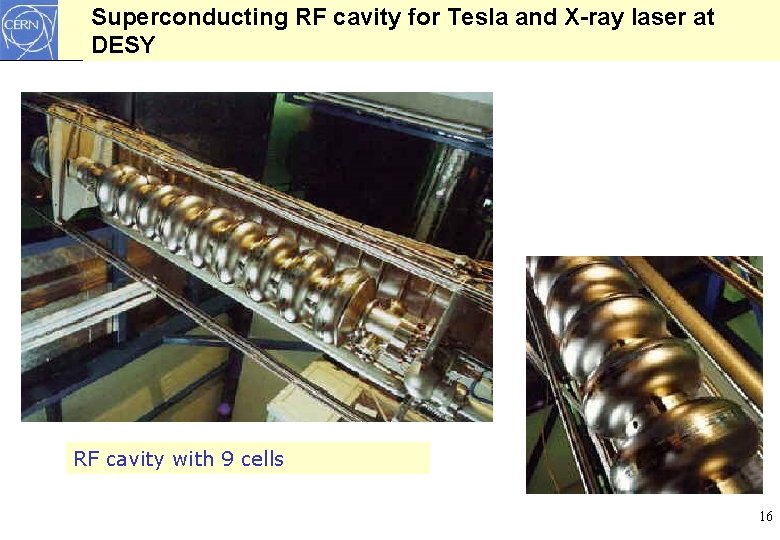
Superconducting RF cavity for Tesla and X-ray laser at DESY RF cavity with 9 cells 16
Normal-conducting RF cavity for LEP 17
Parameters for Cavities Shunt impedance (Definition for a circular accelerator) : For the DORIS Cavity : Q factor: 38000 Quality factor Q : 18