
Chapter 11 Respiratory Emergencies 11 Respiratory Emergencies Objectives
Chapter 11 Respiratory Emergencies

11: Respiratory Emergencies Objectives (1 of 3) • List the structure and functions of the respiratory system. • State the signs and symptoms of a patient with difficulty breathing. • Recognize the need for medical direction to assist in the care of breathing difficulty. Emergency Care and Transportation of the Sick and Injured, 8 th Edition AAOS 2
11: Respiratory Emergencies Objectives (2 of 3) • Describe the care of a patient with breathing distress. • Establish the relationship between airway management and breathing difficulty. • List signs of adequate air exchange. Emergency Care and Transportation of the Sick and Injured, 8 th Edition AAOS 3
11: Respiratory Emergencies Objectives (3 of 3) • State the generic name, forms, dose, administration, actions, indications, and contraindications for inhalers. • Differentiate between upper airway obstruction and lower airway disease in infants. Emergency Care and Transportation of the Sick and Injured, 8 th Edition AAOS 4

11: Respiratory Emergencies Respiratory System Emergency Care and Transportation of the Sick and Injured, 8 th Edition AAOS 5
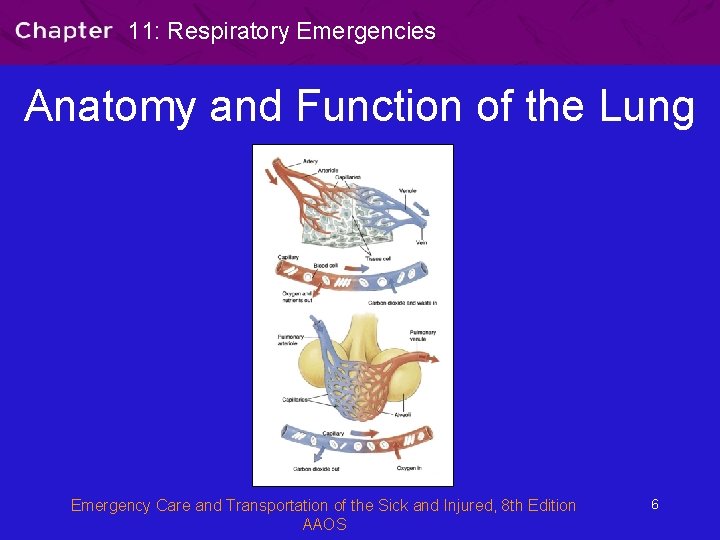
11: Respiratory Emergencies Anatomy and Function of the Lung Emergency Care and Transportation of the Sick and Injured, 8 th Edition AAOS 6
11: Respiratory Emergencies Characteristics of Poor Breathing • Pulmonary vessels become obstructed. • Alveoli are damaged. • Air passages are obstructed. • Blood flow to the lungs is obstructed. • Pleural space is filled. Emergency Care and Transportation of the Sick and Injured, 8 th Edition AAOS 7

11: Respiratory Emergencies Characteristics of Normal Breathing • Normal rate and depth • Regular breathing pattern • Good breath sounds on both sides of the chest • Equal rise and fall of chest • Movement of the abdomen Emergency Care and Transportation of the Sick and Injured, 8 th Edition AAOS 8
11: Respiratory Emergencies Signs of Abnormal Breathing • Slower than 8 breaths/min or faster than 24 breaths/min • Muscle retractions • Pale or cyanotic skin • Cool, damp (clammy) skin • Shallow or irregular respirations • Pursed lips • Nasal flaring Emergency Care and Transportation of the Sick and Injured, 8 th Edition AAOS 9
11: Respiratory Emergencies Dyspnea • Shortness of breath or difficulty breathing • Patient may not be alert enough to complain of shortness of breath. Emergency Care and Transportation of the Sick and Injured, 8 th Edition AAOS 10
11: Respiratory Emergencies Upper or Lower Airway Infection • Infectious diseases may affect all parts of the airway. • The problem is some form of obstruction to the air flow or the exchange of gases. Emergency Care and Transportation of the Sick and Injured, 8 th Edition AAOS 11
11: Respiratory Emergencies Acute Pulmonary Edema • Fluid build-up in the lungs • Signs and symptoms • Dyspnea • Frothy pink sputum • History of chronic congestive heart failure • Recurrence high Emergency Care and Transportation of the Sick and Injured, 8 th Edition AAOS 12
11: Respiratory Emergencies Chronic Obstructive Pulmonary Disease (COPD) • COPD is the result of direct lung and airway damage from repeated infections or inhalation of toxic agents. • Bronchitis and emphysema are two common types of COPD. • Abnormal breath sounds may be present. • Rhonchi and wheezes Emergency Care and Transportation of the Sick and Injured, 8 th Edition AAOS 13
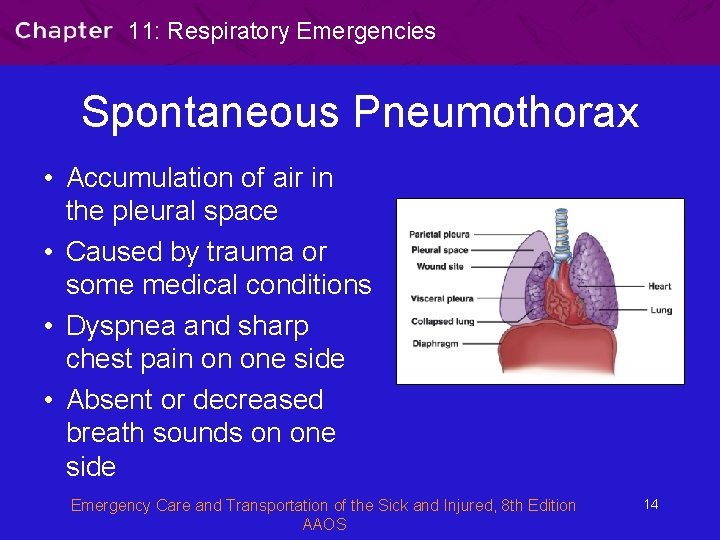
11: Respiratory Emergencies Spontaneous Pneumothorax • Accumulation of air in the pleural space • Caused by trauma or some medical conditions • Dyspnea and sharp chest pain on one side • Absent or decreased breath sounds on one side Emergency Care and Transportation of the Sick and Injured, 8 th Edition AAOS 14
11: Respiratory Emergencies Asthma or Allergic Reactions • Asthma is an acute spasm of the bronchioles. • Wheezing may be audible without a stethoscope. • An allergen can trigger an asthma attack. • Asthma and anaphylactic reactions can be similar. Emergency Care and Transportation of the Sick and Injured, 8 th Edition AAOS 15
11: Respiratory Emergencies Pleural Effusion • • Collection of fluid outside lung Causes dyspnea Caused by irritation, infection, or cancer Decreased breath sounds over region of the chest where fluid has moved the lung away from the chest wall • Eased if patient is sitting up Emergency Care and Transportation of the Sick and Injured, 8 th Edition AAOS 16
11: Respiratory Emergencies Mechanical Obstruction of the Airway • Be prepared to treat quickly. • Obstruction may result from the position of head, the tongue, aspiration of vomitus, or a foreign body. • Opening the airway with the head tiltchin lift maneuver may solve the problem. Emergency Care and Transportation of the Sick and Injured, 8 th Edition AAOS 17

11: Respiratory Emergencies Pulmonary Embolism • A blood clot that breaks off and circulates through the venous system • Signs and symptoms • Dyspnea • Acute pleuritic pain • Hemoptysis • Cyanosis • Tachypnea • Varying degrees of hypoxia Emergency Care and Transportation of the Sick and Injured, 8 th Edition AAOS 18

11: Respiratory Emergencies Hyperventilation • Overbreathing resulting in a decrease in the level of carbon dioxide • Signs and symptoms • Anxiety • Numbness • A sense of dyspnea despite rapid breathing • Dizziness • Tingling in hands and feet Emergency Care and Transportation of the Sick and Injured, 8 th Edition AAOS 19
11: Respiratory Emergencies Treatment of Dyspnea • Perform initial assessment. • Place the patient on oxygen. • If patient is in respiratory distress, ventilate. • Check pulse. Emergency Care and Transportation of the Sick and Injured, 8 th Edition AAOS 20

11: Respiratory Emergencies Signs and Symptoms (1 of 2) • • Difficulty breathing Anxiety or restlessness Decreased respirations Cyanosis Abnormal breath sounds Difficulty speaking Accessory muscles Emergency Care and Transportation of the Sick and Injured, 8 th Edition AAOS 21
11: Respiratory Emergencies Signs and Symptoms (2 of 2) • • Altered mental status Coughing Irregular breathing rhythm Tripod position Barrel chest Pale conjunctivae Increased pulse and respirations Emergency Care and Transportation of the Sick and Injured, 8 th Edition AAOS 22
11: Respiratory Emergencies Emergency Medical Care • Give supplemental oxygen at 10 to 15 L/min via nonrebreathing mask. • Patients with longstanding COPD may be started on low-flow oxygen (2 L/min). • Assist with inhaler if available. • Consult medical control. Emergency Care and Transportation of the Sick and Injured, 8 th Edition AAOS 23
11: Respiratory Emergencies Medications in MOI • Trade names • Proventil • Ventolin • Alupent • Metaprel • Brethine • Generic names • Albuterol • Metaproterenol • Terbutaline Emergency Care and Transportation of the Sick and Injured, 8 th Edition AAOS 24
11: Respiratory Emergencies Prescribed Inhalers • Actions • Relax the muscles surrounding the bronchioles • Enlarge the airways leading to easier passage of air • Side effects • Increased pulse rate • Nervousness • Muscle tremors Emergency Care and Transportation of the Sick and Injured, 8 th Edition AAOS 25
11: Respiratory Emergencies Prior to Administration • Read label carefully. • Verify it has been prescribed by a physician for this patient. • Consult medical control. • Make sure the medication is indicated. • Check for contraindications. Emergency Care and Transportation of the Sick and Injured, 8 th Edition AAOS 26

11: Respiratory Emergencies Contraindications for MDI • Patient unable to help coordinate inhalation • Inhaler not prescribed for patient • No permission from medical control • Maximum dose prescribed has been taken. Emergency Care and Transportation of the Sick and Injured, 8 th Edition AAOS 27

11: Respiratory Emergencies Administration of MDI (1 of 3) • Obtain order from medical control or local protocol. • Check for right medication, right patient, right route. • Make sure the patient is alert. • Check the expiration date. • Check how many doses have been taken. Emergency Care and Transportation of the Sick and Injured, 8 th Edition AAOS 28
11: Respiratory Emergencies Administration of MDI (2 of 3) • Make sure inhaler is at room temperature or warmer. • Shake inhaler. • Stop administration of oxygen. • Ask the patient to exhale deeply and put lips around opening. • If the inhaler has a spacer, use it. Emergency Care and Transportation of the Sick and Injured, 8 th Edition AAOS 29

11: Respiratory Emergencies Administration of MDI (3 of 3) • Have the patient depress the inhaler and inhale deeply. • Instruct the patient to hold his or her breath. • Continue administration of oxygen. • Allow the patient to breathe a few times then repeat dose according to protocol. Emergency Care and Transportation of the Sick and Injured, 8 th Edition AAOS 30
11: Respiratory Emergencies Reassessment • Carefully watch for shortness of breath. • 5 minutes after administration: • Obtain vital signs again. • Perform focused reassessment. • Transport and continue to assess breathing. Emergency Care and Transportation of the Sick and Injured, 8 th Edition AAOS 31

11: Respiratory Emergencies Upper or Lower Airway Infection • Administer warm, humidified oxygen. • Do not attempt to suction the airway or insert an oropharyngeal airway in a patient with suspected epiglottitis. • Transport patient in position of comfort. Emergency Care and Transportation of the Sick and Injured, 8 th Edition AAOS 32

11: Respiratory Emergencies Acute Pulmonary Edema • Administer 100% oxygen. • Suction secretions. • Transport in position of comfort. Emergency Care and Transportation of the Sick and Injured, 8 th Edition AAOS 33
11: Respiratory Emergencies Chronic Obstructive Pulmonary Disease (COPD) • Assist with prescribed inhaler if patient has one. • Transport promptly in position of comfort. Emergency Care and Transportation of the Sick and Injured, 8 th Edition AAOS 34
11: Respiratory Emergencies Spontaneous Pneumothorax • Administer oxygen. • Transport in position of comfort. • Monitor closely. Emergency Care and Transportation of the Sick and Injured, 8 th Edition AAOS 35
11: Respiratory Emergencies Asthma or Allergic Reactions • Obtain history. • Assess vitals signs. • Assist with inhaler if patient has one. • Administer oxygen. • Transport promptly. Emergency Care and Transportation of the Sick and Injured, 8 th Edition AAOS 36
11: Respiratory Emergencies Pleural Effusion • Definitive treatment is performed in a hospital. • Administer oxygen and support measures. • Transport promptly. Emergency Care and Transportation of the Sick and Injured, 8 th Edition AAOS 37

11: Respiratory Emergencies Mechanical Obstruction of the Airway • Clear airway. • Administer oxygen. • Transport promptly. Emergency Care and Transportation of the Sick and Injured, 8 th Edition AAOS 38

11: Respiratory Emergencies Pulmonary Embolism • Administer oxygen. • Place patient in comfortable position, usually sitting. • Assist breathing as necessary. • Keep airway clear. • Transport promptly. Emergency Care and Transportation of the Sick and Injured, 8 th Edition AAOS 39
11: Respiratory Emergencies Hyperventilation • Complete initial assessment and history of the event. • Assume underlying problems. • Do not have patient breathe into a paper bag. • Give oxygen. • Reassure patient and transport. Emergency Care and Transportation of the Sick and Injured, 8 th Edition AAOS 40

11: Respiratory Emergencies Geriatric Needs • Aging alters respiratory system. • Older patients are at risk for lung diseases. • They may need ventilatory support. Emergency Care and Transportation of the Sick and Injured, 8 th Edition AAOS 41
11: Respiratory Emergencies Pediatric Needs • Asthma is common in childhood. • Cyanosis is a late finding. • Treatment is the same as for an adult. Emergency Care and Transportation of the Sick and Injured, 8 th Edition AAOS 42
- Slides: 42