
Chapter 11 Representation and Description Preview Representing a
- Slides: 14
Chapter 11 Representation and Description
Preview Representing a region involves two choices: In terms of its external characteristics (its boundary) In terms of its internal characteristics (the pixels comprising the region) Describe the boundary by features such as length, orientation, number of concavities. Descriptors should be as insensitive as possible to variations in size, translation and rotation.
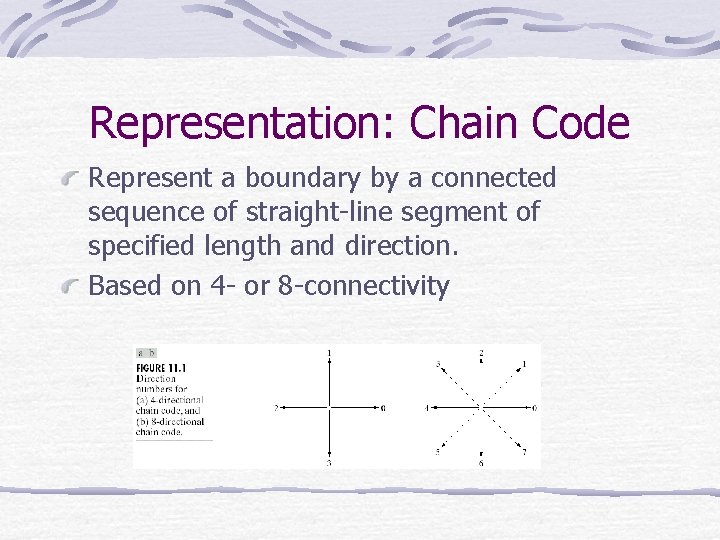
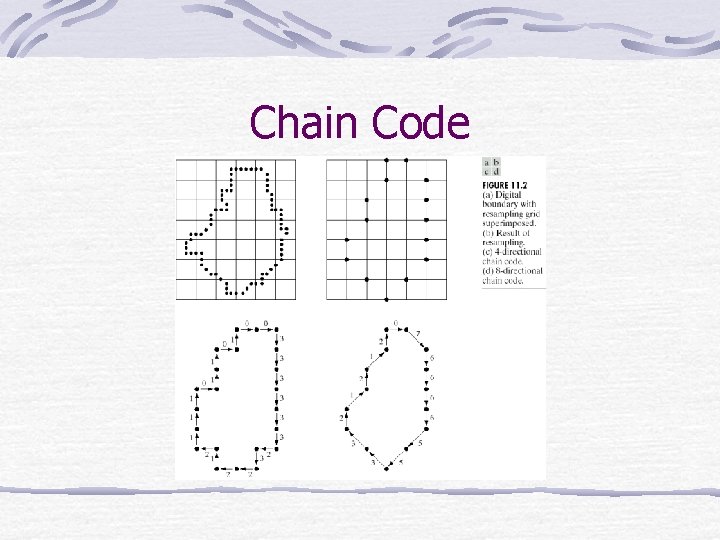
Representation: Chain Code Represent a boundary by a connected sequence of straight-line segment of specified length and direction. Based on 4 - or 8 -connectivity
Chain Code
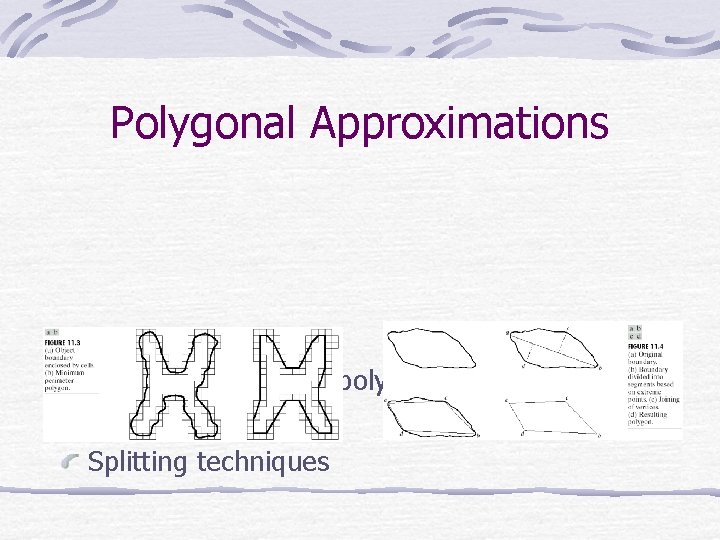
Polygonal Approximations Minimum perimeter polygons Merging techniques Splitting techniques
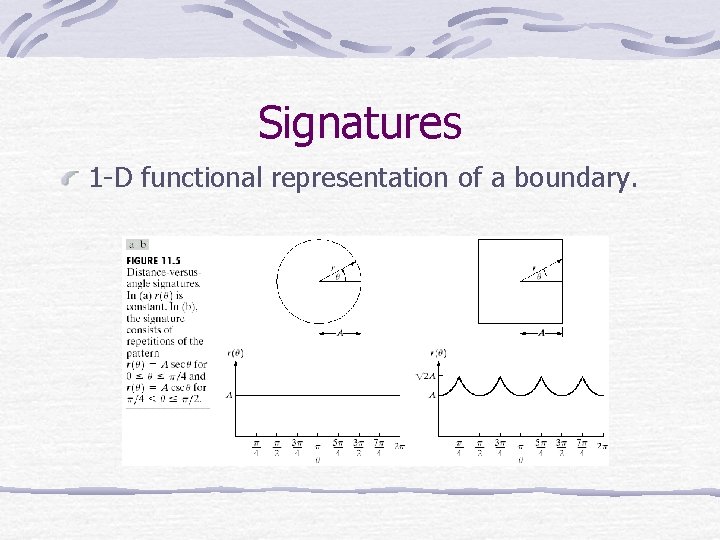
Signatures 1 -D functional representation of a boundary.
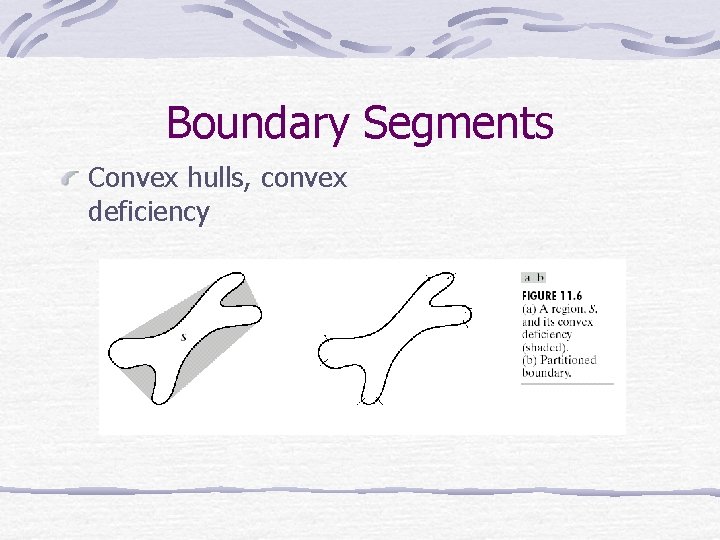
Boundary Segments Convex hulls, convex deficiency
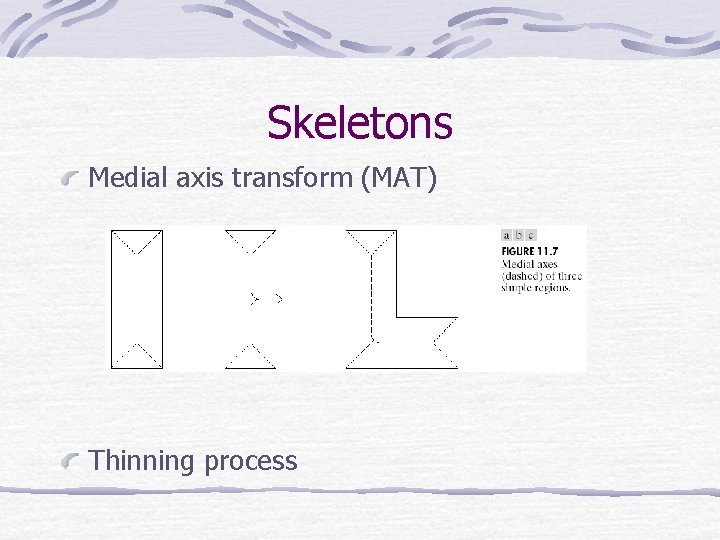
Skeletons Medial axis transform (MAT) Thinning process
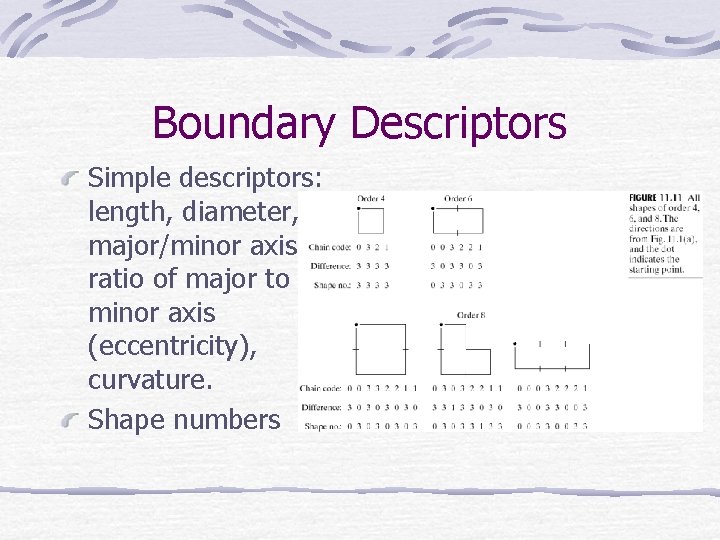
Boundary Descriptors Simple descriptors: length, diameter, major/minor axis, ratio of major to minor axis (eccentricity), curvature. Shape numbers
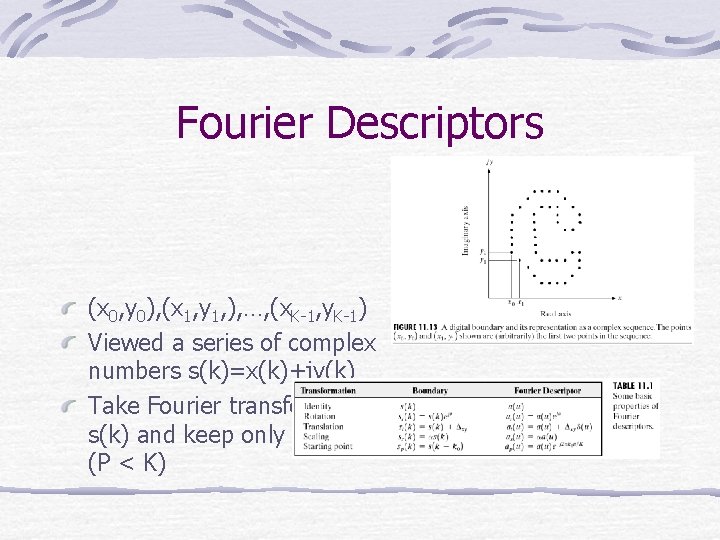
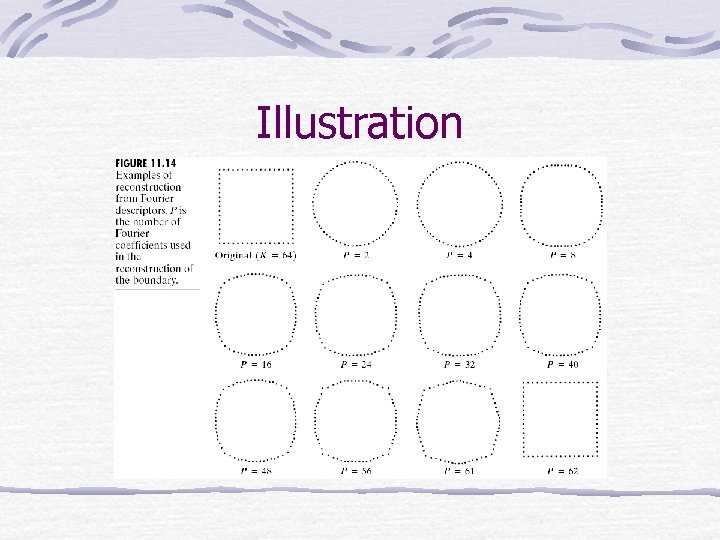
Fourier Descriptors (x 0, y 0), (x 1, y 1, ), …, (x. K-1, y. K-1) Viewed a series of complex numbers s(k)=x(k)+jy(k) Take Fourier transform of s(k) and keep only P terms. (P < K)
Illustration
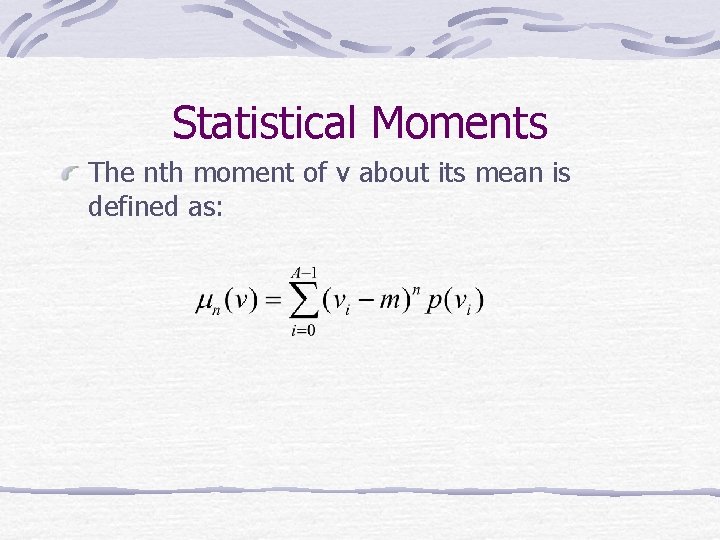
Statistical Moments The nth moment of v about its mean is defined as:
Regional Descriptors Simple descriptors: area, perimeter, compactness, mean, median, max, min. Topological descriptor: Euler number E=C-H. Texture Moments of 2 -D functions
More descriptors PCA Relational descriptors