
Chapter 11 Relevant Costs for Decision Making Mc
- Slides: 79
Chapter 11 Relevant Costs for Decision Making Mc. Graw-Hill /Irwin Copyright © 2008 by The Mc. Graw-Hill Companies, Inc. All rights reserved.
Learning Objective 1 Identify relevant and irrelevant costs and benefits in a decision. Mc. Graw-Hill /Irwin Copyright © 2008 by The Mc. Graw-Hill Companies, Inc. All rights reserved.
Cost Concepts for Decision Making A relevant cost is a cost that differs between alternatives. 1 Mc. Graw-Hill /Irwin 2 Copyright © 2008 by The Mc. Graw-Hill Companies, Inc. All rights reserved.
Identifying Relevant Costs An avoidable cost can be eliminated (in whole or in part) by choosing one alternative over another. Avoidable costs are relevant costs. Unavoidable costs are irrelevant costs. Two broad categories of costs are never relevant in any decision and include: Sunk costs which have already been incurred and cannot be avoided regardless of what a manager decides to do. . Future costs that do not differ between the alternatives. Mc. Graw-Hill /Irwin Copyright © 2008 by The Mc. Graw-Hill Companies, Inc. All rights reserved.
Relevant Cost Analysis: A Two-Step Process Step 1 Eliminate costs and benefits that do not differ between alternatives. Step 2 Use the remaining costs and benefits that do differ between alternatives in making the decision. The costs that remain are the differential, or avoidable, costs. Mc. Graw-Hill /Irwin Copyright © 2008 by The Mc. Graw-Hill Companies, Inc. All rights reserved.
Different Costs for Different Purposes Costs that are relevant in one decision situation may not be relevant in another context. Mc. Graw-Hill /Irwin Copyright © 2008 by The Mc. Graw-Hill Companies, Inc. All rights reserved.
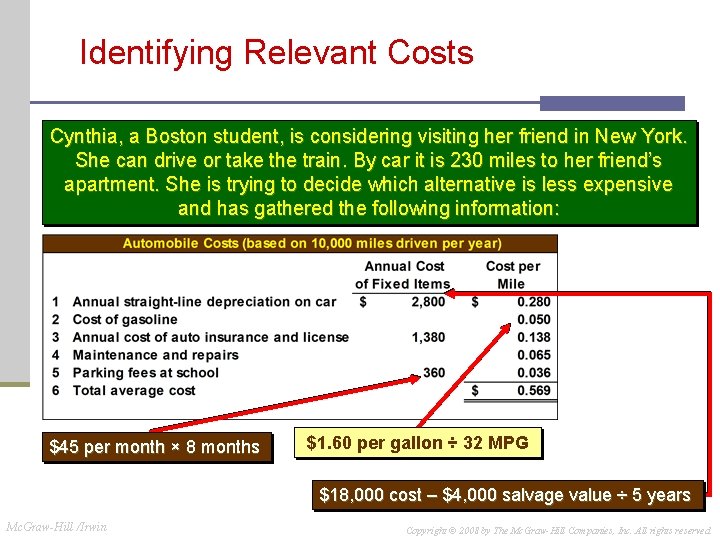
Identifying Relevant Costs Cynthia, a Boston student, is considering visiting her friend in New York. She can drive or take the train. By car it is 230 miles to her friend’s apartment. She is trying to decide which alternative is less expensive and has gathered the following information: $45 per month × 8 months $1. 60 per gallon ÷ 32 MPG $18, 000 cost – $4, 000 salvage value ÷ 5 years Mc. Graw-Hill /Irwin Copyright © 2008 by The Mc. Graw-Hill Companies, Inc. All rights reserved.
Identifying Relevant Costs Mc. Graw-Hill /Irwin Copyright © 2008 by The Mc. Graw-Hill Companies, Inc. All rights reserved.
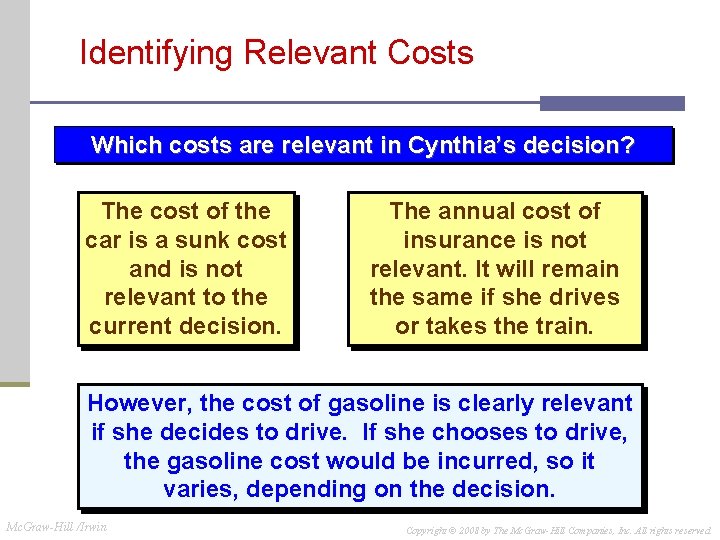
Identifying Relevant Costs Which costs are relevant in Cynthia’s decision? The cost of the car is a sunk cost and is not relevant to the current decision. The annual cost of insurance is not relevant. It will remain the same if she drives or takes the train. However, the cost of gasoline is clearly relevant if she decides to drive. If she chooses to drive, the gasoline cost would be incurred, so it varies, depending on the decision. Mc. Graw-Hill /Irwin Copyright © 2008 by The Mc. Graw-Hill Companies, Inc. All rights reserved.
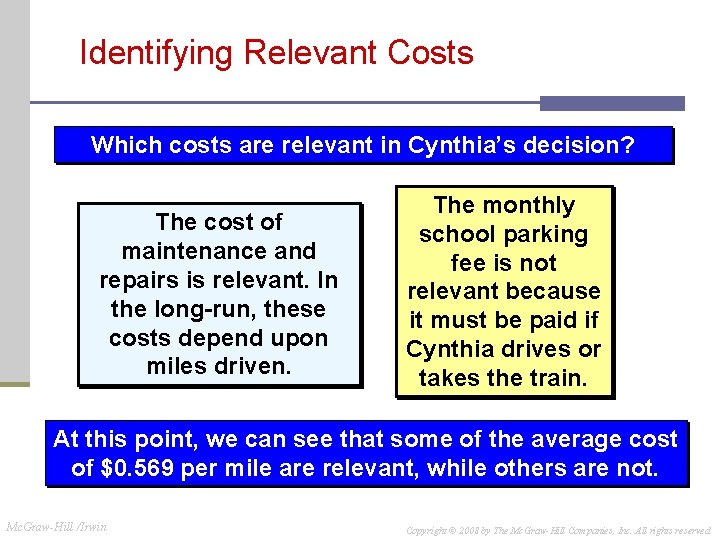
Identifying Relevant Costs Which costs are relevant in Cynthia’s decision? The cost of maintenance and repairs is relevant. In the long-run, these costs depend upon miles driven. The monthly school parking fee is not relevant because it must be paid if Cynthia drives or takes the train. At this point, we can see that some of the average cost of $0. 569 per mile are relevant, while others are not. Mc. Graw-Hill /Irwin Copyright © 2008 by The Mc. Graw-Hill Companies, Inc. All rights reserved.
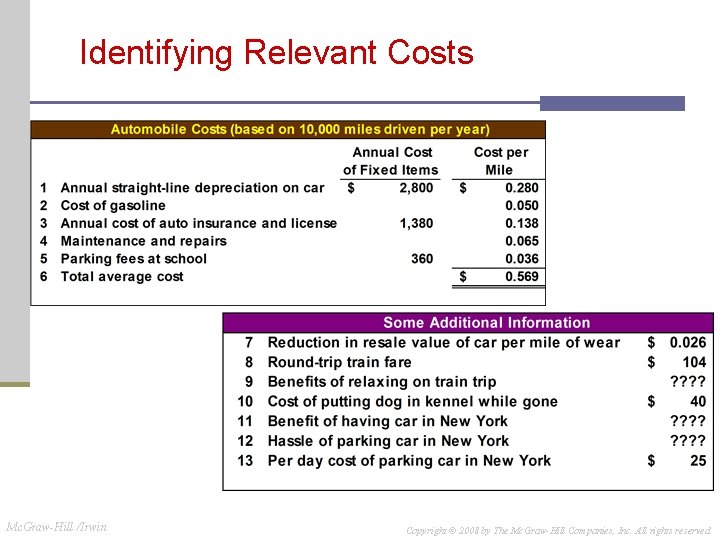
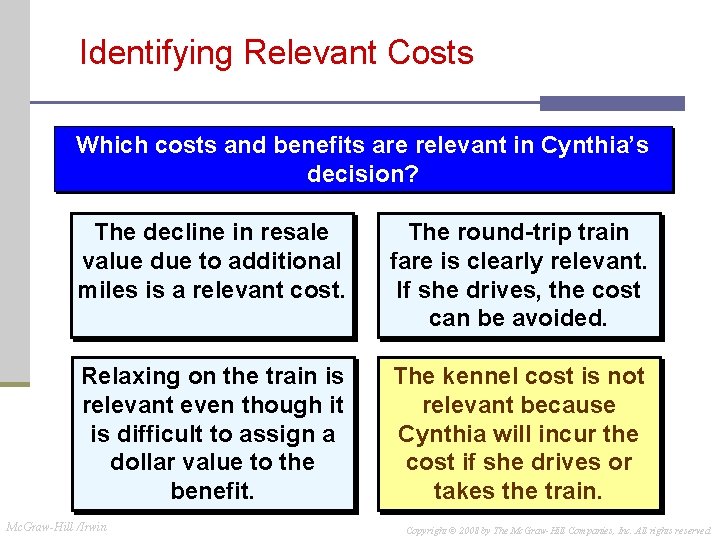
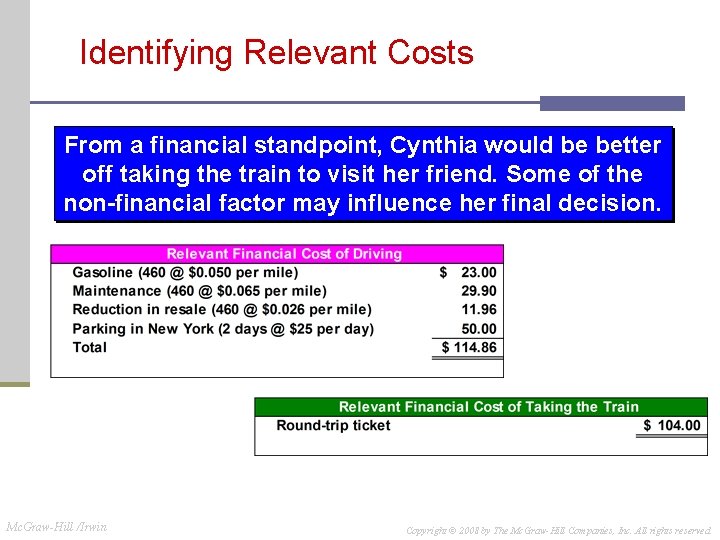
Identifying Relevant Costs Which costs and benefits are relevant in Cynthia’s decision? The decline in resale value due to additional miles is a relevant cost. The round-trip train fare is clearly relevant. If she drives, the cost can be avoided. Relaxing on the train is relevant even though it is difficult to assign a dollar value to the benefit. The kennel cost is not relevant because Cynthia will incur the cost if she drives or takes the train. Mc. Graw-Hill /Irwin Copyright © 2008 by The Mc. Graw-Hill Companies, Inc. All rights reserved.
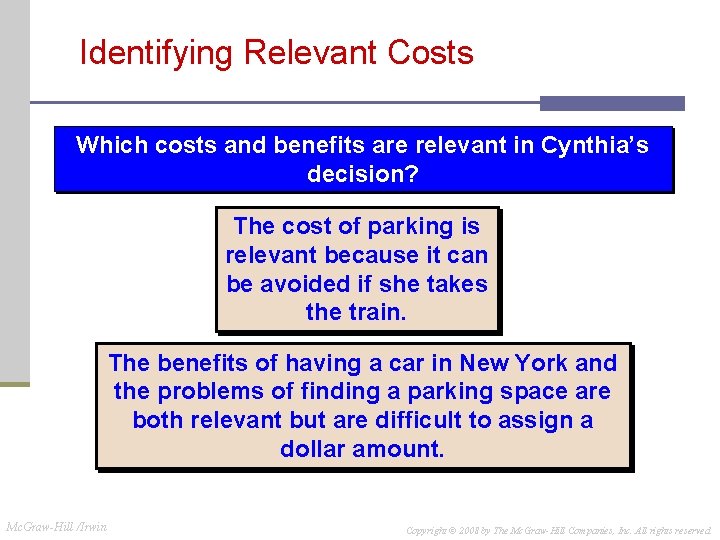
Identifying Relevant Costs Which costs and benefits are relevant in Cynthia’s decision? The cost of parking is relevant because it can be avoided if she takes the train. The benefits of having a car in New York and the problems of finding a parking space are both relevant but are difficult to assign a dollar amount. Mc. Graw-Hill /Irwin Copyright © 2008 by The Mc. Graw-Hill Companies, Inc. All rights reserved.
Identifying Relevant Costs From a financial standpoint, Cynthia would be better off taking the train to visit her friend. Some of the non-financial factor may influence her final decision. Mc. Graw-Hill /Irwin Copyright © 2008 by The Mc. Graw-Hill Companies, Inc. All rights reserved.
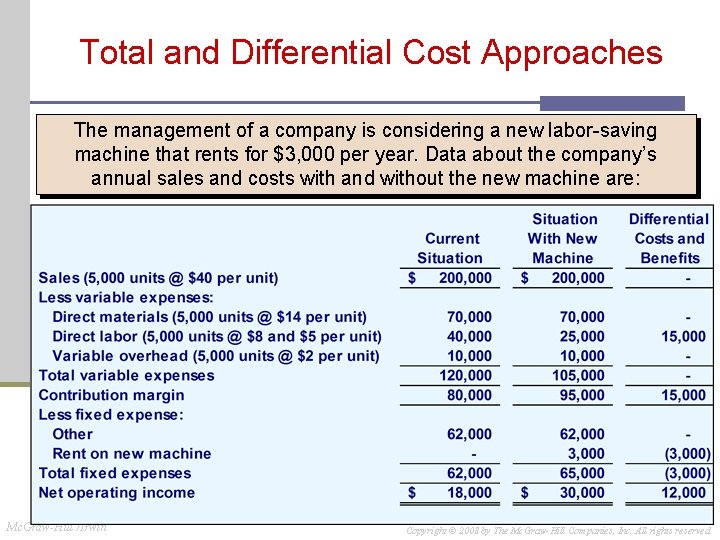
Total and Differential Cost Approaches The management of a company is considering a new labor-saving machine that rents for $3, 000 per year. Data about the company’s annual sales and costs with and without the new machine are: Mc. Graw-Hill /Irwin Copyright © 2008 by The Mc. Graw-Hill Companies, Inc. All rights reserved.
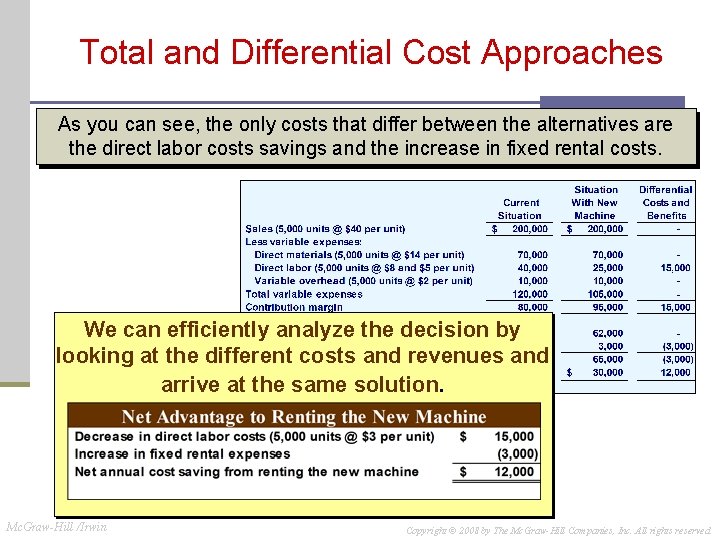
Total and Differential Cost Approaches As you can see, the only costs that differ between the alternatives are the direct labor costs savings and the increase in fixed rental costs. We can efficiently analyze the decision by looking at the different costs and revenues and arrive at the same solution. Mc. Graw-Hill /Irwin Copyright © 2008 by The Mc. Graw-Hill Companies, Inc. All rights reserved.
Total and Differential Cost Approaches Using the differential approach is desirable for two reasons: 1. Only rarely will enough information be available to prepare detailed income statements for both alternatives. 2. Mingling irrelevant costs with relevant costs may cause confusion and distract attention away from the information that is really critical. Mc. Graw-Hill /Irwin Copyright © 2008 by The Mc. Graw-Hill Companies, Inc. All rights reserved.
Learning Objective 2 Prepare an analysis showing whether a product line or other business segment should be dropped or retained. Mc. Graw-Hill /Irwin Copyright © 2008 by The Mc. Graw-Hill Companies, Inc. All rights reserved.
Adding/Dropping Segments One of the most important decisions managers make is whether to add or drop a business segment, such as a product or a store. Let’s see how relevant costs should be used in this type of decision. Mc. Graw-Hill /Irwin Copyright © 2008 by The Mc. Graw-Hill Companies, Inc. All rights reserved.
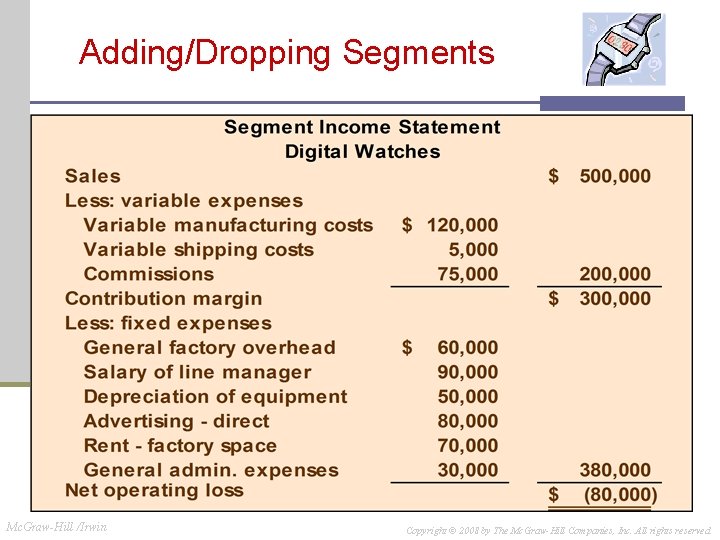
Adding/Dropping Segments Due to the declining popularity of digital watches, Lovell Company’s digital watch line has not reported a profit for several years. Lovell is considering dropping this product line. Mc. Graw-Hill /Irwin Copyright © 2008 by The Mc. Graw-Hill Companies, Inc. All rights reserved.
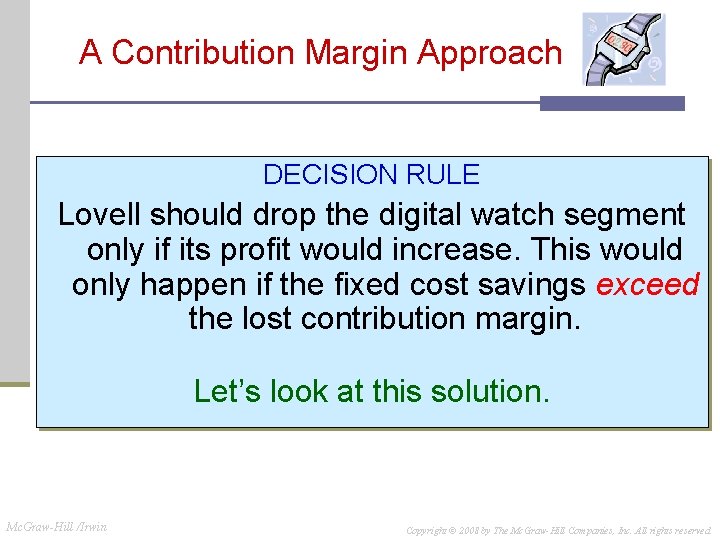
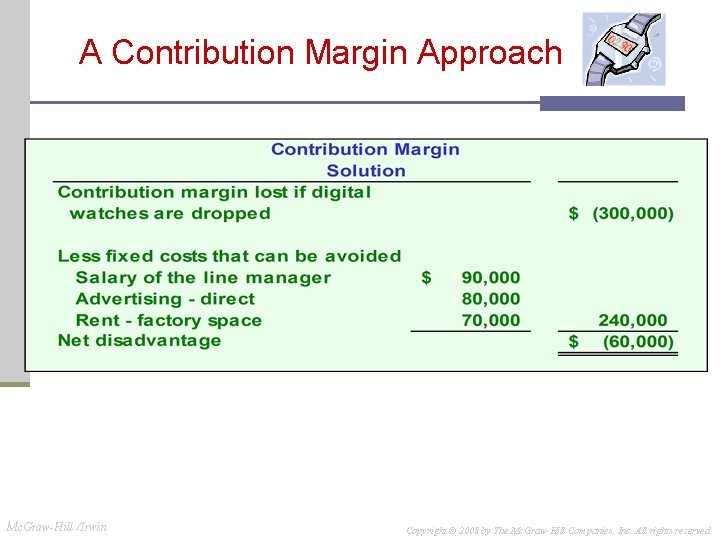
A Contribution Margin Approach DECISION RULE Lovell should drop the digital watch segment only if its profit would increase. This would only happen if the fixed cost savings exceed the lost contribution margin. Let’s look at this solution. Mc. Graw-Hill /Irwin Copyright © 2008 by The Mc. Graw-Hill Companies, Inc. All rights reserved.
Adding/Dropping Segments Mc. Graw-Hill /Irwin Copyright © 2008 by The Mc. Graw-Hill Companies, Inc. All rights reserved.
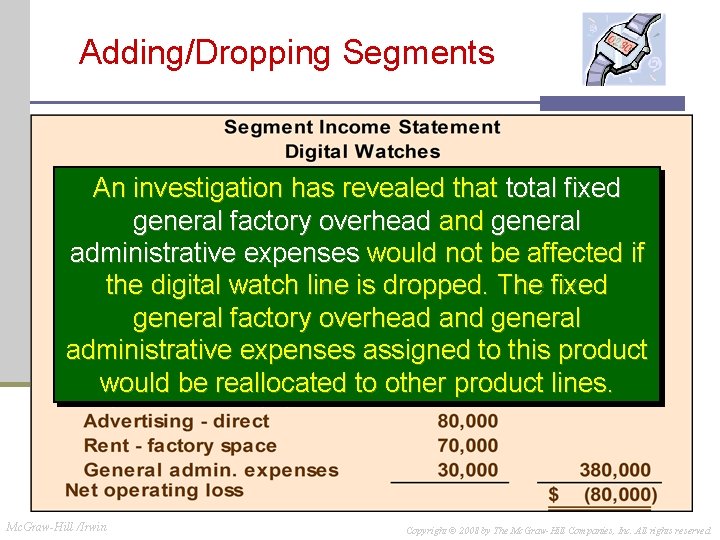
Adding/Dropping Segments An investigation has revealed that total fixed general factory overhead and general administrative expenses would not be affected if the digital watch line is dropped. The fixed general factory overhead and general administrative expenses assigned to this product would be reallocated to other product lines. Mc. Graw-Hill /Irwin Copyright © 2008 by The Mc. Graw-Hill Companies, Inc. All rights reserved.
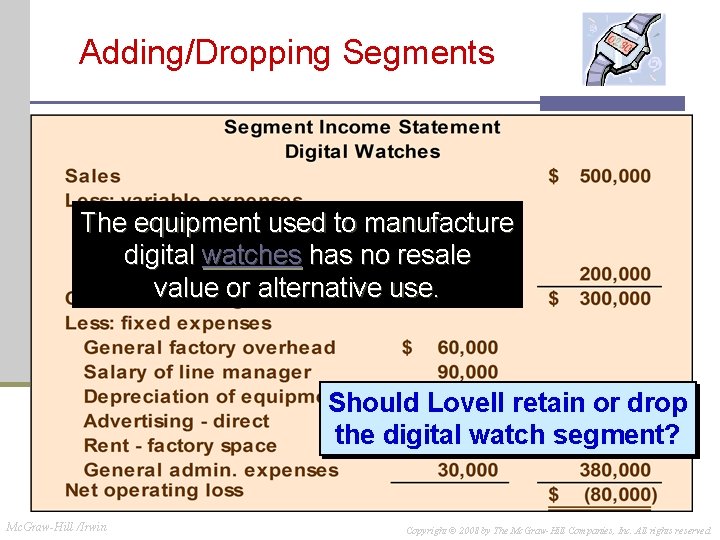
Adding/Dropping Segments The equipment used to manufacture digital watches has no resale value or alternative use. Should Lovell retain or drop the digital watch segment? Mc. Graw-Hill /Irwin Copyright © 2008 by The Mc. Graw-Hill Companies, Inc. All rights reserved.
A Contribution Margin Approach Mc. Graw-Hill /Irwin Copyright © 2008 by The Mc. Graw-Hill Companies, Inc. All rights reserved.
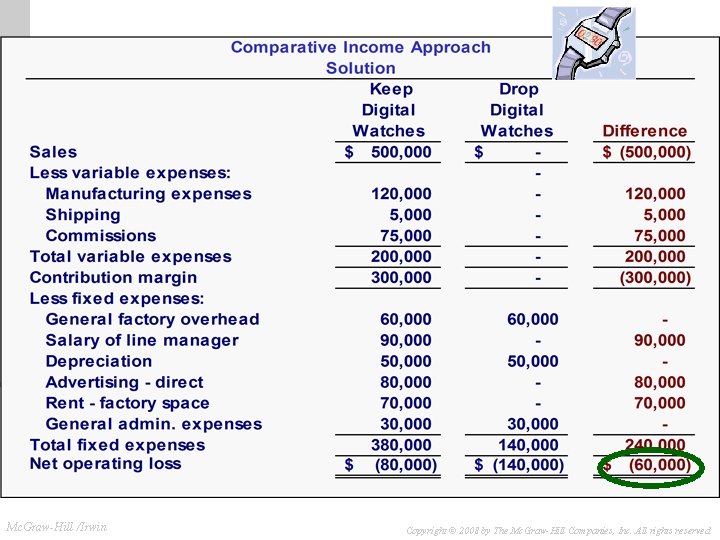
Comparative Income Approach The Lovell solution can also be obtained by preparing comparative income statements showing results with and without the digital watch segment. Let’s look at this second approach. Mc. Graw-Hill /Irwin Copyright © 2008 by The Mc. Graw-Hill Companies, Inc. All rights reserved.
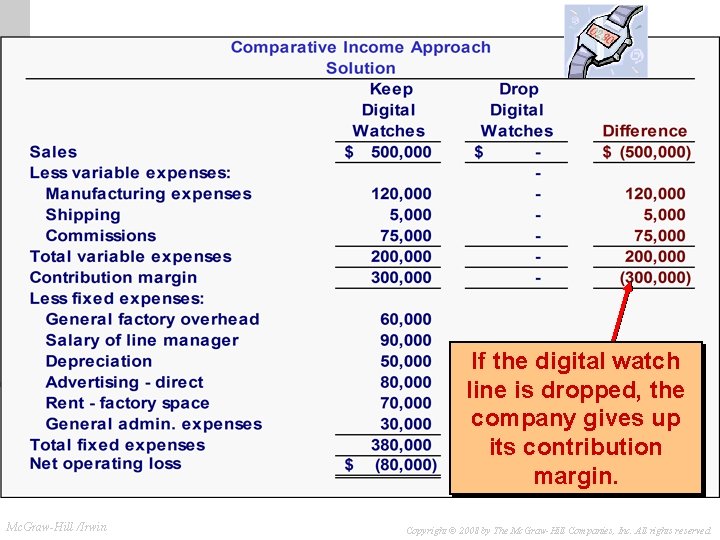
Comparative Income Approach If the digital watch line is dropped, the company gives up its contribution margin. Mc. Graw-Hill /Irwin Copyright © 2008 by The Mc. Graw-Hill Companies, Inc. All rights reserved.
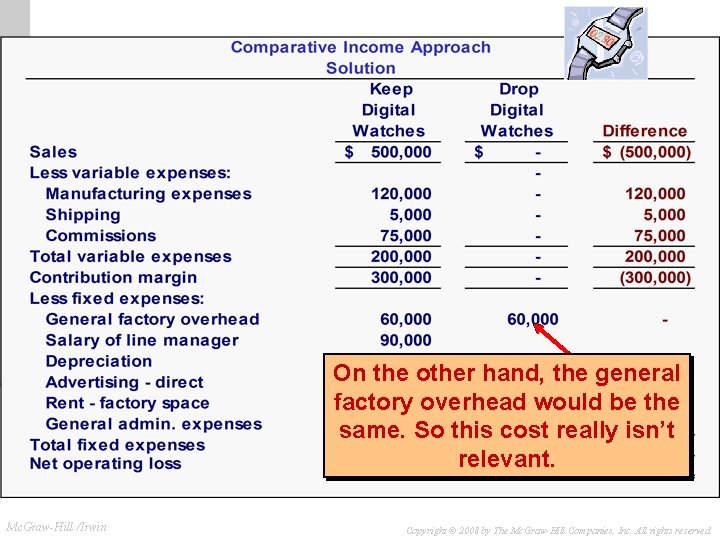
Comparative Income Approach On the other hand, the general factory overhead would be the same. So this cost really isn’t relevant. Mc. Graw-Hill /Irwin Copyright © 2008 by The Mc. Graw-Hill Companies, Inc. All rights reserved.
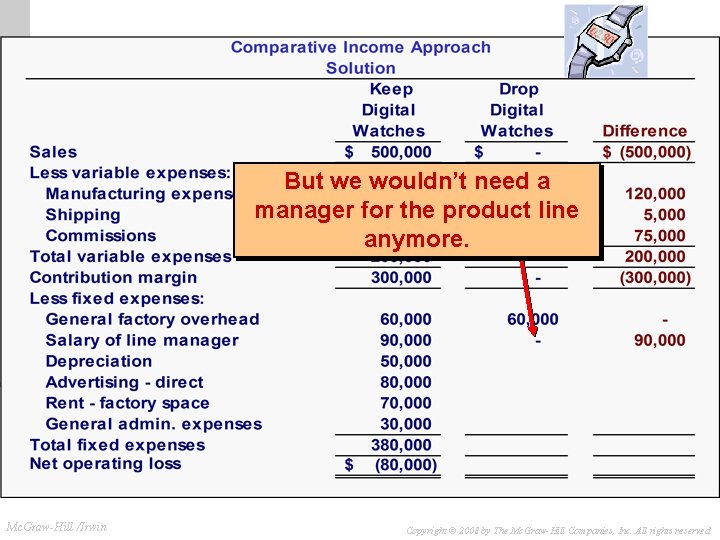
Comparative Income Approach But we wouldn’t need a manager for the product line anymore. Mc. Graw-Hill /Irwin Copyright © 2008 by The Mc. Graw-Hill Companies, Inc. All rights reserved.
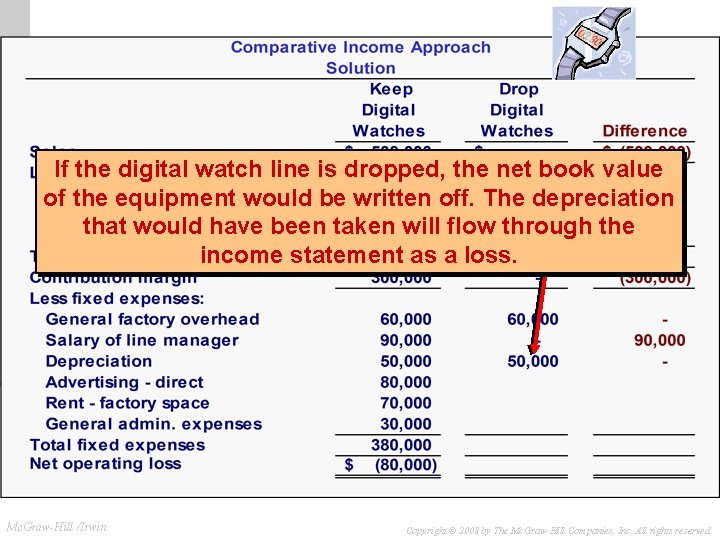
Comparative Income Approach If the digital watch line is dropped, the net book value of the equipment would be written off. The depreciation that would have been taken will flow through the income statement as a loss. Mc. Graw-Hill /Irwin Copyright © 2008 by The Mc. Graw-Hill Companies, Inc. All rights reserved.
Mc. Graw-Hill /Irwin Copyright © 2008 by The Mc. Graw-Hill Companies, Inc. All rights reserved.
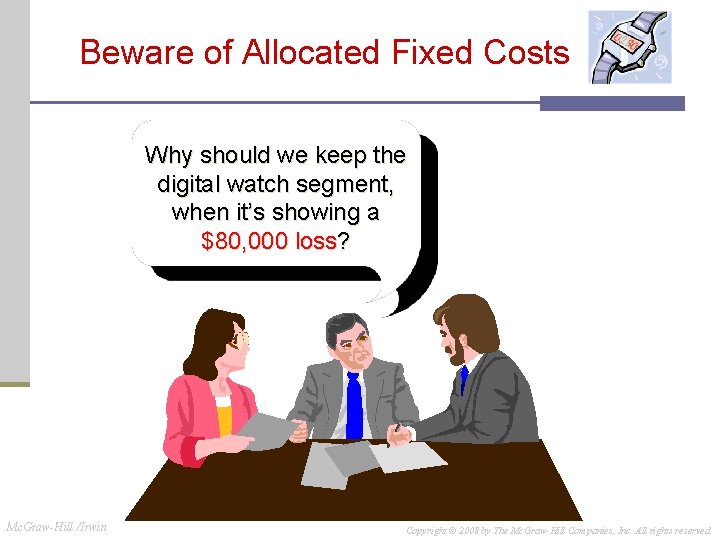
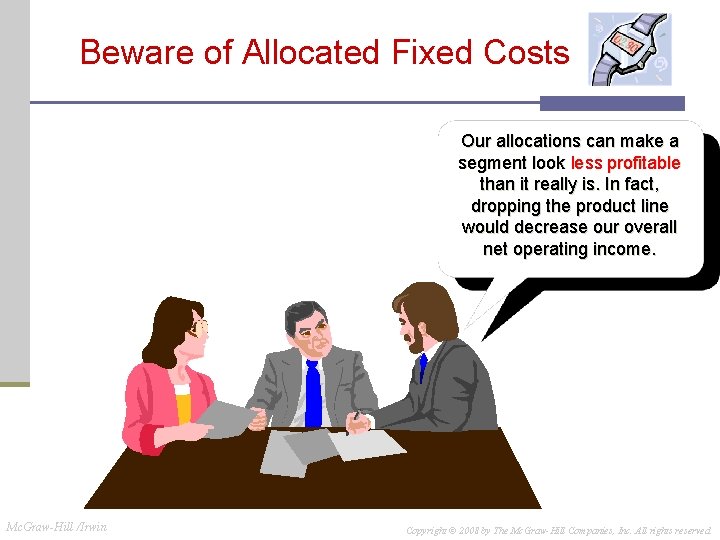
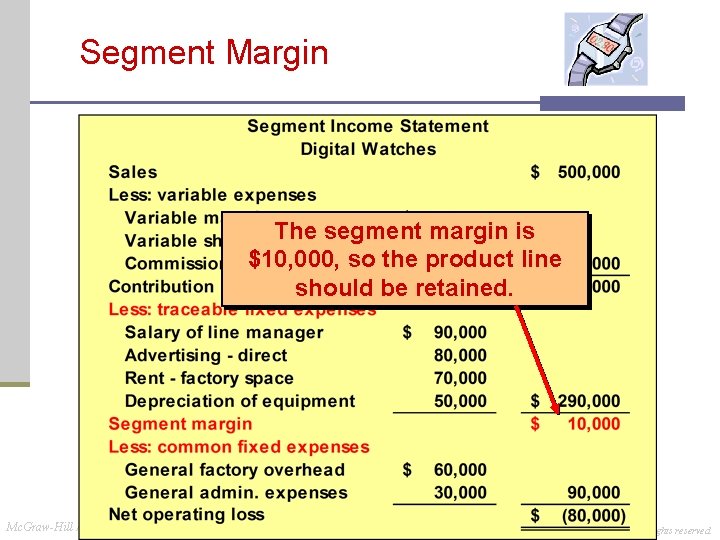
Beware of Allocated Fixed Costs Why should we keep the digital watch segment, when it’s showing a $80, 000 loss? Mc. Graw-Hill /Irwin Copyright © 2008 by The Mc. Graw-Hill Companies, Inc. All rights reserved.
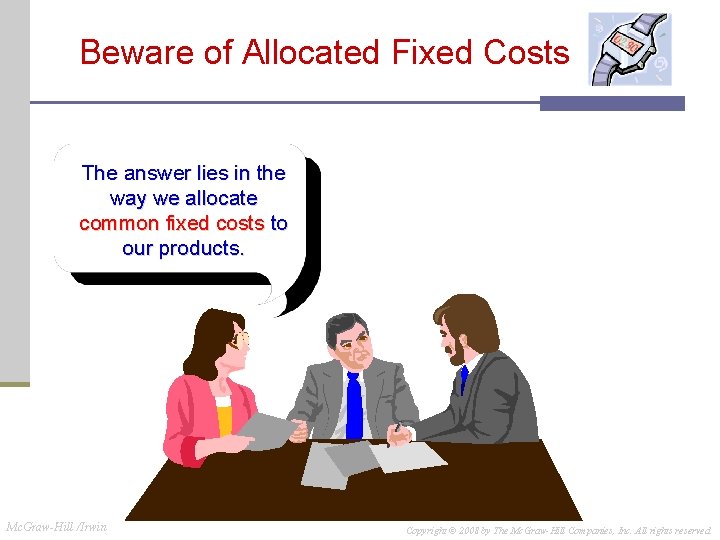
Beware of Allocated Fixed Costs The answer lies in the way we allocate common fixed costs to our products. Mc. Graw-Hill /Irwin Copyright © 2008 by The Mc. Graw-Hill Companies, Inc. All rights reserved.
Beware of Allocated Fixed Costs Our allocations can make a segment look less profitable than it really is. In fact, dropping the product line would decrease our overall net operating income. Mc. Graw-Hill /Irwin Copyright © 2008 by The Mc. Graw-Hill Companies, Inc. All rights reserved.
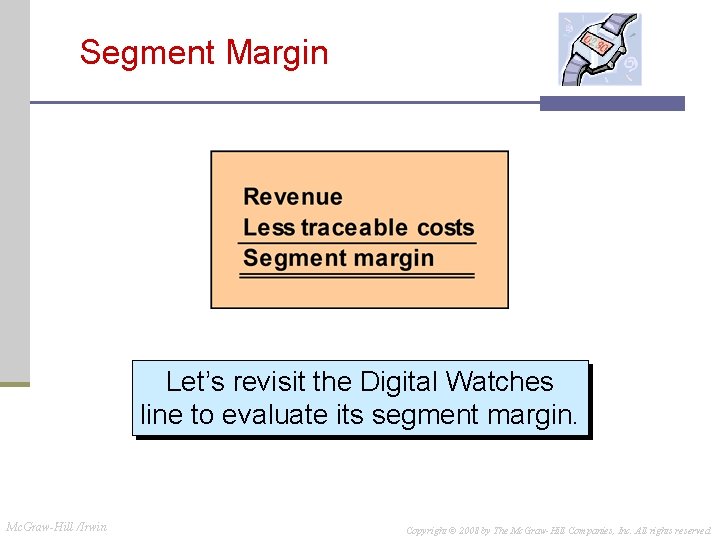
Segment Margin Let’s revisit the Digital Watches line to evaluate its segment margin. Mc. Graw-Hill /Irwin Copyright © 2008 by The Mc. Graw-Hill Companies, Inc. All rights reserved.
Segment Margin The segment margin is $10, 000, so the product line should be retained. Mc. Graw-Hill /Irwin Copyright © 2008 by The Mc. Graw-Hill Companies, Inc. All rights reserved.
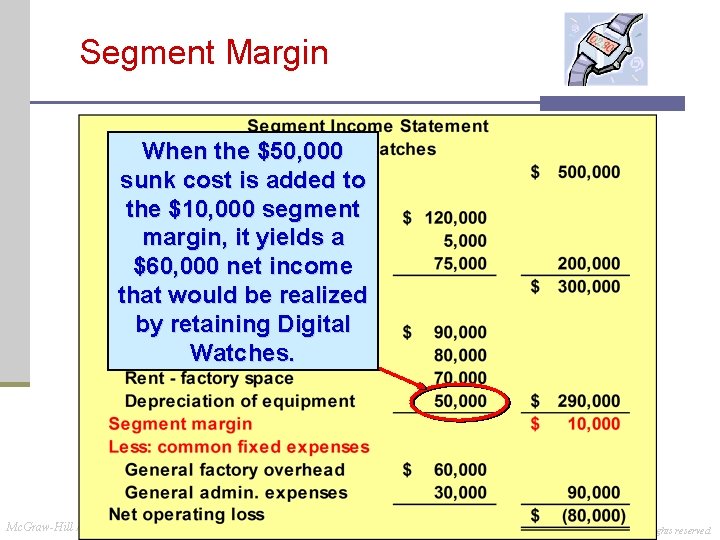
Segment Margin When the $50, 000 sunk cost is added to the $10, 000 segment margin, it yields a $60, 000 net income that would be realized by retaining Digital Watches. Mc. Graw-Hill /Irwin Copyright © 2008 by The Mc. Graw-Hill Companies, Inc. All rights reserved.
Learning Objective 3 Prepare a make or buy analysis. Mc. Graw-Hill /Irwin Copyright © 2008 by The Mc. Graw-Hill Companies, Inc. All rights reserved.
The Make or Buy Decision A decision to carry out one of the activities in the value chain internally, rather than to buy externally from a supplier is called a “make or buy” decision. Mc. Graw-Hill /Irwin Copyright © 2008 by The Mc. Graw-Hill Companies, Inc. All rights reserved.
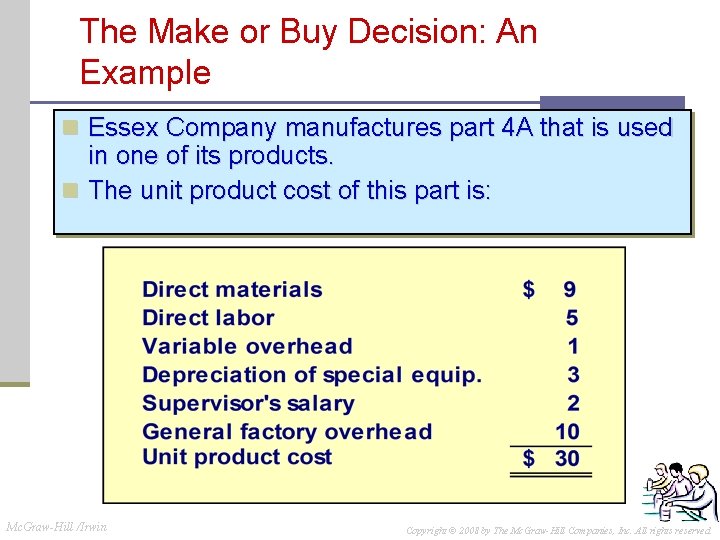
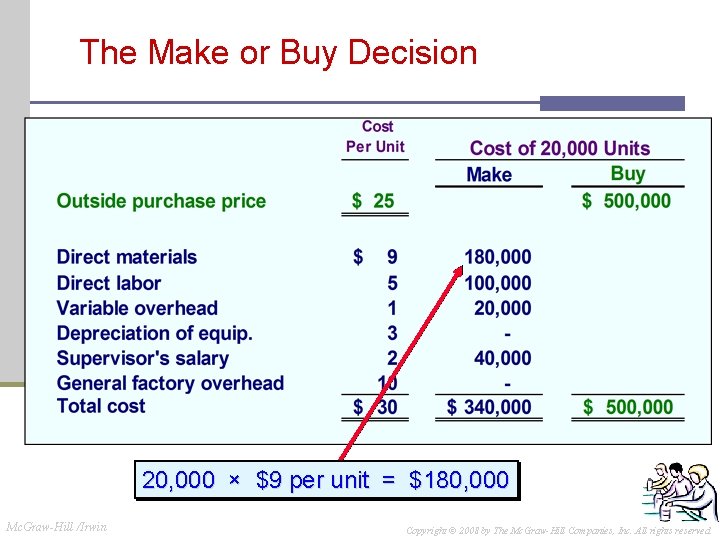
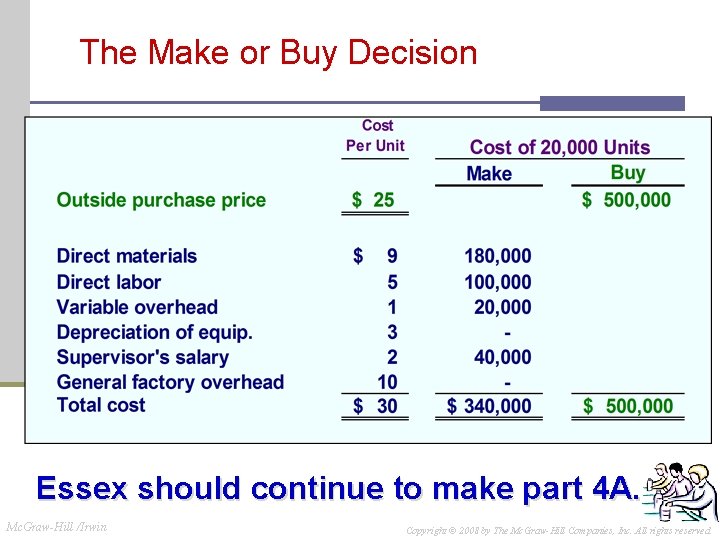
The Make or Buy Decision: An Example n Essex Company manufactures part 4 A that is used in one of its products. n The unit product cost of this part is: Mc. Graw-Hill /Irwin Copyright © 2008 by The Mc. Graw-Hill Companies, Inc. All rights reserved.
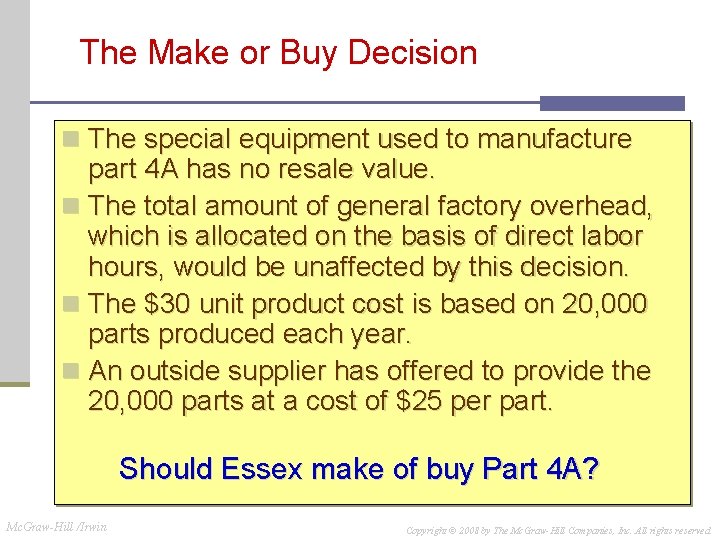
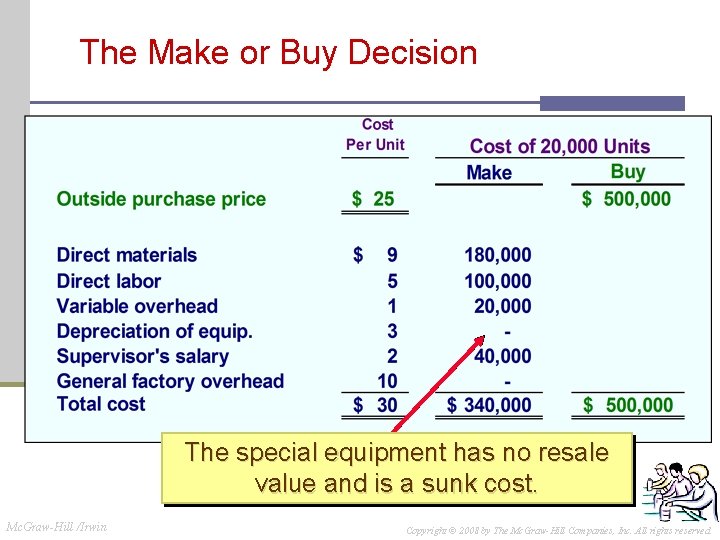
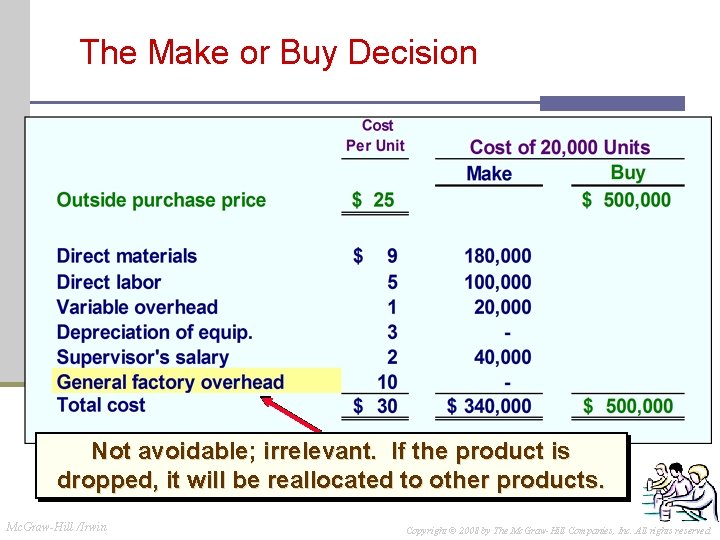
The Make or Buy Decision n The special equipment used to manufacture part 4 A has no resale value. n The total amount of general factory overhead, which is allocated on the basis of direct labor hours, would be unaffected by this decision. n The $30 unit product cost is based on 20, 000 parts produced each year. n An outside supplier has offered to provide the 20, 000 parts at a cost of $25 per part. Should Essex make of buy Part 4 A? Mc. Graw-Hill /Irwin Copyright © 2008 by The Mc. Graw-Hill Companies, Inc. All rights reserved.
The Make or Buy Decision 20, 000 × $9 per unit = $180, 000 Mc. Graw-Hill /Irwin Copyright © 2008 by The Mc. Graw-Hill Companies, Inc. All rights reserved.
The Make or Buy Decision The special equipment has no resale value and is a sunk cost. Mc. Graw-Hill /Irwin Copyright © 2008 by The Mc. Graw-Hill Companies, Inc. All rights reserved.
The Make or Buy Decision Not avoidable; irrelevant. If the product is dropped, it will be reallocated to other products. Mc. Graw-Hill /Irwin Copyright © 2008 by The Mc. Graw-Hill Companies, Inc. All rights reserved.
The Make or Buy Decision Essex should continue to make part 4 A. Mc. Graw-Hill /Irwin Copyright © 2008 by The Mc. Graw-Hill Companies, Inc. All rights reserved.
Opportunity Cost An opportunity cost is the benefit that is foregone as a result of pursuing a course of action. Opportunity costs are not actual dollar outlays and are not recorded in the formal accounts of an organization. How would this concept potentially relate to the Essex Company? Mc. Graw-Hill /Irwin Copyright © 2008 by The Mc. Graw-Hill Companies, Inc. All rights reserved.
Learning Objective 4 Prepare an analysis showing whether a special order should be accepted. Mc. Graw-Hill /Irwin Copyright © 2008 by The Mc. Graw-Hill Companies, Inc. All rights reserved.
Key Terms and Concepts A special order is a one-time order that is not considered part of the company’s normal ongoing business. When analyzing a special order, only the incremental costs and benefits are relevant. Since the fixed overhead costs would not be affected by the order, they are not relevant. Mc. Graw-Hill /Irwin Copyright © 2008 by The Mc. Graw-Hill Companies, Inc. All rights reserved.
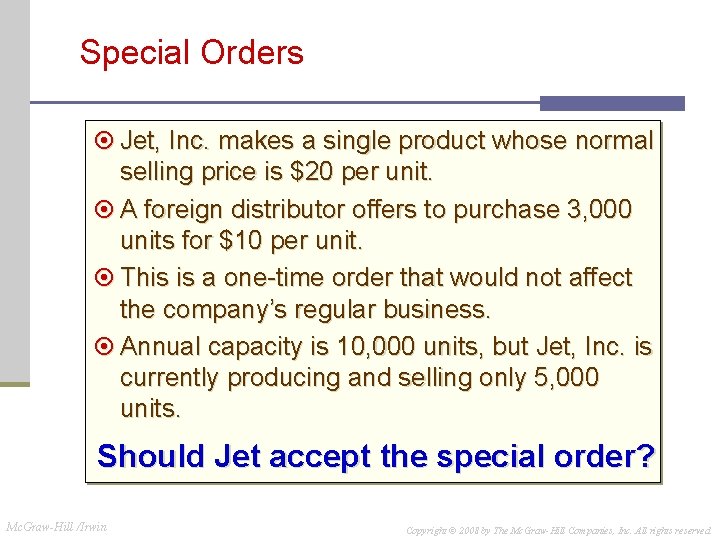
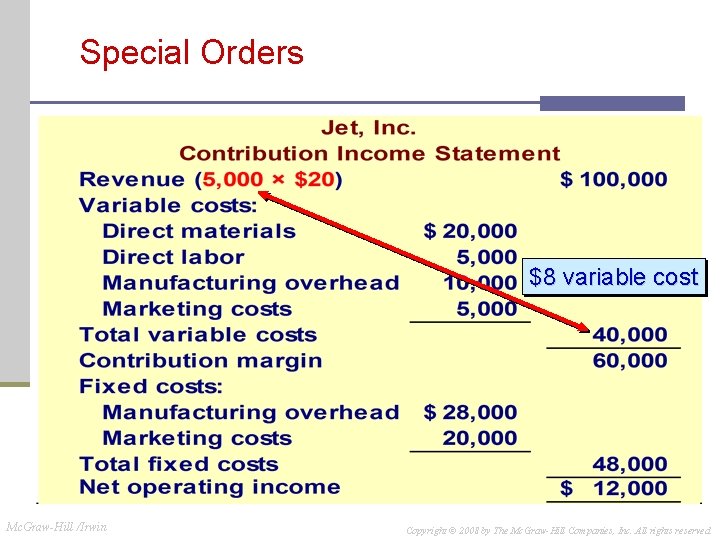
Special Orders ¤ Jet, Inc. makes a single product whose normal selling price is $20 per unit. ¤ A foreign distributor offers to purchase 3, 000 units for $10 per unit. ¤ This is a one-time order that would not affect the company’s regular business. ¤ Annual capacity is 10, 000 units, but Jet, Inc. is currently producing and selling only 5, 000 units. Should Jet accept the special order? Mc. Graw-Hill /Irwin Copyright © 2008 by The Mc. Graw-Hill Companies, Inc. All rights reserved.
Special Orders $8 variable cost Mc. Graw-Hill /Irwin Copyright © 2008 by The Mc. Graw-Hill Companies, Inc. All rights reserved.
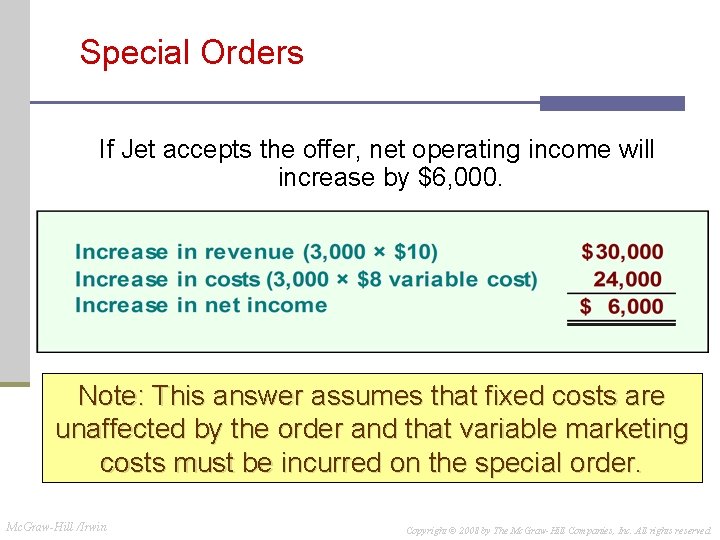
Special Orders If Jet accepts the offer, net operating income will increase by $6, 000. Note: This answer assumes that fixed costs are unaffected by the order and that variable marketing costs must be incurred on the special order. Mc. Graw-Hill /Irwin Copyright © 2008 by The Mc. Graw-Hill Companies, Inc. All rights reserved.
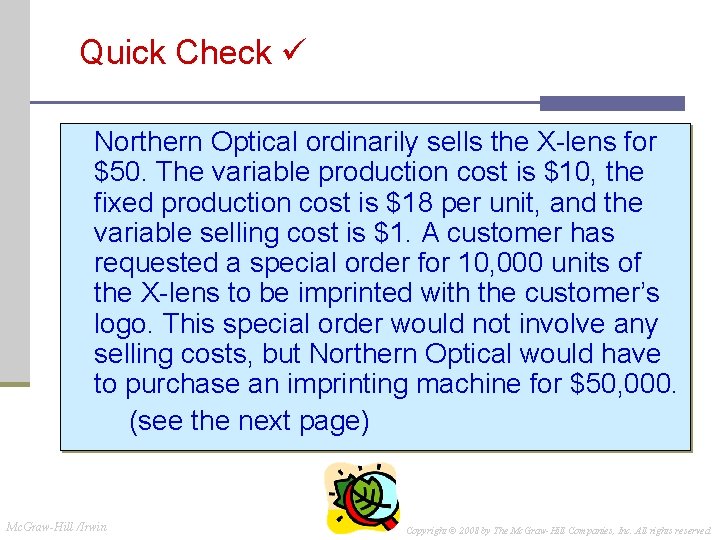
Quick Check Northern Optical ordinarily sells the X-lens for $50. The variable production cost is $10, the fixed production cost is $18 per unit, and the variable selling cost is $1. A customer has requested a special order for 10, 000 units of the X-lens to be imprinted with the customer’s logo. This special order would not involve any selling costs, but Northern Optical would have to purchase an imprinting machine for $50, 000. (see the next page) Mc. Graw-Hill /Irwin Copyright © 2008 by The Mc. Graw-Hill Companies, Inc. All rights reserved.
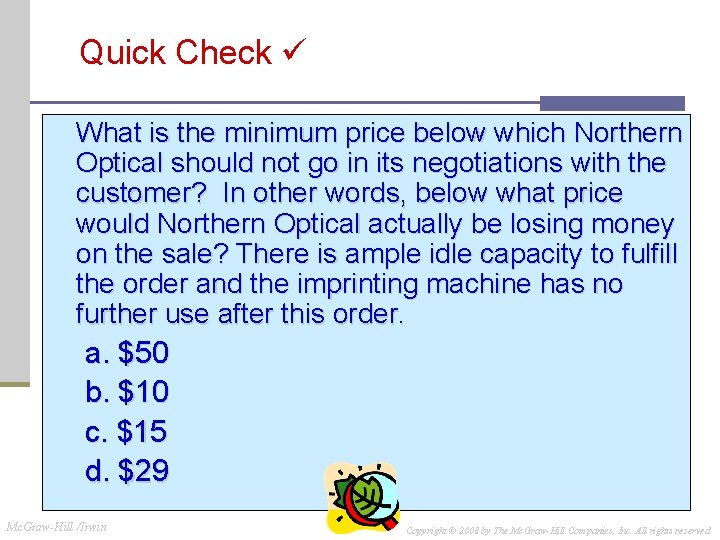
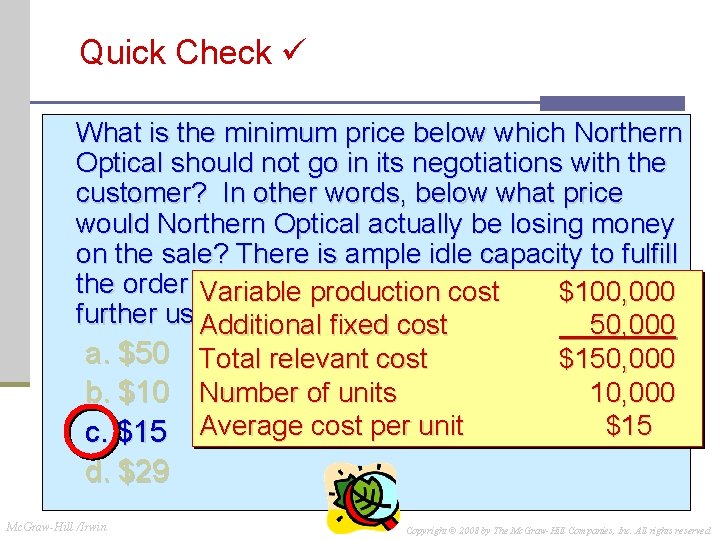
Quick Check What is the minimum price below which Northern Optical should not go in its negotiations with the customer? In other words, below what price would Northern Optical actually be losing money on the sale? There is ample idle capacity to fulfill the order and the imprinting machine has no further use after this order. a. $50 b. $10 c. $15 d. $29 Mc. Graw-Hill /Irwin Copyright © 2008 by The Mc. Graw-Hill Companies, Inc. All rights reserved.
Quick Check What is the minimum price below which Northern Optical should not go in its negotiations with the customer? In other words, below what price would Northern Optical actually be losing money on the sale? There is ample idle capacity to fulfill the order and the imprinting machine no Variable production cost has $100, 000 further use. Additional after this fixed order. cost 50, 000 a. $50 Total relevant cost $150, 000 10, 000 b. $10 Number of units $15 c. $15 Average cost per unit d. $29 Mc. Graw-Hill /Irwin Copyright © 2008 by The Mc. Graw-Hill Companies, Inc. All rights reserved.
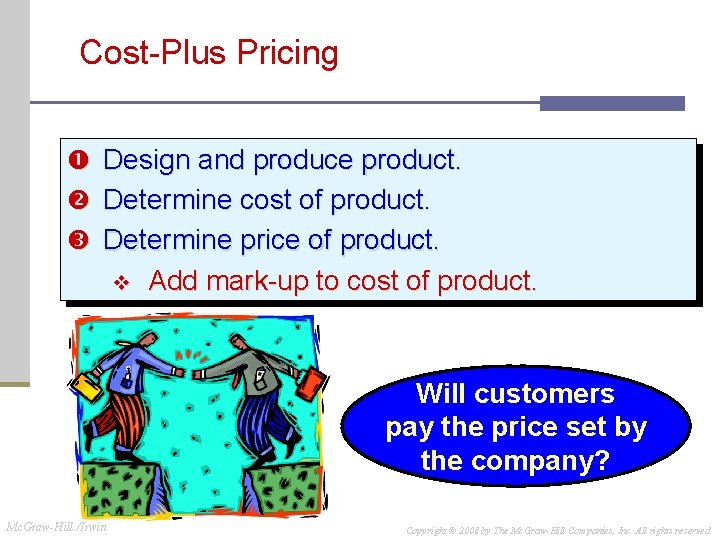
Cost-Plus Pricing Design and produce product. Determine cost of product. Determine price of product. v Add mark-up to cost of product. Will customers pay the price set by the company? Mc. Graw-Hill /Irwin Copyright © 2008 by The Mc. Graw-Hill Companies, Inc. All rights reserved.
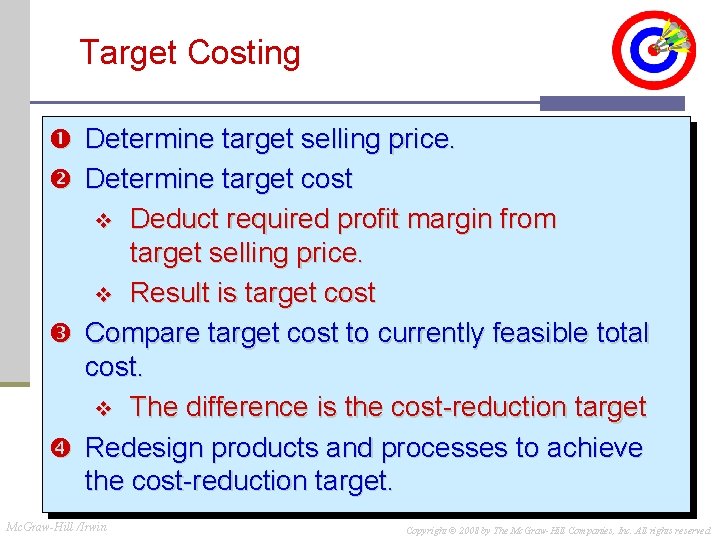
Target Costing Determine target selling price. Determine target cost Deduct required profit margin from target selling price. v Result is target cost Compare target cost to currently feasible total cost. v The difference is the cost-reduction target Redesign products and processes to achieve the cost-reduction target. v Mc. Graw-Hill /Irwin Copyright © 2008 by The Mc. Graw-Hill Companies, Inc. All rights reserved.
Target Costing Advantages • Focus on market and customer. • Higher level of cost-consciousness. Some companies are abandoning the cost-plus approach to new product pricing in favor of target costing. Mc. Graw-Hill /Irwin Copyright © 2008 by The Mc. Graw-Hill Companies, Inc. All rights reserved.
Learning Objective 5 Determine the most profitable use of a constrained resource and the value of obtaining more of the constrained resource. Mc. Graw-Hill /Irwin Copyright © 2008 by The Mc. Graw-Hill Companies, Inc. All rights reserved.
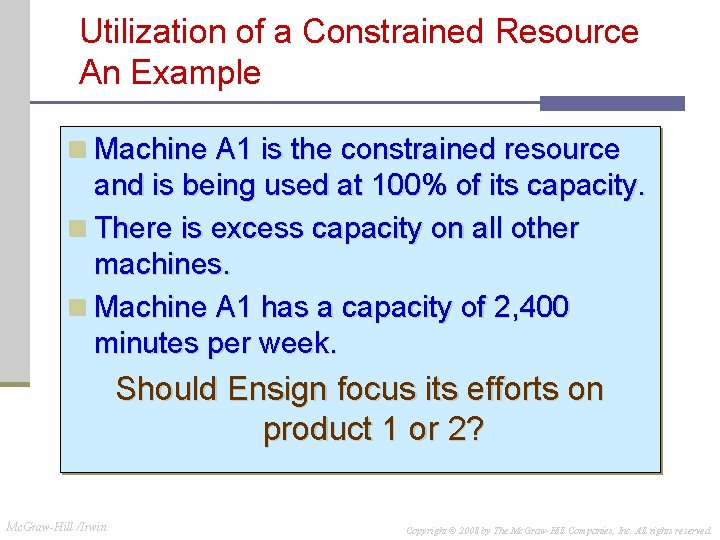
Utilization of a Constrained Resource Key Terms and Concepts When a limited resource of some type restricts the company’s ability to satisfy demand, the company is said to have a constraint. The machine or process that is limiting overall output is called the bottleneck – it is the constraint. Mc. Graw-Hill /Irwin Copyright © 2008 by The Mc. Graw-Hill Companies, Inc. All rights reserved.
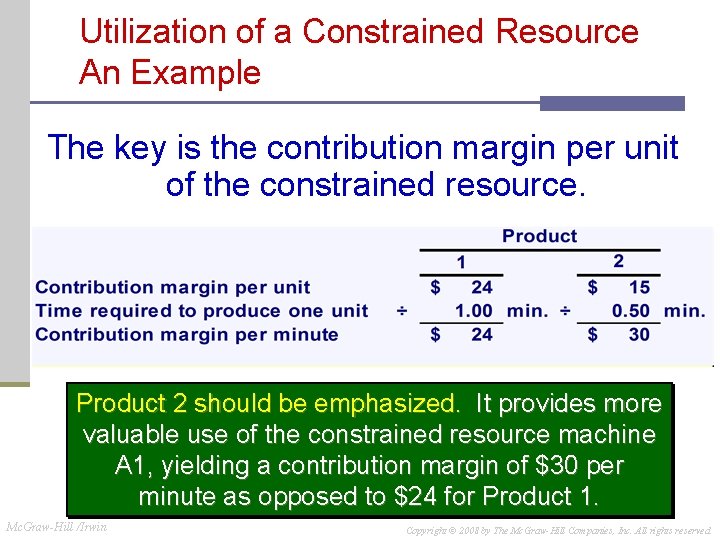
Utilization of a Constrained Resource Key Terms and Concepts n When a constraint exists, a company should select a product mix that maximizes the total contribution margin earned since fixed costs usually remain unchanged. n A company should not necessarily promote those products that have the highest unit contribution margin. n Rather, it should promote those products that earn the highest contribution margin in relation to the constraining resource. Mc. Graw-Hill /Irwin Copyright © 2008 by The Mc. Graw-Hill Companies, Inc. All rights reserved.
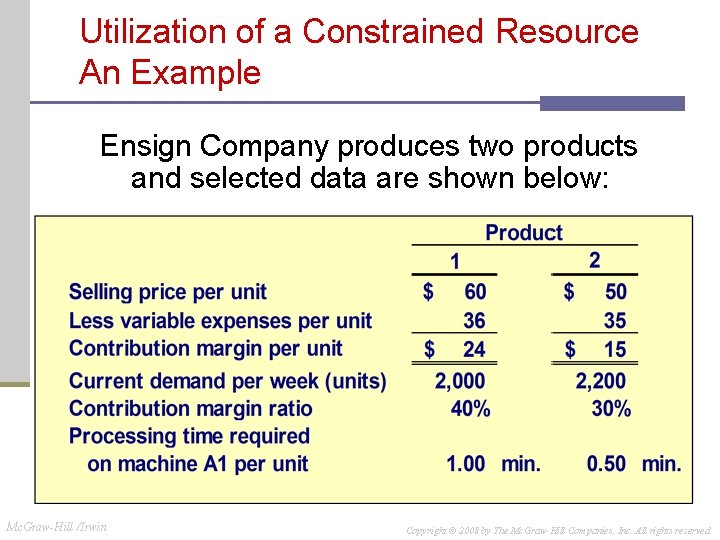
Utilization of a Constrained Resource An Example Ensign Company produces two products and selected data are shown below: Mc. Graw-Hill /Irwin Copyright © 2008 by The Mc. Graw-Hill Companies, Inc. All rights reserved.
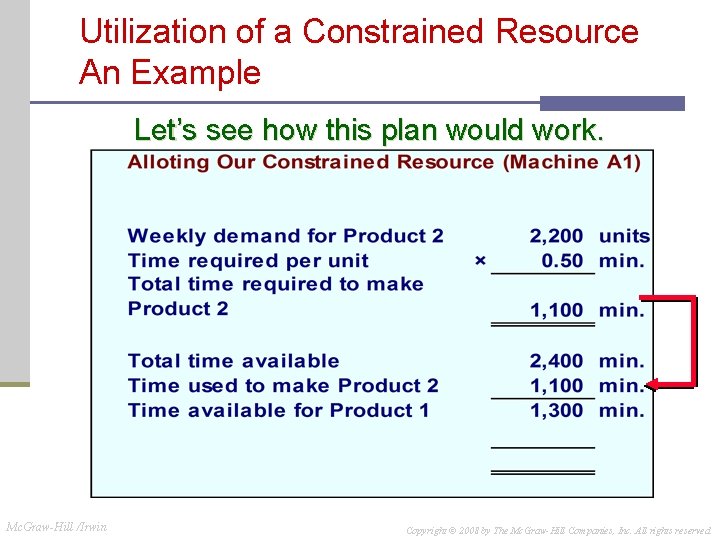
Utilization of a Constrained Resource An Example n Machine A 1 is the constrained resource and is being used at 100% of its capacity. n There is excess capacity on all other machines. n Machine A 1 has a capacity of 2, 400 minutes per week. Should Ensign focus its efforts on product 1 or 2? Mc. Graw-Hill /Irwin Copyright © 2008 by The Mc. Graw-Hill Companies, Inc. All rights reserved.
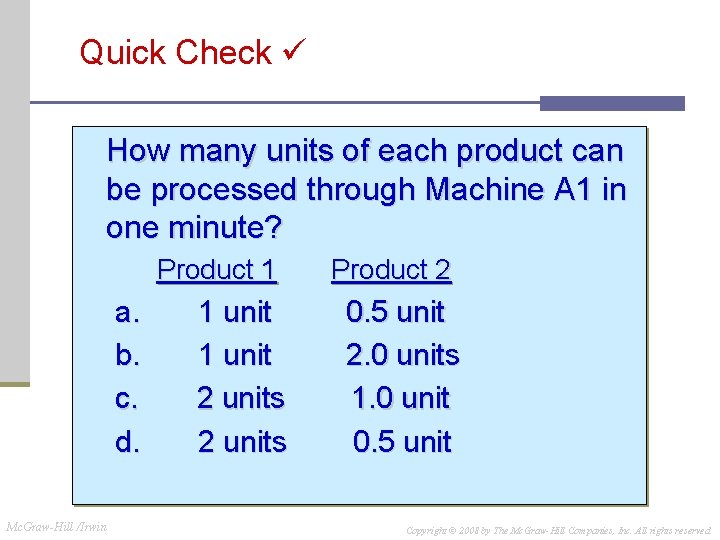
Quick Check How many units of each product can be processed through Machine A 1 in one minute? Product 1 a. b. c. d. Mc. Graw-Hill /Irwin 1 unit 2 units Product 2 0. 5 unit 2. 0 units 1. 0 unit 0. 5 unit Copyright © 2008 by The Mc. Graw-Hill Companies, Inc. All rights reserved.
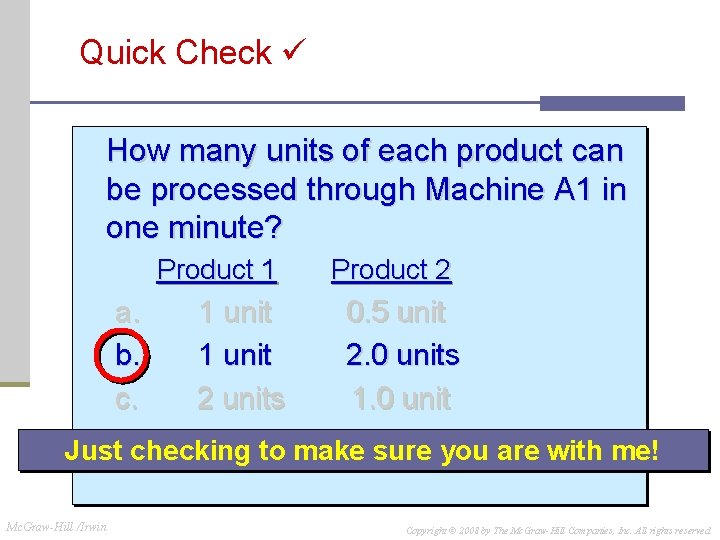
Quick Check How many units of each product can be processed through Machine A 1 in one minute? Product 1 Product 2 a. 1 unit 0. 5 unit b. 1 unit 2. 0 units c. 2 units 1. 0 unit 2 units unityou are with me! Justd. checking to make 0. 5 sure Mc. Graw-Hill /Irwin Copyright © 2008 by The Mc. Graw-Hill Companies, Inc. All rights reserved.
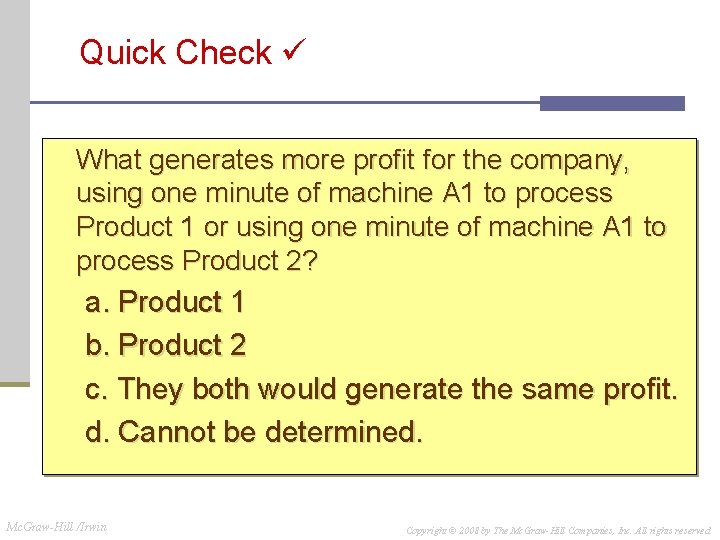
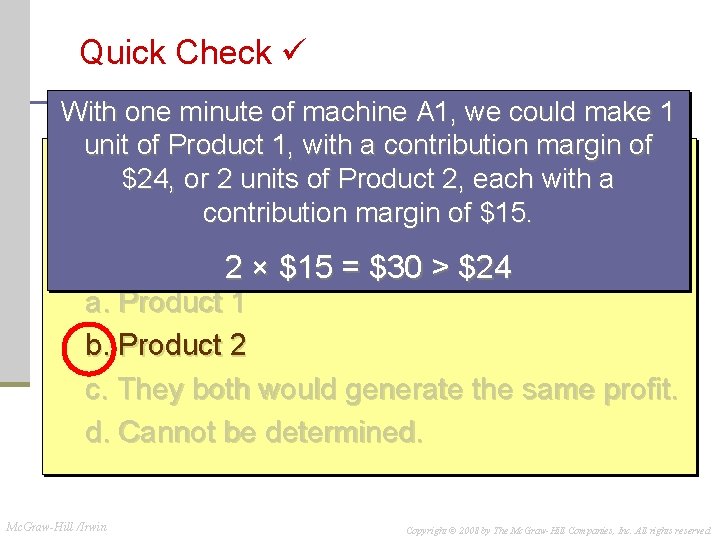
Quick Check What generates more profit for the company, using one minute of machine A 1 to process Product 1 or using one minute of machine A 1 to process Product 2? a. Product 1 b. Product 2 c. They both would generate the same profit. d. Cannot be determined. Mc. Graw-Hill /Irwin Copyright © 2008 by The Mc. Graw-Hill Companies, Inc. All rights reserved.
Quick Check With one minute of machine A 1, we could make 1 unit of Product 1, with a contribution margin of What generates more profit for the company, $24, or 2 units of Product 2, each with a using one minute of machine A 1 to process contribution margin of $15. Product 1 or using one minute of machine A 1 to process Product 2? = $30 > $24 2 × $15 a. Product 1 b. Product 2 c. They both would generate the same profit. d. Cannot be determined. Mc. Graw-Hill /Irwin Copyright © 2008 by The Mc. Graw-Hill Companies, Inc. All rights reserved.
Utilization of a Constrained Resource An Example The key is the contribution margin per unit of the constrained resource. Product 2 should be emphasized. It provides more valuable use of the constrained resource machine A 1, yielding a contribution margin of $30 per minute as opposed to $24 for Product 1. Mc. Graw-Hill /Irwin Copyright © 2008 by The Mc. Graw-Hill Companies, Inc. All rights reserved.
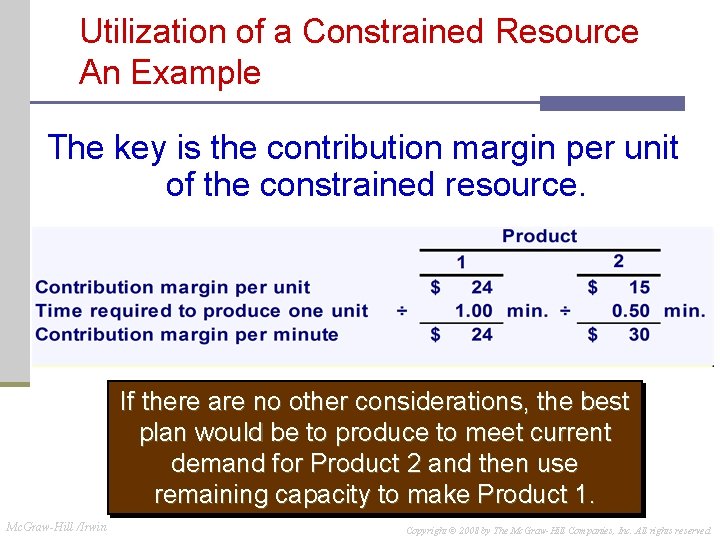
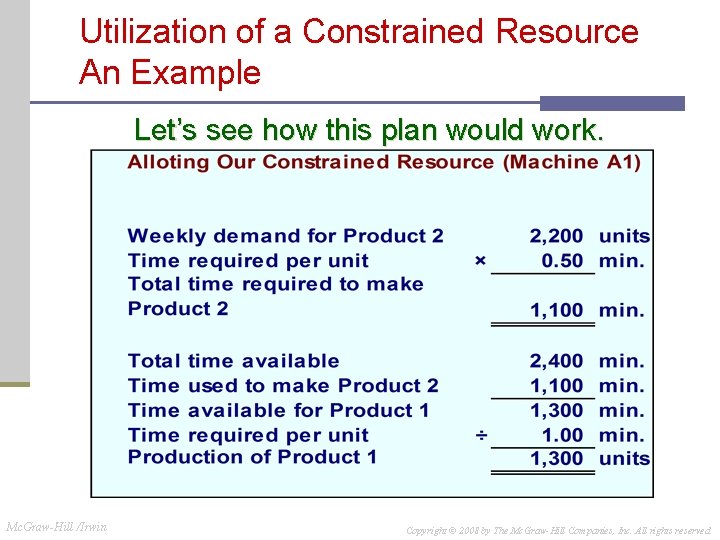
Utilization of a Constrained Resource An Example The key is the contribution margin per unit of the constrained resource. If there are no other considerations, the best plan would be to produce to meet current demand for Product 2 and then use remaining capacity to make Product 1. Mc. Graw-Hill /Irwin Copyright © 2008 by The Mc. Graw-Hill Companies, Inc. All rights reserved.
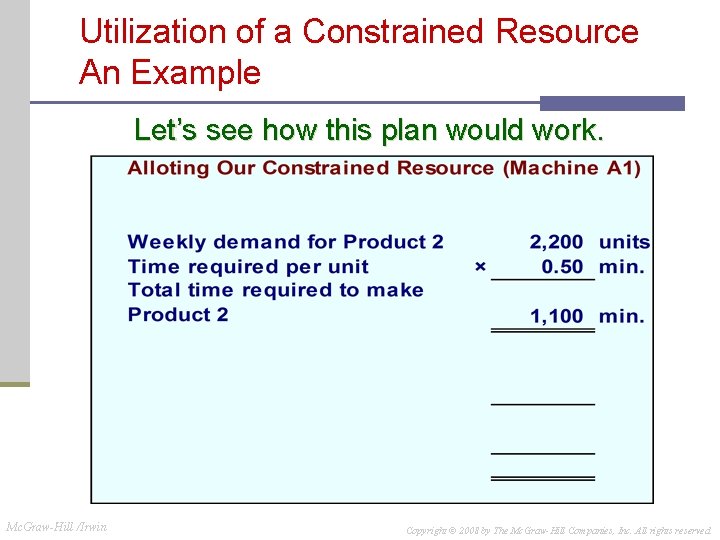
Utilization of a Constrained Resource An Example Let’s see how this plan would work. Mc. Graw-Hill /Irwin Copyright © 2008 by The Mc. Graw-Hill Companies, Inc. All rights reserved.
Utilization of a Constrained Resource An Example Let’s see how this plan would work. Mc. Graw-Hill /Irwin Copyright © 2008 by The Mc. Graw-Hill Companies, Inc. All rights reserved.
Utilization of a Constrained Resource An Example Let’s see how this plan would work. Mc. Graw-Hill /Irwin Copyright © 2008 by The Mc. Graw-Hill Companies, Inc. All rights reserved.
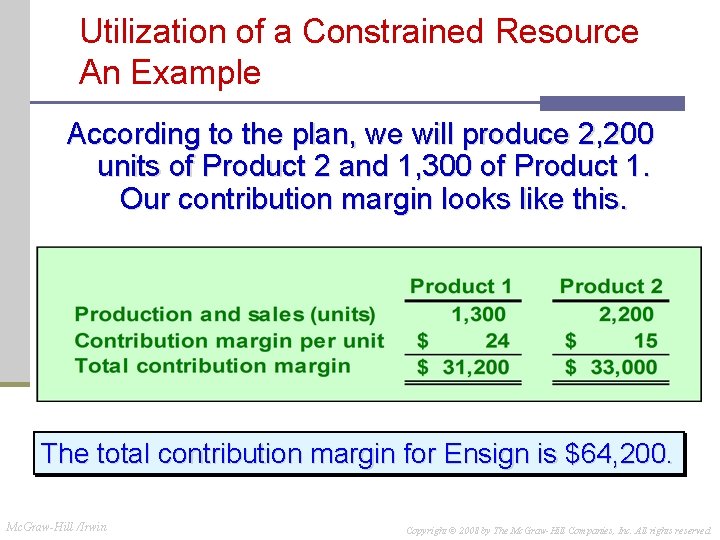
Utilization of a Constrained Resource An Example According to the plan, we will produce 2, 200 units of Product 2 and 1, 300 of Product 1. Our contribution margin looks like this. The total contribution margin for Ensign is $64, 200. Mc. Graw-Hill /Irwin Copyright © 2008 by The Mc. Graw-Hill Companies, Inc. All rights reserved.
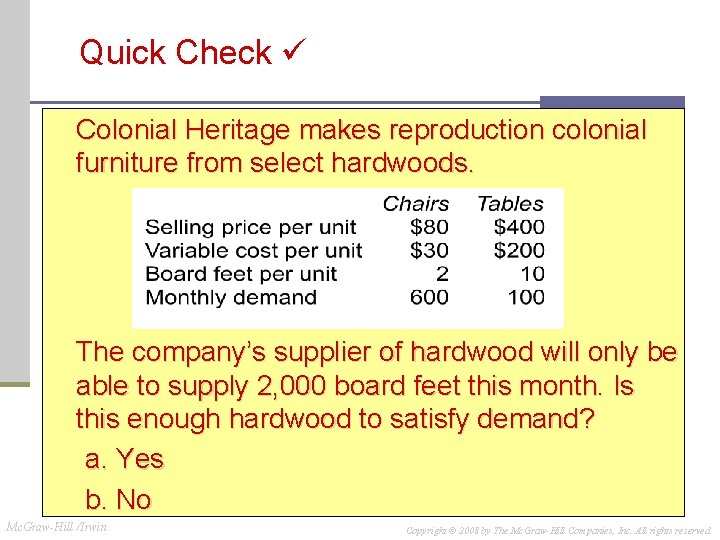
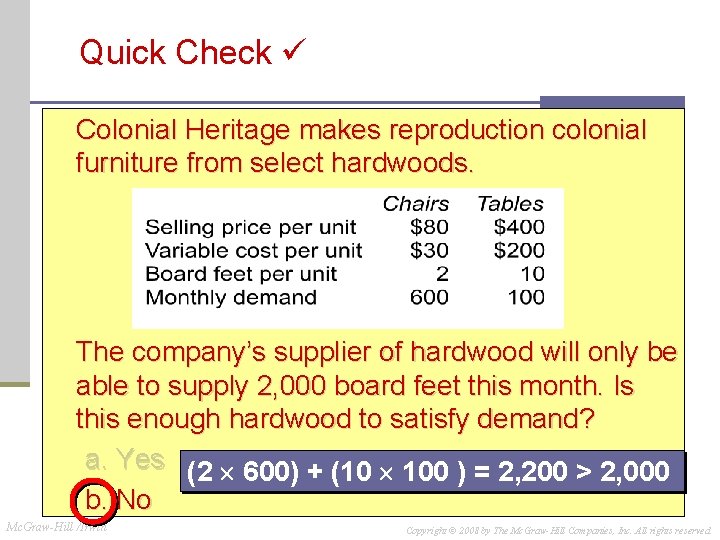
Quick Check Colonial Heritage makes reproduction colonial furniture from select hardwoods. The company’s supplier of hardwood will only be able to supply 2, 000 board feet this month. Is this enough hardwood to satisfy demand? a. Yes b. No Mc. Graw-Hill /Irwin Copyright © 2008 by The Mc. Graw-Hill Companies, Inc. All rights reserved.
Quick Check Colonial Heritage makes reproduction colonial furniture from select hardwoods. The company’s supplier of hardwood will only be able to supply 2, 000 board feet this month. Is this enough hardwood to satisfy demand? a. Yes (2 600) + (10 100 ) = 2, 200 > 2, 000 b. No Mc. Graw-Hill /Irwin Copyright © 2008 by The Mc. Graw-Hill Companies, Inc. All rights reserved.
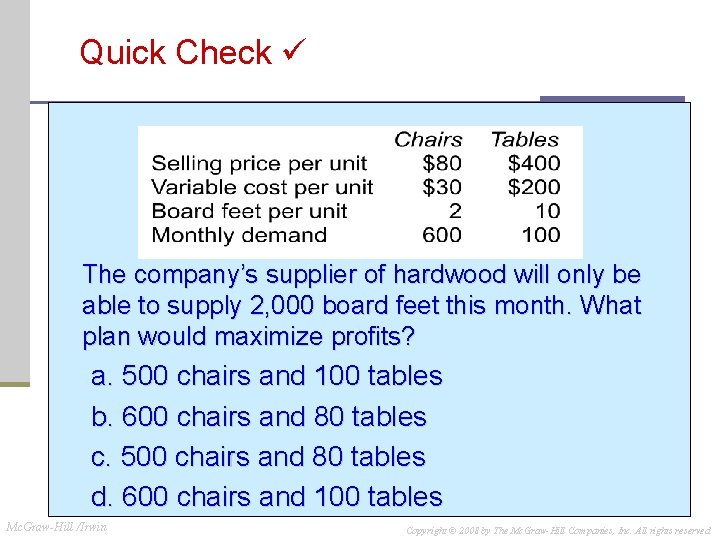
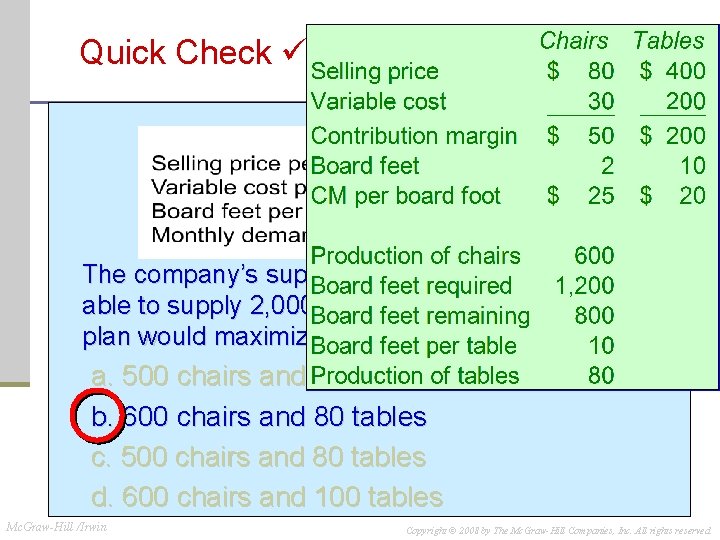
Quick Check The company’s supplier of hardwood will only be able to supply 2, 000 board feet this month. What plan would maximize profits? a. 500 chairs and 100 tables b. 600 chairs and 80 tables c. 500 chairs and 80 tables d. 600 chairs and 100 tables Mc. Graw-Hill /Irwin Copyright © 2008 by The Mc. Graw-Hill Companies, Inc. All rights reserved.
Quick Check The company’s supplier of hardwood will only be able to supply 2, 000 board feet this month. What plan would maximize profits? a. 500 chairs and 100 tables b. 600 chairs and 80 tables c. 500 chairs and 80 tables d. 600 chairs and 100 tables Mc. Graw-Hill /Irwin Copyright © 2008 by The Mc. Graw-Hill Companies, Inc. All rights reserved.
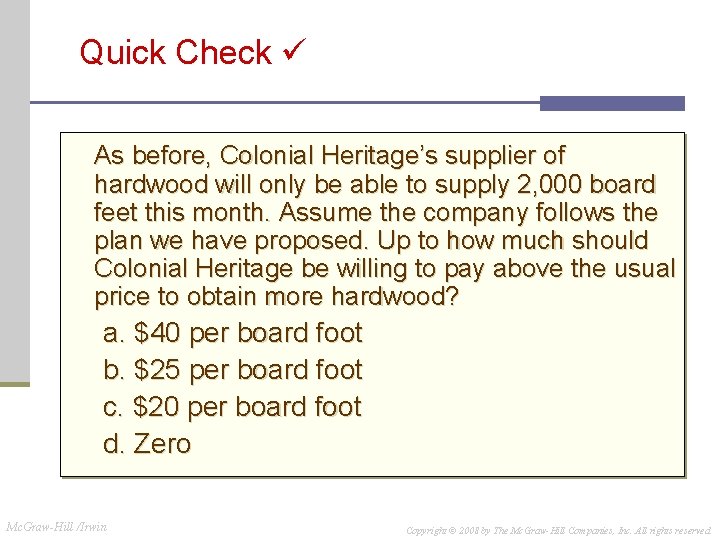
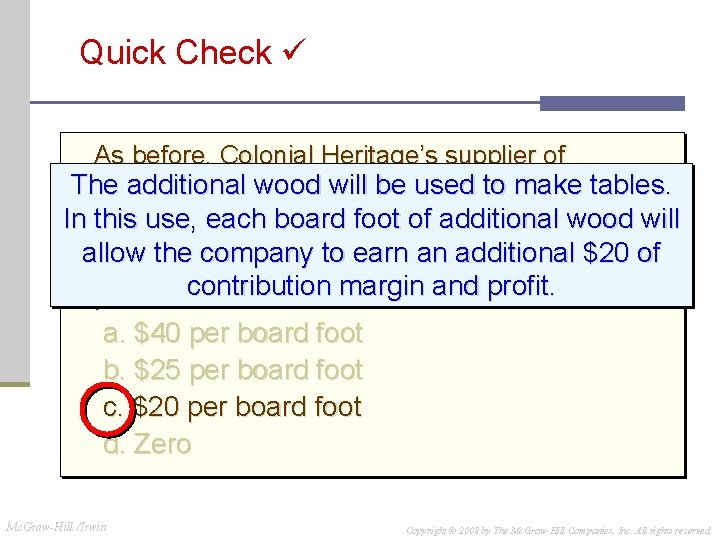
Quick Check As before, Colonial Heritage’s supplier of hardwood will only be able to supply 2, 000 board feet this month. Assume the company follows the plan we have proposed. Up to how much should Colonial Heritage be willing to pay above the usual price to obtain more hardwood? a. $40 per board foot b. $25 per board foot c. $20 per board foot d. Zero Mc. Graw-Hill /Irwin Copyright © 2008 by The Mc. Graw-Hill Companies, Inc. All rights reserved.
Quick Check As before, Colonial Heritage’s supplier of hardwood will wood only be able supply 2, 000 board The additional will betoused to make tables. feet this Assume theofcompany follows In this use, month. each board foot additional woodthe will plan we proposed. Up an to how much should allow thehave company to earn additional $20 of Colonial Heritage be willing to pay above the usual contribution margin and profit. price to obtain more hardwood? a. $40 per board foot b. $25 per board foot c. $20 per board foot d. Zero Mc. Graw-Hill /Irwin Copyright © 2008 by The Mc. Graw-Hill Companies, Inc. All rights reserved.
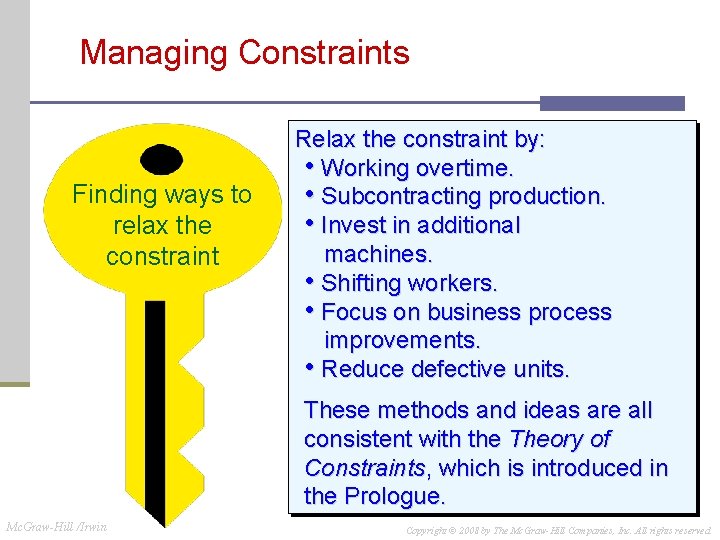
Managing Constraints Finding ways to relax the constraint Relax the constraint by: • Working overtime. • Subcontracting production. • Invest in additional machines. • Shifting workers. • Focus on business process improvements. • Reduce defective units. These methods and ideas are all consistent with the Theory of Constraints, which is introduced in the Prologue. Mc. Graw-Hill /Irwin Copyright © 2008 by The Mc. Graw-Hill Companies, Inc. All rights reserved.
End of Chapter 11 Mc. Graw-Hill /Irwin Copyright © 2008 by The Mc. Graw-Hill Companies, Inc. All rights reserved.