
Chapter 11 Radiation Exchange between Surfaces Define view
Chapter 11 : Radiation Exchange between Surfaces • Define view factor and understand its importance in radiation heat transfer calculations. • Develop view factor relations and calculate the unknown view factors in an enclosure by using these relations. • Calculate radiation heat transfer between black surfaces. • Determine radiation heat transfer between diffuse and gray surfaces in an enclosure using the concept of radiosity. 1
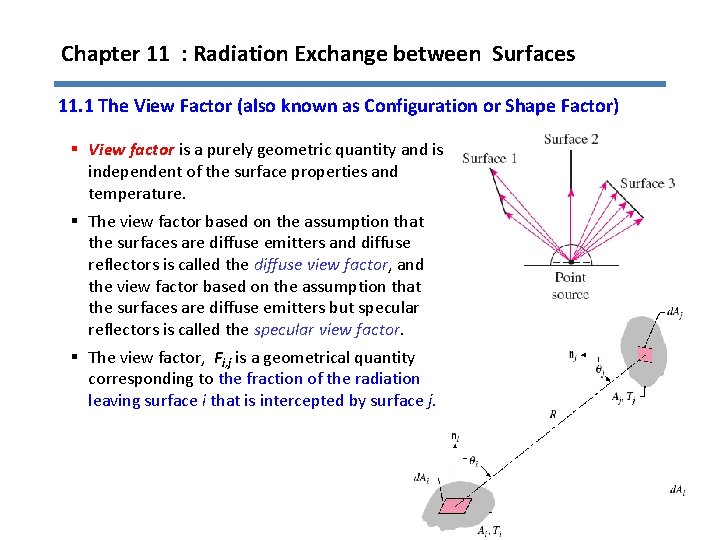
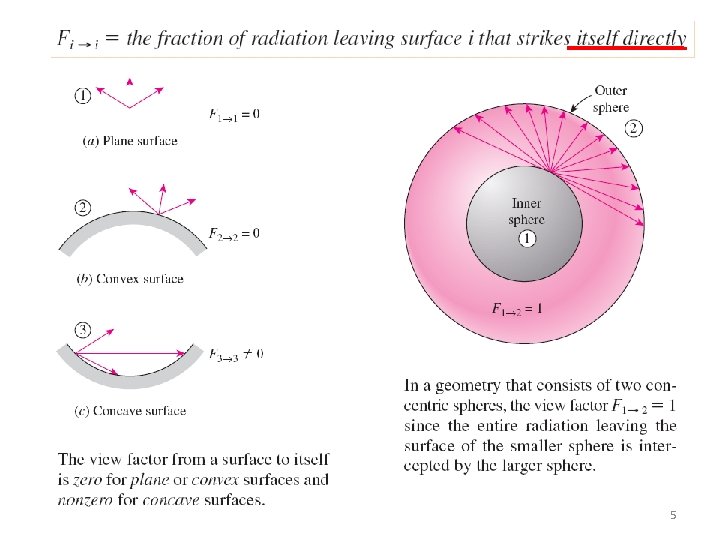
Chapter 11 : Radiation Exchange between Surfaces 11. 1 The View Factor (also known as Configuration or Shape Factor) § View factor is a purely geometric quantity and is independent of the surface properties and temperature. § The view factor based on the assumption that the surfaces are diffuse emitters and diffuse reflectors is called the diffuse view factor, and the view factor based on the assumption that the surfaces are diffuse emitters but specular reflectors is called the specular view factor. § The view factor, Fi, j is a geometrical quantity corresponding to the fraction of the radiation leaving surface i that is intercepted by surface j. 2
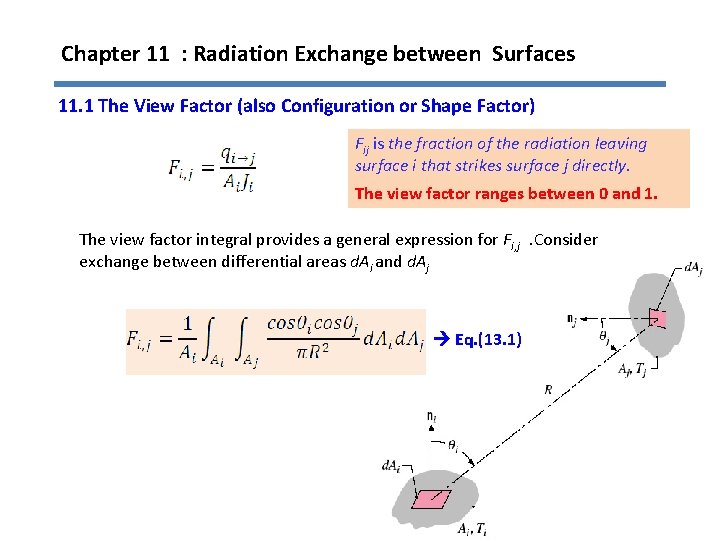
Chapter 11 : Radiation Exchange between Surfaces 11. 1 The View Factor (also Configuration or Shape Factor) Fij is the fraction of the radiation leaving surface i that strikes surface j directly. The view factor ranges between 0 and 1. The view factor integral provides a general expression for Fi, j. Consider exchange between differential areas d. Ai and d. Aj Eq. (13. 1) 3
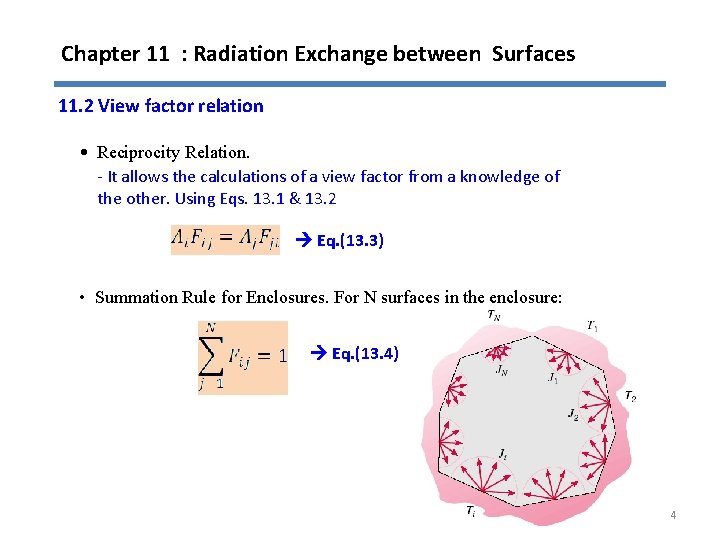
Chapter 11 : Radiation Exchange between Surfaces 11. 2 View factor relation • Reciprocity Relation. - It allows the calculations of a view factor from a knowledge of the other. Using Eqs. 13. 1 & 13. 2 Eq. (13. 3) • Summation Rule for Enclosures. For N surfaces in the enclosure: Eq. (13. 4) 4
5
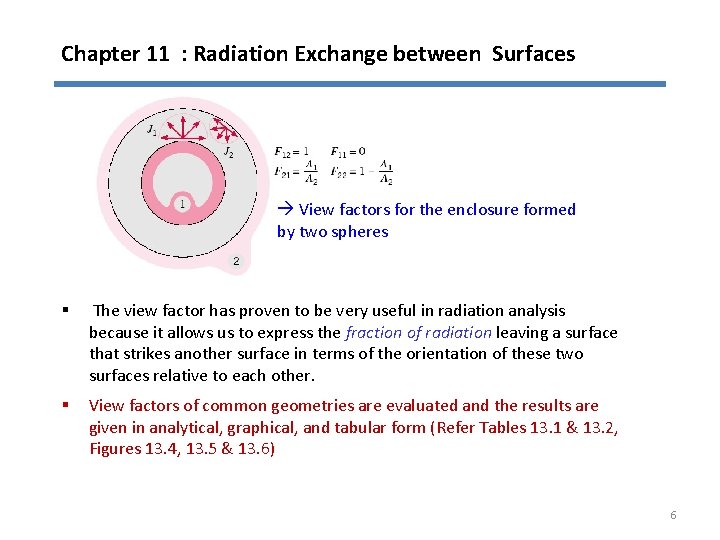
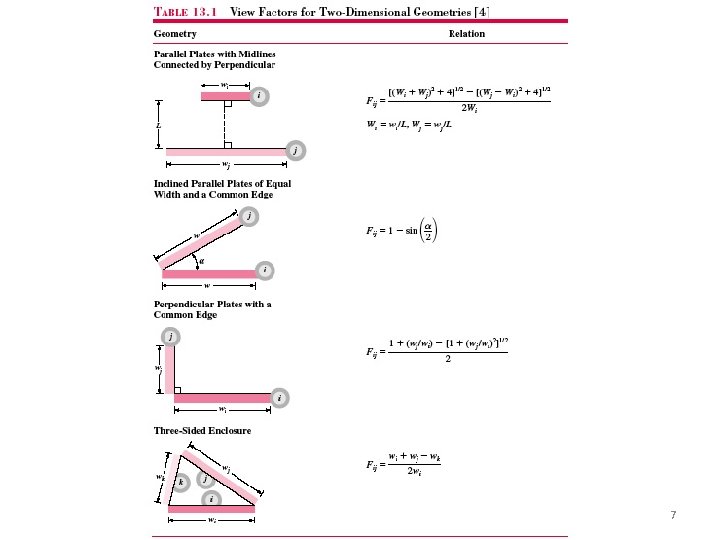
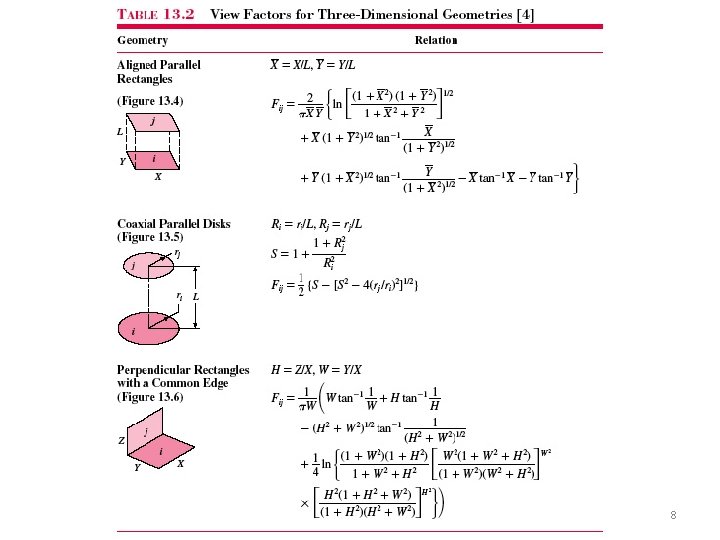
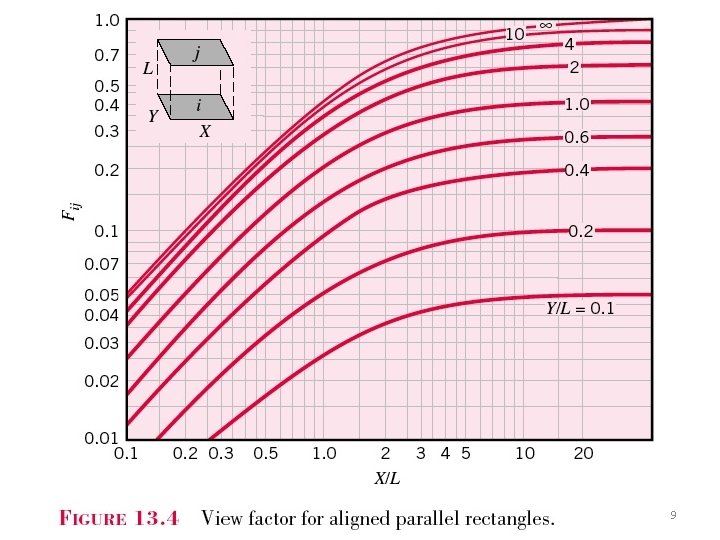
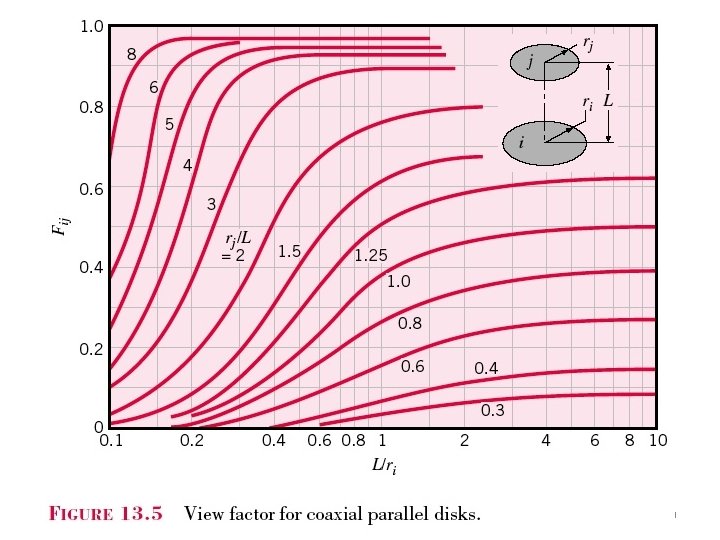
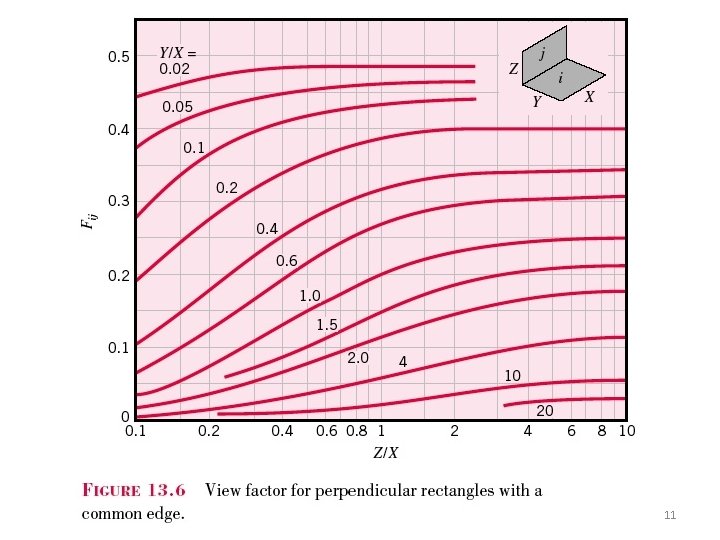
Chapter 11 : Radiation Exchange between Surfaces View factors for the enclosure formed by two spheres § The view factor has proven to be very useful in radiation analysis because it allows us to express the fraction of radiation leaving a surface that strikes another surface in terms of the orientation of these two surfaces relative to each other. § View factors of common geometries are evaluated and the results are given in analytical, graphical, and tabular form (Refer Tables 13. 1 & 13. 2, Figures 13. 4, 13. 5 & 13. 6) 6
7
8
9
10
11
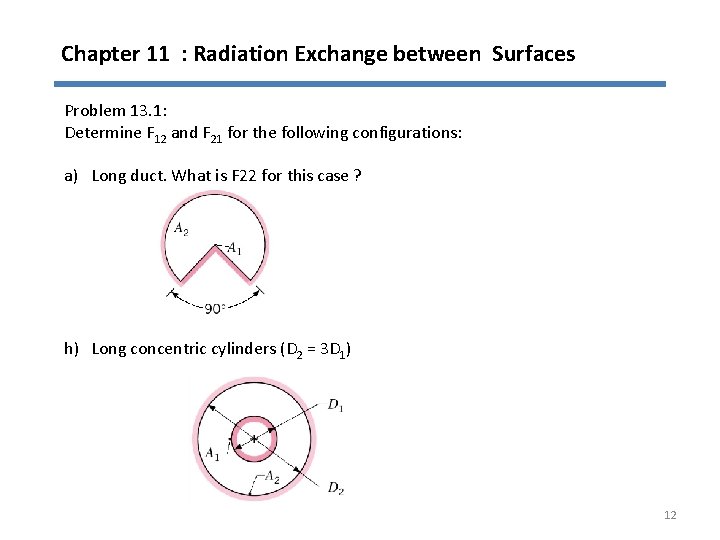
Chapter 11 : Radiation Exchange between Surfaces Problem 13. 1: Determine F 12 and F 21 for the following configurations: a) Long duct. What is F 22 for this case ? h) Long concentric cylinders (D 2 = 3 D 1) 12
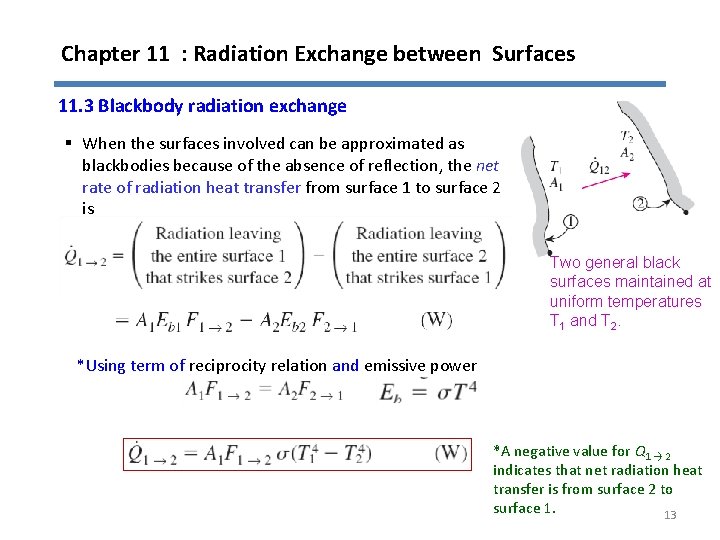
Chapter 11 : Radiation Exchange between Surfaces 11. 3 Blackbody radiation exchange § When the surfaces involved can be approximated as blackbodies because of the absence of reflection, the net rate of radiation heat transfer from surface 1 to surface 2 is Two general black surfaces maintained at uniform temperatures T 1 and T 2. *Using term of reciprocity relation and emissive power *A negative value for Q 1 → 2 indicates that net radiation heat transfer is from surface 2 to surface 1. 13
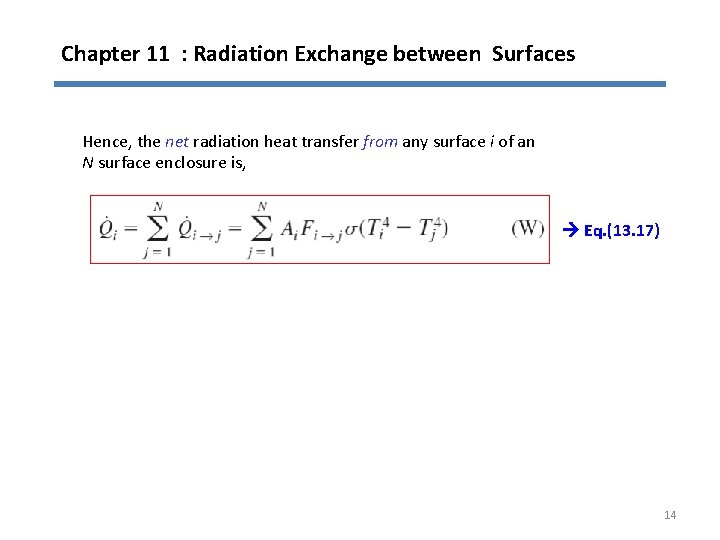
Chapter 11 : Radiation Exchange between Surfaces Hence, the net radiation heat transfer from any surface i of an N surface enclosure is, Eq. (13. 17) 14
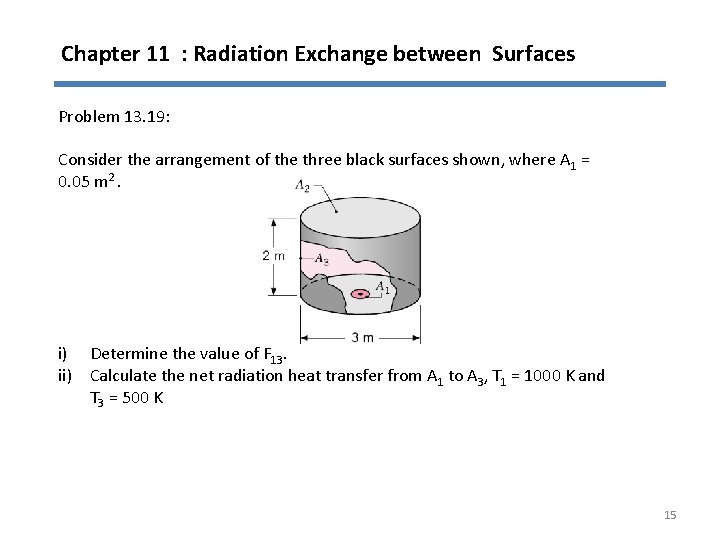
Chapter 11 : Radiation Exchange between Surfaces Problem 13. 19: Consider the arrangement of the three black surfaces shown, where A 1 = 0. 05 m 2. i) Determine the value of F 13. ii) Calculate the net radiation heat transfer from A 1 to A 3, T 1 = 1000 K and T 3 = 500 K 15
Chapter 11 : Radiation Exchange between Surfaces 11. 4 Radiation exchange in real surfaces; diffuse, gray surfaces • Most enclosures encountered in practice involve nonblack surfaces, which allow multiple reflections to occur. • Radiation analysis of such enclosures becomes very complicated unless some simplifying assumptions are made. • It is common to assume the surfaces of an enclosure to be opaque, diffuse, and gray. • Also, each surface of the enclosure is isothermal, and both the incoming and outgoing radiation are uniform over each surface. 16
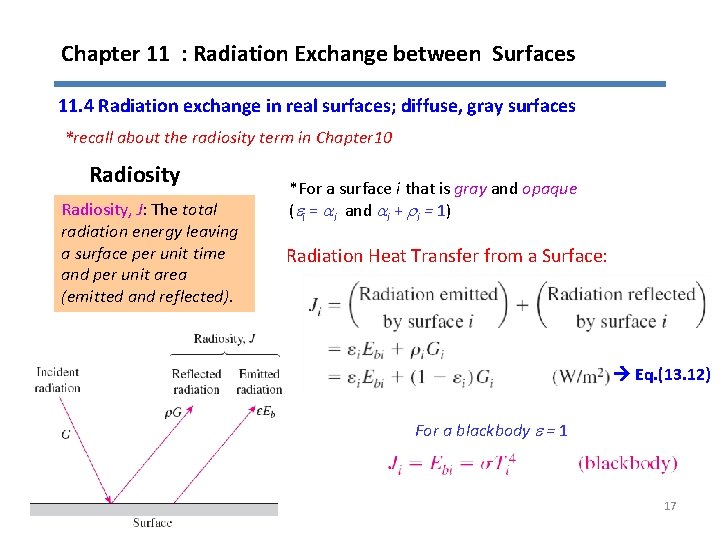
Chapter 11 : Radiation Exchange between Surfaces 11. 4 Radiation exchange in real surfaces; diffuse, gray surfaces *recall about the radiosity term in Chapter 10 Radiosity, J: The total radiation energy leaving a surface per unit time and per unit area (emitted and reflected). *For a surface i that is gray and opaque ( i = i and i + i = 1) Radiation Heat Transfer from a Surface: Eq. (13. 12) For a blackbody = 1 17
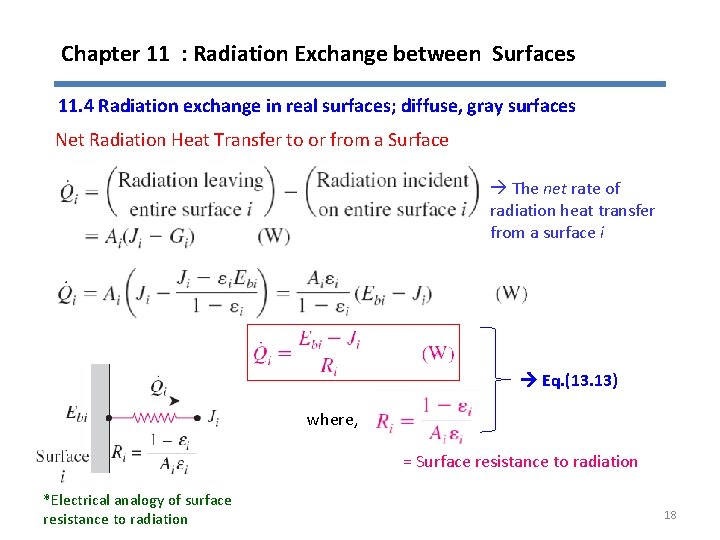
Chapter 11 : Radiation Exchange between Surfaces 11. 4 Radiation exchange in real surfaces; diffuse, gray surfaces Net Radiation Heat Transfer to or from a Surface The net rate of radiation heat transfer from a surface i Eq. (13. 13) where, = Surface resistance to radiation *Electrical analogy of surface resistance to radiation 18
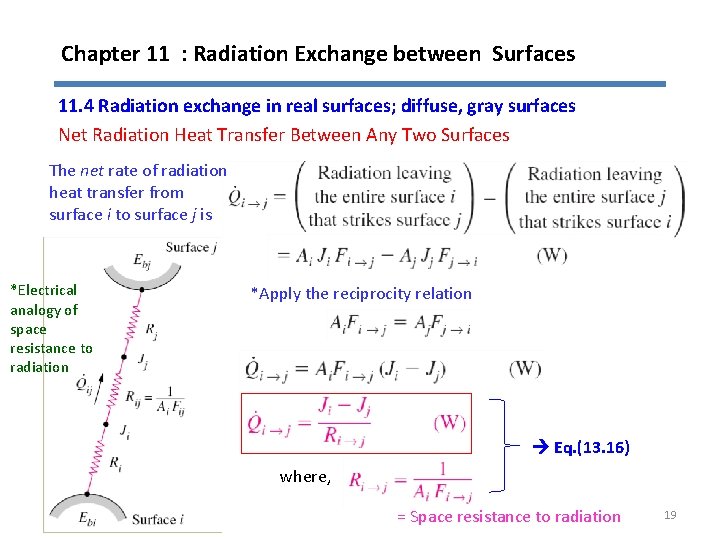
Chapter 11 : Radiation Exchange between Surfaces 11. 4 Radiation exchange in real surfaces; diffuse, gray surfaces Net Radiation Heat Transfer Between Any Two Surfaces The net rate of radiation heat transfer from surface i to surface j is *Electrical analogy of space resistance to radiation *Apply the reciprocity relation Eq. (13. 16) where, = Space resistance to radiation 19
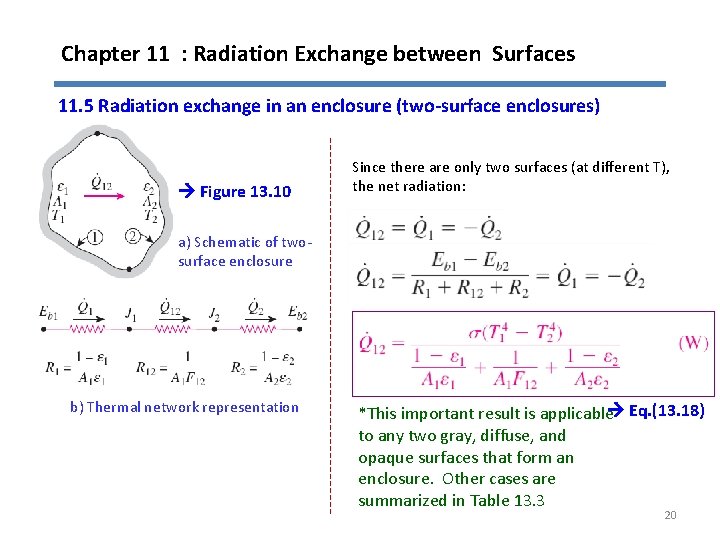
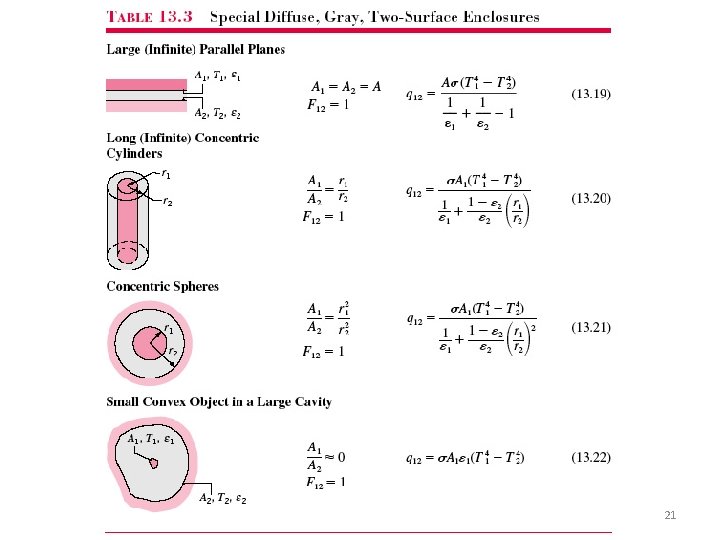
Chapter 11 : Radiation Exchange between Surfaces 11. 5 Radiation exchange in an enclosure (two-surface enclosures) Figure 13. 10 Since there are only two surfaces (at different T), the net radiation: a) Schematic of twosurface enclosure b) Thermal network representation *This important result is applicable Eq. (13. 18) to any two gray, diffuse, and opaque surfaces that form an enclosure. Other cases are summarized in Table 13. 3 20
21
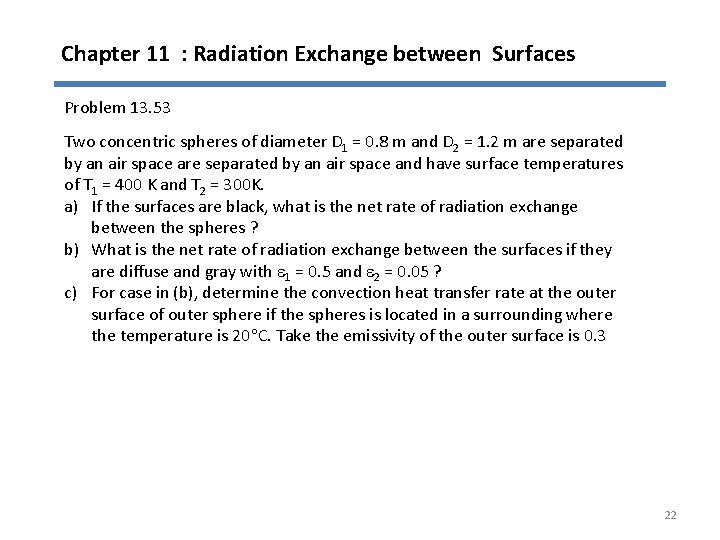
Chapter 11 : Radiation Exchange between Surfaces Problem 13. 53 Two concentric spheres of diameter D 1 = 0. 8 m and D 2 = 1. 2 m are separated by an air space and have surface temperatures of T 1 = 400 K and T 2 = 300 K. a) If the surfaces are black, what is the net rate of radiation exchange between the spheres ? b) What is the net rate of radiation exchange between the surfaces if they are diffuse and gray with 1 = 0. 5 and 2 = 0. 05 ? c) For case in (b), determine the convection heat transfer rate at the outer surface of outer sphere if the spheres is located in a surrounding where the temperature is 20 C. Take the emissivity of the outer surface is 0. 3 22
- Slides: 22