
CHAPTER 11 Public Goods and Common Resources Microeonomics
CHAPTER 11 Public Goods and Common Resources Microeonomics PRINCIPLES OF N. Gregory Mankiw Premium Power. Point Slides by Ron Cronovich © 2009 South-Western, a part of Cengage Learning, all rights reserved

In this chapter, look for the answers to these questions: § What are public goods? What are common resources? Give examples of each. § Why do markets generally fail to provide the efficient amounts of these goods? § How might the government improve market outcomes in the case of public goods or common resources? 1
Introduction § We consume many goods without paying: parks, national defense, clean air & water. § When goods have no prices, the market forces that normally allocate resources are absent. § The private market may fail to provide the socially efficient quantity of such goods. § One of the Ten Principles from Chapter 1: Governments can sometimes improve market outcomes. PUBLIC GOODS AND COMMON RESOURCES 2
Important Characteristics of Goods § A good is excludable if a person can be prevented from using it. § Excludable: fish tacos, wireless internet access § Not excludable: FM radio signals, national defense § A good is rival in consumption if one person’s use of it diminishes others’ use. § Rival: fish tacos § Not rival: An MP 3 file of Kanye West’s latest single PUBLIC GOODS AND COMMON RESOURCES 3

The Different Kinds of Goods Private goods: excludable, rival in consumption Example: food Public goods: not excludable, not rival Example: national defense Common resources: rival but not excludable Example: fish in the ocean Natural monopolies: excludable but not rival Example: cable TV PUBLIC GOODS AND COMMON RESOURCES 4
ACTIVE LEARNING 1 Categorizing roads § A road is which of the four kinds of goods? § Hint: The answer depends on whether the road is congested or not, and whether it’s a toll road or not. Consider the different cases. 5
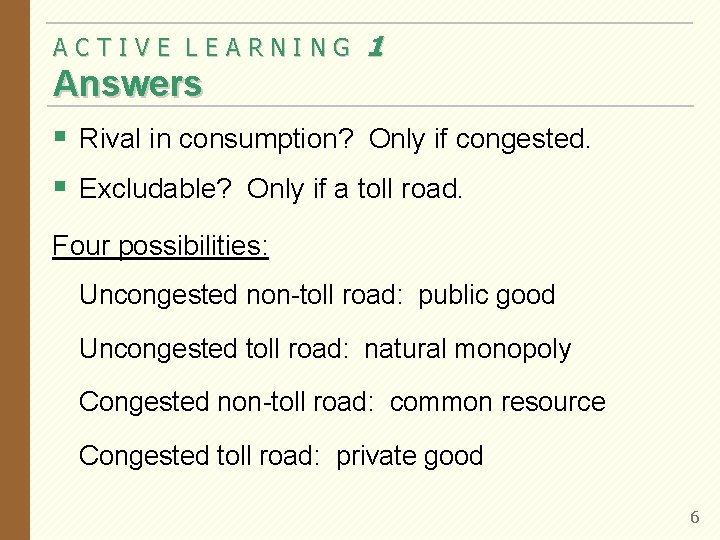
ACTIVE LEARNING 1 Answers § Rival in consumption? Only if congested. § Excludable? Only if a toll road. Four possibilities: Uncongested non-toll road: public good Uncongested toll road: natural monopoly Congested non-toll road: common resource Congested toll road: private good 6
The Different Kinds of Goods § This chapter focuses on public goods and common resources. § For both, externalities arise because something of value has no price attached to it. § So, private decisions about consumption and production can lead to an inefficient outcome. § Public policy can potentially raise economic well-being. PUBLIC GOODS AND COMMON RESOURCES 7
Public Goods § Public goods are difficult for private markets to provide because of the free-rider problem. § Free rider: a person who receives the benefit of a good but avoids paying for it § If good is not excludable, people have incentive to be free riders, because firms cannot prevent non-payers from consuming the good. § Result: The good is not produced, even if buyers collectively value the good higher than the cost of providing it. PUBLIC GOODS AND COMMON RESOURCES 8
Public Goods § If the benefit of a public good exceeds the cost of providing it, govt should provide the good and pay for it with a tax on people who benefit. § Problem: Measuring the benefit is usually difficult. § Cost-benefit analysis: a study that compares the costs and benefits of providing a public good § Cost-benefit analyses are imprecise, so the efficient provision of public goods is more difficult than that of private goods. PUBLIC GOODS AND COMMON RESOURCES 9
Some Important Public Goods § National defense § Knowledge created through basic research § Fighting poverty PUBLIC GOODS AND COMMON RESOURCES 10

Common Resources § Like public goods, common resources are not excludable. § Cannot prevent free riders from using § Little incentive for firms to provide § Role for govt: seeing that they are provided § Additional problem with common resources: rival in consumption § Each person’s use reduces others’ ability to use § Role for govt: ensuring they are not overused PUBLIC GOODS AND COMMON RESOURCES 11
The Tragedy of the Commons § A parable that illustrates why common resources get used more than is socially desirable. § Setting: a medieval town where sheep graze on common land. § As the population grows, the # of sheep grows. § The amount of land is fixed, the grass begins to disappear from overgrazing. § The private incentives (using the land for free) outweigh the social incentives (using it carefully). § Result: People can no longer raise sheep. PUBLIC GOODS AND COMMON RESOURCES 12
The Tragedy of the Commons § The tragedy is due to an externality: Allowing one’s flock to graze on the common land reduces its quality for other families. § People neglect this external cost, resulting in overuse of the land. PUBLIC GOODS AND COMMON RESOURCES 13
ACTIVE LEARNING 2 Policy options for common §resources What could the townspeople (or their government) have done to prevent the tragedy? § Try to think of two or three options. 14
ACTIVE LEARNING 2 Answers § Impose a corrective tax on the use of the land to “internalize the externality. ” § Regulate use of the land (the “command-andcontrol” approach). § Auction off permits allowing use of the land. § Divide the land, sell lots to individual families; each family will have incentive not to overgraze its own land. 15
Policy Options to Prevent Overconsumption of Common Resources § Regulate use of the resource § Impose a corrective tax to internalize the externality § example: hunting & fishing licenses, entrance fees for congested national parks § Auction off permits allowing use of the resource § example: spectrum auctions by the U. S. Federal Communications Commission § If the resource is land, convert to a private good by dividing and selling parcels to individuals PUBLIC GOODS AND COMMON RESOURCES 16
Some Important Common Resources § Clean air and water § Congested roads § Fish, whales, and other wildlife PUBLIC GOODS AND COMMON RESOURCES 17
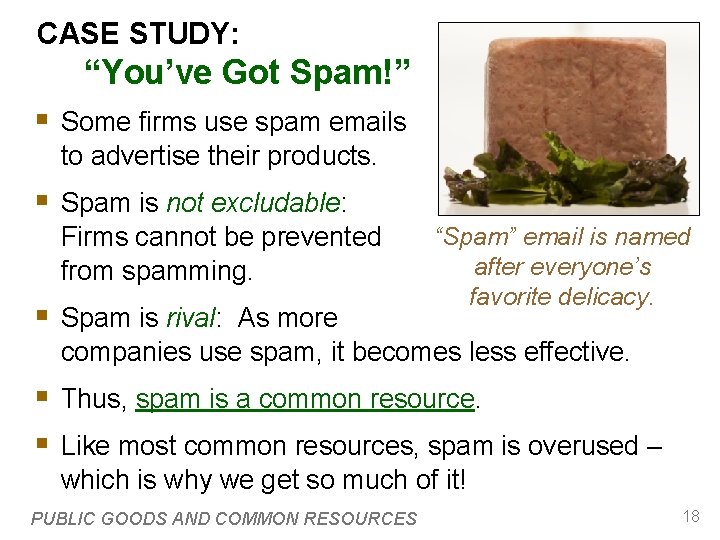
CASE STUDY: “You’ve Got Spam!” § Some firms use spam emails to advertise their products. § Spam is not excludable: Firms cannot be prevented from spamming. § Spam is rival: As more “Spam” email is named after everyone’s favorite delicacy. companies use spam, it becomes less effective. § Thus, spam is a common resource. § Like most common resources, spam is overused – which is why we get so much of it! PUBLIC GOODS AND COMMON RESOURCES 18
CONCLUSION § Public goods tend to be under-provided, while common resources tend to be over-consumed. § These problems arise because property rights are not well-established: § Nobody owns the air, so no one can charge polluters. Result: too much pollution. § Nobody can charge people who benefit from national defense. Result: too little defense. § The govt can potentially solve these problems with appropriate policies. PUBLIC GOODS AND COMMON RESOURCES 19
CHAPTER SUMMARY § A good is excludable if someone can be prevented from using it. A good is rival in consumption if one person’s use reduces others’ ability to use the same unit of the good. § Markets work best for private goods, which are excludable and rival in consumption. Markets do not work well for other types of goods. 20
CHAPTER SUMMARY § Public goods, such as national defense and fundamental knowledge, are neither excludable nor rival in consumption. § Because people do not have to pay to use them, they have an incentive to free ride, and firms have no incentive to provide them. § Therefore, the government provides public goods, using cost-benefit analysis to determine how much to provide. 21
CHAPTER SUMMARY § Common resources are rival in consumption but not excludable. Examples include common grazing land, clean air, and congested roads. § People can use common resources without paying, so they tend to overuse them. Therefore, governments try to limit the use of common resources. 22
- Slides: 23