
Chapter 11 Prosocial Behavior Why Do People Help
Chapter 11 Prosocial Behavior: Why Do People Help? Copyright © 2016, 2013, 2010 Pearson Education, Inc. All Rights Reserved
Prosocial Behavior and Altruism �Prosocial Behavior �Any act performed with the goal of benefiting another person �Altruism �The desire to help another person even if it involves a cost to the helper Copyright © 2016, 2013, 2010 Pearson Education, Inc. All Rights Reserved

Three Basic Motives Underlying Prosocial Behavior �Evolutionary psychology �Pass on genes �Social exchange theory �Maximize rewards, minimize costs �Empathy-altruism hypothesis �Powerful feelings of empathy and compassion lead to selfless giving Copyright © 2016, 2013, 2010 Pearson Education, Inc. All Rights Reserved
Cultural Differences in Prosocial Behavior (2 of 4) �In-group �The group with which an individual identifies as a member �Out-group �Any group with which an individual does not identify Copyright © 2016, 2013, 2010 Pearson Education, Inc. All Rights Reserved
Cultural Differences in Prosocial Behavior (3 of 4) �When will we help in-group and out-group members? �In-group helping �Help when we feel empathy �Out-group helping �Help when it furthers own self-interests Copyright © 2016, 2013, 2010 Pearson Education, Inc. All Rights Reserved
Effects of Positive Moods: Feel Good, Do Good (3 of 3) �Being in a good mood can increase helping for these reasons: �Good moods make us look on the bright side of life. �Helping others can prolong our good mood. �Good moods increase self-attention. Copyright © 2016, 2013, 2010 Pearson Education, Inc. All Rights Reserved
Feel Bad, Do Good �One kind of bad mood clearly leads to an increase in helping—feeling guilty. �People often act on the idea that good deeds cancel out bad deeds. Copyright © 2016, 2013, 2010 Pearson Education, Inc. All Rights Reserved
The Number of Bystanders: The Bystander Effect �Latané and Darley (1970) considered why no one helped. �The greater the number of bystanders who observe an emergency, the less likely any one is to help. Copyright © 2016, 2013, 2010 Pearson Education, Inc. All Rights Reserved
The Bystander Effect Copyright © 2016, 2013, 2010 Pearson Education, Inc. All Rights Reserved
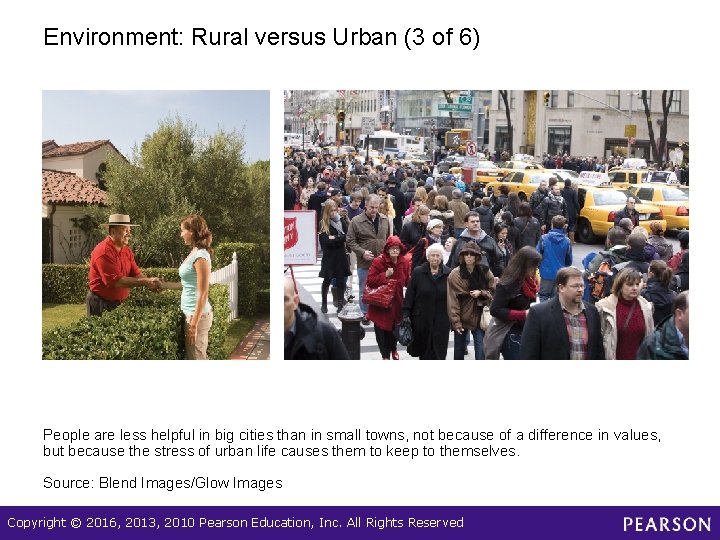
Environment: Rural versus Urban (3 of 6) People are less helpful in big cities than in small towns, not because of a difference in values, but because the stress of urban life causes them to keep to themselves. Source: Blend Images/Glow Images Copyright © 2016, 2013, 2010 Pearson Education, Inc. All Rights Reserved
Interpreting the Event as an Emergency �Pluralistic Ignorance �Bystanders’ assuming that nothing is wrong in an emergency because no one else looks concerned Copyright © 2016, 2013, 2010 Pearson Education, Inc. All Rights Reserved
Assuming Responsibility �Diffusion of Responsibility �bystander’s sense of responsibility to help decreases as the number of witnesses increases Copyright © 2016, 2013, 2010 Pearson Education, Inc. All Rights Reserved
Deciding to Implement the Help �Might not help because of: �Making a fool of yourself �Doing the wrong thing �Placing yourself in danger Copyright © 2016, 2013, 2010 Pearson Education, Inc. All Rights Reserved
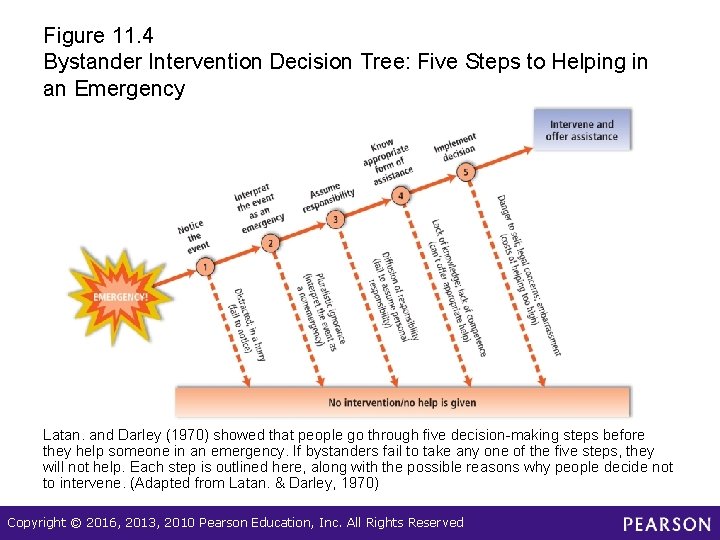
Figure 11. 4 Bystander Intervention Decision Tree: Five Steps to Helping in an Emergency Latan. and Darley (1970) showed that people go through five decision-making steps before they help someone in an emergency. If bystanders fail to take any one of the five steps, they will not help. Each step is outlined here, along with the possible reasons why people decide not to intervene. (Adapted from Latan. & Darley, 1970) Copyright © 2016, 2013, 2010 Pearson Education, Inc. All Rights Reserved
Increasing the Likelihood That Bystanders Will Intervene �Being aware of the barriers to helping in an emergency can increase people’s chances of overcoming those barriers. �People who know about bystander effects can realize that if they don’t act, perhaps no one will. �Reminding ourselves that it is important to overcome inhibitions and do the right thing Copyright © 2016, 2013, 2010 Pearson Education, Inc. All Rights Reserved
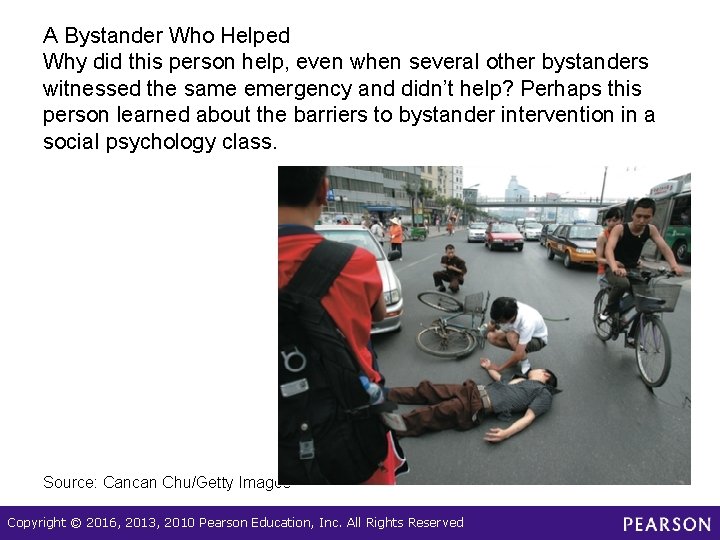
A Bystander Who Helped Why did this person help, even when several other bystanders witnessed the same emergency and didn’t help? Perhaps this person learned about the barriers to bystander intervention in a social psychology class. Source: Cancan Chu/Getty Images Copyright © 2016, 2013, 2010 Pearson Education, Inc. All Rights Reserved
Increasing Volunteerism �“Mandatory Volunteerism” �Strong external reasons can undermine intrinsic interest �Need to encourage volunteering while preserving the sense that the behavior was freely chosen Copyright © 2016, 2013, 2010 Pearson Education, Inc. All Rights Reserved
- Slides: 17