
Chapter 11 Power and Political Behavior Concept of
Chapter 11 Power and Political Behavior
Concept of Power – the ability to influence another person Influence – the process of affecting the thoughts, behavior, and feelings of another person Authority – the right to influence another person
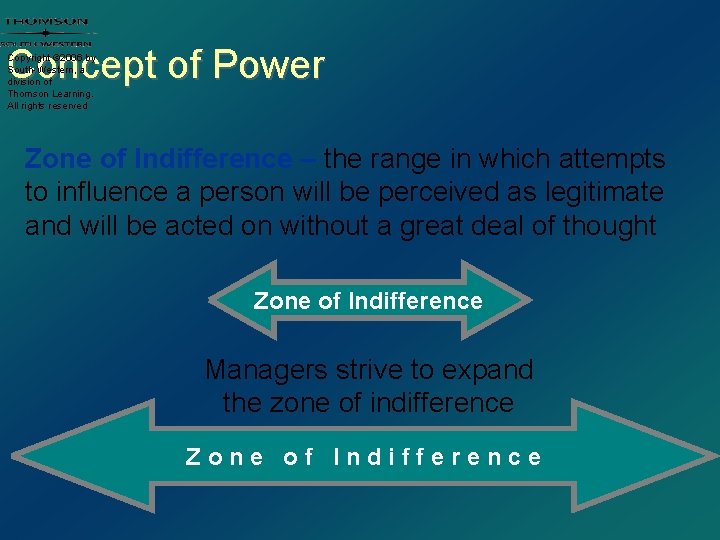
Concept of Power Copyright © 2006 by South-Western, a division of Thomson Learning. All rights reserved Zone of Indifference – the range in which attempts to influence a person will be perceived as legitimate and will be acted on without a great deal of thought Zone of Indifference Managers strive to expand the zone of indifference Zone of Indifference
Sources of Organizational Power: Interpersonal Reward Power – agent’s ability to control the rewards that the target wants Coercive Power – agent’s ability to cause an unpleasant experience for a target Legitimate Power – agent and target agree that agent has influential rights, based on position and mutual agreement
Sources of Organizational Power: Interpersonal Referent Power – based on interpersonal attraction Expert Power – agent has knowledge target needs
Which Power is Most Effective? Expert Power! Strong relationship to performance & satisfaction v Transfers vital skills, abilities, and knowledge within the organization v Employees internalize what they observe & learn from managers they consider “experts” v
Information Power – access to and control over important information v Formal/informal position in communication network v Interpreting information when passing it on (the spin)
Criteria for Using Power Ethically Does the behavior produce a good outcome for people both inside and outside the organization? Does the behavior respect the rights of all parties? Does the behavior treat all parties equitably and fairly?
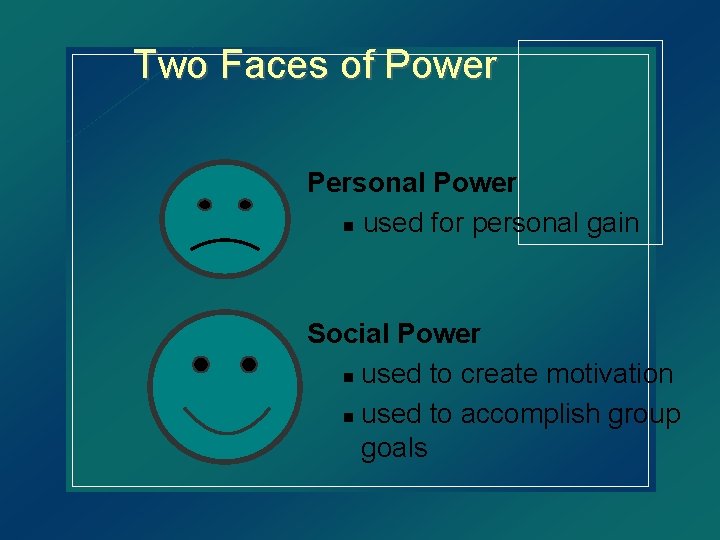
Two Faces of Power Personal Power n used for personal gain Social Power n used to create motivation n used to accomplish group goals
Successful Power Users v Have high need for social power v Approach relationships with a communal orientation v Focus on needs and interests of others belief in the authority system preference for work and discipline belief in justice altruism
Sources of Organizational Power: Intergroup v Control of critical resources v Control of strategic contingencies – activities that other groups need to complete their tasks
Sources of Organizational Power: Intergroup v Ways groups hold power over other groups v Ability to cope with uncertainty v High degree of centrality functionality central to organization’s success v Nonsubstitutability - group’s activities are indispensable
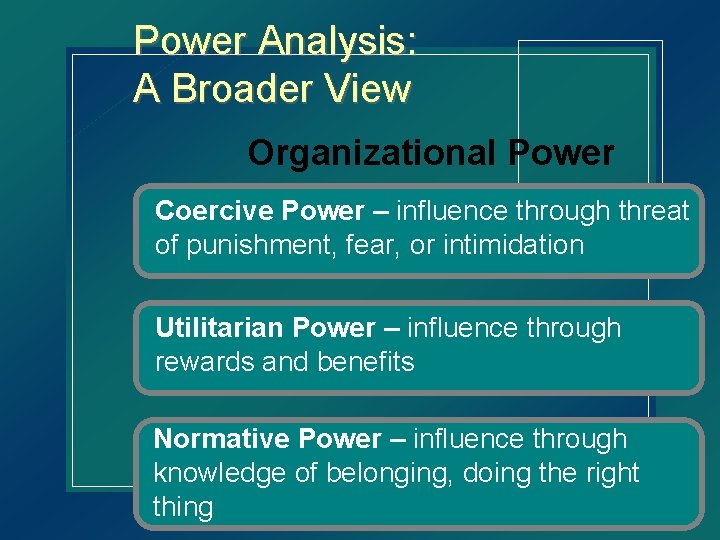
Power Analysis: A Broader View Organizational Power Coercive Power – influence through threat of punishment, fear, or intimidation Utilitarian Power – influence through rewards and benefits Normative Power – influence through knowledge of belonging, doing the right thing
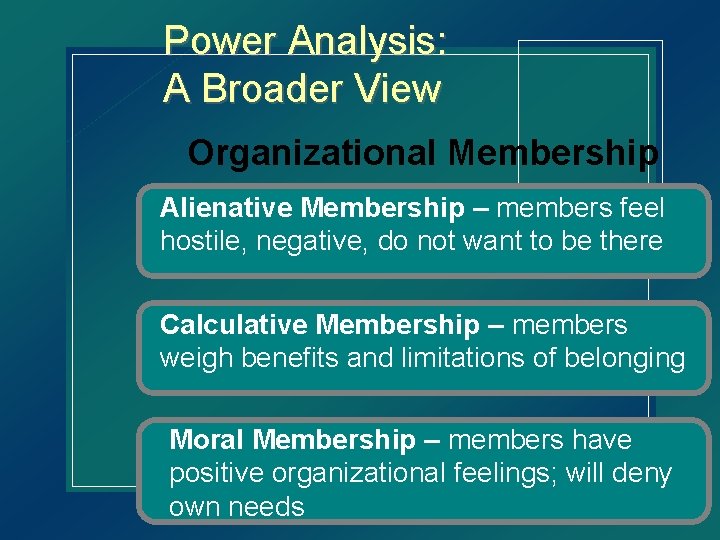
Power Analysis: A Broader View Organizational Membership Alienative Membership – members feel hostile, negative, do not want to be there Calculative Membership – members weigh benefits and limitations of belonging Moral Membership – members have positive organizational feelings; will deny own needs
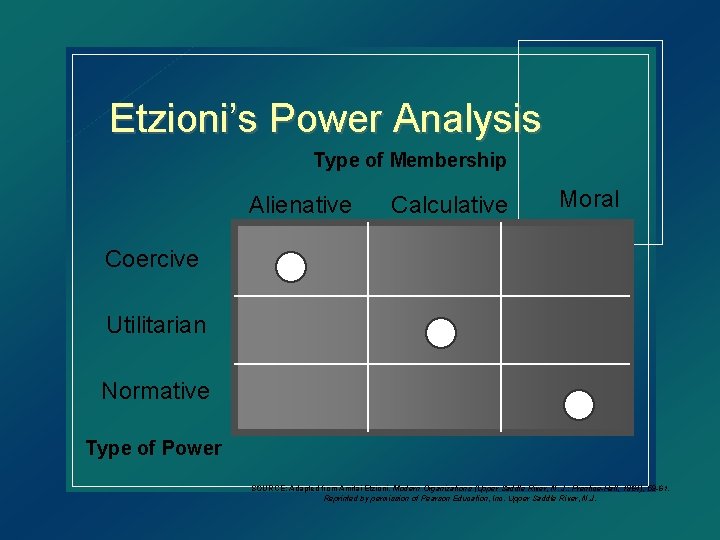
Etzioni’s Power Analysis Type of Membership Alienative Calculative Moral Coercive Utilitarian Normative Type of Power SOURCE: Adapted from Amitai Etzioni, Modern Organizations (Upper Saddle River, N. J. : Prentice-Hall, 1964), 59 -61. Reprinted by permission of Pearson Education, Inc. Upper Saddle River, N. J.
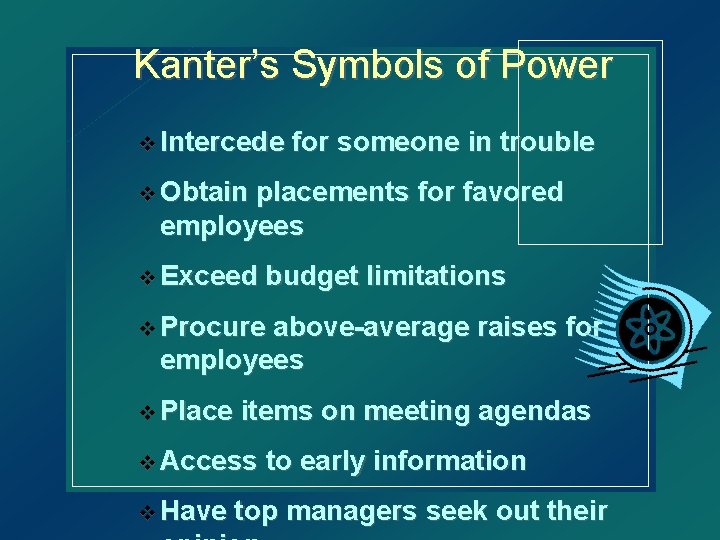
Kanter’s Symbols of Power v Intercede for someone in trouble v Obtain placements for favored employees v Exceed budget limitations v Procure above-average raises for employees v Place items on meeting agendas v Access v Have to early information top managers seek out their

Kanter’s Symbols of Powerlessness Top Executives • budget cuts • punishing behaviors • top-down communications Managers Staff Professionals • resistance to change • turf protection First-line Supervisors • overly close supervision • assign external attribution blame others or environment • inflexible adherence to rules • do job rather than train Key to overcoming powerlessness: share power and delegate decision making Copyright © 2006 by South-Western, a division of Thomson Learning. All rights reserved
Korda’s Power Symbols Power – there are more people who inconvenience themselves on your behalf than there are people on whose behalf you would inconvenience yourself Status – a person’s relative standing in a group based on prestige and deference
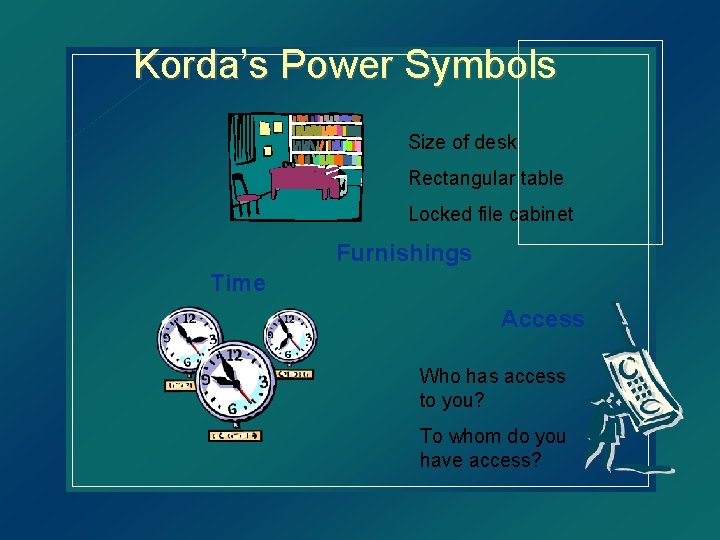
Korda’s Power Symbols Size of desk Rectangular table Locked file cabinet Furnishings Time Access Who has access to you? To whom do you have access?
Political Behavior in Organizations Organizational Politics – the use of power and influence in organizations Political Behavior – actions not officially sanctioned by an organization that are taken to influence others in order to meet one’s personal goals
Conditions Encouraging Political Activity v Unclear goals v Autocratic decision making v Ambiguous lines of authority v Scarce resources v Uncertainty
Effective Political Characteristics What characteristics do effective political actors possess?

Influence Tactics Consultation Inspirational appeals Rational persuasion Ingratiation Coalition Exchange tactics Upward appeals Pressure Copyright © 2006 by South-Western, a division of Thomson Learning. All rights reserved Upward Influence: the boss Lateral Influence: a coworker Downward Influence: an employee
Influence by Consultation This new attendance plan is controversial. How can we make it more acceptable? The person seeks your participation in making a decision or planning how to implement a proposed strategy, policy, or change.

Influence by Rational Persuasion This new procedure will save us over $150, 000. The person uses logical arguments and factual evidence to persuade you that a proposal or request is viable and likely to result in the attainment of task objectives.
Influence by Inspirational Appeals Getting that account will be tough, but I know you can do it. The person makes an emotional request or proposal that arouses enthusiasm by appealing to your values and ideals, or by increasing your confidence that you can do it.
Influence by Ingratiation Only you can do this job right! The person seeks to get you in a good mood or to think favorably of him or her before asking you to do something. Information on slides 23 -27 from the first two columns from G. Yuki and C. M. Falbe. “Influence Tactics and Objectives in Upward, Downward, and Lateral Influence Attempts. ” Journal of Applied Psychology 75 (1990): 132 -140. Copyright © 1990 by the American Psychological Association. Reprinted with permission.
Managing Political Behavior v Maintain open communication v Clarify performance expectations v Use participative management v Encourage cooperation among work groups v Manage scarce resources well v Provide a supportive organizational climate
Copyright © 2006 by South-Western, a division of Thomson Learning. All rights reserved Managing Up: The Boss Understand Your Boss and Her Context Her goals and objectives The pressures on her Her strengths, weaknesses, blind spots Her preferred work style Assess Yourself and Your Needs Your own strengths and weaknesses Your personal style Your predisposition toward dependence on authority figures
Managing Up: The Boss Develop and Maintain a Relationship that · · · Fits both your needs and styles Is characterized by mutual expectations Keeps your boss informed Is based on dependability and honesty Selectively uses your boss’s time and resources SOURCE: Information on slides 29 -30 adapted and reprinted by permission of Harvard Business Review. From J. J. Gabarro and J. P. Kotter, “Managing Your Boss, ” Harvard Business Review (January-February 1980): 92 -100. Copyright© 1980 by the Harvard Business School Publishing Corporation; all rights reserved.
Sharing Power: Empowerment: sharing power in such a way that individuals learn to believe in their ability to do the job!
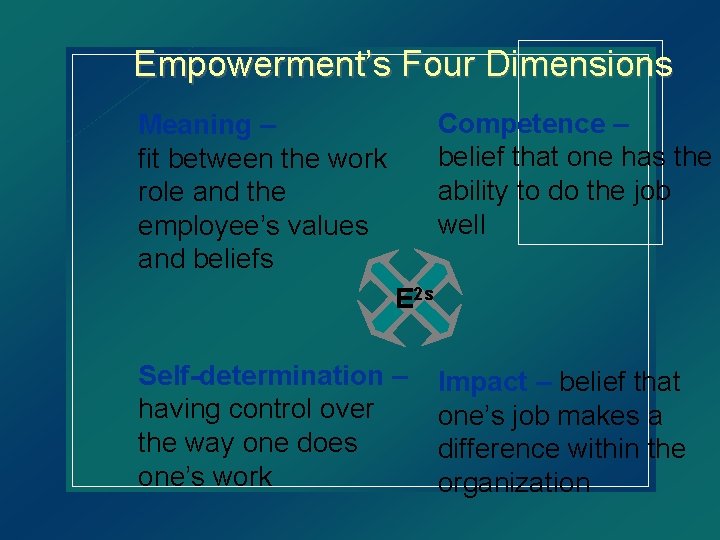
Empowerment’s Four Dimensions Competence – belief that one has the ability to do the job well Meaning – fit between the work role and the employee’s values and beliefs E 2 s Self-determination – having control over the way one does one’s work Impact – belief that one’s job makes a difference within the organization
Guidelines for Empowering v Express confidence in employees v Set high performance expectations v Create opportunities for participative decision making v Remove bureaucratic constraints that stifle autonomy v Set inspirational and meaningful goals
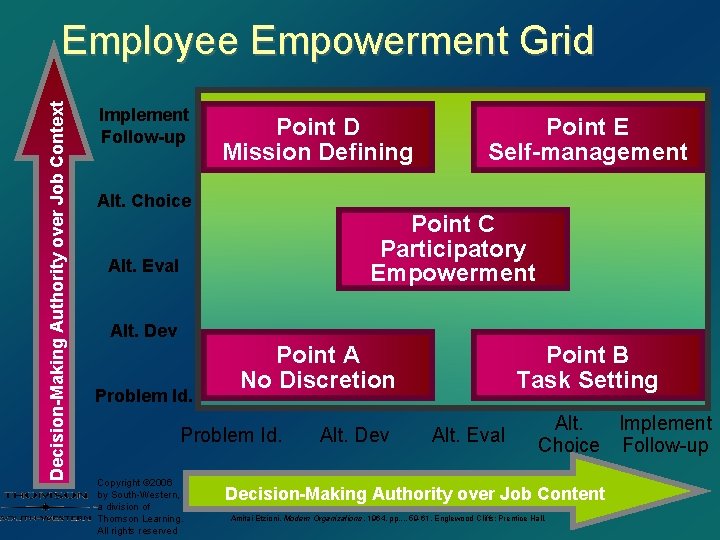
Decision-Making Authority over Job Context Employee Empowerment Grid Implement Follow-up Point D Mission Defining Alt. Choice Point E Self-management Point C Participatory Empowerment Alt. Eval Alt. Dev Problem Id. Point A No Discretion Problem Id. Copyright © 2006 by South-Western, a division of Thomson Learning. All rights reserved Alt. Dev Point B Task Setting Alt. Eval Alt. Implement Choice Follow-up Decision-Making Authority over Job Content Amitai Etzioni, Modern Organizations, 1964, pp. . 59 -61. Englewood Cliffs: Prentice Hall.
Finkelstein: Why Executives Fail v See themselves and their companies as dominant, without peers v Have all the answers v Eliminate those not 100% behind them v Rely on what worked in the past v No clear boundaries between personal interests and corporate interests
Using Power Effectively Use power in ethical ways v Understand use all of the various types of power and influence v Seek out jobs that allow you to develop your power skills v Use power tempered by maturity and self-control v Accept that influencing people is an important part of the management job v
- Slides: 36