
Chapter 11 Political Organization Chapter Outline Social Differentiation
- Slides: 31
Chapter 11 Political Organization
Chapter Outline Social Differentiation § Power and Social Control § Types of Political Organization §
Social Differentiation § The relative access individuals and groups have to basic material resources, wealth, power, and prestige.
Egalitarian Societies No individual or group has more access to resources, power, or prestige than any other. § No fixed number of social positions for which individuals must compete. § Associated with bands and tribes. §
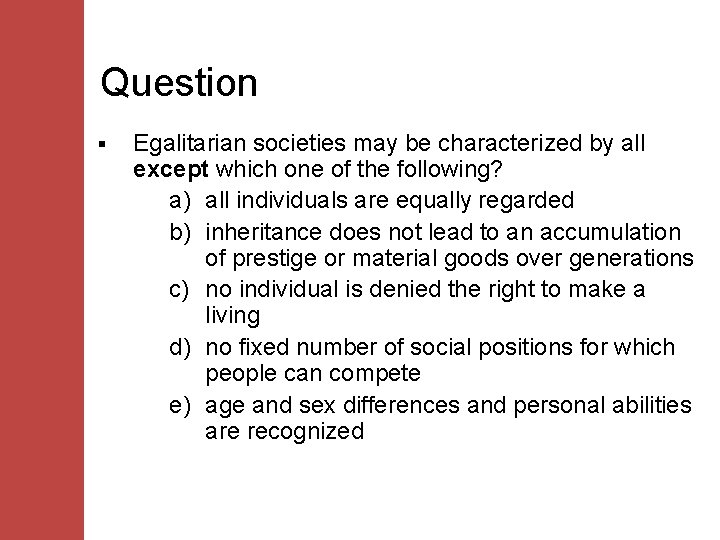
Question § Egalitarian societies may be characterized by all except which one of the following? a) all individuals are equally regarded b) inheritance does not lead to an accumulation of prestige or material goods over generations c) no individual is denied the right to make a living d) no fixed number of social positions for which people can compete e) age and sex differences and personal abilities are recognized
Answer: a § Egalitarian societies may not be characterized by of the following: – all individuals are equally regarded
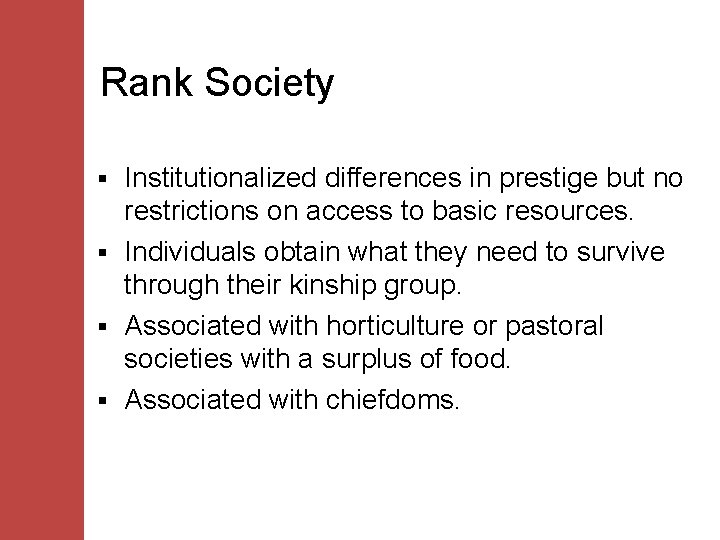
Rank Society Institutionalized differences in prestige but no restrictions on access to basic resources. § Individuals obtain what they need to survive through their kinship group. § Associated with horticulture or pastoral societies with a surplus of food. § Associated with chiefdoms. §
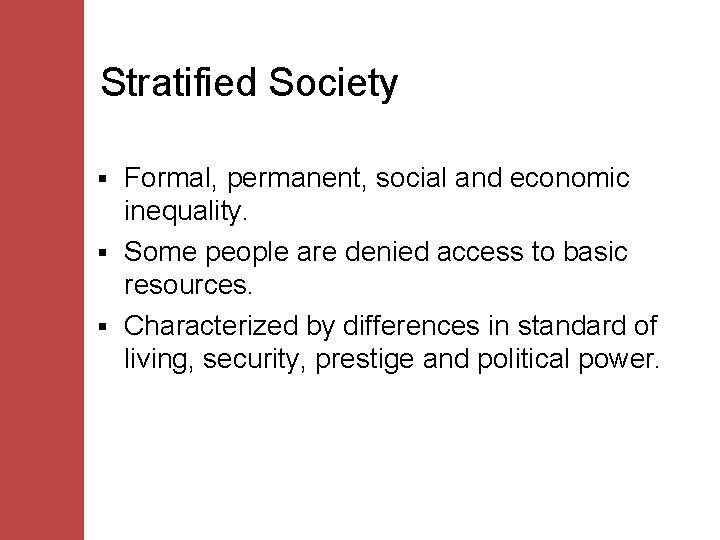
Stratified Society Formal, permanent, social and economic inequality. § Some people are denied access to basic resources. § Characterized by differences in standard of living, security, prestige and political power. §
Stratified Society Economically organized by market systems. § Based on intensive cultivation (agriculture) and industrialism. § Associated with form of political organization called the state. §
Question § A primary difference between rank societies and stratified societies is that in stratified societies a) the primary form of political organization is a chiefdom. b) all individuals have access to basic resources needed to survive. c) the subsistence pattern is generally horticulture or pastoralism. d) there are formal and permanent social and economic inequalities. e) all individuals have an equal opportunity to work their way from one level to the next.
Answer: d § A primary difference between rank societies and stratified societies is that in stratified societies there are formal and permanent social and economic inequalities.
Women and Political Offices Yoruba of Nigeria - certain offices were reserved to represent women’s interests. § Nigeria - some Igbo groups had a female ruler and council concerned with women’s affairs. § Mende - women were paramount chiefs, who derived their power from their roles as mothers. §
Social Control of Behavior Ways societies deal with abnormal behavior and conflict: § Gossip and ridicule § Fear of witchcraft accusations § Avoidance § Supernatural sanctions
Law is found in every society. § In complex societies, functions of law belong to legal institutions, such as courts. § Law addresses conflicts that would otherwise disrupt community life. §
Band Societies Small group of people (20 to 50) § Related by blood or marriage § Live together and are loosely associated with a territory in which they forage § Egalitarian §
Band Societies: Leadership Decision-making is by consensus. § Leaders are older men and women. § Leaders cannot enforce their decisions; They can only persuade. § Sharing and generosity are important sources of respect. §
Band Societies: Social Order Maintained by gossip, ridicule, and avoidance. § Violations of norms are sins. § Offenders may be controlled through ritual means such as public confessions. § Offender is defined as a patient rather than a criminal. §
Tribal Societies Members consider themselves descended from the same ancestor. § Found primarily among pastoralists and horticulturalists. § Egalitarian § Leadership: Bigman §
Chiefdom Societies Characteristics: § Monumental architecture § Distinct ceremonial centers § Elaborate grave goods reflect high social status § Larger settlements by smaller villages § Cultivators and pastoralists
State Societies Central government with monopoly over the use of force. § More populous, heterogeneous, and powerful than other political organizations. § Able to organize large populations for coordinated action. § Defend against external threats. §
Question § Membership in a state is based upon ties of a) citizenship. b) ethnicity. c) "blood. " d) kinship. e) race.
Answer: a § Membership in a state is based upon ties of citizenship.
Quick Quiz
1. Variation in access by individuals and groups to material resources, wealth, power, and prestige within the society is termed a) a hierarchical caste system. b) social differentiation. c) egalitarian. d) clan-based. e) a pecking order.
Answer: b § Variation in access by individuals and groups to material resources, wealth, power, and prestige within the society is termed social differentiation.
2. Which one of the following is not considered an informal social mechanism that encourages conformity among a society's members? a) fear of witchcraft accusation b) gossip and ridicule c) police or military presence d) avoidance, shunning e) supernatural sanctions
Answer: c § Police or military presence is not considered an informal social mechanism that encourages conformity among a society's members.
3. ____ is the patterned ways in which power is legitimately used in a society to regulate behavior. a) Leadership b) Political organization c) A law enforcement system d) justice e) The court
Answer: b § Political organization is the patterned ways in which power is legitimately used in a society to regulate behavior.
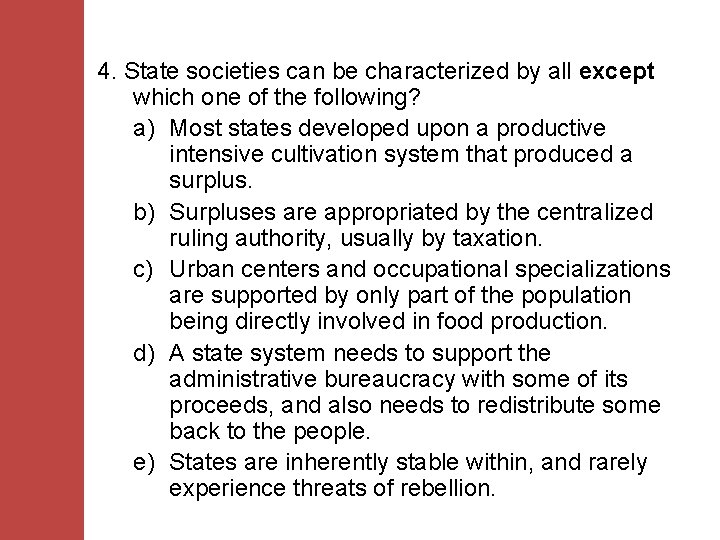
4. State societies can be characterized by all except which one of the following? a) Most states developed upon a productive intensive cultivation system that produced a surplus. b) Surpluses are appropriated by the centralized ruling authority, usually by taxation. c) Urban centers and occupational specializations are supported by only part of the population being directly involved in food production. d) A state system needs to support the administrative bureaucracy with some of its proceeds, and also needs to redistribute some back to the people. e) States are inherently stable within, and rarely experience threats of rebellion.
Answer: e § State societies can not be characterized by the following: – States are inherently stable within, and rarely experience threats of rebellion.