
Chapter 11 Personality Disorders Personality Disorders An Overview
- Slides: 25
Chapter 11 Personality Disorders
Personality Disorders: An Overview The Nature of Personality and Personality Disorders § Enduring and relatively stable predispositions (i. e. , ways of relating and thinking) § Predispositions are inflexible and maladaptive, causing distress and/or impairment § Coded on Axis II of the DSM-IV and DSM-IV-TR Categorical vs. Dimensional Views of Personality Disorders
Personality Disorders: Facts and Statistics Prevalence of Personality Disorders § About 0. 5% to 2. 5% of the general population § Rates are higher in inpatient and outpatient settings Origins and Course of Personality Disorders § Thought to begin in childhood § Run a chronic course § Comorbidity rates are high Gender Distribution and Gender Bias § Gender bias exists in diagnosis § Criterion vs. assessment gender bias
DSM-IV and DSM-IV-TR Personality Disorder Clusters Cluster A § Odd or eccentric § Includes paranoid, schizotypal Cluster B § Dramatic, emotional, erratic § Includes antisocial, borderline, narcissistic, histrionic Cluster C § Fearful or anxious § Includes avoidant, obsessive-compulsive, dependent
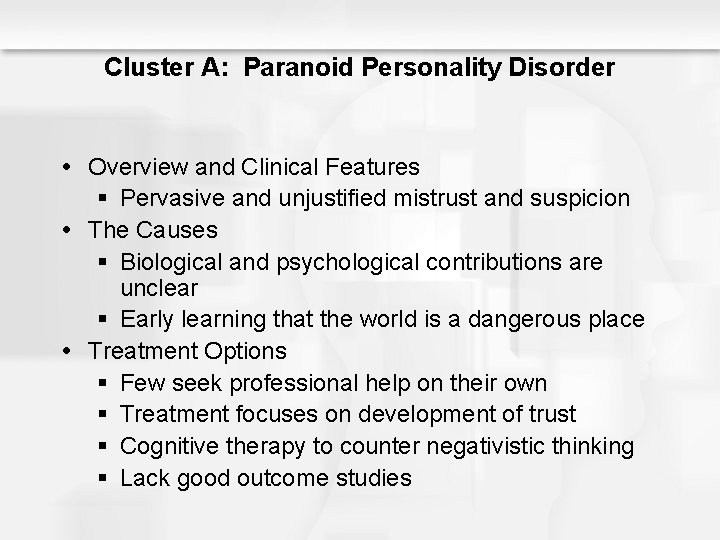
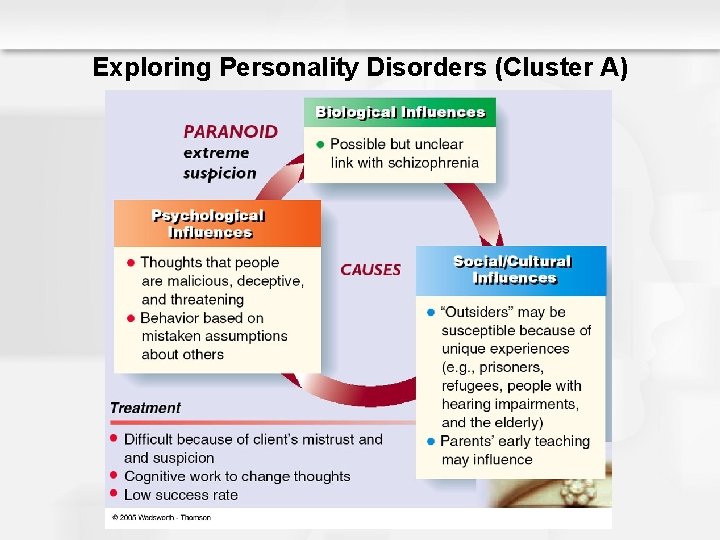
Cluster A: Paranoid Personality Disorder Overview and Clinical Features § Pervasive and unjustified mistrust and suspicion The Causes § Biological and psychological contributions are unclear § Early learning that the world is a dangerous place Treatment Options § Few seek professional help on their own § Treatment focuses on development of trust § Cognitive therapy to counter negativistic thinking § Lack good outcome studies
Exploring Personality Disorders (Cluster A)
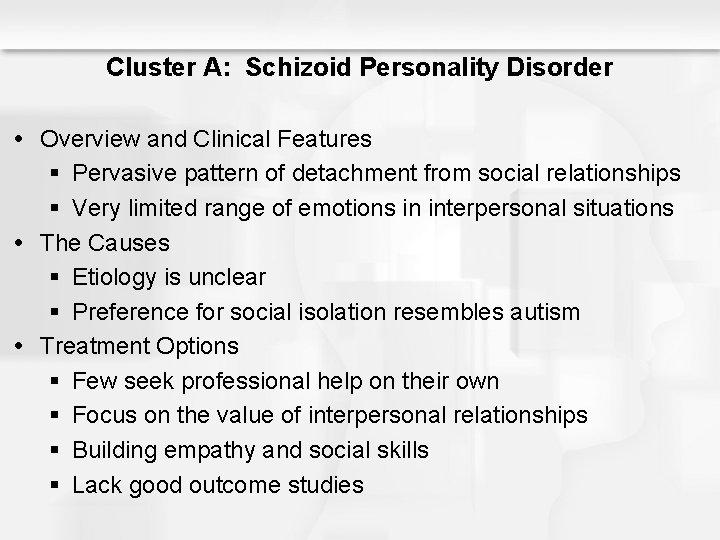
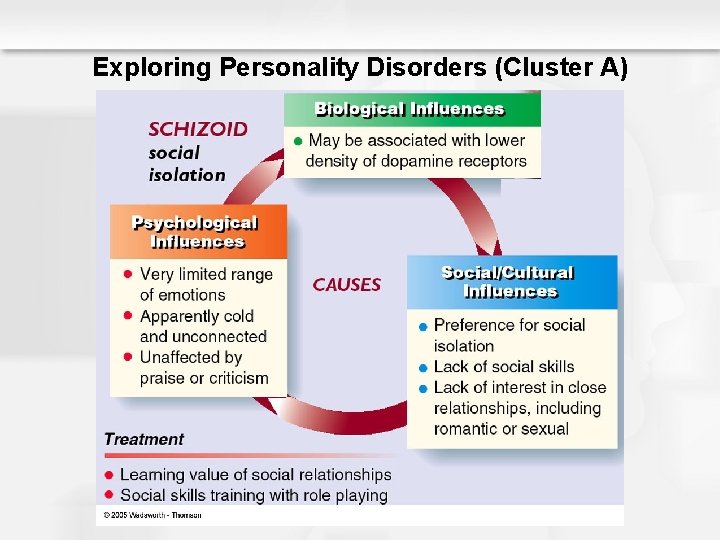
Cluster A: Schizoid Personality Disorder Overview and Clinical Features § Pervasive pattern of detachment from social relationships § Very limited range of emotions in interpersonal situations The Causes § Etiology is unclear § Preference for social isolation resembles autism Treatment Options § Few seek professional help on their own § Focus on the value of interpersonal relationships § Building empathy and social skills § Lack good outcome studies
Exploring Personality Disorders (Cluster A)
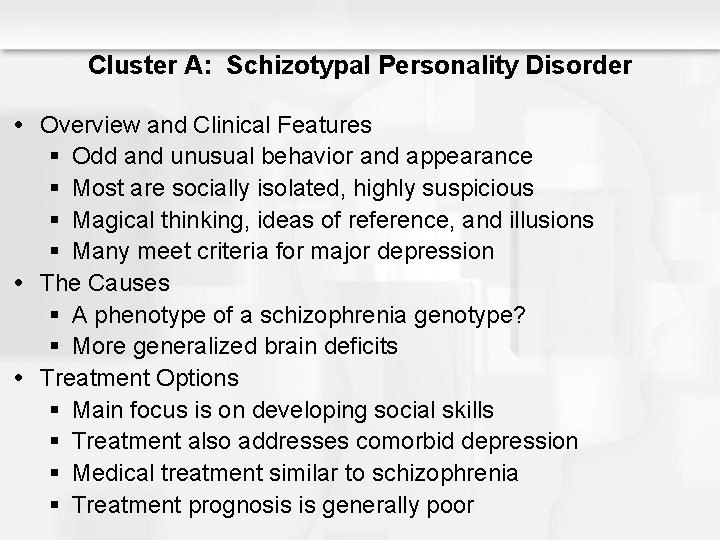
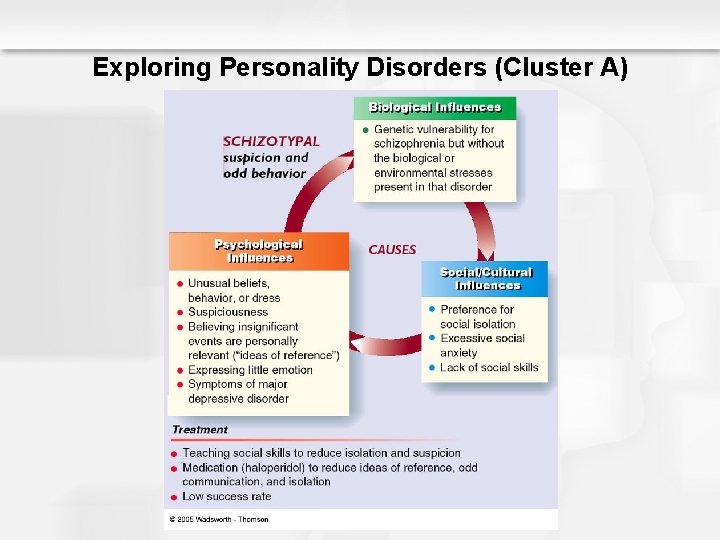
Cluster A: Schizotypal Personality Disorder Overview and Clinical Features § Odd and unusual behavior and appearance § Most are socially isolated, highly suspicious § Magical thinking, ideas of reference, and illusions § Many meet criteria for major depression The Causes § A phenotype of a schizophrenia genotype? § More generalized brain deficits Treatment Options § Main focus is on developing social skills § Treatment also addresses comorbid depression § Medical treatment similar to schizophrenia § Treatment prognosis is generally poor
Exploring Personality Disorders (Cluster A)
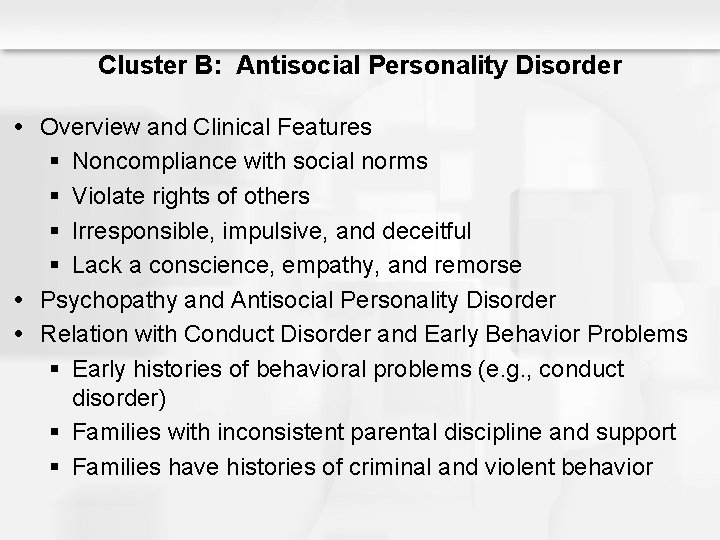
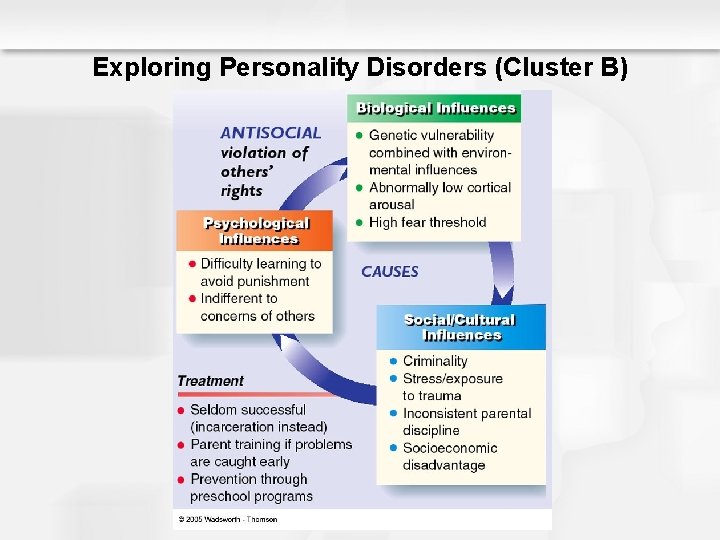
Cluster B: Antisocial Personality Disorder Overview and Clinical Features § Noncompliance with social norms § Violate rights of others § Irresponsible, impulsive, and deceitful § Lack a conscience, empathy, and remorse Psychopathy and Antisocial Personality Disorder Relation with Conduct Disorder and Early Behavior Problems § Early histories of behavioral problems (e. g. , conduct disorder) § Families with inconsistent parental discipline and support § Families have histories of criminal and violent behavior
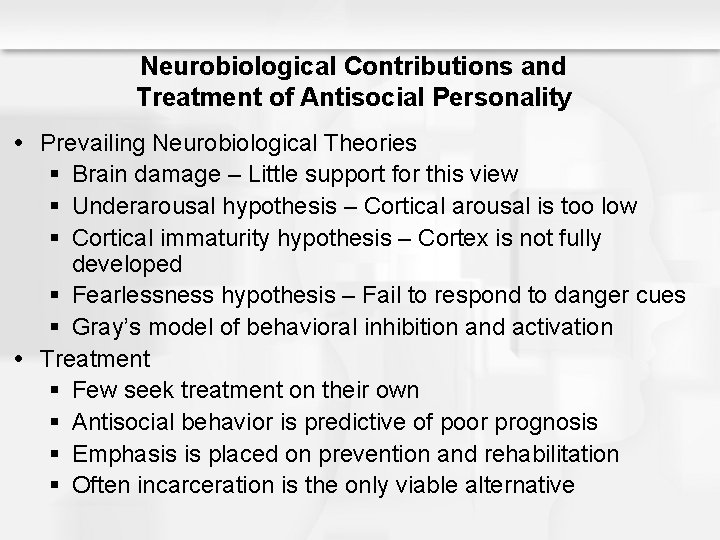
Neurobiological Contributions and Treatment of Antisocial Personality Prevailing Neurobiological Theories § Brain damage – Little support for this view § Underarousal hypothesis – Cortical arousal is too low § Cortical immaturity hypothesis – Cortex is not fully developed § Fearlessness hypothesis – Fail to respond to danger cues § Gray’s model of behavioral inhibition and activation Treatment § Few seek treatment on their own § Antisocial behavior is predictive of poor prognosis § Emphasis is placed on prevention and rehabilitation § Often incarceration is the only viable alternative
Exploring Personality Disorders (Cluster B)
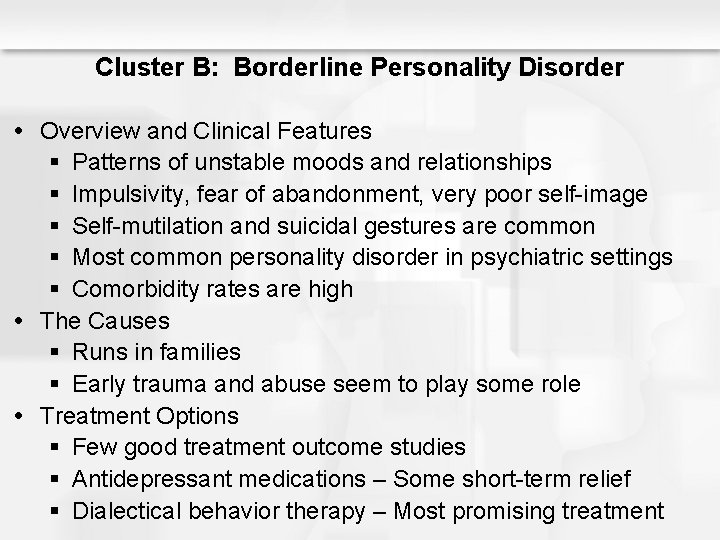
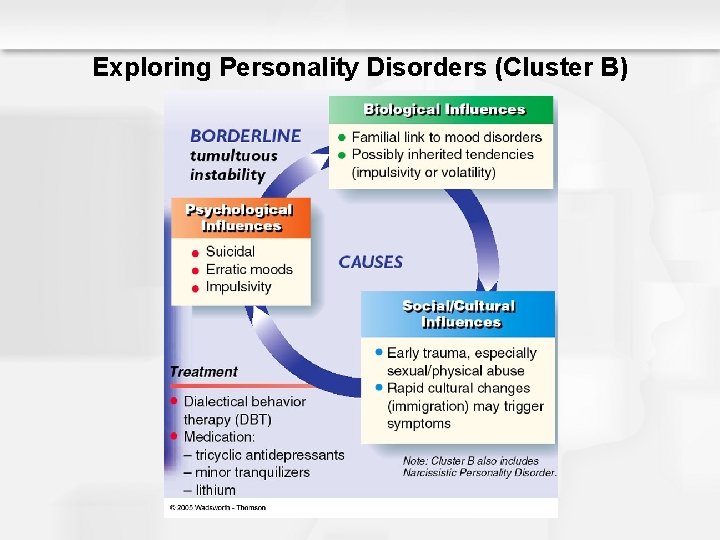
Cluster B: Borderline Personality Disorder Overview and Clinical Features § Patterns of unstable moods and relationships § Impulsivity, fear of abandonment, very poor self-image § Self-mutilation and suicidal gestures are common § Most common personality disorder in psychiatric settings § Comorbidity rates are high The Causes § Runs in families § Early trauma and abuse seem to play some role Treatment Options § Few good treatment outcome studies § Antidepressant medications – Some short-term relief § Dialectical behavior therapy – Most promising treatment
Exploring Personality Disorders (Cluster B)
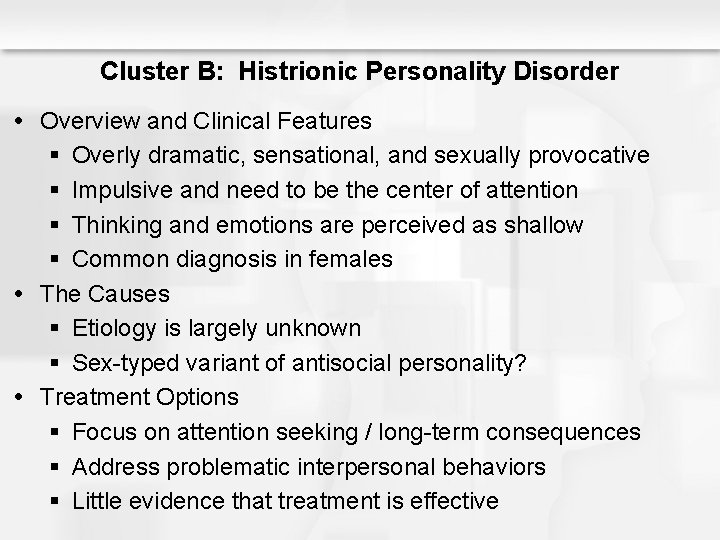
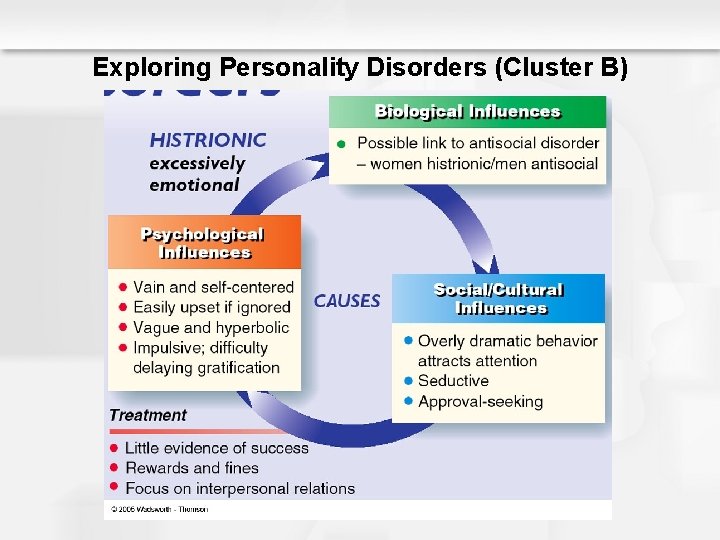
Cluster B: Histrionic Personality Disorder Overview and Clinical Features § Overly dramatic, sensational, and sexually provocative § Impulsive and need to be the center of attention § Thinking and emotions are perceived as shallow § Common diagnosis in females The Causes § Etiology is largely unknown § Sex-typed variant of antisocial personality? Treatment Options § Focus on attention seeking / long-term consequences § Address problematic interpersonal behaviors § Little evidence that treatment is effective
Exploring Personality Disorders (Cluster B)
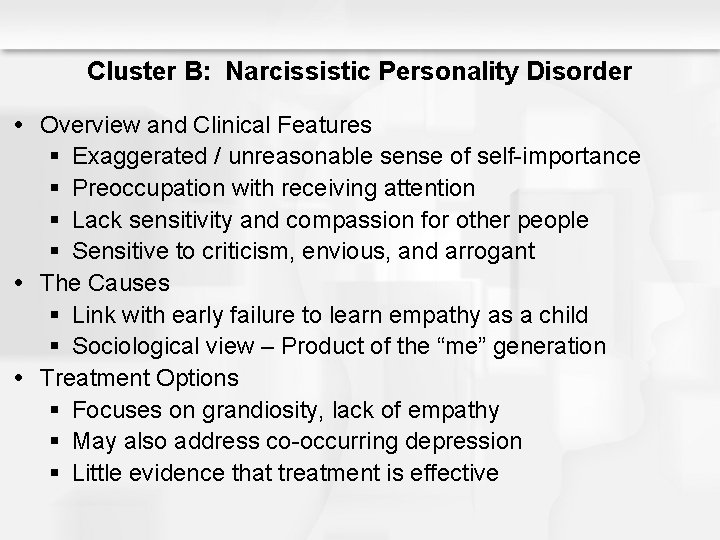
Cluster B: Narcissistic Personality Disorder Overview and Clinical Features § Exaggerated / unreasonable sense of self-importance § Preoccupation with receiving attention § Lack sensitivity and compassion for other people § Sensitive to criticism, envious, and arrogant The Causes § Link with early failure to learn empathy as a child § Sociological view – Product of the “me” generation Treatment Options § Focuses on grandiosity, lack of empathy § May also address co-occurring depression § Little evidence that treatment is effective
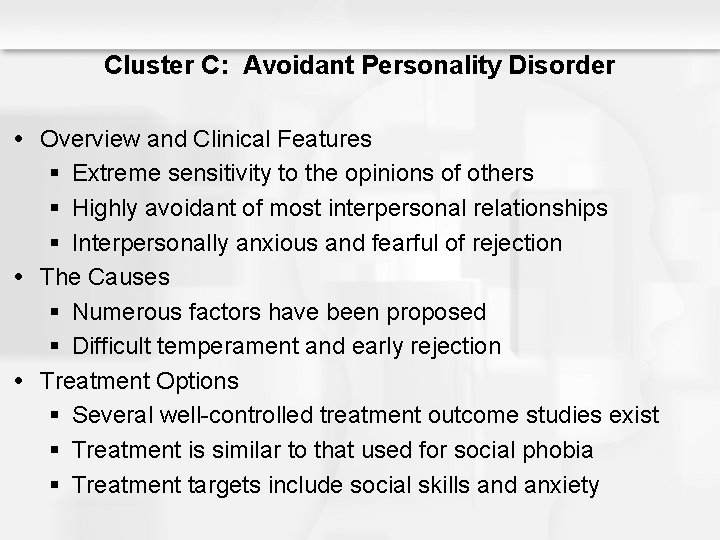
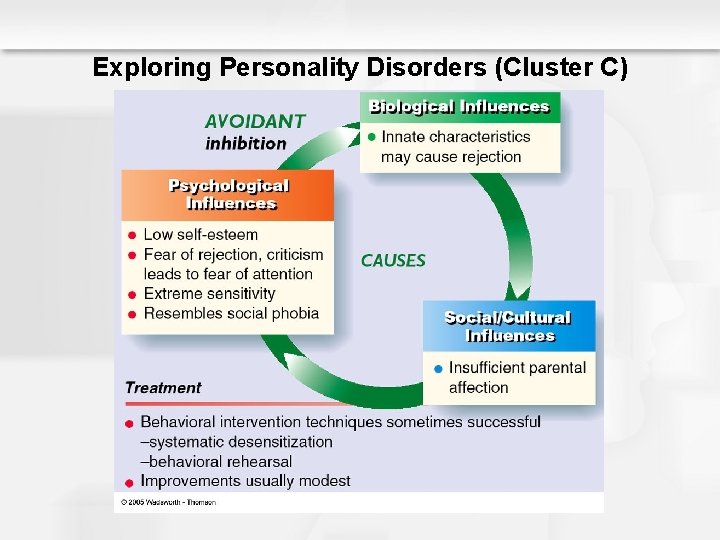
Cluster C: Avoidant Personality Disorder Overview and Clinical Features § Extreme sensitivity to the opinions of others § Highly avoidant of most interpersonal relationships § Interpersonally anxious and fearful of rejection The Causes § Numerous factors have been proposed § Difficult temperament and early rejection Treatment Options § Several well-controlled treatment outcome studies exist § Treatment is similar to that used for social phobia § Treatment targets include social skills and anxiety
Exploring Personality Disorders (Cluster C)
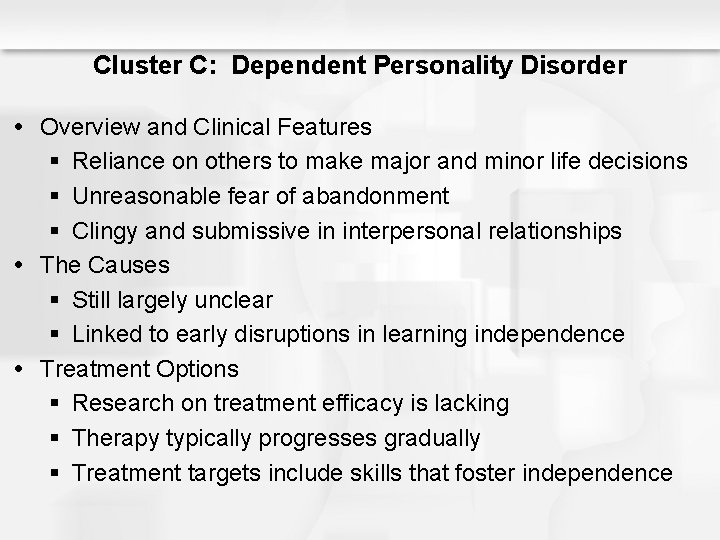
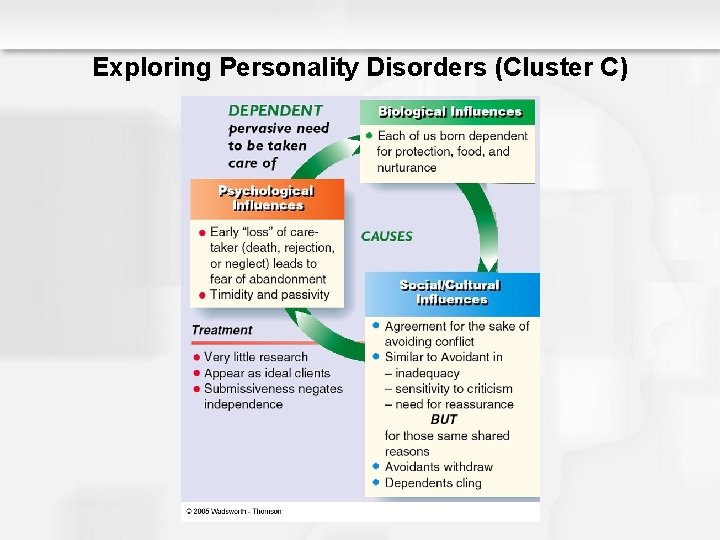
Cluster C: Dependent Personality Disorder Overview and Clinical Features § Reliance on others to make major and minor life decisions § Unreasonable fear of abandonment § Clingy and submissive in interpersonal relationships The Causes § Still largely unclear § Linked to early disruptions in learning independence Treatment Options § Research on treatment efficacy is lacking § Therapy typically progresses gradually § Treatment targets include skills that foster independence
Exploring Personality Disorders (Cluster C)
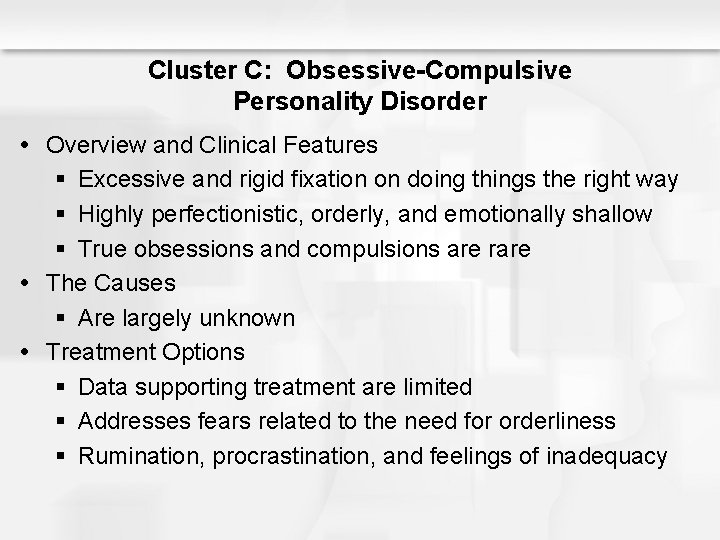
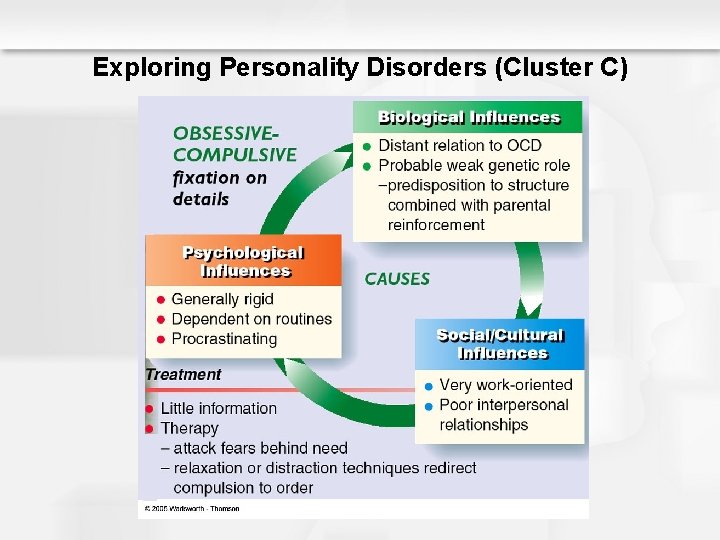
Cluster C: Obsessive-Compulsive Personality Disorder Overview and Clinical Features § Excessive and rigid fixation on doing things the right way § Highly perfectionistic, orderly, and emotionally shallow § True obsessions and compulsions are rare The Causes § Are largely unknown Treatment Options § Data supporting treatment are limited § Addresses fears related to the need for orderliness § Rumination, procrastination, and feelings of inadequacy
Exploring Personality Disorders (Cluster C)
Summary of Personality Disorders § Long-standing patterns of behavior § Begin early in development and run a chronic course Disagreements Exist § Over how to categorize personality disorders § Categorical vs. dimensional, or some combination of both § DSM-IV and DSM-IV-TR – 10 Personality Disorders The Causes of Personality Disorders Are Difficult to Pinpoint Treatment of Is Often Difficult and Prognosis Poor