
Chapter 11 Passive Activity Losses Individual Income Taxes
- Slides: 44
Chapter 11 Passive Activity Losses Individual Income Taxes Copyright © 2006 South-Western/Thomson Learning
Passive Losses Rules (slide 1 of 2) • Require income and losses to be separated into three categories: – Active – Portfolio – Passive • Generally, disallow the deduction of passive losses against active or portfolio income Individual Income Taxes C 11 - 2
Passive Losses Rules (slide 2 of 2) • In general, passive losses can only offset passive income • Passive losses are also subject to the at-risk rules – Designed to prevent taxpayers from deducting losses in excess of their economic investment in an activity Individual Income Taxes C 11 - 3
At-Risk Limits (slide 1 of 4) • At-risk defined – The amount of a taxpayer’s economic investment in an activity • Amount of cash and adjusted basis of property contributed to the activity plus amounts borrowed for which taxpayer is personally liable (recourse debt) Individual Income Taxes C 11 - 4
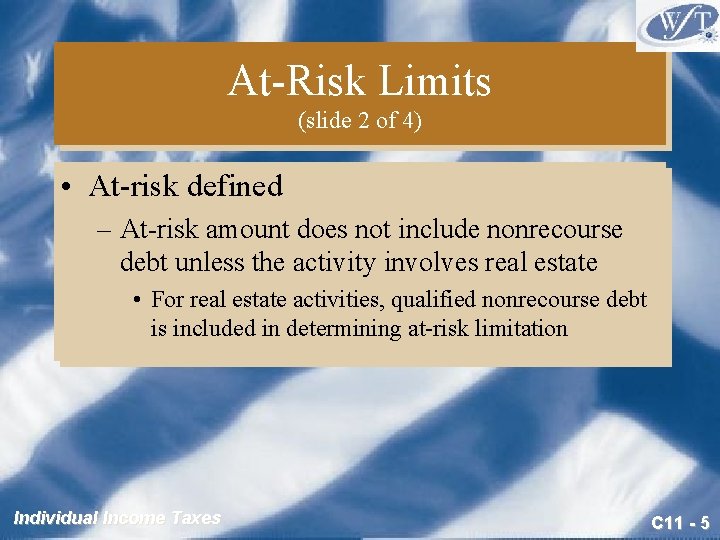
At-Risk Limits (slide 2 of 4) • At-risk defined – At-risk amount does not include nonrecourse debt unless the activity involves real estate • For real estate activities, qualified nonrecourse debt is included in determining at-risk limitation Individual Income Taxes C 11 - 5
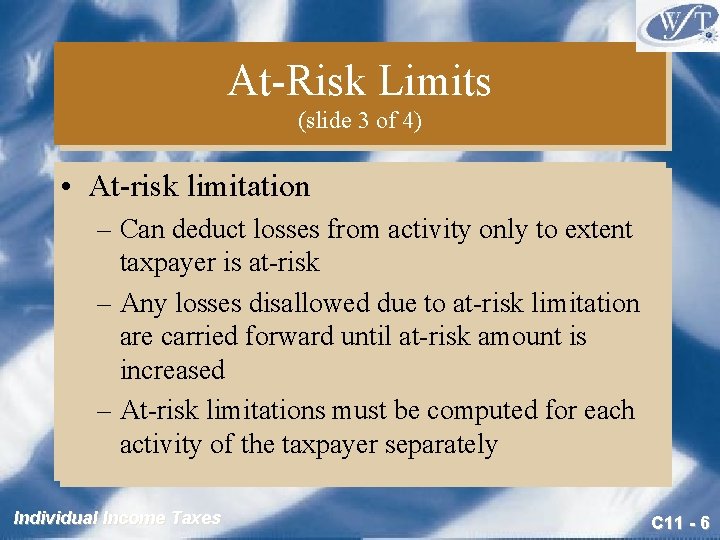
At-Risk Limits (slide 3 of 4) • At-risk limitation – Can deduct losses from activity only to extent taxpayer is at-risk – Any losses disallowed due to at-risk limitation are carried forward until at-risk amount is increased – At-risk limitations must be computed for each activity of the taxpayer separately Individual Income Taxes C 11 - 6
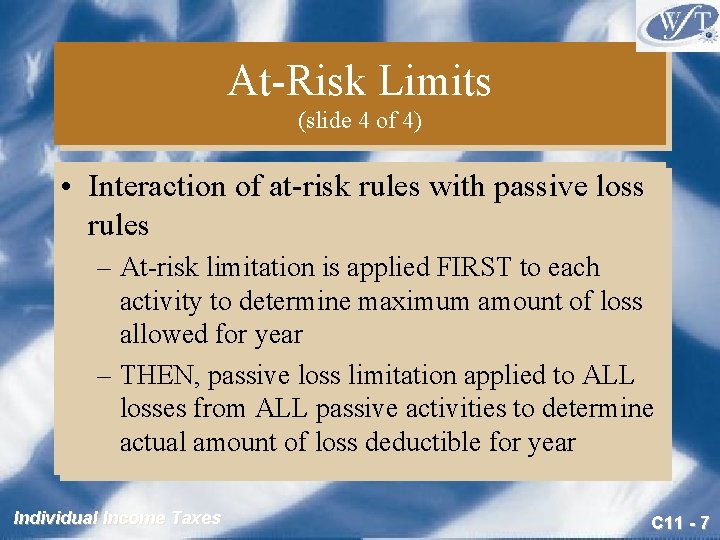
At-Risk Limits (slide 4 of 4) • Interaction of at-risk rules with passive loss rules – At-risk limitation is applied FIRST to each activity to determine maximum amount of loss allowed for year – THEN, passive loss limitation applied to ALL losses from ALL passive activities to determine actual amount of loss deductible for year Individual Income Taxes C 11 - 7
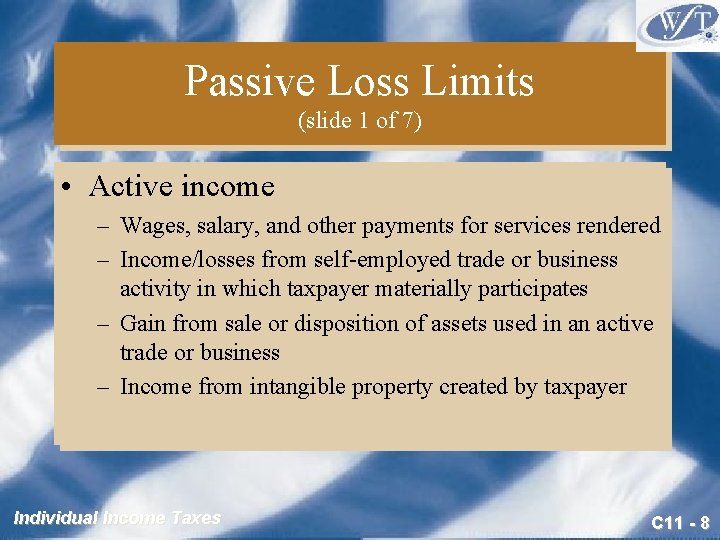
Passive Loss Limits (slide 1 of 7) • Active income – Wages, salary, and other payments for services rendered – Income/losses from self-employed trade or business activity in which taxpayer materially participates – Gain from sale or disposition of assets used in an active trade or business – Income from intangible property created by taxpayer Individual Income Taxes C 11 - 8
Passive Loss Limits (slide 2 of 7) • Portfolio income – Interest, dividends, annuities, and certain royalties not derived in the ordinary course of business – Gains/losses from disposition of assets that produce portfolio income or held for investment Individual Income Taxes C 11 - 9
Passive Loss Limits (slide 3 of 7) • Passive losses defined – Losses from trade or business activities in which taxpayer does not materially participate, and – Certain rental activities Individual Income Taxes C 11 - 10
Passive Loss Limits (slide 4 of 7) • Limitations on passive losses – Generally, passive losses can only offset passive income, i. e. , they cannot reduce active or portfolio income – Disallowed losses are suspended and carried forward • Suspended losses must be allocated to specific activities Individual Income Taxes C 11 - 11
Passive Loss Limits (slide 5 of 7) • Suspended losses are deductible in year related activity is disposed of in a fully taxable transaction Individual Income Taxes C 11 - 12
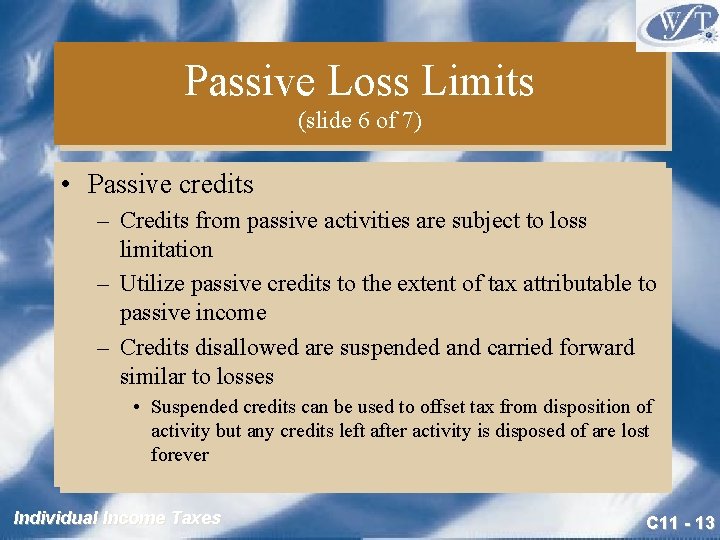
Passive Loss Limits (slide 6 of 7) • Passive credits – Credits from passive activities are subject to loss limitation – Utilize passive credits to the extent of tax attributable to passive income – Credits disallowed are suspended and carried forward similar to losses • Suspended credits can be used to offset tax from disposition of activity but any credits left after activity is disposed of are lost forever Individual Income Taxes C 11 - 13
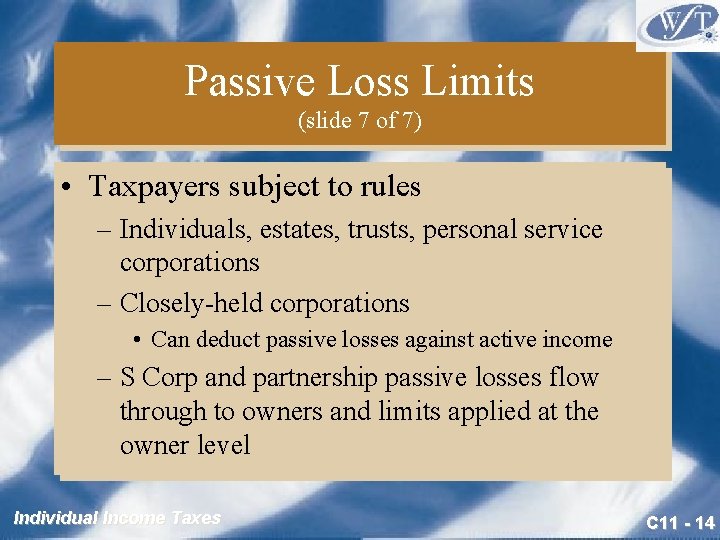
Passive Loss Limits (slide 7 of 7) • Taxpayers subject to rules – Individuals, estates, trusts, personal service corporations – Closely-held corporations • Can deduct passive losses against active income – S Corp and partnership passive losses flow through to owners and limits applied at the owner level Individual Income Taxes C 11 - 14
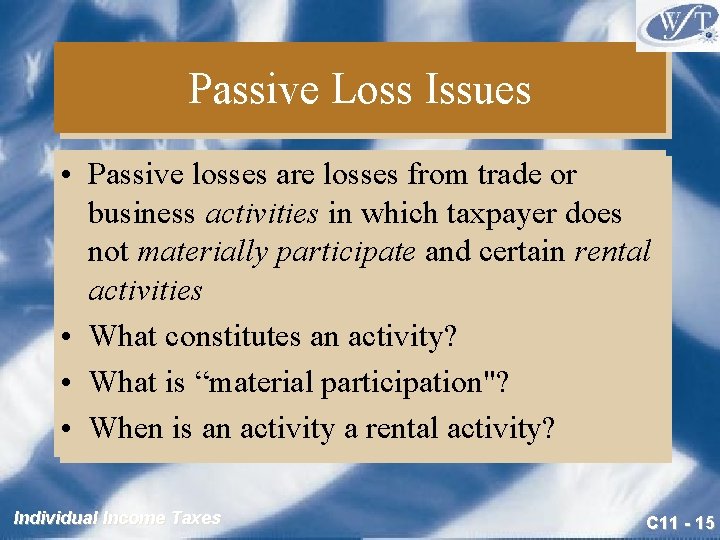
Passive Loss Issues • Passive losses are losses from trade or business activities in which taxpayer does not materially participate and certain rental activities • What constitutes an activity? • What is “material participation"? • When is an activity a rental activity? Individual Income Taxes C 11 - 15
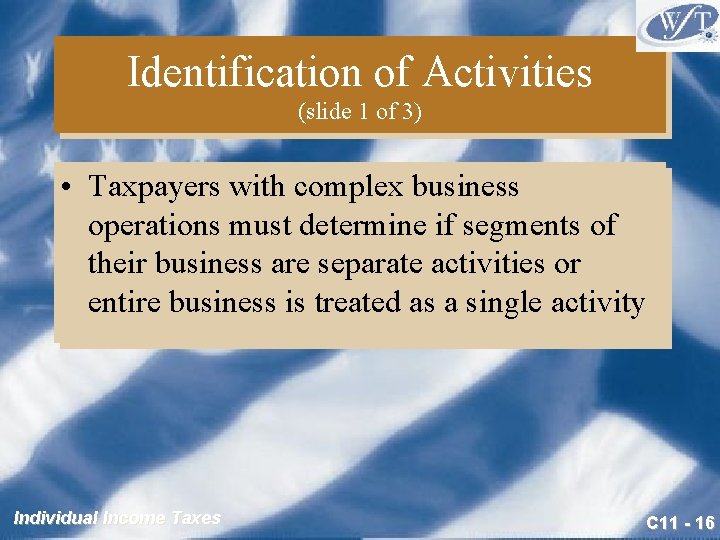
Identification of Activities (slide 1 of 3) • Taxpayers with complex business operations must determine if segments of their business are separate activities or entire business is treated as a single activity Individual Income Taxes C 11 - 16
Identification of Activities (slide 2 of 3) • Regs allow grouping multiple trade or businesses if they form an appropriate economic unit for measuring gain or loss – Once activities are grouped, can’t regroup unless: • Original groups were clearly inappropriate, or • Material change in circumstances Individual Income Taxes C 11 - 17
Identification of Activities (slide 3 of 3) • Factors given greatest weight in determining an appropriate economic unit include: – Similarities and differences in types of businesses – Extent of common control and ownership – Geographic location of different units – Interdependencies among the activities Individual Income Taxes C 11 - 18
Material Participation Tests (slide 1 of 8) • An activity is treated as active rather than passive (thus, not subject to the passive loss limits) if taxpayer meets one of 7 material participation tests • Participation is generally defined as work performed by an owner Individual Income Taxes C 11 - 19
Material Participation Tests (slide 2 of 8) • Test 1 – Taxpayer participates in the activity more than 500 hours during the year Individual Income Taxes C 11 - 20
Material Participation Tests (slide 3 of 8) • Test 2 – Taxpayer’s participation in the activity is substantially all of the participation in the activity of all individuals for the year Individual Income Taxes C 11 - 21
Material Participation Tests (slide 4 of 8) • Test 3 – Taxpayer participates in the activity more than 100 hours during the year and not less than the participation of any other individual in the activity Individual Income Taxes C 11 - 22
Material Participation Tests (slide 5 of 8) • Test 4 – Taxpayer’s participation in the activity is significant and taxpayer’s aggregate participation in all significant participation activities during the year exceeds 500 hours – Significant participation is more than 100 hours Individual Income Taxes C 11 - 23
Material Participation Tests (slide 6 of 8) • Test 5 – Taxpayer materially participated in the activity for any 5 years during the last 10 year period Individual Income Taxes C 11 - 24
Material Participation Tests (slide 7 of 8) • Test 6 – The activity is a personal service activity in which the taxpayer materially participated for any 3 preceding years Individual Income Taxes C 11 - 25
Material Participation Tests (slide 8 of 8) • Test 7 – Based on the facts and circumstances, taxpayer participated in the activity on a regular, continuous, and substantial basis • Regular, continuous, and substantial are not specifically defined in the Regulations Individual Income Taxes C 11 - 26
Participation Defined • Participation generally includes any work done by an individual in an activity that he or she owns – Does not include work if of a type not customarily done by owners and if one of its principal purposes is to avoid the disallowance of passive losses or credits – Work done in an individual’s capacity as an investor is not counted in applying the material participation tests – Participation by an owner’s spouse counts as participation by the owner Individual Income Taxes C 11 - 27
Rental Activities (slide 1 of 7) • Rental of tangible (real or personal) property is automatically passive activity unless it meets one of the 6 exceptions (Regs) • If exception applies, activity is subject to the material participation test Individual Income Taxes C 11 - 28
Rental Activities (slide 2 of 7) • Exception 1 – The average period of customer use of the property is 7 days or less Individual Income Taxes C 11 - 29
Rental Activities (slide 3 of 7) • Exception 2 – The average period of customer use of the property is 30 days or less, and the taxpayer provides significant personal services • Significant services are only services performed by individuals Individual Income Taxes C 11 - 30
Rental Activities (slide 4 of 7) • Exception 3 – Taxpayer provides extraordinary personal services – Average period of customer use is of no consequence • Extraordinary personal services occur when the customer’s use of the property is incidental to the services provided Individual Income Taxes C 11 - 31
Rental Activities (slide 5 of 7) • Exception 4 – Rental of the property is incidental to a nonrental activity of the taxpayer • Temp Regs provide that the following rentals are not passive activities: – – – Property held primarily for investment Property used in a trade or business Property held for sale to customers Lodging rented for the convenience of an employer Property rented to a partnership Individual Income Taxes C 11 - 32
Rental Activities (slide 6 of 7) • Exception 5 – Taxpayer customarily makes the property available during business hours for nonexclusive use by customers Individual Income Taxes C 11 - 33
Rental Activities (slide 7 of 7) • Exception 6 – Property is provided for use in an activity conducted by a partnership, S corporation, or joint venture in which taxpayer owns an interest Individual Income Taxes C 11 - 34
Interaction of At-Risk and Passive Loss Limits • Passive loss rules are applied after the atrisk rules – Losses not allowed under the at-risk rules are suspended under the at-risk rules, not the passive loss rules – Basis is reduced by deductions even if not currently usable due to passive loss rules Individual Income Taxes C 11 - 35
Real Estate Passive Loss Limits (slide 1 of 4) • Generally, losses from rental real estate are treated like other passive losses • There are two significant exceptions to the general rule Individual Income Taxes C 11 - 36
Real Estate Passive Loss Limits (slide 2 of 4) • Exception 1: Real estate professionals – Rental real estate losses are not treated as passive if the following requirements are met: • Taxpayer performs more than half of his/her personal services in real property businesses in which the taxpayer materially participates, and • Taxpayer performs more than 750 hours of services in these real property businesses as a material participant Individual Income Taxes C 11 - 37
Real Estate Passive Loss Limits (slide 3 of 4) • Exception 2: Rental real estate activities – Taxpayer can deduct up to $25, 000 of losses on real estate rental activities against active or portfolio income – Benefit is reduced by 50% of taxpayer’s AGI in excess of $100, 000 Individual Income Taxes C 11 - 38
Real Estate Passive Loss Limits (slide 4 of 4) • Exception 2: Rental real estate activities – To qualify for this exception the taxpayer must: • Actively participate in rental activity, and • Own at least 10% of all interests in activity – Active participation defined: • Requires only participation in making management decisions in a significant and bona fide sense Individual Income Taxes C 11 - 39
Suspended Losses • Losses can be suspended due to the passive loss limits or the at-risk limits • Losses suspended due to at-risk limitations are investment specific, thus no allocation of suspended losses is necessary • Suspended at-risk and passive losses can be carried forward indefinitely Individual Income Taxes C 11 - 40
Disposition of Passive Interests (slide 1 of 3) • Disposition at death: suspended loss deductible on decedent’s final tax return to extent of excess over any step-up in basis • Disposition by gift: suspended loss increases donee’s basis in activity Individual Income Taxes C 11 - 41
Disposition of Passive Interests (slide 2 of 3) • Disposition by installment sale: portion of suspended loss deductible is same as percentage of total gain recognized in year Individual Income Taxes C 11 - 42
Disposition of Passive Interests (slide 3 of 3) • Nontaxable exchange: if activities involved are same, suspended losses can be deducted against income from acquired activity – Otherwise, suspended loss generally deductible in year new activity disposed of in taxable transaction Individual Income Taxes C 11 - 43
If you have any comments or suggestions concerning this Power. Point Presentation for West Federal Taxation, please contact: Dr. Donald R. Trippeer, CPA TRIPPEDR@oneonta. edu SUNY Oneonta Individual Income Taxes C 11 - 44