
Chapter 11 Partnerships Distributions Transfer of Interests and
Chapter 11 Partnerships: Distributions, Transfer of Interests, and Terminations Corporations, Partnerships, Estates & Trusts Copyright © 2010 Cengage Learning Corporations, Partnerships, Estates & Trusts C 11 - 1
Distributions from a Partnership (slide 1 of 4) • All distributions of cash and property fall into two categories: – Liquidating distributions – Nonliquidating distributions • Depends on whether the partner remains a partner in the partnership after the distribution Corporations, Partnerships, Estates & Trusts C 11 - 2
Distributions from a Partnership (slide 2 of 4) • A liquidating distribution occurs when either: – Partnership itself liquidates and distributes all its property to the partners, or – Ongoing partnership redeems interest of one of its partners • e. g. , Partner retires Corporations, Partnerships, Estates & Trusts C 11 - 3
Distributions from a Partnership (slide 3 of 4) • A nonliquidating distribution is any distribution from a continuing partnership to a continuing partner – Two types of nonliquidating distributions • Draw – Distribution of partner’s share of current or accumulated profits • Partially liquidating distribution – Reduces partner’s interest in partnership capital but does not liquidate partner’s interest Corporations, Partnerships, Estates & Trusts C 11 - 4

Distributions from a Partnership (slide 4 of 4) • Distributions from a partnership may be either: – Proportionate—Partner receives his or her share of certain ordinary income-producing assets – Disproportionate—Partner’s share of certain ordinary income-producing assets increases or decreases Corporations, Partnerships, Estates & Trusts C 11 - 5
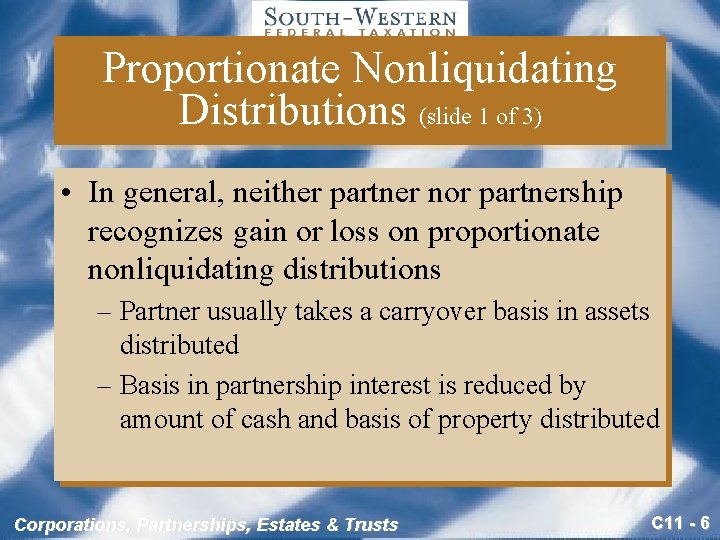
Proportionate Nonliquidating Distributions (slide 1 of 3) • In general, neither partner nor partnership recognizes gain or loss on proportionate nonliquidating distributions – Partner usually takes a carryover basis in assets distributed – Basis in partnership interest is reduced by amount of cash and basis of property distributed Corporations, Partnerships, Estates & Trusts C 11 - 6
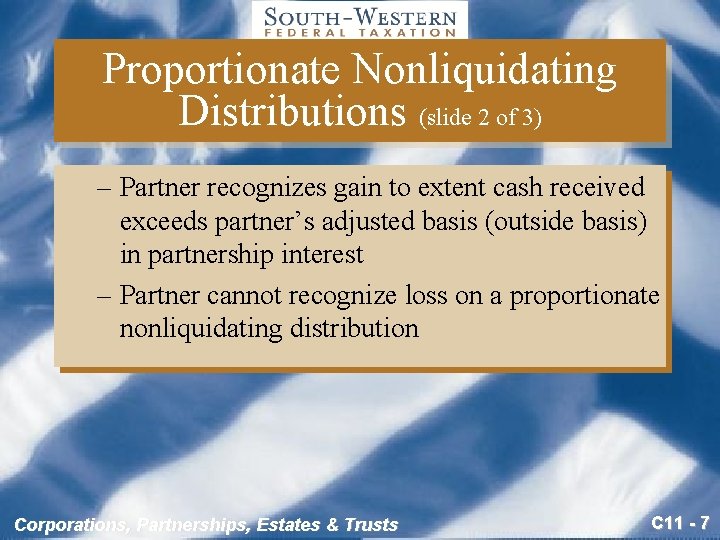
Proportionate Nonliquidating Distributions (slide 2 of 3) – Partner recognizes gain to extent cash received exceeds partner’s adjusted basis (outside basis) in partnership interest – Partner cannot recognize loss on a proportionate nonliquidating distribution Corporations, Partnerships, Estates & Trusts C 11 - 7
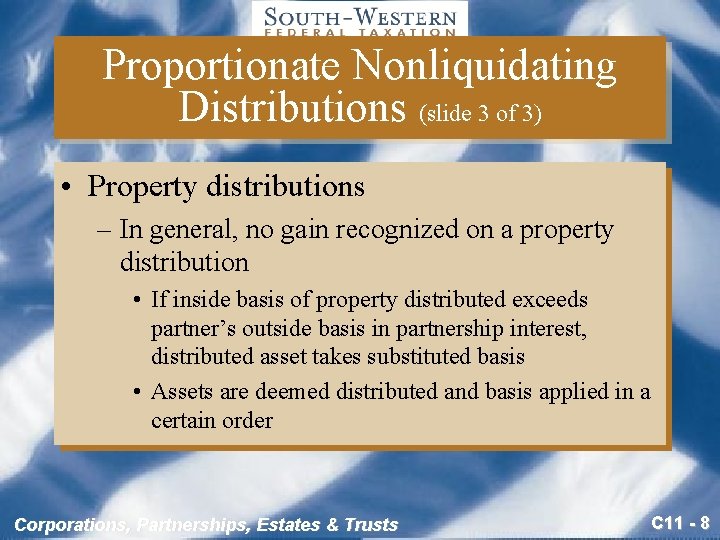
Proportionate Nonliquidating Distributions (slide 3 of 3) • Property distributions – In general, no gain recognized on a property distribution • If inside basis of property distributed exceeds partner’s outside basis in partnership interest, distributed asset takes substituted basis • Assets are deemed distributed and basis applied in a certain order Corporations, Partnerships, Estates & Trusts C 11 - 8
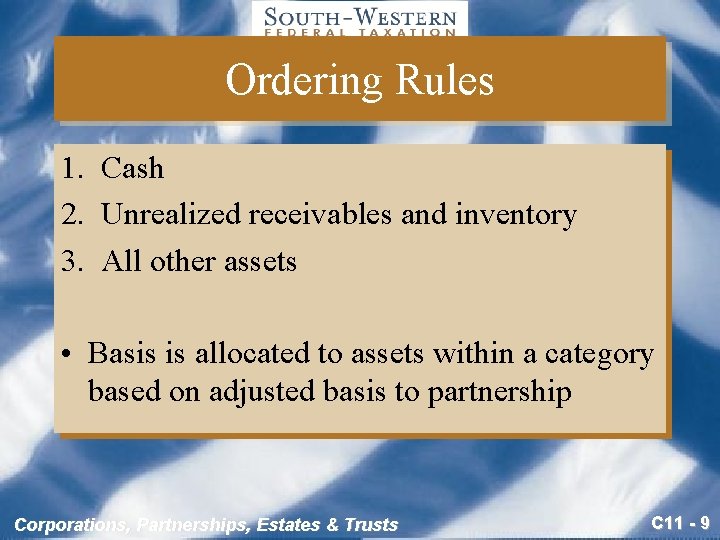
Ordering Rules 1. Cash 2. Unrealized receivables and inventory 3. All other assets • Basis is allocated to assets within a category based on adjusted basis to partnership Corporations, Partnerships, Estates & Trusts C 11 - 9

Proportionate Nonliquidating Distribution Examples (slide 1 of 6) Bill’s basis in partnership interest: $30, 000 Proportionate nonliquidating distributions (independent fact situations): Assets Distributed A B C. Cash $15, 000 $ 5, 000 Land—basis N/A $ 6, 000 N/A (Fair mkt value) N/A $10, 000 N/A Accts rec—basis N/A -0(Fair mkt value) N/A $16, 000 Corporations, Partnerships, Estates & Trusts C 11 - 10

Proportionate Nonliquidating Distribution Examples (slide 2 of 6) A B C Basis in interest $30, 000 Cash distributed Basis after cash Acct. rec. distrib. Basis after A. R. Land Distrib. Basis after all dist. ( 15, 000) 15, 000 N/A $15, 000 (15, 000) 15, 000 N/A 15, 000 ( 6, 000) $ 9, 000 (5, 000) 25, 000 (-0 -) 25, 000 N/A $25, 000 Corporations, Partnerships, Estates & Trusts . C 11 - 11
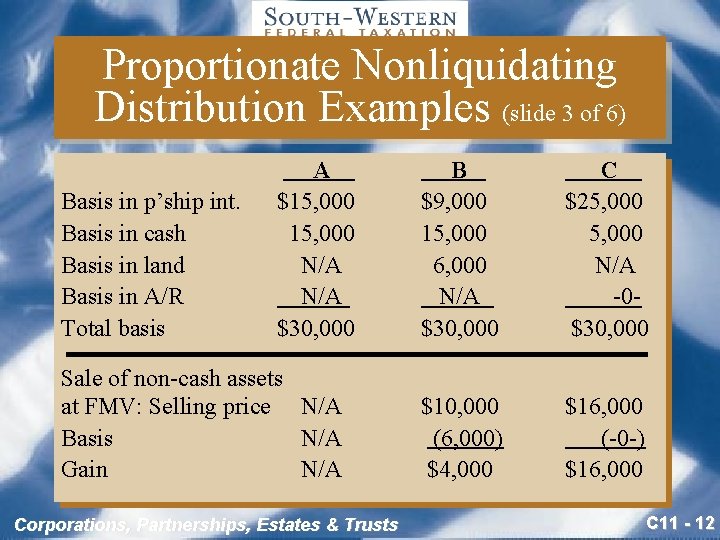
Proportionate Nonliquidating Distribution Examples (slide 3 of 6) Basis in p’ship int. Basis in cash Basis in land Basis in A/R Total basis A $15, 000 N/A $30, 000 Sale of non-cash assets at FMV: Selling price N/A Basis N/A Gain N/A Corporations, Partnerships, Estates & Trusts B $9, 000 15, 000 6, 000 N/A $30, 000 C. $25, 000 N/A -0$30, 000 $10, 000 (6, 000) $4, 000 $16, 000 (-0 -) $16, 000 C 11 - 12
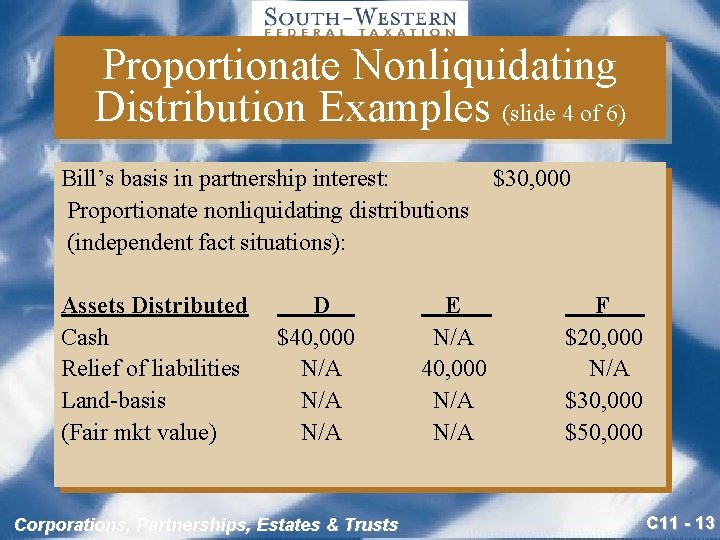
Proportionate Nonliquidating Distribution Examples (slide 4 of 6) Bill’s basis in partnership interest: $30, 000 Proportionate nonliquidating distributions (independent fact situations): Assets Distributed Cash Relief of liabilities Land-basis (Fair mkt value) D $40, 000 N/A N/A Corporations, Partnerships, Estates & Trusts E N/A 40, 000 N/A F. $20, 000 N/A $30, 000 $50, 000 C 11 - 13
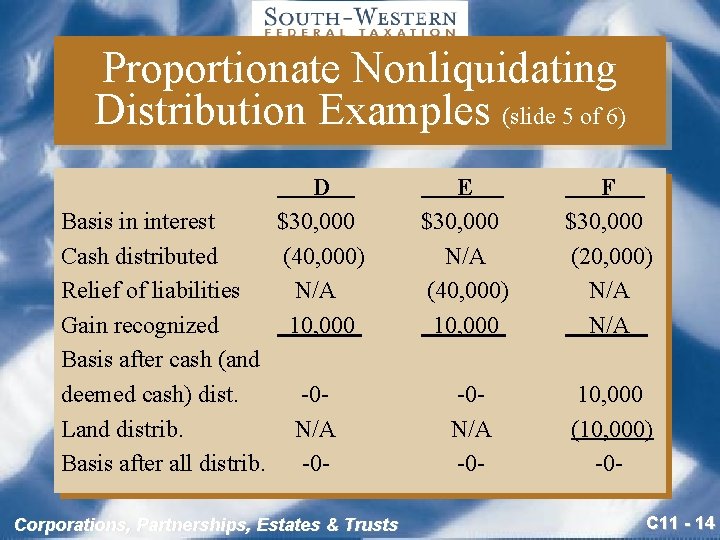
Proportionate Nonliquidating Distribution Examples (slide 5 of 6) Basis in interest Cash distributed Relief of liabilities Gain recognized Basis after cash (and deemed cash) dist. Land distrib. Basis after all distrib. D $30, 000 (40, 000) N/A 10, 000 E $30, 000 N/A (40, 000) 10, 000 F. $30, 000 (20, 000) N/A. -0 N/A -0 - 10, 000 (10, 000) -0 - Corporations, Partnerships, Estates & Trusts C 11 - 14
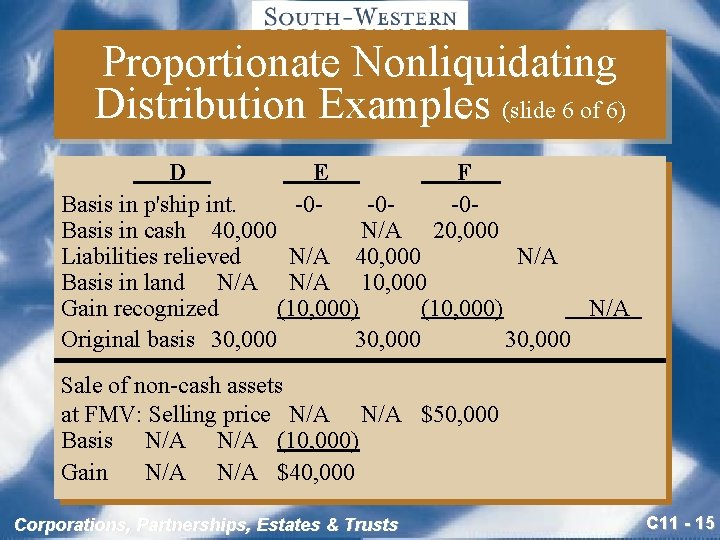
Proportionate Nonliquidating Distribution Examples (slide 6 of 6) D E F. Basis in p'ship int. -0 -0 -0 Basis in cash 40, 000 N/A 20, 000 Liabilities relieved N/A 40, 000 N/A Basis in land N/A 10, 000 Gain recognized (10, 000) N/A. Original basis 30, 000 Sale of non-cash assets at FMV: Selling price N/A $50, 000 Basis N/A (10, 000) Gain N/A $40, 000 Corporations, Partnerships, Estates & Trusts C 11 - 15
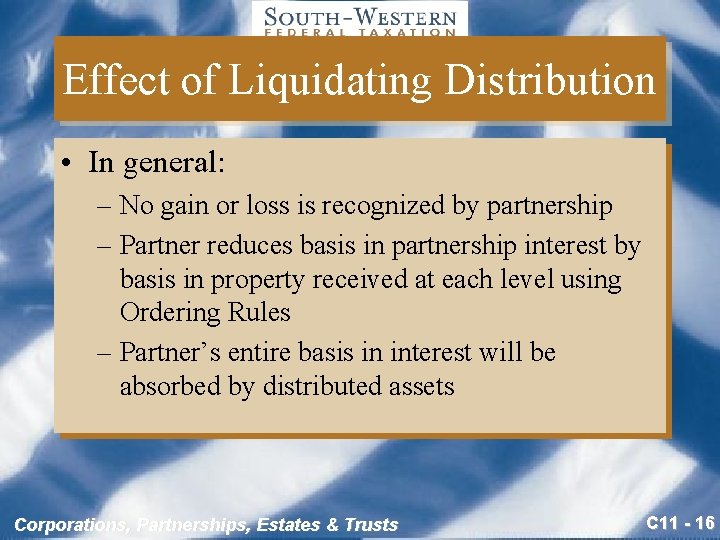
Effect of Liquidating Distribution • In general: – No gain or loss is recognized by partnership – Partner reduces basis in partnership interest by basis in property received at each level using Ordering Rules – Partner’s entire basis in interest will be absorbed by distributed assets Corporations, Partnerships, Estates & Trusts C 11 - 16
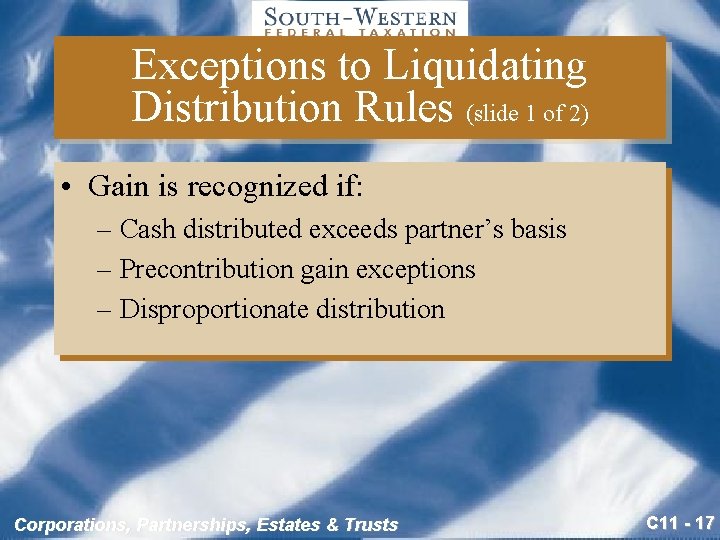
Exceptions to Liquidating Distribution Rules (slide 1 of 2) • Gain is recognized if: – Cash distributed exceeds partner’s basis – Precontribution gain exceptions – Disproportionate distribution Corporations, Partnerships, Estates & Trusts C 11 - 17
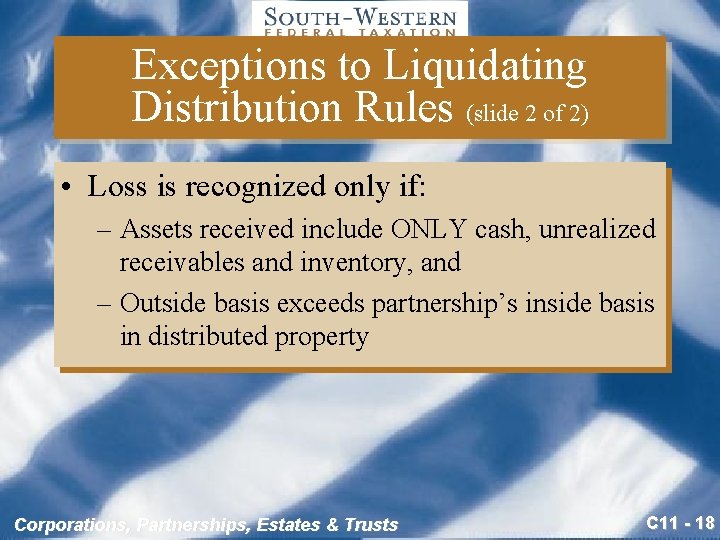
Exceptions to Liquidating Distribution Rules (slide 2 of 2) • Loss is recognized only if: – Assets received include ONLY cash, unrealized receivables and inventory, and – Outside basis exceeds partnership’s inside basis in distributed property Corporations, Partnerships, Estates & Trusts C 11 - 18
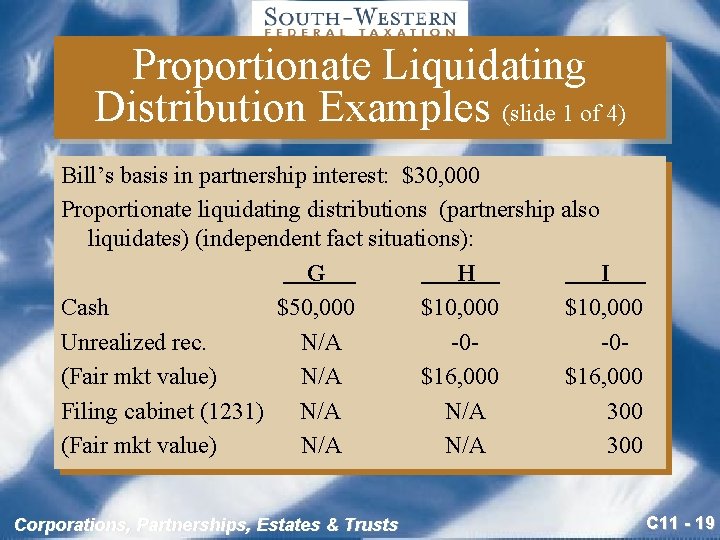
Proportionate Liquidating Distribution Examples (slide 1 of 4) Bill’s basis in partnership interest: $30, 000 Proportionate liquidating distributions (partnership also liquidates) (independent fact situations): G H I. Cash $50, 000 $10, 000 Unrealized rec. N/A -0 -0(Fair mkt value) N/A $16, 000 Filing cabinet (1231) N/A 300 (Fair mkt value) N/A 300 Corporations, Partnerships, Estates & Trusts C 11 - 19
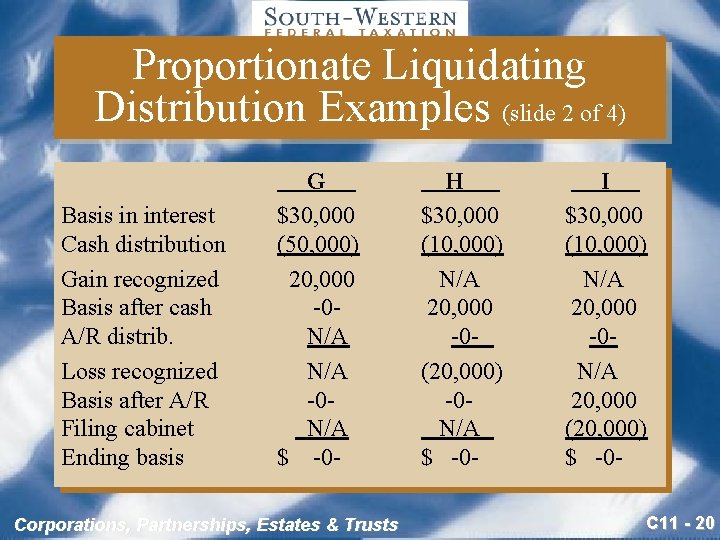
Proportionate Liquidating Distribution Examples (slide 2 of 4) Basis in interest Cash distribution Gain recognized Basis after cash A/R distrib. Loss recognized Basis after A/R Filing cabinet Ending basis G $30, 000 (50, 000) 20, 000 -0 N/A $ -0 - Corporations, Partnerships, Estates & Trusts H $30, 000 (10, 000) N/A 20, 000 -0(20, 000) -0 N/A $ -0 - I. $30, 000 (10, 000) N/A 20, 000 -0 N/A 20, 000 (20, 000) $ -0 C 11 - 20
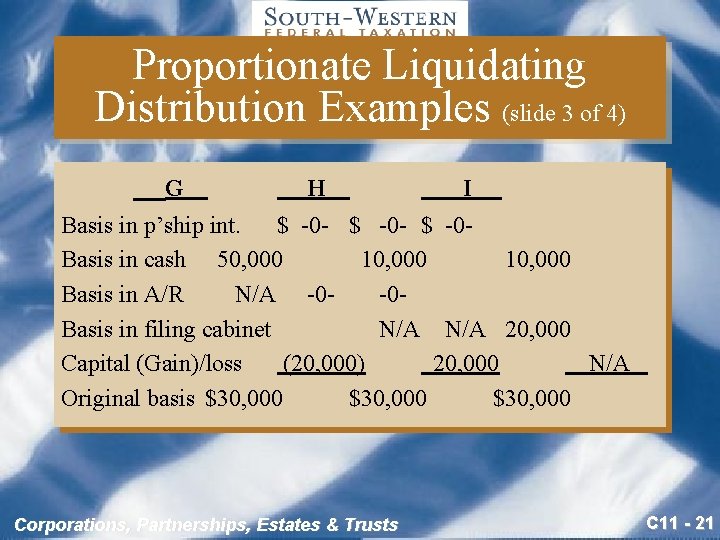
Proportionate Liquidating Distribution Examples (slide 3 of 4) G H I . Basis in p’ship int. $ -0 - $ -0 Basis in cash 50, 000 10, 000 Basis in A/R N/A -0 -0 Basis in filing cabinet N/A 20, 000 Capital (Gain)/loss (20, 000) 20, 000 N/A. Original basis $30, 000 Corporations, Partnerships, Estates & Trusts C 11 - 21
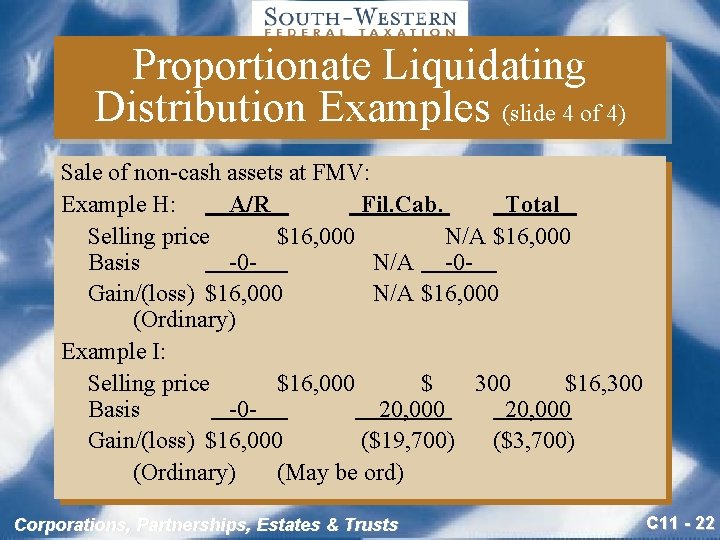
Proportionate Liquidating Distribution Examples (slide 4 of 4) Sale of non-cash assets at FMV: Example H: A/R Fil. Cab. Total. Selling price $16, 000 N/A $16, 000 Basis -0 N/A -0 -. Gain/(loss) $16, 000 N/A $16, 000 (Ordinary) Example I: Selling price $16, 000 $ 300 $16, 300 Basis -020, 000 Gain/(loss) $16, 000 ($19, 700) ($3, 700) (Ordinary) (May be ord) Corporations, Partnerships, Estates & Trusts C 11 - 22
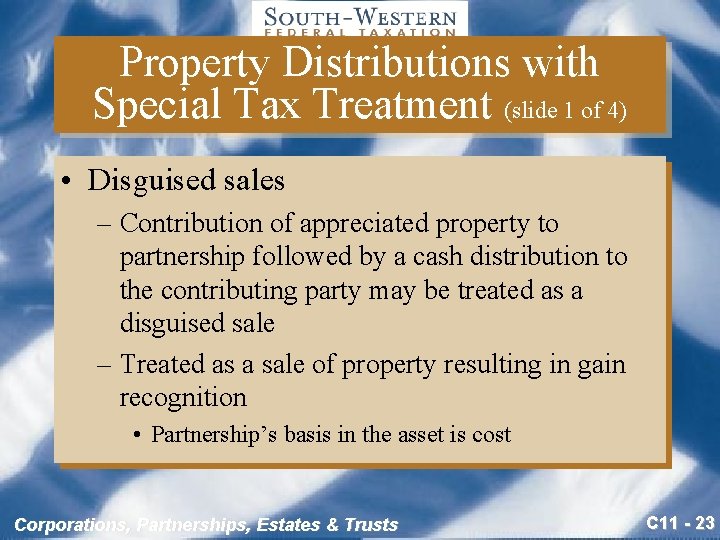
Property Distributions with Special Tax Treatment (slide 1 of 4) • Disguised sales – Contribution of appreciated property to partnership followed by a cash distribution to the contributing party may be treated as a disguised sale – Treated as a sale of property resulting in gain recognition • Partnership’s basis in the asset is cost Corporations, Partnerships, Estates & Trusts C 11 - 23
Property Distributions with Special Tax Treatment (slide 2 of 4) • Marketable securities – FMV of marketable securities distributed to a partner is treated as a cash distribution • Some or all of excess of FMV of securities distributed over partner’s outside basis is taxable gain – Marketable securities include most actively traded debt or equity interests, options, futures, and derivatives – Exceptions apply Corporations, Partnerships, Estates & Trusts C 11 - 24
Property Distributions with Special Tax Treatment (slide 3 of 4) • Precontribution gain property – Contributing partner recognizes gain on distribution of precontribution gain property in two situations: 1. If property is distributed to another partner within 7 years of contribution date, contributing partner recognizes remaining precontribution gain – Partner’s basis in partnership and basis of distributed property is increased by gain recognized Corporations, Partnerships, Estates & Trusts C 11 - 25
Property Distributions with Special Tax Treatment (slide 4 of 4) • Precontribution gain property – Contributing partner recognizes gain on distribution of precontribution gain property in two situations (cont’d): 2. If partnership distributes ANY property other than cash to a partner within 7 years after THAT partner contributes appreciated property, the partner recognizes the lesser of: – Remaining net precontribution gain – Excess of FMV of distributed property over partner’s basis in partnership interest Corporations, Partnerships, Estates & Trusts C 11 - 26
Disproportionate Distributions (slide 1 of 3) • Occurs when partnership distributes cash or property to a partner which increases or decreases the partner’s share of ordinary income-producing assets (hot assets) Corporations, Partnerships, Estates & Trusts C 11 - 27
Disproportionate Distributions (slide 2 of 3) • If partner receives less than proportionate share of hot assets, then treated as if: – Partnership distributed some of the assets, and – Partner sold these hot assets back to partnership – Partner recognizes ordinary income on sale of the hot assets; Partnership’s basis in hot assets is cost Corporations, Partnerships, Estates & Trusts C 11 - 28
Disproportionate Distributions (slide 3 of 3) • Hot assets include: – Substantially appreciated inventory • Inventory includes all assets other than cash, capital and § 1231 assets • Substantially appreciated means FMV > 120% of partnership’s adjusted basis in inventory – Unrealized receivables • Rights to receive future amounts that will result in ordinary income recognition Corporations, Partnerships, Estates & Trusts C 11 - 29
§ 736: Liquidating Distribution Where P’ship Does Not Liquidate (slide 1 of 3) • § 736(a) income payment: – Treated as distributive share of partnership income or guaranteed payment to partner – Certain items if partnership is service-provider and retiring partner is a general partner: • Unrealized receivables (except depreciation recapture) • Goodwill (unless provided for in partnership agreement) • § 736(b) property payment: – Payments made for liquidated partner’s share of partnership’s assets Corporations, Partnerships, Estates & Trusts C 11 - 30
§ 736: Liquidating Distribution Where P’ship Does Not Liquidate (slide 2 of 3) • § 736(a) income payment: – Partner has: • Ordinary income (guaranteed payment), or • Distributive share of income – Partnership has: • Guaranteed payment (deductible) if determined without regard to partnership profits • Distributive share if based on profits Corporations, Partnerships, Estates & Trusts C 11 - 31
§ 736: Liquidating Distribution Where P’ship Does Not Liquidate (slide 3 of 3) • § 736(b) property payment: – Disproportionate distribution to extent of partner’s share of hot assets – Return of basis (and capital gain (loss) for remainder) Corporations, Partnerships, Estates & Trusts C 11 - 32
Sale of Partnership Interest (slide 1 of 4) • Generally, results in gain or loss recognition by selling partner – Gain(loss) = amount realized less partner’s basis in partnership interest – Partnership liabilities assumed by purchasing partner are treated as part of consideration paid for the partnership interest Corporations, Partnerships, Estates & Trusts C 11 - 33
Sale of Partnership Interest (slide 2 of 4) • Partnership tax year closes for selling partner on sale date – Partner’s share of income through sale date is calculated • Can prorate annual income or use interim closing of the books – Taxed to selling partner and increases basis in partnership interest Corporations, Partnerships, Estates & Trusts C 11 - 34
Sale of Partnership Interest (slide 3 of 4) • Effect of hot assets – Hot assets include: • Unrealized receivables (same as for disproportionate distributions) • Inventory – Includes all partnership property except money, capital assets, and § 1231 assets Corporations, Partnerships, Estates & Trusts C 11 - 35
Sale of Partnership Interest (slide 4 of 4) • Effect of hot assets (cont’d) – Must allocate sales price of partnership interest between “hot” (ordinary income) assets and “nonhot” (capital gain) components – Selling partner’s gain is classified as a capital gain or loss portion and an ordinary income or loss amount related to the hot assets Corporations, Partnerships, Estates & Trusts C 11 - 36
Other Dispositions of Partnership Interests (slide 1 of 8) • Transfer of a partnership interest to a controlled corporation – Tax free if § 351 requirements are met – If 50% or more of the total interest in capital and profits of the partnership are transferred, the partnership terminates Corporations, Partnerships, Estates & Trusts C 11 - 37
Other Dispositions of Partnership Interests (slide 2 of 8) • Incorporating a partnership – At least three methods available: 1. Transfer each partner’s interest to the corp in exchange for stock – Partnership terminates – Corp becomes owner of all partnership assets – Corp has substituted basis in assets; Old partners have substituted basis in stock Corporations, Partnerships, Estates & Trusts C 11 - 38
Other Dispositions of Partnership Interests (slide 3 of 8) • Incorporating a partnership (cont’d) 2. Transfer partnership assets to corp in exchange for stock and assumption of partnership liabilities – Partnership distributes stock to partners in liquidating distribution – Corp has carryover basis in assets; Old partners have substituted basis in stock Corporations, Partnerships, Estates & Trusts C 11 - 39
Other Dispositions of Partnership Interests (slide 4 of 8) • Incorporating a partnership (cont’d) 3. Partnership distributes all assets and liabilities pro rata to partners in complete liquidation of partnership – Partners transfer assets and liabilities to corp in exchange for stock under § 351 – Corp has substituted basis for assets; Partners have substituted basis for stock Corporations, Partnerships, Estates & Trusts C 11 - 40
Other Dispositions of Partnership Interests (slide 5 of 8) • Incorporating a partnership (cont’d) – All three methods of incorporating a partnership are tax-free • Exception: if liabilities of partnership exceed basis of transferred assets Corporations, Partnerships, Estates & Trusts C 11 - 41
Other Dispositions of Partnership Interests (slide 6 of 8) • Nontaxable like-kind exchange rules do not apply to the exchange of interests in different partnerships Corporations, Partnerships, Estates & Trusts C 11 - 42
Other Dispositions of Partnership Interests (slide 7 of 8) • Generally, the gift of a partnership interest is tax-free – Partnership income, loss, etc. is prorated between donor and donee Corporations, Partnerships, Estates & Trusts C 11 - 43
Other Dispositions of Partnership Interests (slide 8 of 8) • Death of a partner – Taxable year of partnership closes with respect to that partner on date of death – Compute deceased partner’s share of partnership income or loss to that date and report on partner’s final Form 1040 Corporations, Partnerships, Estates & Trusts C 11 - 44
§ 754 Election • Adjusts partnership’s basis in assets to reflect: – The difference in the amount paid by the purchasing partner and his share of the inside basis of partnership assets • The adjustment can be positive or negative • The adjustment affects the basis of partnership property with respect to the transferee partner only – Gain or loss recognized by partner receiving distribution from partnership • Once made, election remains in effect for all future years unless election revoked with IRS consent Corporations, Partnerships, Estates & Trusts C 11 - 45
Termination of Partnership (slide 1 of 3) • Partnership terminates when either of the following events occur: – No part of the business continues to be carried on by any partners – Within a 12 -month period, 50% or more of the partnership’s capital and profits interests are sold or exchanged Corporations, Partnerships, Estates & Trusts C 11 - 46
Termination of Partnership (slide 2 of 3) • Partnership terminates and its tax year closes when: – The partnership incorporates – One partner in a two-party partnership buys out the other partner • A termination also occurs when the partnership ceases operations and liquidates Corporations, Partnerships, Estates & Trusts C 11 - 47
Termination of Partnership (slide 3 of 3) • Partnership tax year usually does not close: – Upon the death of a partner – Entry of a new partner – Liquidation of a partner’s interest in other than a two-party partnership – Sale or exchange of a less than 50% partnership interest Corporations, Partnerships, Estates & Trusts C 11 - 48
Family Partnerships (slide 1 of 3) • Owned and controlled primarily by members of the same family – Often formed to save taxes by funneling some of parent’s income to the children • Often difficult to establish for tax purposes Corporations, Partnerships, Estates & Trusts C 11 - 49
Family Partnerships (slide 2 of 3) • Family member will be recognized as a partner if: – Capital is a material income-producing factor and partnership interest is acquired in a bona fide transaction where ownership and control are received • Can be acquired by gift or purchase from another family member – Capital is not a material income-producing factor, but family member contributes substantial or vital services Corporations, Partnerships, Estates & Trusts C 11 - 50
Family Partnerships (slide 3 of 3) • Kiddy tax may apply to child partner under age 19 (or a student under age 24) and claimed as a dependent by parent-partner • Family member whose interest is acquired by gift from another family member may only have a portion of partnership income allocated to them – Donor partner must be allocated income representing reasonable compensation for services rendered to the partnership Corporations, Partnerships, Estates & Trusts C 11 - 51
Limited Liability Companies • A LLC with 2 or more owners is taxed as a partnership – LLC members are not personally liable for debts of the entity • Effectively treated as a limited partnership with no general partners – LLCs are relatively new so there is no established body of case law available • Makes planning difficult Corporations, Partnerships, Estates & Trusts C 11 - 52
Limited Liability Partnerships • Partners are not personally liable for the malpractice and torts of their partners • Taxable as a partnership • Conversion of a general partnership into a LLP is not taxable if all of the general partners become LLP partners and hold the same proportionate interest Corporations, Partnerships, Estates & Trusts C 11 - 53

If you have any comments or suggestions concerning this Power. Point Presentation for South-Western Federal Taxation, please contact: Dr. Donald R. Trippeer, CPA trippedr@oneonta. edu SUNY Oneonta Corporations, Partnerships, Estates & Trusts C 11 - 54
- Slides: 54