
Chapter 11 Para abnormal philia attraction To be
Chapter 11 .

Para = abnormal; philia = attraction To be diagnosed with a paraphilic disorder, DSM-5 requires that people with these interests: Symptoms must be present at least 6 months May manifest as sexual fantasies, behaviors, and/or urges which: involves another person’s psychological distress, injury, or death, or a desire for sexual behaviors involving unwilling persons or persons unable to give legal consent. Cause the patient significant distress or impairment in important areas of function, such as social or occupational settings, not merely distress resulting from society’s disapproval The prevalence is mostly seen in males, with a few exceptions (S&M) Paraphilic disorders includes eight conditions: 1. Exhibitionistic Disorder 2. Voyeuristic Disorder 3. Fetishistic Disorder 4. Transvestic Disorder 5. Frotteuristic Disorder 6. Sexual Sadism Disorder 7. Sexual Masochism Disorder 8. Pedophilic Disorder

Exhibitionistic Disorder: Recurrent and result in intense sexual arousal from the exposure of one’s genitals to a stranger or unsuspecting individual. It is an uncontrollable sexual urge that is deliberately intended for an non-consenting person. Possible legal ramifications Voyeuristic Disorder: The term ‘Voyeurism’ refers to the desire to spy on unsuspecting and nonconsenting people during their private activities. Voyeuristic Disorder brings sexual gratification on seeing other people perform private activities such as undressing, being naked and/or seeing people performing a sexual act. In most cases, the voyeur purposefully acts in such a manner without seeking the consent of the target. Voyeurism is considered to be the most common of law -breaking sexual behaviors
Fetishistic Disorder A Fetish was defined as “Something irrationally revered” - an object in which power or force was concentrated. The first recorded use of the word Fetishist was in 1897 Diagnosis assigned to individuals who experience sexual arousal from objects or a specific part of the body which is not typically regarded as erotic. Almost any body part or object can be a Fetish. Examples include: feet, hair, clothes, shoes, stockings, latex, etc. Fetishists may use the desired article for sexual gratification in the absence of a partner, by touching, smelling, licking, or masturbating with it Specifiers for the diagnosis of Fetishistic Disorder include the type of stimulus which is the focus of attention. Body Part(s) (non-genital or erogenous areas of the body - e. g. , feet or hair). This is also referred to as Partialism- preoccupation with a part of the body rather than the whole person. Non-living Object(s) e. g. shoes or boots.

Transvestic Disorder: The individual is sexually aroused by the act of crossdressing as the opposite gender, and yet finds the act of dressing and the resulting arousal distressing In transvestic disorder, feelings of distress at crossdressing are separate from feelings of gender dysphoria, and individuals identify as their anatomical gender DSM-IV limited this behavior to heterosexual males; DSM-5 has no such restriction, opening the diagnosis to women or gay men who have this sexual interest. Frotteuristic Disorder Frotteuristic disorder typically manifests as intense sexual arousal resulting from touching or rubbing against individuals who are nonconsenting, and may extend to fantasies of touching as well. This inappropriate touching often occurs in public settings, such as on crowded buses Due to the nonconsenting contact involved in frotteuristic disorder, it is safe to assume that there is a significant potential for legal consequences, including conviction of and incarceration for sex crimes
Sexual Sadism Disorder Algolagnic disorders are a class of paraphilic disorders wherein sexual arousal is dependent on pain and suffering. Sexual sadism disorder is a specific algolagnic disorder wherein sexual arousal occurs from the physical or psychological suffering of another individual Sexual sadism disorder is hallmarked by intense feelings of sexual excitement when fantasizing about or witnessing another individual undergoing physical or psychological pain. Sadistic acts include restraint (such as with ropes, chains, or handcuffs), imprisonment, biting, spanking, whipping, or beating. Acts of sexual sadism may occur with a consenting partner, or as assault on a nonconsenting individual When diagnosis sexual sadism disorder, it is also important to note that mild forms of pain, including scratching or spanking, between consenting adults is considered within the normal range of human sexual experimentation. As long as the intent of the behavior is for mutual attraction and all parties are consenting, acts of sadism may not qualify for diagnosis of sexual sadism disorder.
Sexual Masochism Disorder Sexual masochism disorder is diagnosed in individuals who experience sexual arousal in response to extreme pain, humiliation, bondage, or torture. The masochist will have unrelenting fantasies with urges to be beaten, bound or humiliated during sex Although behaviors associated with sexual masochism disorder are very prevalent, diagnostic criteria requires that the patient experience distress, such as shame, guilt or anxiety related to sexual fantasy, urges or sexual experiences. Masochistic behaviors can be self inflicted. The masochist inflicts pain on themselves for reasons of arousal. Cases of severe injury or death do happen. Autoerotic Asphyxiation – leading cause of death directly related to sexual masochistic disorder. It involves oxygen deprivation by means of neck compression during sexual activity. The most common manifestations of autoerotic asphyxia are hanging, ligature or plastic bags. Milder forms of masochism between consenting adults, sometimes also referred to as "BDSM" or dominant and submissive, are not classified as disorders by the DSM-5. "BDSM" is an umbrella term for certain kinds of erotic behavior between consenting adults. (Bondage, Discipline, Sadism and Masochism- Dominatrix) Many who engage in BDSM within consensual relationships and do not experience guilt, shame or other negative emotions view the behavior as a subculture or alternative lifestyle choice, not a sexual deviance
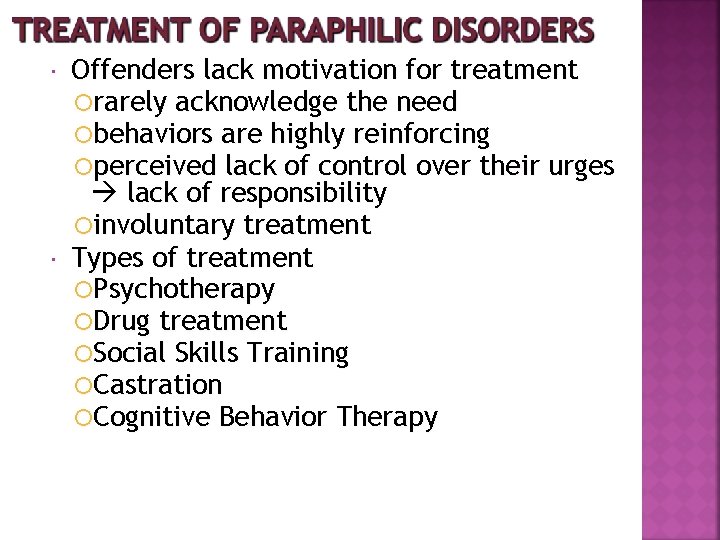
Offenders lack motivation for treatment rarely acknowledge the need behaviors are highly reinforcing perceived lack of control over their urges lack of responsibility involuntary treatment Types of treatment Psychotherapy Drug treatment Social Skills Training Castration Cognitive Behavior Therapy
Pedophilic Disorder is a DSM-5 diagnosis assigned to adults ( defined as age 16 and up) who have sexual desire for prepubescent children Any behavioral expression of Pedophilic Disorder is a offense in the United States. criminal Pedophilic Disorder is highly treatment resistant and rates of recidivism have been estimated to be 25% -50%, (Harvard University, 2010) The individual who is predatory ( Pedophilic Disordered) will not be safe around children at any point in their lives, and must therefore be contained and monitored indefinitely. According to the DSM-5, there are three criterion, with six specifiers: An individual who has had arousing fantasies about, urges for, or behaviors with a prepubescent child or children. The individual has acted out these sexual desires, or is experiencing significant distress or difficulty as a result of these desires. The Individual is 16 years of age, and at least five years older than the child or children noted in Criterion A. The Specifiers are: Exclusive type- sexual attraction to children only. Non-exclusive type- sexual attraction to adults and children. Attraction to boys or Attraction to girls. Incestuous only. (American Psychiatric Association, 2013 a).
Impact on Functioning Those with Pedophilic Disorder typically lead dual lives. They maintain secrecy, presenting a picture of normalcy, respectability, responsibility, and adult sexual functioning. Some are married and have families, and even their spouses are not aware of their aberrant desires and activities Once apprehended, they may experience incarceration or other involvement with the criminal justice system, and public shame and humiliation. Typically, not even other violent offenders will tolerate an inmate with Pedophile Disorder in their midst.
Treatment for Pedophilic Disorder is highly resistant to any type of treatment such as, Psychotherapy, CBT (Cognitive Behavioral Therapy), Pharmacotherapy (i. e. , using estrogens to suppress sexual desire or SSRI’’s -Selective Serotonin Re-uptake Inhibitors), and/or chemical or physical castration. Physical castration of sex offenders was practiced in the United States through 1975 and as of 2012, in nine states, chemical castration through the use of synthetic estrogen can be used, in some states as a condition of attaining parole status. California enforces chemical castration on the second conviction “where the victim has not attained 13 years of age. ” Sex offenders paroled in the state could opt for a surgical alternative. However, even castration may not dissuade a determined and predatory offender, as they will resort to using foreign objects for penetration, watch other individuals perpetrate on a victim, or watch pornographic videos or images. The distinction is that the deviant desires are in the offenders mind, not body. The most viable option at this time is long term incarceration, and post release monitoring and supervision
Treatment for Pedophilic Disorder Designation as an MDSO (Mentally Disordered Sex offender) under SVP (Sexually Violent Predator) laws is another option for long term incapacitation of the offender, and is practiced in 20 states, including Ca. A "sexually violent predator" is defined in California Welfare and Institutions Code Sections 6600 et seq. as a person who: (A) has been convicted of a sexually violent offense against one or more victim(s); and (B) has a diagnosed mental disorder(pedophiliac disorder) that makes the person a danger to the health and safety of others; and (C) it is likely that he or she will engage in sexually violent criminal behavior. The term "sexually violent offense" includes a variety of sex crimes which typically involve force, violence, duress, menace or threats of immediate bodily injury or threats of future retaliation against a person. Pedophilia, whether or not it involves force or violence, is also included.
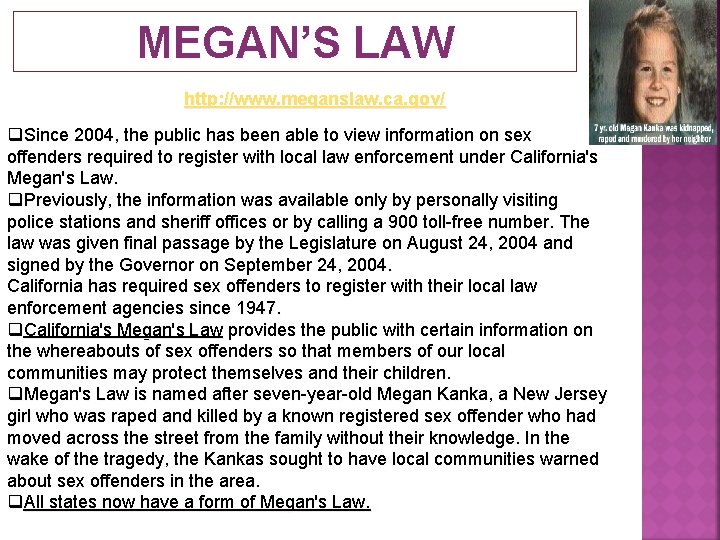
MEGAN’S LAW http: //www. meganslaw. ca. gov/ q. Since 2004, the public has been able to view information on sex offenders required to register with local law enforcement under California's Megan's Law. q. Previously, the information was available only by personally visiting police stations and sheriff offices or by calling a 900 toll-free number. The law was given final passage by the Legislature on August 24, 2004 and signed by the Governor on September 24, 2004. California has required sex offenders to register with their local law enforcement agencies since 1947. q. California's Megan's Law provides the public with certain information on the whereabouts of sex offenders so that members of our local communities may protect themselves and their children. q. Megan's Law is named after seven-year-old Megan Kanka, a New Jersey girl who was raped and killed by a known registered sex offender who had moved across the street from the family without their knowledge. In the wake of the tragedy, the Kankas sought to have local communities warned about sex offenders in the area. q. All states now have a form of Megan's Law.

SEX ADDICTION IS NOT INCLUDED AT THIS POINT IN THE DSM 5 Sex addiction can refer to a range of behaviors that are done in excess and significantly impact one’s life in a negative way. What Are the Different Types of Sexual Addictions? There are no distinct categories, but sexual addictions can come in different forms, including addiction to: Pornography. Prostitution. Masturbation or fantasy. Sadistic or masochistic behavior. Exhibition/Voyeurism. Other excessive sexual pursuits. Multiple extra marital affairs
Involves an ongoing preoccupation and/or obsession with sexual fantasies and behavior. For sex addicts, sex becomes a primary focus in their lives. Sex addicts are unable to quit or curtail their sexual acting out, despite a variety of negative life consequences, such as: Relationship issues Trouble at work or in school, including reprimands or even dismissals Declining physical and/or emotional health Loss of interest in hobbies and other healthy and previously enjoyable activities Financial woes Legal problems, including arrest
Like other addicts, sex addicts often feel great shame and remorse about what they’re doing, yet before they even realize it, they’re back at it, in the same or a very similar sexual situation; this is their “loss of control. ” Fantasies and behaviors go against their core values and beliefs (such as safe sex, marital fidelity and not hurting others). Because of this, sex addicts find themselves leading double lives, putting a great deal of effort into separating and compartmentalizing their sex life and their work and home lives. Causes Sex addiction is not driven by a desire for sexual enjoyment. Instead, sex addicts use their addiction to escape from stress and other emotional discomfort, including the pain of underlying psychological issues like depression, anxiety, social inhibition and unresolved early-life trauma. (Alcoholics drink and drug addicts use for exactly the same reasons. ) So, as with other addictions, sex addicts are not looking to feel good, they’re looking to feel less.
Symptoms of Sex Addiction The core symptoms of sex addiction are the same regardless of gender, life history or psychology. Behavior typically exhibited by sex addicts may include all or some of the following: 1. 2. 3. 4. 5. 6. 7. 8. 9. Compulsive masturbation, with or without pornography (including online porn and traditional forms of porn) Engaging in multiple affairs and/or brief “serial” relationships Repeatedly engaging in anonymous and/or casual sex with people met online or in-person (i. e. , Grinder, Tinder) Repeatedly engaging in unprotected sex Consistently visiting strip clubs, adult bookstores and other sex-focused environments Participating in prostitution (hiring or providing), including “sensual massage” Seeking and engaging in sexual activity without thinking about potential consequences Misdemeanor sexual offenses such as voyeurism and exhibitionism Pedophilic Behavior
Abnormality in an individual’s sexual responsiveness and reactions Feelings of significant distress or impairment Lifelong or acquired Generalized or situational
Masters & Johnson identified three phases of the sexual response cycle—desire, excitement, and orgasm—with the last stage consisting of resolution (post-orgasm). • Physiological factors and chronic health conditions are strongly related to risk of developing sexual disorders. • Risk factors • • Diabetes, cardiovascular disease, other genitourinary diseases, psychological disorders, other chronic diseases, and smoking.
Male hypoactive sexual desire disorder Low level of interest in sexual activity. Female sexual interest/ arousal disorder Persistent or recurrent inability to attain or maintain normal physiological and psychological arousal responses during sexual activity.
Erectile disorder Male cannot attain or maintain an erection during sexual activity that is sufficient to allow them to initiate or maintain sexual activity
An active dislike of intercourse or related sexual activities.
• Female orgasmic disorder: A woman experiences problems having an orgasm during sexual activity. • Factors relating to female orgasmic disorder: • • • Stress Anxiety Depression Relationship satisfaction Age-related changes in the genital area that can lead to pain, discomfort, irritation, or bleeding. Male orgasmic disorder: A man experiences problems having an orgasm during sexual activity. • Also known as: • • Inhibited male orgasm Delayed ejaculation
Delayed ejaculation A sexual dysfunction in which a man experiences problems having an orgasm during sexual activity. also known as inhibited male orgasm. Premature ejaculation A sexual dysfunction in which a man reaches orgasm well before he wishes to, perhaps even prior to penetration.
Genito-pelvic pain/penetration disorder The individual experiences recurrent or persistent genital pain before, during, or after sexual intercourse. Can affect both males and females.
• Biological perspective • Erectile dysfunction - Medications to treat include the prescription drugs Viagra, Levitra, and Cialis • Hormonal replacement therapy Copyright (c) 2014 Mc. Graw-Hill Education. All rights reserved. No reproduction or distribution without the prior written consent of Mc. Graw-Hill Education.
Quality of the relationship might contribute to sexual dysfunction Psychological perspectives Sensate focus: method of treating sexual dysfunction in which the interaction is not intended to lead to orgasm, but to experience pleasurable sensations during the phases prior to orgasm
- Slides: 30