
CHAPTER 11 Packaging and Materials Handling Learning Objectives
CHAPTER 11 Packaging and Materials Handling

Learning Objectives • To illustrate how product characteristics affect packaging and materials handling • To discuss packaging fundamentals such as packaging functions and labeling • To identify select issues that affect packaging such as environmental protection and packaging inefficiencies 11 -2
Learning Objectives • To learn about unit loads and the unit load platform • To explain materials handling principles and materials handling equipment 11 -3
Protective Packaging and Materials Handling Key Terms • Building-blocks concept • Closed-loop systems • Cube out • Ergonomics • Globally Harmonized System of Classification and Labeling of Chemicals (GHS) • Materials handling (material handling) 11 -4
Protective Packaging and Materials Handling Key Terms • • Packaging • Shrink-wrap Pallet (skid) • Slip sheet Part-to-picker system • Unit load (Unitization) Picker-to-part system • Weighing out 11 -5
Product Characteristics • Physical Characteristics – Substance form (solid, liquid, and gas) – Density of bulk materials – Ability to withstand exposure to elements – Respiration • Chemical Characteristics – Incompatible products • Characteristics must be made known to consumers 11 -6
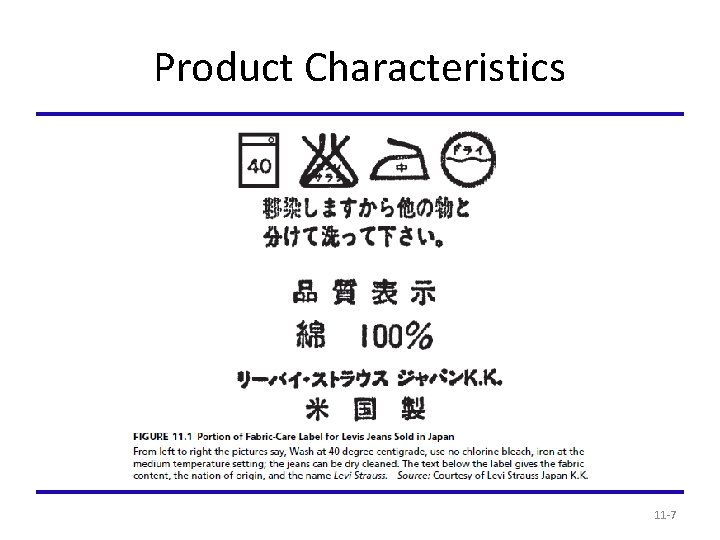
Product Characteristics 11 -7
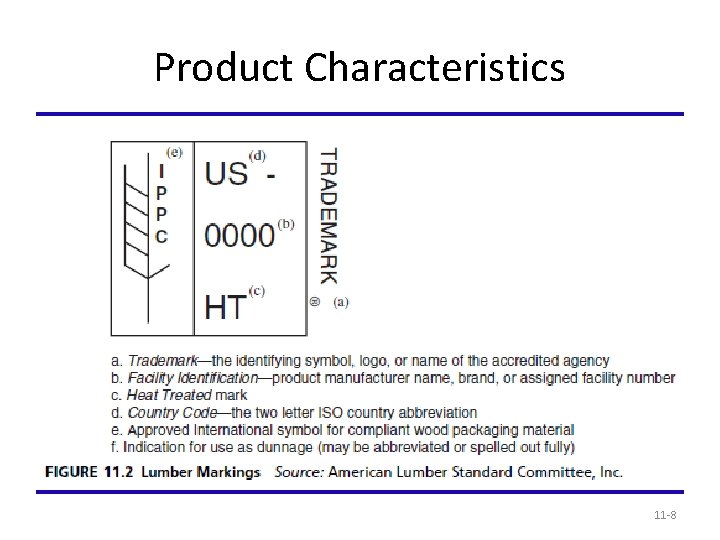
Product Characteristics 11 -8
Packaging Fundamentals • Building-blocks concept – Smallest unit is consumer package – Each unit is stocked within the next larger one to protect the product • Packaging – refers to materials used for the containment, protection, handling, delivery, and presentation of goods 1 1 Logistics Dictionary, www. tntfreight. com 11 -9
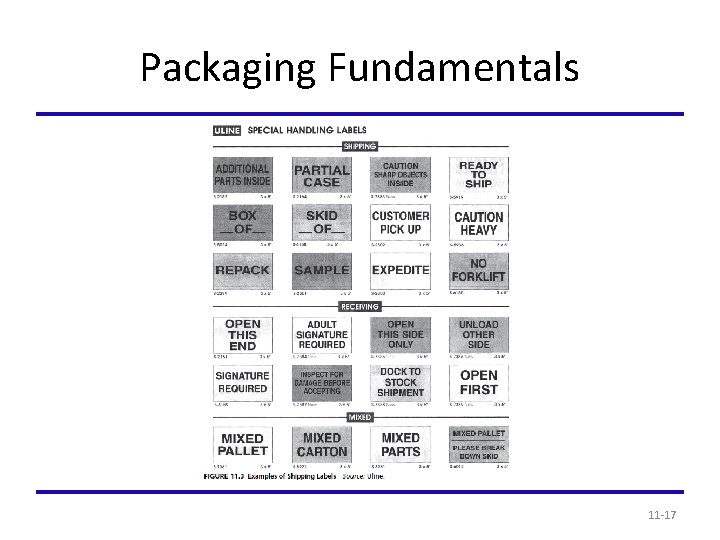
Packaging Fundamentals • Some of the many packaging fundamentals include: – Functional trade-offs – Packaging testing and monitoring – Labeling 11 -10
Packaging Fundamentals • Functional trade-offs – Packaging serves three general functions • To promote • To protect • To identify (label) the relevant product – Packaging design decisions involve a number of departments within an organization -Engineering -Manufacturing -Marketing -Quality Control -Transportation -Warehousing 11 -11

Packaging Fundamentals • Package testing and monitoring – Three important kinds of information needed to properly design protective packaging system • Severity of the distribution environment • Fragility of the product to be protected • Performance characteristics of various cushion materials – Advisable to have packages pretested 11 -12
Packaging Fundamentals • Package testing – Vibrations – Dropping – Horizontal impacts – Compression – Overexposure to extreme temperatures or moisture – Rough handling 11 -13

Packaging Fundamentals • Labeling – Typically occurs at the end of the assembly process – Boxes must be labeled when contents are hidden – Many regulations govern labeling • Weight • Specific contents • Instructions for use – Regulations differ from country to country and from state to state 11 -14
Packaging Fundamentals • Labeling – Retroflective labels – Batch numbers – Weight – Specific contents – Instructions for use – Information to allow passage through customs – Compliance labeling – One- or two-dimensional bar codes – Smart labels or RFID labels 11 -15

Packaging Fundamentals • Labeling - Hazardous Materials – Governmental regulations address labeling of hazardous materials • Requirements involve – Labeling – Packaging and repackaging – Placing warnings on shipping documents – Notifying transportation carriers in advance • Globally Harmonized System of Classification and Labeling of Chemicals (GHS) is a global system to classify and label hazardous materials. 11 -16
Packaging Fundamentals 11 -17
Issues in Packaging • Environmental Protection – Reduce packing materials used – Use packaging materials that are more environmentally friendly with recycled content – Use reusable containers (closed-loop system) – Retain or support services that collect used packaging and recycle it (closed-loop system) 11 -18
Issues in Packaging • Metric System – U. S. , Liberia, and Myanmar (formerly Burma) are the only 3 countries in the world that do not use the metric system of measurement – Increasing pressure on U. S. exporters to market their products overseas in metric units 11 -19
Issues in Packaging • Identifying Packaging Inefficiencies – Building-blocks concept is useful for analyzing packaging inefficiencies. – Packaging inefficiencies can have a number of undesirable logistics consequences including: • • • Increased loss Increase damage Slower materials handling Higher storage costs Higher transportation costs 11 -20
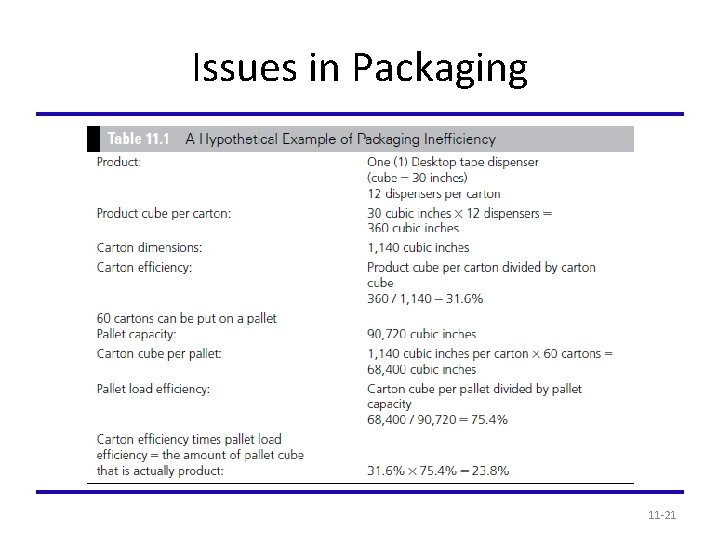
Issues in Packaging 11 -21
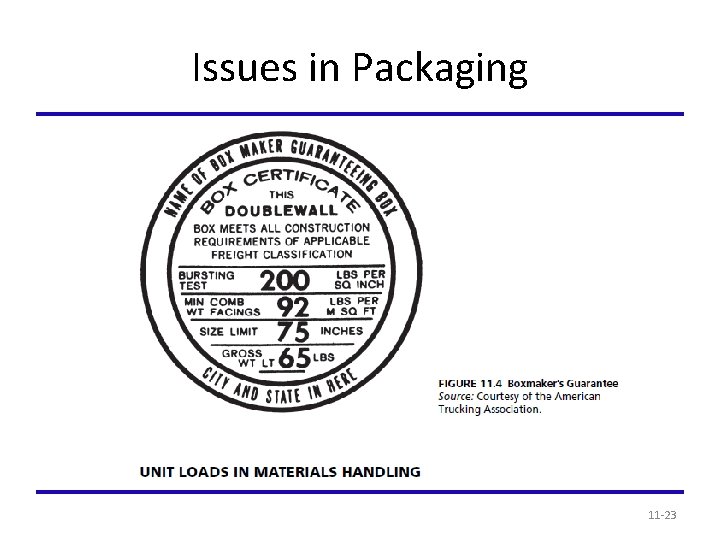
Issues in Packaging • Packaging’s Influence on Transportation Considerations ─ Carrier’s tariffs and classifications influence the type of packaging and packing methods that must be used ─ Carriers established classifications for two main reasons: • Packaging specifications determined by product density lead to the best use of the equipment’s weight and volume capabilities • Carrier specifications for protective packaging reduce likelihood of damage to products thus reducing the loss and damage claims filed against the carrier 11 -22
Issues in Packaging 11 -23
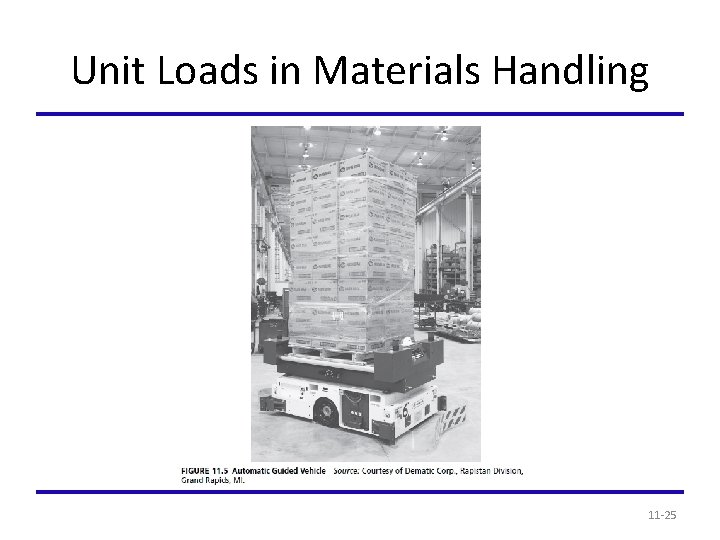
Unit Loads in Materials Handling • A unit load (unitization) refers to consolidation of several units (cartons or cases) into larger units to improve efficiency in handling and to reduce shipping costs. Source: http: //cscmp. org/digital/glossary. asp • Handling efficiency can be facilitated by mechanical devices (pallet jack or forklift) as well as by using a pallet or skid. 11 -24
Unit Loads in Materials Handling 11 -25
Unit Loads in Materials Handling • Advantages – Additional protection – Pilferage is discouraged – More fragile items can be stacked inside the load – Mechanical devices can be substituted for manual labor 11 -26
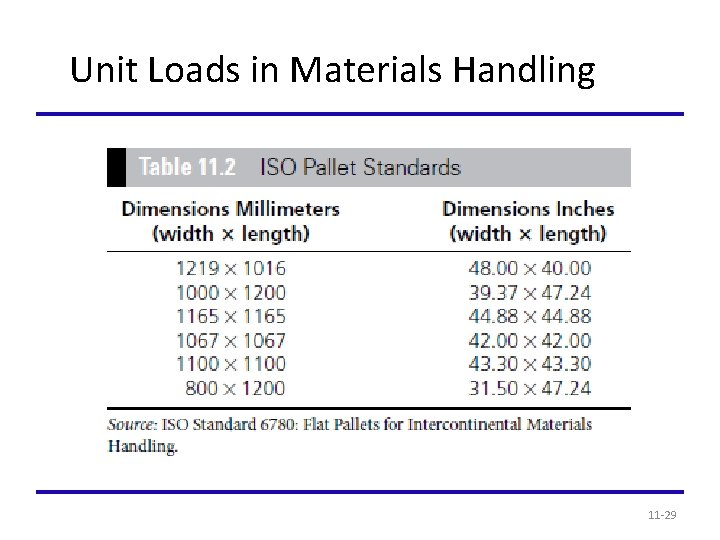
Unit Loads in Materials Handling • Disadvantages – Provides large quantity that sometimes is of limited value to resellers dealing in smaller quantities – Must use mechanical or automated device to move – Drives need for routine equipment maintenance – Lack of standard pallet size 11 -27
Unit Loads in Materials Handling • The Unit Load Platform – Basic unit is a pallet or skid • Can be constructed from wood, wood composites, plastic, paper, and metal • Each pallet material has advantages and disadvantages • Should be less than 50 pounds – Pallet or skid alternatives • Slip sheet • Shrink-wrap 11 -28
Unit Loads in Materials Handling 11 -29
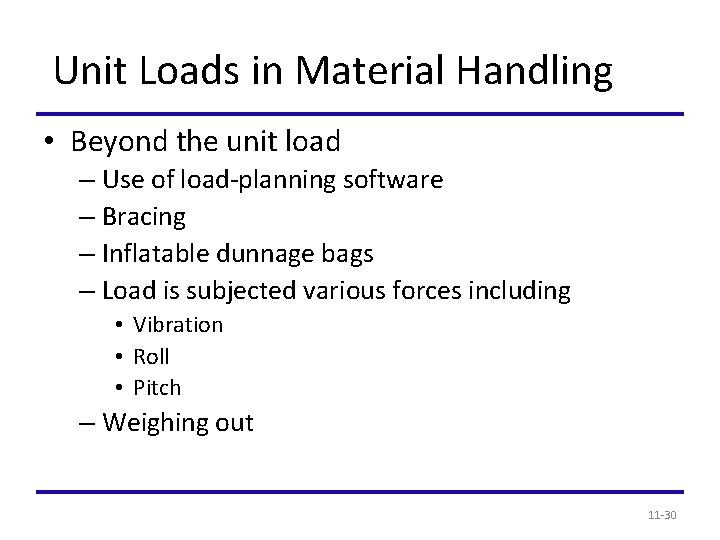
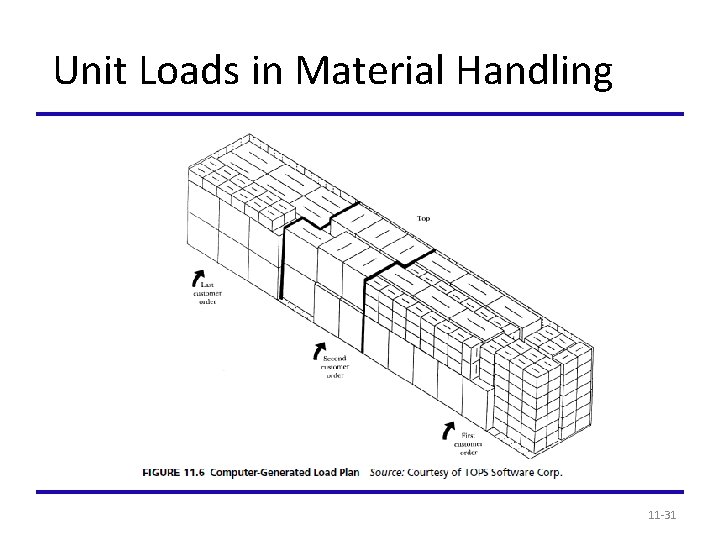
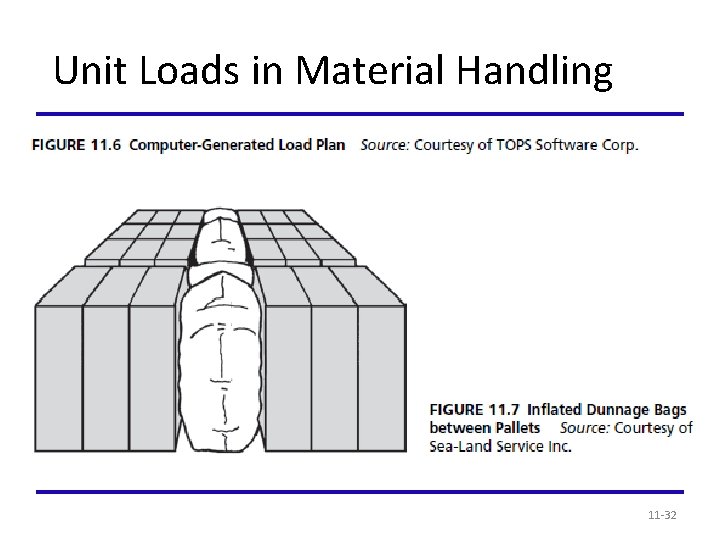
Unit Loads in Material Handling • Beyond the unit load – Use of load-planning software – Bracing – Inflatable dunnage bags – Load is subjected various forces including • Vibration • Roll • Pitch – Weighing out 11 -30
Unit Loads in Material Handling 11 -31
Unit Loads in Material Handling 11 -32
Materials Handling • Materials handling refers to the “short-distance movement that usually takes place within the confines of a building such as a plant or DC and between a build and a transportation service provider. ” Source: John J. Coyle, C. John Langley, Jr. , Brian J. Gibson, Robert A. Novack, and Edward J. Bardi, Supply Chain Management: A Logistics Perspective, 8 th ed. (Mason, OH: South-Western Cengage Learning, 2009), Appendix 11 -A. • How the products are handled depends on whether they are packaged or in bulk • Handling may change the characteristics of the product 11 -33
Materials Handling 10 Material Handling Principles Include: 1. Planning 2. Standardization 3. Work 4. Ergonomic 5. Unit load 6. Space utilization 7. System 8. Automation 9. Environmental 10. Life cycle cost Source: “The Ten Principles of Material Handling, ” www. mhia. org. 11 -34
Materials Handling Two categories of material handling equipment – Storage equipment • Shelves • Racks • Bins – Handling equipment • • Conveyor systems Lift trucks Carts Cranes 11 -35
Materials Handling • The choice of handling equipment can influence the type of storage equipment. • The choice of storage equipment can influence the type of handling equipment. 11 -36
Materials Handling • Material handling equipment can also be categorized as: – Labor intensive – Mechanized – Automated • Sufficient volume is needed to justify high cost of automated equipment 11 -37
Materials Handling Equipment • An organization’s order picking and assembly system can also influence the type of handling equipment. – Picker-to-part systems – Part-to-picker systems 11 -38
- Slides: 38