
Chapter 11 Organizational Structure and Controls Power Point
- Slides: 56
Chapter 11 Organizational Structure and Controls Power. Point slides by: R. Dennis Middlemist Colorado State University Copyright © 2004 South-Western All rights reserved.
Knowledge Objectives • Studying this chapter should provide you with the strategic management knowledge needed to: Ø Define organizational structure and controls and discuss the difference between strategic and financial controls. Ø Describe the relationship between strategy and structure. Ø Discuss the functional structures used to implement business-level strategies. Ø Explain the use of three versions of the multidivisional (Mform) structure to implement different diversification strategies. Ø Discuss the organizational structures used to implement three international strategies. Ø Define strategic networks and strategic center firms. Copyright © 2004 South-Western. All rights reserved. 2
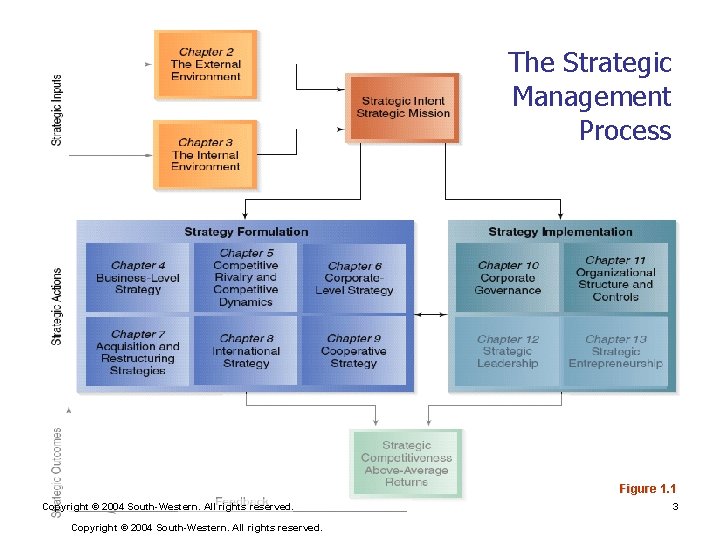
The Strategic Management Process Figure 1. 1 Copyright © 2004 South-Western. All rights reserved. 3
Organizational Structure • Organizational structure specifies: Ø The firm’s formal reporting relationships, procedures, controls, and authority and decisionmaking processes Ø The work to be done and how to do it, given the firm’s strategy or strategies • It is critical to match organizational structure to the firm’s strategy Copyright © 2004 South-Western. All rights reserved. 4
Organizational Structure • Effective structures provide: Ø Stability Ø Flexibility • Structural stability provides: Ø The capacity required to consistently and predictably manage daily work routines • Structural flexibility provides for: Ø The opportunity to explore competitive possibilities Ø The allocation of resources to activities that shape needed competitive advantages Copyright © 2004 South-Western. All rights reserved. 5
Organizational Controls • Purposes of Organizational Controls: Ø Guide the use of strategy Ø Indicate how to compare actual results with expected results Ø Suggest corrective actions to take when the difference between actual and expected results is unacceptable • Two types of organizational controls Ø Strategic controls Ø Financial controls Copyright © 2004 South-Western. All rights reserved. 6
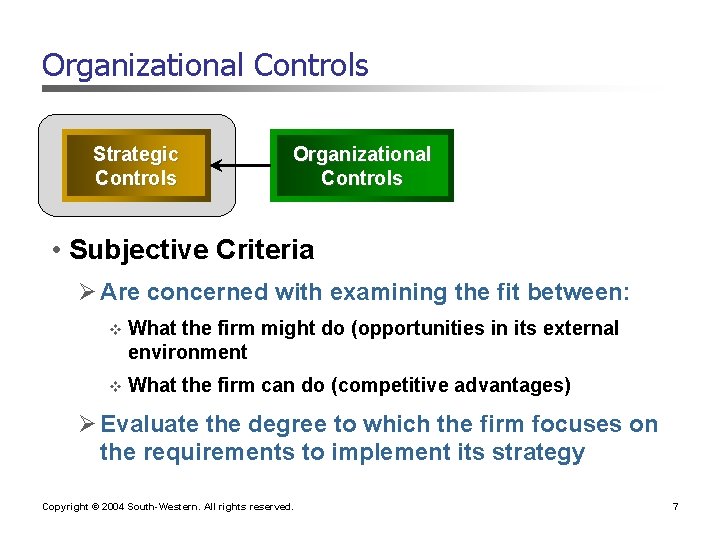
Organizational Controls Strategic Controls Organizational Controls • Subjective Criteria Ø Are concerned with examining the fit between: v What the firm might do (opportunities in its external environment v What the firm can do (competitive advantages) Ø Evaluate the degree to which the firm focuses on the requirements to implement its strategy Copyright © 2004 South-Western. All rights reserved. 7
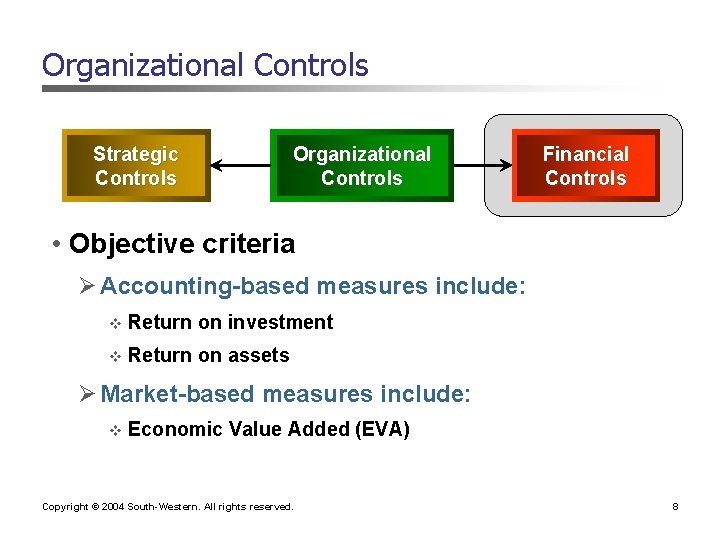
Organizational Controls Strategic Controls Organizational Controls Financial Controls • Objective criteria Ø Accounting-based measures include: v Return on investment v Return on assets Ø Market-based measures include: v Economic Value Added (EVA) Copyright © 2004 South-Western. All rights reserved. 8
Matching Control to Strategy • Relative use of controls varies by type of strategy Ø Large diversified firms using a cost leadership strategy emphasize financial controls Ø Companies and business units using a differentiation strategy emphasize strategic controls Copyright © 2004 South-Western. All rights reserved. 9
Relationships between Strategy and Structure • Strategy and structure have a reciprocal relationship: Ø Structure flows from or follows the selection of the firm’s strategy but … Ø Once in place, structure can influence current strategic actions as well as choices about future strategies Copyright © 2004 South-Western. All rights reserved. 10
Evolutionary Patterns of Strategy and Organizational Structure • Firms grow in predictable patterns: Ø First by volume Ø Then by geography Ø Then integration (vertical, horizontal) Ø And finally through product/business diversification • A firm’s growth patterns determine its structural form Copyright © 2004 South-Western. All rights reserved. 11
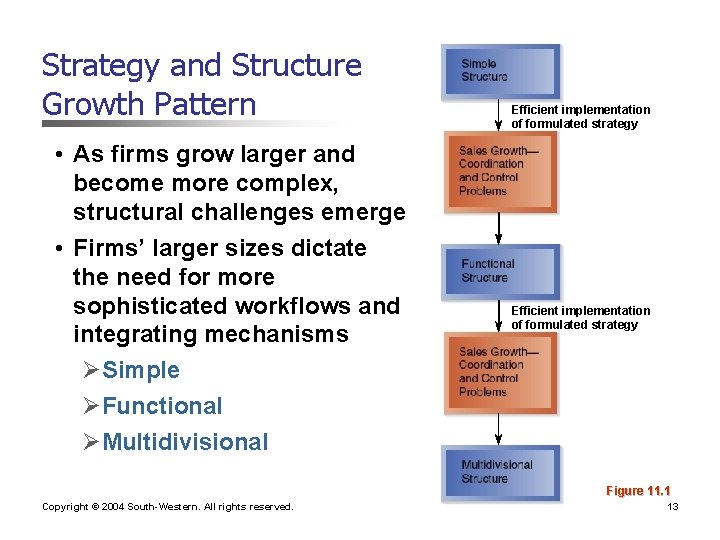
Evolutionary Patterns of Strategy and Organizational Structure • All organizations require some form of organizational structure to implement and manage their strategies • Firms frequently alter their structure as they grow in size and complexity • Three basic structure types: Ø Simple structure Ø Functional structure Ø Multidivisional structure (M-form) Copyright © 2004 South-Western. All rights reserved. 12
Strategy and Structure Growth Pattern • As firms grow larger and become more complex, structural challenges emerge • Firms’ larger sizes dictate the need for more sophisticated workflows and integrating mechanisms ØSimple ØFunctional ØMultidivisional Efficient implementation of formulated strategy Figure 11. 1 Copyright © 2004 South-Western. All rights reserved. 13
Strategy and Structure: Simple Structure • Owner-manager Ø Makes all major decisions directly Ø Monitors all activities • Staff Ø Serves as an extension of the manager’s supervisor authority • Matched with focus strategies and businesslevel strategies Ø Commonly compete by offering a single product line in a single geographic market Copyright © 2004 South-Western. All rights reserved. 14
Simple Structure (cont’d) • Growth creates: Ø Complexity Ø Managerial and structural challenges • Owner-managers Ø Commonly lack organizational skills and experience Ø Become ineffective in managing the specialized and complex tasks involved with multiple organizational functions Copyright © 2004 South-Western. All rights reserved. 15
Strategy and Structure: Functional Structure • Chief Executive Officer (CEO) Ø Limited corporate staff • Functional line managers in dominant organizational areas of: Ø Manufacturing Marketing Engineering Ø Accounting R&D Human resources • Supports use of business-level strategies and some corporate-level strategies Ø Single or dominant business with low levels of diversification Copyright © 2004 South-Western. All rights reserved. 16
Functional Structure (cont’d) • Differences in orientation among organizational functions can: Ø Impede communication and coordination Ø Increase the need for CEO to integrate decisions and actions of business functions Ø Facilitate career paths and professional development in specialized functional areas Ø Cause functional-area managers to focus on local versus overall company strategic issues Copyright © 2004 South-Western. All rights reserved. 17
Strategy and Structure: Multidivisional Structure • Strategic Control Ø Operating divisions function as separate businesses or profit centers • Top corporate officer delegates responsibilities to division managers Ø For day-to-day operations Ø For business-unit strategy • Appropriate as firm grows through diversification Copyright © 2004 South-Western. All rights reserved. 18
Multidivisional Structure (cont’d) • Three Major Benefits Ø Corporate officers are able to more accurately monitor the performance of each business, which simplifies the problem of control Ø Facilitates comparisons between divisions, which improves the resource allocation process Ø Stimulates managers of poorly performing divisions to look for ways of improving performance Copyright © 2004 South-Western. All rights reserved. 19
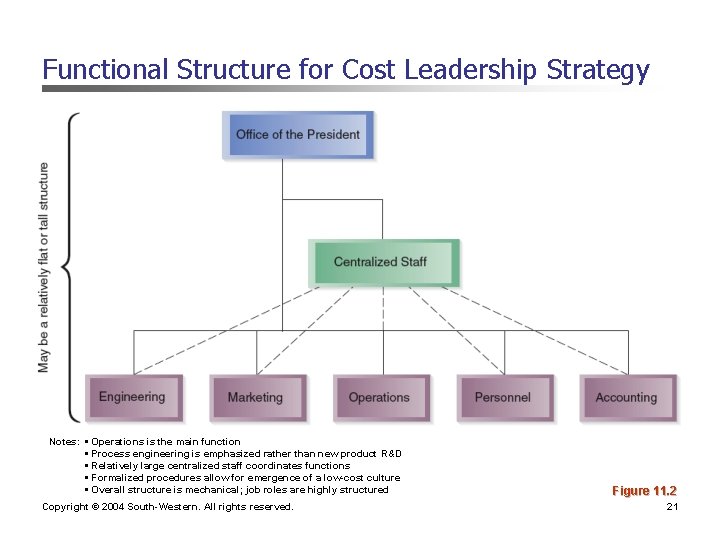
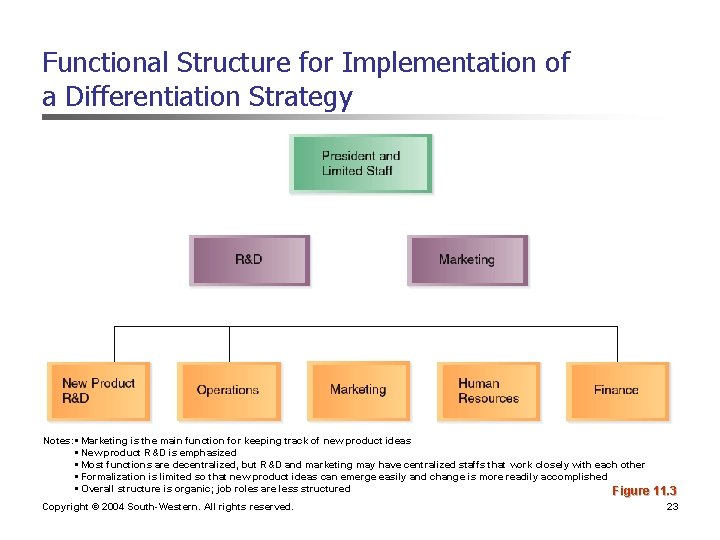
Matching Strategy and Functional Structure • Different forms of the functional organizational structure are matched to: Ø Cost leadership strategy Ø Differentiation strategy Ø Integrated cost leadership/differentiation strategy • Differences in these forms are seen in three important structural characteristics: Ø Specialization (number and types of jobs) Ø Centralization (decision-making authority) Ø Formalization (formal rules and work procedures) Copyright © 2004 South-Western. All rights reserved. 20
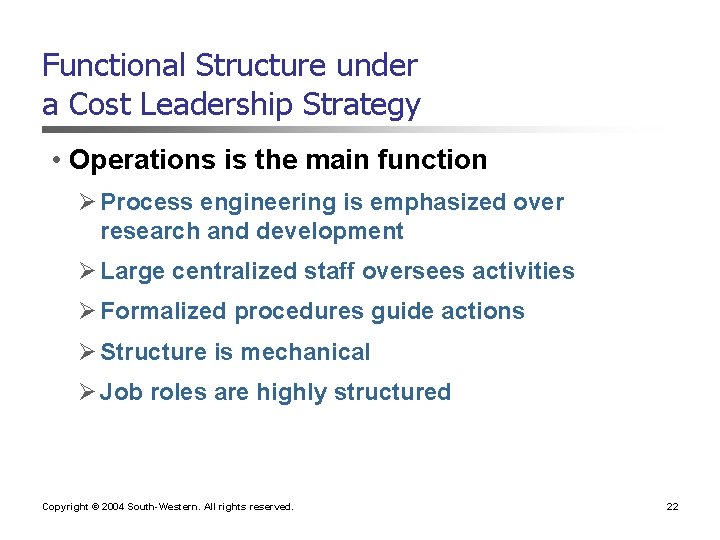
Functional Structure for Cost Leadership Strategy Notes: • Operations is the main function • Process engineering is emphasized rather than new product R&D • Relatively large centralized staff coordinates functions • Formalized procedures allow for emergence of a low-cost culture • Overall structure is mechanical; job roles are highly structured Copyright © 2004 South-Western. All rights reserved. Figure 11. 2 21
Functional Structure under a Cost Leadership Strategy • Operations is the main function Ø Process engineering is emphasized over research and development Ø Large centralized staff oversees activities Ø Formalized procedures guide actions Ø Structure is mechanical Ø Job roles are highly structured Copyright © 2004 South-Western. All rights reserved. 22
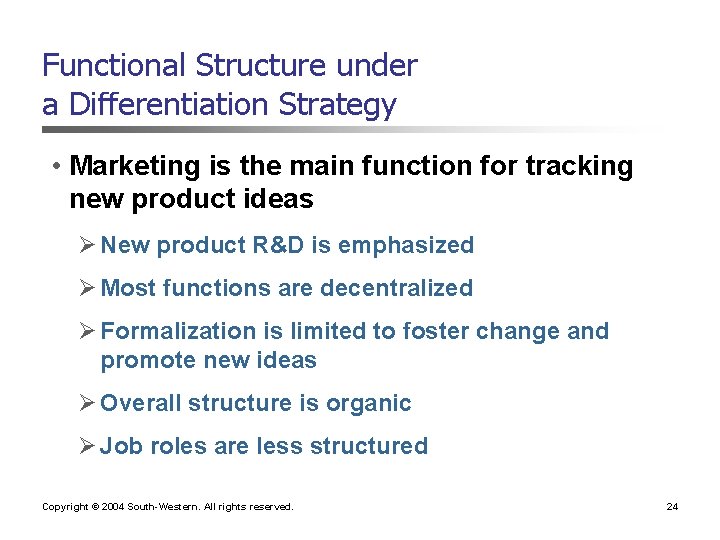
Functional Structure for Implementation of a Differentiation Strategy Notes: • Marketing is the main function for keeping track of new product ideas • New product R&D is emphasized • Most functions are decentralized, but R&D and marketing may have centralized staffs that work closely with each other • Formalization is limited so that new product ideas can emerge easily and change is more readily accomplished • Overall structure is organic; job roles are less structured Figure 11. 3 Copyright © 2004 South-Western. All rights reserved. 23
Functional Structure under a Differentiation Strategy • Marketing is the main function for tracking new product ideas Ø New product R&D is emphasized Ø Most functions are decentralized Ø Formalization is limited to foster change and promote new ideas Ø Overall structure is organic Ø Job roles are less structured Copyright © 2004 South-Western. All rights reserved. 24
Implementing an Integrated Cost Leadership/ Differentiation Strategy • Selling products that create customer value due to: Ø Their relatively low product cost through an emphasis on manufacturing and process engineering, with infrequent product changes Ø Reasonable sources of differentiation based on new-product R&D are emphasized while manufacturing and process engineering are not • Used frequently in global economy Copyright © 2004 South-Western. All rights reserved. 25
Implementing an Integrated Cost Leadership/Differentiation Strategy (cont’d) • The integrated form of the functional structure must have: Ø Decision-making patterns that are partially centralized and partially decentralized Ø Semi-specialized jobs Ø Rules and procedures that allow both formal and informal job behaviors Copyright © 2004 South-Western. All rights reserved. 26
Corporate-Level Strategies and the Multidivisional Structure • A firm’s continuing success that leads to: Ø Product diversification, or Ø Market diversification, or Ø Both product and market diversification • Increasing diversification creates control problems that the functional structure can’t handle Ø Information processing, coordination Ø Control Copyright © 2004 South-Western. All rights reserved. 27
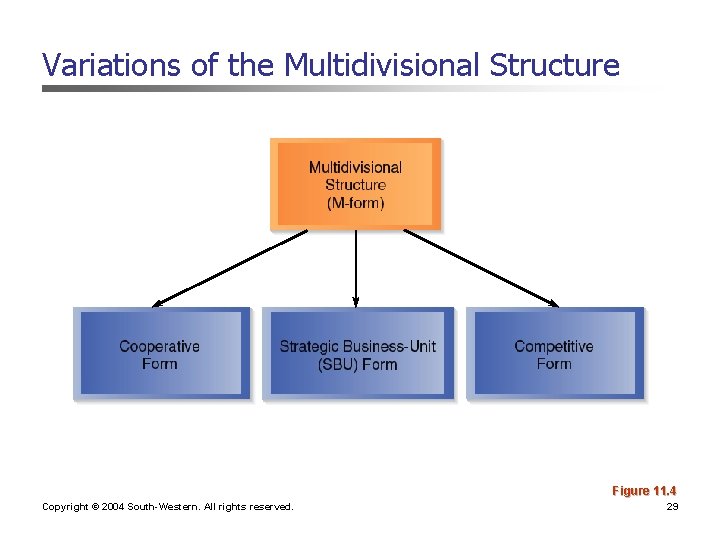
Corporate-Level Strategies and the Multidivisional Structure (cont’d) • Diversification strategy requires firm to change from functional structure to a multidivisional structure • Different levels of diversification create the need for implementation of a unique form of the multidivisional structure Copyright © 2004 South-Western. All rights reserved. 28
Variations of the Multidivisional Structure Figure 11. 4 Copyright © 2004 South-Western. All rights reserved. 29
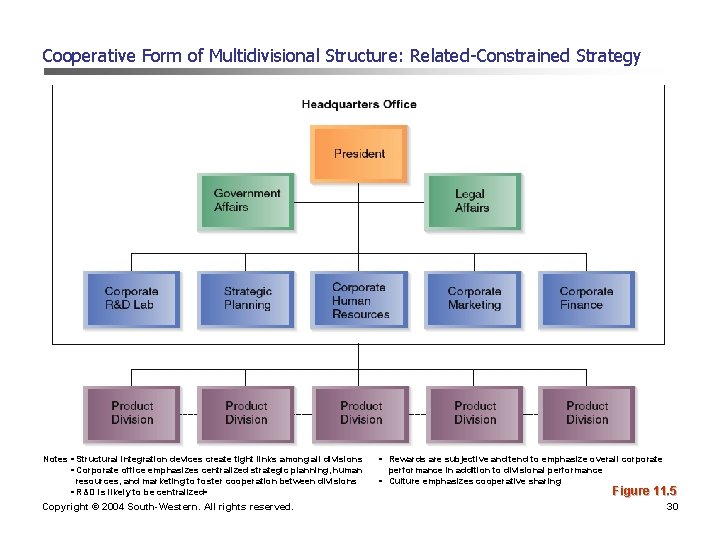
Cooperative Form of Multidivisional Structure: Related-Constrained Strategy Notes • Structural integration devices create tight links among all divisions • Corporate office emphasizes centralized strategic planning, human resources, and marketing to foster cooperation between divisions • R&D is likely to be centralized • Copyright © 2004 South-Western. All rights reserved. • Rewards are subjective and tend to emphasize overall corporate performance in addition to divisional performance • Culture emphasizes cooperative sharing Figure 11. 5 30
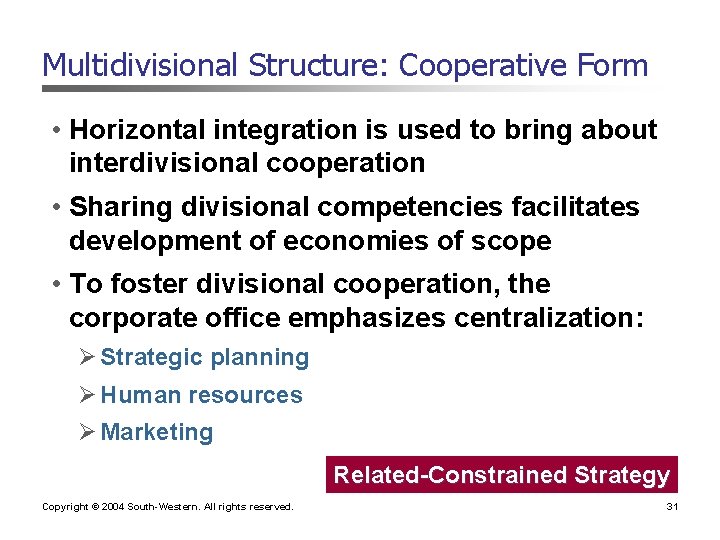
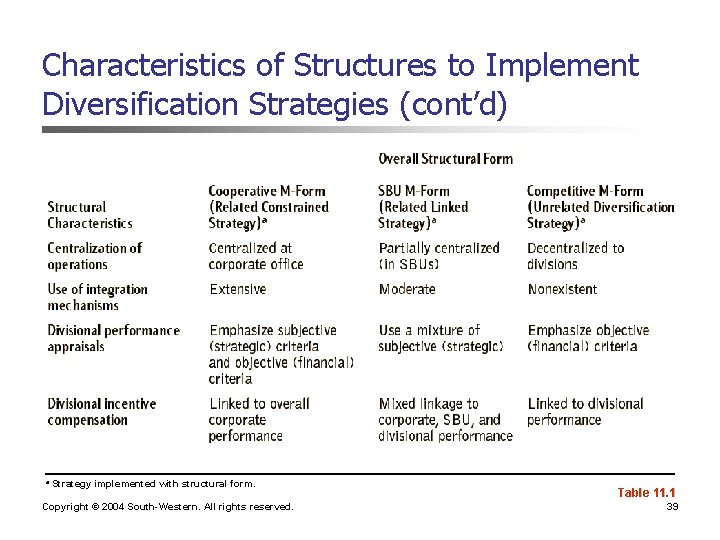
Multidivisional Structure: Cooperative Form • Horizontal integration is used to bring about interdivisional cooperation • Sharing divisional competencies facilitates development of economies of scope • To foster divisional cooperation, the corporate office emphasizes centralization: Ø Strategic planning Ø Human resources Ø Marketing Related-Constrained Strategy Copyright © 2004 South-Western. All rights reserved. 31
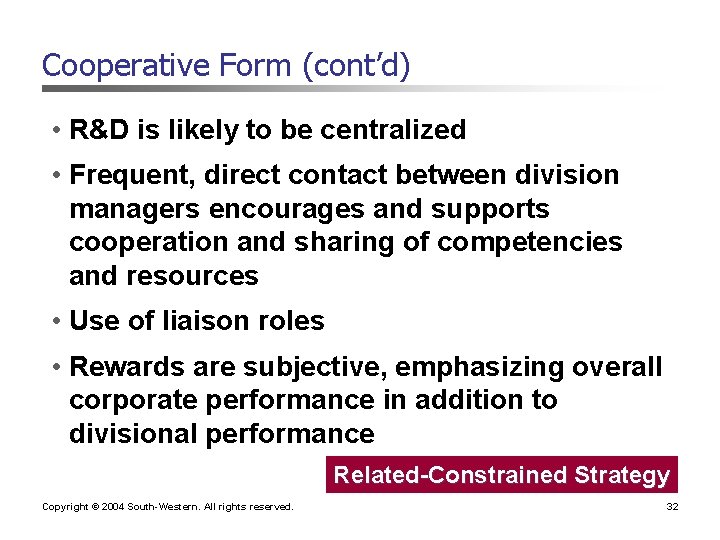
Cooperative Form (cont’d) • R&D is likely to be centralized • Frequent, direct contact between division managers encourages and supports cooperation and sharing of competencies and resources • Use of liaison roles • Rewards are subjective, emphasizing overall corporate performance in addition to divisional performance Related-Constrained Strategy Copyright © 2004 South-Western. All rights reserved. 32
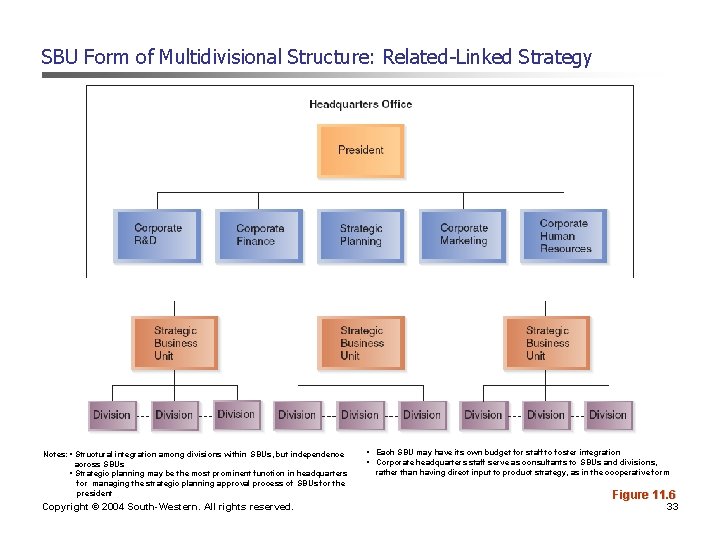
SBU Form of Multidivisional Structure: Related-Linked Strategy Notes: • Structural integration among divisions within SBUs, but independence across SBUs • Strategic planning may be the most prominent function in headquarters for managing the strategic planning approval process of SBUs for the president Copyright © 2004 South-Western. All rights reserved. • Each SBU may have its own budget for staff to foster integration • Corporate headquarters staff serve as consultants to SBUs and divisions, rather than having direct input to product strategy, as in the cooperative form Figure 11. 6 33
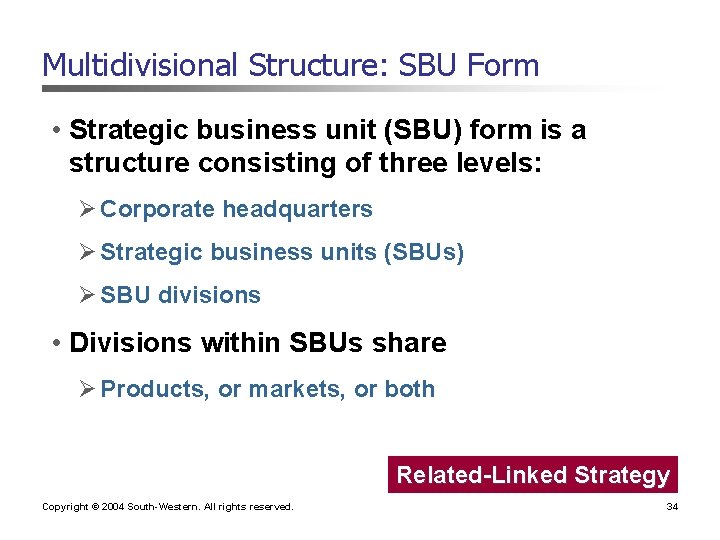
Multidivisional Structure: SBU Form • Strategic business unit (SBU) form is a structure consisting of three levels: Ø Corporate headquarters Ø Strategic business units (SBUs) Ø SBU divisions • Divisions within SBUs share Ø Products, or markets, or both Related-Linked Strategy Copyright © 2004 South-Western. All rights reserved. 34
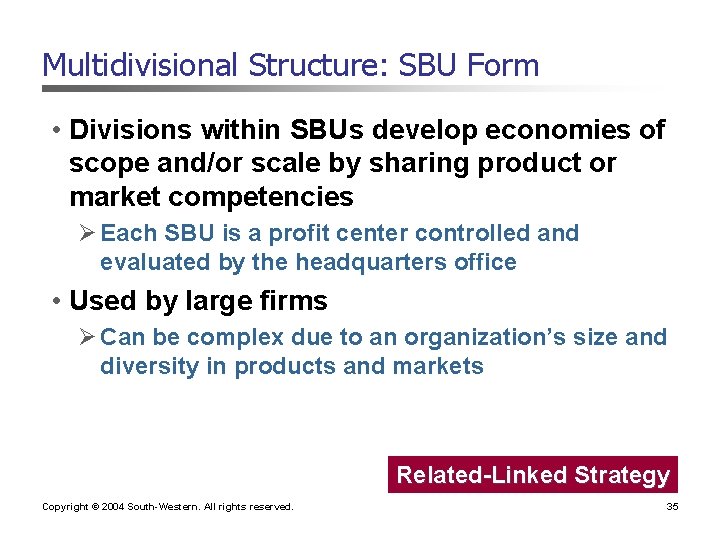
Multidivisional Structure: SBU Form • Divisions within SBUs develop economies of scope and/or scale by sharing product or market competencies Ø Each SBU is a profit center controlled and evaluated by the headquarters office • Used by large firms Ø Can be complex due to an organization’s size and diversity in products and markets Related-Linked Strategy Copyright © 2004 South-Western. All rights reserved. 35
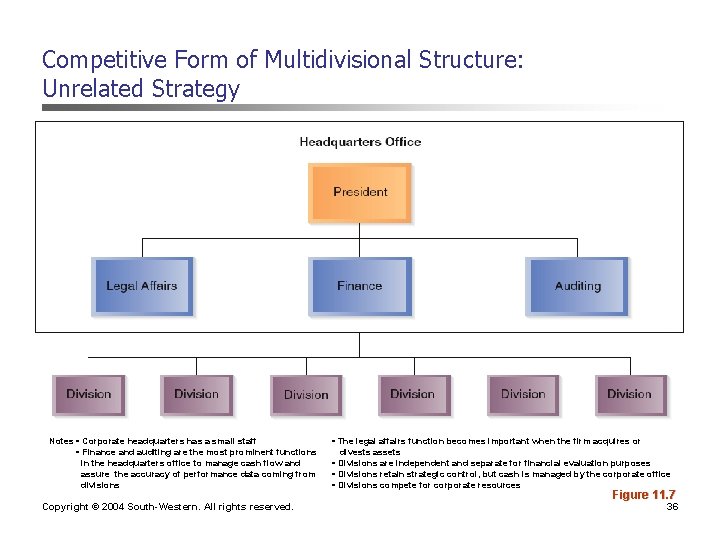
Competitive Form of Multidivisional Structure: Unrelated Strategy Notes • Corporate headquarters has a small staff • Finance and auditing are the most prominent functions in the headquarters office to manage cash flow and assure the accuracy of performance data coming from divisions Copyright © 2004 South-Western. All rights reserved. • The legal affairs function becomes important when the firm acquires or divests assets • Divisions are independent and separate for financial evaluation purposes • Divisions retain strategic control, but cash is managed by the corporate office • Divisions compete for corporate resources Figure 11. 7 36
Multidivisional Structure: Competitive Form • A structure in which there is complete independence among the firm’s divisions Ø Divisions do not share common corporate strengths Ø Because strengths aren’t shared, integrating devices aren’t developed Ø Organizational arrangements emphasize divisional competition rather than cooperation Unrelated Strategy Copyright © 2004 South-Western. All rights reserved. 37
Competitive Form (cont’d) • Three benefits from the internal competition Ø Flexibility—corporate headquarters can have divisions working on different technologies to identify those with greatest future potential Ø Challenges the status quo and inertia Ø Motivates effort • Creates specific profit performance expectations for each division to promote internal competition for resources Unrelated Strategy Copyright © 2004 South-Western. All rights reserved. 38
Characteristics of Structures to Implement Diversification Strategies (cont’d) a Strategy implemented with structural form. Copyright © 2004 South-Western. All rights reserved. Table 11. 1 39
International Strategies and Worldwide Structures • Allow the firm to search for new: Ø Ø Markets Resources Core competencies Technologies Copyright © 2004 South-Western. All rights reserved. 40
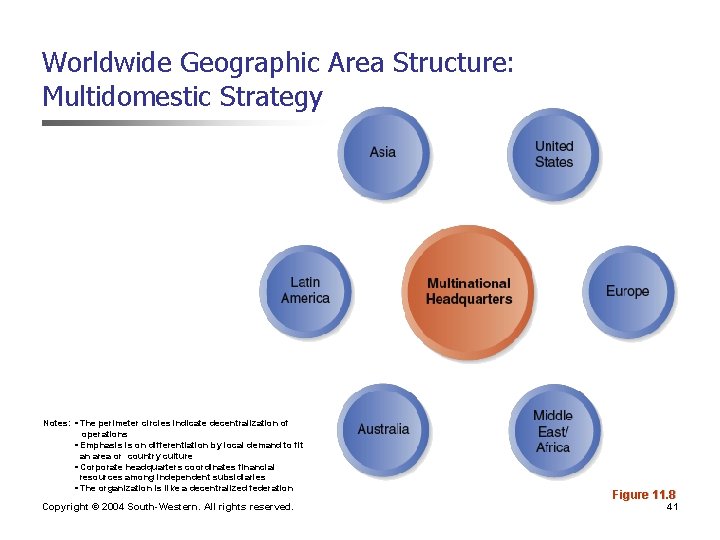
Worldwide Geographic Area Structure: Multidomestic Strategy Notes: • The perimeter circles indicate decentralization of operations • Emphasis is on differentiation by local demand to fit an area or country culture • Corporate headquarters coordinates financial resources among independent subsidiaries • The organization is like a decentralized federation Copyright © 2004 South-Western. All rights reserved. Figure 11. 8 41
Worldwide Geographic Area Structure: Implementing a Multidomestic Strategy • Multidomestic strategy decentralizes strategic and operating decisions to: Ø Business units in each country Ø Product characteristics tailored to local preferences • Firms counter global competitive forces by: Ø Establishing protected market positions, or Ø Competing in industry segments most affected by differences among local countries Copyright © 2004 South-Western. All rights reserved. 42
Worldwide Geographic Area Structure • Worldwide geographic area structure Ø Emphasizes national interests Ø Facilitates the firm’s efforts to satisfy local or cultural differences • Multidomestic strategy Ø Requires little coordination between different county markets: integrating mechanisms aren’t needed Ø Key disadvantage is inability to create global efficiencies Copyright © 2004 South-Western. All rights reserved. 43
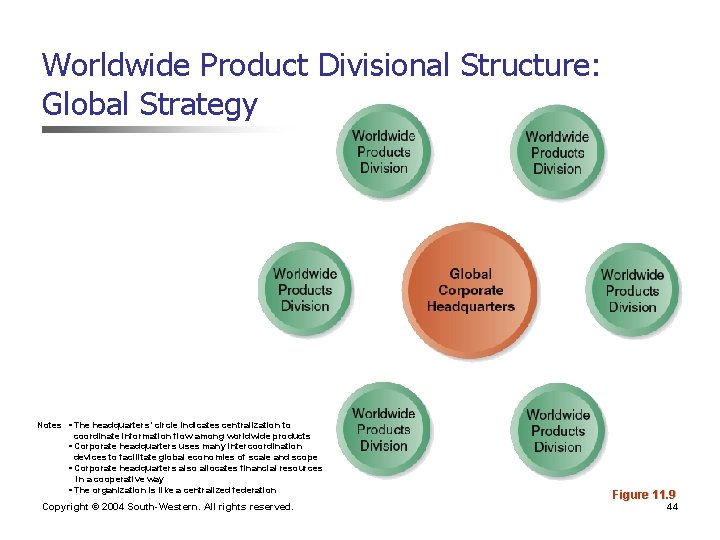
Worldwide Product Divisional Structure: Global Strategy Notes • The headquarters’ circle indicates centralization to coordinate information flow among worldwide products • Corporate headquarters uses many intercoordination devices to facilitate global economies of scale and scope • Corporate headquarters also allocates financial resources in a cooperative way • The organization is like a centralized federation Copyright © 2004 South-Western. All rights reserved. Figure 11. 9 44
Worldwide Product Divisional Structure: Implementing a Global Strategy • Global strategy Ø Allows firm to offer standardized products across country market • Effects on Firm Ø Success depends on firm’s ability to develop and take advantage of economies of scope and scale on global level Ø Firm tends to outsource some primary or support activities to the world’s best providers Copyright © 2004 South-Western. All rights reserved. 45
Worldwide Product Divisional Structure • Centralizes decision-making authority in the worldwide division headquarters Ø Headquarters coordinates and integrates decisions and actions among divisional business units • Integrating mechanisms are important: Ø Direct contact between managers Ø Liaison roles between departments Ø Temporary task forces as well as permanent teams Copyright © 2004 South-Western. All rights reserved. 46
Combination Structure: A Transnational Strategy • Transnational Strategy Ø Combines multidomestic strategy’s local responsiveness with global strategy’s efficiency • Combination structure draws characteristics and mechanisms from both: Ø Worldwide geographic area structure Ø Worldwide product divisional structure • Appropriate integrating mechanisms for the combination structure are less obvious Copyright © 2004 South-Western. All rights reserved. 47
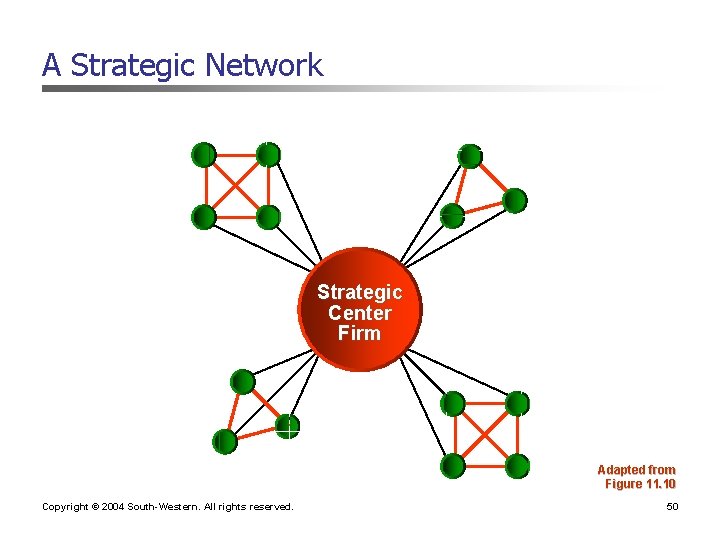
Cooperative Strategies and Network Structures • Network strategy exists when: Ø Partners form several alliances in order to improve performance of the alliance network itself through cooperative endeavors • Strategic Network Ø A group of firms formed to create value by participating in multiple cooperative arrangements such as alliances and joint ventures Copyright © 2004 South-Western. All rights reserved. 48
Cooperative Strategies and Network Structures (cont’d) • Strategic networks are used to implement: Ø Business-level strategies Ø Corporate-level strategies Ø International cooperative strategies • Strategic center firm Ø The firm around which the network’s cooperative relationships revolve Copyright © 2004 South-Western. All rights reserved. 49
A Strategic Network Strategic Center Firm Adapted from Figure 11. 10 Copyright © 2004 South-Western. All rights reserved. 50
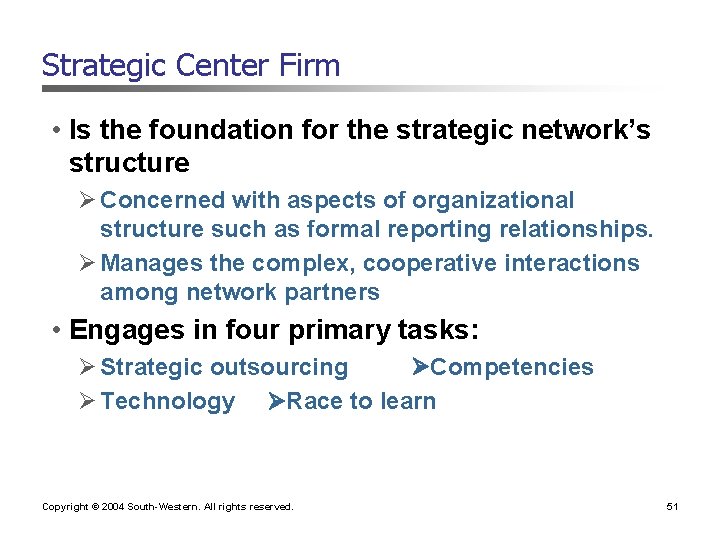
Strategic Center Firm • Is the foundation for the strategic network’s structure Ø Concerned with aspects of organizational structure such as formal reporting relationships. Ø Manages the complex, cooperative interactions among network partners • Engages in four primary tasks: Ø Strategic outsourcing Competencies Ø Technology Race to learn Copyright © 2004 South-Western. All rights reserved. 51
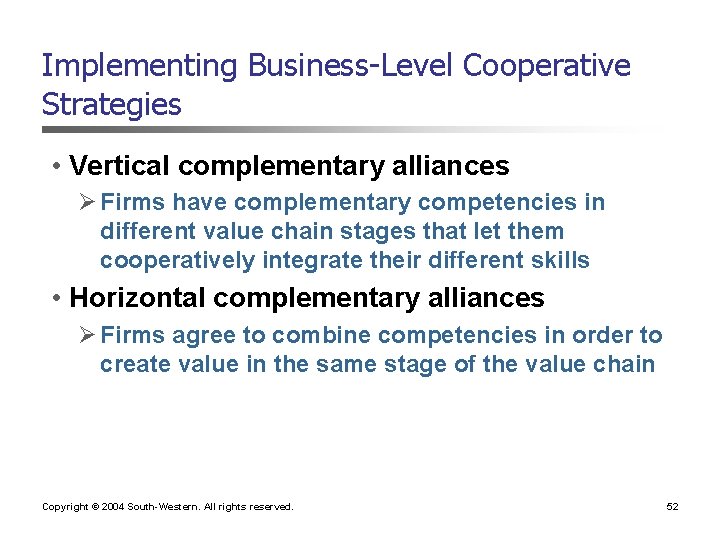
Implementing Business-Level Cooperative Strategies • Vertical complementary alliances Ø Firms have complementary competencies in different value chain stages that let them cooperatively integrate their different skills • Horizontal complementary alliances Ø Firms agree to combine competencies in order to create value in the same stage of the value chain Copyright © 2004 South-Western. All rights reserved. 52
Implementing Business-Level Cooperative Strategies (cont’d) • The strategic center firm is obvious in vertical complementary strategic alliances, but not always in horizontal complementary strategic alliances Copyright © 2004 South-Western. All rights reserved. 53
Implementing Business-Level Cooperative Strategies: International Franchising • Franchising Ø A common form of cooperative strategy used to facilitate product and market diversification Ø Allows the firm to use its competencies to extend or diversify its product or market reach without completing a merger or acquisition Copyright © 2004 South-Western. All rights reserved. 54
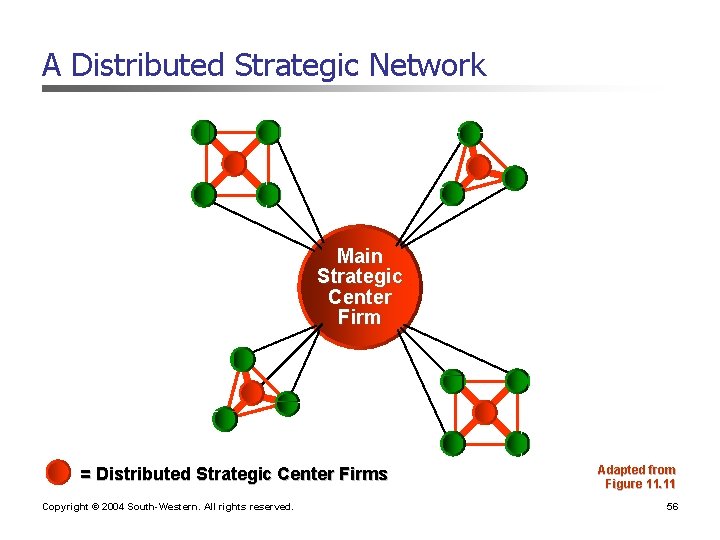
Implementing Corporate-Level Cooperative Strategies: International • Strategic networks Ø Are used to implement international cooperative strategies for competing in several countries v Differences in countries’ regulatory environments increase the challenge of managing international networks • Distributed strategic networks Ø Are the organizational structure used to manage international cooperative strategies v Regional strategic center firms Copyright © 2004 South-Western. All rights reserved. 55
A Distributed Strategic Network Main Strategic Center Firm = Distributed Strategic Center Firms Copyright © 2004 South-Western. All rights reserved. Adapted from Figure 11. 11 56