
Chapter 11 Opinion Mining Bing Liu Department of
Chapter 11: Opinion Mining Bing Liu Department of Computer Science University of Illinois at Chicago http: //www. cs. uic. edu/~liub Bing Liu, UIC CS 583
Introduction – facts and opinions n Two main types of textual information on the Web. q n Current search engines search for facts (assume they are true) q n Facts and Opinions Facts can be expressed with topic keywords. Search engines do not search for opinions q Opinions are hard to express with a few keywords n q How do people think of Motorola Cell phones? Current search ranking strategy is not appropriate for opinion retrieval/search. Bing Liu, UIC CS 583 2
Introduction – user generated content n Word-of-mouth on the Web q q q n One can express personal experiences and opinions on almost anything, at review sites, forums, discussion groups, blogs. . . (called the user generated content. ) They contain valuable information Web/global scale n No longer limited to your circle of friends Our interest: to mine opinions expressed in the usergenerated content q q An intellectually very challenging problem. Practically very useful. Bing Liu, UIC CS 583 3
Introduction – Applications n n Businesses and organizations: product and service benchmarking. Market intelligence. q Business spends a huge amount of money to find consumer sentiments and opinions. n Consultants, surveys and focused groups, etc Individuals: interested in other’s opinions when q Purchasing a product or using a service, q Finding opinions on political topics, q Many other decision making tasks. Ads placements: Placing ads in the user-generated content q Place an ad when one praises a product. q Place an ad from a competitor if one criticizes a product. Opinion retrieval/search: providing general search for opinions. Bing Liu, UIC CS 583 4
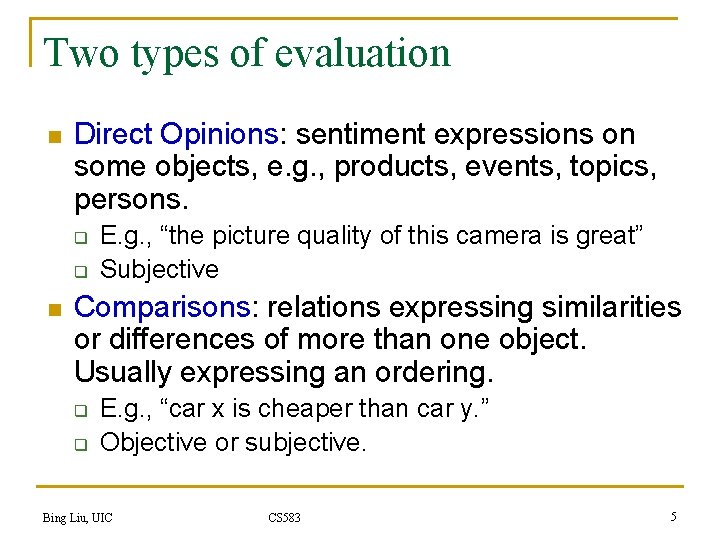
Two types of evaluation n Direct Opinions: sentiment expressions on some objects, e. g. , products, events, topics, persons. q q n E. g. , “the picture quality of this camera is great” Subjective Comparisons: relations expressing similarities or differences of more than one object. Usually expressing an ordering. q q E. g. , “car x is cheaper than car y. ” Objective or subjective. Bing Liu, UIC CS 583 5
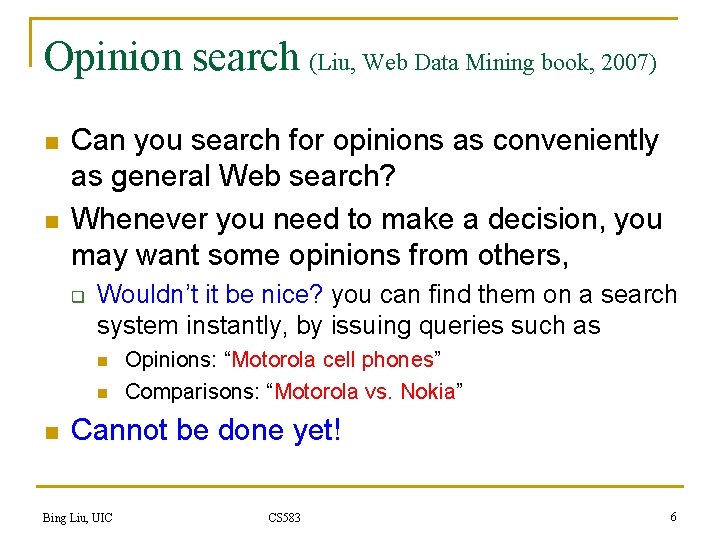
Opinion search (Liu, Web Data Mining book, 2007) n n Can you search for opinions as conveniently as general Web search? Whenever you need to make a decision, you may want some opinions from others, q Wouldn’t it be nice? you can find them on a search system instantly, by issuing queries such as n n n Opinions: “Motorola cell phones” Comparisons: “Motorola vs. Nokia” Cannot be done yet! Bing Liu, UIC CS 583 6
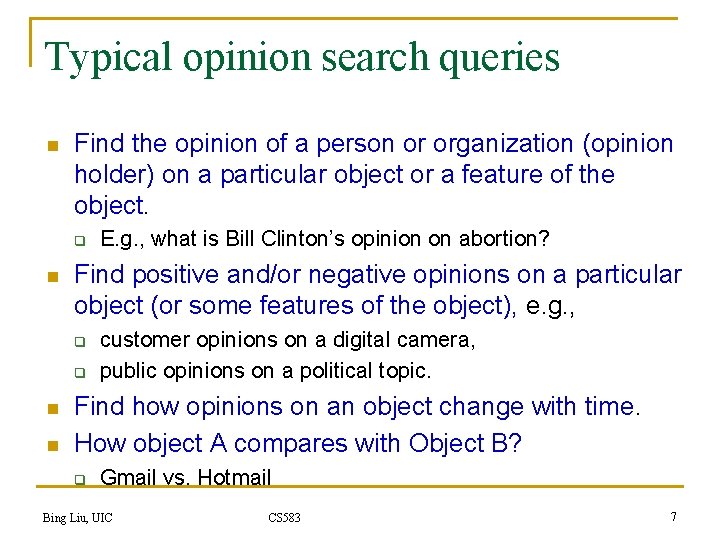
Typical opinion search queries n Find the opinion of a person or organization (opinion holder) on a particular object or a feature of the object. q n Find positive and/or negative opinions on a particular object (or some features of the object), e. g. , q q n n E. g. , what is Bill Clinton’s opinion on abortion? customer opinions on a digital camera, public opinions on a political topic. Find how opinions on an object change with time. How object A compares with Object B? q Gmail vs. Hotmail Bing Liu, UIC CS 583 7
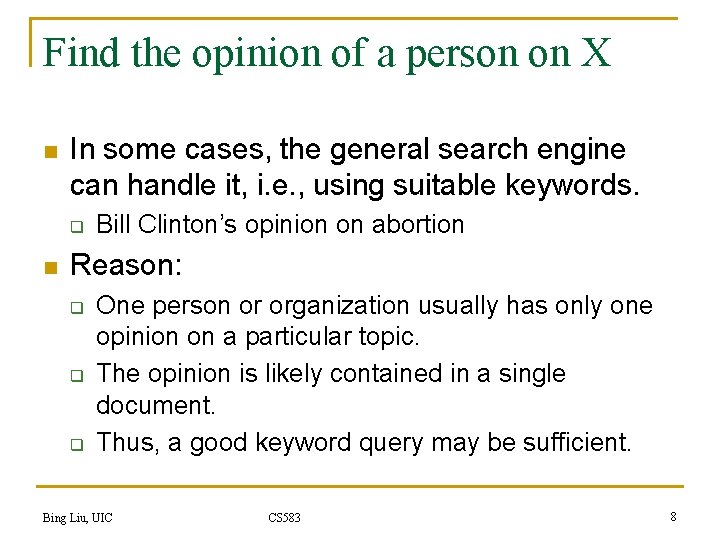
Find the opinion of a person on X n In some cases, the general search engine can handle it, i. e. , using suitable keywords. q n Bill Clinton’s opinion on abortion Reason: q q q One person or organization usually has only one opinion on a particular topic. The opinion is likely contained in a single document. Thus, a good keyword query may be sufficient. Bing Liu, UIC CS 583 8
Find opinions on an object We use product reviews as an example: n n Searching for opinions in product reviews is different from general Web search. q E. g. , search for opinions on “Motorola RAZR V 3” General Web search for a fact: rank pages according to some authority and relevance scores. q q n The user views the first page (if the search is perfect). One fact = Multiple facts Opinion search: rank is desirable, however q q reading only the review ranked at the top is not appropriate because it is only the opinion of one person. One opinion Multiple opinions Bing Liu, UIC CS 583 9
Search opinions (contd) n Ranking: q produce two rankings n n q Or, one ranking but n n Positive opinions and negative opinions Some kind of summary of both, e. g. , # of each The top (say 30) reviews should reflect the natural distribution of all reviews (assume that there is no spam), i. e. , with the right balance of positive and negative reviews. Questions: q q Should the user reads all the top reviews? OR Should the system prepare a summary of the reviews? Bing Liu, UIC CS 583 10
Reviews are similar to surveys n Reviews can be regarded as traditional surveys. q q In traditional survey, returned survey forms are treated as raw data. Analysis is performed to summarize the survey results. n n E. g. , % against or for a particular issue, etc. In opinion search, q q Can a summary be produced? What should the summary be? Bing Liu, UIC CS 583 11
Roadmap n n n Opinion mining – the abstraction Document level sentiment classification Sentence level sentiment analysis Feature-based opinion mining and summarization Comparative sentence and relation extraction Summary Bing Liu, UIC CS 583 12
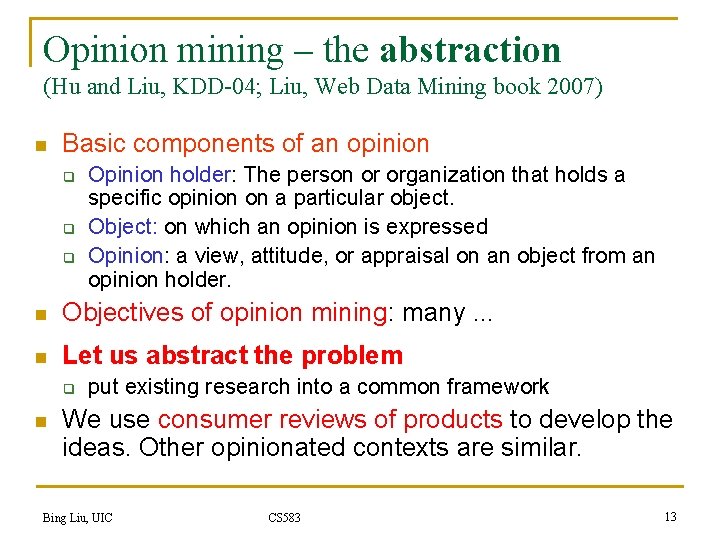
Opinion mining – the abstraction (Hu and Liu, KDD-04; Liu, Web Data Mining book 2007) n Basic components of an opinion q q q Opinion holder: The person or organization that holds a specific opinion on a particular object. Object: on which an opinion is expressed Opinion: a view, attitude, or appraisal on an object from an opinion holder. n Objectives of opinion mining: many. . . n Let us abstract the problem q n put existing research into a common framework We use consumer reviews of products to develop the ideas. Other opinionated contexts are similar. Bing Liu, UIC CS 583 13
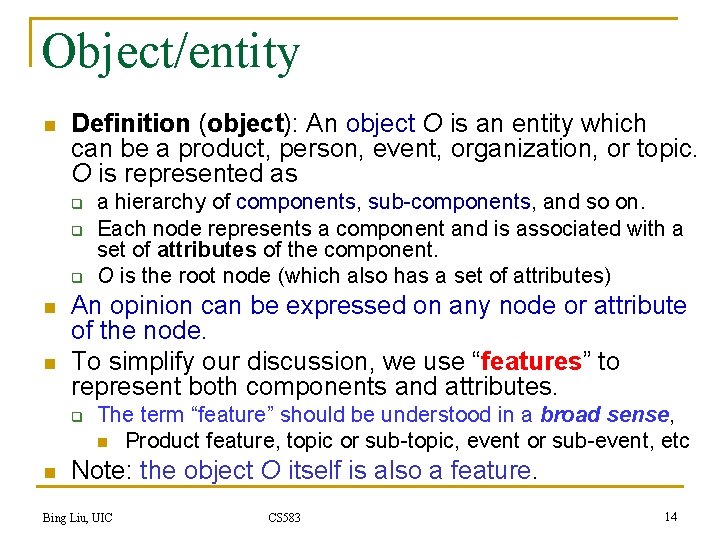
Object/entity n Definition (object): An object O is an entity which can be a product, person, event, organization, or topic. O is represented as q q q n n An opinion can be expressed on any node or attribute of the node. To simplify our discussion, we use “features” to represent both components and attributes. q n a hierarchy of components, sub-components, and so on. Each node represents a component and is associated with a set of attributes of the component. O is the root node (which also has a set of attributes) The term “feature” should be understood in a broad sense, n Product feature, topic or sub-topic, event or sub-event, etc Note: the object O itself is also a feature. Bing Liu, UIC CS 583 14
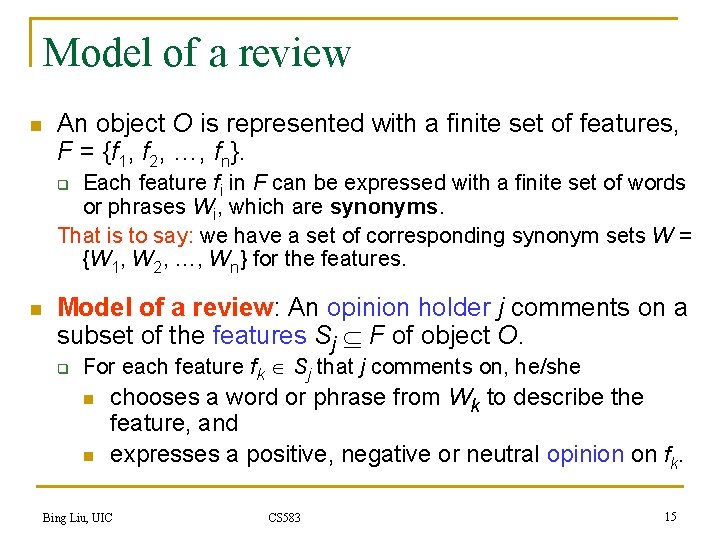
Model of a review n An object O is represented with a finite set of features, F = {f 1, f 2, …, fn}. Each feature fi in F can be expressed with a finite set of words or phrases Wi, which are synonyms. That is to say: we have a set of corresponding synonym sets W = {W 1, W 2, …, Wn} for the features. q n Model of a review: An opinion holder j comments on a subset of the features Sj F of object O. q For each feature fk Sj that j comments on, he/she n n chooses a word or phrase from Wk to describe the feature, and expresses a positive, negative or neutral opinion on fk. Bing Liu, UIC CS 583 15
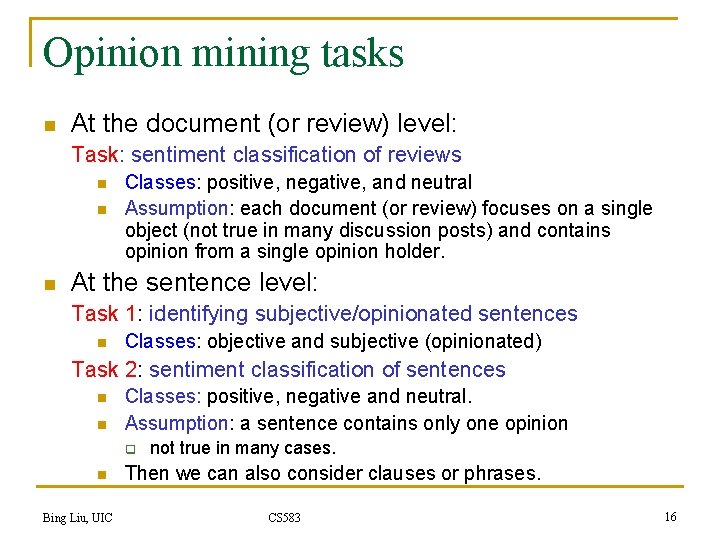
Opinion mining tasks n At the document (or review) level: Task: sentiment classification of reviews n n n Classes: positive, negative, and neutral Assumption: each document (or review) focuses on a single object (not true in many discussion posts) and contains opinion from a single opinion holder. At the sentence level: Task 1: identifying subjective/opinionated sentences n Classes: objective and subjective (opinionated) Task 2: sentiment classification of sentences n n Classes: positive, negative and neutral. Assumption: a sentence contains only one opinion q n Bing Liu, UIC not true in many cases. Then we can also consider clauses or phrases. CS 583 16
Opinion mining tasks (contd) n At the feature level: Task 1: Identify and extract object features that have been commented on by an opinion holder (e. g. , a reviewer). Task 2: Determine whether the opinions on the features are positive, negative or neutral. Task 3: Group feature synonyms. q n Produce a feature-based opinion summary of multiple reviews (more on this later). Opinion holders: identify holders is also useful, e. g. , in news articles, etc, but they are usually known in the user generated content, i. e. , authors of the posts. Bing Liu, UIC CS 583 17
More at the feature level n Problem 1: Both F and W are unknown. q n Problem 2: F is known but W is unknown. q n We need to perform all three tasks: All three tasks are still needed. Task 3 is easier. It becomes the problem of matching the discovered features with the set of given features F. Problem 3: W is known (F is known too). q Only task 2 is needed. F: the set of features W: synonyms of each feature Bing Liu, UIC CS 583 18
Roadmap n n n Bing Liu, UIC Opinion mining – the abstraction Document level sentiment classification Sentence level sentiment analysis Feature-based opinion mining and summarization Comparative sentence and relation extraction Summary CS 583 19
Sentiment classification n Classify documents (e. g. , reviews) based on the overall sentiments expressed by opinion holders (authors), q q n Positive, negative, and (possibly) neutral Since in our model an object O itself is also a feature, then sentiment classification essentially determines the opinion expressed on O in each document (e. g. , review). Similar but different from topic-based text classification. q q In topic-based text classification, topic words are important. In sentiment classification, sentiment words are more important, e. g. , great, excellent, horrible, bad, worst, etc. Bing Liu, UIC CS 583 20
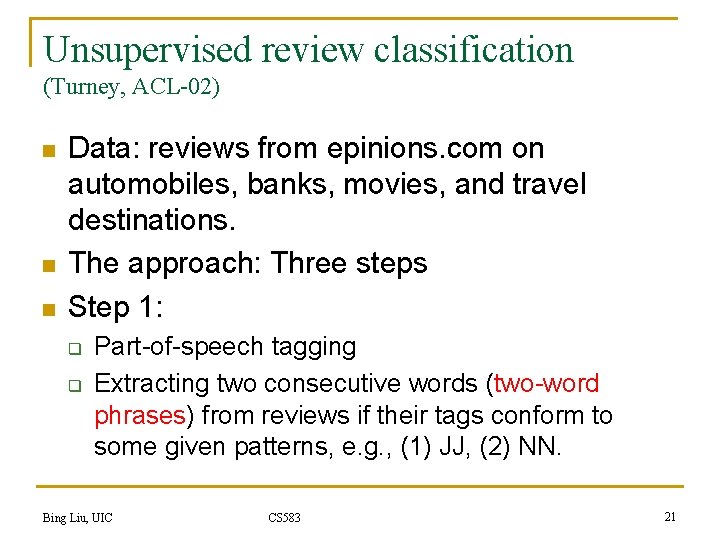
Unsupervised review classification (Turney, ACL-02) n n n Data: reviews from epinions. com on automobiles, banks, movies, and travel destinations. The approach: Three steps Step 1: q q Part-of-speech tagging Extracting two consecutive words (two-word phrases) from reviews if their tags conform to some given patterns, e. g. , (1) JJ, (2) NN. Bing Liu, UIC CS 583 21
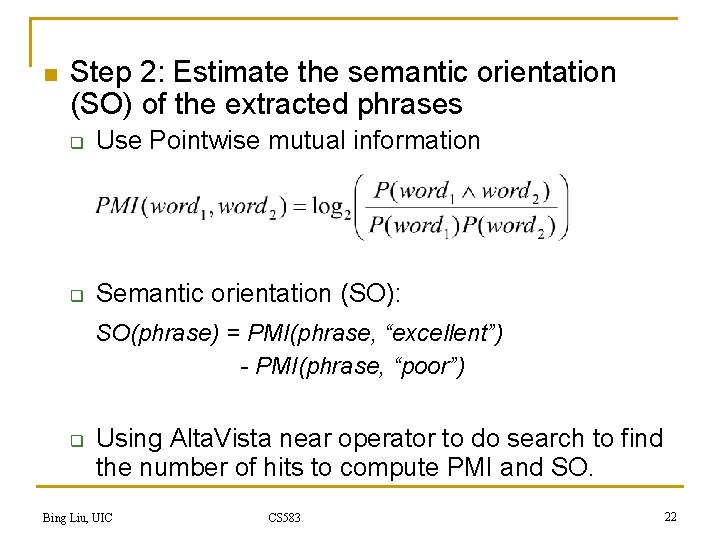
n Step 2: Estimate the semantic orientation (SO) of the extracted phrases q Use Pointwise mutual information q Semantic orientation (SO): SO(phrase) = PMI(phrase, “excellent”) - PMI(phrase, “poor”) q Using Alta. Vista near operator to do search to find the number of hits to compute PMI and SO. Bing Liu, UIC CS 583 22
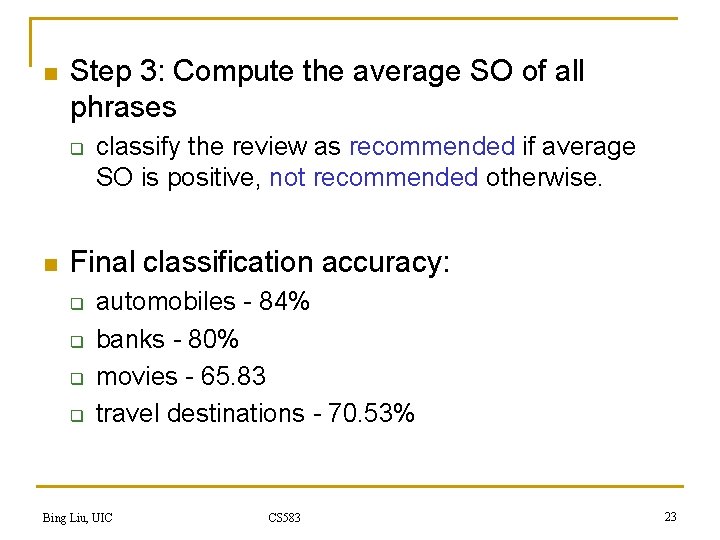
n Step 3: Compute the average SO of all phrases q n classify the review as recommended if average SO is positive, not recommended otherwise. Final classification accuracy: q q automobiles - 84% banks - 80% movies - 65. 83 travel destinations - 70. 53% Bing Liu, UIC CS 583 23
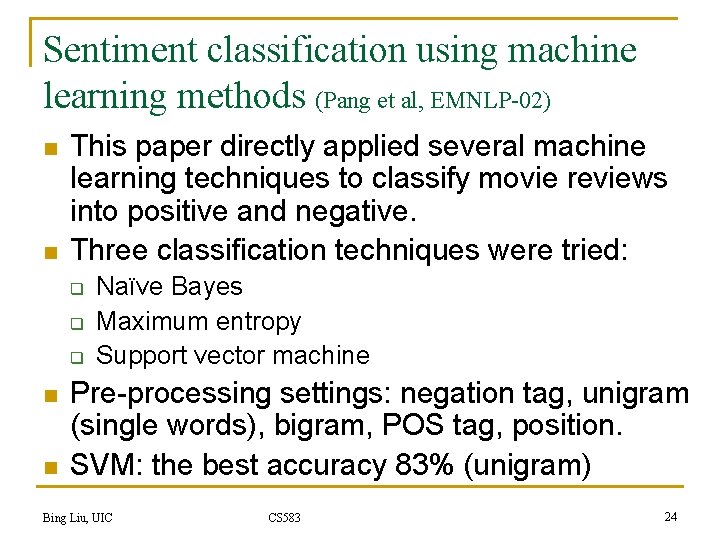
Sentiment classification using machine learning methods (Pang et al, EMNLP-02) n n This paper directly applied several machine learning techniques to classify movie reviews into positive and negative. Three classification techniques were tried: q q q n n Naïve Bayes Maximum entropy Support vector machine Pre-processing settings: negation tag, unigram (single words), bigram, POS tag, position. SVM: the best accuracy 83% (unigram) Bing Liu, UIC CS 583 24
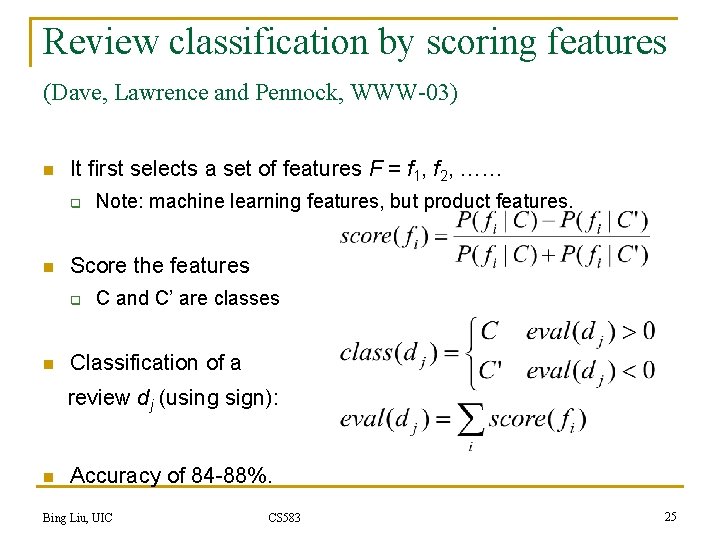
Review classification by scoring features (Dave, Lawrence and Pennock, WWW-03) n It first selects a set of features F = f 1, f 2, …… q n Score the features q n Note: machine learning features, but product features. C and C’ are classes Classification of a review dj (using sign): n Accuracy of 84 -88%. Bing Liu, UIC CS 583 25
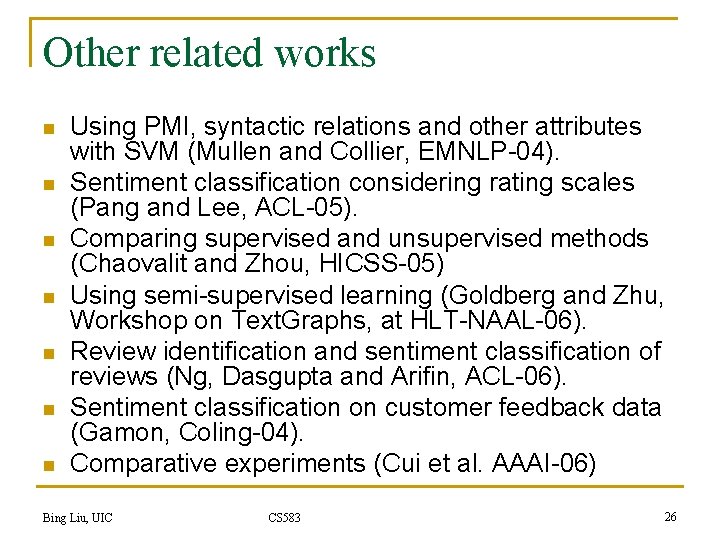
Other related works n n n n Using PMI, syntactic relations and other attributes with SVM (Mullen and Collier, EMNLP-04). Sentiment classification considering rating scales (Pang and Lee, ACL-05). Comparing supervised and unsupervised methods (Chaovalit and Zhou, HICSS-05) Using semi-supervised learning (Goldberg and Zhu, Workshop on Text. Graphs, at HLT-NAAL-06). Review identification and sentiment classification of reviews (Ng, Dasgupta and Arifin, ACL-06). Sentiment classification on customer feedback data (Gamon, Coling-04). Comparative experiments (Cui et al. AAAI-06) Bing Liu, UIC CS 583 26
Roadmap n n n Opinion mining – the abstraction Document level sentiment classification Sentence level sentiment analysis Feature-based opinion mining and summarization Comparative sentence and relation extraction Summary Bing Liu, UIC CS 583 27
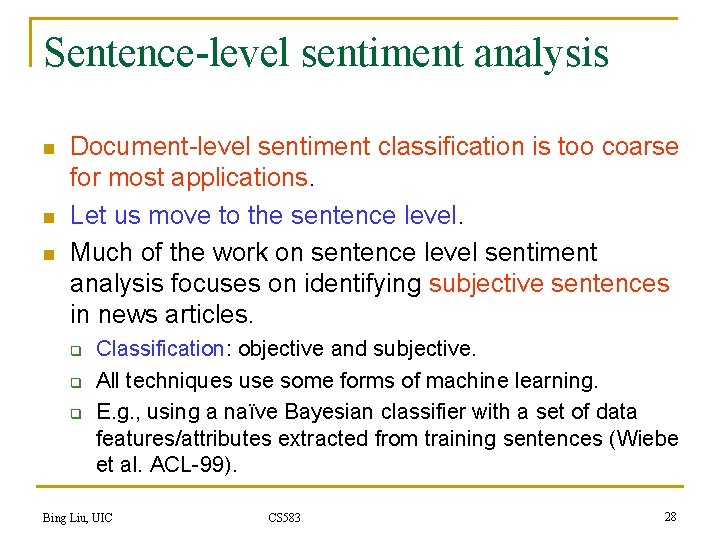
Sentence-level sentiment analysis n n n Document-level sentiment classification is too coarse for most applications. Let us move to the sentence level. Much of the work on sentence level sentiment analysis focuses on identifying subjective sentences in news articles. q q q Classification: objective and subjective. All techniques use some forms of machine learning. E. g. , using a naïve Bayesian classifier with a set of data features/attributes extracted from training sentences (Wiebe et al. ACL-99). Bing Liu, UIC CS 583 28
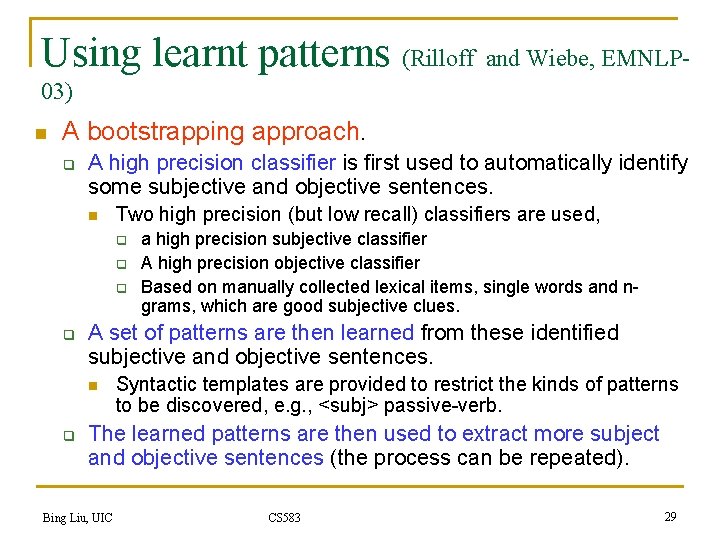
Using learnt patterns (Rilloff and Wiebe, EMNLP 03) n A bootstrapping approach. q A high precision classifier is first used to automatically identify some subjective and objective sentences. n Two high precision (but low recall) classifiers are used, q q A set of patterns are then learned from these identified subjective and objective sentences. n q a high precision subjective classifier A high precision objective classifier Based on manually collected lexical items, single words and ngrams, which are good subjective clues. Syntactic templates are provided to restrict the kinds of patterns to be discovered, e. g. , <subj> passive-verb. The learned patterns are then used to extract more subject and objective sentences (the process can be repeated). Bing Liu, UIC CS 583 29
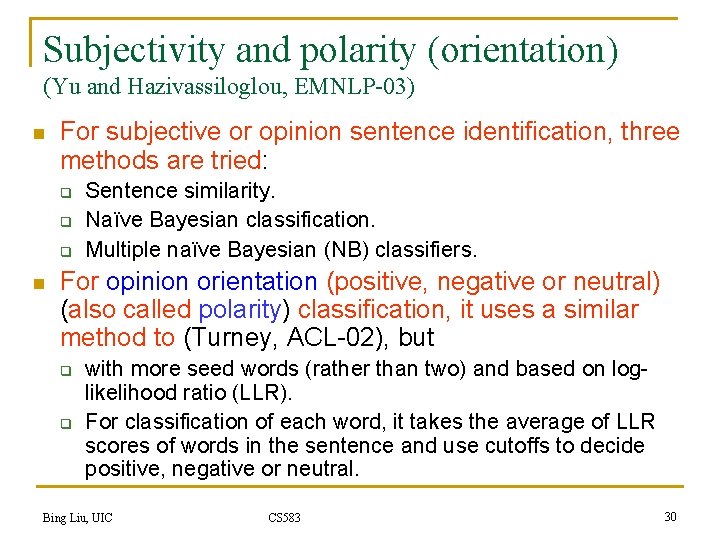
Subjectivity and polarity (orientation) (Yu and Hazivassiloglou, EMNLP-03) n For subjective or opinion sentence identification, three methods are tried: q q q n Sentence similarity. Naïve Bayesian classification. Multiple naïve Bayesian (NB) classifiers. For opinion orientation (positive, negative or neutral) (also called polarity) classification, it uses a similar method to (Turney, ACL-02), but q q with more seed words (rather than two) and based on loglikelihood ratio (LLR). For classification of each word, it takes the average of LLR scores of words in the sentence and use cutoffs to decide positive, negative or neutral. Bing Liu, UIC CS 583 30
Other related work n n n Consider gradable adjectives (Hatzivassiloglou and Wiebe, Coling-00) Semi-supervised learning with the initial training set identified by some strong patterns and then applying NB or self-training (Wiebe and Riloff, CICLing-05). Finding strength of opinions at the clause level (Wilson et al. AAAI-04). Sum up orientations of opinion words in a sentence (or within some word window) (Kim and Hovy, COLING-04). Find clause or phrase polarities based on priori opinion words and classification (Wilson et al. EMNLP-05) Semi-supervised learning to classify sentences in reviews (Gamon et al. IDA-05) Bing Liu, UIC CS 583 31
Let us go further? n Sentiment classifications at both document and sentence (or clause) level are useful, but q n An negative sentiment on an object q n does not mean that the opinion holder dislikes everything about the object. A positive sentiment on an object q n They do not find what the opinion holder liked and disliked. does not mean that the opinion holder likes everything about the object. We need to go to the feature level. Bing Liu, UIC CS 583 32
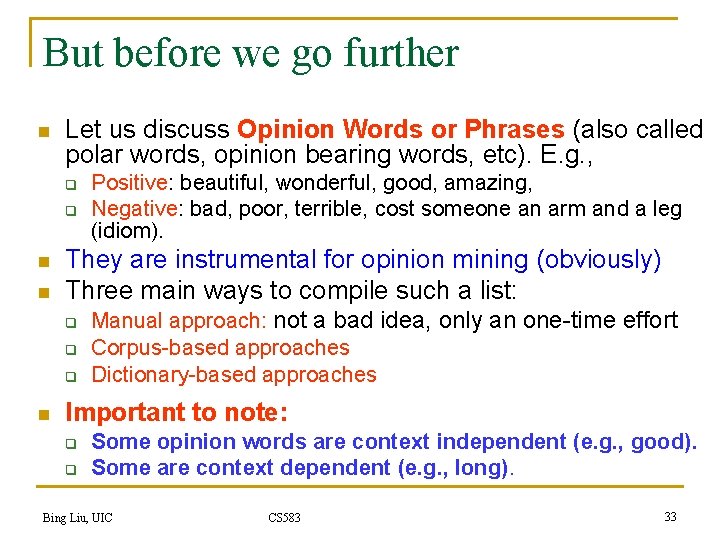
But before we go further n Let us discuss Opinion Words or Phrases (also called polar words, opinion bearing words, etc). E. g. , q q n n They are instrumental for opinion mining (obviously) Three main ways to compile such a list: q q q n Positive: beautiful, wonderful, good, amazing, Negative: bad, poor, terrible, cost someone an arm and a leg (idiom). Manual approach: not a bad idea, only an one-time effort Corpus-based approaches Dictionary-based approaches Important to note: q q Some opinion words are context independent (e. g. , good). Some are context dependent (e. g. , long). Bing Liu, UIC CS 583 33
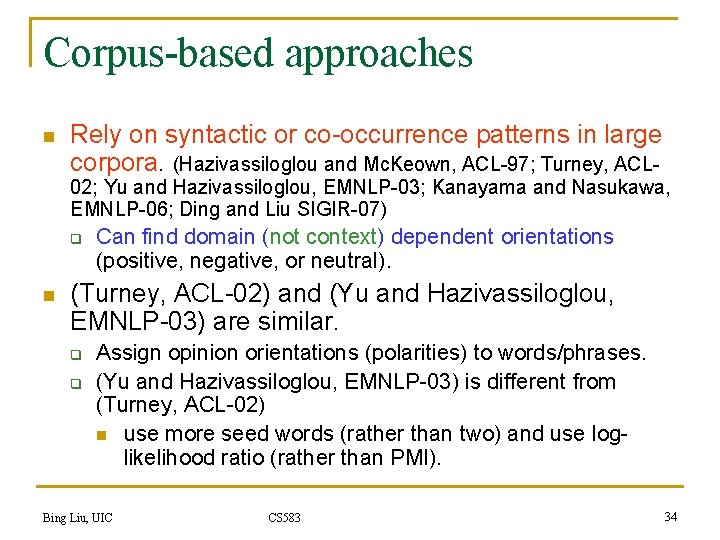
Corpus-based approaches n Rely on syntactic or co-occurrence patterns in large corpora. (Hazivassiloglou and Mc. Keown, ACL-97; Turney, ACL- 02; Yu and Hazivassiloglou, EMNLP-03; Kanayama and Nasukawa, EMNLP-06; Ding and Liu SIGIR-07) q n Can find domain (not context) dependent orientations (positive, negative, or neutral). (Turney, ACL-02) and (Yu and Hazivassiloglou, EMNLP-03) are similar. q q Assign opinion orientations (polarities) to words/phrases. (Yu and Hazivassiloglou, EMNLP-03) is different from (Turney, ACL-02) n use more seed words (rather than two) and use loglikelihood ratio (rather than PMI). Bing Liu, UIC CS 583 34
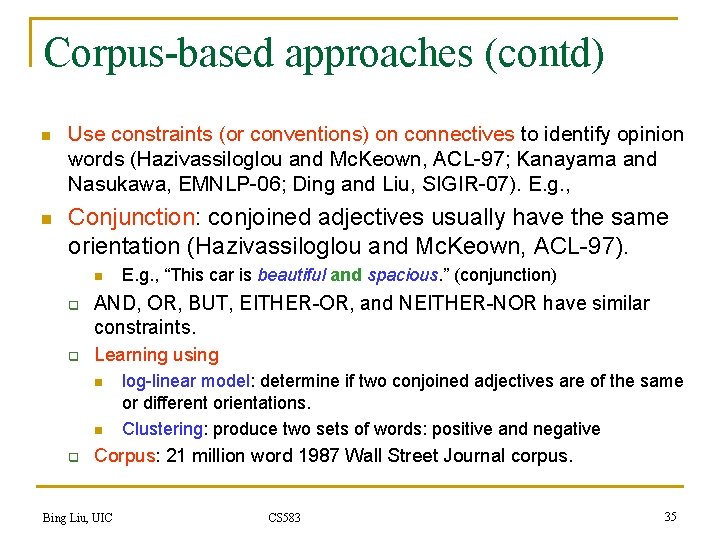
Corpus-based approaches (contd) n n Use constraints (or conventions) on connectives to identify opinion words (Hazivassiloglou and Mc. Keown, ACL-97; Kanayama and Nasukawa, EMNLP-06; Ding and Liu, SIGIR-07). E. g. , Conjunction: conjoined adjectives usually have the same orientation (Hazivassiloglou and Mc. Keown, ACL-97). n q q AND, OR, BUT, EITHER-OR, and NEITHER-NOR have similar constraints. Learning using n n q E. g. , “This car is beautiful and spacious. ” (conjunction) log-linear model: determine if two conjoined adjectives are of the same or different orientations. Clustering: produce two sets of words: positive and negative Corpus: 21 million word 1987 Wall Street Journal corpus. Bing Liu, UIC CS 583 35
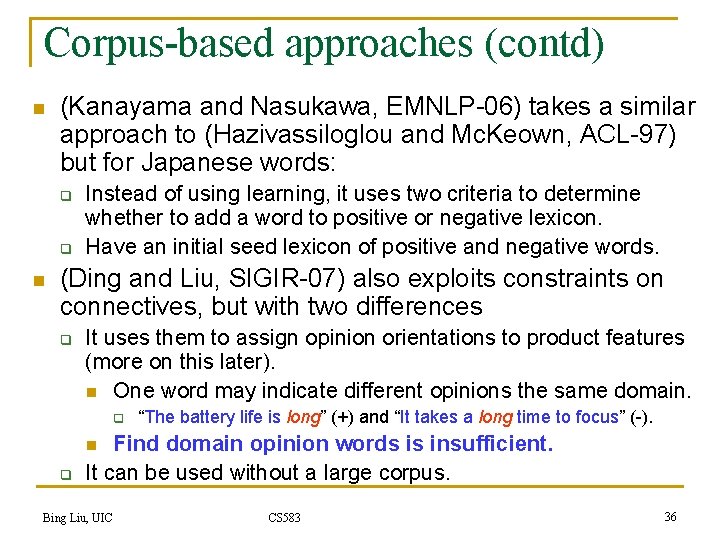
Corpus-based approaches (contd) n (Kanayama and Nasukawa, EMNLP-06) takes a similar approach to (Hazivassiloglou and Mc. Keown, ACL-97) but for Japanese words: q q n Instead of using learning, it uses two criteria to determine whether to add a word to positive or negative lexicon. Have an initial seed lexicon of positive and negative words. (Ding and Liu, SIGIR-07) also exploits constraints on connectives, but with two differences q It uses them to assign opinion orientations to product features (more on this later). n One word may indicate different opinions the same domain. q “The battery life is long” (+) and “It takes a long time to focus” (-). Find domain opinion words is insufficient. It can be used without a large corpus. n q Bing Liu, UIC CS 583 36
Dictionary-based approaches n Typically use Word. Net’s synsets and hierarchies to acquire opinion words q q q n n Start with a small seed set of opinion words Use the set to search for synonyms and antonyms in Word. Net (Hu and Liu, KDD-04; Kim and Hovy, COLING-04). Manual inspection may be used afterward. Use additional information (e. g. , glosses) from Word. Net (Andreevskaia and Bergler, EACL-06) and learning (Esuti and Sebastiani, CIKM-05). Weakness of the approach: Do not find domain and/or context dependent opinion words, e. g. , small, long, fast. Bing Liu, UIC CS 583 37
Roadmap n n n Opinion mining – the abstraction Document level sentiment classification Sentence level sentiment analysis Feature-based opinion mining and summarization Comparative sentence and relation extraction Summary Bing Liu, UIC CS 583 38
Feature-based opinion mining and summarization (Hu and Liu, KDD-04) n n Again focus on reviews (easier to work in a concrete domain!) Objective: find what reviewers (opinion holders) liked and disliked q n Product features and opinions on the features Since the number of reviews on an object can be large, an opinion summary should be produced. q q q Desirable to be a structured summary. Easy to visualize and to compare. Analogous to multi-document summarization. Bing Liu, UIC CS 583 39
The tasks n Recall the three tasks in our model. Task 1: Extract object features that have been commented on in each review. Task 2: Determine whether the opinions on the features are positive, negative or neutral. Task 3: Group feature synonyms. q Produce a summary n Task 2 may not be needed depending on the format of reviews. Bing Liu, UIC CS 583 40
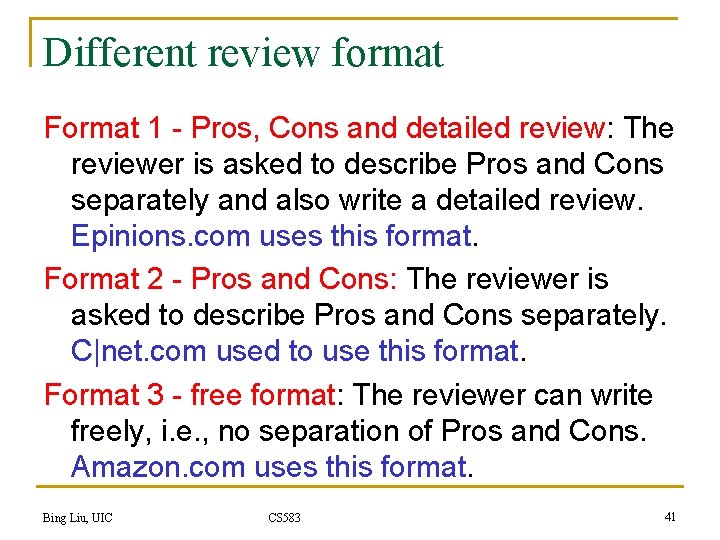
Different review format Format 1 - Pros, Cons and detailed review: The reviewer is asked to describe Pros and Cons separately and also write a detailed review. Epinions. com uses this format. Format 2 - Pros and Cons: The reviewer is asked to describe Pros and Cons separately. C|net. com used to use this format. Format 3 - free format: The reviewer can write freely, i. e. , no separation of Pros and Cons. Amazon. com uses this format. Bing Liu, UIC CS 583 41
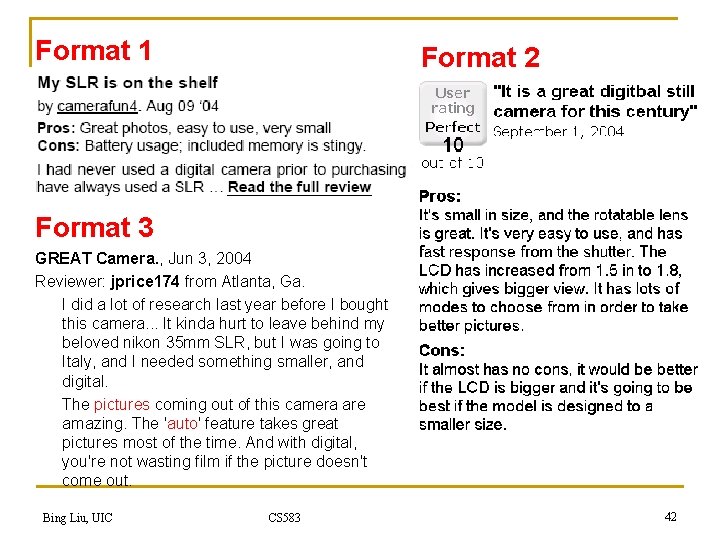
Format 1 Format 2 Format 3 GREAT Camera. , Jun 3, 2004 Reviewer: jprice 174 from Atlanta, Ga. I did a lot of research last year before I bought this camera. . . It kinda hurt to leave behind my beloved nikon 35 mm SLR, but I was going to Italy, and I needed something smaller, and digital. The pictures coming out of this camera are amazing. The 'auto' feature takes great pictures most of the time. And with digital, you're not wasting film if the picture doesn't come out. Bing Liu, UIC CS 583 42
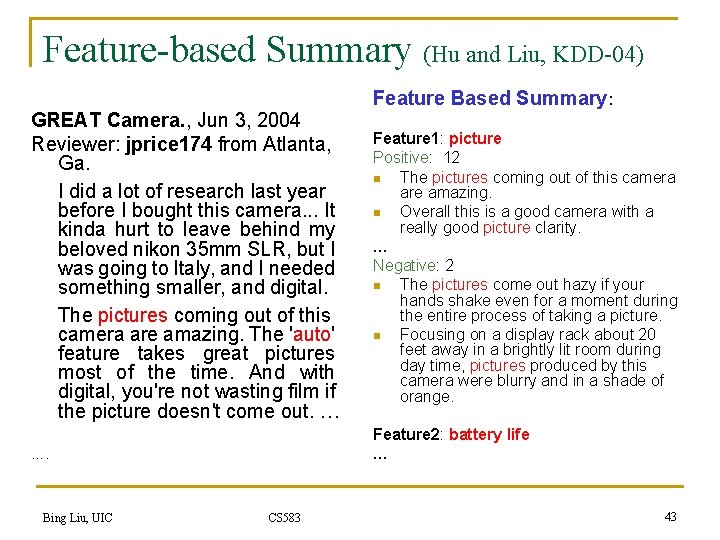
Feature-based Summary (Hu and Liu, KDD-04) GREAT Camera. , Jun 3, 2004 Reviewer: jprice 174 from Atlanta, Ga. I did a lot of research last year before I bought this camera. . . It kinda hurt to leave behind my beloved nikon 35 mm SLR, but I was going to Italy, and I needed something smaller, and digital. The pictures coming out of this camera are amazing. The 'auto' feature takes great pictures most of the time. And with digital, you're not wasting film if the picture doesn't come out. … Feature 1: picture Positive: 12 n The pictures coming out of this camera are amazing. n Overall this is a good camera with a really good picture clarity. … Negative: 2 n The pictures come out hazy if your hands shake even for a moment during the entire process of taking a picture. n Focusing on a display rack about 20 feet away in a brightly lit room during day time, pictures produced by this camera were blurry and in a shade of orange. Feature 2: battery life … …. Bing Liu, UIC Feature Based Summary: CS 583 43
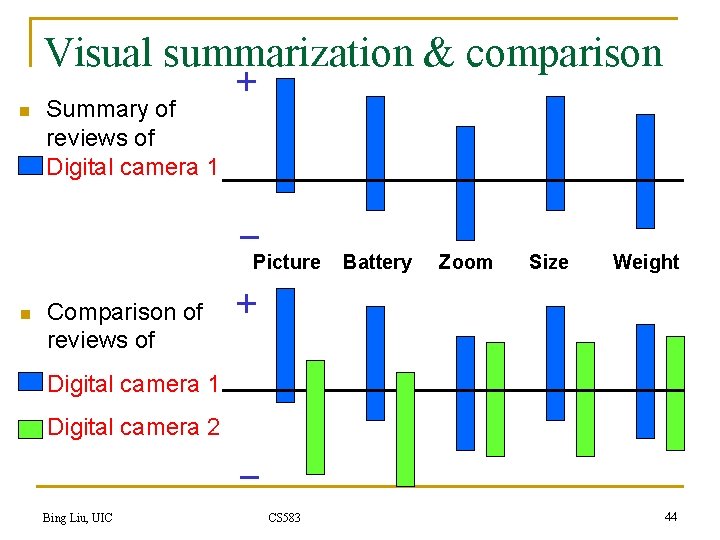
n Visual summarization & comparison + Summary of reviews of Digital camera 1 _ Picture n Comparison of reviews of Battery Zoom Size Weight + Digital camera 1 Digital camera 2 _ Bing Liu, UIC CS 583 44
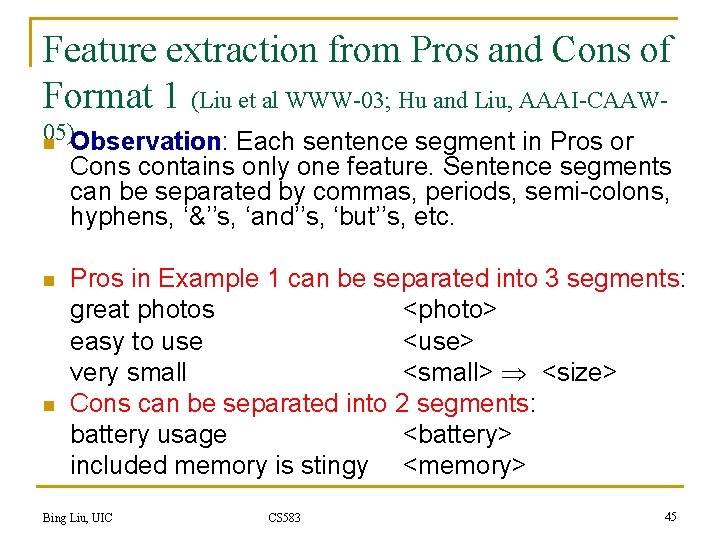
Feature extraction from Pros and Cons of Format 1 (Liu et al WWW-03; Hu and Liu, AAAI-CAAW 05) n Observation: Each sentence segment in Pros or Cons contains only one feature. Sentence segments can be separated by commas, periods, semi-colons, hyphens, ‘&’’s, ‘and’’s, ‘but’’s, etc. n n Pros in Example 1 can be separated into 3 segments: great photos <photo> easy to use <use> very small <small> <size> Cons can be separated into 2 segments: battery usage <battery> included memory is stingy <memory> Bing Liu, UIC CS 583 45
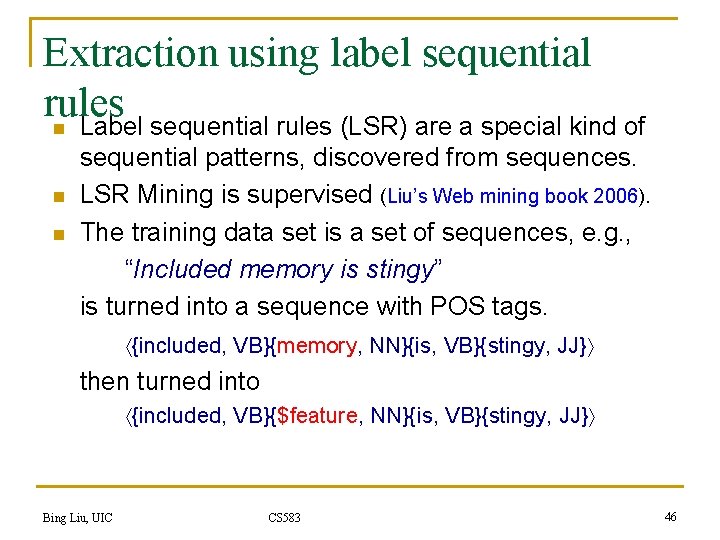
Extraction using label sequential rules n Label sequential rules (LSR) are a special kind of n n sequential patterns, discovered from sequences. LSR Mining is supervised (Liu’s Web mining book 2006). The training data set is a set of sequences, e. g. , “Included memory is stingy” is turned into a sequence with POS tags. {included, VB}{memory, NN}{is, VB}{stingy, JJ} then turned into {included, VB}{$feature, NN}{is, VB}{stingy, JJ} Bing Liu, UIC CS 583 46
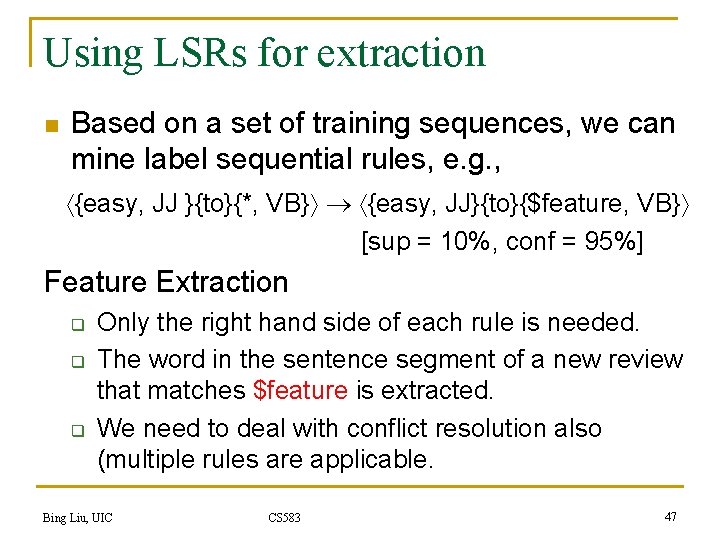
Using LSRs for extraction n Based on a set of training sequences, we can mine label sequential rules, e. g. , {easy, JJ }{to}{*, VB} {easy, JJ}{to}{$feature, VB} [sup = 10%, conf = 95%] Feature Extraction q q q Only the right hand side of each rule is needed. The word in the sentence segment of a new review that matches $feature is extracted. We need to deal with conflict resolution also (multiple rules are applicable. Bing Liu, UIC CS 583 47
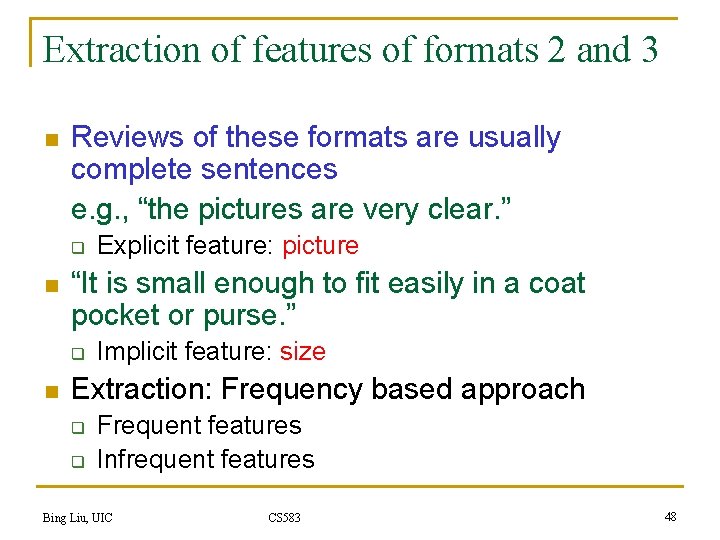
Extraction of features of formats 2 and 3 n Reviews of these formats are usually complete sentences e. g. , “the pictures are very clear. ” q n “It is small enough to fit easily in a coat pocket or purse. ” q n Explicit feature: picture Implicit feature: size Extraction: Frequency based approach q q Frequent features Infrequent features Bing Liu, UIC CS 583 48
Frequency based approach (Hu and Liu, KDD-04; Liu, Web Data Mining book 2007) n n n Frequent features: those features that have been talked about by many reviewers. Use sequential pattern mining Why the frequency based approach? q Different reviewers tell different stories (irrelevant) q When product features are discussed, the words that they use converge. q They are main features. n Sequential pattern mining finds frequent phrases. n Froogle has an implementation of the approach (no POS restriction). Bing Liu, UIC CS 583 49
Using part-of relationship and the Web (Popescu and Etzioni, EMNLP-05) n n Improved (Hu and Liu, KDD-04) by removing those frequent noun phrases that may not be features: better precision (a small drop in recall). It identifies part-of relationship q q Each noun phrase is given a pointwise mutual information score between the phrase and part discriminators associated with the product class, e. g. , a scanner class. The part discriminators for the scanner class are, “of scanner”, “scanner has”, “scanner comes with”, etc, which are used to find components or parts of scanners by searching on the Web: the Know. It. All approach, (Etzioni et al, WWW-04). Bing Liu, UIC CS 583 50
Infrequent features extraction n n How to find the infrequent features? Observation: the same opinion word can be used to describe different features and objects. q q “The pictures are absolutely amazing. ” “The software that comes with it is amazing. ” n Frequent features n Bing Liu, UIC n Infrequent features Opinion words CS 583 51
Identify feature synonyms n n Liu et al (WWW-05) made an attempt using only Word. Net. Carenini et al (K-CAP-05) proposed a more sophisticated method based on several similarity metrics, but it requires a taxonomy of features to be given. q q q n The system merges each discovered feature to a feature node in the taxonomy. The similarity metrics are defined based on string similarity, synonyms and other distances measured using Word. Net. Experimental results based on digital camera and DVD reviews show promising results. Many ideas in information integration are applicable. Bing Liu, UIC CS 583 52
Identify opinion orientation on feature n n For each feature, we identify the sentiment or opinion orientation expressed by a reviewer. We work based on sentences, but also consider, q q q n Almost all approaches make use of opinion words and phrases. But notice again: q q n A sentence can contain multiple features. Different features may have different opinions. E. g. , The battery life and picture quality are great (+), but the view founder is small (-). Some opinion words have context independent orientations, e. g. , great. Some other opinion words have context dependent orientations, e. g. , “small” Many ways to use them. Bing Liu, UIC CS 583 53
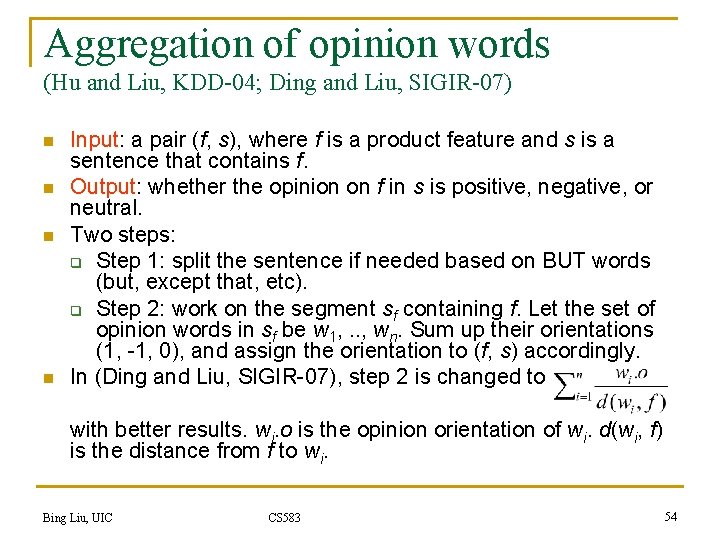
Aggregation of opinion words (Hu and Liu, KDD-04; Ding and Liu, SIGIR-07) n n Input: a pair (f, s), where f is a product feature and s is a sentence that contains f. Output: whether the opinion on f in s is positive, negative, or neutral. Two steps: q Step 1: split the sentence if needed based on BUT words (but, except that, etc). q Step 2: work on the segment sf containing f. Let the set of opinion words in sf be w 1, . . , wn. Sum up their orientations (1, -1, 0), and assign the orientation to (f, s) accordingly. In (Ding and Liu, SIGIR-07), step 2 is changed to with better results. wi. o is the opinion orientation of wi. d(wi, f) is the distance from f to wi. Bing Liu, UIC CS 583 54
Context dependent opinions n Popescu and Etzioni (EMNLP-05) used q q n constraints of connectives in (Hazivassiloglou and Mc. Keown, ACL-97), and some additional constraints, e. g. , morphological relationships, synonymy and antonymy, and relaxation labeling to propagate opinion orientations to words and features. Ding and Liu (SIGIR-07) used q q constraints of connectives both at intra-sentence and intersentence levels, and additional constraints of, e. g. , TOO, BUT, NEGATION. to directly assign opinions to (f, s) with good results (> 0. 85 of F-score). Bing Liu, UIC CS 583 55
Some other related work n n n n n Morinaga et al. (KDD-02). Yi et al. (ICDM-03) Kobayashi et al. (AAAI-CAAW-05) Ku et al. (AAAI-CAAW-05) Carenini et al (EACL-06) Kim and Hovy (ACL-06 a) Kim and Hovy (ACL-06 b) Zhuang et al (CIKM-06) Many more Bing Liu, UIC CS 583 56
Roadmap n n n Opinion mining – the abstraction Document level sentiment classification Sentence level sentiment analysis Feature-based opinion mining and summarization Comparative sentence and relation extraction Summary Bing Liu, UIC CS 583 57
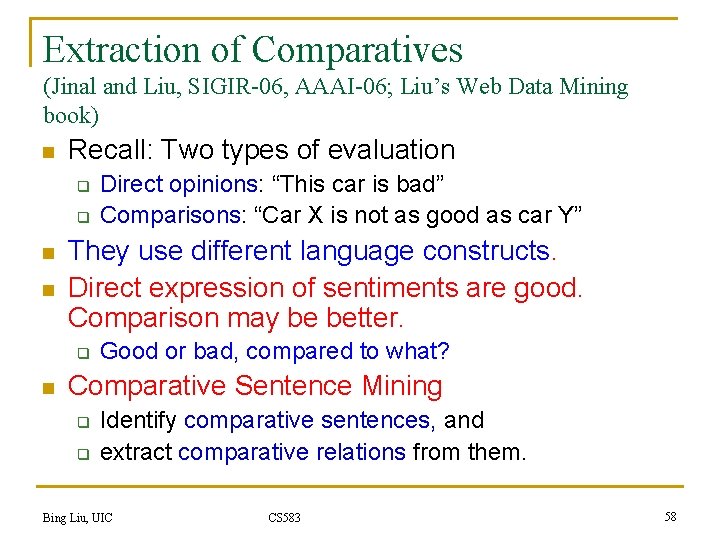
Extraction of Comparatives (Jinal and Liu, SIGIR-06, AAAI-06; Liu’s Web Data Mining book) n Recall: Two types of evaluation q q n n They use different language constructs. Direct expression of sentiments are good. Comparison may be better. q n Direct opinions: “This car is bad” Comparisons: “Car X is not as good as car Y” Good or bad, compared to what? Comparative Sentence Mining q q Identify comparative sentences, and extract comparative relations from them. Bing Liu, UIC CS 583 58
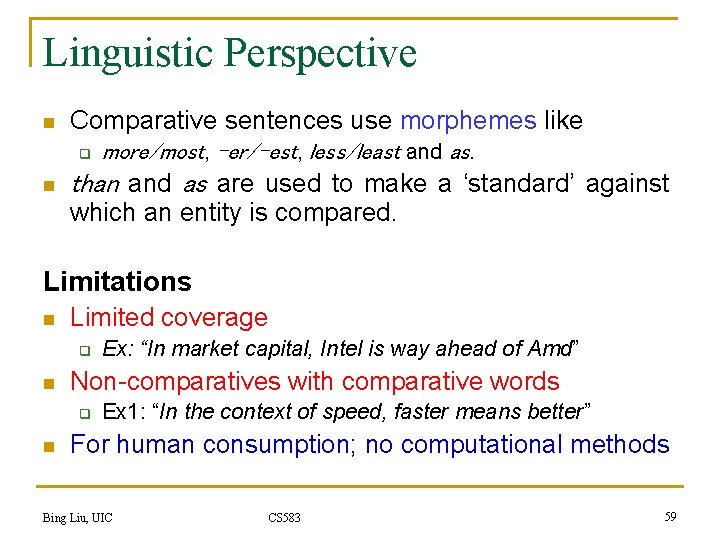
Linguistic Perspective n Comparative sentences use morphemes like q n more/most, -er/-est, less/least and as. than and as are used to make a ‘standard’ against which an entity is compared. Limitations n Limited coverage q n Non-comparatives with comparative words q n Ex: “In market capital, Intel is way ahead of Amd” Ex 1: “In the context of speed, faster means better” For human consumption; no computational methods Bing Liu, UIC CS 583 59
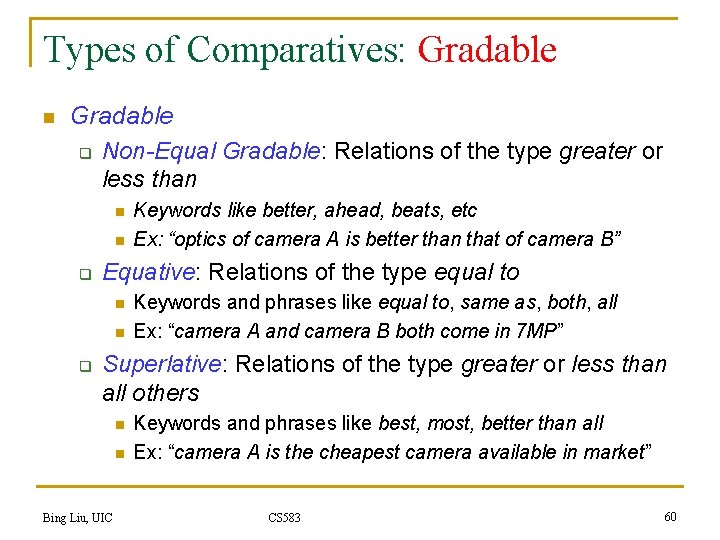
Types of Comparatives: Gradable n Gradable q Non-Equal Gradable: Relations of the type greater or less than n n q Equative: Relations of the type equal to n n q Keywords like better, ahead, beats, etc Ex: “optics of camera A is better than that of camera B” Keywords and phrases like equal to, same as, both, all Ex: “camera A and camera B both come in 7 MP” Superlative: Relations of the type greater or less than all others n n Bing Liu, UIC Keywords and phrases like best, most, better than all Ex: “camera A is the cheapest camera available in market” CS 583 60
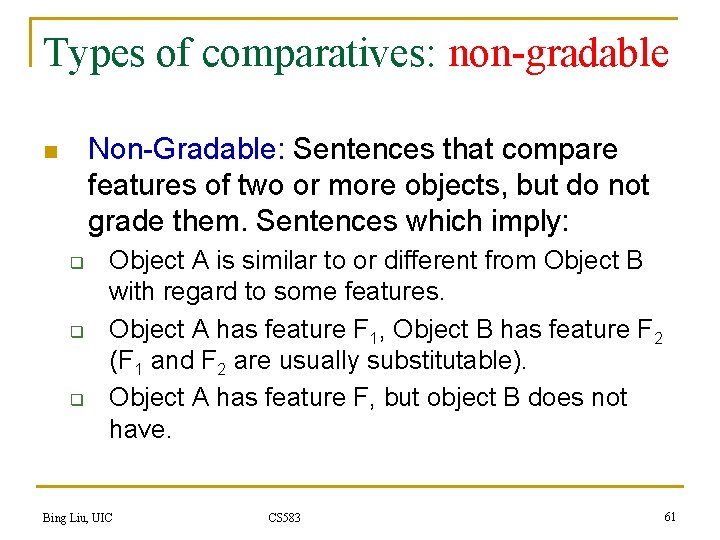
Types of comparatives: non-gradable Non-Gradable: Sentences that compare features of two or more objects, but do not grade them. Sentences which imply: n q q q Object A is similar to or different from Object B with regard to some features. Object A has feature F 1, Object B has feature F 2 (F 1 and F 2 are usually substitutable). Object A has feature F, but object B does not have. Bing Liu, UIC CS 583 61
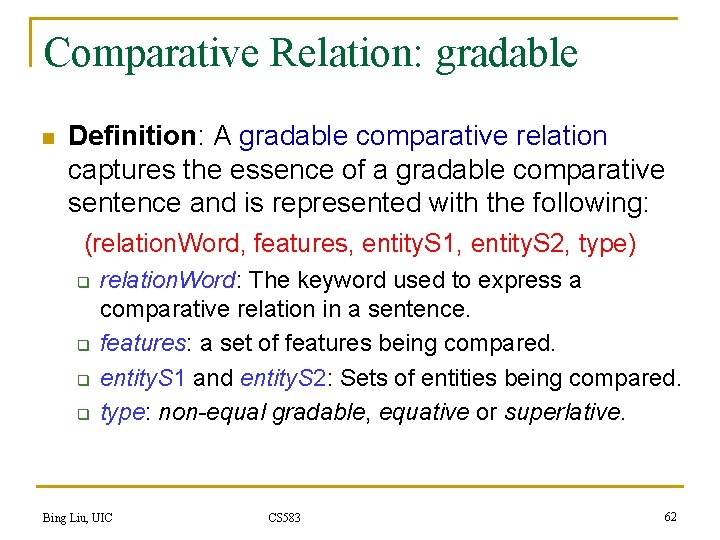
Comparative Relation: gradable n Definition: A gradable comparative relation captures the essence of a gradable comparative sentence and is represented with the following: (relation. Word, features, entity. S 1, entity. S 2, type) q q relation. Word: The keyword used to express a comparative relation in a sentence. features: a set of features being compared. entity. S 1 and entity. S 2: Sets of entities being compared. type: non-equal gradable, equative or superlative. Bing Liu, UIC CS 583 62
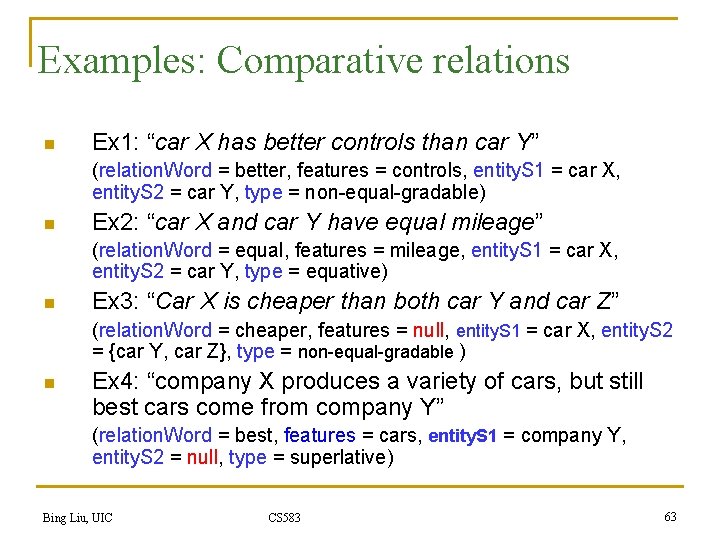
Examples: Comparative relations n Ex 1: “car X has better controls than car Y” (relation. Word = better, features = controls, entity. S 1 = car X, entity. S 2 = car Y, type = non-equal-gradable) n Ex 2: “car X and car Y have equal mileage” (relation. Word = equal, features = mileage, entity. S 1 = car X, entity. S 2 = car Y, type = equative) n Ex 3: “Car X is cheaper than both car Y and car Z” (relation. Word = cheaper, features = null, entity. S 1 = car X, entity. S 2 = {car Y, car Z}, type = non-equal-gradable ) n Ex 4: “company X produces a variety of cars, but still best cars come from company Y” (relation. Word = best, features = cars, entity. S 1 = company Y, entity. S 2 = null, type = superlative) Bing Liu, UIC CS 583 63
Tasks Given a collection of evaluative texts Task 1: Identify comparative sentences. Task 2: Categorize different types of comparative sentences. Task 2: Extract comparative relations from the sentences. Bing Liu, UIC CS 583 64
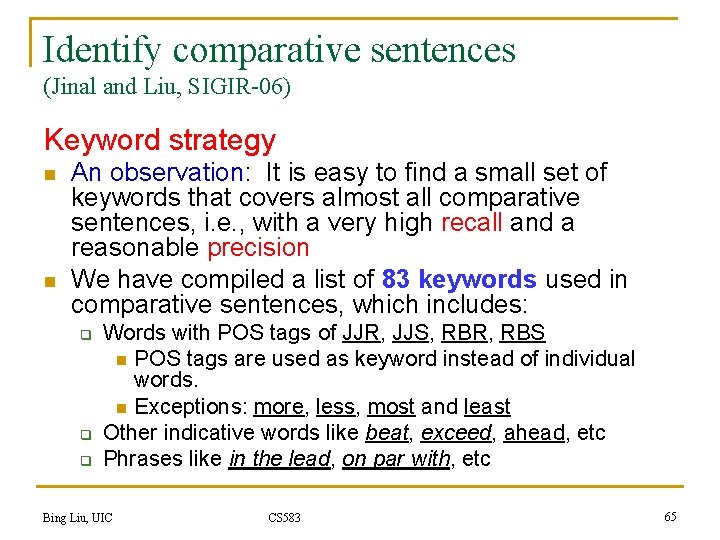
Identify comparative sentences (Jinal and Liu, SIGIR-06) Keyword strategy n n An observation: It is easy to find a small set of keywords that covers almost all comparative sentences, i. e. , with a very high recall and a reasonable precision We have compiled a list of 83 keywords used in comparative sentences, which includes: q q q Words with POS tags of JJR, JJS, RBR, RBS n POS tags are used as keyword instead of individual words. n Exceptions: more, less, most and least Other indicative words like beat, exceed, ahead, etc Phrases like in the lead, on par with, etc Bing Liu, UIC CS 583 65
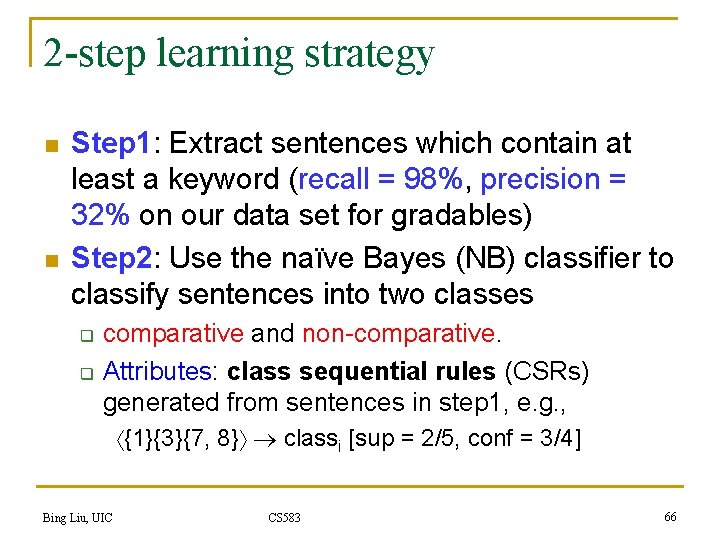
2 -step learning strategy n n Step 1: Extract sentences which contain at least a keyword (recall = 98%, precision = 32% on our data set for gradables) Step 2: Use the naïve Bayes (NB) classifier to classify sentences into two classes q q comparative and non-comparative. Attributes: class sequential rules (CSRs) generated from sentences in step 1, e. g. , {1}{3}{7, 8} classi [sup = 2/5, conf = 3/4] Bing Liu, UIC CS 583 66
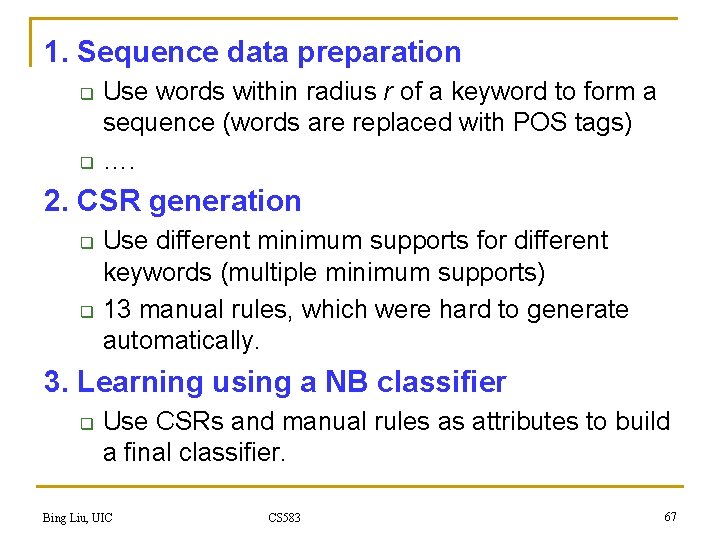
1. Sequence data preparation q q Use words within radius r of a keyword to form a sequence (words are replaced with POS tags) …. 2. CSR generation q q Use different minimum supports for different keywords (multiple minimum supports) 13 manual rules, which were hard to generate automatically. 3. Learning using a NB classifier q Use CSRs and manual rules as attributes to build a final classifier. Bing Liu, UIC CS 583 67
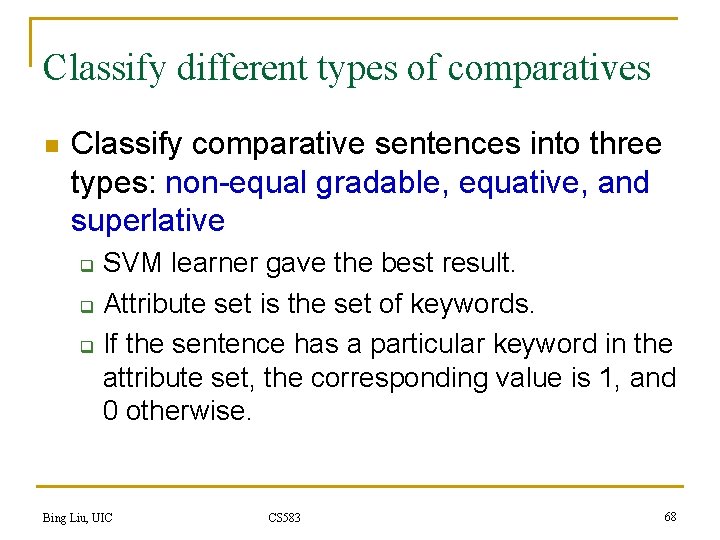
Classify different types of comparatives n Classify comparative sentences into three types: non-equal gradable, equative, and superlative SVM learner gave the best result. q Attribute set is the set of keywords. q If the sentence has a particular keyword in the attribute set, the corresponding value is 1, and 0 otherwise. q Bing Liu, UIC CS 583 68
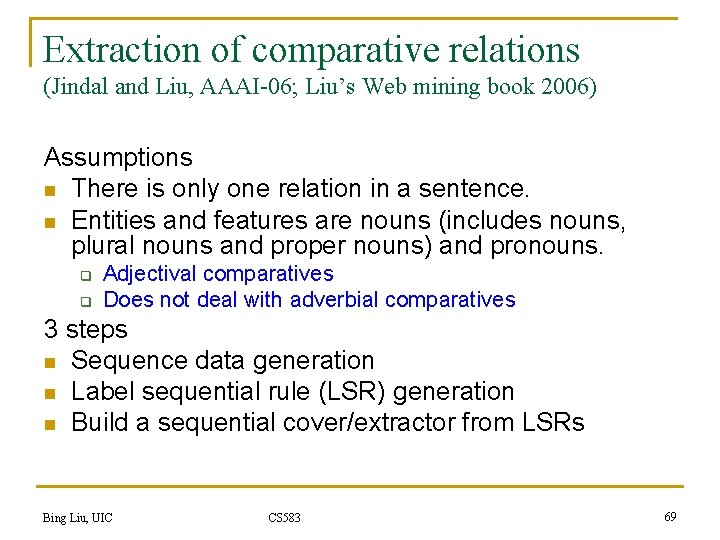
Extraction of comparative relations (Jindal and Liu, AAAI-06; Liu’s Web mining book 2006) Assumptions n There is only one relation in a sentence. n Entities and features are nouns (includes nouns, plural nouns and proper nouns) and pronouns. q q Adjectival comparatives Does not deal with adverbial comparatives 3 steps n Sequence data generation n Label sequential rule (LSR) generation n Build a sequential cover/extractor from LSRs Bing Liu, UIC CS 583 69
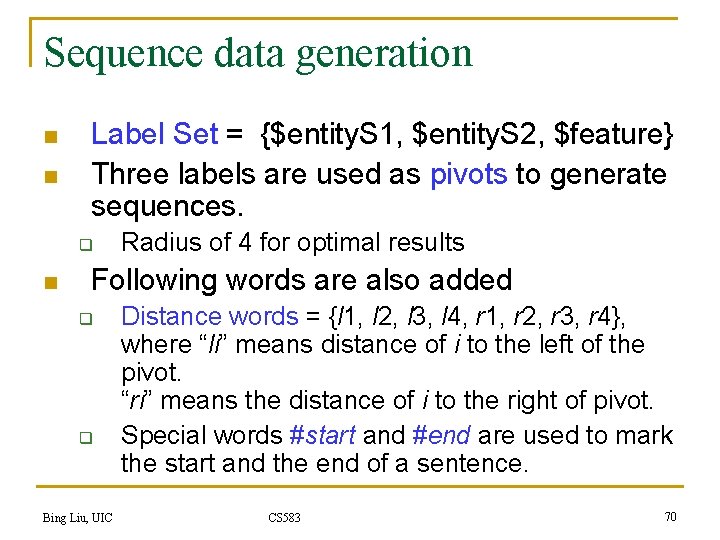
Sequence data generation n n Label Set = {$entity. S 1, $entity. S 2, $feature} Three labels are used as pivots to generate sequences. q n Radius of 4 for optimal results Following words are also added q q Bing Liu, UIC Distance words = {l 1, l 2, l 3, l 4, r 1, r 2, r 3, r 4}, where “li” means distance of i to the left of the pivot. “ri” means the distance of i to the right of pivot. Special words #start and #end are used to mark the start and the end of a sentence. CS 583 70
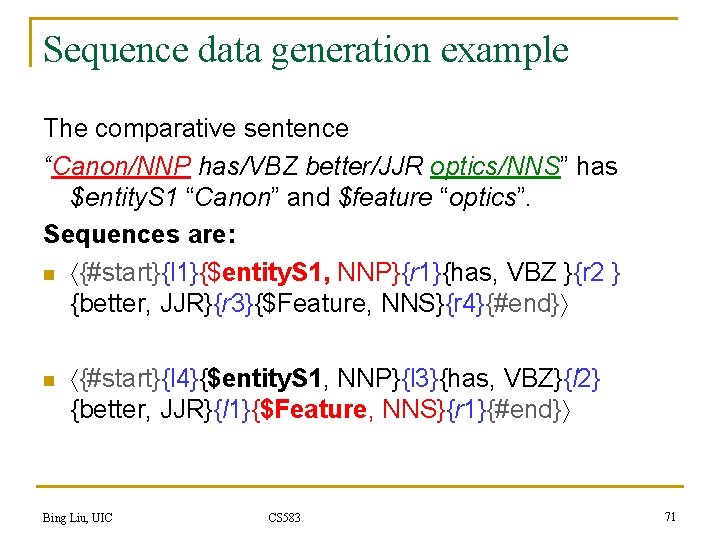
Sequence data generation example The comparative sentence “Canon/NNP has/VBZ better/JJR optics/NNS” has $entity. S 1 “Canon” and $feature “optics”. Sequences are: n {#start}{l 1}{$entity. S 1, NNP}{r 1}{has, VBZ }{r 2 } {better, JJR}{r 3}{$Feature, NNS}{r 4}{#end} n {#start}{l 4}{$entity. S 1, NNP}{l 3}{has, VBZ}{l 2} {better, JJR}{l 1}{$Feature, NNS}{r 1}{#end} Bing Liu, UIC CS 583 71
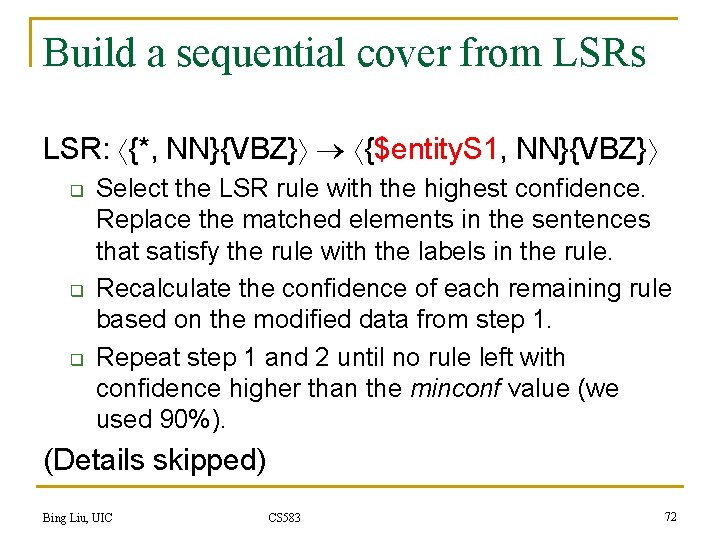
Build a sequential cover from LSRs LSR: {*, NN}{VBZ} {$entity. S 1, NN}{VBZ} q q q Select the LSR rule with the highest confidence. Replace the matched elements in the sentences that satisfy the rule with the labels in the rule. Recalculate the confidence of each remaining rule based on the modified data from step 1. Repeat step 1 and 2 until no rule left with confidence higher than the minconf value (we used 90%). (Details skipped) Bing Liu, UIC CS 583 72
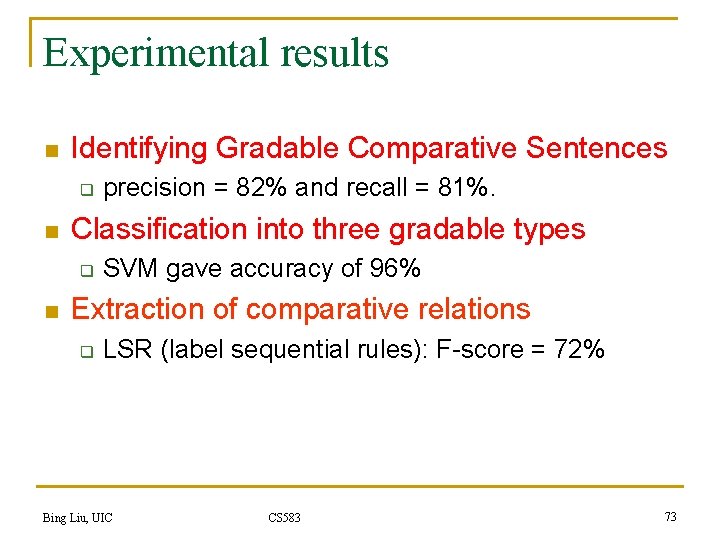
Experimental results n Identifying Gradable Comparative Sentences q n Classification into three gradable types q n precision = 82% and recall = 81%. SVM gave accuracy of 96% Extraction of comparative relations q LSR (label sequential rules): F-score = 72% Bing Liu, UIC CS 583 73
Roadmap n n n Opinion mining – the abstraction Document level sentiment classification Sentence level sentiment analysis Feature-based opinion mining and summarization Comparative sentence and relation extraction Summary Bing Liu, UIC CS 583 74
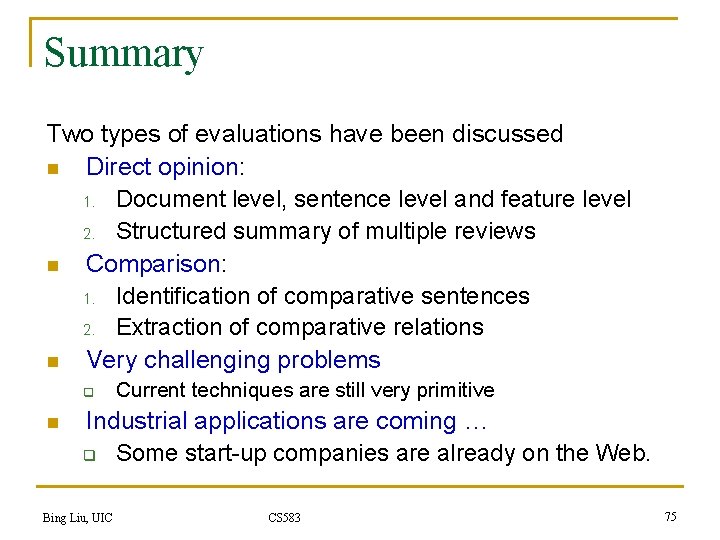
Summary Two types of evaluations have been discussed n Direct opinion: 1. Document level, sentence level and feature level 2. Structured summary of multiple reviews n Comparison: 1. Identification of comparative sentences 2. Extraction of comparative relations n Very challenging problems q n Current techniques are still very primitive Industrial applications are coming … q Some start-up companies are already on the Web. Bing Liu, UIC CS 583 75
- Slides: 75