
CHAPTER 11 NUCLEIC ACID STRUCTURE AND DNA REPLICATION
- Slides: 52
CHAPTER 11 NUCLEIC ACID STRUCTURE AND DNA REPLICATION Prepared by Brenda Leady, University of Toledo Copyright (c) The Mc. Graw-Hill Companies, Inc. Permission required for reproduction or display. 1
Genetic material must be able to: Contain the information necessary to construct an entire organism n Pass from parent to offspring and from cell to cell during cell division n Be accurately copied n Account for the known variation within and between species n 2
Late 1800 s scientists postulated a biochemical basis n Researchers became convinced chromosomes carry genetic information n 1920 s to 1940 s expected the protein portion of chromosomes to be the genetic material n 3
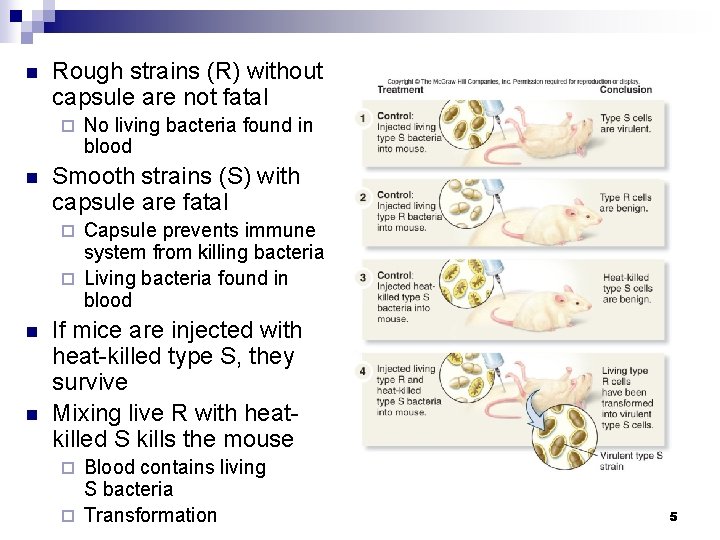
Griffith’s bacterial transformations Late 1920 s Frederick Griffith was working with Streptococcus pneumoniae n S. pneumoniae n ¨ Strains that secrete capsules look smooth and can cause fatal infections in mice ¨ Strains that do not secrete capsules look rough and infections are not fatal in mice 4
n Rough strains (R) without capsule are not fatal ¨ n No living bacteria found in blood Smooth strains (S) with capsule are fatal Capsule prevents immune system from killing bacteria ¨ Living bacteria found in blood ¨ n n If mice are injected with heat-killed type S, they survive Mixing live R with heatkilled S kills the mouse Blood contains living S bacteria ¨ Transformation ¨ 5
Genetic material from the heat-killed type S bacteria had been transferred to the living type R bacteria n This trait gave them the capsule and was passed on to their offspring n Griffith did not know the biochemical basis of his transforming principle n 6
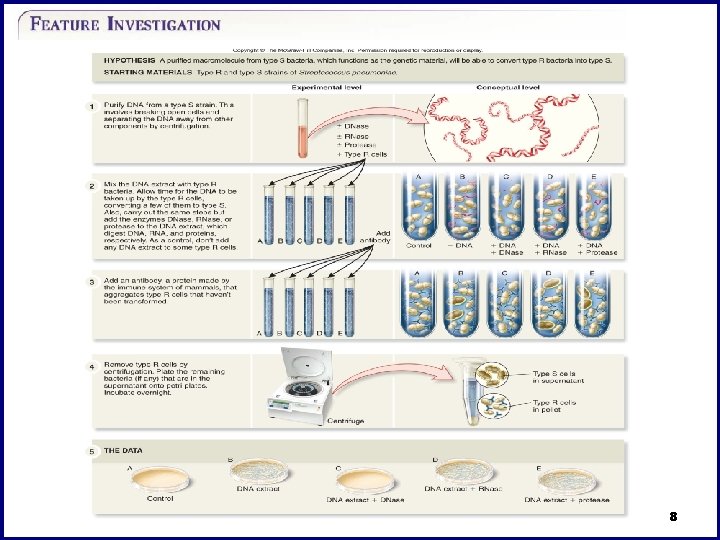
Avery, Mac. Leod, and Mc. Carty used purification methods to reveal that DNA is the genetic material n n n n 1940 s interested in bacterial transformation Only purified DNA from type S could transform type R Purified DNA might still contain traces of contamination that may be the transforming principle Added DNase, RNase and proteases RNase and protease had no effect With DNase no transformation DNA is the genetic material 7
8
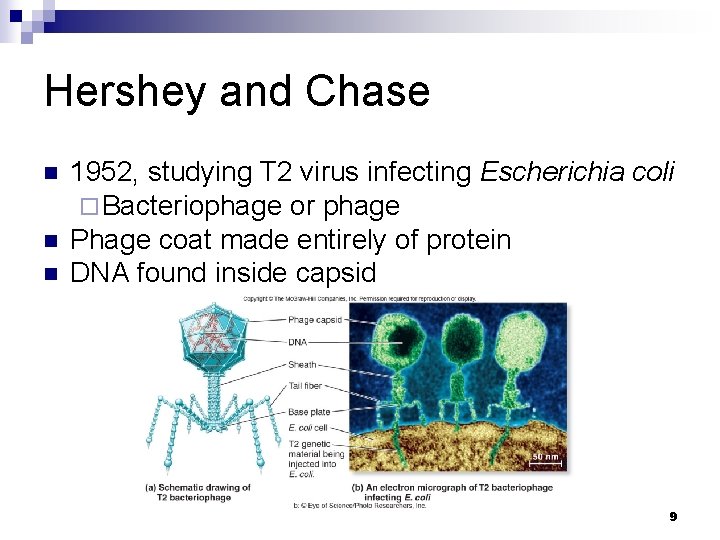
Hershey and Chase n n n 1952, studying T 2 virus infecting Escherichia coli ¨ Bacteriophage or phage Phage coat made entirely of protein DNA found inside capsid 9
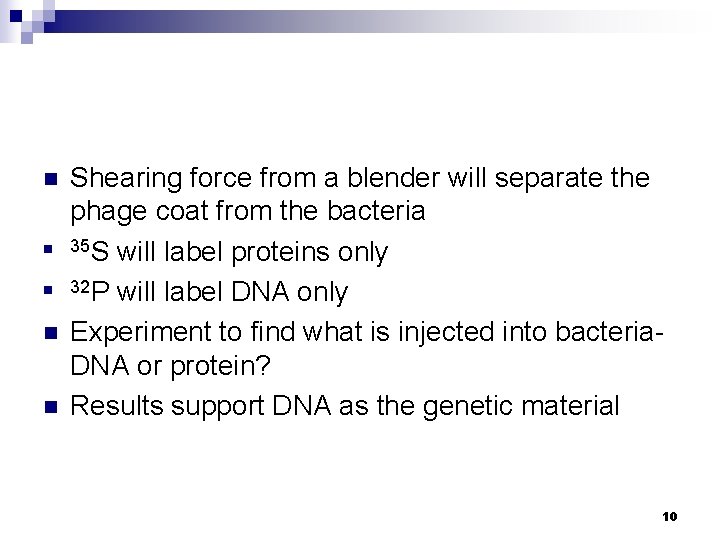
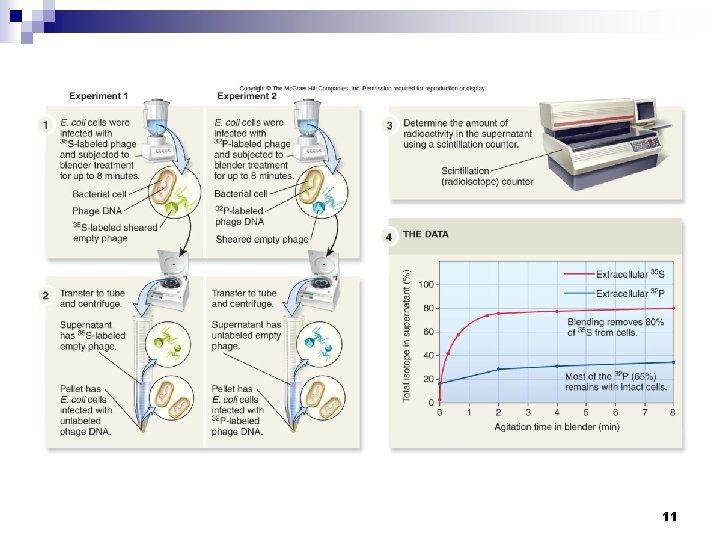
n n n Shearing force from a blender will separate the phage coat from the bacteria 35 S will label proteins only 32 P will label DNA only Experiment to find what is injected into bacteria. DNA or protein? Results support DNA as the genetic material 10
11
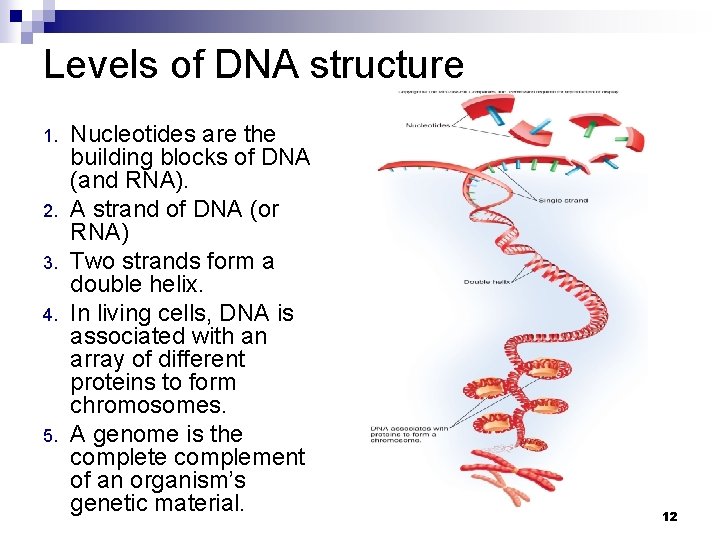
Levels of DNA structure 1. 2. 3. 4. 5. Nucleotides are the building blocks of DNA (and RNA). A strand of DNA (or RNA) Two strands form a double helix. In living cells, DNA is associated with an array of different proteins to form chromosomes. A genome is the complete complement of an organism’s genetic material. 12
Nucleotides n 3 components ¨Phosphate group ¨Pentose sugar ¨Nitrogenous base 13
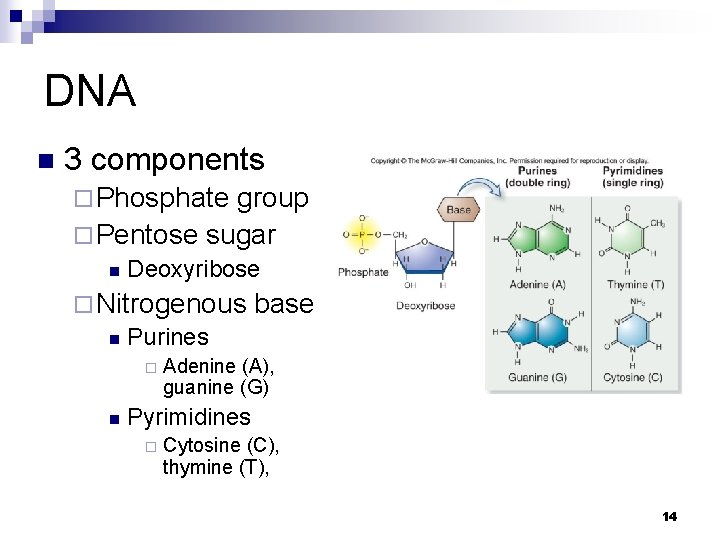
DNA n 3 components ¨ Phosphate group ¨ Pentose sugar n Deoxyribose ¨ Nitrogenous n Purines ¨ n base Adenine (A), guanine (G) Pyrimidines ¨ Cytosine (C), thymine (T), 14
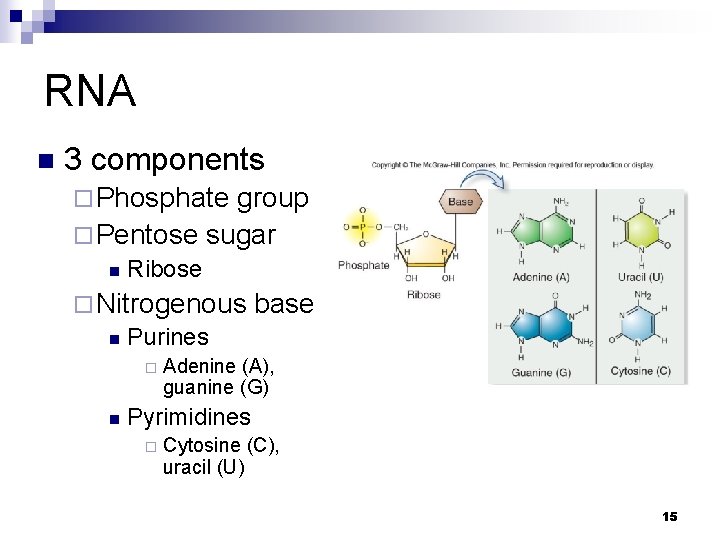
RNA n 3 components ¨ Phosphate group ¨ Pentose sugar n Ribose ¨ Nitrogenous n Purines ¨ n base Adenine (A), guanine (G) Pyrimidines ¨ Cytosine (C), uracil (U) 15
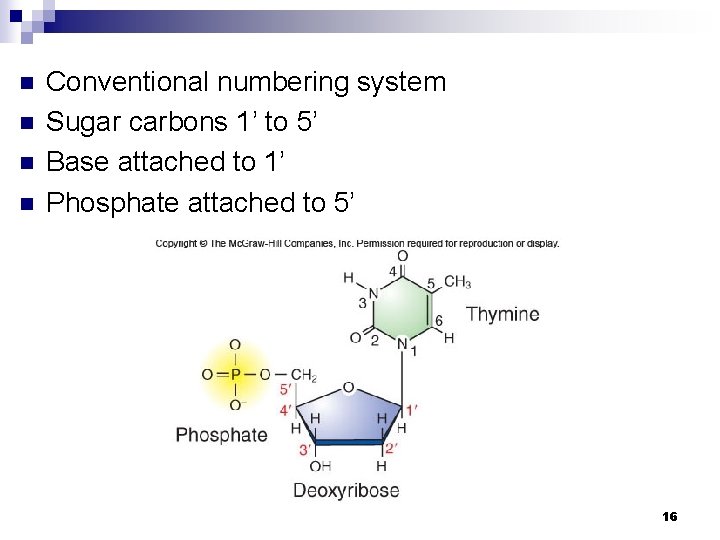
n n Conventional numbering system Sugar carbons 1’ to 5’ Base attached to 1’ Phosphate attached to 5’ 16
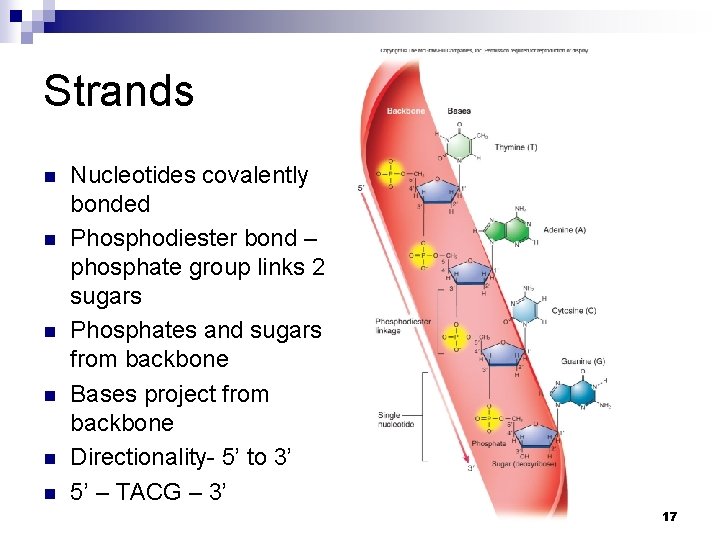
Strands n n n Nucleotides covalently bonded Phosphodiester bond – phosphate group links 2 sugars Phosphates and sugars from backbone Bases project from backbone Directionality- 5’ to 3’ 5’ – TACG – 3’ 17
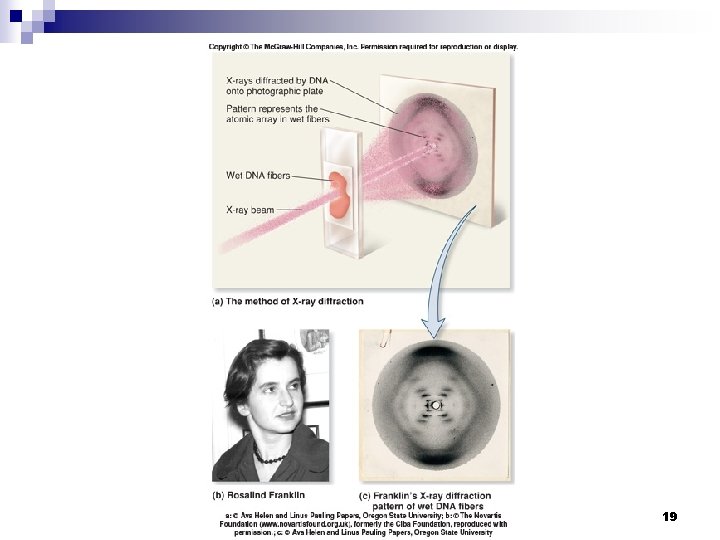
Solving DNA structure n n 1953, James Watson and Francis Crick, with Maurice Wilkins, proposed the structure of the DNA double helix Watson and Crick used Linus Pauling’s method of working out protein structures using simple ball-and-stick models Rosalind Franklin’s X-ray diffraction results provided crucial information Erwin Chargoff analyzed base composition of DNA that also provided important information 18
19
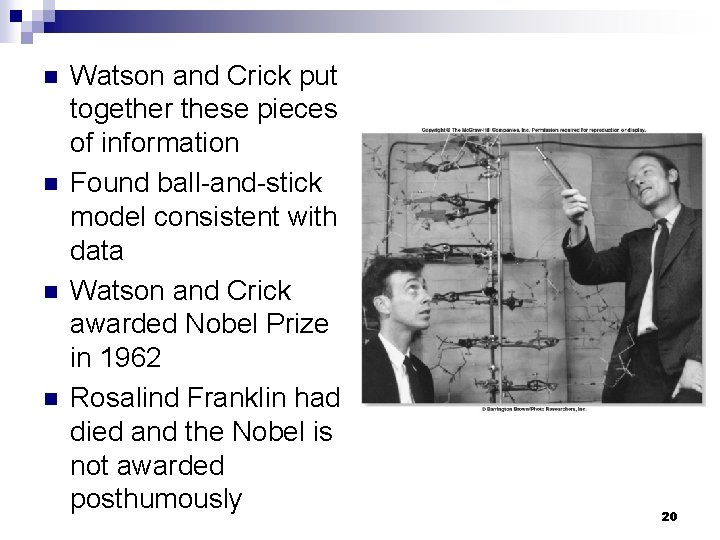
n n Watson and Crick put together these pieces of information Found ball-and-stick model consistent with data Watson and Crick awarded Nobel Prize in 1962 Rosalind Franklin had died and the Nobel is not awarded posthumously 20
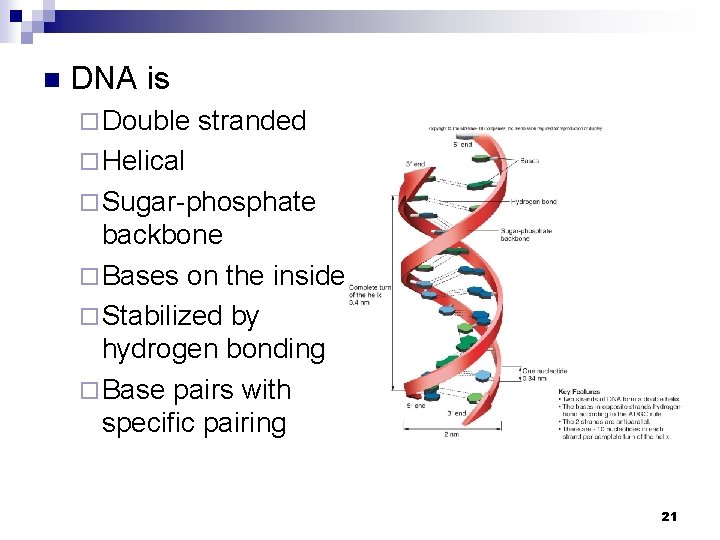
n DNA is ¨ Double stranded ¨ Helical ¨ Sugar-phosphate backbone ¨ Bases on the inside ¨ Stabilized by hydrogen bonding ¨ Base pairs with specific pairing 21
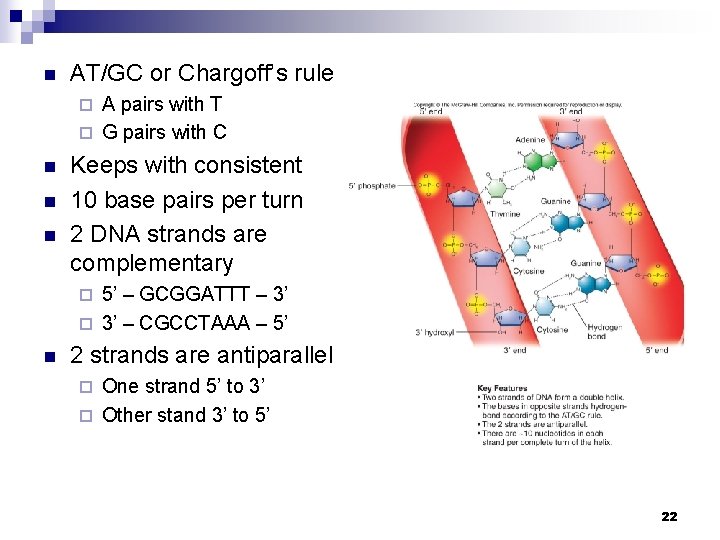
n AT/GC or Chargoff’s rule A pairs with T ¨ G pairs with C ¨ n n n Keeps with consistent 10 base pairs per turn 2 DNA strands are complementary 5’ – GCGGATTT – 3’ ¨ 3’ – CGCCTAAA – 5’ ¨ n 2 strands are antiparallel One strand 5’ to 3’ ¨ Other stand 3’ to 5’ ¨ 22
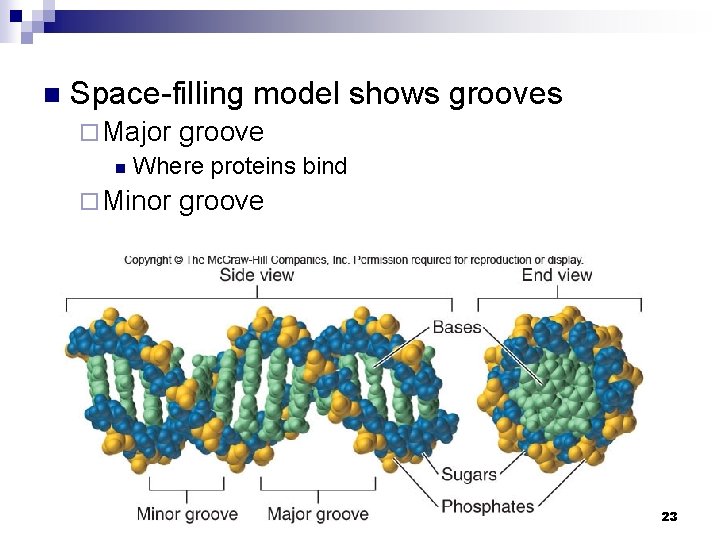
n Space-filling model shows grooves ¨ Major groove n Where proteins bind ¨ Minor groove 23
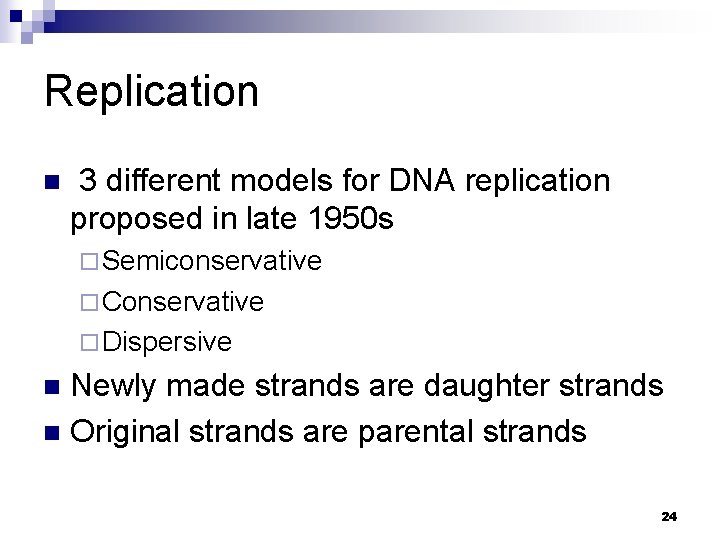
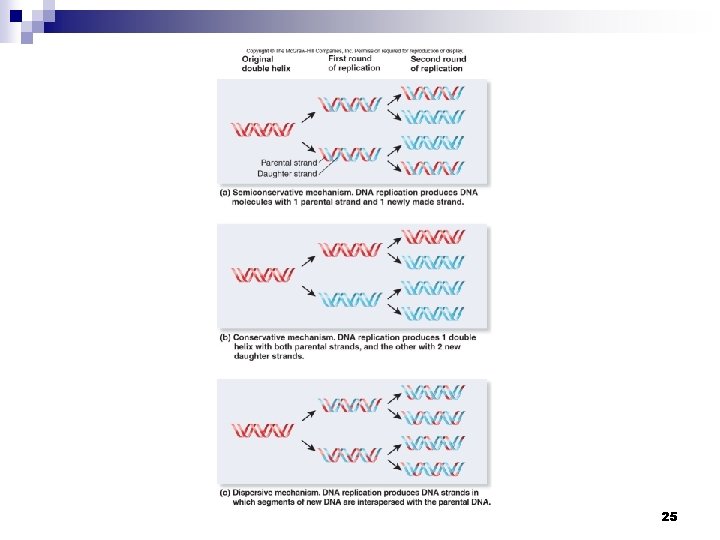
Replication n 3 different models for DNA replication proposed in late 1950 s ¨ Semiconservative ¨ Conservative ¨ Dispersive Newly made strands are daughter strands n Original strands are parental strands n 24
25
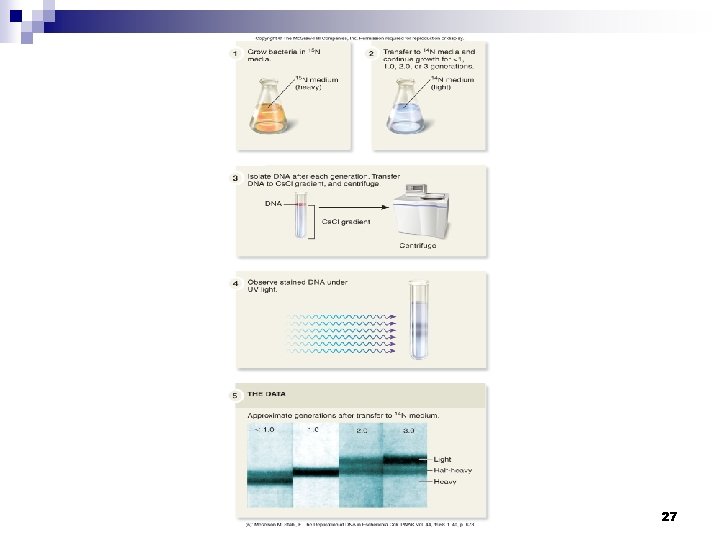
n n n n In 1958, Matthew Meselson and Franklin Stahl devised experiment to differentiate among 3 proposed mechanisms Nitrogen comes in a common light form (14 N) and a rare heavy form (15 N) Grew E. coli in medium with only 15 N Then switched to medium with only 14 N Collected sample after each generation Original parental strands would be 15 N while newly made strands would be 14 N Results consistent with semiconservative mechanism 26
27
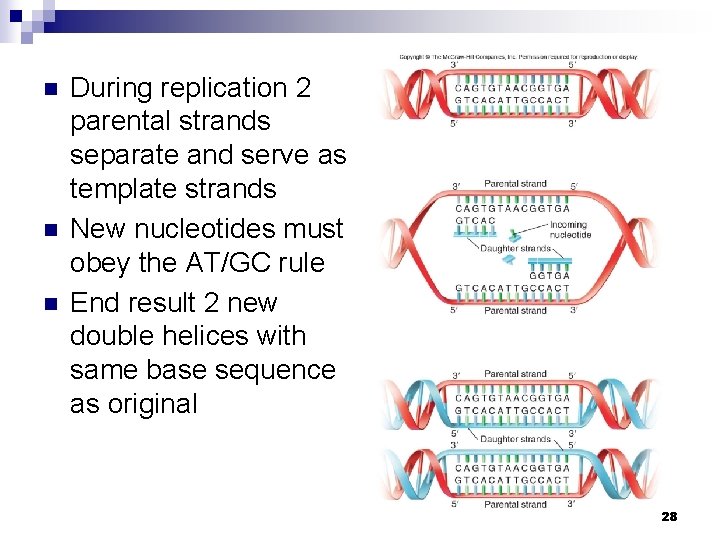
n n n During replication 2 parental strands separate and serve as template strands New nucleotides must obey the AT/GC rule End result 2 new double helices with same base sequence as original 28
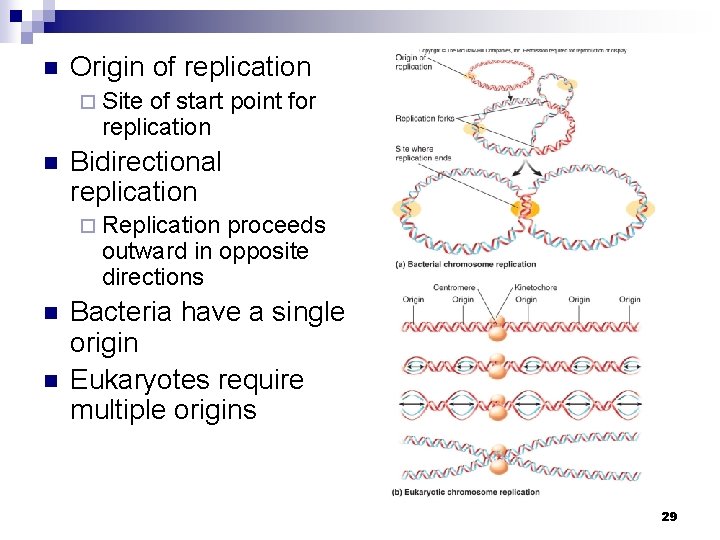
n Origin of replication ¨ Site of start point for replication n Bidirectional replication ¨ Replication proceeds outward in opposite directions n n Bacteria have a single origin Eukaryotes require multiple origins 29
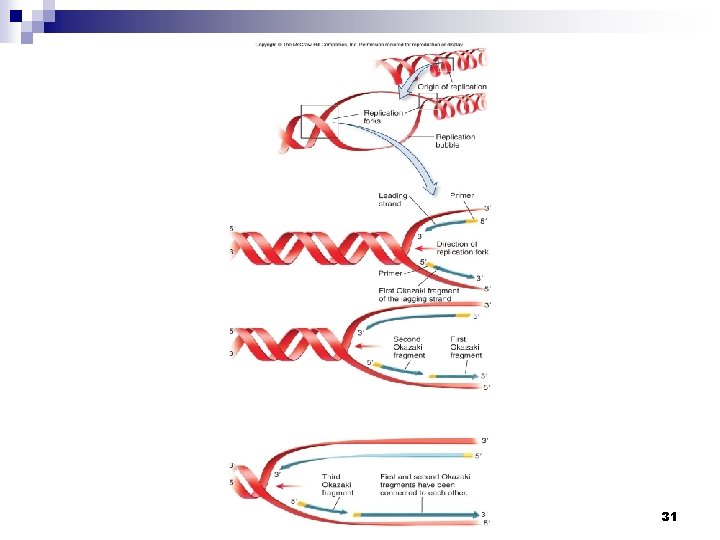
Origin of replication provides an opening called a replication bubble that forms two replication forks n DNA replication occurs near the fork n Synthesis begins with a primer n Proceeds 5’ to 3’ n Leading strand made in direction fork is moving n ¨ Synthesized n as one long continuous molecule Lagging strand made as Okazaki fragments that have to be connected later 30
31
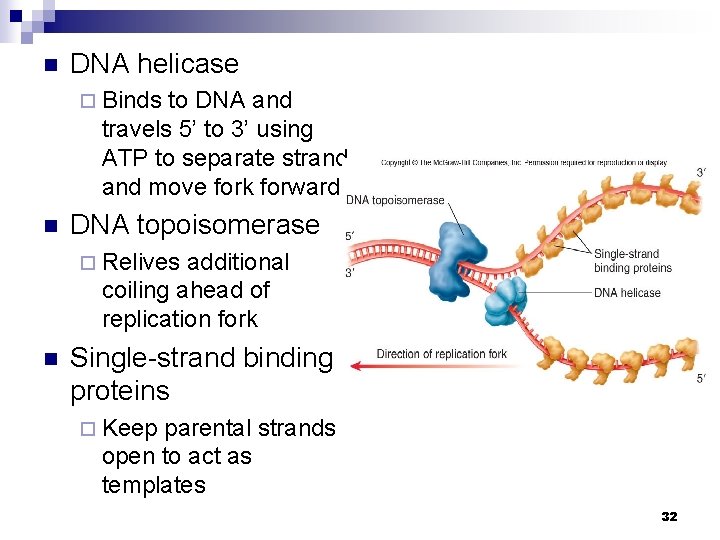
n DNA helicase ¨ Binds to DNA and travels 5’ to 3’ using ATP to separate strand move fork forward n DNA topoisomerase ¨ Relives additional coiling ahead of replication fork n Single-strand binding proteins ¨ Keep parental strands open to act as templates 32
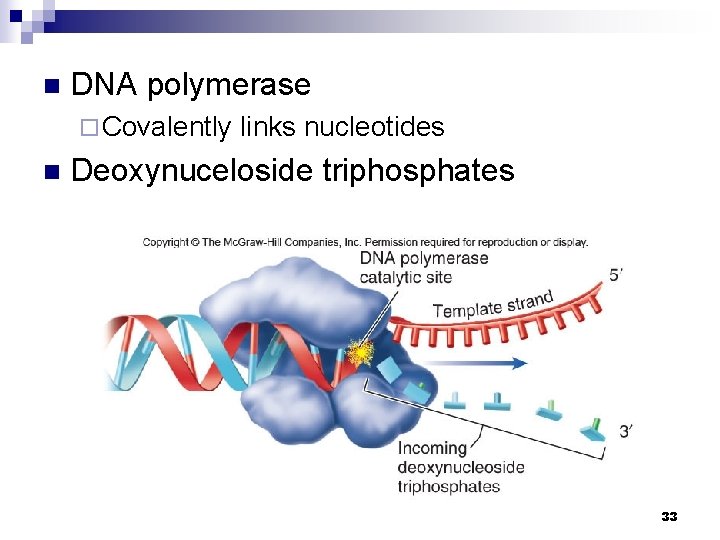
n DNA polymerase ¨ Covalently n links nucleotides Deoxynuceloside triphosphates 33
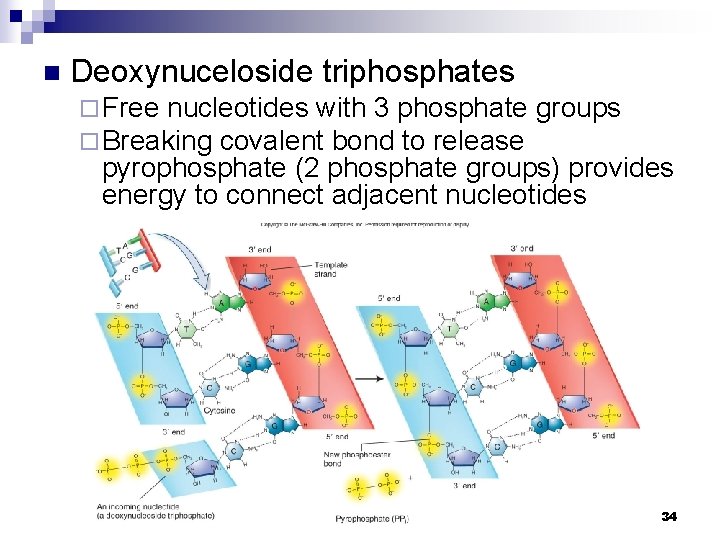
n Deoxynuceloside triphosphates ¨ Free nucleotides with 3 phosphate ¨ Breaking covalent bond to release groups pyrophosphate (2 phosphate groups) provides energy to connect adjacent nucleotides 34
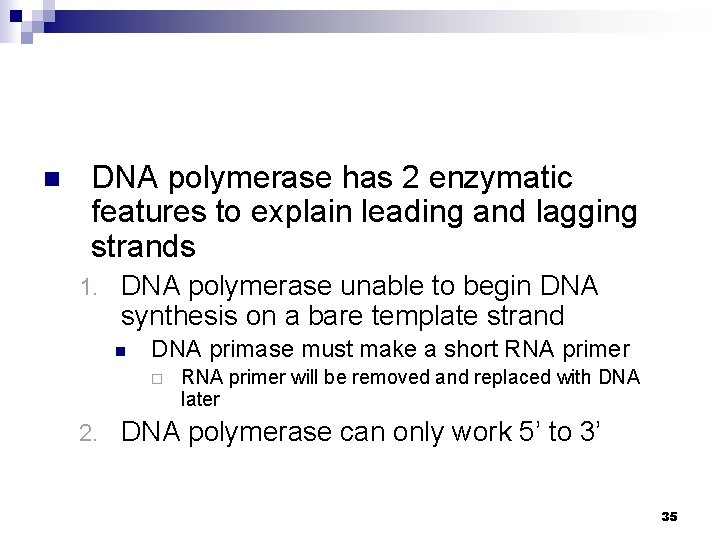
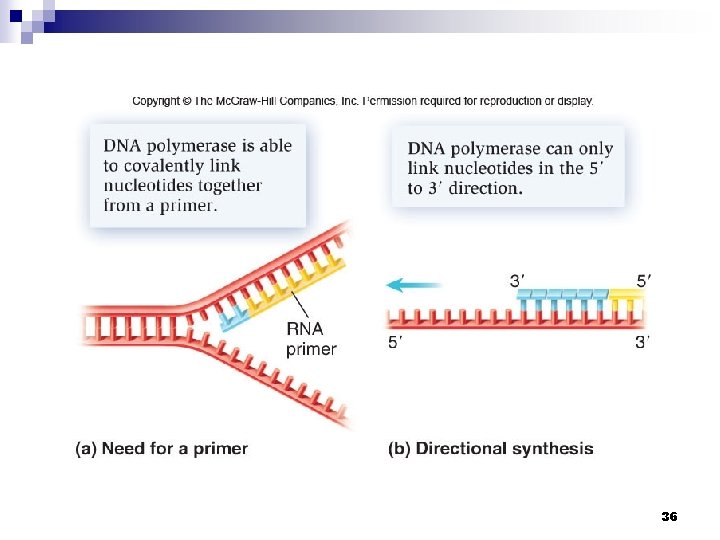
n DNA polymerase has 2 enzymatic features to explain leading and lagging strands 1. DNA polymerase unable to begin DNA synthesis on a bare template strand n DNA primase must make a short RNA primer ¨ 2. RNA primer will be removed and replaced with DNA later DNA polymerase can only work 5’ to 3’ 35
36
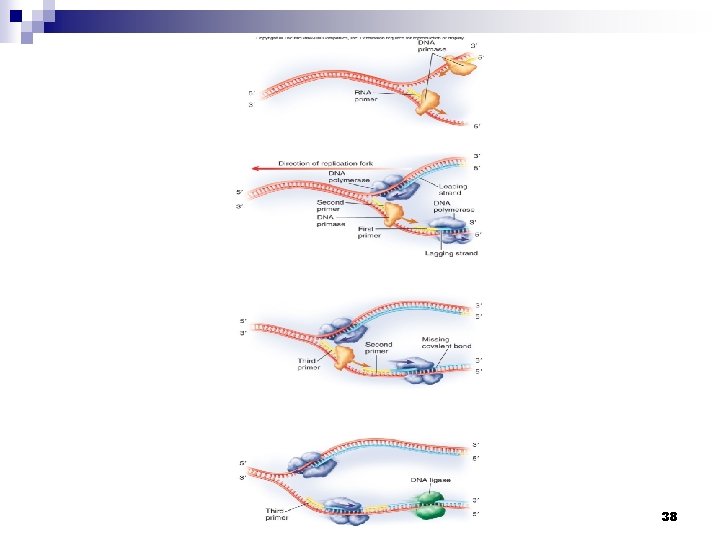
n In the leading strand ¨ DNA primase makes one RNA primer ¨ DNA polymerase attaches nucleotides in a 5’ to 3’ direction as it slides forward n In the lagging strand ¨ DNA synthesized 5’ to 3’ but in a direction away from the fork ¨ Okazaki fragments made as a short RNA primer made by DNA primase at the 5’ end and then DNA laid down by DNA polymerase ¨ RNA primers will be removed by DNA polymerase and filled in with DNA ¨ DNA ligase will join adjacent DNA fragments 37
38
DNA replication is very accurate n 3 reasons Hydrogen bonding between A and T or G and C more stable than mismatches 2. Active site of DNA polymerase unlikely to form bonds if pairs mismatched 3. DNA polymerase removes mismatched pairs 1. n n Proofreading results in DNA polymerase backing up and digesting linkages Other DNA repair enzymes 39
The family of DNA polymerases 3 important issues for DNA polymerase are speed, fidelity, and completeness n Nearly all living species have more than 1 type of DNA polymerase n Genomes of most species have several DNA polymerase genes due to gene duplication n Independent genetic changes produce enzymes with specialized functions suited to the organism n 40
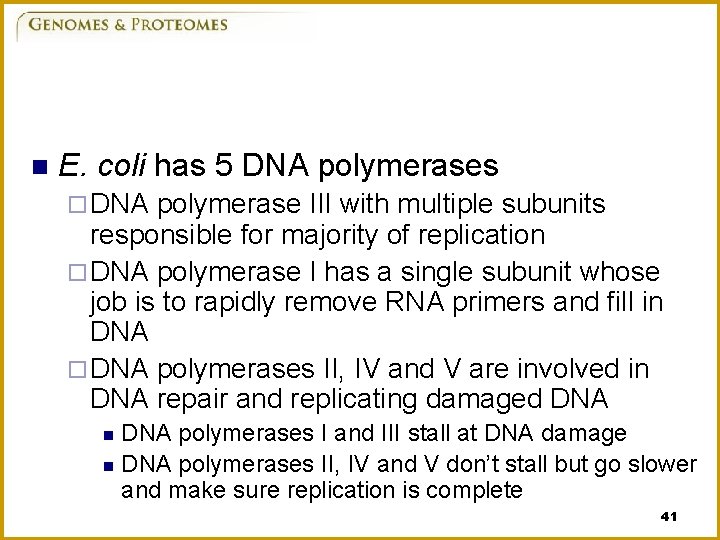
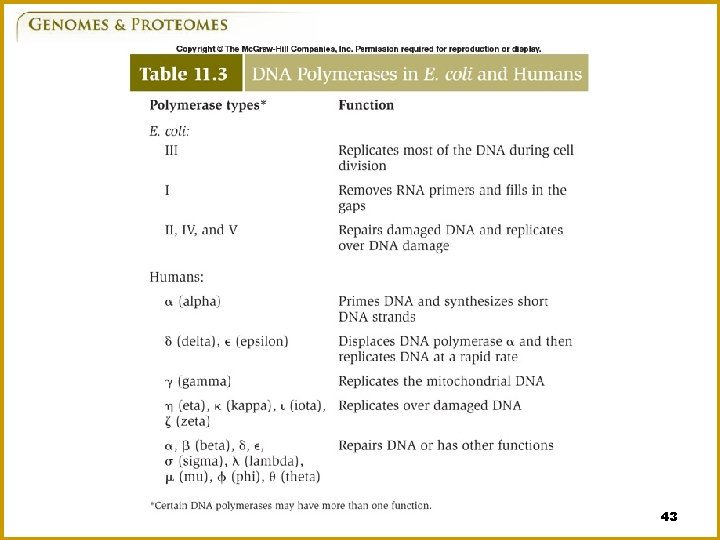
n E. coli has 5 DNA polymerases ¨ DNA polymerase III with multiple subunits responsible for majority of replication ¨ DNA polymerase I has a single subunit whose job is to rapidly remove RNA primers and fill in DNA ¨ DNA polymerases II, IV and V are involved in DNA repair and replicating damaged DNA polymerases I and III stall at DNA damage n DNA polymerases II, IV and V don’t stall but go slower and make sure replication is complete n 41
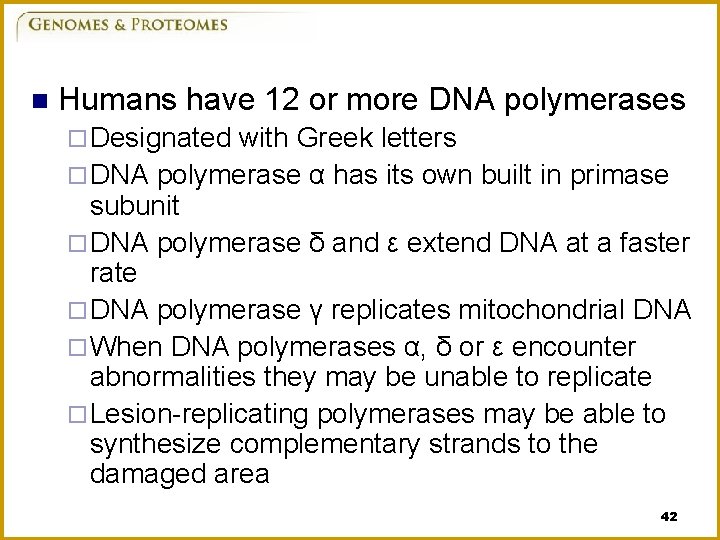
n Humans have 12 or more DNA polymerases ¨ Designated with Greek letters ¨ DNA polymerase α has its own built in primase subunit ¨ DNA polymerase δ and ε extend DNA at a faster rate ¨ DNA polymerase γ replicates mitochondrial DNA ¨ When DNA polymerases α, δ or ε encounter abnormalities they may be unable to replicate ¨ Lesion-replicating polymerases may be able to synthesize complementary strands to the damaged area 42
43
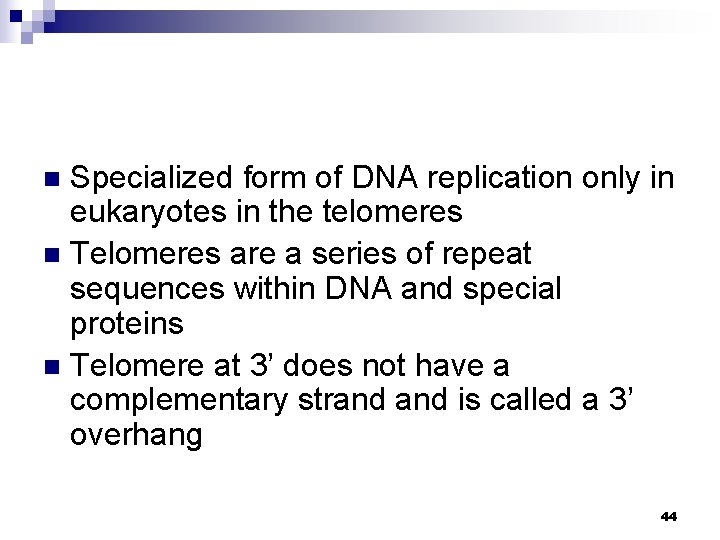
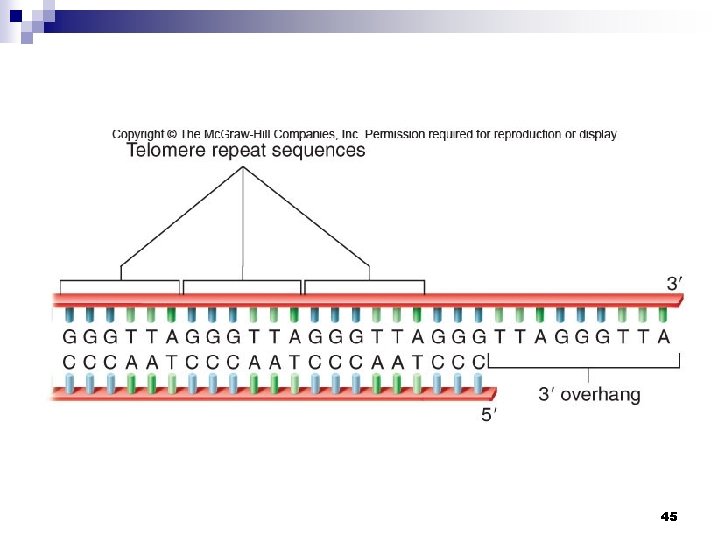
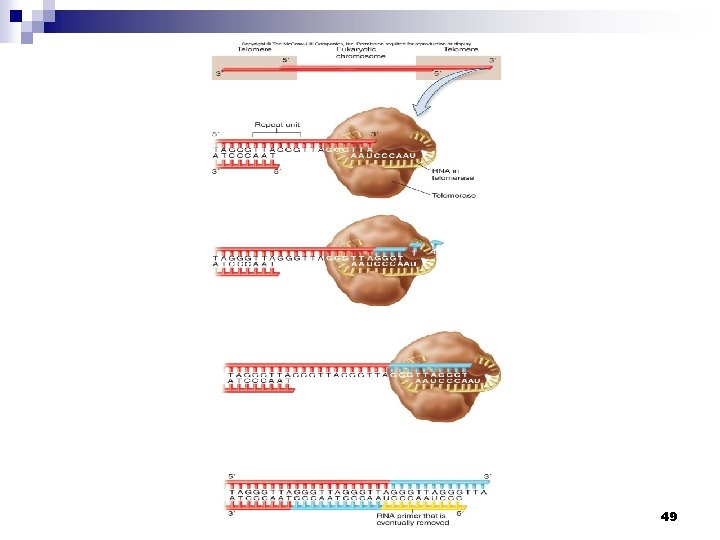
Specialized form of DNA replication only in eukaryotes in the telomeres n Telomeres are a series of repeat sequences within DNA and special proteins n Telomere at 3’ does not have a complementary strand is called a 3’ overhang n 44
45
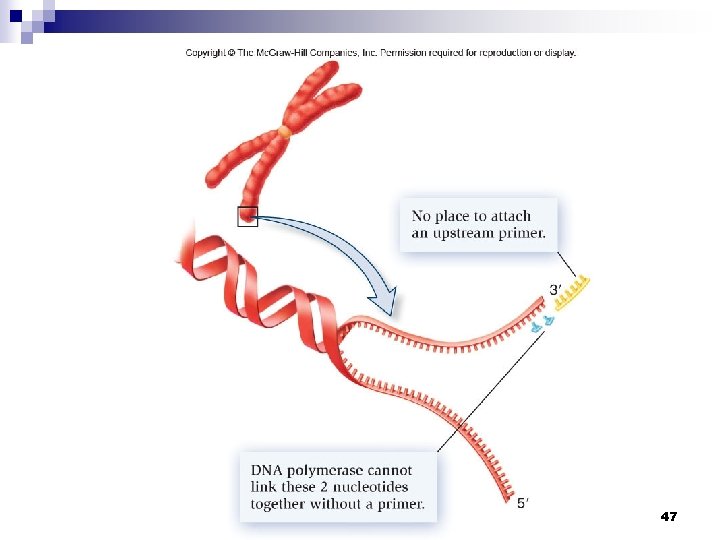
n DNA polymerase cannot copy the tip of the DNA strand with a 3’ end ¨ No n place for upstream primer to be made If this replication problem were not solved, linear chromosomes would become progressively shorter 46
47
Telomerase prevents chromosome shortening n Attaches many copies of repeated DNA sequences to the ends of the chromosomes n Provides upstream site for RNA primer n 48
49
Telomeres and aging Body cells have a predetermined life span n Skin sample grown in a dish will double a finite number of times n ¨ Infants, about 80 times ¨ Older person, 10 to 20 times n Senescent cells have lost the capacity to divide 50
Progressive shortening of telomeres correlated with cellular senescence n Telomerase present in germ-line cells and in rapidly dividing somatic cells n Telomerase function reduces with age n Inserting a highly active telomerase gene into cells in the lab causes them to continue to divide n 51
Telomeres and cancer When cells become cancerous they divide uncontrollably n In 90% of all types of human cancers, telomerase is found at high levels n Prevents telomere shortening and may play a role in continued growth of cancer cells n Mechanism unknown n 52