
Chapter 11 Network Management Applications Chapter 11 18
- Slides: 69
Chapter 11 Network Management Applications Chapter 11 18 -29 ﻣﺤﺬﻭﻑ Network Management Applications Network Management: Principles and Practice © Mani Subramanian 2010 *
Chapter 11 Network Management Applications Objectives • • • Network management and system management Network management • Configuration • Fault • Performance • Security • Accounting Configuration management • Service/Network provisioning • Inventory management Fault management • Fault detection and isolation • Correlation techniques for root cause analysis Performance management • Performance metrics • Data monitoring • Problem isolation • Performance statistics (continued) Network Management: Principles and Practice © Mani Subramanian 2010 *
Chapter 11 Network Management Applications Objectives (cont. ) • • • Security management • Security policies and procedures • Security threats • Firewall • Cryptography: keys, algorithms, authentication, and authorization schemes • Secure message transfer methods Accounting management Report management Policy-based management Service level management • Quality of service, Qo. S • Service level agreement, SLA Network Management: Principles and Practice © Mani Subramanian 2010 *
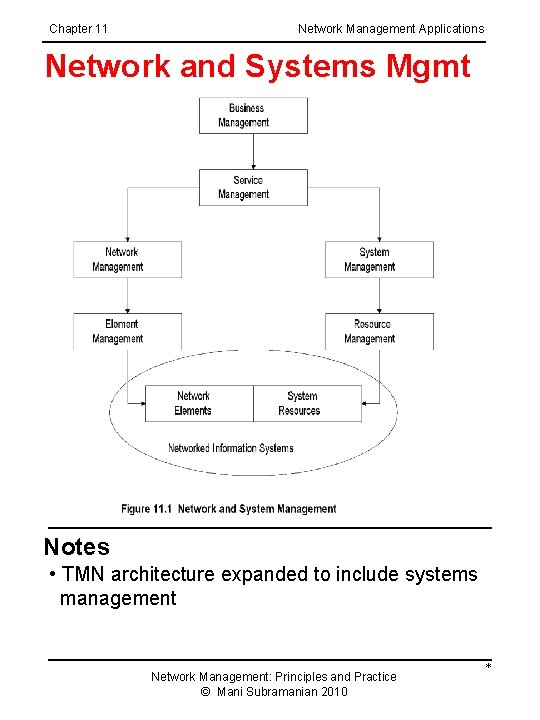
Chapter 11 Network Management Applications Network and Systems Mgmt Notes • TMN architecture expanded to include systems management Network Management: Principles and Practice © Mani Subramanian 2010 *
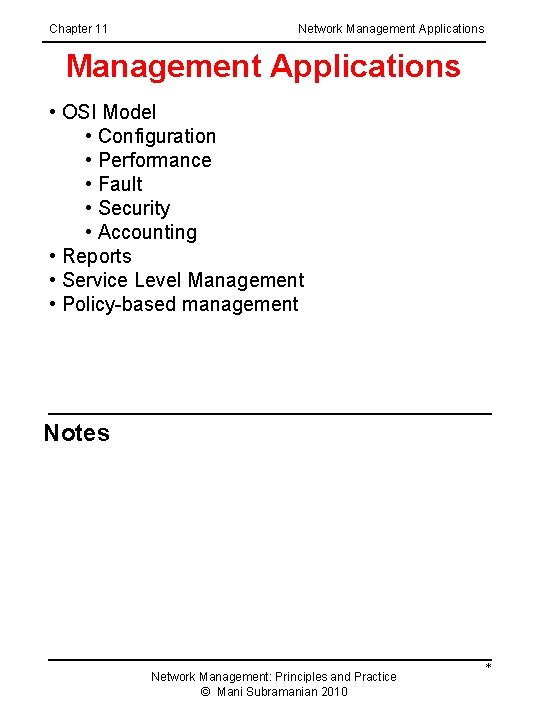
Chapter 11 Network Management Applications • OSI Model • Configuration • Performance • Fault • Security • Accounting • Reports • Service Level Management • Policy-based management Notes Network Management: Principles and Practice © Mani Subramanian 2010 *
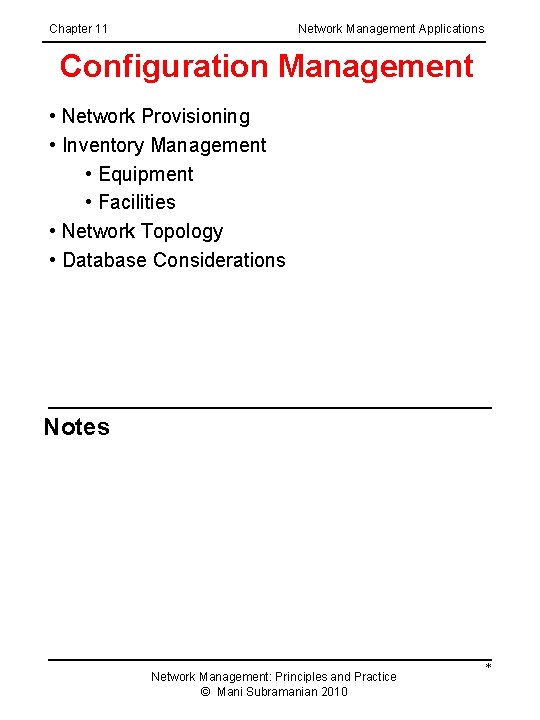
Chapter 11 Network Management Applications Configuration Management • Network Provisioning • Inventory Management • Equipment • Facilities • Network Topology • Database Considerations Notes Network Management: Principles and Practice © Mani Subramanian 2010 *
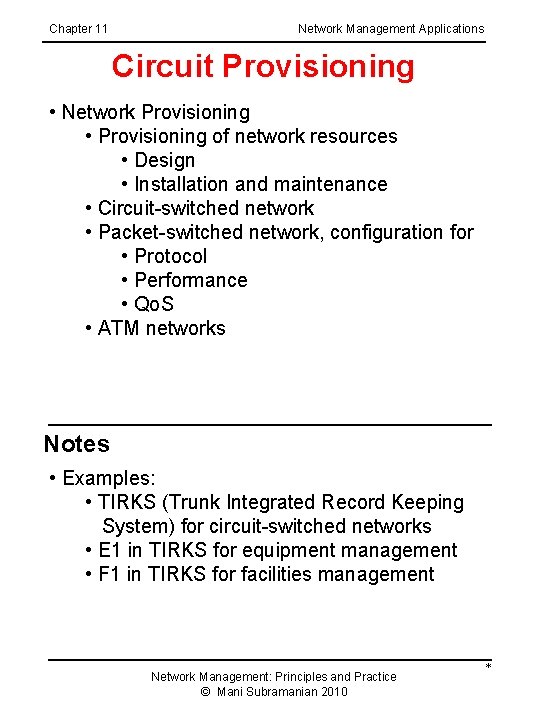
Chapter 11 Network Management Applications Circuit Provisioning • Network Provisioning • Provisioning of network resources • Design • Installation and maintenance • Circuit-switched network • Packet-switched network, configuration for • Protocol • Performance • Qo. S • ATM networks Notes • Examples: • TIRKS (Trunk Integrated Record Keeping System) for circuit-switched networks • E 1 in TIRKS for equipment management • F 1 in TIRKS for facilities management Network Management: Principles and Practice © Mani Subramanian 2010 *
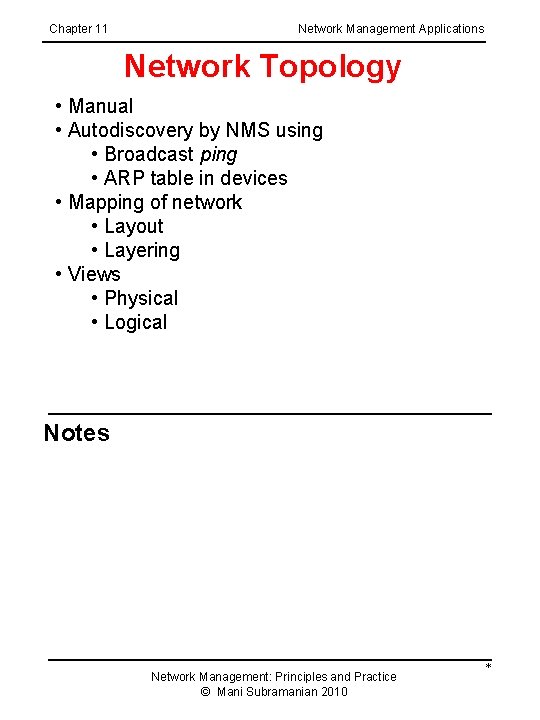
Chapter 11 Network Management Applications Network Topology • Manual • Autodiscovery by NMS using • Broadcast ping • ARP table in devices • Mapping of network • Layout • Layering • Views • Physical • Logical Notes Network Management: Principles and Practice © Mani Subramanian 2010 *
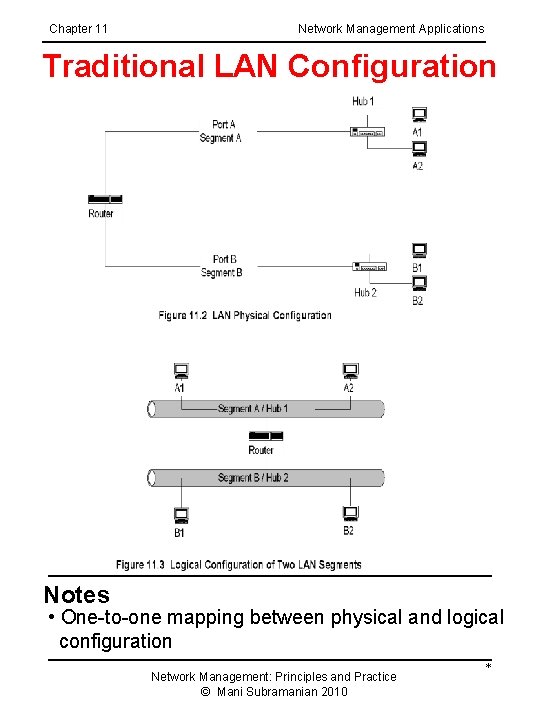
Chapter 11 Network Management Applications Traditional LAN Configuration Notes • One-to-one mapping between physical and logical configuration Network Management: Principles and Practice © Mani Subramanian 2010 *
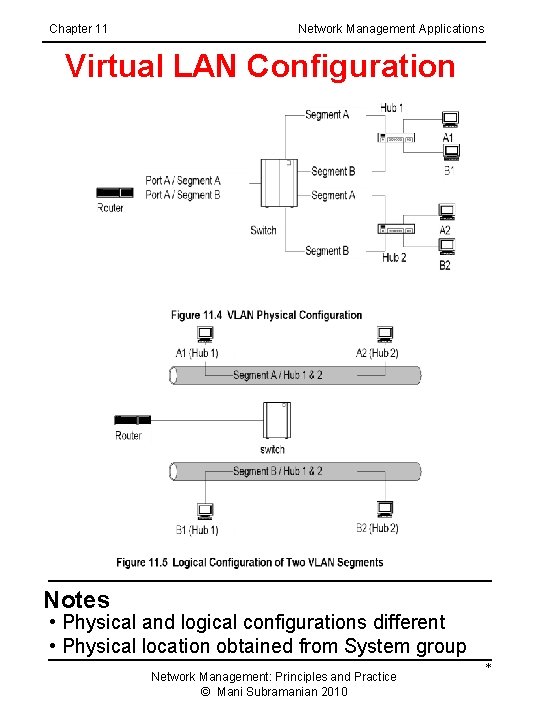
Chapter 11 Network Management Applications Virtual LAN Configuration Notes • Physical and logical configurations different • Physical location obtained from System group Network Management: Principles and Practice © Mani Subramanian 2010 *
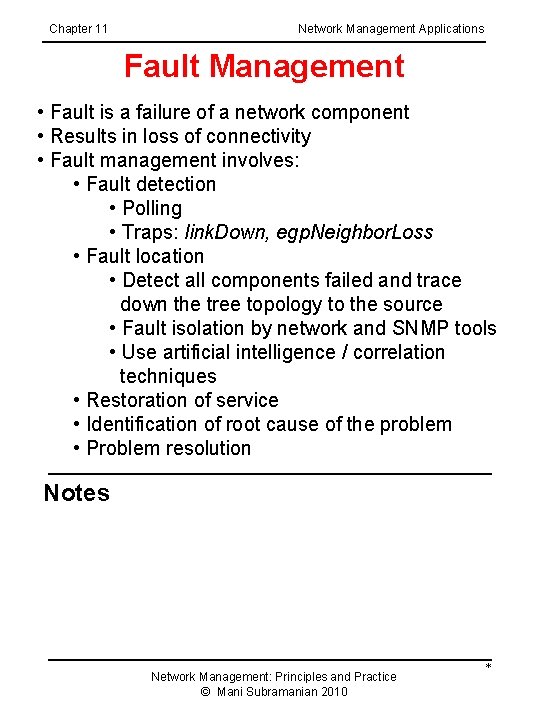
Chapter 11 Network Management Applications Fault Management • Fault is a failure of a network component • Results in loss of connectivity • Fault management involves: • Fault detection • Polling • Traps: link. Down, egp. Neighbor. Loss • Fault location • Detect all components failed and trace down the tree topology to the source • Fault isolation by network and SNMP tools • Use artificial intelligence / correlation techniques • Restoration of service • Identification of root cause of the problem • Problem resolution Notes Network Management: Principles and Practice © Mani Subramanian 2010 *
Chapter 11 Network Management Applications Performance Management • Tools • Performance Metrics • Data Monitoring • Problem Isolation • Performance Statistics Notes • Tools: • Protocol analyzers • RMON • MRTG Network Management: Principles and Practice © Mani Subramanian 2010 *
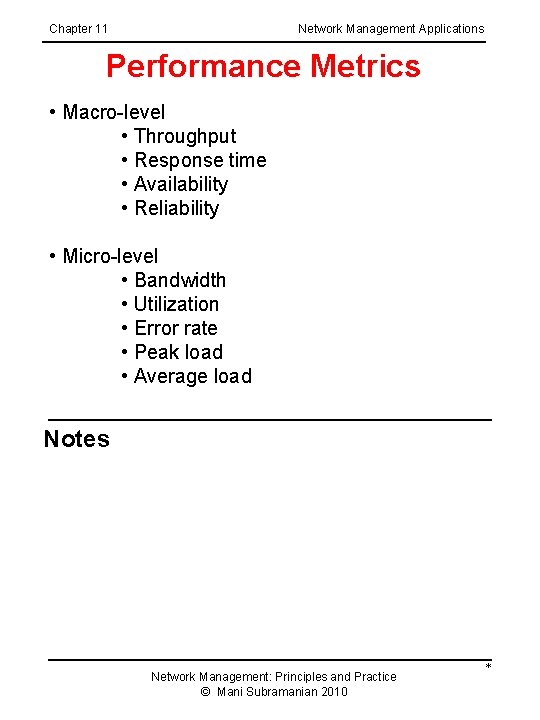
Chapter 11 Network Management Applications Performance Metrics • Macro-level • Throughput • Response time • Availability • Reliability • Micro-level • Bandwidth • Utilization • Error rate • Peak load • Average load Notes Network Management: Principles and Practice © Mani Subramanian 2010 *
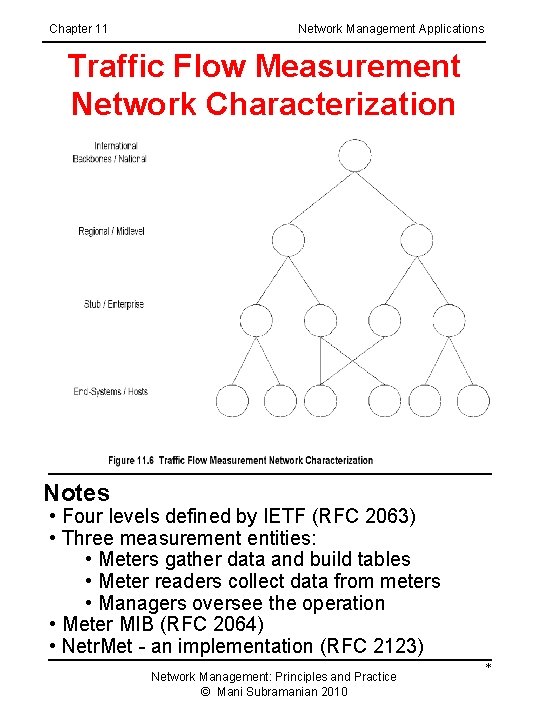
Chapter 11 Network Management Applications Traffic Flow Measurement Network Characterization Notes • Four levels defined by IETF (RFC 2063) • Three measurement entities: • Meters gather data and build tables • Meter readers collect data from meters • Managers oversee the operation • Meter MIB (RFC 2064) • Netr. Met - an implementation (RFC 2123) Network Management: Principles and Practice © Mani Subramanian 2010 *
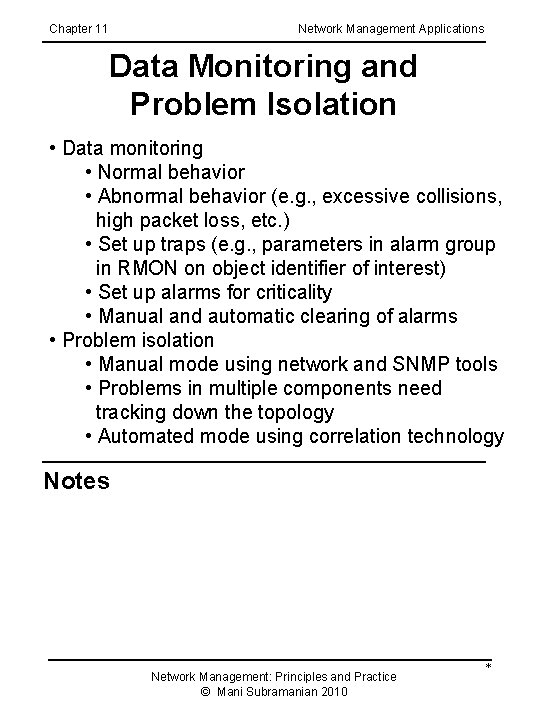
Chapter 11 Network Management Applications Data Monitoring and Problem Isolation • Data monitoring • Normal behavior • Abnormal behavior (e. g. , excessive collisions, high packet loss, etc. ) • Set up traps (e. g. , parameters in alarm group in RMON on object identifier of interest) • Set up alarms for criticality • Manual and automatic clearing of alarms • Problem isolation • Manual mode using network and SNMP tools • Problems in multiple components need tracking down the topology • Automated mode using correlation technology Notes Network Management: Principles and Practice © Mani Subramanian 2010 *
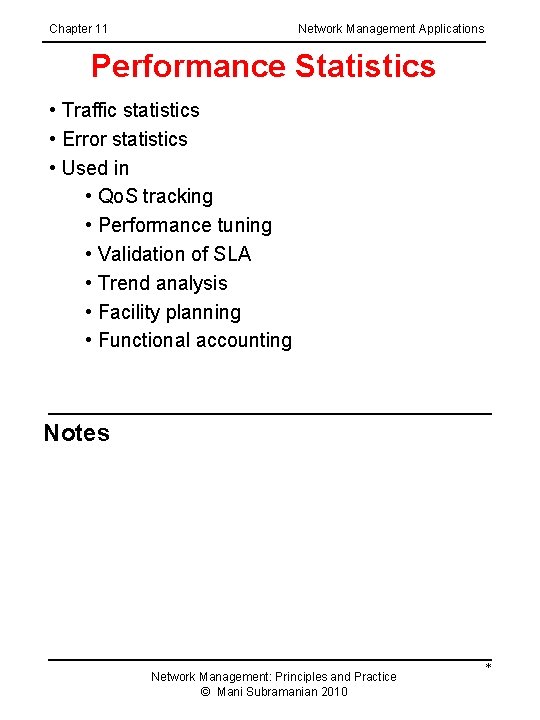
Chapter 11 Network Management Applications Performance Statistics • Traffic statistics • Error statistics • Used in • Qo. S tracking • Performance tuning • Validation of SLA • Trend analysis • Facility planning • Functional accounting Notes Network Management: Principles and Practice © Mani Subramanian 2010 *
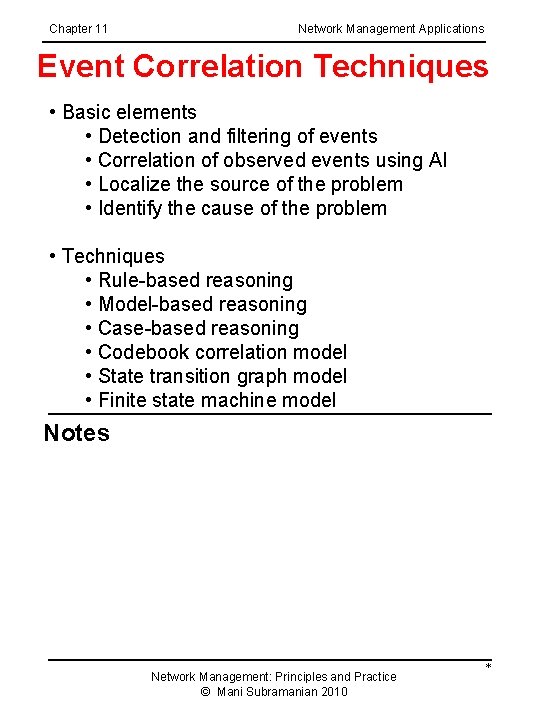
Chapter 11 Network Management Applications Event Correlation Techniques • Basic elements • Detection and filtering of events • Correlation of observed events using AI • Localize the source of the problem • Identify the cause of the problem • Techniques • Rule-based reasoning • Model-based reasoning • Case-based reasoning • Codebook correlation model • State transition graph model • Finite state machine model Notes Network Management: Principles and Practice © Mani Subramanian 2010 *
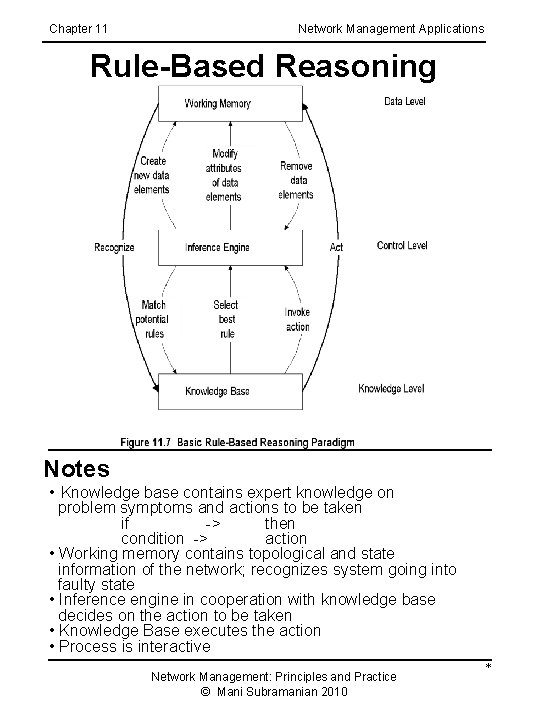
Chapter 11 Network Management Applications Rule-Based Reasoning Notes • Knowledge base contains expert knowledge on problem symptoms and actions to be taken if -> then condition -> action • Working memory contains topological and state information of the network; recognizes system going into faulty state • Inference engine in cooperation with knowledge base decides on the action to be taken • Knowledge Base executes the action • Process is interactive Network Management: Principles and Practice © Mani Subramanian 2010 *
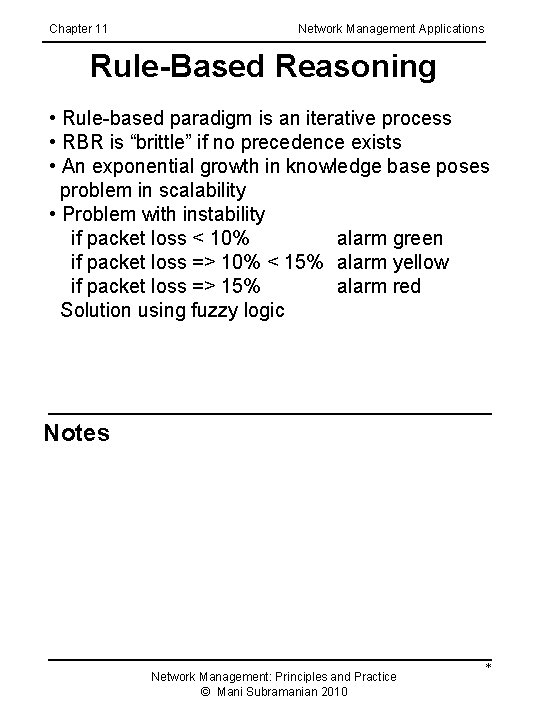
Chapter 11 Network Management Applications Rule-Based Reasoning • Rule-based paradigm is an iterative process • RBR is “brittle” if no precedence exists • An exponential growth in knowledge base poses problem in scalability • Problem with instability if packet loss < 10% alarm green if packet loss => 10% < 15% alarm yellow if packet loss => 15% alarm red Solution using fuzzy logic Notes Network Management: Principles and Practice © Mani Subramanian 2010 *
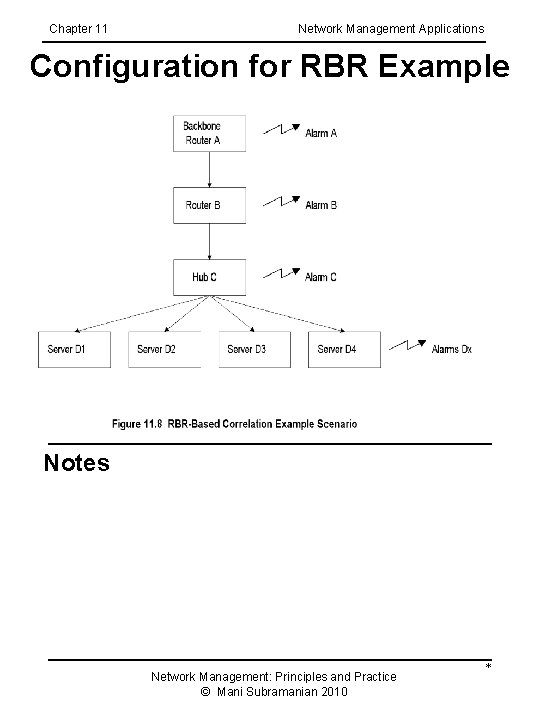
Chapter 11 Network Management Applications Configuration for RBR Example Notes Network Management: Principles and Practice © Mani Subramanian 2010 *
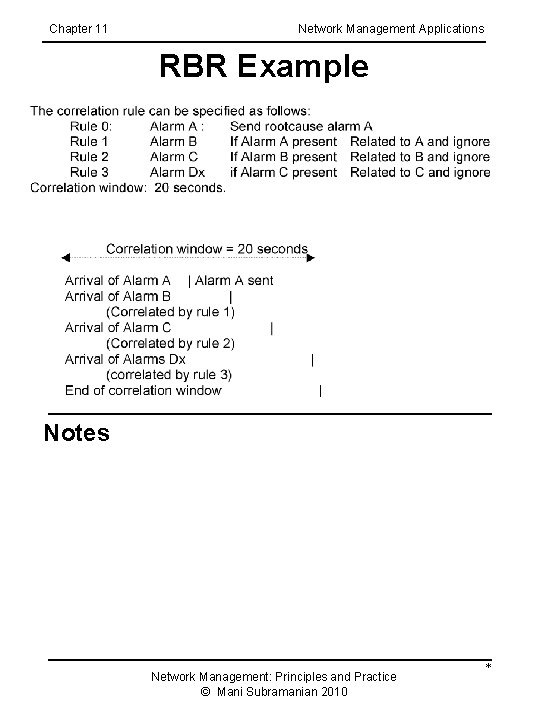
Chapter 11 Network Management Applications RBR Example Notes Network Management: Principles and Practice © Mani Subramanian 2010 *
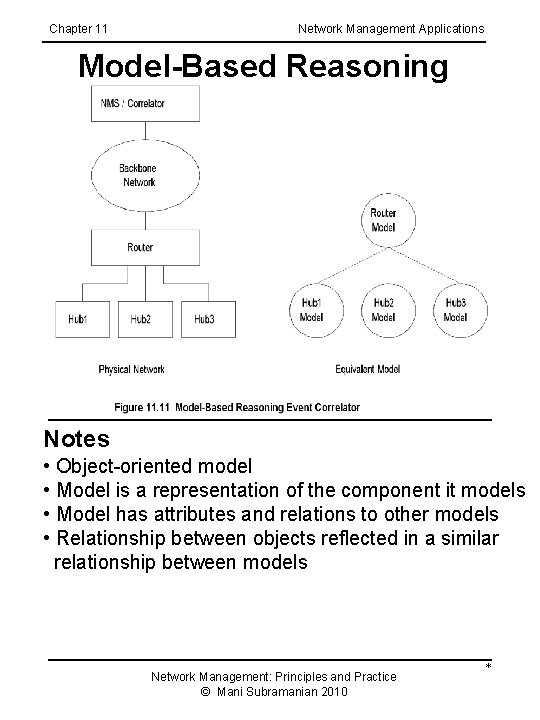
Chapter 11 Network Management Applications Model-Based Reasoning Notes • Object-oriented model • Model is a representation of the component it models • Model has attributes and relations to other models • Relationship between objects reflected in a similar relationship between models Network Management: Principles and Practice © Mani Subramanian 2010 *
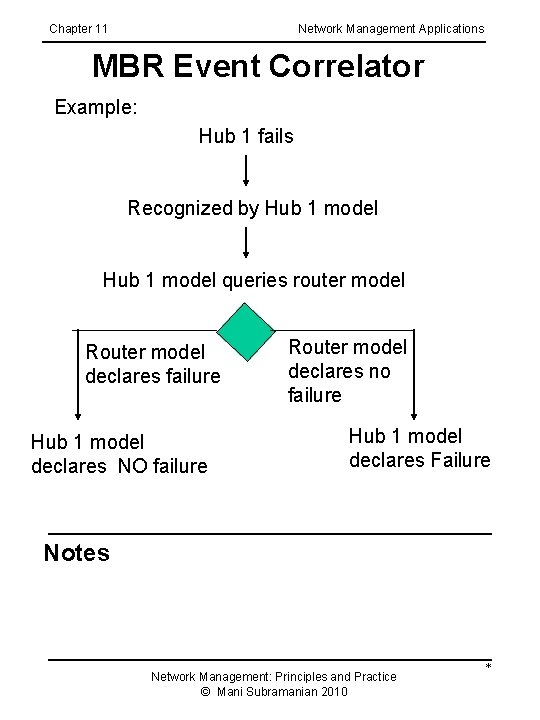
Chapter 11 Network Management Applications MBR Event Correlator Example: Hub 1 fails Recognized by Hub 1 model queries router model Router model declares failure Hub 1 model declares NO failure Router model declares no failure Hub 1 model declares Failure Notes Network Management: Principles and Practice © Mani Subramanian 2010 *
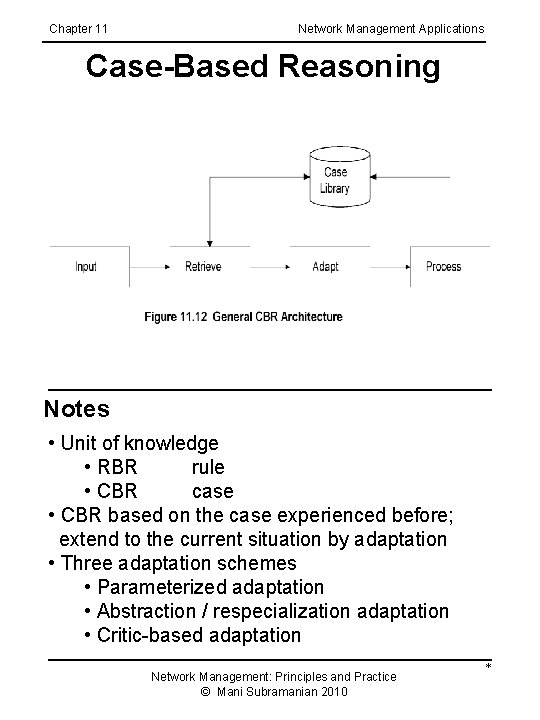
Chapter 11 Network Management Applications Case-Based Reasoning Notes • Unit of knowledge • RBR rule • CBR case • CBR based on the case experienced before; extend to the current situation by adaptation • Three adaptation schemes • Parameterized adaptation • Abstraction / respecialization adaptation • Critic-based adaptation Network Management: Principles and Practice © Mani Subramanian 2010 *
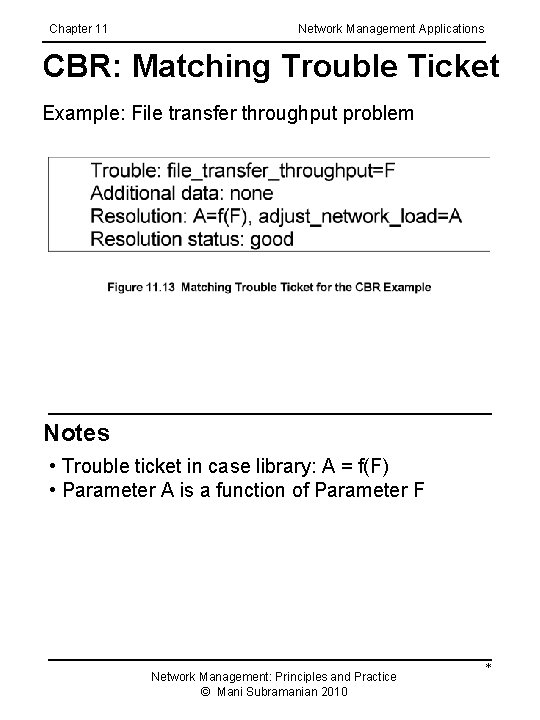
Chapter 11 Network Management Applications CBR: Matching Trouble Ticket Example: File transfer throughput problem Notes • Trouble ticket in case library: A = f(F) • Parameter A is a function of Parameter F Network Management: Principles and Practice © Mani Subramanian 2010 *
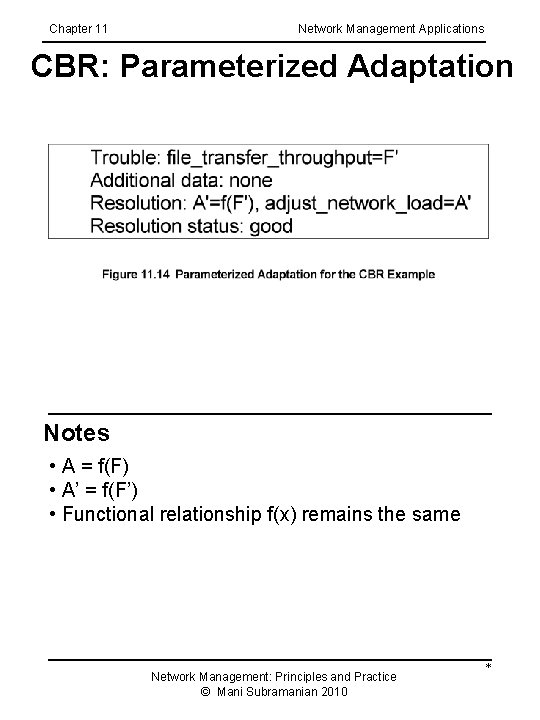
Chapter 11 Network Management Applications CBR: Parameterized Adaptation Notes • A = f(F) • A’ = f(F’) • Functional relationship f(x) remains the same Network Management: Principles and Practice © Mani Subramanian 2010 *
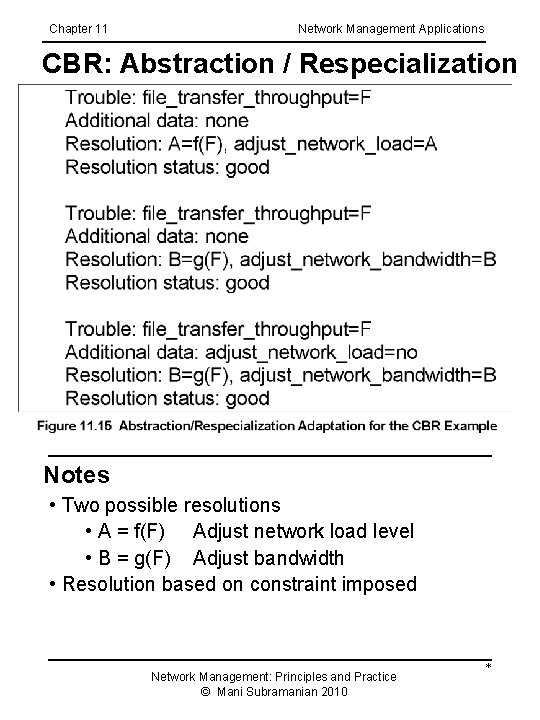
Chapter 11 Network Management Applications CBR: Abstraction / Respecialization Notes • Two possible resolutions • A = f(F) Adjust network load level • B = g(F) Adjust bandwidth • Resolution based on constraint imposed Network Management: Principles and Practice © Mani Subramanian 2010 *
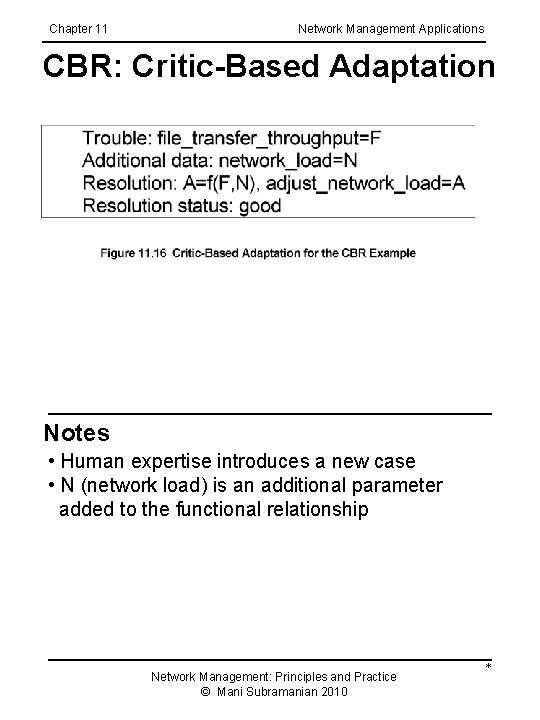
Chapter 11 Network Management Applications CBR: Critic-Based Adaptation Notes • Human expertise introduces a new case • N (network load) is an additional parameter added to the functional relationship Network Management: Principles and Practice © Mani Subramanian 2010 *
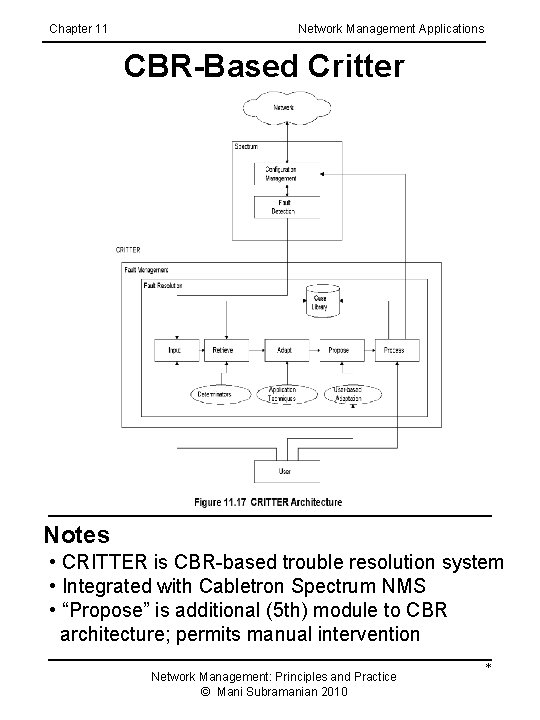
Chapter 11 Network Management Applications CBR-Based Critter Notes • CRITTER is CBR-based trouble resolution system • Integrated with Cabletron Spectrum NMS • “Propose” is additional (5 th) module to CBR architecture; permits manual intervention Network Management: Principles and Practice © Mani Subramanian 2010 *
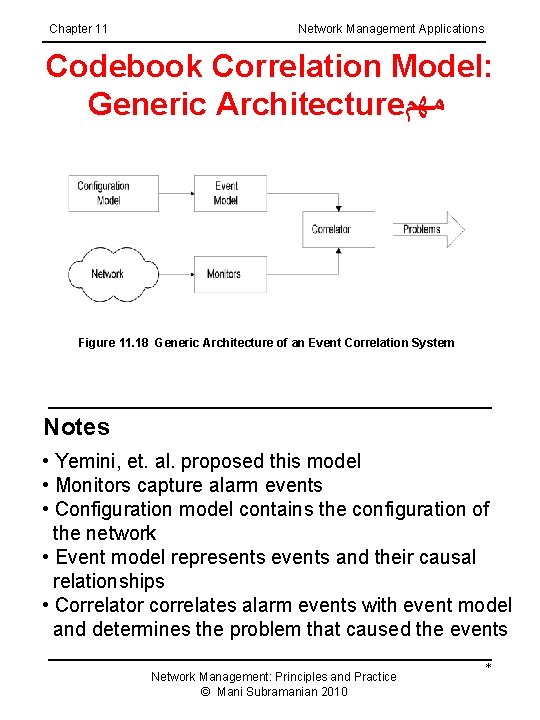
Chapter 11 Network Management Applications Codebook Correlation Model: Generic Architecture ﻣﻬﻢ Figure 11. 18 Generic Architecture of an Event Correlation System Notes • Yemini, et. al. proposed this model • Monitors capture alarm events • Configuration model contains the configuration of the network • Event model represents events and their causal relationships • Correlator correlates alarm events with event model and determines the problem that caused the events Network Management: Principles and Practice © Mani Subramanian 2010 *
Chapter 11 Network Management Applications Codebook Approach ﻣﻬﻢ Approach: • Correlation algorithms based upon coding approach to even correlation • Problem events viewed as messages generated by a system and encoded in sets of alarms • Correlator decodes the problem messages to identify the problems Two phases: 1. Codebook selection phase: Problems to be monitored identified and the symptoms they generate are associated with the problem. This generates codebook (problem-symptom matrix) 2. Correlator compares alarm events with codebook and identifies the problem. Notes Network Management: Principles and Practice © Mani Subramanian 2010 *
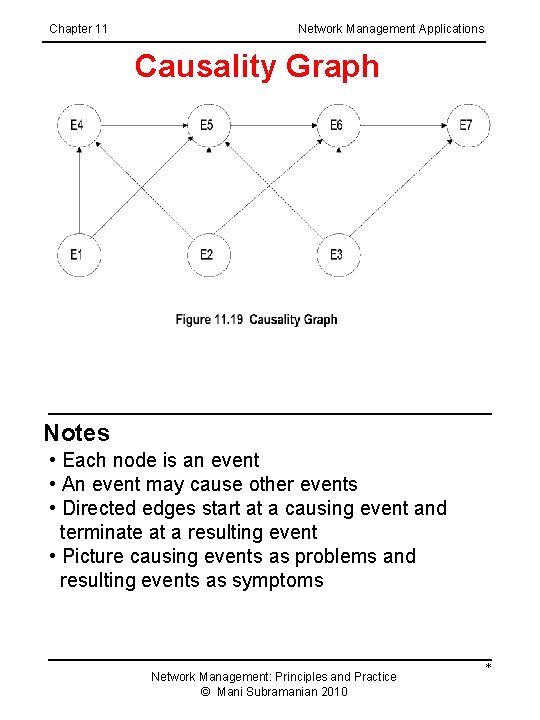
Chapter 11 Network Management Applications Causality Graph Notes • Each node is an event • An event may cause other events • Directed edges start at a causing event and terminate at a resulting event • Picture causing events as problems and resulting events as symptoms Network Management: Principles and Practice © Mani Subramanian 2010 *
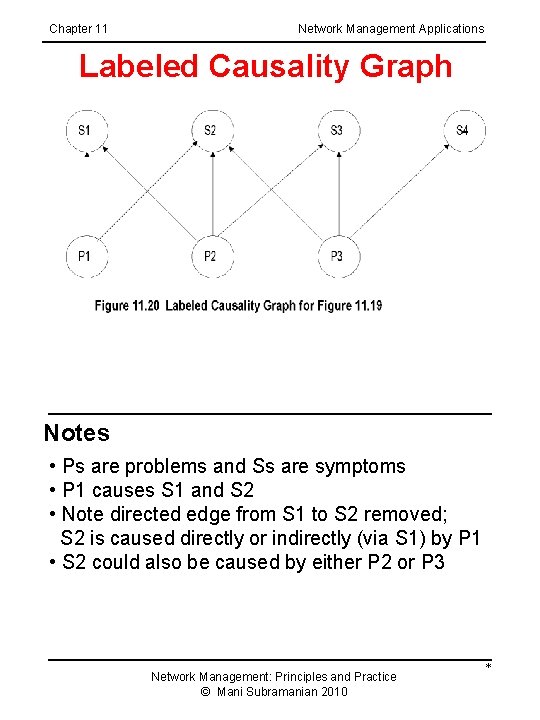
Chapter 11 Network Management Applications Labeled Causality Graph Notes • Ps are problems and Ss are symptoms • P 1 causes S 1 and S 2 • Note directed edge from S 1 to S 2 removed; S 2 is caused directly or indirectly (via S 1) by P 1 • S 2 could also be caused by either P 2 or P 3 Network Management: Principles and Practice © Mani Subramanian 2010 *
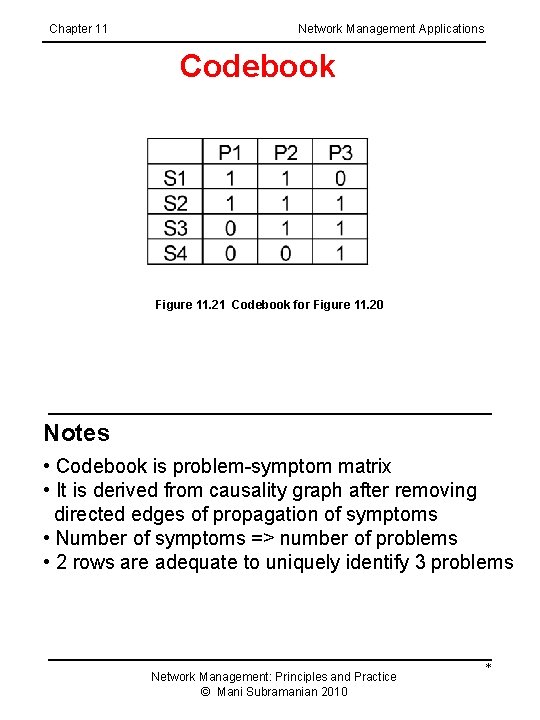
Chapter 11 Network Management Applications Codebook Figure 11. 21 Codebook for Figure 11. 20 Notes • Codebook is problem-symptom matrix • It is derived from causality graph after removing directed edges of propagation of symptoms • Number of symptoms => number of problems • 2 rows are adequate to uniquely identify 3 problems Network Management: Principles and Practice © Mani Subramanian 2010 *
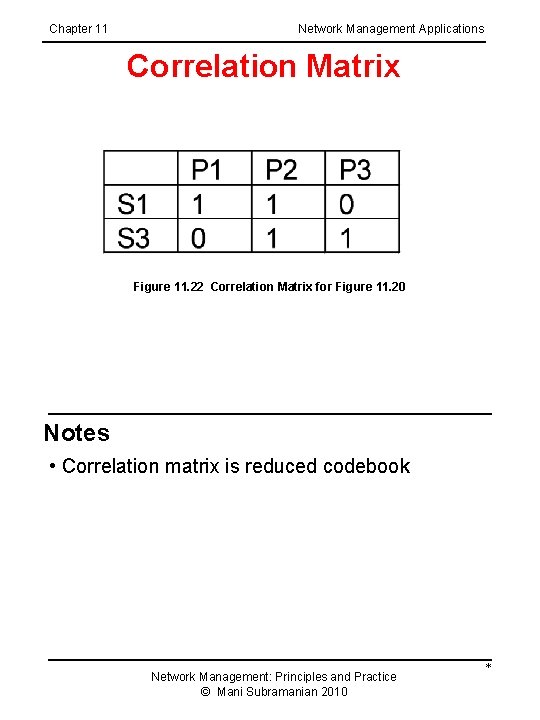
Chapter 11 Network Management Applications Correlation Matrix Figure 11. 22 Correlation Matrix for Figure 11. 20 Notes • Correlation matrix is reduced codebook Network Management: Principles and Practice © Mani Subramanian 2010 *
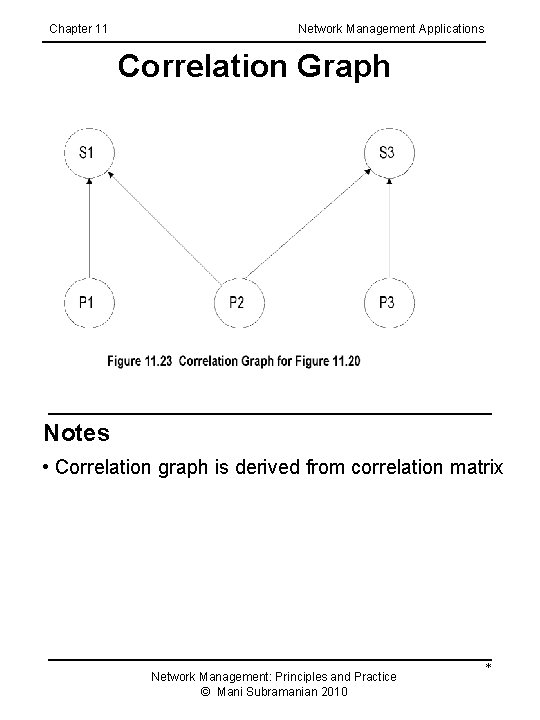
Chapter 11 Network Management Applications Correlation Graph Notes • Correlation graph is derived from correlation matrix Network Management: Principles and Practice © Mani Subramanian 2010 *
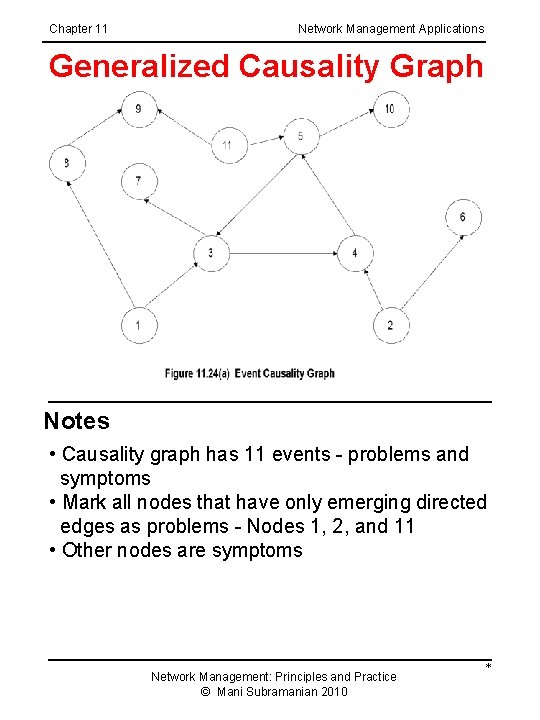
Chapter 11 Network Management Applications Generalized Causality Graph Notes • Causality graph has 11 events - problems and symptoms • Mark all nodes that have only emerging directed edges as problems - Nodes 1, 2, and 11 • Other nodes are symptoms Network Management: Principles and Practice © Mani Subramanian 2010 *
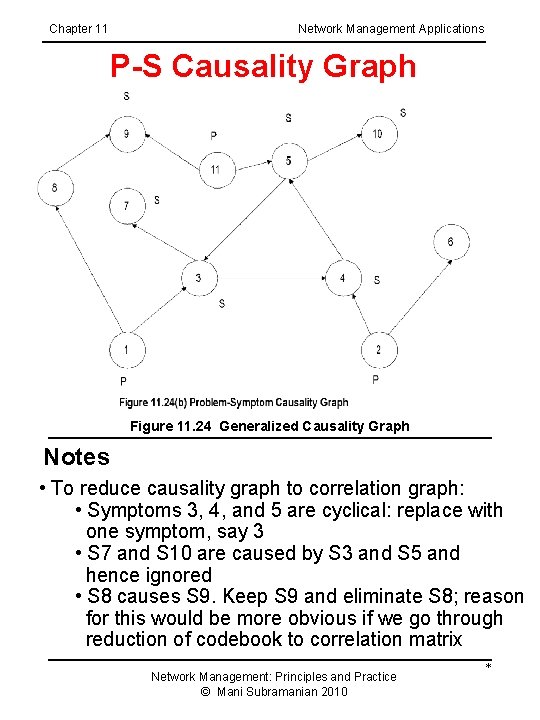
Chapter 11 Network Management Applications P-S Causality Graph Figure 11. 24 Generalized Causality Graph Notes • To reduce causality graph to correlation graph: • Symptoms 3, 4, and 5 are cyclical: replace with one symptom, say 3 • S 7 and S 10 are caused by S 3 and S 5 and hence ignored • S 8 causes S 9. Keep S 9 and eliminate S 8; reason for this would be more obvious if we go through reduction of codebook to correlation matrix Network Management: Principles and Practice © Mani Subramanian 2010 *
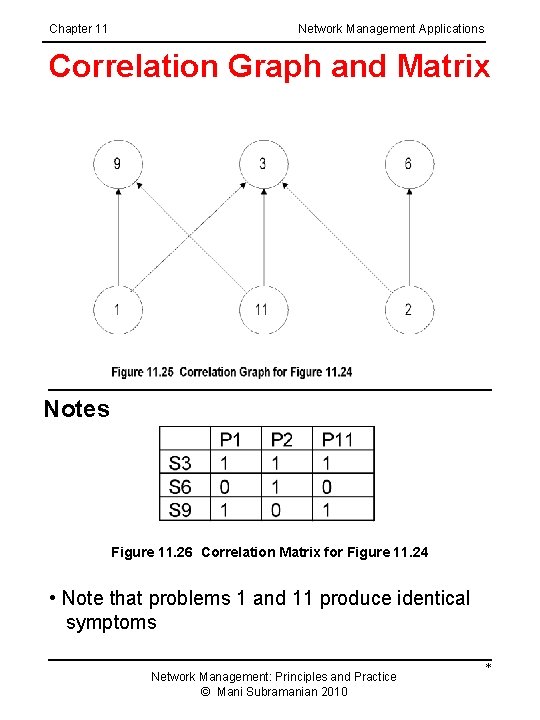
Chapter 11 Network Management Applications Correlation Graph and Matrix Notes Figure 11. 26 Correlation Matrix for Figure 11. 24 • Note that problems 1 and 11 produce identical symptoms Network Management: Principles and Practice © Mani Subramanian 2010 *
Chapter 11 Network Management Applications Codebook Enhancements • Codebook described so far assumes Hamming distance of 1 for uniqueness • Noise affects accuracy • Increase Hamming distance to >1 • Probability of a problem causing a symptom assumed as 1. It can be made Si = Pr(Pj) to be more realistic Notes Network Management: Principles and Practice © Mani Subramanian 2010 *
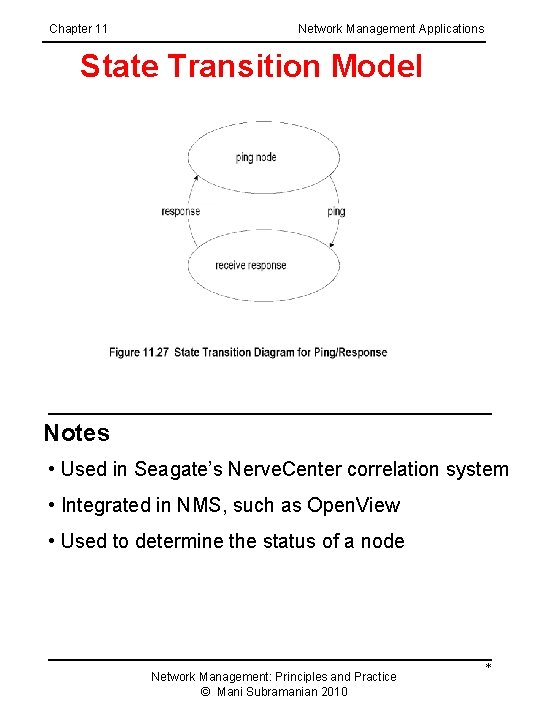
Chapter 11 Network Management Applications State Transition Model Notes • Used in Seagate’s Nerve. Center correlation system • Integrated in NMS, such as Open. View • Used to determine the status of a node Network Management: Principles and Practice © Mani Subramanian 2010 *
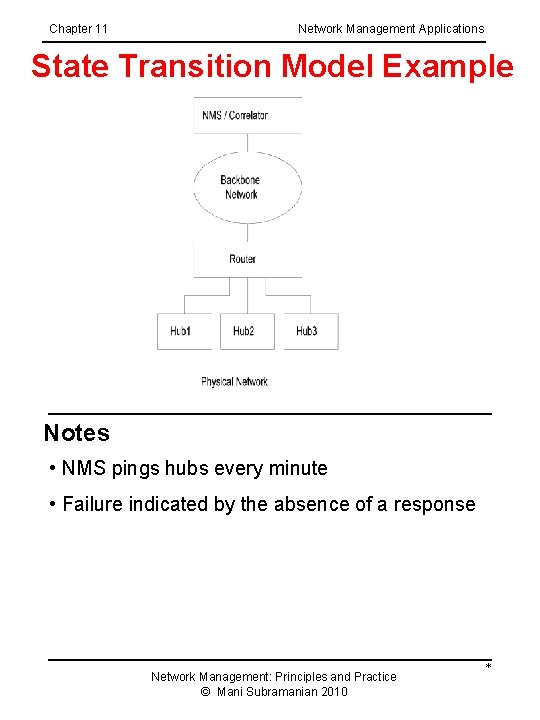
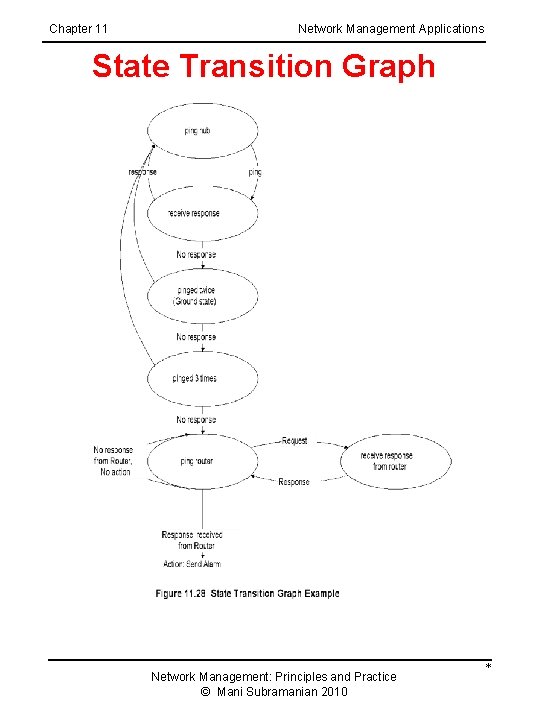
Chapter 11 Network Management Applications State Transition Model Example Notes • NMS pings hubs every minute • Failure indicated by the absence of a response Network Management: Principles and Practice © Mani Subramanian 2010 *
Chapter 11 Network Management Applications State Transition Graph Network Management: Principles and Practice © Mani Subramanian 2010 *
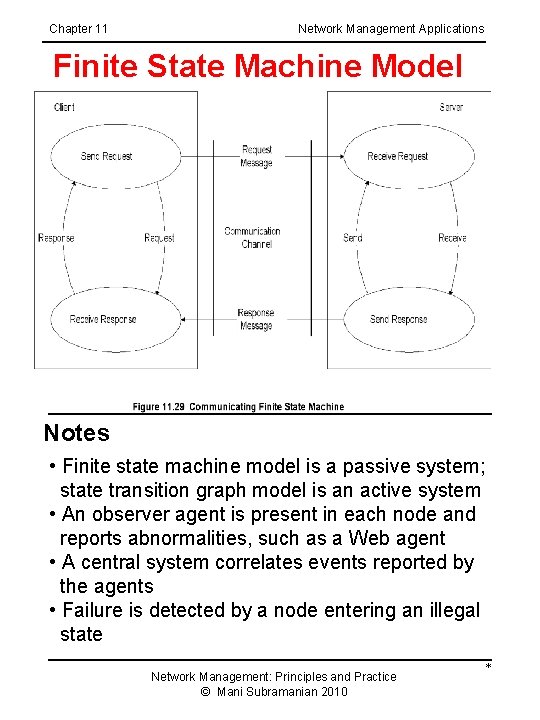
Chapter 11 Network Management Applications Finite State Machine Model Notes • Finite state machine model is a passive system; state transition graph model is an active system • An observer agent is present in each node and reports abnormalities, such as a Web agent • A central system correlates events reported by the agents • Failure is detected by a node entering an illegal state Network Management: Principles and Practice © Mani Subramanian 2010 *
Chapter 11 Network Management Applications Security Management • Security threats • Policies and Procedures • Resources to prevent security breaches • Firewalls • Cryptography • Authentication and Authorization • Client/Server authentication system • Message transfer security • Network protection security Notes Network Management: Principles and Practice © Mani Subramanian 2010 *
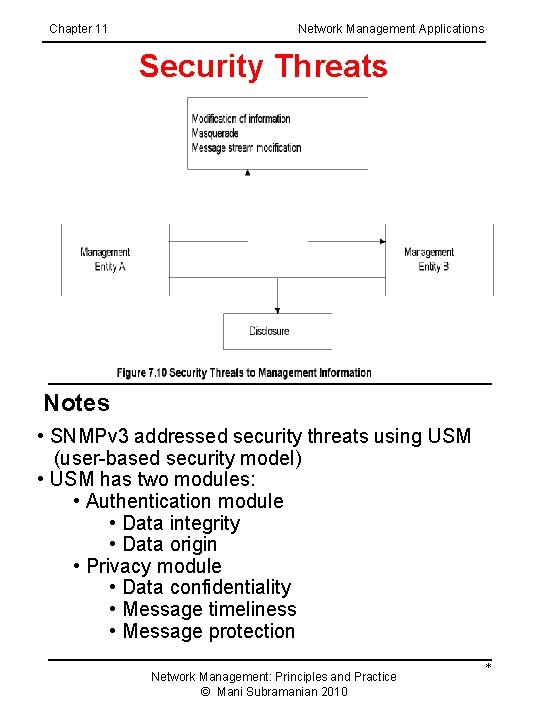
Chapter 11 Network Management Applications Security Threats Notes • SNMPv 3 addressed security threats using USM (user-based security model) • USM has two modules: • Authentication module • Data integrity • Data origin • Privacy module • Data confidentiality • Message timeliness • Message protection Network Management: Principles and Practice © Mani Subramanian 2010 *
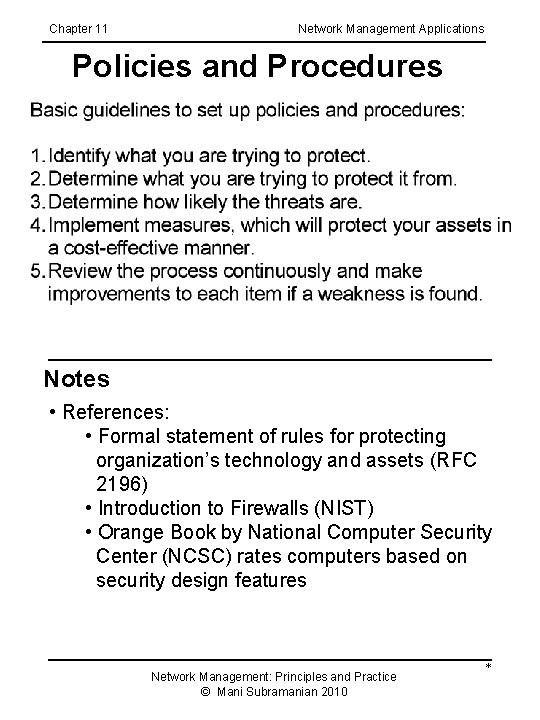
Chapter 11 Network Management Applications Policies and Procedures Notes • References: • Formal statement of rules for protecting organization’s technology and assets (RFC 2196) • Introduction to Firewalls (NIST) • Orange Book by National Computer Security Center (NCSC) rates computers based on security design features Network Management: Principles and Practice © Mani Subramanian 2010 *
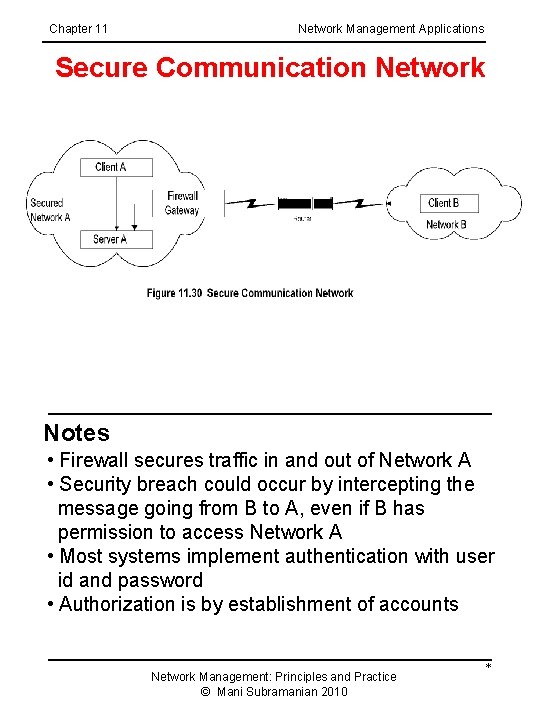
Chapter 11 Network Management Applications Secure Communication Network Notes • Firewall secures traffic in and out of Network A • Security breach could occur by intercepting the message going from B to A, even if B has permission to access Network A • Most systems implement authentication with user id and password • Authorization is by establishment of accounts Network Management: Principles and Practice © Mani Subramanian 2010 *
Chapter 11 Network Management Applications Firewalls • Protects a network from external attacks • Controls traffic in and out of a secured network • Could be implemented in a router, gateway, or a special host • Benefits • Reduces risks of access to hosts • Controlled access • Eliminates annoyance to the users • Protects privacy (e. g. , finger) • Hierarchical implementation of policy and technology (e. g. , finger) Notes Network Management: Principles and Practice © Mani Subramanian 2010 *
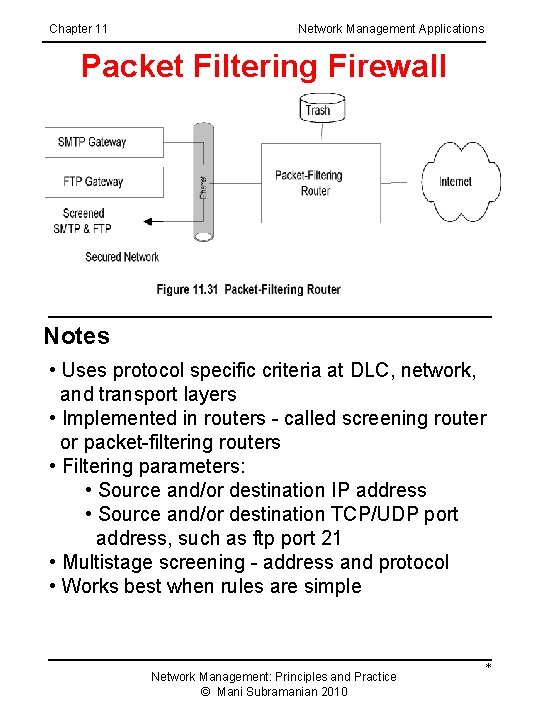
Chapter 11 Network Management Applications Packet Filtering Firewall Notes • Uses protocol specific criteria at DLC, network, and transport layers • Implemented in routers - called screening router or packet-filtering routers • Filtering parameters: • Source and/or destination IP address • Source and/or destination TCP/UDP port address, such as ftp port 21 • Multistage screening - address and protocol • Works best when rules are simple Network Management: Principles and Practice © Mani Subramanian 2010 *
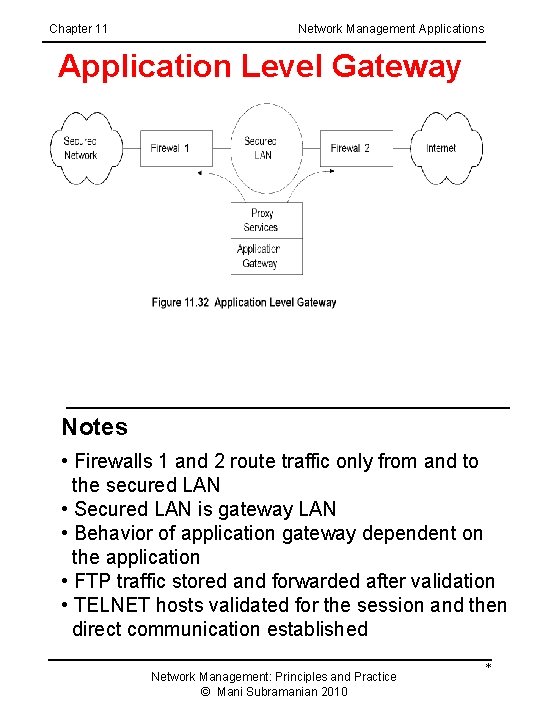
Chapter 11 Network Management Applications Application Level Gateway Notes • Firewalls 1 and 2 route traffic only from and to the secured LAN • Secured LAN is gateway LAN • Behavior of application gateway dependent on the application • FTP traffic stored and forwarded after validation • TELNET hosts validated for the session and then direct communication established Network Management: Principles and Practice © Mani Subramanian 2010 *
Chapter 11 Network Management Applications Cryptography • Secure communication requires • Integrity protection: ensuring that the message is not tampered with • Authentication validation: ensures the originator identification • Security threats • Modification of information • Masquerade • Message stream modification • Disclosure • Hardware and software solutions • Most secure communication is software based Notes Network Management: Principles and Practice © Mani Subramanian 2010 *
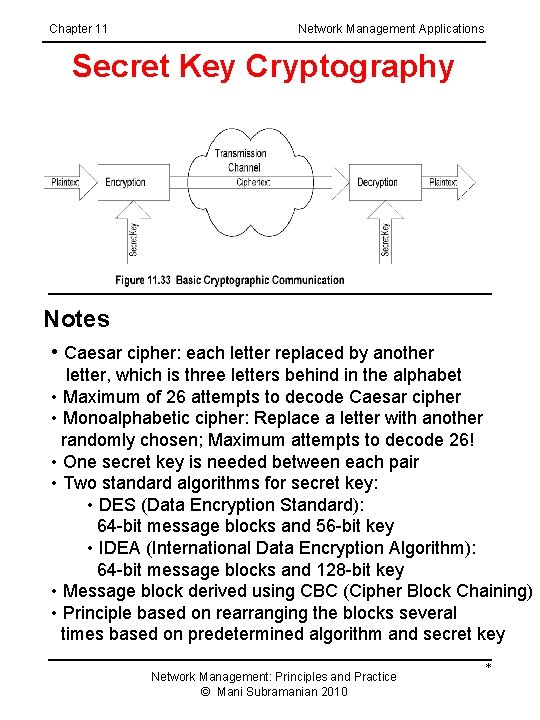
Chapter 11 Network Management Applications Secret Key Cryptography Notes • Caesar cipher: each letter replaced by another letter, which is three letters behind in the alphabet • Maximum of 26 attempts to decode Caesar cipher • Monoalphabetic cipher: Replace a letter with another randomly chosen; Maximum attempts to decode 26! • One secret key is needed between each pair • Two standard algorithms for secret key: • DES (Data Encryption Standard): 64 -bit message blocks and 56 -bit key • IDEA (International Data Encryption Algorithm): 64 -bit message blocks and 128 -bit key • Message block derived using CBC (Cipher Block Chaining) • Principle based on rearranging the blocks several times based on predetermined algorithm and secret key Network Management: Principles and Practice © Mani Subramanian 2010 *
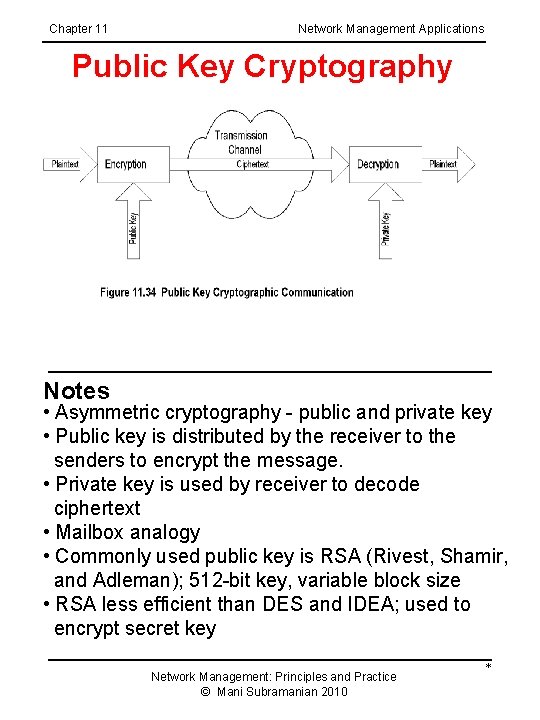
Chapter 11 Network Management Applications Public Key Cryptography Notes • Asymmetric cryptography - public and private key • Public key is distributed by the receiver to the senders to encrypt the message. • Private key is used by receiver to decode ciphertext • Mailbox analogy • Commonly used public key is RSA (Rivest, Shamir, and Adleman); 512 -bit key, variable block size • RSA less efficient than DES and IDEA; used to encrypt secret key Network Management: Principles and Practice © Mani Subramanian 2010 *
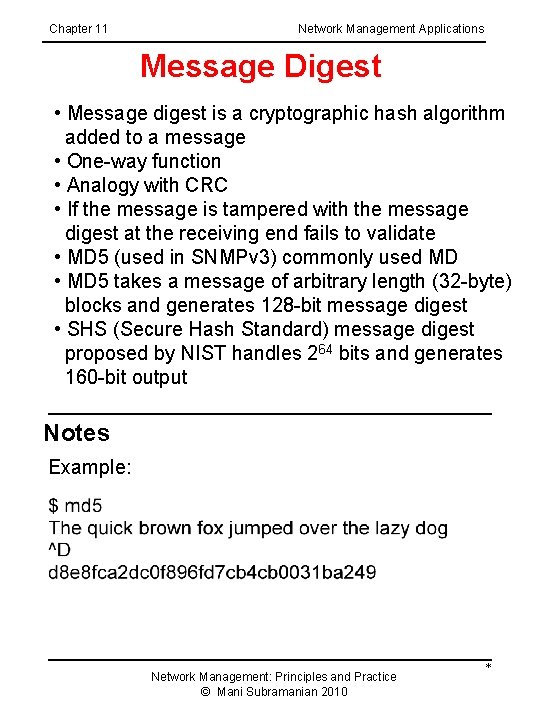
Chapter 11 Network Management Applications Message Digest • Message digest is a cryptographic hash algorithm added to a message • One-way function • Analogy with CRC • If the message is tampered with the message digest at the receiving end fails to validate • MD 5 (used in SNMPv 3) commonly used MD • MD 5 takes a message of arbitrary length (32 -byte) blocks and generates 128 -bit message digest • SHS (Secure Hash Standard) message digest proposed by NIST handles 264 bits and generates 160 -bit output Notes Example: Network Management: Principles and Practice © Mani Subramanian 2010 *
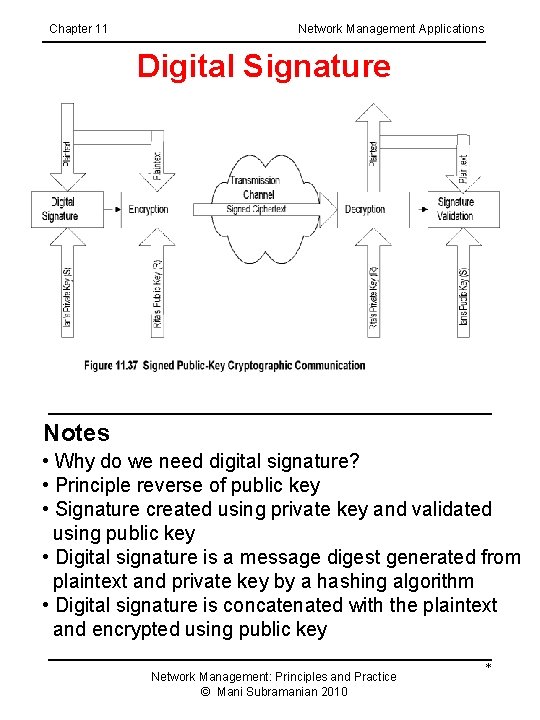
Chapter 11 Network Management Applications Digital Signature Notes • Why do we need digital signature? • Principle reverse of public key • Signature created using private key and validated using public key • Digital signature is a message digest generated from plaintext and private key by a hashing algorithm • Digital signature is concatenated with the plaintext and encrypted using public key Network Management: Principles and Practice © Mani Subramanian 2010 *
Chapter 11 Network Management Applications Authentication and Authorization • Authentication verifies user identification • Client/server environment • Ticket-granting system • Authentication server system • Cryptographic authentication • Messaging environment • e-mail • e-commerce • Authorization grants access to information • Read, read-write, no-access • Indefinite period, one-time use Notes Network Management: Principles and Practice © Mani Subramanian 2010 *
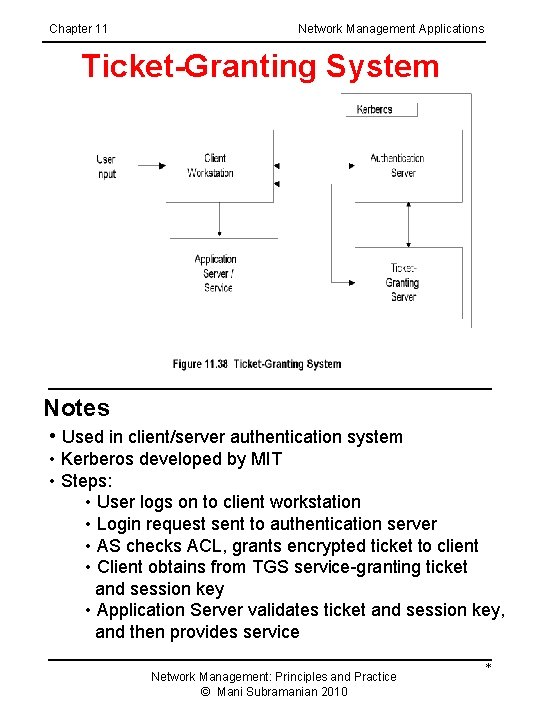
Chapter 11 Network Management Applications Ticket-Granting System Notes • Used in client/server authentication system • Kerberos developed by MIT • Steps: • User logs on to client workstation • Login request sent to authentication server • AS checks ACL, grants encrypted ticket to client • Client obtains from TGS service-granting ticket and session key • Application Server validates ticket and session key, and then provides service Network Management: Principles and Practice © Mani Subramanian 2010 *
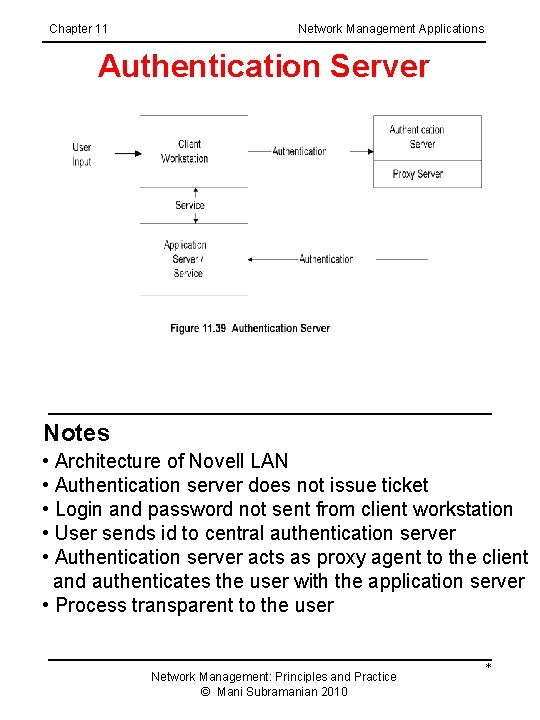
Chapter 11 Network Management Applications Authentication Server Notes • Architecture of Novell LAN • Authentication server does not issue ticket • Login and password not sent from client workstation • User sends id to central authentication server • Authentication server acts as proxy agent to the client and authenticates the user with the application server • Process transparent to the user Network Management: Principles and Practice © Mani Subramanian 2010 *
Chapter 11 Network Management Applications Message Transfer Security • Messaging one-way communication • Secure message needs to be authenticated and secured • Three secure mail systems • Privacy Enhanced Mail (PEM) • Pretty Good Privacy (PGP) • X-400: OSI specifications that define framework; not implementation specific Notes Network Management: Principles and Practice © Mani Subramanian 2010 *
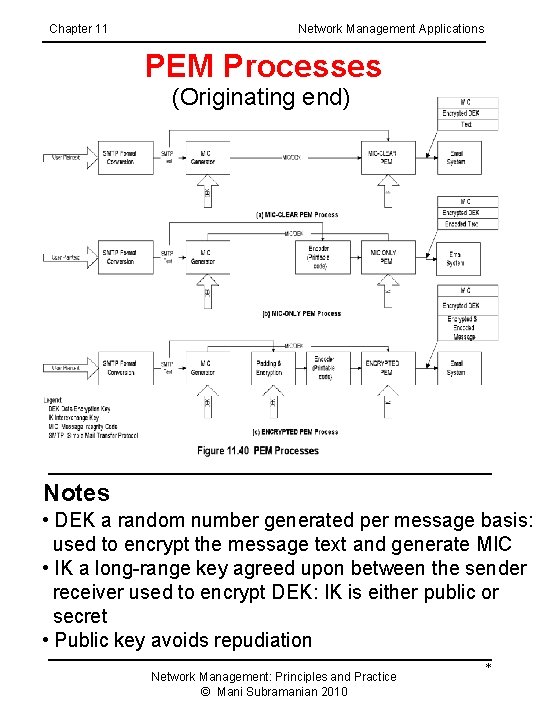
Chapter 11 Network Management Applications Privacy Enhanced Mail • Developed by IETF (RFC 1421 - 1424) • End-to-end cryptography • Provides • Confidentiality • Authentication • Message integrity assurance • Nonrepudiation of origin • Data encryption key (DEK) could be secret or public key-based originator and receiver agreed upon method • PEM processes based on cryptography and message encoding • MIC-CLEAR (Message Integrity Code. CLEAR) • MIC-ONLY • ENCRYPTED Notes Network Management: Principles and Practice © Mani Subramanian 2010 *
Chapter 11 Network Management Applications PEM Processes (Originating end) Notes • DEK a random number generated per message basis: used to encrypt the message text and generate MIC • IK a long-range key agreed upon between the sender receiver used to encrypt DEK: IK is either public or secret • Public key avoids repudiation Network Management: Principles and Practice © Mani Subramanian 2010 *
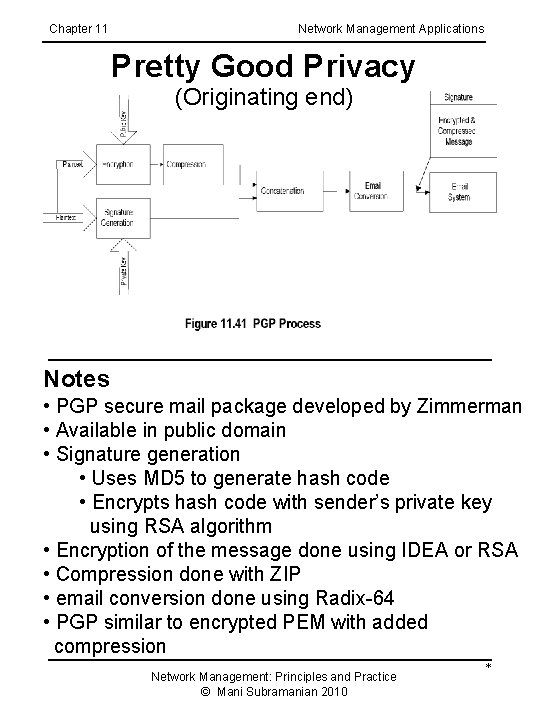
Chapter 11 Network Management Applications Pretty Good Privacy (Originating end) Notes • PGP secure mail package developed by Zimmerman • Available in public domain • Signature generation • Uses MD 5 to generate hash code • Encrypts hash code with sender’s private key using RSA algorithm • Encryption of the message done using IDEA or RSA • Compression done with ZIP • email conversion done using Radix-64 • PGP similar to encrypted PEM with added compression Network Management: Principles and Practice © Mani Subramanian 2010 *
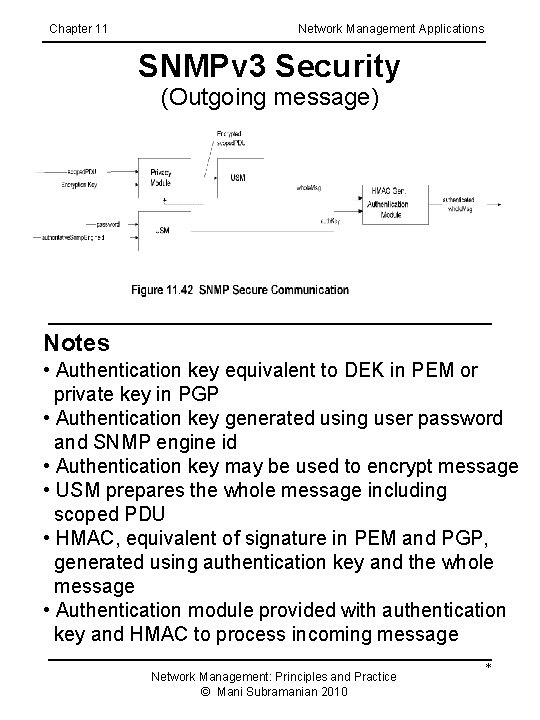
Chapter 11 Network Management Applications SNMPv 3 Security (Outgoing message) Notes • Authentication key equivalent to DEK in PEM or private key in PGP • Authentication key generated using user password and SNMP engine id • Authentication key may be used to encrypt message • USM prepares the whole message including scoped PDU • HMAC, equivalent of signature in PEM and PGP, generated using authentication key and the whole message • Authentication module provided with authentication key and HMAC to process incoming message Network Management: Principles and Practice © Mani Subramanian 2010 *
Chapter 11 Network Management Applications Virus Attacks • Executable programs that make copies and insert them into other programs • Attack hosts and routers • Attack infects boot track, compromises cpu, floods network traffic, etc. • Prevention is by identifying the pattern of the virus and implementing protection in virus checkers Notes Network Management: Principles and Practice © Mani Subramanian 2010 *
Chapter 11 Network Management Applications Accounting Management • Least developed • Usage of resources • Hidden cost of IT usage (libraries) • Functional accounting • Business application Notes Network Management: Principles and Practice © Mani Subramanian 2010 *
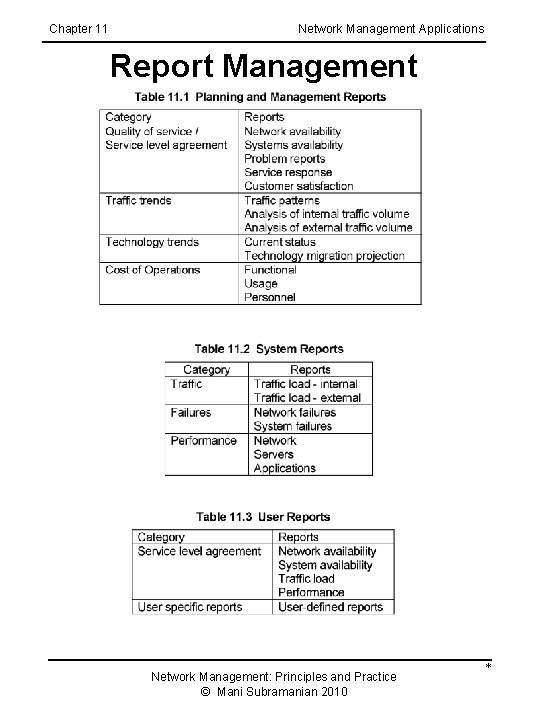
Chapter 11 Network Management Applications Report Management Network Management: Principles and Practice © Mani Subramanian 2010 *
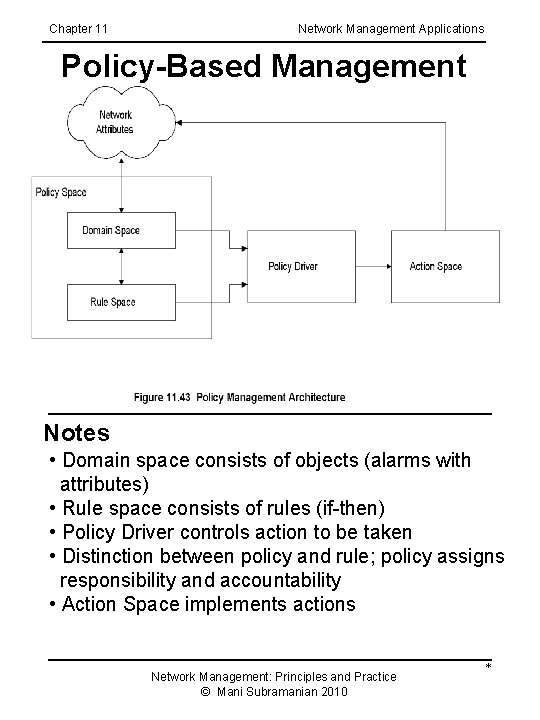
Chapter 11 Network Management Applications Policy-Based Management Notes • Domain space consists of objects (alarms with attributes) • Rule space consists of rules (if-then) • Policy Driver controls action to be taken • Distinction between policy and rule; policy assigns responsibility and accountability • Action Space implements actions Network Management: Principles and Practice © Mani Subramanian 2010 *
Chapter 11 Network Management Applications Service Level Management • SLA management of service equivalent to Qo. S of network • SLA defines • Identification of services and characteristics • Negotiation of SLA • Deployment of agents to monitor and control • Generation of reports • SLA characteristics • Service parameters • Service levels • Component parameters • Component-to-service mappings Notes Network Management: Principles and Practice © Mani Subramanian 2010 *