
Chapter 11 Multinomial Experiments and Contingency Tables Lecture

Chapter 11 Multinomial Experiments and Contingency Tables Lecture 1 Sections: 11. 1 – 11. 2
In this chapter we continue to apply inferential methods to different configurations of data. Recall from Chapter 1 that categorical or qualitative data are those data that can be separated into different categories (often called cells) that are distinguished by some nonnumeric characteristic. For example, we might separate a sample of M&Ms into the color categories of red, orange, yellow, brown, blue, and green. After finding the frequency count for each category, we might proceed to test the claim that the frequencies fit (or agree with) the color distribution claimed by the manufacturer Our main objective is to test claims considering categorical data. We will do this by using frequency counts for different categories. What we will start with is multinomial experiments. These experiments consist of observed frequency counts arranged in a single row or column called a “one-way frequency table”, and we will test the claim that the observed frequency counts agree with some claimed distribution.
Definition: Multinomial experiment requirements: 1. The number of trials is fixed. 2. The trials are independent. 3. All outcomes of each trial must be classified into exactly one of several different categories. 4. The probabilities for the different categories remain constant for each trial. What we are trying to do in this section is to determine whether the distribution agrees with or FITS some claimed distribution. Thus we will use a test called the Goodness-of-Fit Test. Definition: A goodness-of-fit test is used to test the hypothesis that an observed frequency distribution fits some claimed distribution.

Notation: O = the observed frequency of an outcome. E = the expected frequency of an outcome. k = the number of different categories. n = the total number of trials. Finding E, expected frequency. 1. ) If all expected frequencies are equal, then each expected frequency is the sum of all observed frequencies divided by the number of categories, so that E = n/k. 2. ) If the expected frequencies are not all equal, then each expected frequency is found by multiplying the sum of all observed frequencies by the probability for the category, so E = np for each category. Examples are as follows.
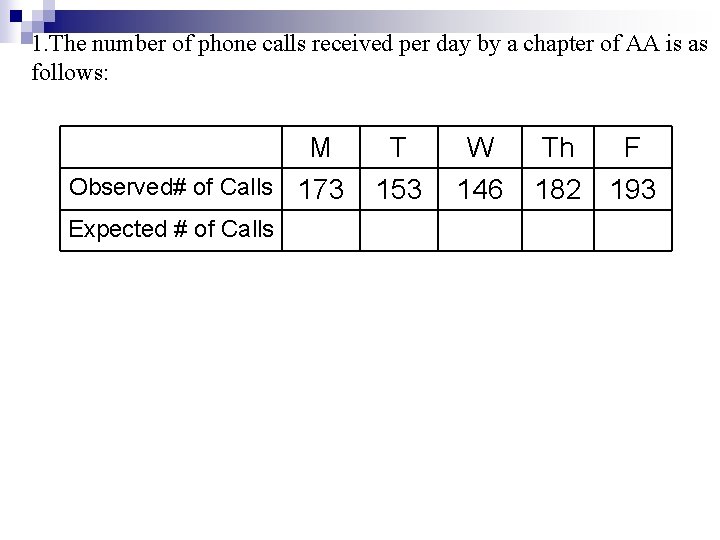
1. The number of phone calls received per day by a chapter of AA is as follows: M Observed# of Calls 173 Expected # of Calls T 153 W 146 Th 182 F 193
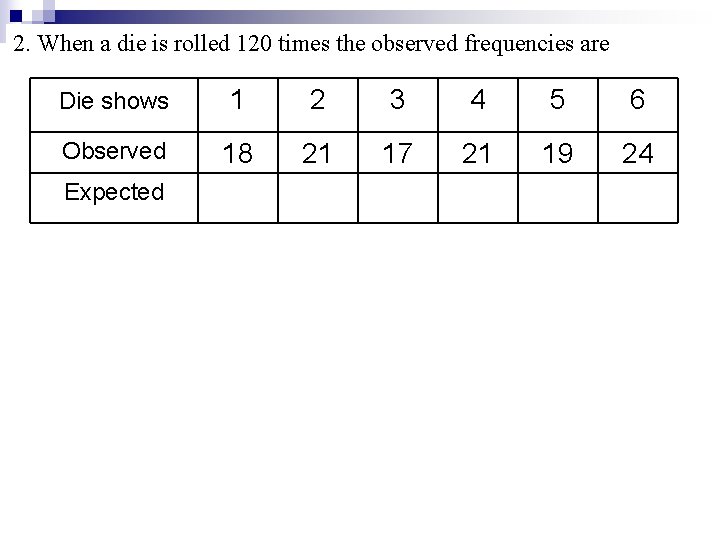
2. When a die is rolled 120 times the observed frequencies are Die shows 1 2 3 4 5 6 Observed 18 21 17 21 19 24 Expected
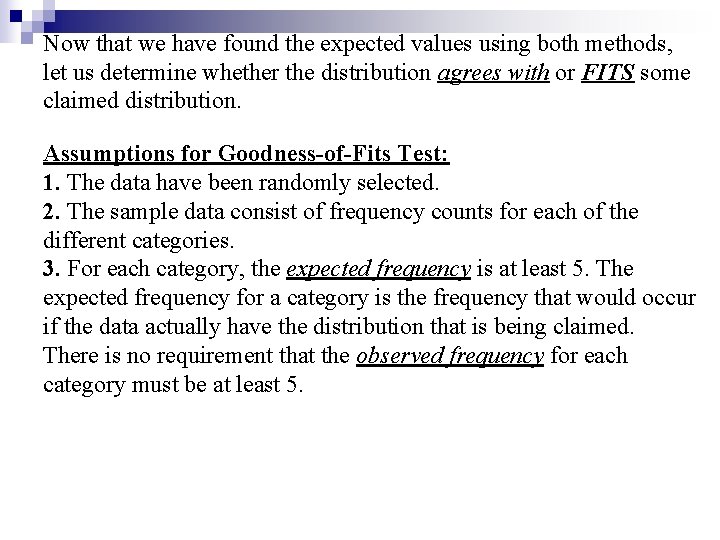
Now that we have found the expected values using both methods, let us determine whether the distribution agrees with or FITS some claimed distribution. Assumptions for Goodness-of-Fits Test: 1. The data have been randomly selected. 2. The sample data consist of frequency counts for each of the different categories. 3. For each category, the expected frequency is at least 5. The expected frequency for a category is the frequency that would occur if the data actually have the distribution that is being claimed. There is no requirement that the observed frequency for each category must be at least 5.
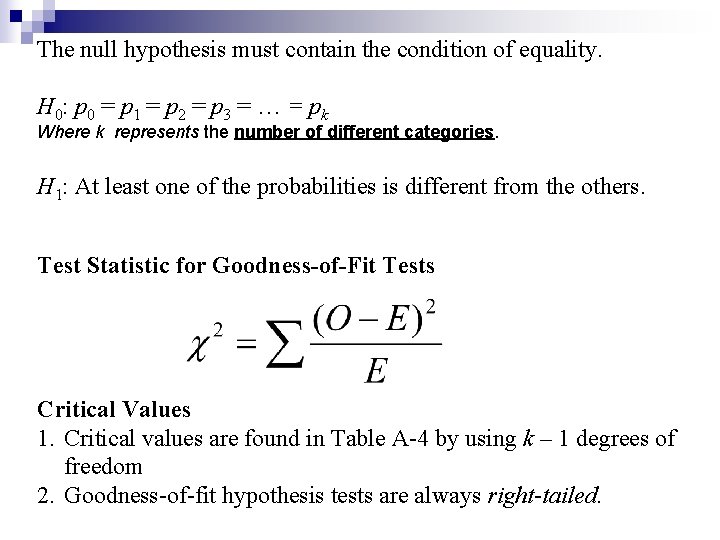
The null hypothesis must contain the condition of equality. H 0: p 0 = p 1 = p 2 = p 3 = … = pk Where k represents the number of different categories. H 1: At least one of the probabilities is different from the others. Test Statistic for Goodness-of-Fit Tests Critical Values 1. Critical values are found in Table A-4 by using k – 1 degrees of freedom 2. Goodness-of-fit hypothesis tests are always right-tailed.
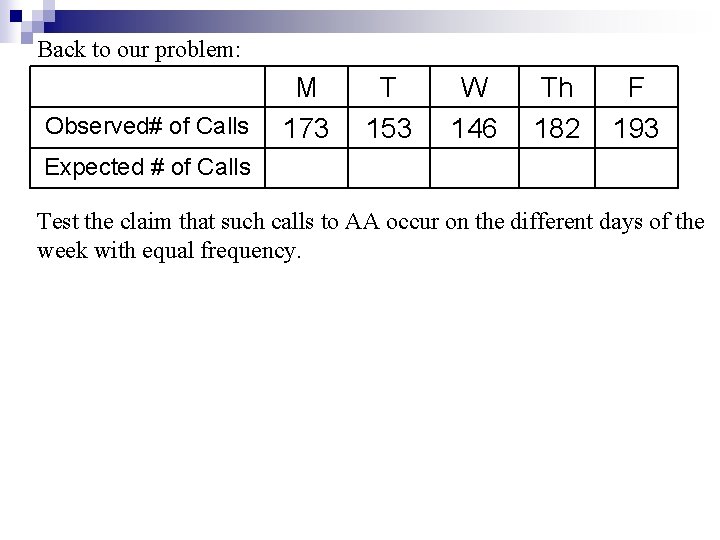
Back to our problem: Observed# of Calls M 173 T 153 W 146 Th 182 F 193 Expected # of Calls Test the claim that such calls to AA occur on the different days of the week with equal frequency.
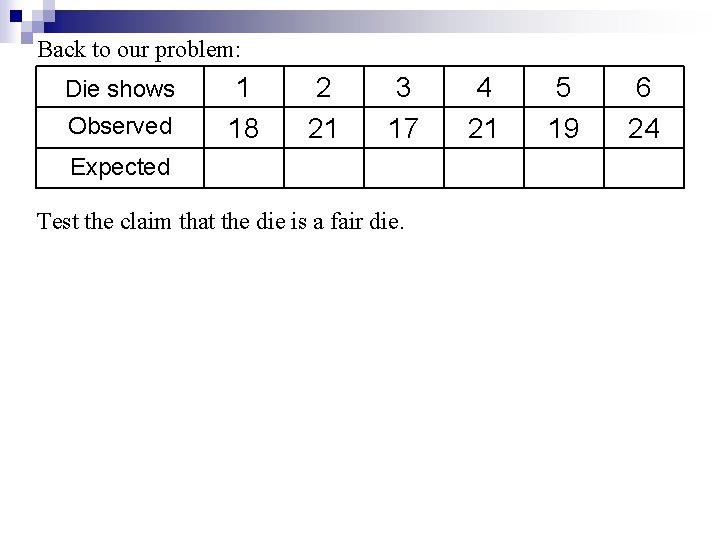
Back to our problem: Die shows Observed 1 18 2 21 3 17 Expected Test the claim that the die is a fair die. 4 21 5 19 6 24
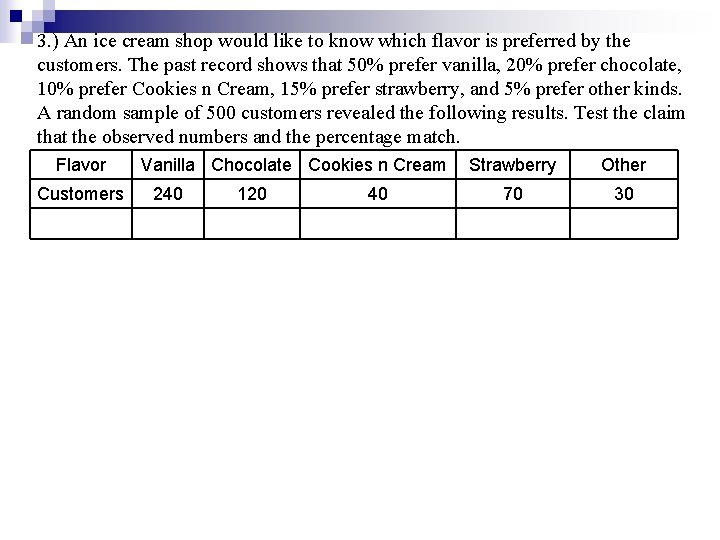
3. ) An ice cream shop would like to know which flavor is preferred by the customers. The past record shows that 50% prefer vanilla, 20% prefer chocolate, 10% prefer Cookies n Cream, 15% prefer strawberry, and 5% prefer other kinds. A random sample of 500 customers revealed the following results. Test the claim that the observed numbers and the percentage match. Flavor Customers Vanilla Chocolate Cookies n Cream 240 120 40 Strawberry Other 70 30
- Slides: 11