
Chapter 11 Motivating and Leading 11 1 Copyright
- Slides: 39
Chapter 11: Motivating and Leading 11 -1 Copyright © 2014 Pearson Education, Inc.
Chapter Learning Goals 1. Understand the complexity and the variables involved in cross-cultural motivation and leadership. 2. Learn to use the research on cultural dimensions as tools to understand how to motivate people in different cultural contexts. 3. Become familiar with some common features of Mexican culture and context and how to motivate employees. 11 -2 Copyright © 2014 Pearson Education, Inc.
Chapter Learning Goals 4. Understand how leadership styles and practices vary around the world. 5. Gain familiarity with the variables of context, people, and situations affecting the leadership role. 6. Emphasize what makes a successful “global leader”. 11 -3 Copyright © 2014 Pearson Education, Inc.
Opening Profile: The EU Business Leader —Myth or Reality? The EU is now compromised of 27 nations and a market of over 400 million people. Differences in: Histories and language Government systems Business practices Educational systems Religions National cultures Demonstrates the need for an “EU style” leadership which will work across EU markets? 11 -4 Copyright © 2014 Pearson Education, Inc.
Chapter Learning Goals Understand the complexity and the variables involved in crosscultural motivation and leadership. 11 -5 Copyright © 2014 Pearson Education, Inc.
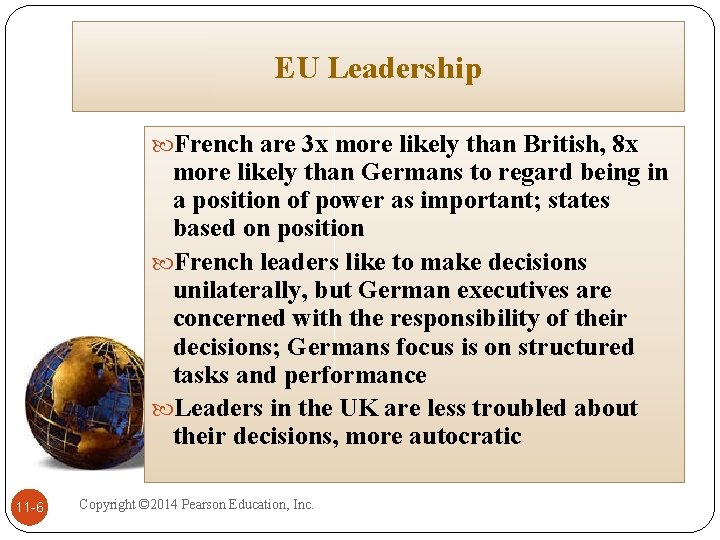
EU Leadership French are 3 x more likely than British, 8 x more likely than Germans to regard being in a position of power as important; states based on position French leaders like to make decisions unilaterally, but German executives are concerned with the responsibility of their decisions; Germans focus is on structured tasks and performance Leaders in the UK are less troubled about their decisions, more autocratic 11 -6 Copyright © 2014 Pearson Education, Inc.
Chapter Learning Goals Learn to use the research on cultural dimensions as tools to understand how to motivate people in different cultural contexts. 11 -7 Copyright © 2014 Pearson Education, Inc.
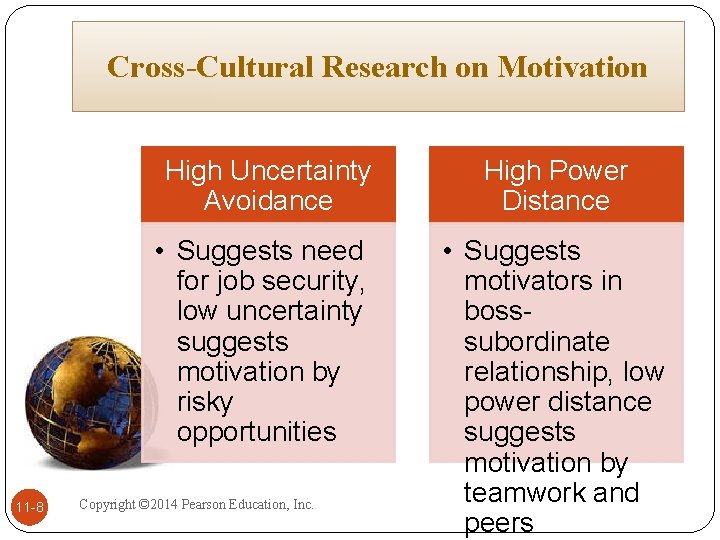
Cross-Cultural Research on Motivation 11 -8 High Uncertainty Avoidance High Power Distance • Suggests need for job security, low uncertainty suggests motivation by risky opportunities • Suggests motivators in bosssubordinate relationship, low power distance suggests motivation by teamwork and peers Copyright © 2014 Pearson Education, Inc.
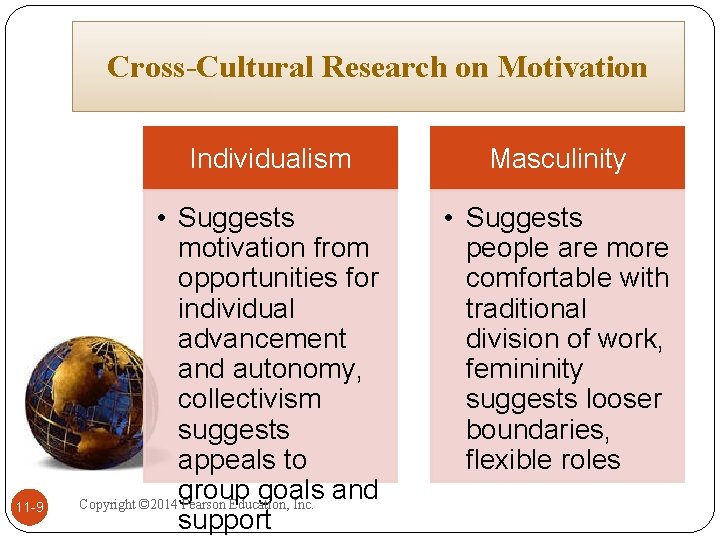
Cross-Cultural Research on Motivation Individualism 11 -9 • Suggests motivation from opportunities for individual advancement and autonomy, collectivism suggests appeals to group goals and Copyright © 2014 Pearson Education, Inc. support Masculinity • Suggests people are more comfortable with traditional division of work, femininity suggests looser boundaries, flexible roles
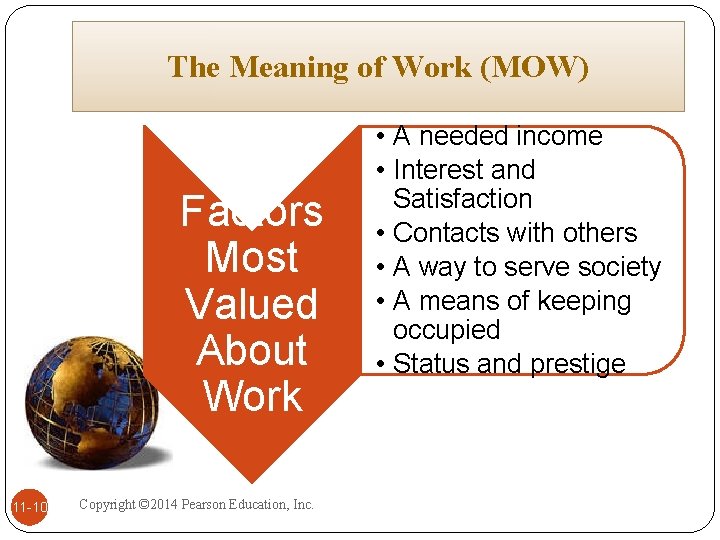
The Meaning of Work (MOW) Factors Most Valued About Work 11 -10 Copyright © 2014 Pearson Education, Inc. • A needed income • Interest and Satisfaction • Contacts with others • A way to serve society • A means of keeping occupied • Status and prestige
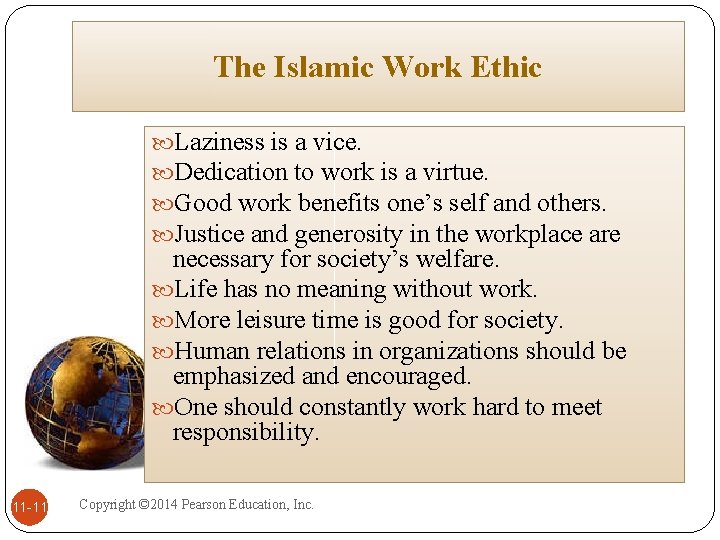
The Islamic Work Ethic Laziness is a vice. Dedication to work is a virtue. Good work benefits one’s self and others. Justice and generosity in the workplace are necessary for society’s welfare. Life has no meaning without work. More leisure time is good for society. Human relations in organizations should be emphasized and encouraged. One should constantly work hard to meet responsibility. 11 -11 Copyright © 2014 Pearson Education, Inc.
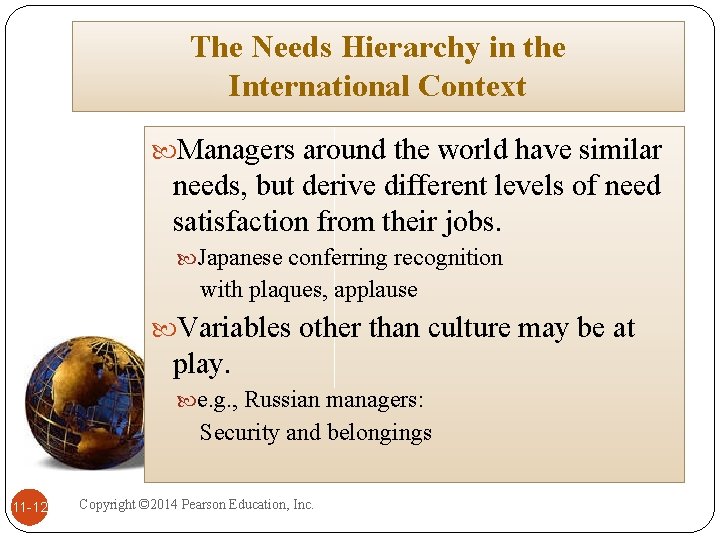
The Needs Hierarchy in the International Context Managers around the world have similar needs, but derive different levels of need satisfaction from their jobs. Japanese conferring recognition with plaques, applause Variables other than culture may be at play. e. g. , Russian managers: Security and belongings 11 -12 Copyright © 2014 Pearson Education, Inc.
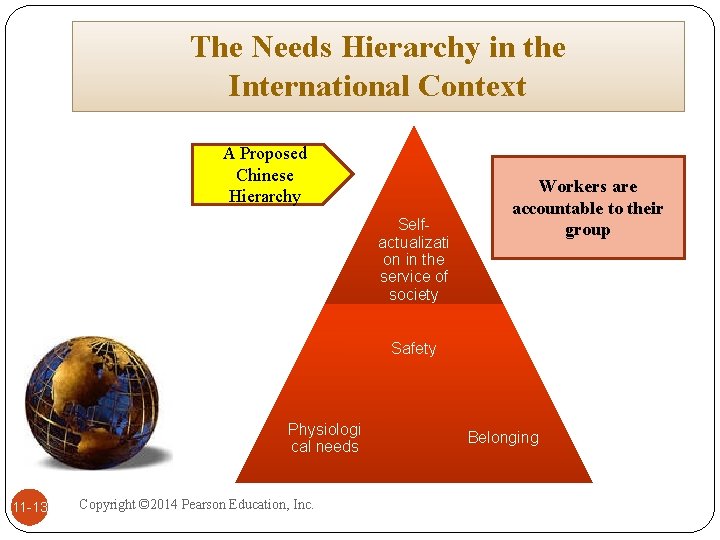
The Needs Hierarchy in the International Context A Proposed Chinese Hierarchy Selfactualizati on in the service of society Workers are accountable to their group Safety Physiologi cal needs 11 -13 Copyright © 2014 Pearson Education, Inc. Belonging
Chapter Learning Goals Become familiar with some common features of Mexican culture and context and how to motivate employees. 11 -14 Copyright © 2014 Pearson Education, Inc.
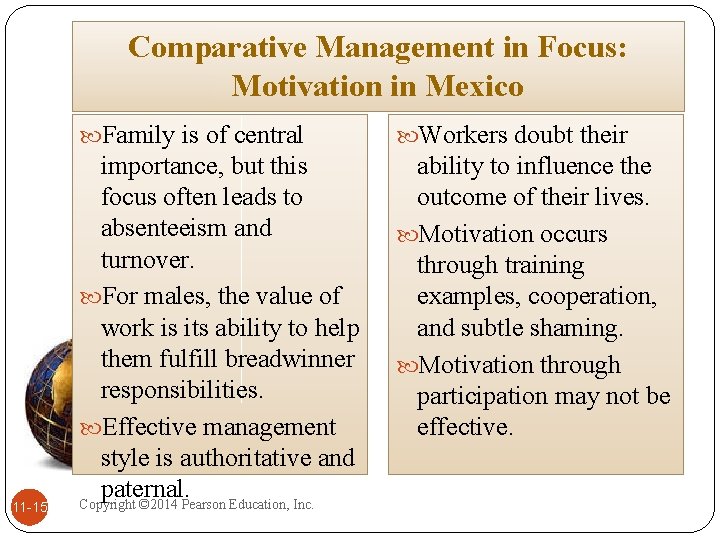
Comparative Management in Focus: Motivation in Mexico 11 -15 Family is of central Workers doubt their importance, but this focus often leads to absenteeism and turnover. For males, the value of work is its ability to help them fulfill breadwinner responsibilities. Effective management style is authoritative and paternal. Copyright © 2014 Pearson Education, Inc. ability to influence the outcome of their lives. Motivation occurs through training examples, cooperation, and subtle shaming. Motivation through participation may not be effective.
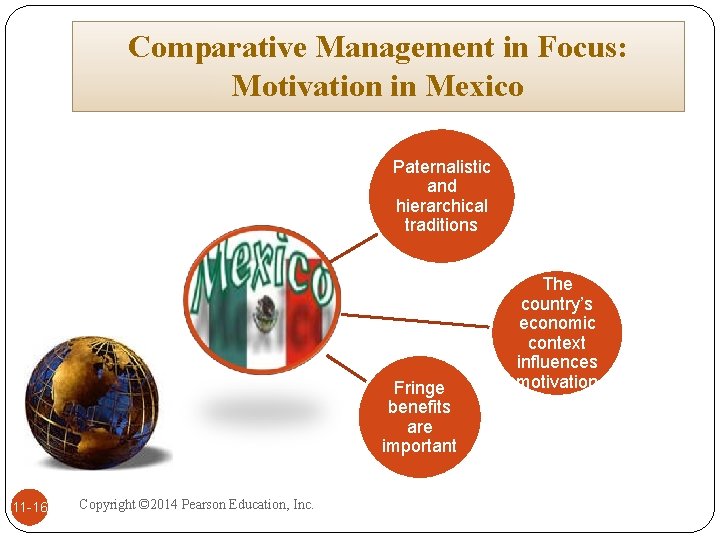
Comparative Management in Focus: Motivation in Mexico Paternalistic and hierarchical traditions Fringe benefits are important 11 -16 Copyright © 2014 Pearson Education, Inc. The country’s economic context influences motivation
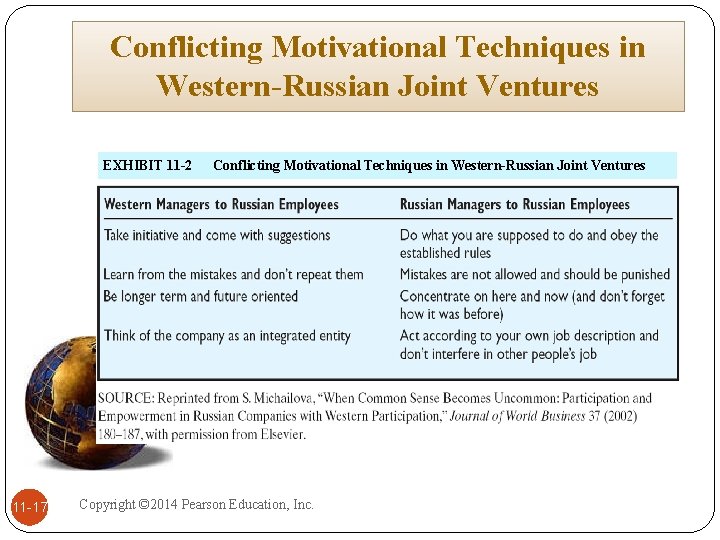
Conflicting Motivational Techniques in Western-Russian Joint Ventures EXHIBIT 11 -2 11 -17 Conflicting Motivational Techniques in Western-Russian Joint Ventures Copyright © 2014 Pearson Education, Inc.
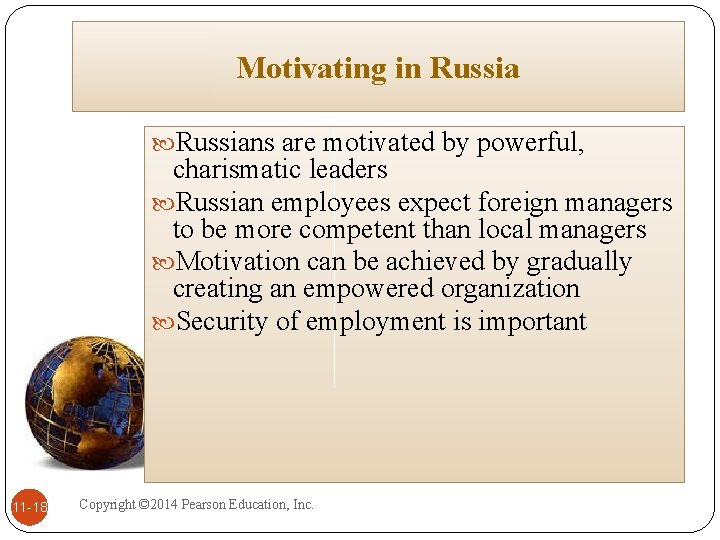
Motivating in Russians are motivated by powerful, charismatic leaders Russian employees expect foreign managers to be more competent than local managers Motivation can be achieved by gradually creating an empowered organization Security of employment is important 11 -18 Copyright © 2014 Pearson Education, Inc.
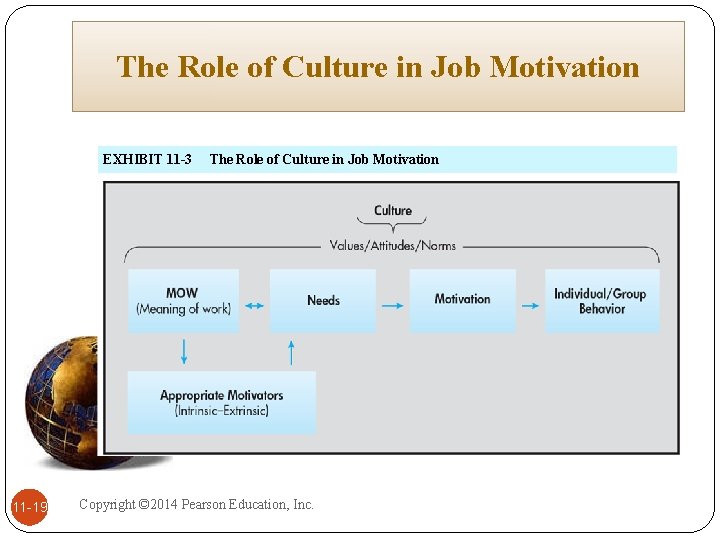
The Role of Culture in Job Motivation EXHIBIT 11 -3 11 -19 The Role of Culture in Job Motivation Copyright © 2014 Pearson Education, Inc.
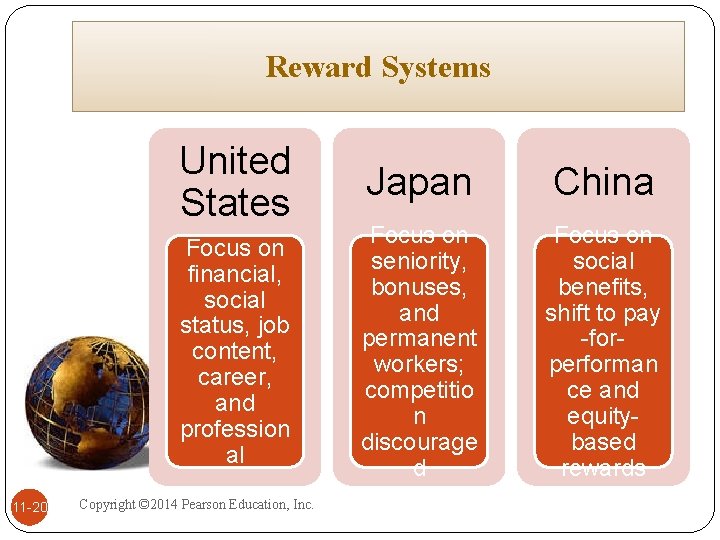
Reward Systems United States Focus on financial, social status, job content, career, and profession al 11 -20 Copyright © 2014 Pearson Education, Inc. Japan China Focus on seniority, bonuses, and permanent workers; competitio n discourage d Focus on social benefits, shift to pay -forperforman ce and equitybased rewards
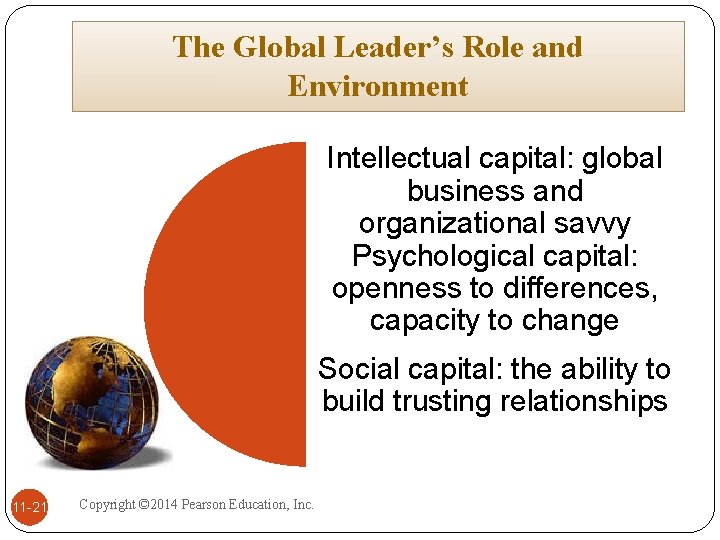
The Global Leader’s Role and Environment Intellectual capital: global business and organizational savvy Psychological capital: openness to differences, capacity to change Social capital: the ability to build trusting relationships 11 -21 Copyright © 2014 Pearson Education, Inc.
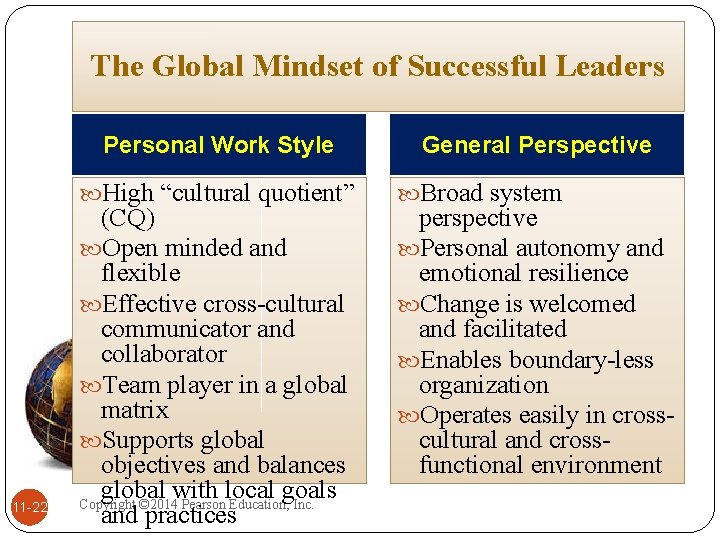
The Global Mindset of Successful Leaders Personal Work Style High “cultural quotient” 11 -22 (CQ) Open minded and flexible Effective cross-cultural communicator and collaborator Team player in a global matrix Supports global objectives and balances global with local goals Copyright © 2014 Pearson Education, Inc. and practices General Perspective Broad system perspective Personal autonomy and emotional resilience Change is welcomed and facilitated Enables boundary-less organization Operates easily in crosscultural and crossfunctional environment
Under the Lens: Global Leaders From India There are more Indian CEOs in the S&P 500 companies than any other nationality except Americans Ajay and Vindi Banga: Unilever, Citigroup, Master. Card Ajay traveled throughout the world meeting MC clients, employees, and regulators Indian managers learn to work around bureaucratic culture 11 -23 Copyright © 2014 Pearson Education, Inc.
Maximizing Leadership Effectiveness 1. 2. 3. 4. 5. 6. 11 -24 Representative of the parent firm Manager of the local firm Resident of the local community Citizen of the host country Member of a profession Family member Copyright © 2014 Pearson Education, Inc.
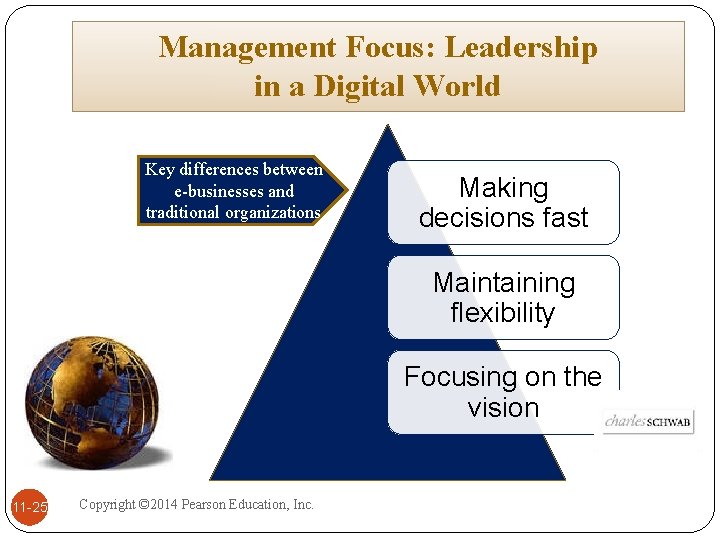
Management Focus: Leadership in a Digital World Key differences between e-businesses and traditional organizations Making decisions fast Maintaining flexibility Focusing on the vision 11 -25 Copyright © 2014 Pearson Education, Inc.
Chapter Learning Goals Understand how leadership styles and practices vary around the world. 11 -26 Copyright © 2014 Pearson Education, Inc.
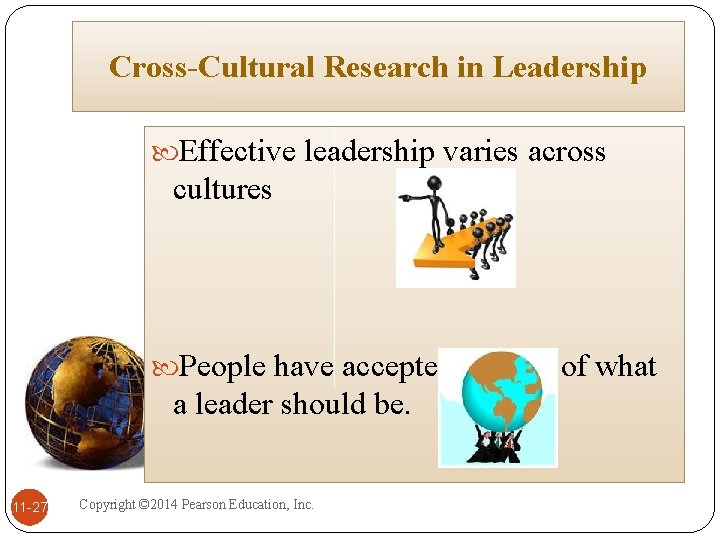
Cross-Cultural Research in Leadership Effective leadership varies across cultures People have accepted images of what a leader should be. 11 -27 Copyright © 2014 Pearson Education, Inc.
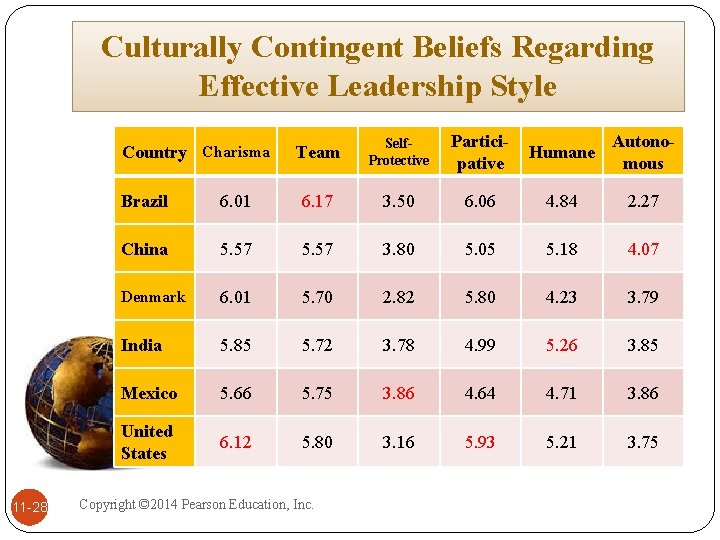
Culturally Contingent Beliefs Regarding Effective Leadership Style Country Charisma 11 -28 Team Self. Protective Participative Humane Autonomous Brazil 6. 01 6. 17 3. 50 6. 06 4. 84 2. 27 China 5. 57 3. 80 5. 05 5. 18 4. 07 Denmark 6. 01 5. 70 2. 82 5. 80 4. 23 3. 79 India 5. 85 5. 72 3. 78 4. 99 5. 26 3. 85 Mexico 5. 66 5. 75 3. 86 4. 64 4. 71 3. 86 United States 6. 12 5. 80 3. 16 5. 93 5. 21 3. 75 Copyright © 2014 Pearson Education, Inc.
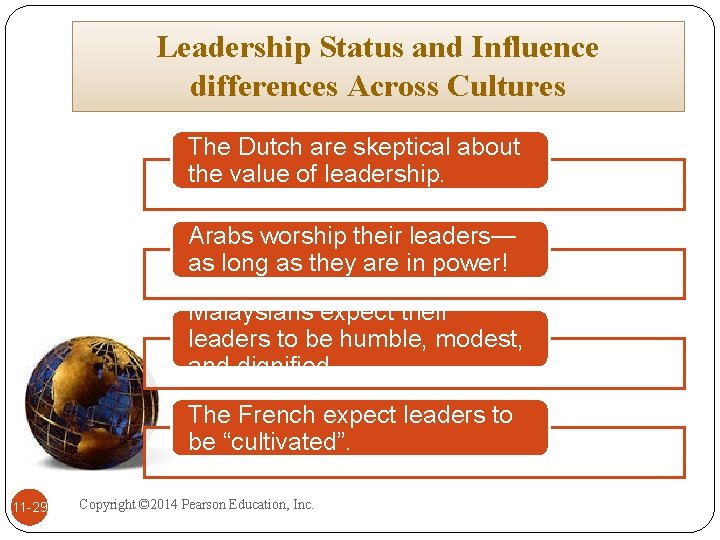
Leadership Status and Influence differences Across Cultures The Dutch are skeptical about the value of leadership. Arabs worship their leaders— as long as they are in power! Malaysians expect their leaders to be humble, modest, and dignified. The French expect leaders to be “cultivated”. 11 -29 Copyright © 2014 Pearson Education, Inc.
Chapter Learning Goals Gain familiarity with the variables of context, people, and situations affecting the leadership role. 11 -30 Copyright © 2014 Pearson Education, Inc.
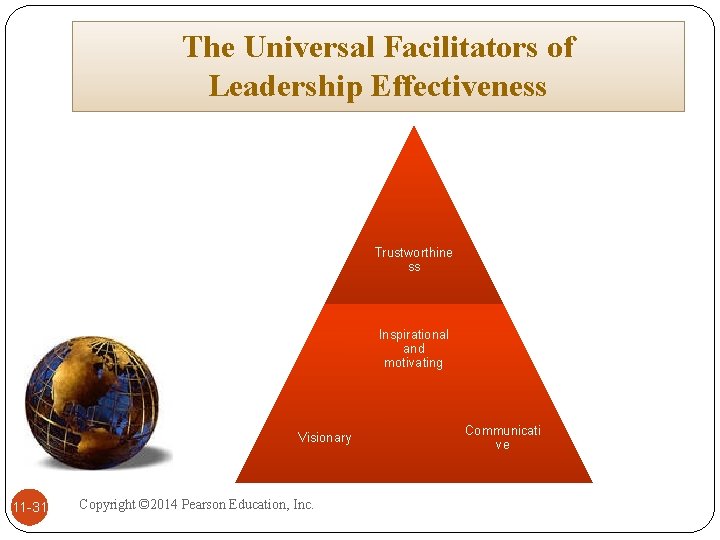
The Universal Facilitators of Leadership Effectiveness Trustworthine ss Inspirational and motivating Visionary 11 -31 Copyright © 2014 Pearson Education, Inc. Communicati ve
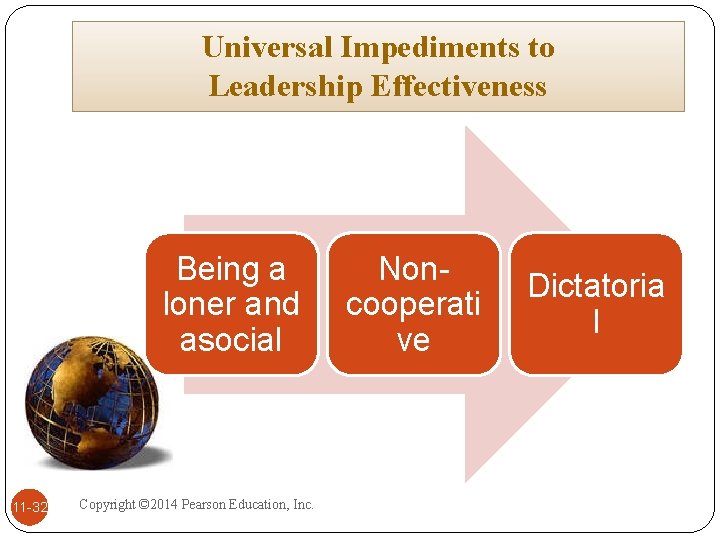
Universal Impediments to Leadership Effectiveness Being a loner and asocial 11 -32 Copyright © 2014 Pearson Education, Inc. Noncooperati ve Dictatoria l
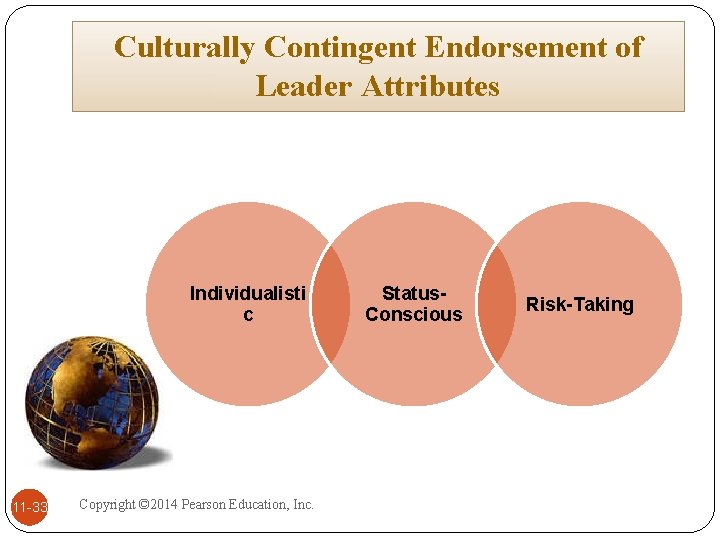
Culturally Contingent Endorsement of Leader Attributes Individualisti c 11 -33 Copyright © 2014 Pearson Education, Inc. Status. Conscious Risk-Taking
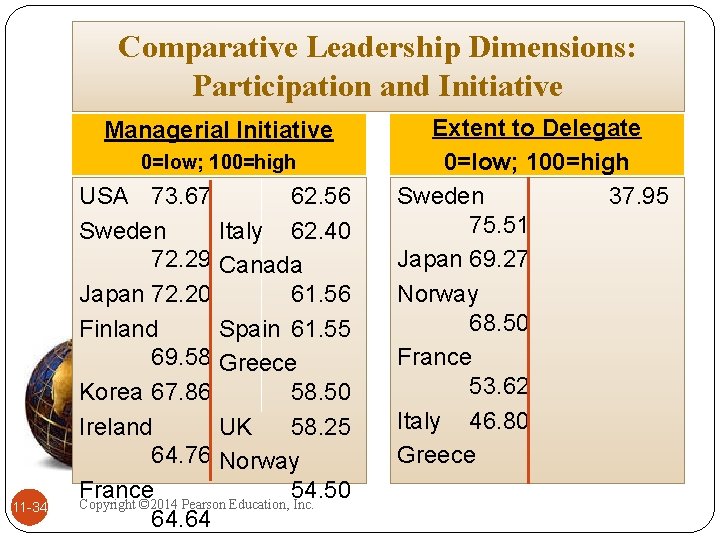
Comparative Leadership Dimensions: Participation and Initiative Managerial Initiative 0=low; 100=high 11 -34 USA 73. 67 62. 56 Sweden Italy 62. 40 72. 29 Canada Japan 72. 20 61. 56 Finland Spain 61. 55 69. 58 Greece 58. 50 Korea 67. 86 UK 58. 25 Ireland 64. 76 Norway 54. 50 France Copyright © 2014 Pearson Education, Inc. 64 Extent to Delegate 0=low; 100=high Sweden 37. 95 75. 51 Japan 69. 27 Norway 68. 50 France 53. 62 Italy 46. 80 Greece
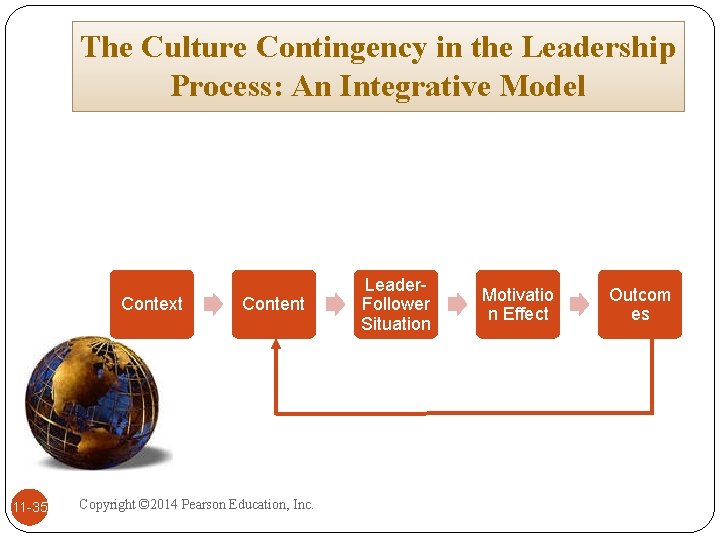
The Culture Contingency in the Leadership Process: An Integrative Model Context 11 -35 Content Copyright © 2014 Pearson Education, Inc. Leader. Follower Situation Motivatio n Effect Outcom es
Chapter Learning Goals Emphasize what makes a successful “global leader”. 11 -36 Copyright © 2014 Pearson Education, Inc.
Leader in a Global Context Leadership is not just manager subordinate relationship, running the whole company, division or unit Vital to be able to adapt one’s leadership style to the local context “National and cultural differences can both bedevil and enliven business. ” Listen hard and “How are you going to go about meeting this goal? ” 11 -37 Copyright © 2014 Pearson Education, Inc.
Conclusions Motivation and leadership are factors in the successful implementation of strategy-challenge is what is effective leadership in that country? Concepts such as achievement or esteem may have different meanings in other countries “Meaning of work” show cross-cultural differences Motivation Hofstede Incentives/rewards are contingent on culture as is leadership style JVs are complex situations for cross-cultural leadership 11 -38 Copyright © 2014 Pearson Education, Inc.
All rights reserved. No part of this publication may be reproduced, stored in a retrieval system, or transmitted, in any form or by any means, electronic, mechanical, photocopying, recording, or otherwise, without the prior written permission of the publisher. Printed in the United States of America. Copyright © 2014 Pearson Education, Inc. 39